Final Exam: Micobiology
 Studied by 0 people
 Call Kai
 Learn
Learn Practice Test
 Spaced Repetition
 Match
Match Flashcards
 Knowt Play
 Podcast
1/214

There's no tags or description
Looks like no tags are added yet.
Name | Mastery | Learn | Test | Matching | Spaced | Call with Kai |
|---|
No analytics yet
Send a link to your students to track their progress
215 Terms
Which of the following is a scientific name?
Streptococcus pyogenes
In the name Escherichia coli, coli is the ___ .
specific epithet
Classification of organisms in the three domains is based on ___ .
Type of cell
Which of the following statements about fungi is true?
All require organic material for growth
Which of the following statements about protozoa is false?
They have rigid cell walls
Which of the following statements about viruses is false?
They have both DNA and RNA
Fungi differ from bacteria in that fungi ___ .
have a nucleus
You are observing a cell through a microscope and note that it has no apparent nucleus. You conclude that it most likely ___ .
has a peptidoglycan cell wall
You are looking at a white cottony growth on a culture medium. Microscopic examination reveals it is multicellular. Which of the following conclusions about this organism is false?
It is a bacterium.
An agent that reproduces in cells but is NOT composed of cells and contains RNA as its genetic material is a(n) __ .
virus
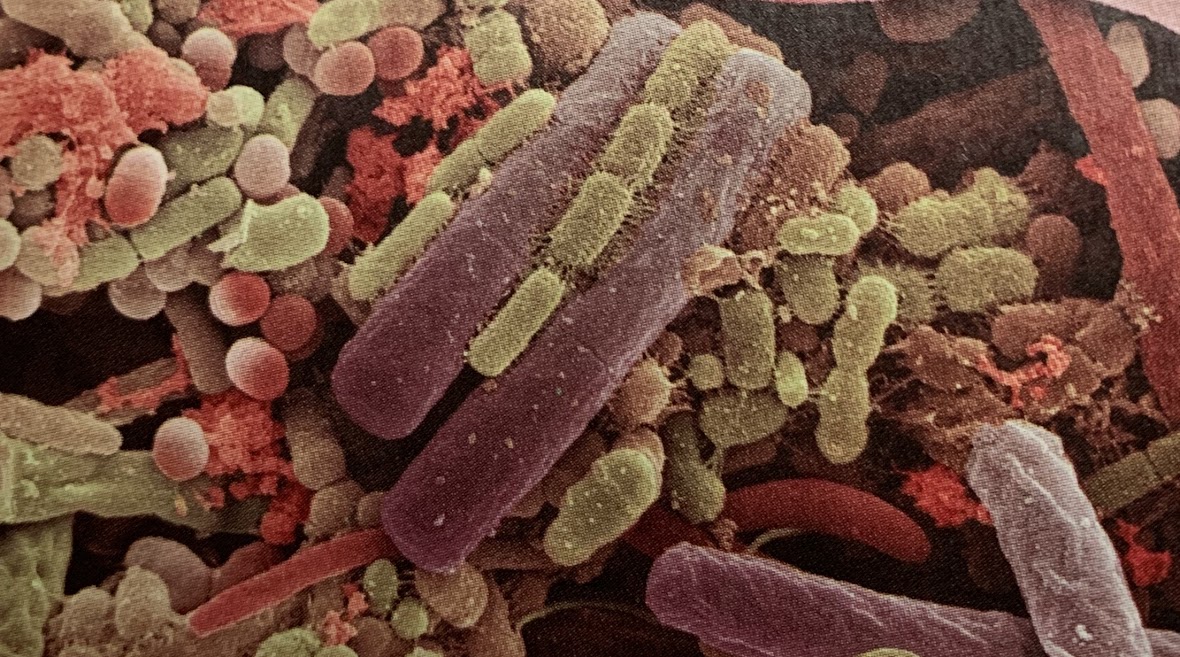
This images is a scanning electron micrograph of a microbial community from a human tongue.
Most of the microorganisms shown are ___ .
bacteria
Which of the following statements about the bacterial capsule is false?
It protects from osmotic lysis
Which of the following is a function of the bacterial cell wall?
Provides protection against osmotic lysis
Which type of bacterial cell wall contains an outer layer of lipopolysaccharide?
Gram-negative
Which type of bacterial cell wall is resistant to many antibiotics (e.g., penicillin)?
Gram-negative
Which component of the bacterial cell wall causes septic shock when released into the bloodstream?
lipid A
Which of the following statements about acid-fast cell wall is false?
It is found in some gram-negative bacteria
Bacterial cell wall protects against osmotic pressure in ____ solution.
hypotonic
Which of the following statements is true?
Endospores allow a cell to survive environmental changes.
Which of the following is NOT a distinguishing characteristic of prokaryotic cells?
They lack a plasma membrane.
Which type of bacterial cell wall contains an endotoxin?
Gram-negative
Which of the following statements about a gram-positive cell wall is false?
It protects the cell in a hypertonic environment.
Which of the following compounds is NOT an enzyme?
Coenzyme A
Which of the following statements about anaerobic respiration is false?
It involves glycolysis only
What is the fate of pyruvic acid in an organism that uses aerobic respiration?
It is oxidized in the Krebs cycle.
Which of the following is the best definition of fermentation?
The oxidation of glucose with organic molecules serving as electron acceptors
Which of the following is NOT necessary for respiration?
Oxygen
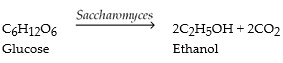
Which of the following is true about this reaction?
This process occurs anaerobically.
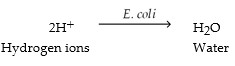
Which of the following is true about this reaction?
This process requires oxygen.
Assume you are working for a chemical company and are responsible for growing a yeast culture that produces ethanol. The yeasts are growing well on the maltose medium but are not producing alcohol. What is the most likely explanation?
Oxygen is in the medium
Which organism is NOT correctly matched to its energy source?
Photoautotroph — carbon dioxide
What will be the growth rate of an obligate anaerobe in the presence of O2?What will be the growth rate of an obligate anaerobe in the presence of O2?
No growth
What will be the growth rate of a facultative anaerobe incubated aerobically?
Optimal growth
What will be the growth rate of a psychrotroph incubated at room temperature?
Optimal growth
What will be the growth rate of Neisseria gonorrhoeae when growing inside the human body?
Optimal growth
Most human pathogens belong to the group of ____ .
Mesophiles
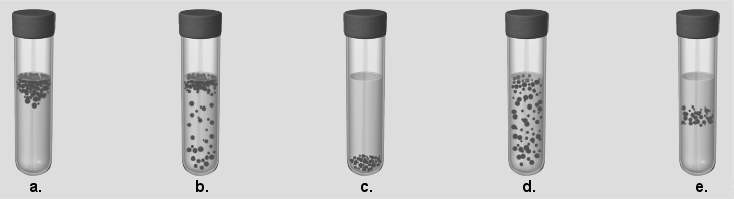
Which tube is showing the growth of facultative anaerobes?
b.
During which growth phase will gram-positive bacteria be most susceptible to penicillin?
Log phase
Patients with indwelling catheters are susceptible to infections because ___.
biofilms develop on catheters
Which of the following is the best method to sterilize heat-labile solutions?
Membrane filtration
Which of the following substances is used for surgical hand scrubs?
Chlorhexidine
Iodophors differ from iodine (I2) in that iodophors ___ .
all of these choices
Which of the following does NOT achieve sterilization?
Pasteurization
Which of the following is a limitation of the autoclave?
Cannot be used with heat-labile materials
Which of the following affects the elimination of bacteria from an object?
All of these choices
Which of the following substances is NOT effective against nonenveloped viruses?
Alcohol
Glutaraldehyde is considered one of the most effective disinfectants for hospital use. Which of the following statements about glutaraldehyde is false?
Stains and corrodes
Which of the following is NOT a factor contributing to hospital-acquired infections?
All of the these may contribute to hospital-acquired infection.
Which one of the following is most resistant to chemical biocides?
Mycobacteria
Which of the following statements about biofilms is false?
Compared to free-living bacteria, biofilms are more sensitive to antibiotics.
An enzyme that synthesizes, proofreads and repairs DNA is ___ .
DNA Polymerase
The antibiotic chloramphenicol binds the 50S ribosome. From this information you can conclude that chloramphenicol ___ .
prevents translation in prokaryotes ✅
Genetic change in bacteria can be brought about by ___ .
all of these choices
Transformation is the transfer of DNA from a donor to a recipient cell ___ .
as naked DNA in solution
Congugation is the transfer of DNA from a donor to a recipient cell ___ .
by cell-to-cell contact
Transduction is the transfer of DNA from a donor to a recipient cell ___ .
by a bacteriophage
Conjugation differs from reproduction because conjugation ___ .
transfers DNA horizontally, to cells in the same generation
Which of the following process of genetic transfer is most commonly used by bacteria to acquire toxins?
transduction
Which of the following process of genetic transfer is most commonly used by bacteria to acquire virulent factors such as a capsule?
transformation
Which of the following process of genetic transfer is most commonly used by bacteria to acquire antibiotic resistance?
conjugation
You have isolated a prokaryotic cell. The first step in identification is a(n) ___ .
Gram stain
Which of the following are found primarily in the intestines of humans?
Facultatively anaerobic gram-negative rods
Which of the following do you expect to be most resistant to high temperatures?
Bacillus subtilis
Rickettsia differ from Chlamydia in that Rickettsia ___ .
require an arthropod for transmission
Which genus of Enterobacteriales has over 2400 serovars commonly located in the intestinal tract of poutry and cattle?
Salmonella
Which of the following bacteria are responsible for more infections and more different kinds of infections?
Pseudomonas aeruginosa
Which if the following statements about Nesseria is false?
It is oxidase-negative
The causative agent of peptic ulcer is ___ .
Helicobacter pylori
Which of the following about the causative agent of tetanus is false?
It is Clostridium botulinum
Which of the following about Streptococcus pyogenes is false?
It is gram-negative bacteria
Which of the following about the causative agent of Lyme disease is false?
It is diplococci
Which of the following about the causative agent of tuberculosis is false?
It is Mycobacterium leprae
Which of the these is the most common cause of pelvic inflammatory disease (PID)?
Chlamidia trachomatis
The causative agent of meningococcal meningitis is ___ .
Neisseria meningitidis
All algae are ___ .
none of these choices
Ringworm is caused by a(n) ___ .
ascomycetes
Yeast infections are caused by ___ .
Candida albicans
Which of the following causes an infection that may be spread to humans through contact with pigeon droppings?
Cryptococcus neoformans
The most common life-threatening fungal infection experienced by AIDS patients is caused by ___ .
Cryptococcus neoformans
Opportunistic infections associated with AIDS and AIDS Related Complex are ___ .
all of these choices
Which of the following about Giardia lamblia is false?
It must be transferred from host to host quickly.
Which of the following protozoan can be transmitted via cat faeces or undercooked meat and causes congenital infections in uterus?
Toxoplasma gondii
Which of the following is a causative agent of malaria?
Plasmodium falciparum
Which of the following tends to be more complex in a parasitic helminth than in free-living helminths?
Reproductive system
Helminthic diseases are usually transmitted to humans by ___ .
gastrointestinal route
The life cycle of the fish tapeworm is similar to that of the beef tapeworm. Which of the following is the most effective preventive measure?
Cooking fish before eating
Which of the following arthropods does NOT transmit diseases by sucking blood from a human host?
houseflies
In which of the following ways do viruses differ from bacteria?
Viruses don’t reproduce,
Which of the following is NOT a method of culturing viruses?
In culture media
An envelope is acquired during which of the following steps?
Release
Lysogeny can result in all of the following EXCEPT ___.
immunity to reinfection by any phage
Which of the following would be the first step in biosynthesis of a virus with a - strand of RNA?
Synthesis of double-stranded RNA from an RNA template
The following steps occur during multiplication of retroviruses. What is the fourth step?
Synthesis of double-stranded DNA.
A persistent infection is an infection in which ___.
the disease process occurs gradually over a long period.
An example of a latent viral infection is ___.
cold sores
Viruses that have reverse transcriptase are in the ___.
Retroviridae
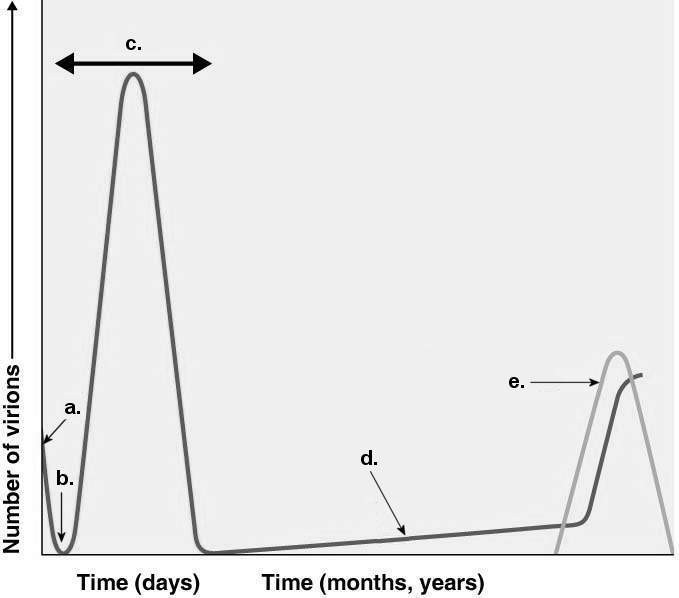
Assume a patient had chickenpox (human herpesvirus 3) as a child. Which line on the graph below would show the number of viruses present in this person as a 60-year-old with shingles (human herpesvirus 3)?
e,
An infectious protein is a ___.
prion
A viroid is ___.
a nonenveloped, infectious piece of RNA
The most common route of accidental AIDS transmission to health care workers is ___.
needlestick
 Note
Note  Flashcards (32)