Platyhelminthes
 View linked note
 Call Kai
 Learn
Learn Practice Test
 Spaced Repetition
 Match
Match Flashcards
 Knowt Play
1/24

There's no tags or description
Looks like no tags are added yet.
Name | Mastery | Learn | Test | Matching | Spaced | Call with Kai |
|---|
No analytics yet
Send a link to your students to track their progress
25 Terms
What are they?
common name?
phylogeny basics
Flatworms
Complicated classification and changing ~ polyphyletic
~ 34,000 species DESCRIBED probably 75,000 to 80,000 total
4 Orders
- 3 parasitic Cestoda, Monogenea, Trematoda
- 1 mainly free living Turbellaria
small and hard to find due to living in habitats unobtainable to us
9 Major Characteristics
Triploblastic
Acoelomate - may be derived from coelomates (loose complexity)
Bilaterally symmetric (cephalization for quicker and better coordinated responses because of anterior nerves—allows for more organ development)
80% parasitic
Cleavage is spiral and mostly determinate (protostome)
No synapomorphies, more defined by lack of characteristics (no clarity in homology, no derived characteristics - new)
Lack circulatory and respiratory systems (oxygen and CO2 diffuse through body surface, limiting size and shape, high evaporation must be in moist environment—will dry out)
Have digestive and nervous systems (cerebral ganglion)
Have circular and longitudinal muscles (around circumference and length of body)
4 Classes
Turbellaria - mostly free living, pretty
(Eu)cestoda - parasitic tapeworms
Monogenea - parasitic monogenetic flukes
Trematoda - parasitic diagenetic flukes
Turbellaria
• Highly flattened
• Mostly free-living
• Most are marine, some freshwater, and a few terrestrial species
• Most are benthic (substrates)
• Definitely paraphyletic
– May be polyphyletic (diff orders/classses)
Turbellaria Movement
• Ciliary – Outer surface is covered with cilia
More on the ventral surface
– Secrete mucus and beat the ventral cilia within the mucus (swim>walk)
• Pedal Waves
– Ventral surface contracts in waves along the body, pushing it forward
• Looping “inchworming“
• Swimming
Turbellaria – Feeding
• Most are predators or detritivores
– Feed on small invertebrates, protozoans
– Scavenge on dead plants or animals Most are predators or detritivores
• Many have a protrusible pharynx (eject and bring back—most)
• Some have a proboscis for spearing prey (rare)
Turbellaria – Digestion
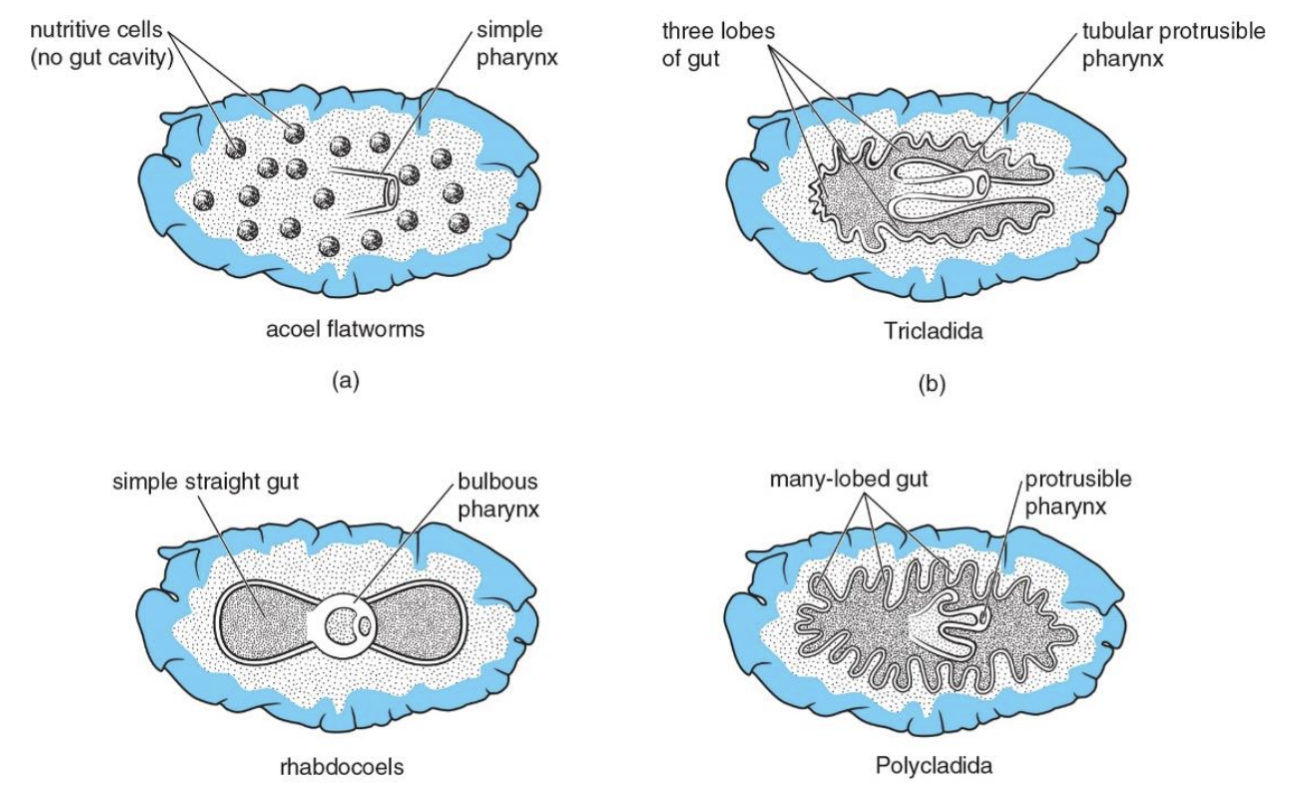
The orders in Turbellaria are primarily determined by gut complexity
a. not them
b. 3 lobed
c. straight
d. many lobes
Turbellaria – Sensory systems
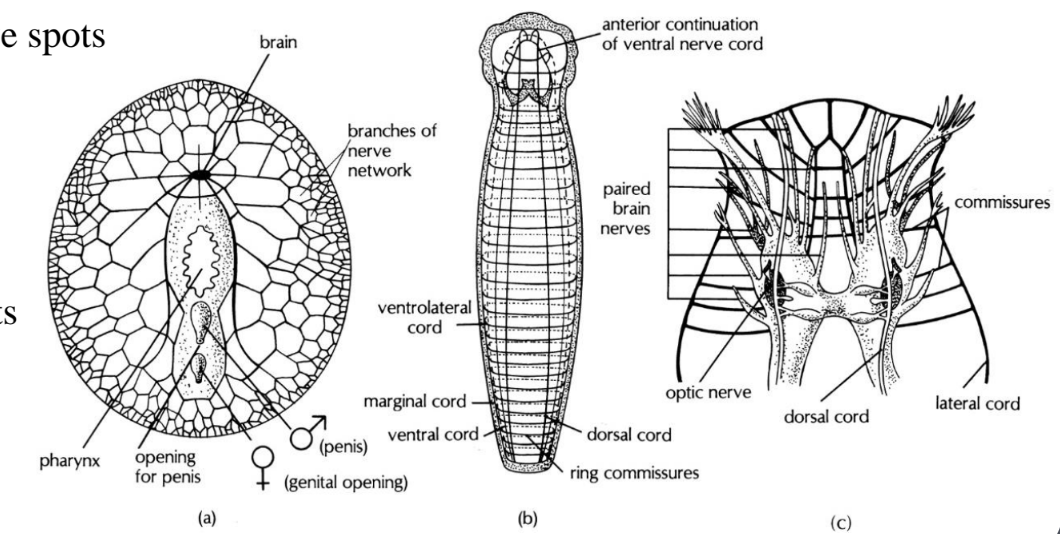
• Nervous system ranges from diffuse nerve net (like Cnidaria) to more cephalized cerebral ganglion (simple brain)
– 1+ pair of eyes or eye spots
– Chemoreceptors (taste and smell what they touch)
– Cells that sense pressure changes
– Mechanoreceptors (vibrations)
– A few have statocysts (water ones to orient)
Turbellaria – Reproduction
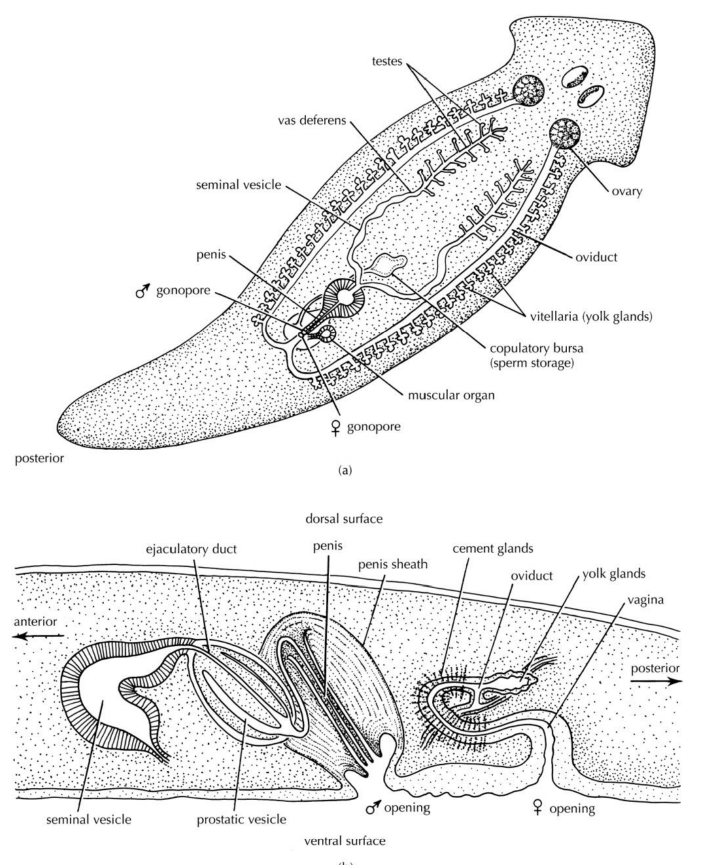
• Asexual and sexual reproduction
• Simultaneous hermaphrodites with internal fertilization
• One group (triclads) fertilize simultaneously
• Most other groups use hypodermic impregnation
• “Penis fencing” (fight to impregnate as its ecologically better to be the male)
Turbellaria – Development
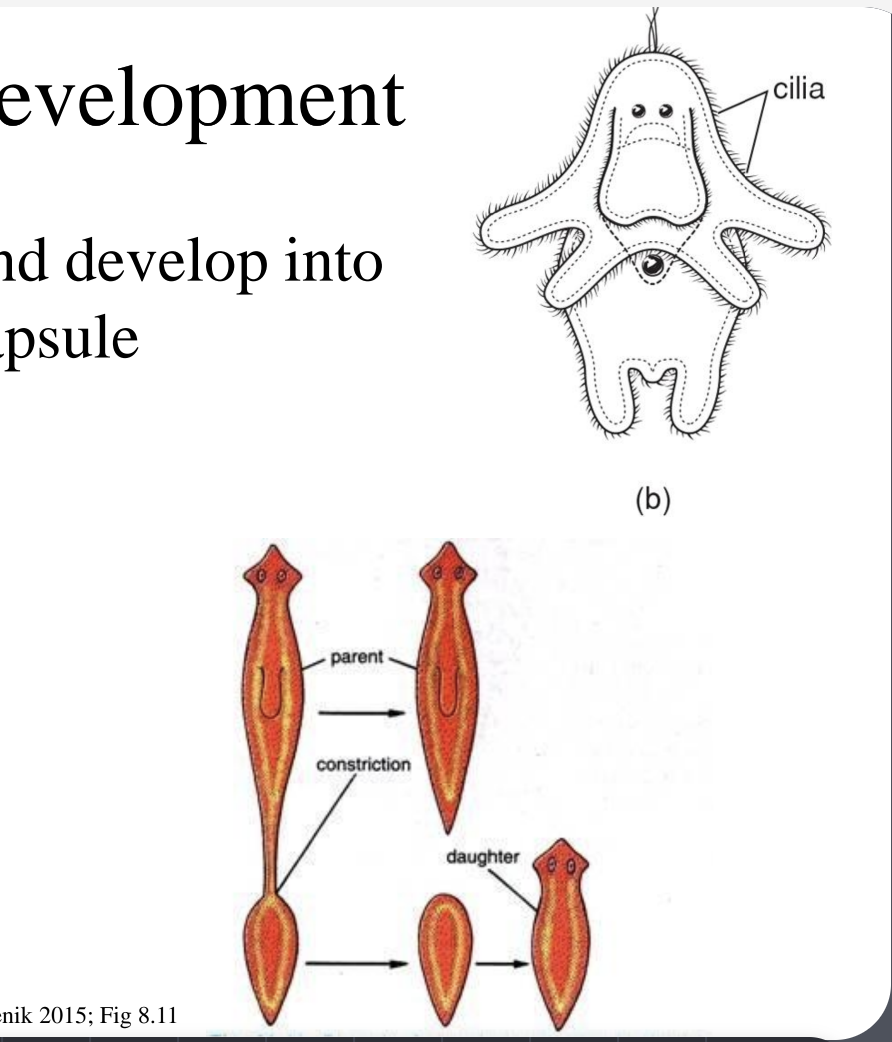
• After fertilization, eggs are laid and develop into miniature adults within the egg capsule
– What type of development is this? DIRECT
• A few marine species develop into a free- swimming larval stage (Müller’s larva)
• Asexual budding
Turbellaria – Tricladida – The Planarians
• Extreme regeneration – Planaria are used as a model organism
Turbellaria – Tricladida – Bipalinae
• “Hammerhead” planarians • ~100 species of large (relatively) terrestrial planarians
• Predatory on mollusks and earthworms
– Stalk prey and secrete tetrodotoxin when contacted
– Can digest extracorporeally
• Can decimate local earthworm populations where they are invasive
Turbellaria – Acoela
NO LONGER PLATYHELMINTHES
• Extremely basic
– No permanent digestive cavity
– No gonads
• Smaller than 1 mm
• Usually in marine sediments
– Some are planktonic or commensal
• Many have symbiotic algae
• Are probably a new phylum (Acoelomorpha) along with the Nemertodermatida flatworms
Turbellaria – Pseudocerotidae
• >200 beautiful, free-living, tropical species one of these
– If you were a flatworm, you would want to be
• Anterior folded to make two tentacles
– “False horn”
(Eu)Cestoda
• All 5000+ are parasitic, mostly in guts of their host which has led to the loss of their digestive track
• Anterior hooked attachment organ (scolex) - HEAD WITH HOOKS AND SUCKERS
• Body is divided into segments (proglottids) arising from anterior end behind the scolex — reproduction
• Two subclasses
– Cestodaria: poorly understood, lack a scolex
– Eucestoda: True tapeworms, 12 orders, mostly separated by scolex morphology or host
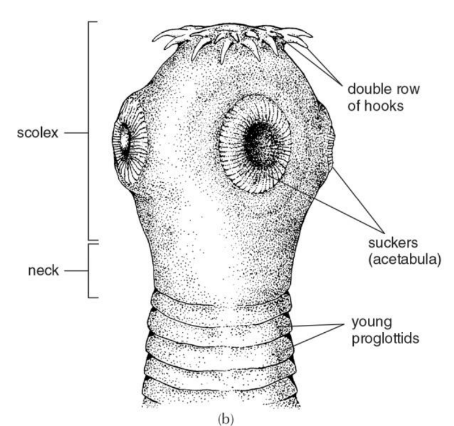
Eucestoda – Sexual Reproduction
• Eucestodes use proglottids to reproduce!
• Can self-fertilize and produce several proglottids per day
–Each proglottid can contain 50,000 eggs
• Once mature, the proglottids break off or burst open
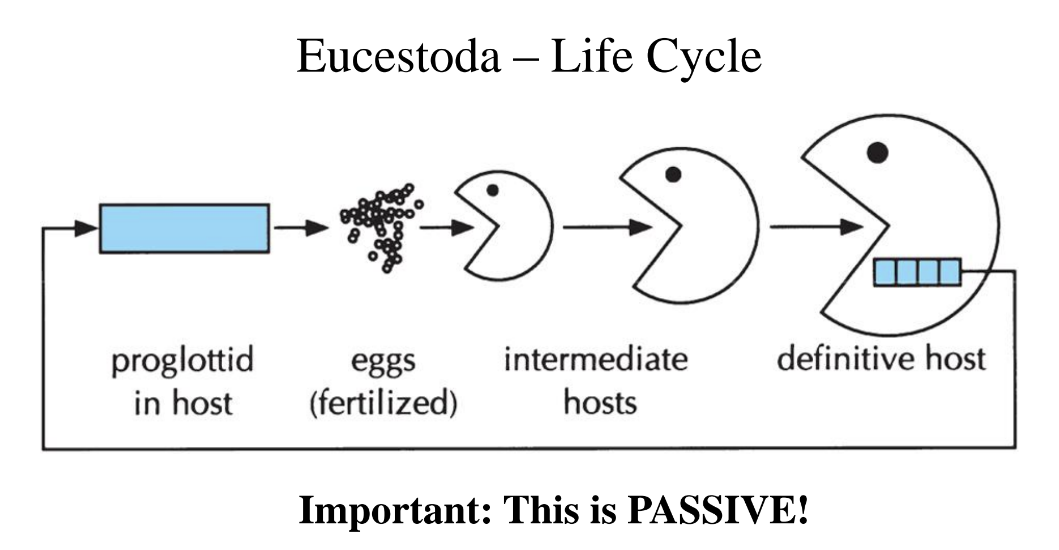
Eucestoda – Life Cycle
• Most have a vertebrate definitive host (host that houses the parasite until sexual maturity) and an invertebrate or vertebrate intermediate host(s)
• After leaving the vertebrate host (waste) are eaten by the intermediate host
• Take up residence in the hosts tissues and reproduce asexually
• Encyst until the intermediate host is eaten by another intermediate host or the definitive host
• Humans can become infected be eating undercooked beef, pork, or fish — more common in underdeveloped countries
• Fun fact: Whale tapeworms can be 30 m long!
PASSIVE - REQUIRES ANIMALS IN CYCLE TO EAT SHIT OR COME IN CONTACT WITH IS
Monogenea
DEFINED BY MORPHOLOGY
• ~8000 described species, probably many, many more
ALL ARE PARASITES
• Ectoparasites, usually on fish gills or skin (NOT ALWAYS SEEN ROOT IN GUT)
• Only one host, no intermediate ones
• Usually very specific host
– One species only parasitizes the eyes of hippos!
– One species lives at the base of one species of fish gills, another Monogenean lives at the end of the same gill filaments (same host)
• Simple digestive system of a mouth, pharynx, and intestine
• Simultaneous hermaphrodites
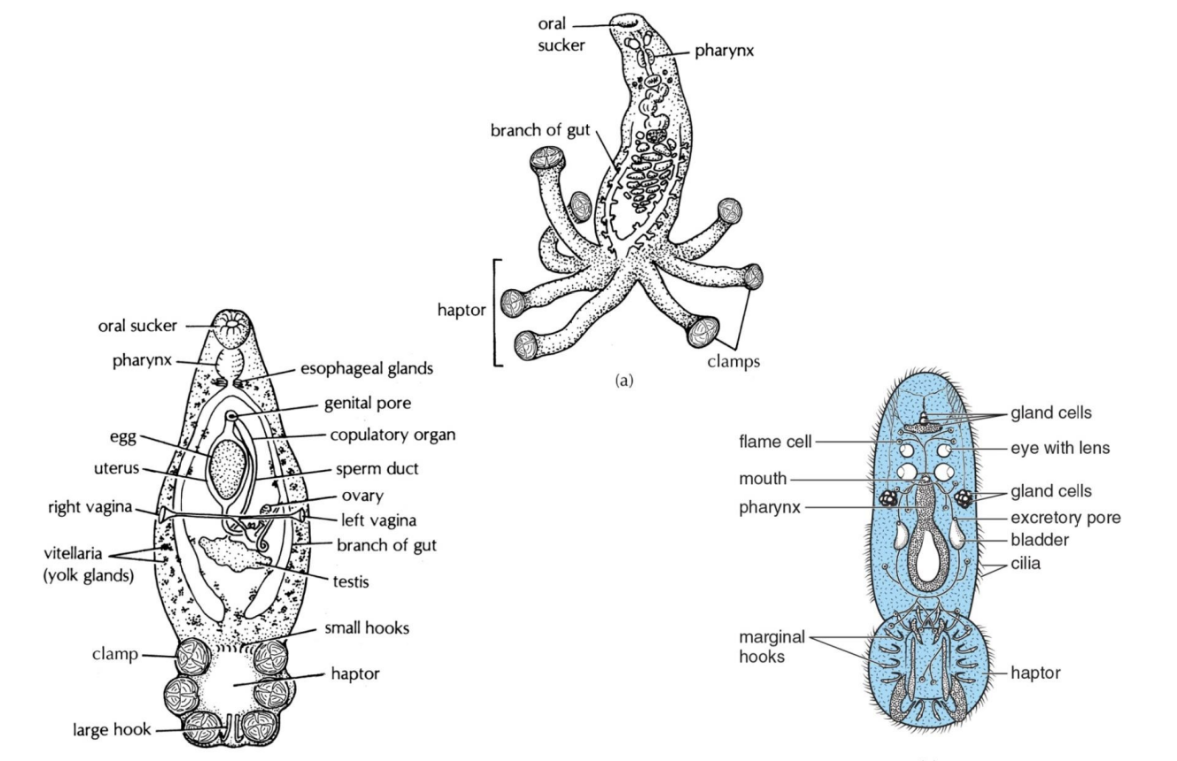
Monogenea’s well-developed posterior attachment organ…
Haptor
to attach it can have hooks
- marginal, large, sucker clamps
Trematoda
PARASITIC DIAGENETIC FLUKES - WORST DISEASE IN HUMANS
• Two major groups
– Digeneans, ~6000 species
– Aspidogastreans, <100 species
• All are internal parasites
• “Flukes” – named after the tissue the adult inhabits
– Tissues flukes – i.e. lung fluke, liver fluke
– Blood flukes
• Digeneans
– “Two births”, at least two hosts
– Not passive like Cestoda
– ACTIVE, specialized process of moving from host to host
– Extremely complicated and highly specialized life cycles
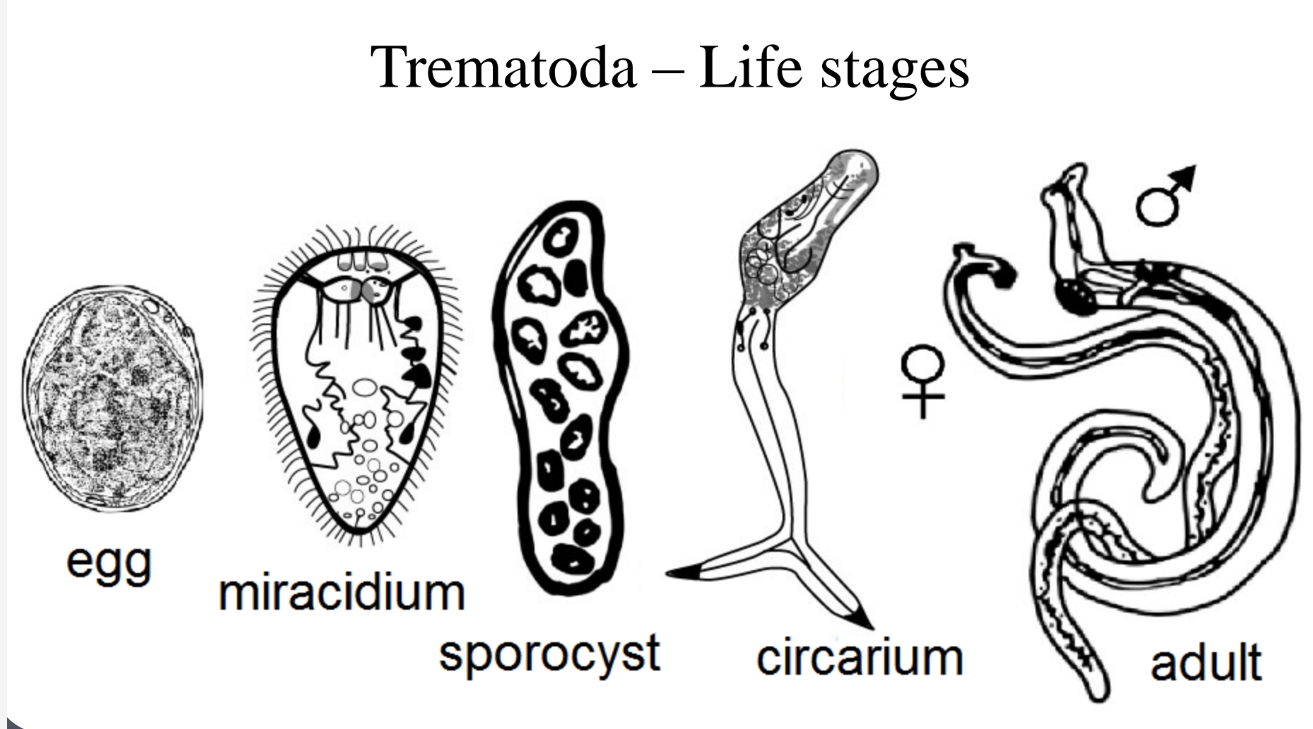
Trematoda — Life Stages
Egg
Miracidium - Eaten by intermediate host: Usually a snail, sometimes species specific
Sporocyst - Then, metamorphoses in to a sporocyst: lives in blood, divides asexually, produces redia
Circarium - Sporocysts or redia produce circarium larva, Circarium wait for intermediate host to get eaten by next host - MOBILE
Adult - When in final host, transforms into adult that reproduces very quickly
- INTERTWINE TOGETHER AND FLOAT AS THEY COAGULATE
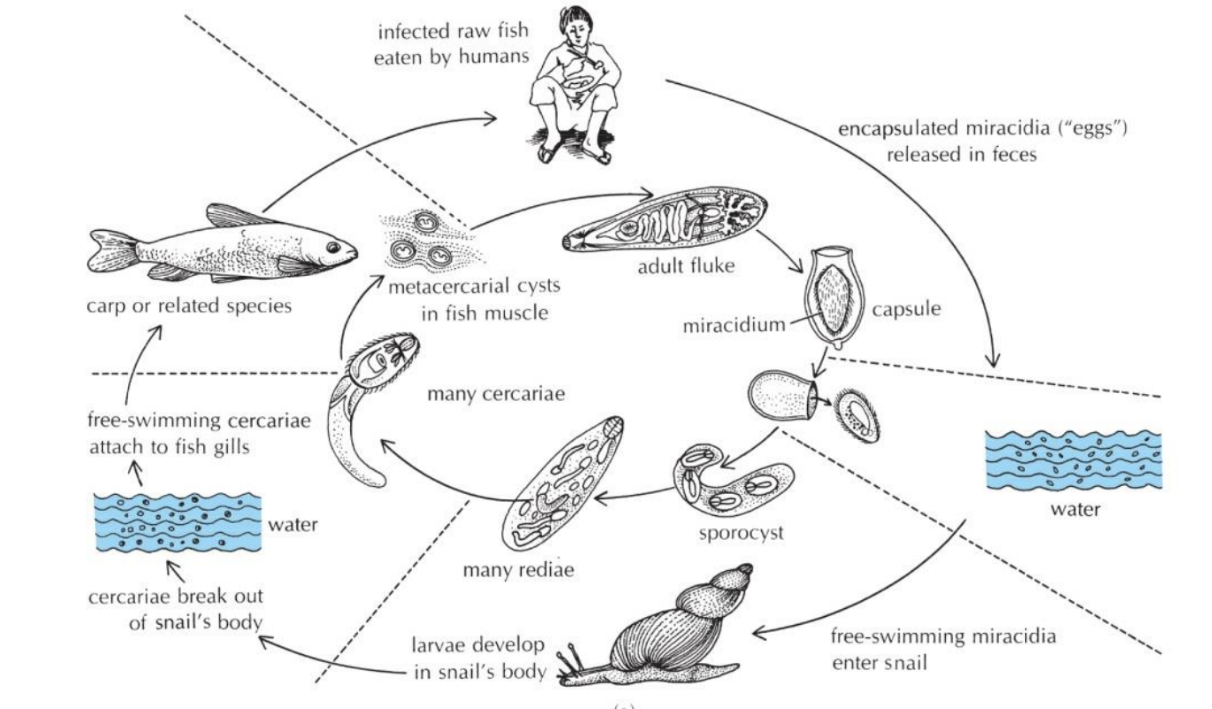
Trematoda – Opisthorchis sinensis
REQUIRE WATER AT DIFFERENT PHASES
Eggs in feces (encapsulated miracidia) released into waterways
free swimming larvae
enter/attack snail (sporocyst/rediae)
break out and enter waterway becoming attached to fish gills or snail is eaten by fish (cercariae-mobile)
carp(fish) is definitive host or human who eats raw fish (metacercarial cysts in fish gills)
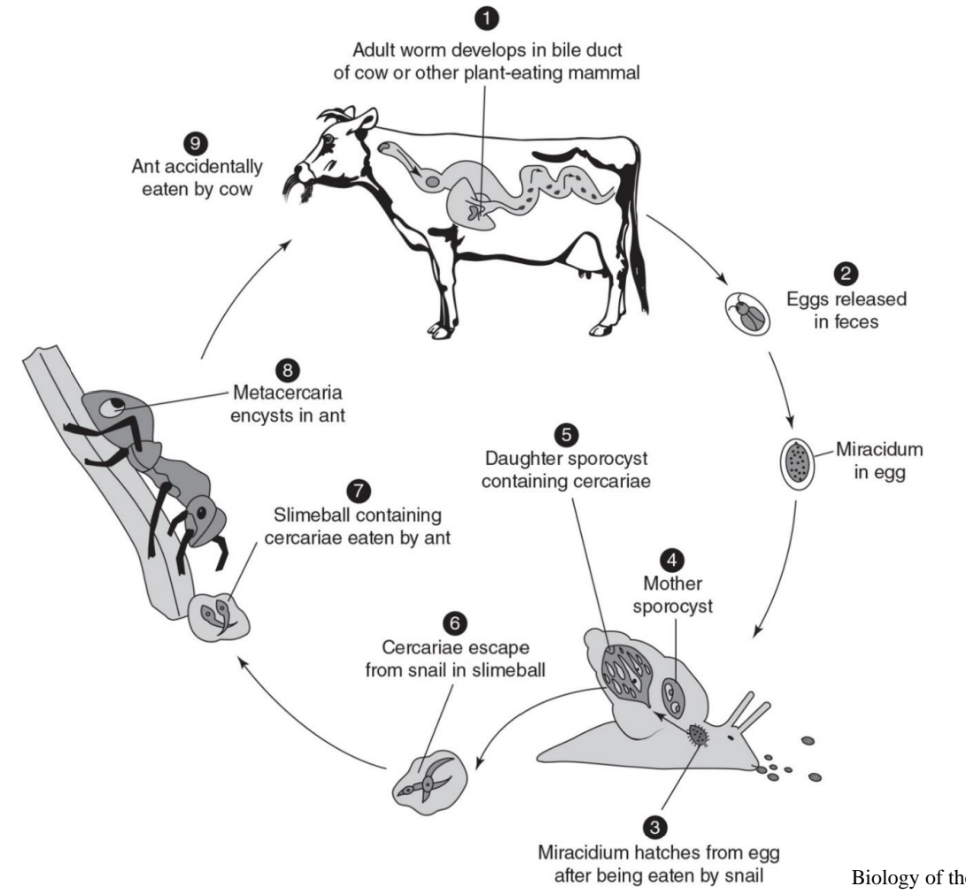
Trematoda – Dicrocoelium dendriticum
eggs released in cow poop
miracidum in egg
hatches after snail eats it
mother sporocyst
daughter sporocyst containing cercariae
which leave snail via slime ball
this is eaten by an ant
metacercaria encyst in the ant
ant eaten by cow because its on grass
adult develops in bile duct of cow/plant eating animal
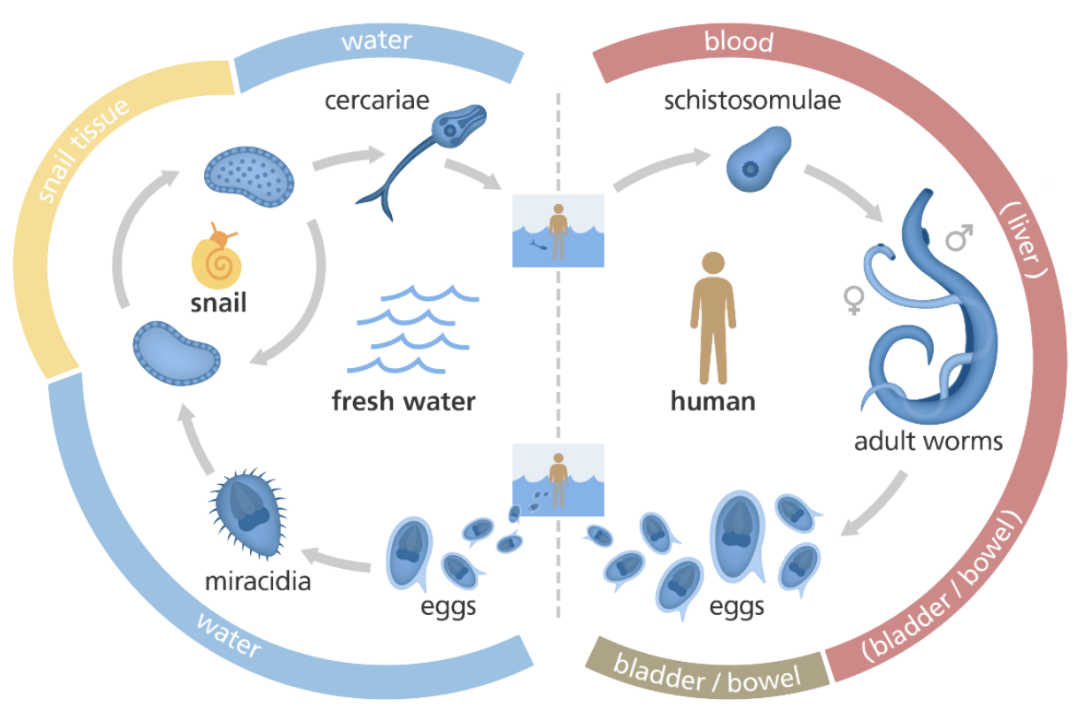
Trematoda – Schistosoma
Blood fluke that causes Schistosomiasis
• ~250 million people are infected
– 2nd most common infectious disease after malaria
• 200,000 people die annually
– Often causes cancer, kidney failure, liver damage, developmental disabilities
eggs in bladder / bowel of human
enter water and become miracidia
enter snail tissue become cercariae and leave snail entering into water again
enter in human feet/skin hair follicules
in the blood they develop into schistosomulae
then adult worms reproducing in liver — male has groove for female to fit into “worm sex tobaggan”
eggs in bowels
Trematoda – Leucochloridium paradoxum
– Grow “brood sacs” in the intermediate snail host
• These are filled with cercaria which throb and imitate grubs or caterpillars (take over snail brain / antennae via neurotransmitters so brain chemistry is changed)
• Also blinds the snail so it doesn’t avoid the light like normal — takes it to the tops of blades of grass
• A bird eats the sacs, not necessarily the whole snail
• Cercaria and snail regrow more sacs to be eaten
Explore top notes
Explore top flashcards
