D+E Unit 2 Exam - Chapters 38 (Classifying Angiosperms) + 35 (Vascular plant structure, growth, and development)
 Call Kai
 Learn
Learn Practice Test
 Spaced Repetition
 Match
Match Flashcards
 Knowt Play
1/82

There's no tags or description
Looks like no tags are added yet.
Name | Mastery | Learn | Test | Matching | Spaced | Call with Kai |
|---|
No analytics yet
Send a link to your students to track their progress
83 Terms
Monocots
seeds cont. one cotyledon (embryonic leaf/1st leaf that emerges)
leaf venation usually parallel
stems - vascular tissue usually scattered
roots - usually fibrous, no main root
pollen grain - w/ 1 opening
less common as angiosperms
have floral parts/organs in threes (or multiples of threes)
ex. incl. grasses, orchids, irises, onions, lilies, palms, and CORN
eudicots (or just dicots)
two cotyledons
leaves - usually net like
stems - vascular tissue usually arranged in a ring
roots - taproot (main root) usually present
pollen grain - w/ 3 openings
more common as angiosperms
floral parts in fours or fives
ex. roses, mustard, cacti, blueberries, sunflowers
as seeds mature…
they dehydrate
water content drops 5-15% of its weight — embryo enters dormancy and metabolism almost completely stops
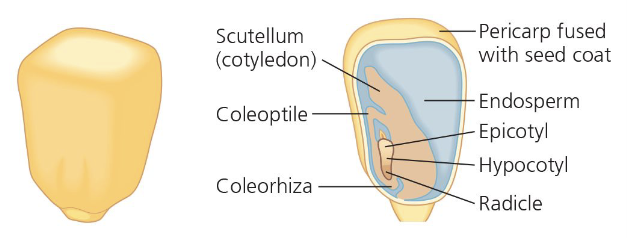
monocot seed (draw and diagram)
(corn)
epicotyl - embryonic shoot above the cotyledon (dev. into stem and leaves, grows upward)
hypocotyl - (region of the embryo below the cotyledon and above the radicle in the middle, connects shoot system to root)
radicle - embryonic root, dev. into primary root system
coleorhiza - protective sheath that covers the radicle (protects young root as it grows through soil)
coleoptile - protective shoot that covers the shoot
scutellum - single cotyledon (seed leaf) of monocots, absorbs nutrients from endosperm
pericarp - outer covering of the seeds (in many monocots the pericarp is fused with the seed coat)
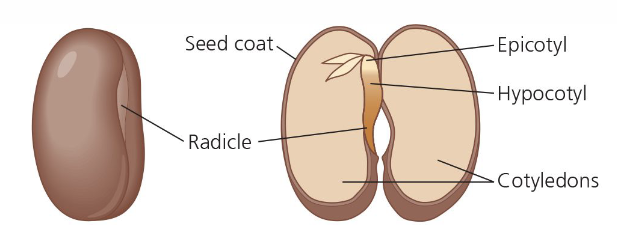
Dicot seed (draw and diagram with part labels)
(bean)
2 cotyledon
epicotyl - grows into shoot
hypocotyl - connects the two (middle)
radicle - grows into root
simple fruit
dev. from a single carpel (or several fused carpel) of one flower (ex. pea, peanut, lemon)
aggregate fruit
an aggregate fruit dev. from many separate carpels of one flower (ex. raspberry, blackberry, strawberry)
multiple fruit
a mult. fruit dev. from many carpels of the many flowers that form an inflorescence (ex. fig/pineapple) - each segment of the fruit dev. from the carpel of one flower
accessory fruit
an accessory fruit dev. lrgly. from tissues other than the ovary—in apples, ovary is embedded in a fleshy receptacle
angiosperms reproduce sexually, asexually, or both and this means
sexual reproduction = results in offspring genetically different from their parents (genetic variation) —> meaning evolutionary adaptations are made possible
only a fraction of seedlings survive
some flowers can self fertilize (ensuring every ovule will develop into a seed)
many species have dev. mech. to prevent “selfing”
dioecious
means to prevent self fertilization
species have staminate and carpellate flowers on diff. plants (so need both male and female plants to be near each other to fertilize)
stamens and carpels maturing at different times
arranged in such a way to prevent selfing
self incompatibility
most common means to prevent self fertilization
plants ability to reject its own pollen (still being studied)
some plants reject pollen that has an s gene (self incompatibility gene in plants) matching an allele in stigma cells (top part of the pistil of a flower where pollen lands)
recognition of self pollen triggers a signal transduction pathway leading to a block in growth of a pollen tube
asexual reproduction - vegetative reproduction
results in a clone of genetically identical organism (can be beneficial to a successful plant in a stable environment)
cloned plants are vulnerable to extinction from environmental change
totipotency
an ability of a cell to divide and asexually regenerate a clone
how do plants know when to break dormancy
cues from the environment
desert plants —> substantial rainfall
fire prone areas —> heat or smoke
harsh winters —> extended cold exposure
tiny seeds —> light
seed coats susceptible/needing acidity —> pass through animal digestive tract (ex. Kori Luwak coffee pooped out by monkeys)
dormancy length
days to decades (most seeds are 1-2 years old, seasonal)
oldest carbon dated seed grown (2000 y/o isralei palm)
what happens when conditions are right
imbition (means taking in water), leads to germination
seed expands bc/ of imbition —> this ruptures the seed coat
embryonic root (radicle) goes down, shoot (hypocotyl) goes up
triggers changes that allow embryo to resume growth - enzymes digest endosperm/cotyledons and send these nutrients to growing areas
plants all have
cell tissues, organs, organ systems
organs are
roots, stems, leaves
organ systems
shoot and root systems
roots
are multicellular organs that anchor plant, absorb nutrients, and STORES organic nutrients
taproot system
consists of one main vertical root
lateral roots
branch roots (increase surface area for absorbing minerals and water) and anchor plant
adventitious/fibrous roots
arise from stems or leaves (instead of coming off of original root)
seedless vadcular plants and monocots all have…
a FIBROUS root system
characterized by thin lateral roots w/ no main root
absorption of water and minerals
happens near root hairs (which inc. surface area for absorption)
imp. symbiotic interactions w/ soil fungi called mycorrhizal associations
prop roots
legs of a tripod, but more than 3) giving exterior support
storage roots
store nutrients (starch) helps plant survive
aerial roots
“strangling” (grow aboveground, anchor plants + take nutrients aboveground)
butress roots
wide plank-like roots aboveground, base of tropical trees (structural stability in nutrient poor soil)
stems
organs consisting of an alternating system of nodes (the point at which leaves are attached)
internodes
stem segments between nodes
apical bud/terminal bud
located near shoot tip and causes elongation of a young shoot
auxiliary bud
structure that has pot. to form lateral shoot or branch
tubers
type of modified stem - (potatoes) = enlarged ends of rhizomes/stolons spec. for storing food
“eyes” of potatoes are clusters of auxiliary buds
rhizomes
(ex. base of iris) horizontal shoot growing just below the surface (vert. shoots emerge from auxiliary buds on rhizome)
stolon
ex. strawb plant
“runners” horizontal shoots grow along surface
reproduce asexually
leaves
main photosynthetic organism
consists of flattened blade (main surface of the leaf) and a stalk called the petiole (which joins the leaf to a node of the stem “leaf stalk”)
what do monocots lack?
petiole
this is because the base of the leaf wraps around the stem forming a sheath in monocots
simple leaf
single, undivided blade
compound leaf
blade consists of mult. leaflets - no aux. bud at its base, sometimes futher develops into smaller leaflets
tendrils
type of modified leaf (seen a lot in pea plants)
used to cling after lassoing a support tendril forms a coil that brings the plant closer to support (typically these are modified leaves but can be modified stems)
spines
type of modified leaves (seen in cacti)
actually the ‘leaves’, photosynthesis carried out by the fleshy green part
storage leaves
ex. bulb (cut onion) - short underground stem and modified leaves that store food
reproductive leaves
succulents
produce adventitious plantlets which fall off the leaf and take root in the soil
3 kinds of plant tissue
dermal, vascular, ground tissue
each plant organism has all 3 and each of these 3 categories forms a tissue system
the 3 are sort of arranged in rings, arrangement differs in diff. parts of the plant
dermal tissue
outside
stomata = allow CO2 exchange between air and photosynthetic cells in a leaf
2 guard cells - regulate opening and closing
root hairs
trichomes (hair-like/peach-fuzz outgrowths of the epidermis) offering protection, reduce water loss, reflect sunlight, secreting substances (like oils or toxins)
epidermal tissue of leaf and stem produce the cuticle
periderm = woody plants (forms outer bark of stems and roots)
vascular
inside
system carries out long-distance transport of materials between roots and shoots (wherever plant needs it)
icl. xylem, phloem, stele, vascular cylinder, tracheids, vessels, sieve tube elements, sieve plates
stele
vasc. tissue (cylinder) inside a stem or root that cont. tissues that transport water and nutrients
vascular cylinder
in most monocots, vasc. tissue of roots is in a ring
stele of stems and leaves is divided into vascular bundles, strands of xylem and phloem
tracheids and vessels
water conducting cells of xylem
tracheids = found in xylem of all vascular plants
vessels = vessel elements align end to end to form long micropipes (most angiosperms, few gymnosperms)
xylem
conveys water and dissolved minerals upwards from roots —> shoots
bigger tubes
think: X marks the spot (in dicots)
phloem
transports organic nutrients from where they’re made to where they’re needed
smaller tubes surrounding tissue
think: phloem phills in
sieve-tube elements
alive at functional maturity, lack organelles - specialized cells in the phloem that transport sugars and other org. nutrients through a plant
sieve plates
porous end walls that allow fluid to flow between cells along the sieve tube -each sieve tube element has a companion cell who’s ribosomes and nucleus serve both cells (sieve tube elements lack one and can’t do a lot so companion cells help them)
ground tissue
leftover cells, neither dermal nor vascular (ground tissue system)
ground tissue is mesophyll cells (palisade + spongy)
incl. cells spec, for storage, photosynthesis, and support
pith
ground tissue internal to the vascular tissue (soft, central tissue found in the middle of many plant stems (and sometimes roots)
cortex
ground tissue external to vascular tissue
layer of tissue between the epidermis and the vascular tissue
3 types of ground tissue
parenchyma, collenchyma, sclerenchyma
parenchyma
thin and flexible primary walls
lack secondary walls
are the least specialized
performs most metabolic function
collenchyma
grouped in strands and help support young parts of the plant shoot
thicker and uneven cell walls
lack secondary walls
cells provide flexible support w/o restraining growth (bend w/o breaking)
ex. cellery or sunflower // petiole “strings”
sclerenchyma
extremely THICK cell walls, lignified, non-living cells that provide strength, support, structure, heft
2 types:
fibers - long and slender grouped into strands (like a twizzler)
sclerids - irregular shaped cells ex.) grit of pears or cherry stone (provide structural support to prevent imploding)
root cap + 3 zones of cells (growth)
covers root tip, which protects apical meristem as root pushes through soil. growth occurs just behind root tip in 3 zones of cells:
zone of cell division - cells dividing by mitosis
zone of elongation - divided alr. getting bigger/aka longer (goal = reach water and nutrients)
zone of differentiation - when roothairs start forming (having spec. jobs @ this point)
intermediate growth
plant can grow throughout its life
determinate growth
some plant orgs. grow to a certain size then stop (leaves)
annuals
life cycle comp. in a year or less
biennials
req. 2 growing seasons
perennials
live for many years
meristematic tissue incl
meristems, apical meristems, leaf primordia, lateral meristems, vascular cambium, cork cambium, early/late wood, periderm, bark, primary growth, secondary growth, heartwood, sapwood
meristems
perpetually embryonic tissue and allows for indeterminate growth
cont. actively dividing, undifferentiated cells
apical meristems
tips of roots and shoots and aux. buds of shoots // (elongate shoots + roots) which is primary growth (green!)
leaf primordia
formed from leaves along sides of apical meristem
aux. buds dev. meristematic cells left at bases of leaf promordia
lateral meristems
add thickness to woody plants, called secondary growth (brown/woody)
vascular cambium
“magic layer”
adds layers of vascular tissue called secondary xylem (growing to inside “wood”) and secondary phloem (growing to outside “bark”) —> grows in both directions to widen trunk
cork cambium
replaces the epidermis w/ peridem which is thicker and tougher
early wood
(growing to inside, secondary xylem)
made at the beginning of a growth season
maximizes water flow
spring
late wood
contributes to stem support
late summer
made at the end of a growing season
periderm
cork cambium plus the laters of cork cells it produces on outside
bark
all tissues external to the vascular cambium, inc. secondary phloem and periderm
secondary growth
in stems and roots of woody plants, rarely in leaves
characteristic of gymnosperms and many dicots but NOT monocots
secondary xylem accumulates as WOOD
heartwood
older (central) layers of secondary xylem, no longer transport water + minerals
sapwood
outer layers, still growing, still transporting materials through xylem

