Language - studies
 Call Kai
 Learn
Learn Practice Test
 Spaced Repetition
 Match
Match Flashcards
 Knowt Play
1/17

There's no tags or description
Looks like no tags are added yet.
Name | Mastery | Learn | Test | Matching | Spaced | Call with Kai |
|---|
No analytics yet
Send a link to your students to track their progress
18 Terms
Who’s research summarises the timeline of lanuage and speech development?
Kuhl (2004)
young children learn their native lange rapidly and effortlessly, babbling at 6 months to full sentences by 3 years
Who’s research descibres the references problem with word mapping?
Quine (1960)
if point at a rabbit and say the word gavagai
is that the ears, the fluffiness, the jumping, the grass
mapping problem is a particular challenge for non-nouns and for words that represent more abstract concepts
What research explores the looking while listening paradigm?
Bergelson and Swingley (2012)
child shown a ball and an apple
monitor eye movements as children hear lanuage and view objects/events
can help determine what they know
What research provides evidence for the whole object bias?
Hollich et al (2007)
12 and 19 months shown obcts made of 2 parts
training: shown base and part
test: looking preference when hear the label
looks longer at the whole object ‘modi’
What research provides evidence for the taxonomic bias?
Markman and Hutchinson (1984)
child shown a ‘fep’ - picture of dog
asked to find another fep and shown a cat and a bone
3 yrs - more likely to choose taxonomically related
Who argues against Markman and Hutchinsons evidence for the taxnomic bias?
Baldwin (1992)
argues whether evidence supports taxonomic constraint or shape bias
What research provides evidence for and explains the basic level bias?
Rosch et al (1976)
What research provides evidence for mutual exclusivity?
Markman and Watchel (1988)
shown an object they know the name of and an unknown object
ask wheres the dax
pick the object they don’t know
if familiar - dras inference that the dorsal fin must represent a characteristic on the animal
shows that constraints interact as kids can use mutual exclusivity to override the whole object bias
Who provides evidence for fast mapping showing a fast refined process of learning?
Carey and Bartlett (1978)
3 year olds
ask ‘can you get me that chromium tray? Not the blue one the chromium one’
learn the new one due to mutual exlcusivity therefore shows how this can lead to fast learning of words
good controls:
accustoming the children to non-focal colours in order to conclude that the choosing was not due to a tendency to pick the ‘odd’ coloured tray
Who argues that fast mapping is transient for lexical retention?
Horst and Samuelson (2008)
when a 5 minute delay was added to the referent selection task retention was poor
maybe this isn’t actually that involved in learning of words - repetition probably more important
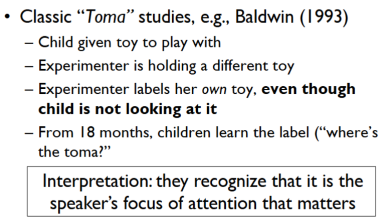
Who provides evidence for focus of attention being main assistance in word mapping?
Baldwin (1993)
picture (can u see it?)
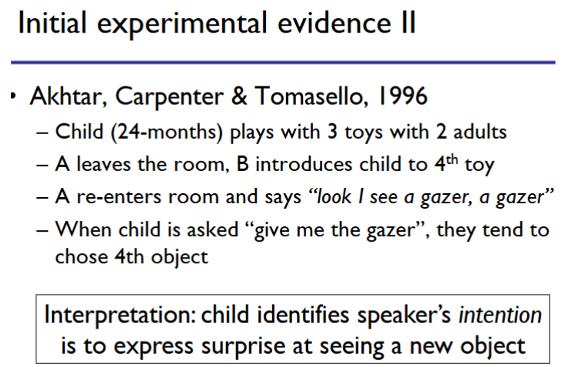
Who provides evidence for identification of speakers intention influencing acquisition of language?
Akhtar, Carpenter and Tomasello (1996)
Who suggested a problem with Akhtar… account due to knowldge of words?
Bergelson and Swingley (2012)
eye movement data for knowldge of words
suggests that 6 months already have knowledge before joint attention and intention reading in place
mutual exclusivity?
Who provides evidence for social interaction due to culture????
Kuhl et al (2003)
9-10 month American infants
3 conditions:
mandarin speaking visitor 12 × 25 min sessions in which read book, play toys etc
mandarin TV
mandarin audio
sensitivity to Mandarin phenome was high in visitor condition similar to 10 month old Chinese infants whereas no different from no exposure American infants for AV and V conditions
learning process doesn’t requier long term listening and enhanced by social interaction
Evidence for gaze folowing correlation with lnaguage progression?
Brooks and Meltzoff (2005)
Infants (N = 96) watched as an adult turned her head toward a target with either open or closed eyes. The 10- and 11-month-olds followed adult turns significantly more often in the open-eyes than the closed-eyes condition, but the 9-month-olds did not respond differentially.
· strong positive correlation between gaze-following behavior at 10–11 months and subsequent language scores at 18 months.
o Can this be used as evidence for social pragmatics? What’s the counter-argument?
intention reading predicts better language skills at 18 months
social pragmatics direct attention to make associate learning more efficient
Who provided evidence for associative learning with cross situation learning experiment?
Smith and Yu (2008)
12-14 month olds, 4 min experiment
see a series of objects in pairs accompanied by a word
asked what the star is called for example
sesnitive to pairings across contexts and instances
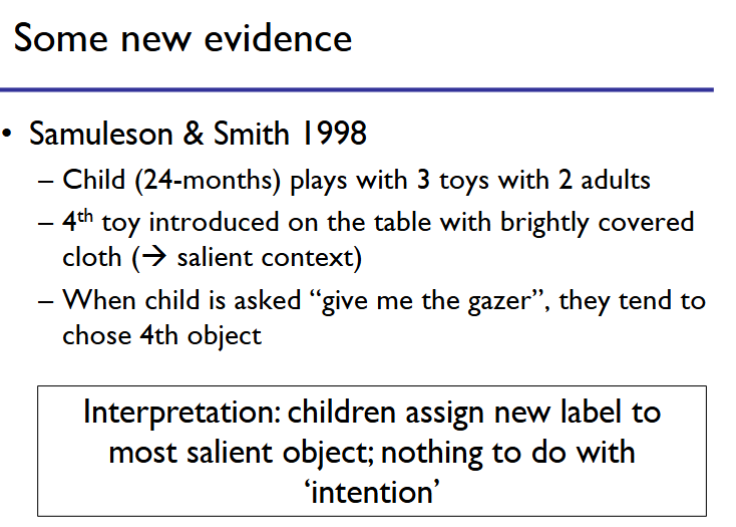
Who argued against social pragmatic account by altering evidence to suggest salience is the most important?
Samuelson and Smith (1998)
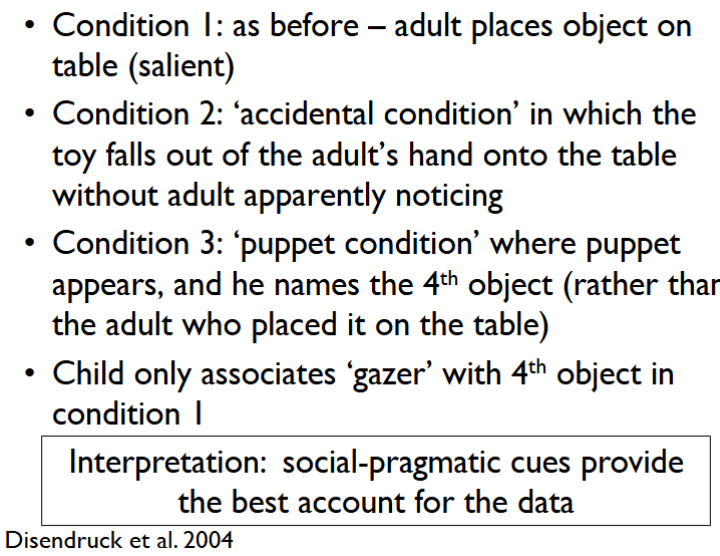
Who argued against Samuelson and Smith to reinforce involvement of socio pragmatics by again altering the experiment?
Disendruck et al (2004)
argued that in Samuelson and Smith by introducing 4th object in new way it inadvertently tells the child that this object is special to adults hence chosen