3.2.3 Transport across cell membranes
 Call Kai
 Learn
Learn Practice Test
 Spaced Repetition
 Match
Match Flashcards
 Knowt Play
1/21

There's no tags or description
Looks like no tags are added yet.
Name | Mastery | Learn | Test | Matching | Spaced | Call with Kai |
|---|
No analytics yet
Send a link to your students to track their progress
22 Terms
State the three main examples of cell membranes. (3 marks)
- Cell surface membrane.
- Mitochondrial membrane.
- Chloroplast membrane.
Describe the fluid-mosaic model of membrane structure. (3 marks)
- Phospholipids and proteins can move laterally within the bilayer and hence fluid structure.
- Membranes contain multiple components, including phospholipids, proteins, glycoproteins, and glycolipids, hence mosaic structure.
- The basic structure of all cell membranes is the same.
Draw a labelled diagram of general structure of the cell membrane. (6 marks)
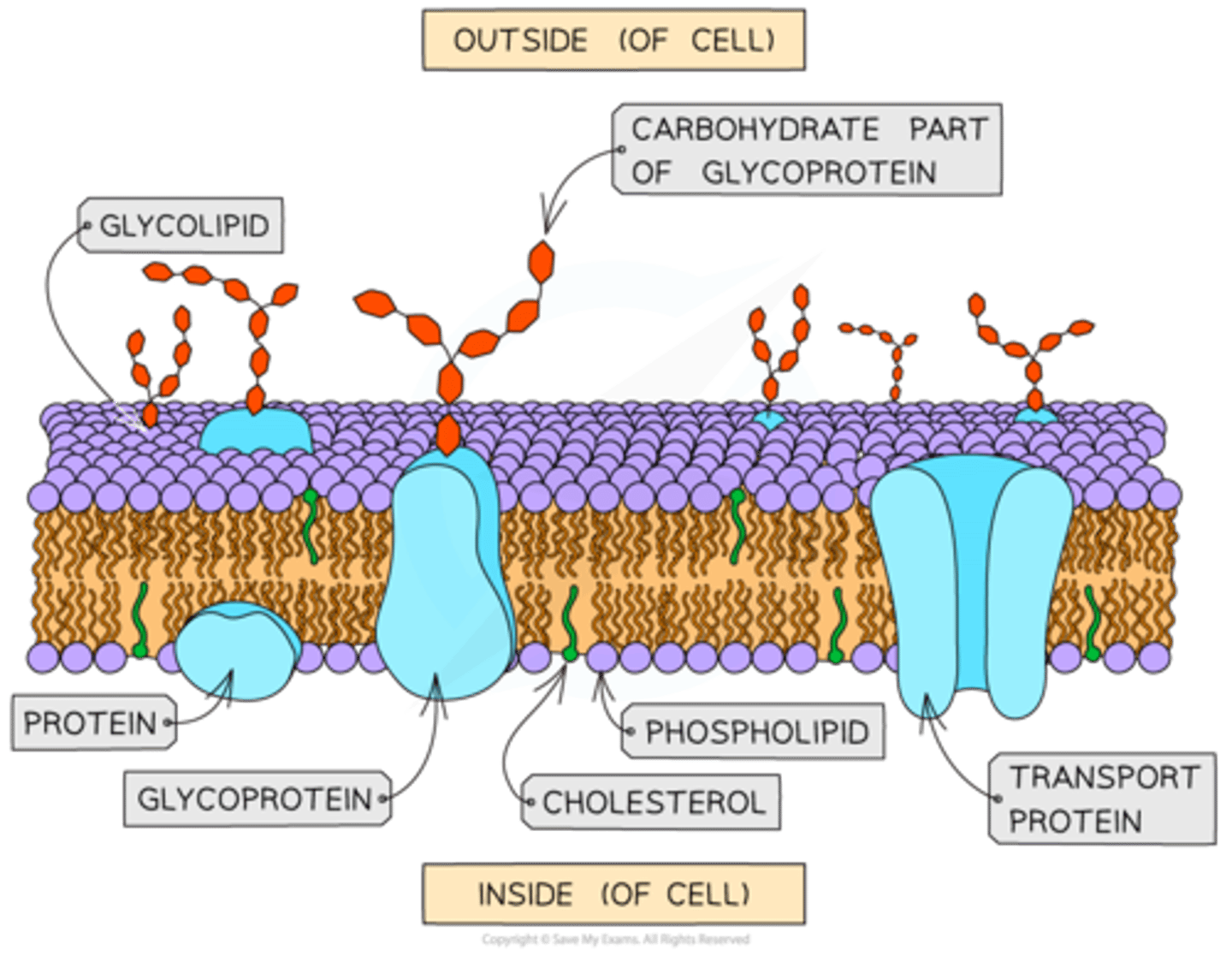
State the components of a typical cell membrane. (5 marks)
- Phospholipid bilayer
- Intrinsic proteins that span bilayer e.g. channel and carrier proteins
- Extrinsic proteins on the surface of membrane.
- Glycolipids and glycoproteins on exterior surface.
- Cholesterol that is sometimes present bound to phospholipid fatty acid tails.
Explain the arrangement of phospholipids in a cell membrane. (3 marks)
- Phospholipids form a bilayer with water on both sides.
- Hydrophobic fatty acid tails face inwards, away from water.
- Hydrophilic phosphate heads face outwards towards water.
Describe the role of cholesterol in cell membranes. (2 marks)
- Restricts the movement of molecules in the membrane.
- Reduces fluidity and permeability while increasing rigidity.
Suggest two ways cell membranes are adapted for other functions. (2 marks)
- Fluid bilayer allows bending for vesicle formation and phagocytosis.
- Glycoproteins and glycolipids act as receptors or antigens in cell signalling and recognition.
Describe how movement across membranes occurs by simple diffusion. (4 marks)
- Lipid-soluble or very small molecules diffuse through the phospholipid bilayer.
- They move down a concentration gradient, from high to low concentration.
- Diffusion is passive and requires no energy from respiration.
- Only the kinetic energy of molecules is needed.
Explain why the phospholipid bilayer restricts some substances from passing through. (2 marks)
- Water-soluble, polar, and large molecules cannot pass through easily.
- This is due to the hydrophobic fatty acid tails in the bilayer's interior.
Describe facilitated diffusion across cell membranes. (4 marks)
- Polar or charged molecules, and slightly larger substances, move down their concentration gradient.
- Movement occurs through specific channel proteins or carrier proteins.
- Process is passive and does not require ATP.
- Only the kinetic energy of the molecules is used.
Explain the role of channel and carrier proteins in facilitated diffusion. (4 marks)
- The shape or charge of the protein determines which substances can pass.
- Channel proteins provide a hydrophilic pore for water-soluble substances, and may be gated.
- Carrier proteins bind specific molecules, then change shape to transport them across.
- Both types enable diffusion of substances that cannot pass through the bilayer directly.
Describe how osmosis moves water across cell membranes. (4 marks)
- Water moves from a high water potential to a low water potential.
- Movement is down a water potential gradient.
- It passes through a partially permeable membrane.
- Process is passive and requires no ATP.
Define isotonic solutions and state what has the highest water potential. (2 marks)
- Isotonic solutions are solutions that have the same water potential.
- Pure water has the highest Ψ at 0 kPa.
Describe what happens when you put a plant cell in a dilute solution. (3 marks)
- Water enters the cell via osmosis as the water potential inside the cell is less than the water potential in the surrounding solution.
- Swells but does not burst due to the cell wall of the plant.
- The cell becomes turgid (swollen).
Describe what happens when you put a animal cell in a dilute solution. (2 marks)
- Water enters the cell via osmosis as the water potential inside the cell is less than the water potential in the surrounding solution.
- This causes the animal cell to burst.
Describe how movement across membranes occurs by active transport. (2 marks)
- Substances move from an area of lower concentration to an area of higher concentration, against a concentration gradient.
- This process requires ATP hydrolysis and specific carrier proteins.
State what factors decrease the rate of respiration and hence, the rate of active transport. (3 marks)
- A decrease in temperature.
- A lack of oxygen.
- Metabolic and respiratory inhibitors such as cyanide.
Explain the role of carrier proteins and ATP in active transport. (4 marks)
- A complementary substance binds to a specific carrier protein.
- ATP is hydrolysed to ADP and Pi, releasing energy.
- The carrier protein changes shape, releasing the substance on the opposite side.
- Pi is released and the protein returns to its original shape.
Describe how co-transport works. (2 marks)
- Two different substances bind to a co-transporter protein and are moved at the same time.
- One substance moves against its gradient, while the other moves down its gradient.
Describe the absorption of sodium ions and glucose in the ileum as an example of co-transport. (3 marks)
- Sodium ions are actively transported from epithelial cells into the blood, creating a sodium gradient.
- Sodium enters the epithelial cell from the lumen with glucose via a co-transporter protein.
- Glucose moves into the blood down its concentration gradient by facilitated diffusion.
Explain how surface area, protein numbers, and gradients affect transport rates. (4 marks)
- Increasing membrane surface area increases movement rate.
- More channel or carrier proteins increase facilitated diffusion or active transport rates.
- Steeper concentration gradients increase rates of simple or facilitated diffusion.
- A steeper water potential gradient increases osmosis rates.
Describe adaptations of specialised cells for transport. (3 marks)
- Folded membranes, such as microvilli, increase surface area.
- Higher numbers of protein channels or carriers speed up facilitated diffusion or active transport.
- Many mitochondria provide ATP for active transport.

