B3.1 Gas exchange - human*
 Call Kai
 Learn
Learn Practice Test
 Spaced Repetition
 Match
Match Flashcards
 Knowt Play
1/42

There's no tags or description
Looks like no tags are added yet.
Name | Mastery | Learn | Test | Matching | Spaced | Call with Kai |
|---|
No analytics yet
Send a link to your students to track their progress
43 Terms
three physiological processes
ventilation
gas exchange
cellular respiration
ventilation
exchange of air between atmosphere and lungs - through breathing
gas exchange
exchange of oxygen and carbon dioxide between the alveoli and bloodstream via passive diffusion
cellular respiration
release of ATP from organic molecules
enhanced by presence of oxygen
ventilation has to happen before this
purpose of ventilation
Oxygen is consumed by cells during cellular respiration and carbon dioxide is produced as a waste product.
hence O2 is constantly being removed from the alveoli into the bloodstream and CO2 is continually being released
The lungs function as a ventilation system by continually cycling fresh air into the alveoli from the atmosphere.
help O2 levels stay high in alveoli (and diffuse into the blood) and CO2 levels stay low (and diffuse out the blood)
The lungs very large surface area increase the overall rate of gas exchange.
effect of exercise on ventilation rate
rate exercise increase
atp demand increase
cellular respiration increases
need more o2 so breathe faster
CO₂ product increase
cant because caused acidity (avoidance)
breathe out faster
Hence, the ventilation rate increases.
Adaptations for Gas Exchange in terms of sa:v
Specialized respiratory surfaces to increase sa:v
Thin respiratory surfaces reduces the distance that gases need to diffuse, enhancing the rate of exchange.
Circulatory systems transport gases and nutrients to and from cells, compensating for the increased diffusion distances caused by a lower surface area to volume ratio.
Large organisms have evolved specialised structures to facilitate gas exchange such as
arge SA in relation to volume of organism
Permeability to O2 and CO2
Thin tissue layer to minimise diffusion distance
Moist surface allows fo gases to dissolve
The higher the concentration gradient, the () the rate of diffusion
faster
structure of alveolus
site of gas exchange
thin epithelial layer to minimize diffusion distances
surrounded by rich capillary network—increases capacity for gas exchange with blood
roughly spherical—maximize available surface area
internal surface covered with surfactant—dissolves gas—better diffusion to bloodstream
how is a high concentration gradient maintained during gas exchange?
Dense capillary network around gas exchange surfaces
Continuous blood flow
Ventilation
With air for lungs
With water for gills
adaptations of mammalian lungs
surfactant
bronchioles
many alveoli
extensive capillary network
alveoli are made of
Type I and II pneumocytes.
Type I pneumocytes
involved in the process of gas exchange between the alveoli and the capillaries
extremely thin - minimising diffusion distance for respiratory gases.
unable to replicate
Type II pneumocytes
secrete alveolar fluid, which contains surfactant.
decrease surface tension
can differentiate to type I
surfactant function
reduces the surface tension to prevent alveoli collapse during exhalation.
dissolve oxygen in liquid
alveoli attached to where and why
ends of the bronchioles
increase surface area for gas exchange
small diameter of bronchioles can
slows down air flow to increase efficiency
Extensive capillary network around alveoli
diffusion distance for gases is always short.
breathing depends on
inverse relationship between pressure and volume
is lung tissue muscular
no
what force air into and out of the lungs
Muscles surrounding the lungs contract and the pressure changes in the thorax
muscles facilitate ventilation
Antagonistic muscles
thoracic cavity
chest pressure
what happens when the thoracic cavity increases (vice versa)
pressure in thorax decrease since more areas for particles to move
hence atmospheric pressure increases and is higher than inside thorax
hence air travel from atmosphere to thorax causing inhalation
inhalation/inspiration
The muscles responsible for inspiration are the diaphragm and external intercoastal muscles
• Diaphragm muscles contract causing the diaphragm to flatten and increase the volume of the thoracic cavity, hence decreasing the pressure of thorax below atmospheric pressure
• External intercostals contract, pulling ribs upwards and outwards (expanding chest)
Air flows into the lungs from outside until it reaches atmospheric pressure
exhalation/expiration
The muscles responsible for inspiration are the abdominal muscles and internal costal
• Diaphragm muscles relax, causing the diaphragm to curve upwards and reduce the volume of the thoracic cavity - increase pressure above atmospheric pressure
• Internal intercostals contract, pulling ribs inwards and downwards (reducing breadth chest)
• Abdominal muscles contract and push the diaphragm upwards during forced exhalation.
Air flows out of the lungs from outside until it reaches atmospheric pressure
cause and risk factors of lung cancer
uncontrolled proliferation of lung cells - leading to abnormal growth of lung tissues
smoking
pollution
environmental factors eg radon gas
symptoms of lung cancer
coughing blood
weight loss
emphysema what is it and cause
lung condition where the walls of the alveoli lose their elasticity due to damage to the alveolar walls.
result in enlargement of alveoli—lower sav for gas exchange
major cause smoking
symptoms of emphysema
shortness of breath
expansion of ribcage
increase susceptibility to chest infection
phlegm production
cyanosis
respirometry vs spirometry
metabolic activity vs lung activity
if not specify gas = spirometry
Exercise will influence ventilation in two main ways
increase ventilation rate/ tidal volume
spirometry practical
measuring the amount and/or speed at which air can be inhaled or exhaled.
detects the changes in ventilation and presents the data on a digital display
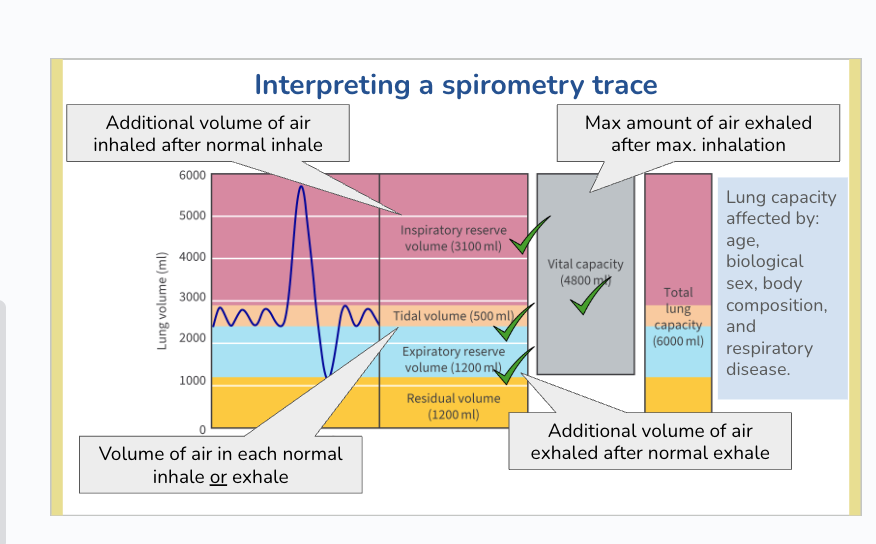
total lung capacity
Volume of air in the lungs after a maximal inhalation
vital capacity
Volume of air in the lungs after a maximal inhalation
residual volume
volume of air that is always present in the lung
tidal volume
Volume of air that is exchanged via normal breathing
expiratory reserve volume
Additional volume of air exhaled after normal exhale
inspiratory reserve volume
Additional volume of air inhaled after normal inhale
factors affecting ventilation rate
height location lifestyle
effect of exercise on respiration
As exercise intensity increases, the volume of oxygen supplied to the tissues also increases
If energy demands exceed oxygen intake, ATP may be produced via anaerobic respiration (producing lactic acid)
The lactic acid is transferred to the liver and requires oxygen to convert it back to a usable form
This extra oxygen required to restore normal body functioning after exercise is referred to as the oxygen debt
less oxygen required to metabolise carbohydrates than fat
This is why there is an increase in carbohydrate metabolism and a decrease in fat metabolism with higher intensity exercise
diagram for lung capacity