Music History FINAL
 Studied by 0 people
 Call Kai
 Learn
Learn Practice Test
 Spaced Repetition
 Match
Match Flashcards
 Knowt Play
1/68

There's no tags or description
Looks like no tags are added yet.
Name | Mastery | Learn | Test | Matching | Spaced | Call with Kai |
|---|
No analytics yet
Send a link to your students to track their progress
69 Terms
Renaissance
1300-1600 AD
“Rebirth”
Baroque
1610-1750
“Age of Absolutism/Reason”
Classical era
1750-1815
-meant to please, not impress/instruct
-pleasing variety
Romantic era
1815-1900
concerned with individual expression
innovation (freedom from artistic barriers)
concern for urban life
*MYSTERY (natrual vs supernatural, ghosts, death, unrequited love, dreams, uncontrollable passions
Modernist Era
1910-1960
Expressionism, Primitivism, Futurism, Objectivism (EPFO)**
focuses on the NEW
goal oriented
binary relationships
SINGULARITY OF MEANING
radical experimentation in technology and the arts
self-identifying with “Avant-garde”
complex, fragmented, abstract melodies
Post-modernism
1960-present
favors multiplicity of meaning
self-referential, not developmental (no concern for being cutting edge, moving forward)
concerned with decentered networks (ONLINE), not linear
**STYLISTICALLY DIVERSE
Symphonic form
A large-scale work for orchestra in 4 movements
Movement Plan of symphonic form
Movement I- Sonata Form (moderate to fast)
Movement II- variety of forms- slow
Movement III- minuet with trio- moderate
Movement IV- Generally Sonata or Rondo- fast
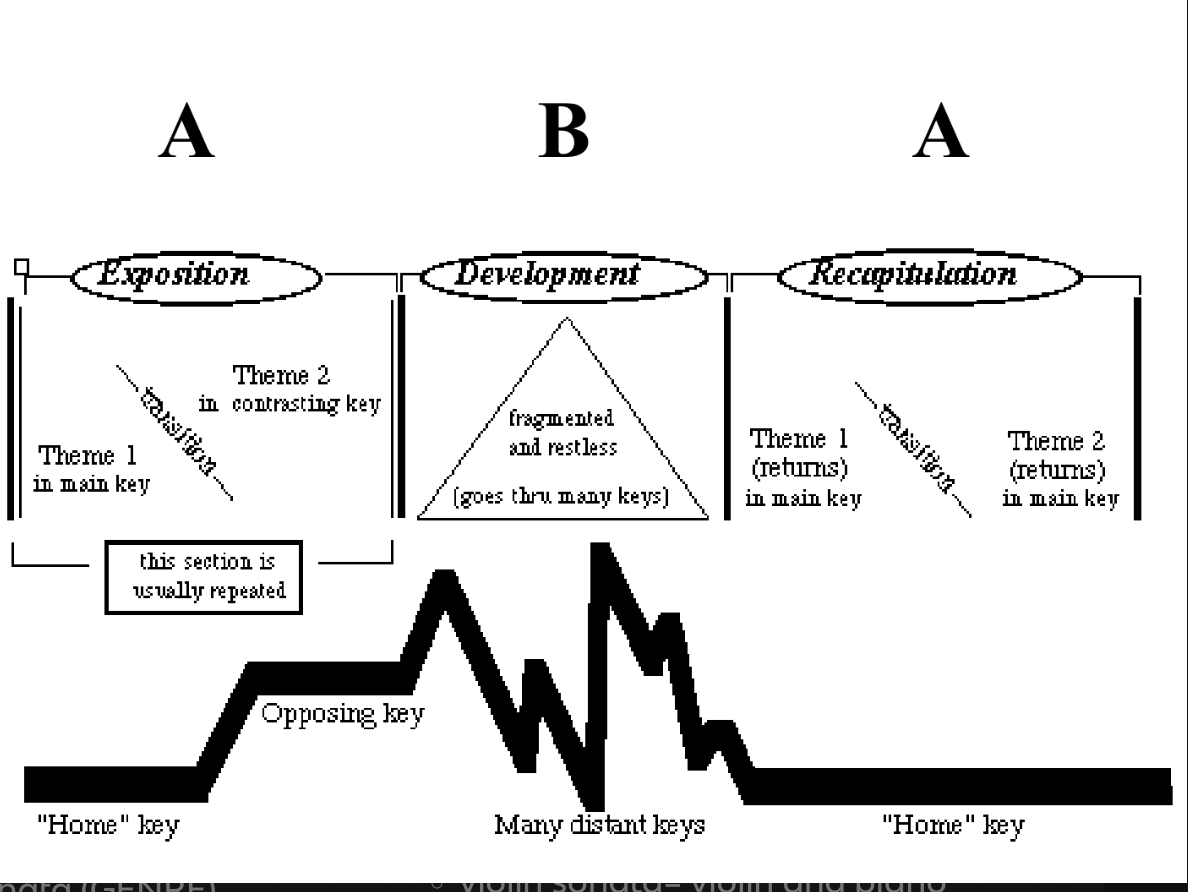
Sonata form
3 main sections
Exposition
Development
Recapitulation
Rondo form
similar to Ritornello derived from ABA BUT main theme is always in same key
ABACA
ABACABA
Movement Plan of Sonata (genre)
I. moderate to fast- sonata form
II. slow, various forms
III. fast, sonata or rondo
Concerto
3 movements:
I. bright, fast, Ritornello
II. slower, quieter, emotional, CONTRASTING* key
III. similar to I, faster, home key
Ritornello Form
ABACADAEA
based on contrast of musical ideas
orchestral material (ritornello)
solo material episodes
returns to stable element many times
in whole or in part
in various keys (builds tension)
usually in full and in tonic key to end piece
Ludwig van Beethoven
TRANSITIONAL figure (Classical to Romantic)
*never gets to Romanticism
Beethoven musical innovations
Classical principles (structure) and Romantic expression
sense of excitement, urgency, striving
wide range of emotional qualities
expansion of all musical elements
higher and lower extremes
sharper syncopations/disruptions
classical forms stretched to limits
harsher dissonances
Program Music
Program Music
Instrumental music associated with poems, stories, etc; intimately tied with non-musical ideas
NEVER HAS TEXT
e.g. Beethoven’s Symphony No.6 in F Major (Pastoral)
Franz Schubert
Romantic era (d.1828)
“Erlkonig” (King of the Fairies)
Erlkonig
story song based on a ballad poem- 8 stanza poem with many characters
themes of death and supernatural- father tries to save deathly ill son
through-composed setting- music keeps CHANGING
narrator, father, son, Erlkonig, horse (piano)
Billie Holiday
“Strange Fruit”
written in response to lynching of Thomas Shipp and Abram Smith in Indiana in 1930; accused of harassing a white woman, sent to jail, broken out, and lynched
text reminded Holiday of father who died from not receiving cancer treatment due to racism
NO applause after performances, sang the song even when requested not to
sang with “detached anger”- enunciates last word
hard to ignore brutality of subject
sparse accompaniment- TEXT is most important
juxtaposition: sweet smell, burning flesh
Nina Simone
sang “Strange Fruit” 30 years later, but with a sadness instead of an anger
Hector Berlioz
Romantic era
“Fantasic Symphony”
PROGRAM SYMPHONY in 5 movements'
inspired by unrequited love —> “Idee Fixed”
tarantella, depressed musician poisons himself
idee fixed
recurring theme that reappears in all 5 movements; symbolizes each appearance of the beloved
no direction —> AMBIGUITY
Johannes Brahms
Romantic era
found new life in classical forms but still romantic in expressive effect
looked up to Beethoven
Violin Concerto in D
shows off virtuosity
Gustave Mahler
**TRANSITIONAL FIGURE TO MODERNISM
wrote 10 long symphonies and 6 song cycles
dealing with weighty themes (Good vs Evil, finding God in music)
embraced Romanticism’s excesses, but could not fully enter Romantic fantasy world (tragic life)
song cycle
collection of songs that deal with one theme
3rd Movement on 1st Symphony
Mahler
funeral march in MINOR mode
sounds like Jewish folk song
stripping innocence from OG children’s song Frere Jaques
Claude Debussy
TRANSITIONAL FIGURE between Romanticism and Modernism
-revolutionary spirit
-breaks with tradition
-draws inspiration from outside of Western traditions (Asia, jazz)
-AMBIGUITY
Pagodes from Estampes
Debussy
influenced by gamelan music (traditional music from Indonesian islands of Java and Bali)
big gong signals new cycle
based on Pentatonic scale (black keys, no same directionality)
different layers of TIME from Gamelan tradition
no direction
extensive use of pedal and repeated tones (to create overtones and static harmony)
**doesnt depend on traditional structure harmony
Debussy Preludes for Piano
preferred to not have titles printed in the program because he did not believe he should affect how the audience interprets the piece
SHOULD NOT have the agency
Maple Leaf Rag
Scott Joplin
similar to Rondo form, syncopated melody
stride bass
Ragtime in Debussy’s preludes
General Lavine, Eccentric
lively, choppy
Expressionism
(Modernism)
exploited extremes
inner turmoil- hysteria, madness, nightmares, etc.
distorted, exaggerated melody and harmony
tends toward abstraction
Romantics vs Expressionists
Romantics: outward expression
Expressionists: looking inwards, nightmares, psychology
Arnold Schoenberg
Expressionist (began carer as a romantic)
left Europe to escape persecution by Nazis
concerned with FORM and UNITY
wants to “emancipate the dissonance”
writes ATONAL works
developed 12 tone system
Twelve Tone System
Schoenberg
organizes all 12 notes of the chromatic scale into a specific sequence, or tone row, ensuring no note is repeated until all 12 are used, thus creating atonal music by avoiding traditional keys and emphasizing pitch equality
Pierrot Lunaire
SONG CYCLE based on poem about a clown
kaleidoscopic scoring- each song uses different combo of instruments
sprechstimme- speech and singing combination —> more animated
Igor Stravinsky
Primitivism (Modernism)
draws inspiration from and reinterprets the distant past
abstract use of folk tunes
“The Firebird”
“The Rite of Spring”
uses and combines BLOCKS of sounds- working with patterns
The Rite of Spring
deliberately barbaric style
crude use of folk-tune fragments
“unemotional” dissonant music
visceral, unpredictable rythyms, mixed meters
first performance caused a riot
*1provocative, 2nonballetic choreography, 3set design!!
violent, brutal, dissonant sounds
subject matter found offensive (young girl sacrificed in spring ritual)
The Futurist Project
Futuristic distaste for the past (Futurist Manifesto Marinetti)
BUT you cannot forget the past
sought to literally destroy the past (libraries, monuments, etc.)
wanted futurism to be the official state art of Fascism
like CHANGE- speed, dynamism, technological progress
Futurism in Music
views traditional music as artificial (incapable of making urban-like sounds)
“Art of Noises” - Luigi Russolo
new need to develop new instruments to reflect modern, urban life
Luigi Russolo pieces
“The Art of Noises”
“Awakening of a City”
bound by traditional notation (cannot fully escape past —> Primitivism)
sounds are material, form should be free
sound as an ABSTRACT
2 Aesthetic Streams in U.S.
MODERNISM (1900-1945)
Mavericks
Populists
**different aesthetic conerns but BOTH want music that is distinctly AMERICAN
Mavericks
fiercely independent
brash, rugged individuals
do their own thing
Populists
seek broad appeal
music is more acceptable than Mavericks
Charles Ives
Modernism, Maverick
collage technique (layered textures that are disruptive)
quarter tones, tone clusters, and aleatoric techniques
SPECIFIC IMAGERY, atmospheric, contemplative
Central Park in the Dark
Ives
Programatic piece (“picture in sounds”)
CP on hot summer night, getting lost, no straight lines
individual’s quiet contemplation is interrupted by increasing cacaphony
ragtime tunes
taxi horse jumps the wall- climax
Aaron Copland
Modernist, populist
promoted AMERICAN music that should serve ALL PEOPLE
“innately” and recognizably American
adopted a nationalist agenda
used American music of all kinds, regions, and ages
wide range
Appalachian Spring
Copeland
ballet score, concert suite
pioneer celebration around farmhouse in PA hills
uses quotation of Shaker hymn “Simple Gifts”
expansive sounds
VERNACULAR music
vernacular music
specific to ethnicity or region
Post WW2 Serialism (High Modernism)
Europe in shambles
12 tone system (Schoenberg) taken to an extreme
controlling every aspect of the music, leaving nothing up to interpretation
music as a science
music’s relationship to math, stats, structural linguistics is explored
John Cage = unofficial aesthetic mediator
High Modernism
style has reached its apex, cannot go anywhere else
centered around Darmstadt Summer Festival (whats on cutting edge of music)
takes Schoenberg’s ideas about form and structure to an extreme
complexity of STRUCTURE
High Modernism composers
Pierre Boulez
Luciano Berio
Pierre Boulez
High Modernist
complexity of structure
“Structures” piece for 2 pianos
removing subjectivity
structure, repeatable, etc
HOW STRUCTURE UNFOLDS
seeking ORDER in aftermath of WW2, want control
John Cage
END OF MODERNISM (transition to post-modernism)
studied under Schoenberg
developed techniques and ideas with limits as solutions for practical problems
“The Prepared Piano”- corks/screws/nails/papers/erasers/tape
wanted music to imitate nature in its manner of operation
created graphic scores that could be rearranged by the performer
rules based but different outcomes
all sounds valid as music material
wanted to remove the expressiveness/subjectivity from the piece
Fontana Mix
Cage
dots and lines intersect
Cage makes the rules but performer performs
all that matters is making sounds
Luciano Berio
Post Modernism
Sinfonia, 3rd Movement
comments on events of 1968, second movement dedicated to MLK
Gerard Grisey
Post-modernism
“Partiels from Les Espaces Acoustiques”
no clear sense of time, sound is changing, rethinking how time works
new elements introduced as time goes on
points are EXTENDED
example of SPECTRALISM
sound created from sound itself
undermines idea of grand narratives with a logical end
spectralism
not a school of thought, but a STATE OF MIND, and ATTITUDE
no set of rules
Steve Reich
post-modernism
doesnt like 12-tone system
fascinated with tape loops
“Pendulum Music”
example of MINIMALISM, but prefers “PROCESS MUSIC”
Minimalism
simple, repetitive patterns (like drones, steady pulses) focusing on gradual change
Glenn Branca
post-modernism
uses NONMUSICAL sounds
reacts against the overly academic sensibility of High Modernism
Symphony No. 5
Julius Eastman
post modernism
composer, performer, dancer, choreographer
theatrical sense to him
active in Downtown and Uptown, but never felt comfortable in either
minimalist, post-minimalist, and experimentalist
“organic music”- each section connected by a common element
**repetition, improvisation, gradual transformation of musical material
open instrumentation and open forms
disrupts hierarchy; sees structural issues with how music is presented
provocative titles
behavior/personality becomes more erratic- schizophrenia or BPD?
scores were tossed, but now being assembled by Mary Jane Leach
Downtown NYC
concerts in old industrial buildings, loading docks, piers, lofts, etc
doesnt conform for academic
experimental
John Cage
Uptown NYC
academic institutions!! Columbia, Julliard, NYU
Stay on It
Eastman
upbeat, catchy tune that is repeated/transformed in various ways
dissonant long tones
rythmic disruption
free imporvisation
chaos, unpredictable
**metaphor for feeling comfortable, that being violently disrupted, and then going back to comfort
**ORGANIC MUSIC
organic music
you feel connected to what came before
Fluxus Collective
blending art with everyday life through playful, experimental, anti-art performances
should be groundbreaking
interventions- do things in spaces that are not meant to be there
e.g. disrupting an art gallery
Program Music
extramusical content, story
Absolute music
only about music
 Note
Note  Flashcards (25)