Experimental psychology
 Studied by 5 people
 Call Kai
 Learn
Learn Practice Test
 Spaced Repetition
 Match
Match Flashcards
 Knowt Play
1/46

There's no tags or description
Looks like no tags are added yet.
Name | Mastery | Learn | Test | Matching | Spaced | Call with Kai |
|---|
No analytics yet
Send a link to your students to track their progress
47 Terms
What is intuition provide provide an example and list any potential problems?
Is the first approach to acquiring knowledge. Is the act or process of coming to direct knowledge or certainty without reasoning or inferring
Jackie's friend tells her what to do in her personal life based on her "gut instincts." A more formal name for this source of knowledge is:
The problem is that it does not provide a mechanism for separating accurate from inaccurate knowledge
What is authority provide an example unless any potential problems?
Refers to the acceptance of information or fact stated by another person because that person is a highly respected source
If you accept your physician's explanation for your illness without researching your condition or asking how she came to her conclusion, you are relying on _______________ as a source of knowledge.
The problem with this approach is that informational fact, stated by the authority might be inaccurate
What is rationalism provide an example in this any potential problems?
The gain of knowledge, through reasoning
A rationalist Wordle player uses logic and reasoning (not random guessing) to systematically figure out the correct word.
One danger of this is it’s not unusual for two well-meaning and honest individuals to reach different conclusions
What is empiricism provided example enlist any potential problems?
Is the gain of knowledge through experience
When studying flashcards, you learn through direct experience by seeing recalling of knowledge Repeatedly
Perception is affected by lots of variables, past experiences in our motivation at the time of perceiving can alter what we see,our memory for rent does not remain constant,we forget things and may have distortions of memory
Describe the historical process with Induction and providing an example
reasoning process that involves going from specific observations to general conclusions.
📘 Example: Observing several children being aggressive at a daycare and concluding that children in general tend to be aggressive.
was the dominant scientific method from the late seventeenth century to the mid-nineteenth century, used by scientists such as Francis Bacon and Isaac Newton to develop general laws from observed phenomena.
Describe the historical process Associated with deduction and provide an example
Defined by Aristotle refers from going to general to specific,
Levine’s (2000) study predicting that seeing a group task as important reduces social loafing
describe historical processes associated with hypothesistesting, and provide an example
is the process by which investigator formulate a hypothesis to explain some phenomenon that has been observed, and then compares the hypothesis with fact
Proctor and Capaldi in 2001 argue that the era of _____ testing extended from 1850 to 1990 and is still very important for scientific active activity in psychology
as a scientific methodology was associated with logical positive movement
assumption that there is reality in nature
The assumption that the things we see here feel smell and taste are real
what is discoverability?
it is possible to _____ the regularities that exist in nature
scientist make the assumption that there is an underlying reality and the attempt to uncover this reality
what is uniformity regularity in nature
If there was no uniformity in the nature, there could be no understanding, explanation or knowledge about nature without regularity we could not develop theories or laws or generalization
understand the importance of control, Operationalism, and replication characteristics of science research and discuss what it might mean if each of these is missing
Refers to the elimination of influence of extraneous variables, if this was missing might mean there’s no comparison, no control group, or variables aren’t managed properly
Explains exactly how you measure or identify something in an experiment, if missing could mean variables aren’t clearly defined in measurable terms
Refers to the reproduction of the results of a study in a new study could mean if missing research can be repeated or results haven’t been tested again
Give examples of operationalizing constructs
Turning abstract ideas (constructs) into something measurable
Stress
happiness
Anxiety
What is placebo effect? give an example?
Is the improvement due to our participants expectations for improvement rather than the actual treatment?
A person takes a sugar pill they believe is medicine and their headache gets better.
Explain pseudoscience and provide specific examples of factors of pseudoscience
Is an approach that claims to be scientific, but is based on methods and practices that violate many tenants of science
creating new ad hoc hypothesis in order to explain away negative findings
using ambiguous or confusing language to make claim sound like it went through scientific scrutiny
Relying on testimonials supporting claim
Descriptive vs experimental research
Focuses on describing some phenomenon, event or situation.tells you what is happening
Attempts to identify cause-and-effect relationship by conducting controlled psychological experiments. tells you why it’s happening
What are the advantages and disadvantages of experimental approach?
causal inference, causal description, causal explanation, ability to manipulate variables, control,
Does not test effects of non-manipulation variables, artificiality, inadequate method of science inquiry
What is qualitative and quantitative research and the types of data collected in each
Collects non-numerical data is statements written records pics, observed behavior to answer research question
Collects numerical data to answer results questions and is most popular type of research in psychology
What is a dependent variable, an independent variable and extraneous variable give an example of each
The ______________ variable is the presumed cause of another variable, while the ______________ variable is the presumed effect.
is a variable that competes with the independent variable in explaining the outcome
A researcher wants to see if sleep affects test performances
IV = cause (sleep)
DV = effect (test performance)
Extraneous = outside influences (like caffeine)
What is field experiment vs laboratory experiment what are the times for use and benefits and problems
Conducted in a real life setting, while experiments are actively manipulates variables, and carefully controls the influence of many extraneous variables
More realistic
Cannot control extraneous variables
conducted an laboratory, investigator, precisely manipulates, one or more independent variables, and controls influence of all or nearly all extraneous variables
Prob- artificiality problems
Can control extraneous variables
Use lab experiments for control and precision.
Use field experiments for realism and natural behavior.
What is Internet experiment, the time for use and the benefits and problems?
Experimental study conducted over the Internet
Use when you need large, diverse samples or when your research dose not need lab
Some advantages are ease of reach to participants from previously inaccessible areas, brings experiment to the participant, has high statistical power because it has access to large samples, has direct assessment of motivational confounding, cost savings
Issues include multiple submission Lack of experimental control, self selection, dropout.
What is natural manipulation research the time for use and then the benefits and problems
explains possible causes that are not usually manipulated by researcher but the causal variable is one that describes a natural occurring contrast between a treatment and a comparison condition
Use ___________ research when the variable happens on its own, not by the researcher — it’s realistic and ethical, but harder to control and prove causation.
What is correlational study? When do you use it in? What are the benefits and problems with it?
Measures two variables, and then determining the degree of the relationship that exists between them
Enabling us to accomplish the research objectives of description and prediction
One weakness is when someone assumes that simply because two variables are related did that one causes the other
Cross-sectional study vs longitudinal study
Study conducted at a single time. Period and data are collected from multiple groups. Data are collected during a single brief time. You use it when you compare different groups at a single point in time.
Quick inexpensive, no follow up needed and is easy to collect large samples
Problem is it changes over time
You use it when you want to study people over a long period of time Data are collected at two or more points in time. Has aged cohort effect. All individuals within this cohort experience, similar environmental events.
Shows real change overtime, stronger for showing cause-and-effect patterns but is time consuming and expensive
Research vs Noel hypothesis
Is the researchers predicted relationship among the variables being investigated?
Is a statement of no relationship among the variables being investigated and is used in a statistical analysis
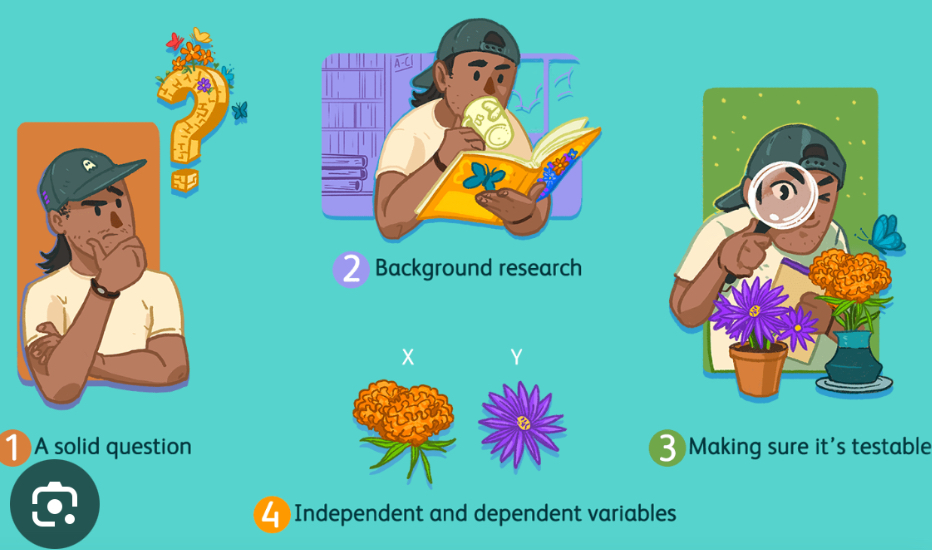
What are the aspects of a good research question
a relation was expressed between the variables. The problem was stated in question form, and it was possible to test the problem empirically
Specificity of research question
What is relationship between society and science what are the ethical concerns and give an example?
The extent to its societal concerns and cultural values should direct the course of scientific investigation
An example is aids prior to 1980s. It was very unheard of few federal dollars were committed to investigating this disorder but when AIDS turned off in the US population and its lethal characteristics was identified, it rapidly became a national concern. Millions of dollars was immediately invested to find cures.
Conflict of interest
Creating a new drug to make more money
What are the ethical concerns in professional issues? give example.
Research misconduct.
Fabrication falsification or plagiarism this can look like forging, falsifying data, manipulating results to support theory or a selectively reporting data
The most serious crime in the scientific profession is to cheat or present fraudulent results
What are the ethical concerns with treatment of research participants and give examples?
The conduct of research with humans can potentially create a great deal of physical and psychological harm
An example is a radiation study was conducted on patients with cancer resistance to radiation in these experiments. The principal investigator even stated that he was experimenting, not treating the patient’s disease. And a was a 25% mortality rate
What is fabrication give example
Definition: Making up data or results and pretending they are real.
Example: A psychologist invents fake participants or data to support their hypothesis.
What is falsification and given an example
Definition: Changing or manipulating data, equipment, or procedures so results are misleading.
Example: A researcher edits participants’ scores to make a treatment seem more effective.
What is plagiarism and given an example
Definition: Using someone else’s ideas or words without giving them credit.
Example: Copying text from another researcher’s paper into your own report without citing them.
What are the primary ethical dilemmas that psychological researchers face?
determine if potential gain and knowledge from the research study outweigh the cost to the research participant
Give primary consideration to welfare of participant
Can’t have biased because you might exaggerate it scientific merit or potential contribution
Investigators must submit a research protocol that the IRB can review
List the ethical principles important in conducting research discussed violations of these ethical principles provide examples from historical psychological studies
?
What is cost benefit analysis and how do you apply to a study?
Comparing the potential benefits of a study to the possible risks or harms to decide if the research is ethically acceptable.
Identify benefits (e.g., new knowledge, better treatments).
Identify costs (e.g., stress, harm, privacy risks).
Compare — do benefits outweigh the costs?
Modify study to reduce risks (use consent, debriefing, etc.).
IRB vs. IACUC
Reviews studies involving human participants to ensure ethical treatment.
Reviews studies involving animals to ensure humane care and minimize suffering.
Informed Consent
Definition: Participants must be told the purpose, procedures, risks, and right to withdraw before agreeing to join.
Importance: Protects participants’ autonomy.
Exceptions: Some field or deception studies where revealing full info would ruin results (but must debrief later).
Deception
Definition: Intentionally withholding or misleading participants about the true purpose of a study.
Appropriate Use: Only if necessary, causes no harm, and participants are debriefed afterward.
Debriefing
Definition: Explaining the study’s purpose and procedures after participation.
Importance: Reduces distress and restores trust.
Major Elements: Reveal true purpose, explain deception, answer questions, ensure participant well-being.
Confidentiality vs. Anonymity
Researcher knows participants’ identities but keeps data private.
No identifying information is collected at all.
Animal Welfare vs. Animal Rights
Animal Welfare: Animals can be used in research if treated humanely and suffering is minimized.
Animal Rights: Belief that animals should never be used for research under any condition.
APA-Formatted Research Report
Title Page
Abstract
Introduction
Method
Results
Discussion
References
Times New Roman 12 pt
Proper Language Choice
Avoid bias (e.g., say “participants with depression” not “depressed people”).
Be precise with terms and labels.
Use professional, objective tone — no slang or emotional language.
Proper Citation Techniques
In-Text Citation Example:
(Author, Year) → e.g., (Smith, 2021)
Direct Quote Example:
(Smith, 2021, p. 45)
Reference Page:
Author, A. A. (Year). Title of work in italics. Publisher.
Purpose: Give credit and avoid plagiarism.
Presenting Research in Other Forms
Oral presentations, posters, or elevator pitches.
Tip: Know your audience, summarize key points clearly, and use visuals effectively.
Oral Presentation Tips
Practice timing and clarity.
Start with purpose, methods, results, and implications.
Speak confidently and maintain eye contact.
Use visuals or slides to support, not distract.
Elevator Pitch
A short, 30–60 second summary of your study.
Goal: Explain what your research is about, why it matters, and what you found — quickly and clearly.
Tip: Focus on the “hook” — what makes your research interesting or important.
 Note
Note  Flashcards (76)