Bonds
 Call Kai
 Learn
Learn Practice Test
 Spaced Repetition
 Match
Match Flashcards
 Knowt Play
1/61

Earn XP
Description and Tags
Name | Mastery | Learn | Test | Matching | Spaced | Call with Kai |
|---|
No analytics yet
Send a link to your students to track their progress
62 Terms
What is the yield order for Premium bonds? (highest to lowest)
Nominal Yield → Current Yield → YTM → YTC
What is the yield order for Discount bonds? (highest to lowest)
YTC → YTM → Current Yield → Nominal Yield
When a bond is trading at a discount, it’s ________ is greater than it’s _____
current yield, coupon (nominal yield)
When a bond is trading at a premium, it’s ________ is greater than it’s _____
coupon, current yield
What is Yield to Call?
the rate of return that a bond would provide if the investor held it to a call date as opposed to maturity.
The _____ will be higher than the ____ for a bond trading at a discount.
YTC, YTM
The ____ will be lower than the ____ for a bond trading at a premium.
YTC, YTM
The YTW for a bond trading at a discount will be the ____.
YTM
The YTW for a bond trading at a premium will be the ____
YTC
Once a bond is issued and starts to trade in the market, ______ and _____ don't change
the coupon rate, par value
Bond prices fluctuate due to what?
Interest rate changes
When interest rates ____, callable bonds are likely to be called.
Fall
When interest rates ____, puttable bonds are likely to be redeemed.
Rise
What is the S&P ranking for investment grade bonds? (highest to lowest)
AAA
AA
A
BBB
What is the Moody’s ranking for investment grade bonds? (highest to lowest)
Aaa
Aa
A
Baa
What is the S&P ranking for speculative grade bonds? (highest to lowest)
BB
B
CCC
CC
C
What is the Moody’s ranking for speculative grade bonds? (highest to lowest)
Ba
B
Caa
Ca
C
Bonds with long-term maturities or low coupon rates, and those sold at a deep discount, are most susceptible to _____
interest rate risk.
What is the “3M” rule in bonds?
Maturity Magnifies Move. Longer maturity bonds are impacted more heavily by price changes.
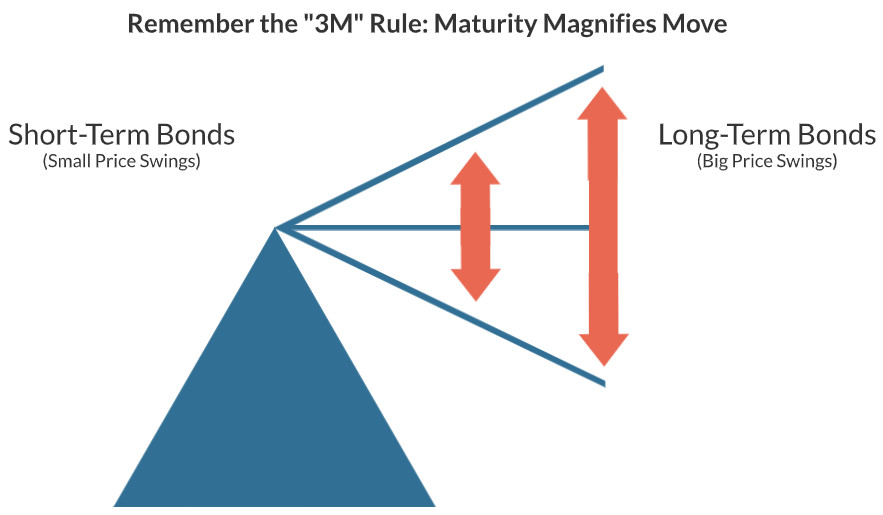
_______ term-maturity bonds are more volatile.
Long
________ term-maturity bonds are less volatile.
Short
______-coupon (______) bonds are more volatile.
Low, discount
______-coupon (______) bonds are less volatile.
High, premium
What is the conversion ratio formula?
Conversion Ratio = Par value of bond / Conversion price

What is the bond parity price formula?
Parity price of bond= conversion ratio x stocks market price

What is the stock parity formula?
Parity price of stock = Bond market value / conversion ratio

What is Arbitrage?
when a trader buys the lower priced security and simultaneously sells the equivalent higher priced security to lock in a profit.
What is a debenture?
the written contract between issuer and bondholder.
How is a debenture listed?
Under an indenture per the Trust Indenture act of 1939
What is the maturity for T-Bills?
One year or less
What is the maturity for T-Notes?
2 to 10 years
What is the maturity for T-Bonds?
10 to 30 years
When is interest paid for T-Bills?
None, they are sold at a discount.
When is interest paid for T-Notes?
Semiannually
When is interest paid for T-Bonds?
Semiannually
How are T-Bills taxed?
Taxed by Fed, exempt from state & local
How are municipal securities taxed?
Exempt from Fed, subject to state and local
How are mortgage-backed securities taxed?
Fed, State and local
For municipal securities, what document is required by the confirmation of the trade?
an Official Statement
What is a debt limit?
a limit on the dollar amount of bonds sold by a municipality
What is a GO Bond (general obligation bond)?
a bond that is backed by the full faith, credit, and taxing power of the issuer. Typically backed by tax revenue.
What are limited tax bonds?
Bonds where the municipality is required to collect enough taxes to service the debt
What are Capital Appreciation Bonds (CABs)?
Municipal zero coupon bonds, sold at a deep discount to par. Only the discounted principal is counted against the issuers debt limit.
What are GO Bonds backed by?
Ad valorem taxes & municipality credit/faith
What are revenue bonds backed by?
The specific project they’re involved with (ex: sports arena revenue)
What is a GO bond issued for?
To fund a municipality’s budget
What is a revenue bond issued for?
To fund a specific project
What is a trust indenture?
A series of promises made by the issuer of a debt security. Typically requires the issuer to make semi-annual interest payments to bondholders, and to file reports with the SEC (for corp. bonds)
What are Special Tax Bonds?
Issues secured by a tax other than an ad valorem tax. Typically excise tax such as cigarette, liquor and gasoline. The tax source does not have to be related to the project.
What are Special Assessment Bonds?
Used to fund improvements not for the general public (ex: new sidewalk for a particular neighborhood.) Increased taxes in the area typically back these.
What are Moral Obligation Bonds?
Backed by a promise to pay, but not an obligation. (Typically issued in times of need and incur a higher level of risk)
What is a double-barreled bond?
backed by a revenue source other than ad valorem taxes, but are also backed by a municipal issuer. (Ex: highway rev bond backed by toll revenue, but also municipal taxing power)
What is a parity bond?
How/where are municipals traded?
OTC (Over the Counter)
When is a muni bond triple tax free?
When the investor resides in the state of issuance
When are muni bonds always triple tax free?
Puerto Rico, Guam, Virgin Islands
What is “Current Yield”?
the rate an investor earns if they purchase a bond and hold it for a year
How are corporate bonds quoted?
Percentage of par in 1/8ths (Ex: 105 5/8 = 105.625% of par = $1,056.25 per bond)
What is the dollar value of a bond point?
$10
The ______ the maturity, the _______ the change in price for a given change in interest rates
longer, greater
The ______ the coupon, the _______ the change in price for a given change in interest rates
lower, greater
What is reinvestment risk?
The risk that interest rates will drop and interest payments received over the life of the bond will be reinvested at lower rates.

