Evolution
 Call Kai
 Learn
Learn Practice Test
 Spaced Repetition
 Match
Match Flashcards
 Knowt Play
1/48

Name | Mastery | Learn | Test | Matching | Spaced | Call with Kai |
|---|
No analytics yet
Send a link to your students to track their progress
49 Terms
Adapt
A trait that you are born that becomes common among a species due to its fitness in an environment.
Acquired characteristics
Lamarck’s misconception of traits being acquired through experience.
natural selection
Organisms with favorable traits will survive reproduce more.
criteria of natural selection
over reproduction
genetic variation
competition for survival
uneven reproduction
uniformitarianism
Geological processes don’t change with time, but with natural forces.
gradualism
geological processes results are from small changes over a long period of time.
catastrophism
sudden geological catastrophes cause the start of mass extinctions.
competition
a population will fight for resources if limited.
biogeography
how organisms were distributed across the earth as evidence for evolution
island trend
island species closer to the mainland species are more similar
comparative morphology
comparing anatomical structures to support evidence of evolution
morph
structure
homologous structure
organisms with a common ancestor share a similar skeletal structure but for different functions
divergent evolution
organisms with the same common ancestor will evolve differently in response to their environment.
vestigial structures
less useful body parts that underdeveloped throughout evolution due to the lack of need for them. They can be used to discover a common ancestor.
convergent evolution
unrelated species develop similar characteristics in response to their similar environment.
analogous structures
anatomic structures that have the same function, but aren’t similar.
fossil
imprints of organisms (poop, bones, tracks, body parts, etc.) for proof of past life. They are only found in sediment.
trace fossil
A fossil of an organism’s activity (footprints, poop)
transitional fossils
a fossil of an intermediate organism between 2 species in the process of evolution
relative dating
Dating a fossil or rock if they’re younger or older than each other by observing what stratum it is in.
law of superposition
new strata layers upon the older one.
absolute radiometric dating
dating a fossil’s age by years through the decay of radioactive isotopes.
similar embryology
the similar appearance of early embryos of different species as evidence for a common ancestor
microevolution
a change in genetic frequency within a population in a short period of time
frequency equation
the number of individuals with the trait / the whole population
p
the frequency of the dominant allele
q
the frequency of the recessive allele
p+q=1
the formula of allele frequency in a total population
evolution
change in a population’s allele frequencies over time.
genetic equilibrium
the frequency for all alleles are the same (50/50)
Hardy-Weinberg Equilibrium
No mutations
no gene flow
infinitely large population
no natural selection
random mating
r
the frequency for a new allele caused by mutation
genetic drift
smaller populations have a greater chance for evolution.
founder effect
a small group of organisms start a new population in a different location
bottleneck effect
an event that drastically shrinks the population.
sexual selection
mates choose who to reproduce with.
intersexual selection
one sex chooses who in the opposite sex to mate with.
sexual dimorphism
different morphology between opposite sexes in the same species.
intrasexual selection
members of the same sex compete to mate with the opposite sex.
gene flow
the movement of alleles into or out of a population
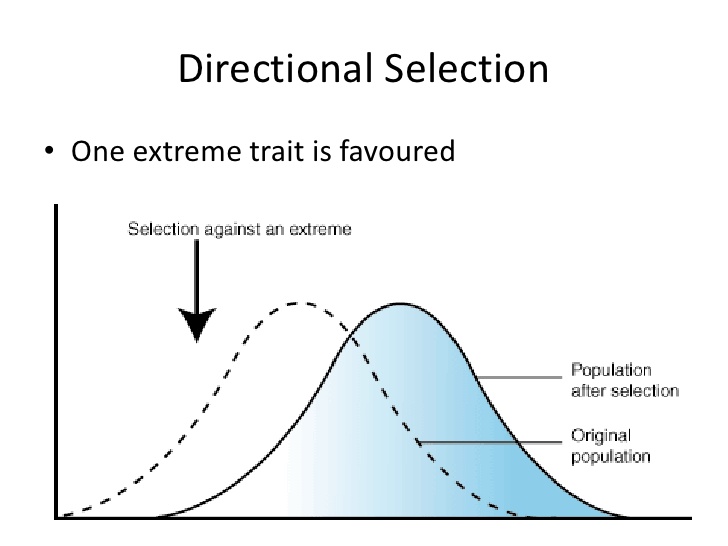
Directional selection
Natural selection that shifts the allele distribution graph to one way.
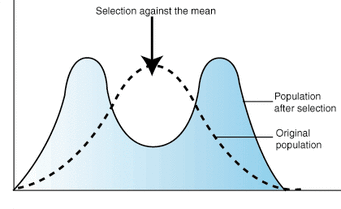
Disruptive selection
Both extreme traits are favored during natural selection.
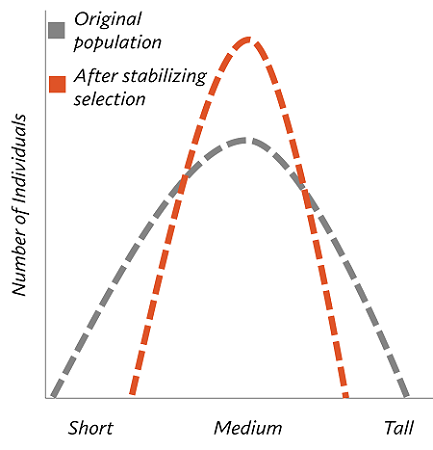
Stabilizing selection
When the intermediate trait is favored.
Sexual selection
individuals choose who to mate with based on phenotype (looks)
There are two types: intersexual and intrasexual selection
intersexual selection
one individual attracts another through the display of traits or behaviors.
intrasexual selection
Two individuals of the same sex compete to mate with the opposite sex.
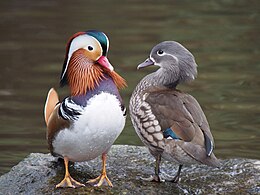
sexual dimorphism
Males and females of a species may have different morphs because of intersexual selection.
4 criteria of natural selection
over reproduction
competition (struggle to survive)
genetic variation
different reproduction (not everyone reproduces the same)

