Diffraction + Diffraction grating (8.2, 8.4)
 Studied by 0 people
 Call Kai
 Learn
Learn Practice Test
 Spaced Repetition
 Match
Match Flashcards
 Knowt Play
1/10

There's no tags or description
Looks like no tags are added yet.
Name | Mastery | Learn | Test | Matching | Spaced | Call with Kai |
|---|
No analytics yet
Send a link to your students to track their progress
11 Terms
What is diffraction?
Diffraction - when a wave passes through an aperture/gap or past an obstacle, it spreads out
Speed, frequency and wavelength stay the same
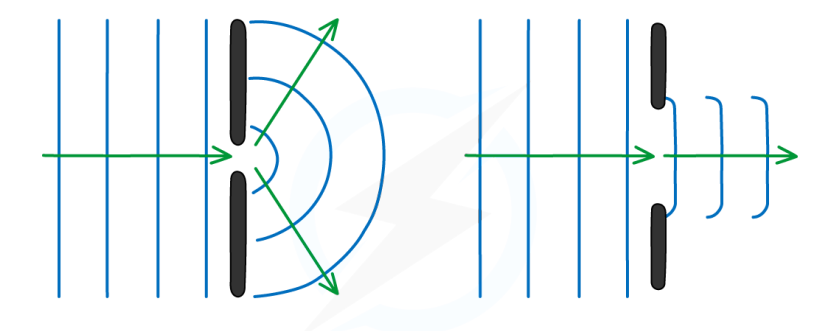
How does diffraction change depending on the size of the aperture?
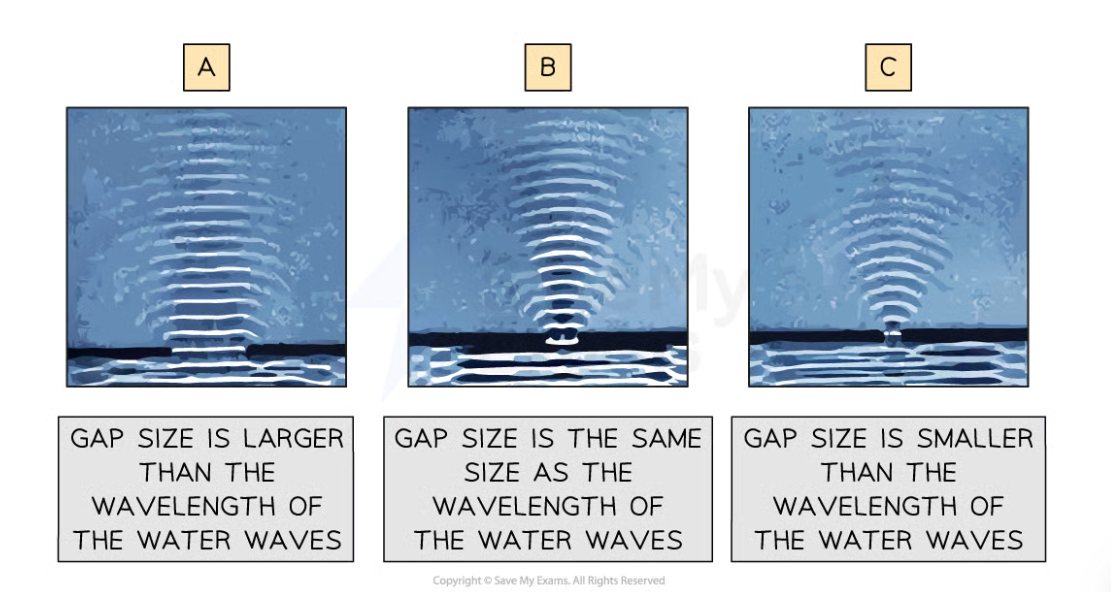
Diffraction is the greatest when the size of the gap is approximately the same as the wavelength of the wave
When the size of the gap is much larger than the wavelength, the wave is transmitted with little spreading
When the size of the gap is much smaller than the wavelength, there is little transmission as most of the wave is reflected
How does diffraction change depending on the size of the obstacle?
The wider the obstacle compared to the wavelength, the less diffraction
How can diffraction be demonstrated in an experiment?
Ripple tanks
By placing different sized apertures in a ripple tank the different ‘types’ of diffraction can be shown
What is a diffraction grating?
Diffraction grating - a slide with many equally spaced slits, very close together
What happens when monochromatic light is incident on a diffraction grating?
Bright spots called maxima or orders are seen on a screen, which is usually semi-circular.
These maxima are much sharper than the bright spots in the double-slit because there are many more rays of light reinforcing the pattern
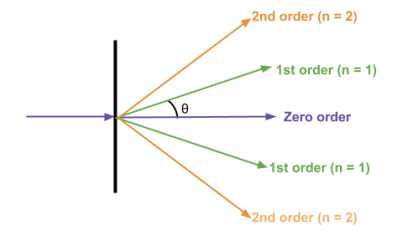
How are the orders formed?
The zeroth order forms as each ray from each slit has a zero path difference with another ray so constructive interference occurs
What is the relationship between the order, wavelength, slit separation and angle to each order from the central line?
nλ = dsinθ
Where n is the order number
Where λ is the wavelength (m)
When d is the slit separation (m)
Where θ is the angle between each order and the central line
How do you work out slit separation from slits per m?
d = 1/N
Where d is slit seperation (m)
Where N is slits/lines per m (m)
How do you work out the total number of maxima?
Since the max value of sinθ is 1, plug it into nλ = dsinθ. Then round down the value of n you get. Do 2n + 1 to get the maximum number of orders.
 Note
Note  Flashcards (244)