GEOS 412 exam 2

0.0(0)
Studied by 0 people
call kaiCall Kai
learnLearn
examPractice Test
spaced repetitionSpaced Repetition
heart puzzleMatch
flashcardsFlashcards
GameKnowt Play
Card Sorting

1/147

flashcard set

Earn XP

Description and Tags

starts at lecture 11

Last updated 11:56 PM on 3/31/26
Name
Mastery
Learn
Test
Matching
Spaced
Call with Kai

No analytics yet

Send a link to your students to track their progress

148 Terms

1
New cards

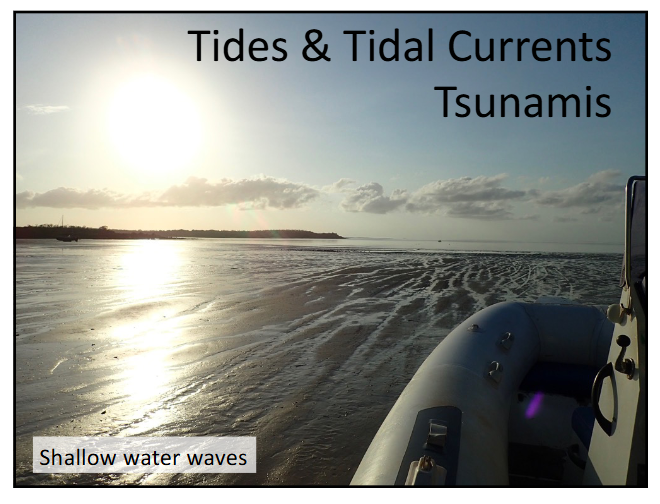
are both tides (tidal currents) and tsunamis shallow or deep-water waves?

shallow water waves
<p>shallow water waves</p>
2
New cards

what are tides?

-periodic, predictable short-term changes in the height of the ocean

-longest of all waves → wavelength can be equal to ½ the Earth’s circumference

-generated by the balance of gravity and motion between the Earth, moon and sun: forced waves (caused by planetary orbits)

-forced, fast-moving, shallow water waves
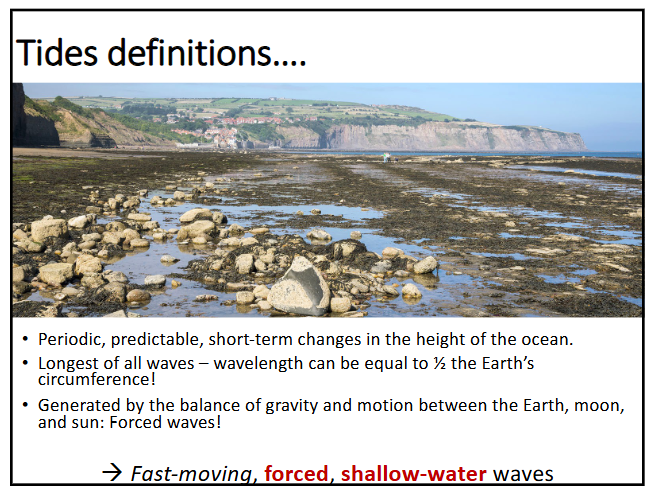
<p>-periodic, predictable short-term changes in the height of the ocean</p><p>-longest of all waves → wavelength can be equal to ½ the Earth’s circumference</p><p>-generated by the balance of gravity and motion between the Earth, moon and sun: forced waves (caused by planetary orbits)</p><p>-forced, fast-moving, shallow water waves</p>
3
New cards

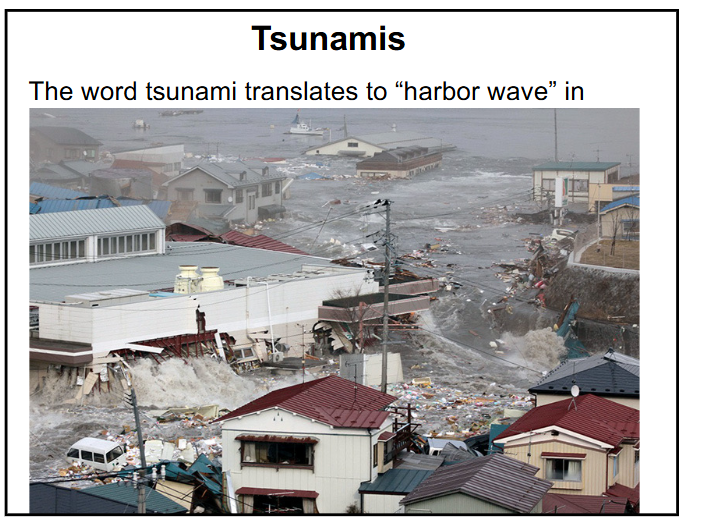
what are tsunamis?

-fast-moving, progressive, shallow-water waves caused by vertical movement / tectonic activity

-“harbor wave” in Japanese
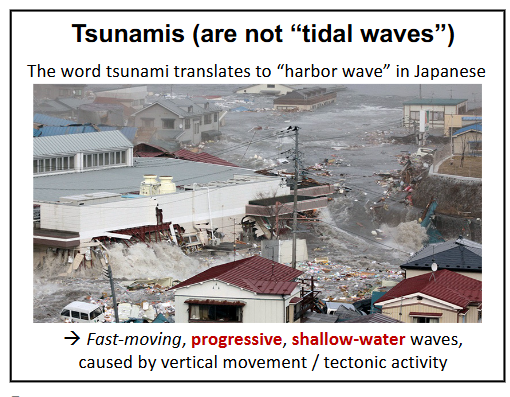
<p>-fast-moving, progressive, shallow-water waves caused by vertical movement / tectonic activity</p><p>-“harbor wave” in Japanese</p>
4
New cards

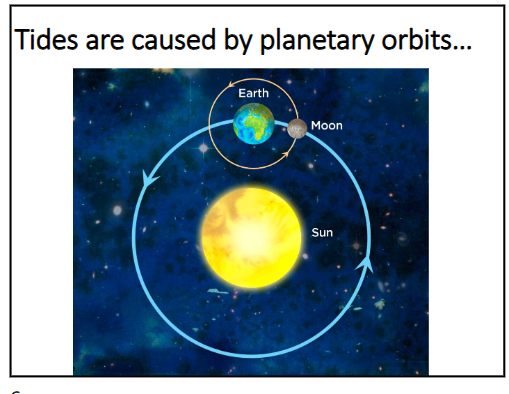
what is Newton’s first law?

an object in motion stays in motion with the same speed and same direction unless acted upon by an unbalanced force
5
New cards
<p>tides are caused by planetary orbits; what helps maintain stable planetary orbits?</p>

tides are caused by planetary orbits; what helps maintain stable planetary orbits?

-gravity pulls the two bodies towards each other

-inertial force dictates speed and direction

-when inertial force balances gravity, a stable orbit is achieved
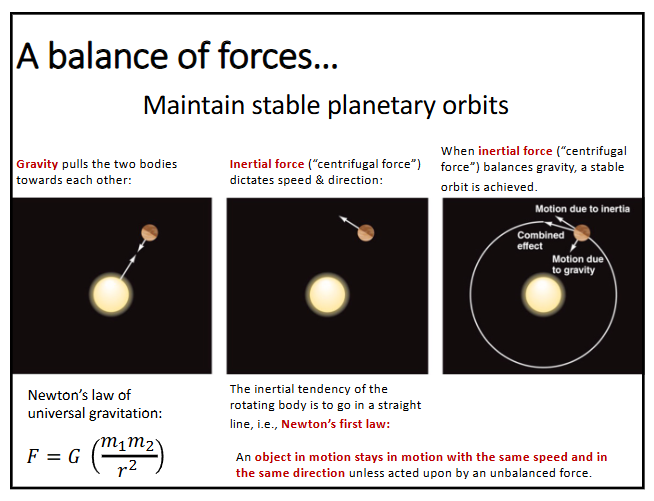
<p>-gravity pulls the two bodies towards each other</p><p>-inertial force dictates speed and direction</p><p>-when inertial force balances gravity, a stable orbit is achieved</p>
6
New cards

describe the equilibrium theory of tides (based on Newtonian physics)

few key assumptions:

-earth’s surface is completely covered by seawater with infinite depth

-waves are assumed to be progressive waves

-water is assumed to be in equilibrium with the tide-generating forces-gravitational attraction and centrifugal effect

equilibrium theory of tides:

-the moon is responsible for ~2/3 of the tidal force because the moons’ orbit has a smaller radius and is closed compared to the sun which is much farther away than the moon and has a greater radius of orbit

-the earth and moon are rotating simultaneously around a common center of mass

-inequalities in mass (earth is 81x more massive than the moon) puts the center of rotation or center of mass beneath the earth’s surface
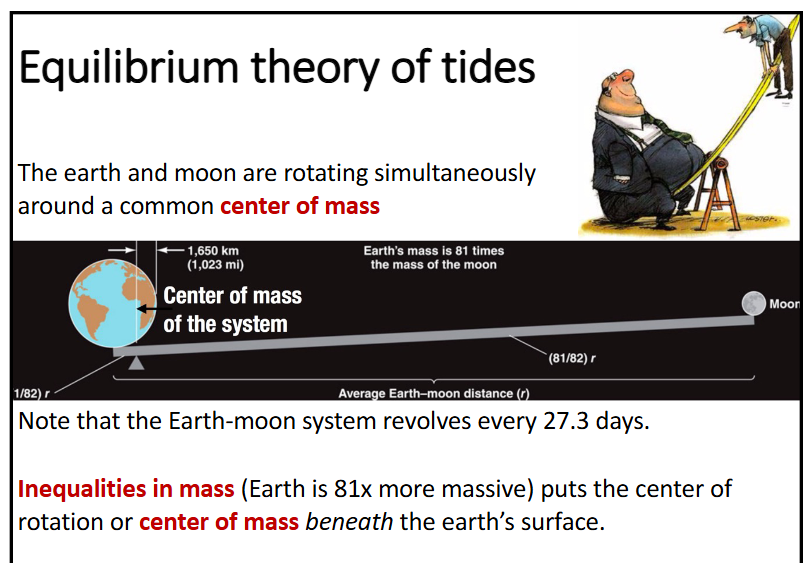
<p><strong>few key assumptions:</strong></p><p>-earth’s surface is completely covered by seawater with infinite depth</p><p>-waves are assumed to be progressive waves</p><p>-water is assumed to be in equilibrium with the tide-generating forces-gravitational attraction and centrifugal effect</p><p><strong>equilibrium theory of tides:</strong></p><p>-the moon is responsible for ~2/3 of the tidal force because the moons’ orbit has a smaller radius and is closed compared to the sun which is much farther away than the moon and has a greater radius of orbit</p><p>-the earth and moon are rotating simultaneously around a common center of mass</p><p>-inequalities in mass (earth is 81x more massive than the moon) puts the center of rotation or center of mass beneath the earth’s surface</p>
7
New cards

how do tidal bulges form?

they’re created by a balance of forces (gravitational + inertial = tidal “bulges”)
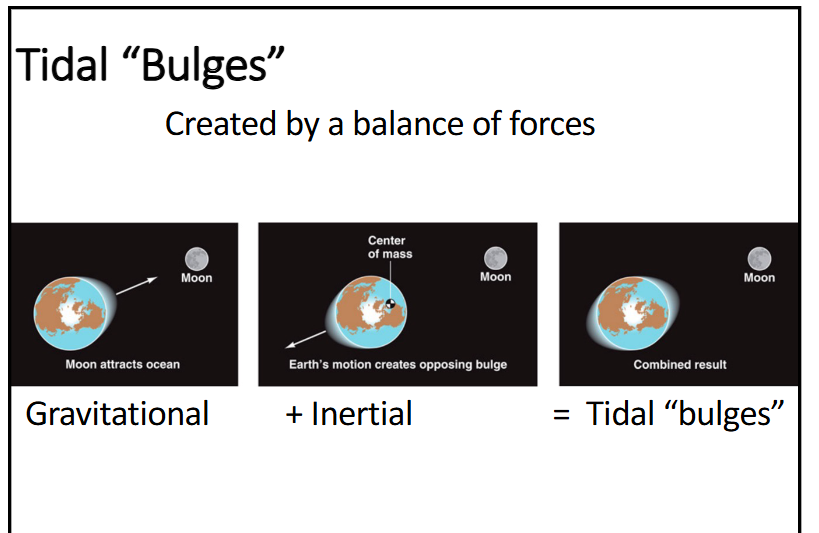
<p>they’re created by a balance of forces (gravitational + inertial = tidal “bulges”)</p>
8
New cards

what do tidal forces equal?

Ftidal = Fgravity - Fcm

tidal forces are the result of subtracting the center of mass (centripetal) force from the total gravitational force
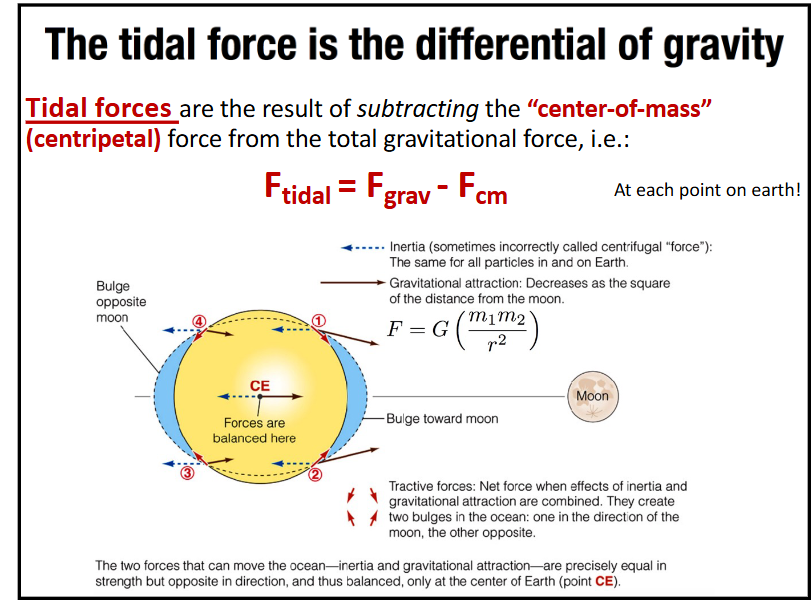
<p>F<sub>tidal</sub> = F<sub>gravity</sub> - F<sub>cm</sub></p><p>tidal forces are the result of subtracting the center of mass (centripetal) force from the total gravitational force</p>
9
New cards

what creates two high and two low tides (semidiurnal)?

earth rotates through the bulges and creates a low and a high tide in 12 hours or two high and two low tides in 24 hours
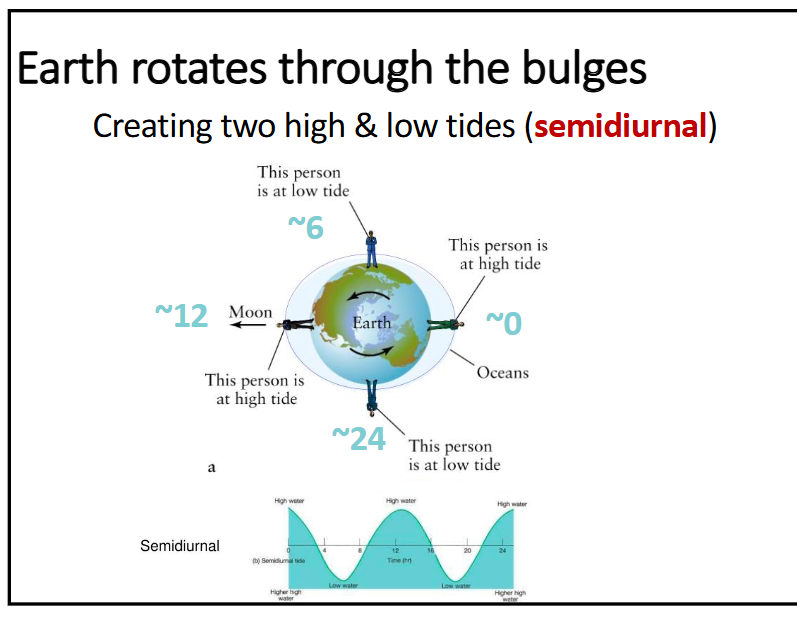
<p>earth rotates through the bulges and creates a low and a high tide in 12 hours or two high and two low tides in 24 hours</p>
10
New cards

what is a lunar day?

-time that elapses between when the moon is directly overhead (on meridian) and the next time that it is directly overhead
-the moon moves a bit each day in accordance with the revolution
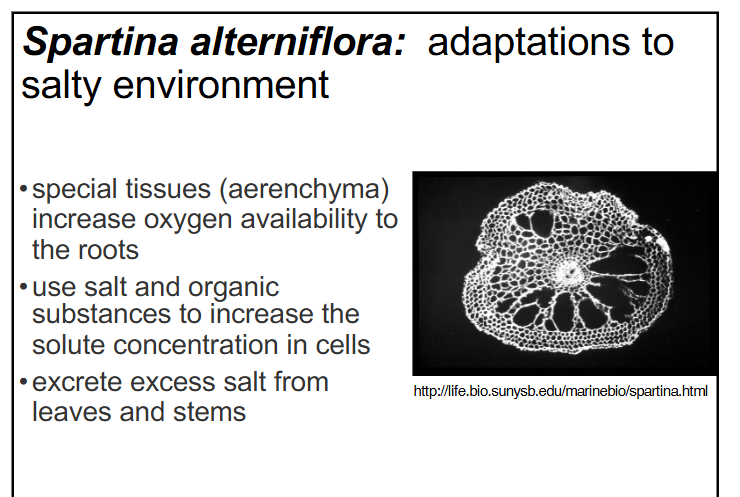
of the earth-moon system

-a “tidal day” is 24 hours 50 minutes, the bulges follow the moon, moving the tides back by 50 minutes
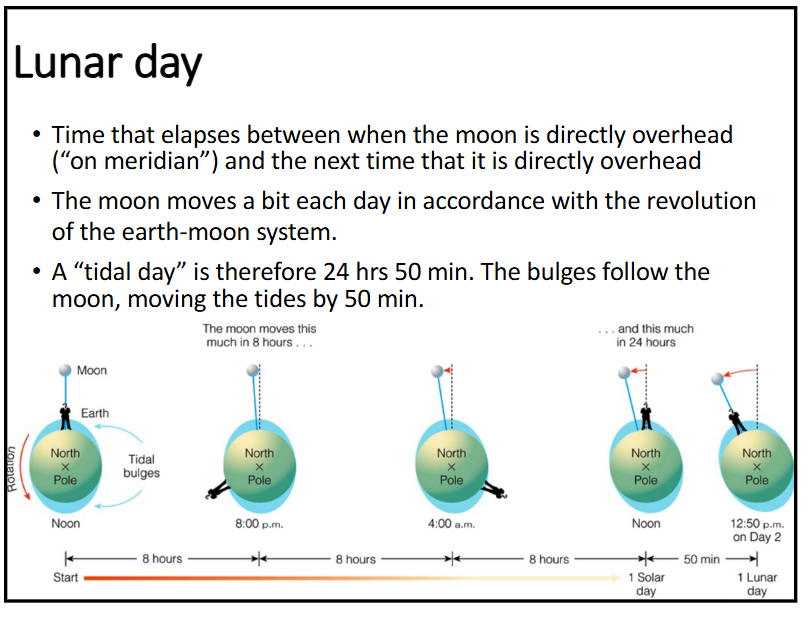
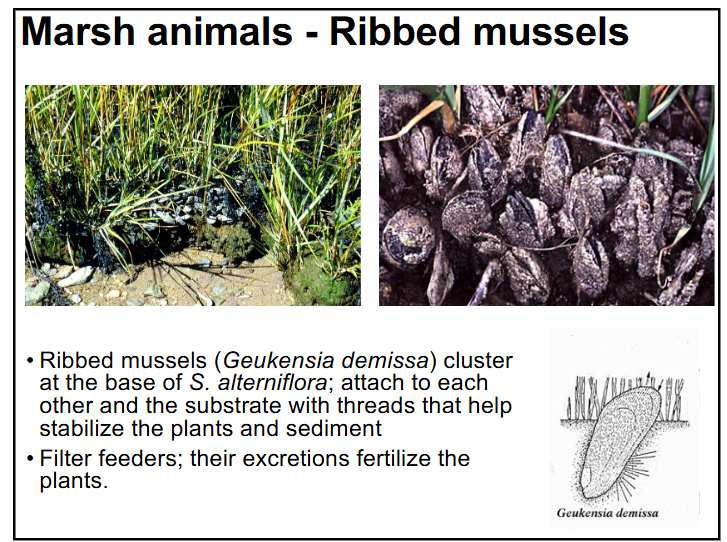
<p>-time that elapses between when the moon is directly overhead (on meridian) and the next time that it is directly overhead<br><span style="color: rgb(0, 0, 0);">-the moon moves a bit each day in accordance with the revolution<br>of the earth-moon system</span></p><p>-a “tidal day” is 24 hours 50 minutes, the bulges follow the moon, moving the <span style="color: rgb(0, 0, 0);">tides back by 50 minutes</span></p>
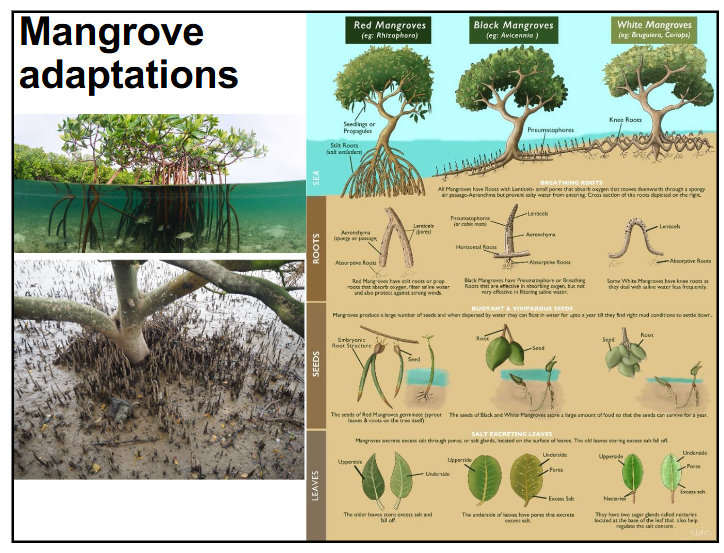
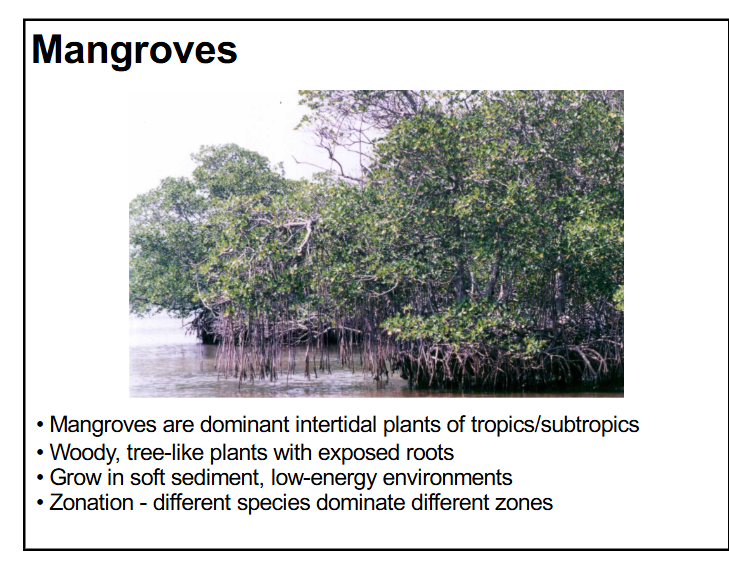
11
New cards
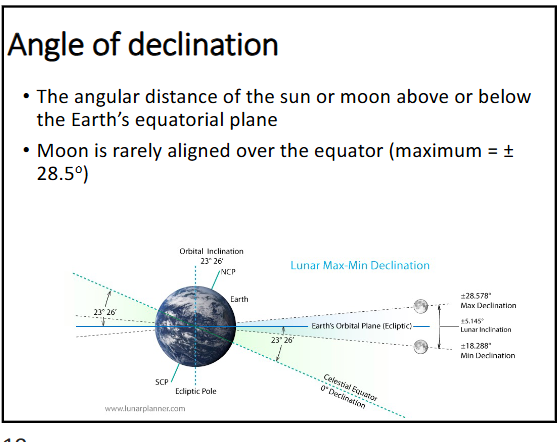
<p>what is the angle of declination? what does this mean for predicting idealized tides?</p>

what is the angle of declination? what does this mean for predicting idealized tides?

the angular distance of the moon or the sun above or below the earths’ equatorial plane

-the moon is rarely aligned over the equator (maximum = ± 28.5 degrees)

-this means some places only pass through one bulge (diurnal tide) or have a higher high tide and a lower high tide (mixed tide)
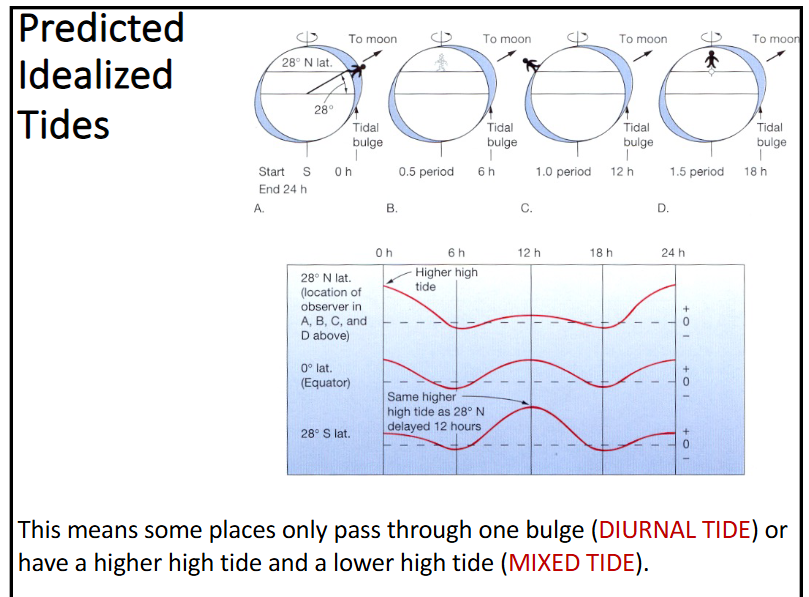
<p>the angular distance of the moon or the sun above or below the earths’ equatorial plane</p><p>-the moon is rarely aligned over the equator (maximum = ± 28.5 degrees)</p><p>-this means some places only pass through one bulge (diurnal tide) or have a higher high tide and a lower high tide (mixed tide)</p>
12
New cards
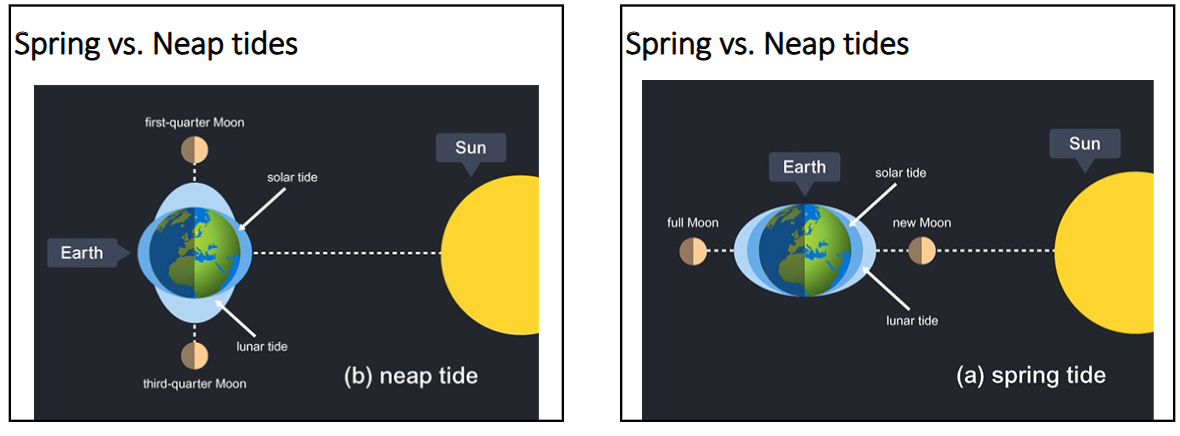
<p>what are spring versus neap tides?</p>

what are spring versus neap tides?

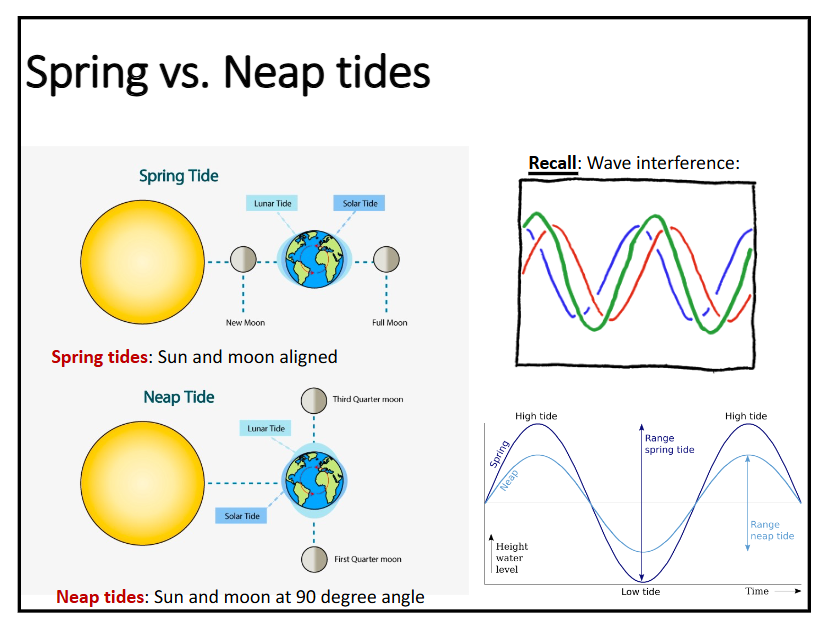
spring tide: moon and sun align together so there are only two bulges which amplify each other and are larger

spring tide → larger tidal range

neap tide: moon and sun are at a 90-degree angle (don’t align) so there are two bulges from each orbit (sun and moon), and the solar budges are smaller than the lunar tides

neap tide → smaller tidal range
<p>spring tide: moon and sun align together so there are only two bulges which amplify each other and are larger</p><p>spring tide → larger tidal range</p><p>neap tide: moon and sun are at a 90-degree angle (don’t align) so there are two bulges from each orbit (sun and moon), and the solar budges are smaller than the lunar tides</p><p>neap tide → smaller tidal range</p>
13
New cards

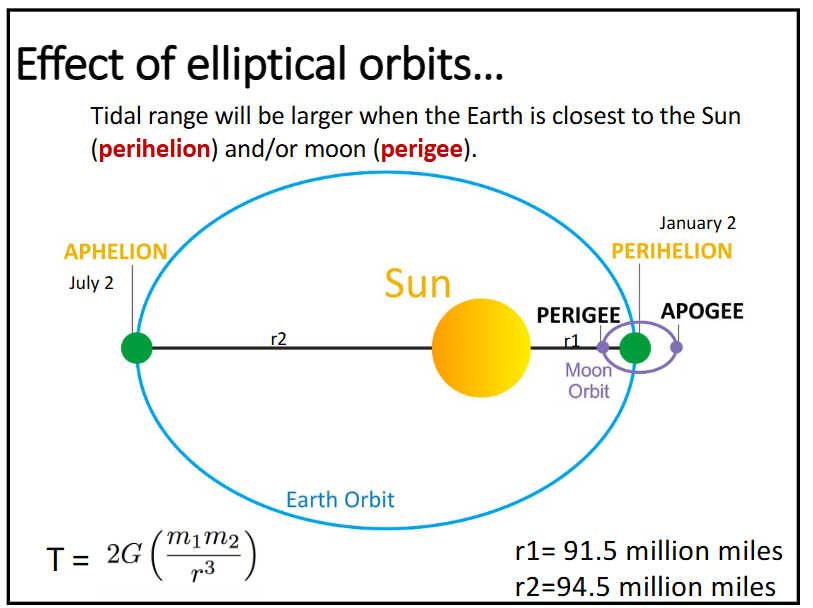
when is the tidal range (height difference) even larger (not dependent on neap versus spring tides)?

the tidal range will be larger when the Earth is closest to the Sun (perihelion) and/or moon (perigee)
<p>the tidal range will be larger when the Earth is closest to the Sun (perihelion) and/or moon (perigee)</p>
14
New cards

describe the dynamic theory of tides (developed by Pierre-Simon Laplace in 1775)

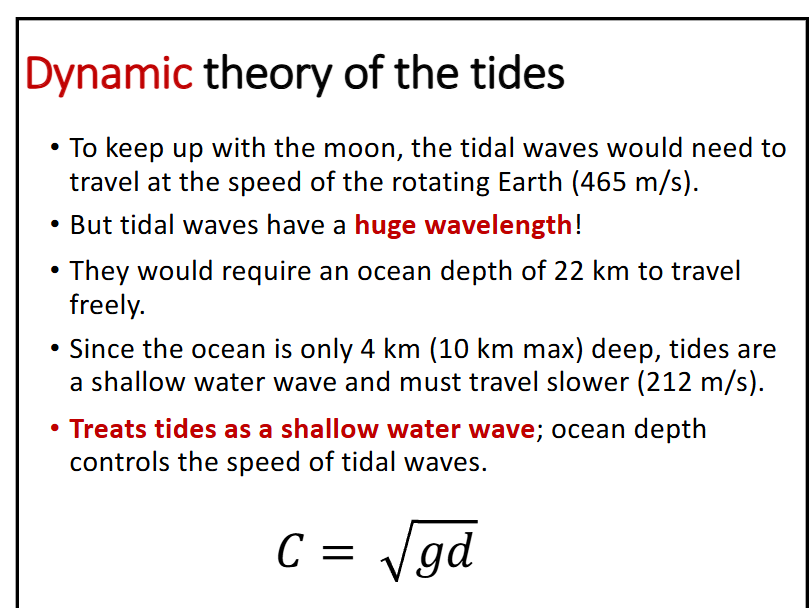
-to keep up with the moon, the tidal waves would need to travel at the speed of the rotating earth (465 m/s), but tidal waves have a huge wavelength

-they would require an ocean depth of 22 km to travel freely

-since the ocean is only 4km deep, tides are a shallow water wave and must travel slower (212 m/s)

-treats tides as a shallow water wave; ocean depth controls the speed of tidal waves

-also accounts for interference with continents and the Coriolis effect
<p>-to keep up with the moon, the tidal waves would need to travel at the speed of the rotating earth (465 m/s), but tidal waves have a huge wavelength</p><p>-they would require an ocean depth of 22 km to travel freely</p><p>-since the ocean is only 4km deep, tides are a shallow water wave and must travel slower (212 m/s)</p><p>-treats tides as a shallow water wave; ocean depth controls the speed of tidal waves</p><p>-also accounts for interference with continents and the Coriolis effect</p>
15
New cards
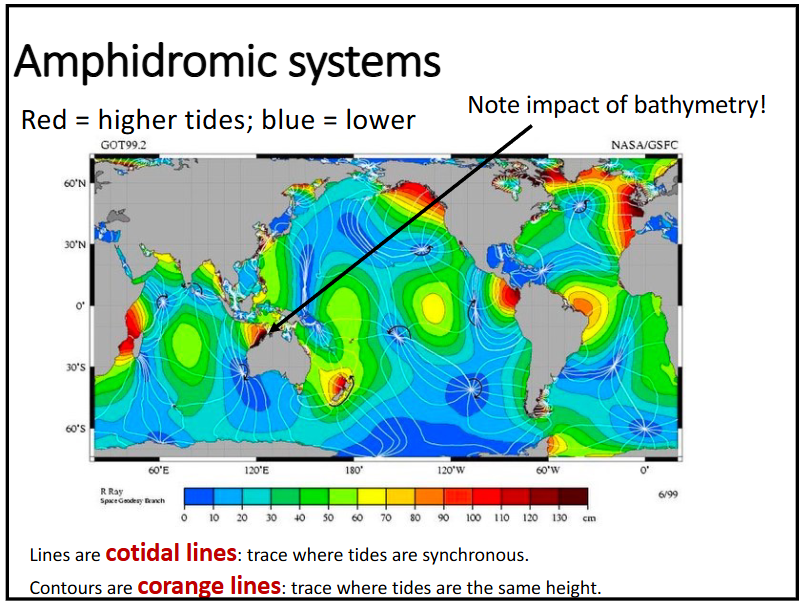
<p>describe Amphidromic systems</p>

describe Amphidromic systems

-point that the bulge rotates around is called the amphidromic point, where the ocean surface/bulge isn’t moving

-bulge continues to move northward following coastline, propagates around basin in CC direction, high tide is now on the east side

-tidal bulge moves into basin, gets deflected to the right due to Coriolis (in NH)

-no tidal movement in the middle with lots of tidal movement on the edges

-creates a pressure gradient force [recall: rotary waves] which moves the water

<p>-point that the bulge rotates around is called the amphidromic point, where the ocean surface/bulge isn’t moving</p><p>-bulge continues to move northward following coastline, propagates around basin in CC direction, high tide is now on the east side</p><p>-tidal bulge moves into basin, gets deflected to the <strong>right </strong>due to Coriolis (in NH)</p><p>-no tidal movement in the middle with lots of tidal movement on the edges</p><p>-creates a pressure gradient force [recall: rotary waves] which moves the water</p>
16
New cards
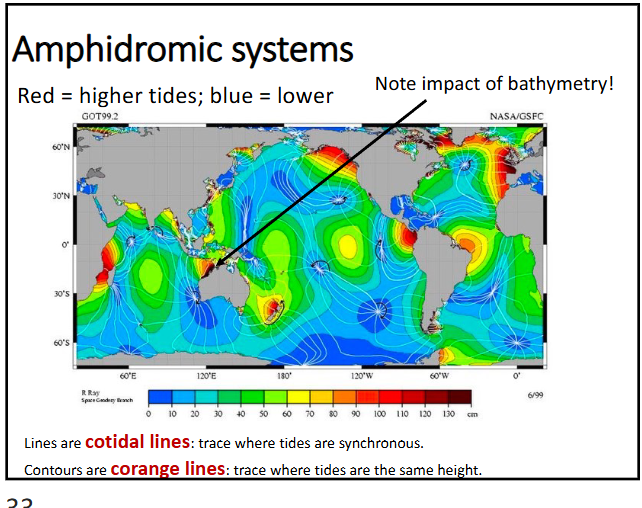
<p>in this image, what do the lines and contours represent?</p>

in this image, what do the lines and contours represent?

lines are cotidal lines: trace where the tides are synchronous

contours are corange lines: trace where tides are the same height

17
New cards

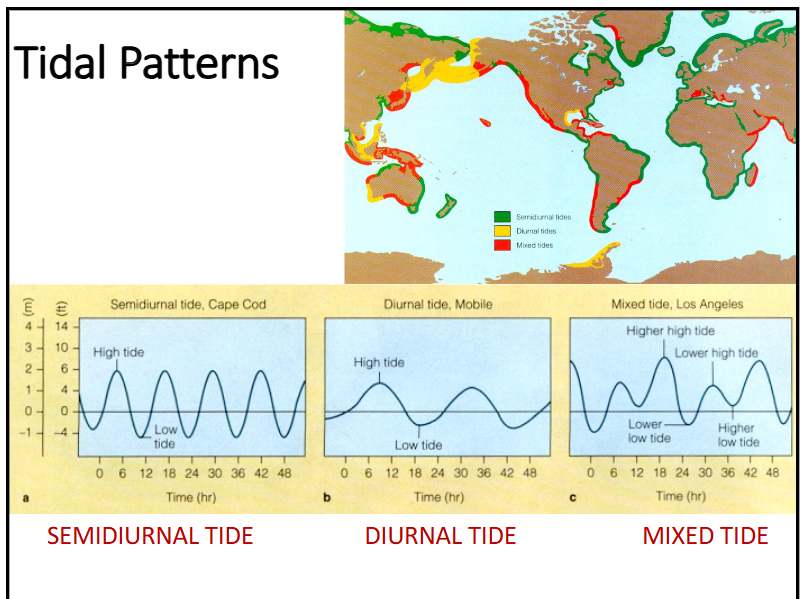
what are the different tidal patterns?

semidiurnal tide, diurnal tide and mixed tide
<p>semidiurnal tide, diurnal tide and mixed tide</p>
18
New cards

describe tides in confined basins

bay of Fundy → 100 billion tons of water twice a day

Cignet Bay, Western Australia → 12m
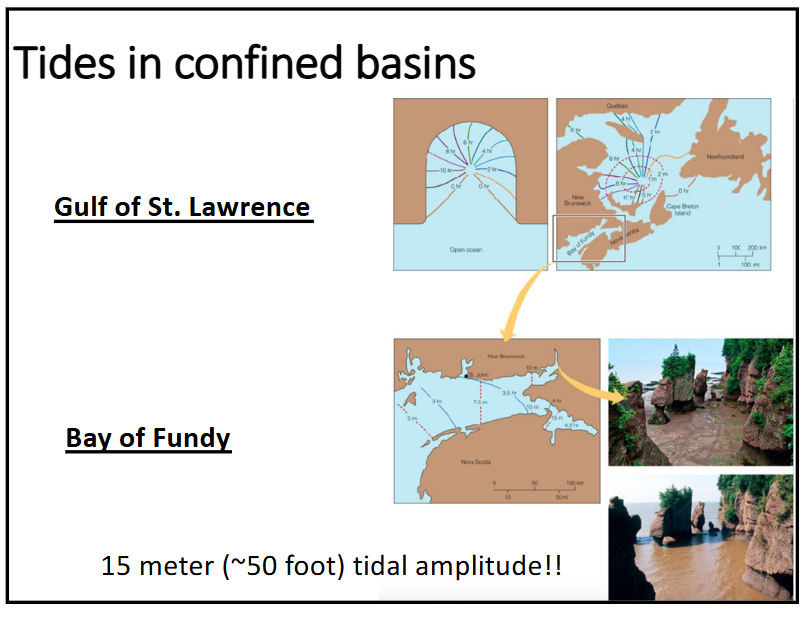
<p>bay of Fundy → 100 billion tons of water twice a day</p><p>Cignet Bay, Western Australia → 12m</p>
19
New cards

what is a flood current and an ebb current? what is HSW and LSW?

flood current: tide coming in

ebb current: tide going out

HSW: high slack water

LSW: low slack water

MLLW: mean low low water
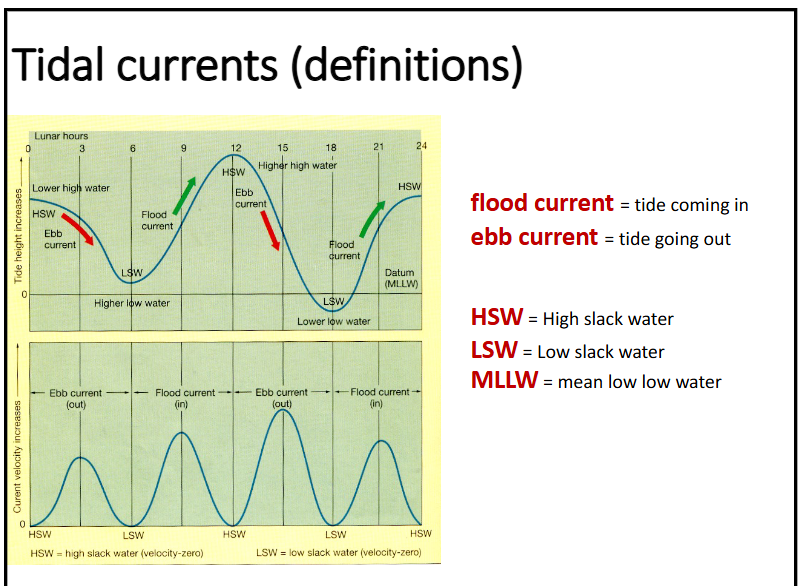
<p>flood current: tide coming in</p><p>ebb current: tide going out</p><p>HSW: high slack water</p><p>LSW: low slack water</p><p>MLLW: mean low low water</p>
20
New cards
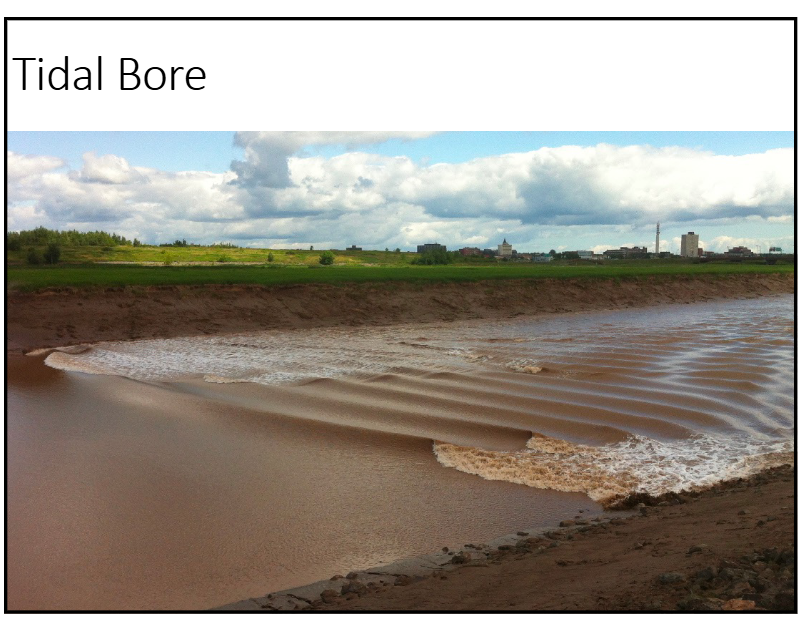
<p>what is a tidal bore?</p>

what is a tidal bore?

a surge of water that travels up a river/estuary system that creates a flow of waves which flows up and then back down

21
New cards

how do we measure tides?

tide gauge houses using acoustic technology to measure the depth of the water (or old-school wells that move up and down with the tide)
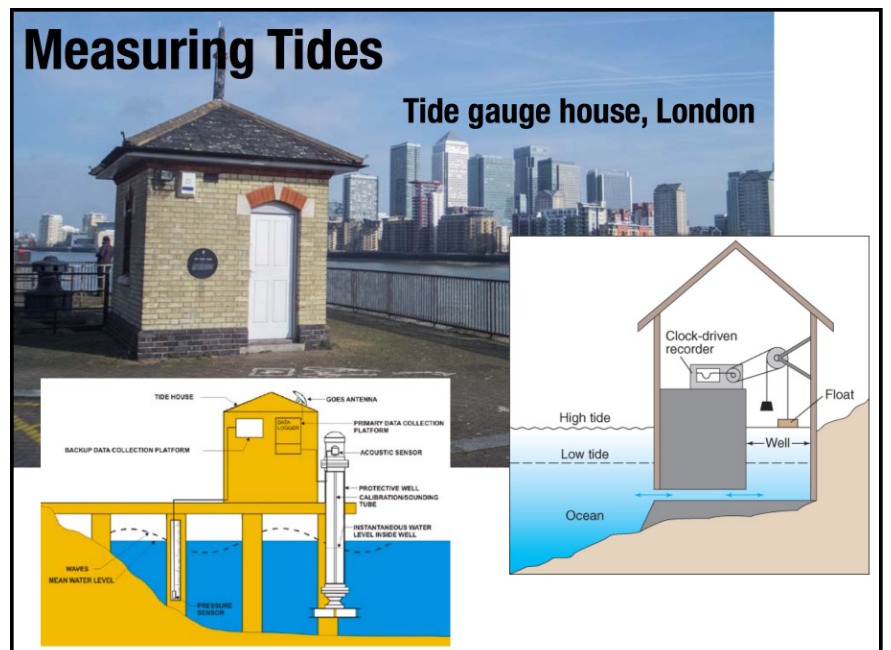
<p>tide gauge houses using acoustic technology to measure the depth of the water (or old-school wells that move up and down with the tide)</p>
22
New cards
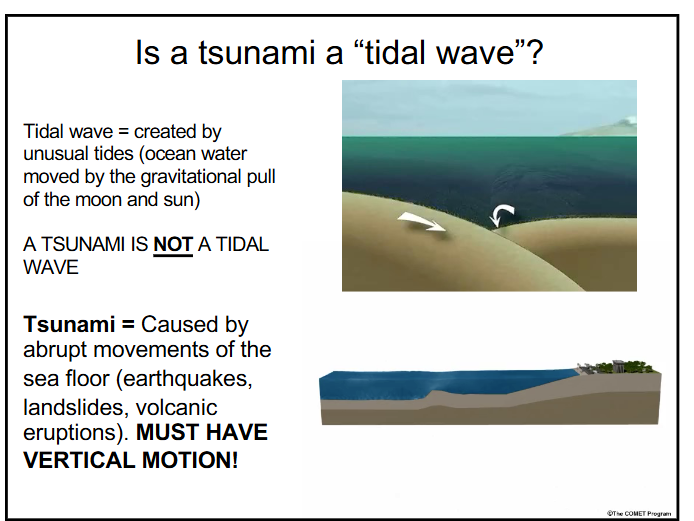
<p>is a tsunami a tidal wave (created by unusual tides (ocean water moved by the gravitational pull of the moon and sun))? what is a tsunami?</p>

is a tsunami a tidal wave (created by unusual tides (ocean water moved by the gravitational pull of the moon and sun))? what is a tsunami?

-no, a tsunami is not a tidal wave

-tsunami = caused by abrupt movements of the sea floor (earthquakes, landslides, volcanic eruptions). must have vertical movement!

-huge wavelength (>100km) = always a shallow water wave and travel extremely fast (~200 m/s or ~472 mph)

-water recedes right before a tsunami hits and are unpredictable for the most part
<p>-no, a tsunami is not a tidal wave</p><p>-tsunami = caused by abrupt movements of the sea floor (earthquakes, landslides, volcanic eruptions). must have vertical movement!</p><p>-huge wavelength (&gt;100km) = always a shallow water wave and travel extremely fast (~200 m/s or ~472 mph)</p><p>-water recedes right before a tsunami hits and are unpredictable for the most part</p>
23
New cards

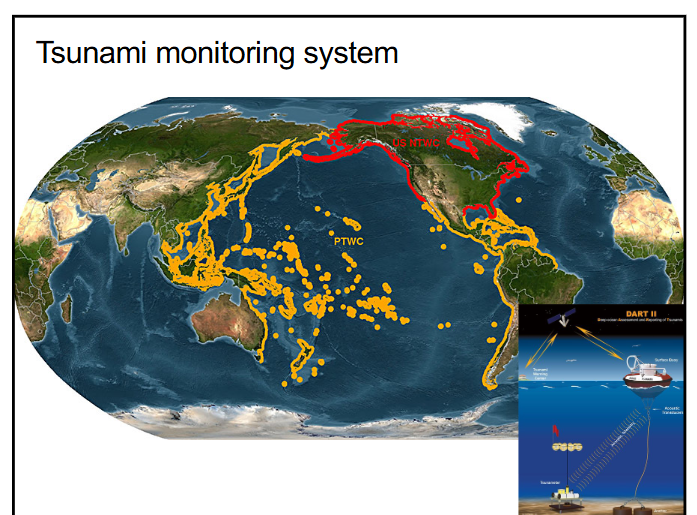
where do tsunamis occur most frequently?

mostly in the Pacific Ocean’s ring of fire

-tsunamis are tracked by tsunameters which track acoustic telemetry
<p>mostly in the Pacific Ocean’s ring of fire</p><p>-tsunamis are tracked by tsunameters which track acoustic telemetry</p>
24
New cards
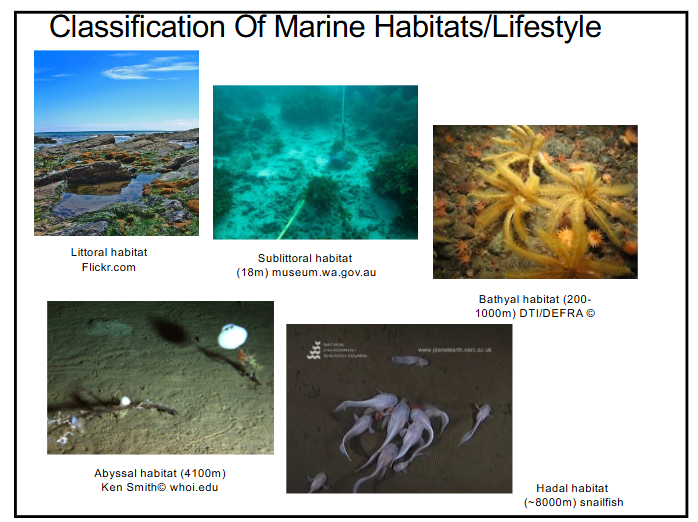
<p>how do we classify marine habitats?</p>

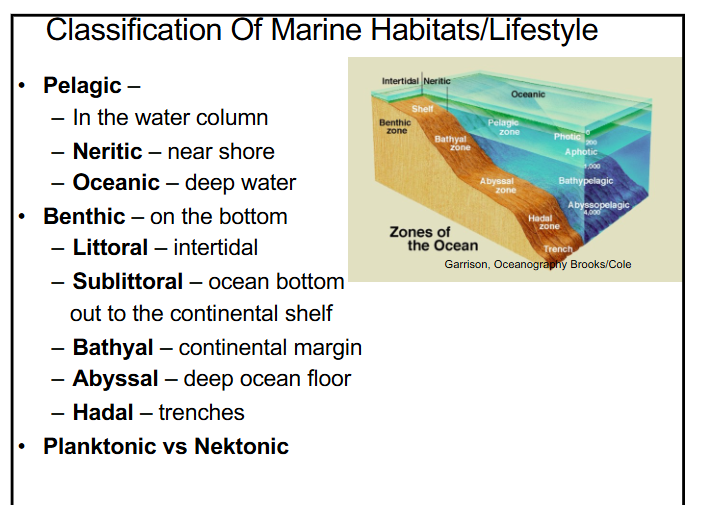
how do we classify marine habitats?

based on organisms’ habitat in the water column and their lifestyle:

-pelagic (in the water column) → neritic (near shore), oceanic (deep water)

-benthic (on the bottom of the ocean floor) → littoral (intertidal), sublittoral (ocean bottom out to the continental shelf), bathyal (continental margin), abyssal (deep ocean floor), hadal (trenches)

-photic zone (sunlight zone, top 100m) vs. aphotic zone (no sunlight, 400m and deeper) vs. twilight (or dysphotic zone) (~1% of sunlight is coming through, 100-400m deep)

-light drives organism distribution, blue and green light penetrates deepest into water
<p><span style="color: rgb(0, 0, 0);"><span>based on organisms’ habitat in the water column and their lifestyle:</span></span></p><p><span style="color: rgb(0, 0, 0);"><span>-pelagic (in the water column) → </span></span><span style="color: rgb(0, 0, 0);"><span>neritic (near shore), oceanic (deep water)</span></span></p><p>-benthic (on the bottom of the ocean floor) → littoral (intertidal), sublittoral (ocean bottom out to the continental shelf), bathyal (continental margin), abyssal (deep ocean floor), hadal (trenches)</p><p>-photic zone (sunlight zone, top 100m) vs. aphotic zone (no sunlight, 400m and deeper) vs. twilight (or dysphotic zone) (~1% of sunlight is coming through, 100-400m deep)</p><p>-light drives organism distribution, blue and green light penetrates deepest into water</p>
25
New cards

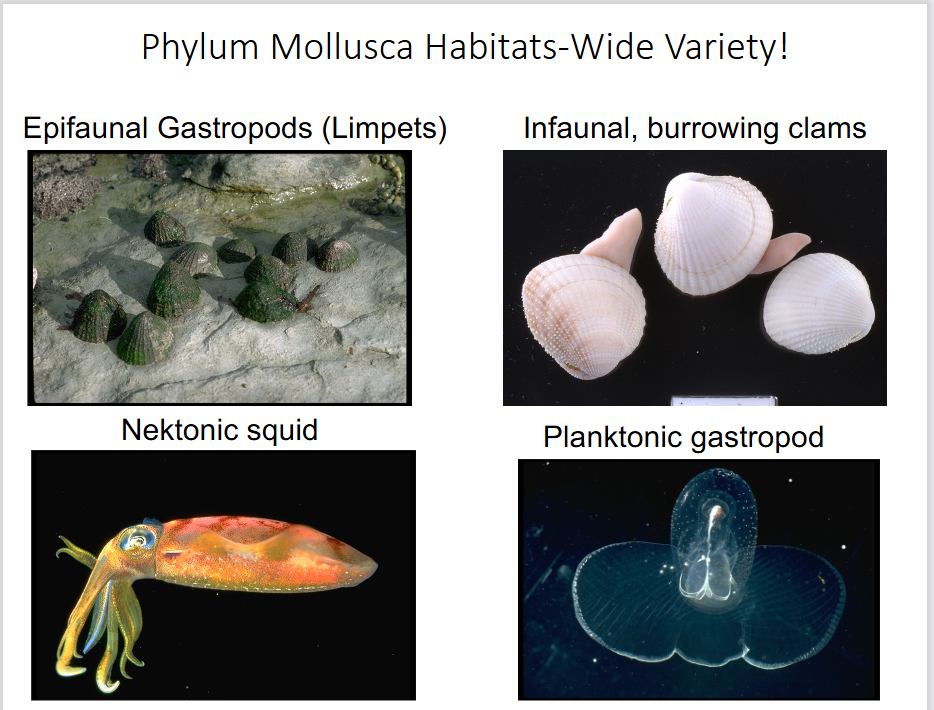
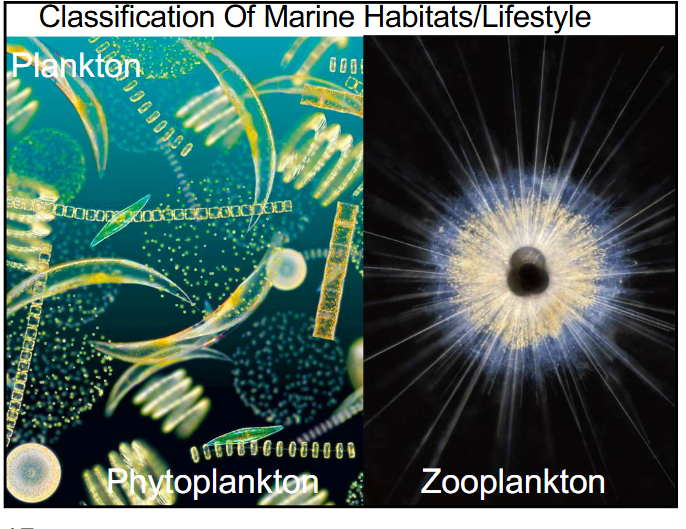
what are nekton and plankton?

plankton → phytoplankton and zooplankton (organisms that can’t swim against a current and move passively)

nekton → larger animals (can swim strongly and move against a current)
<p>plankton → phytoplankton and zooplankton (organisms that can’t swim against a current and move passively)</p><p>nekton → larger animals (can swim strongly and move against a current)</p>
26
New cards

what are epifauna, epiflora and infauna?

epifauna → animals living on the bottom of the ocean (benthic)

epiflora → plants living on the bottom of the ocean (benthic)

infauna → animals living in between sediments and underneath the sediment surface
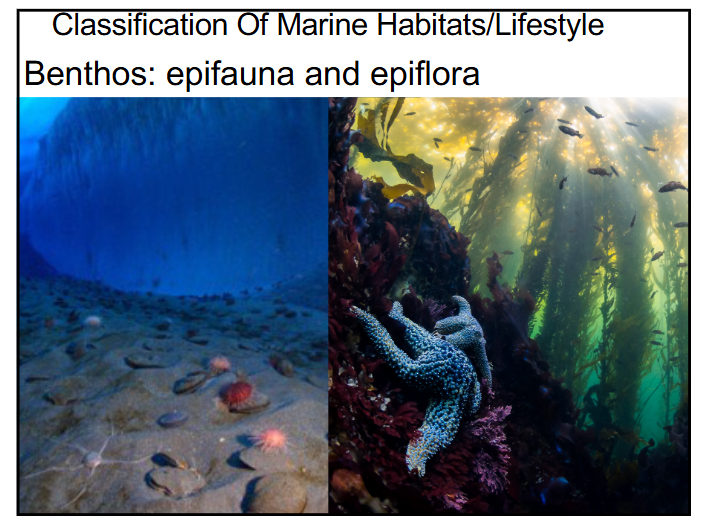
<p>epifauna → animals living on the bottom of the ocean (benthic)</p><p>epiflora → plants living on the bottom of the ocean (benthic)</p><p>infauna → animals living in between sediments and underneath the sediment surface</p>
27
New cards

can marine habitats and lifestyle change throughout an organism’s life cycle?

yes, some larvae live and float in the water column until they settle into one habitat and become benthic and sessile
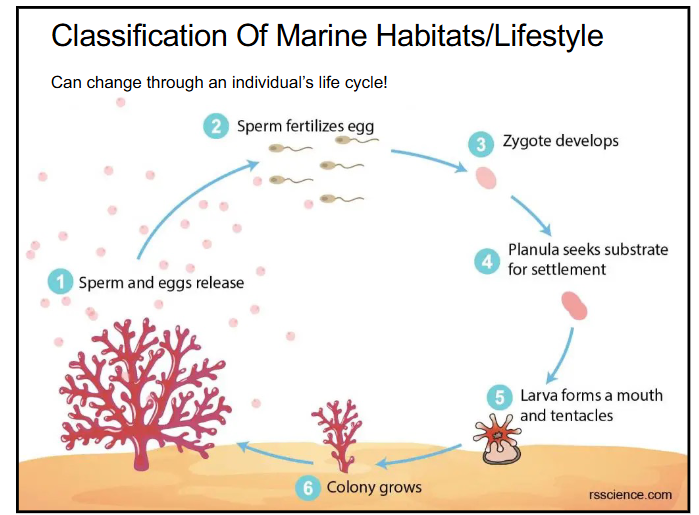
<p>yes, some larvae live and float in the water column until they settle into one habitat and become benthic and sessile</p>
28
New cards
<p>what are the top 6 environmental requirements and constraints on oceanic life?</p>

what are the top 6 environmental requirements and constraints on oceanic life?

  1. light → light penetration effects the organisms living in the photic zone and creates feedback from biological growth; light also effects sediments and nutrification. too much light creates a negative feedback loop because too many phytoplankton limit light availability at depth (too much light → UV inhibition and harm)

  2. nutrients → nitrogen, phosphorus, and silicon (Si required by diatoms and radiolarians and Ca required for calcifying organisms)

  3. temperature → direct: metabolic rate, survival/reproduction of temperature-sensitive organisms, viscosity/motion in water. indirect: water column mixing, nutrient and food availability

  4. dissolved O2 → required for all multicellular animal life; cellular respiration

  5. substrate effects → habitat complexity/structure and surfaces for food accumulation

  6. pressure → hydrostatic pressure increases 1 atmosphere every ~10m depth. dissolved substance solubility (generally increases with pressure) and buoyancy (gas bladders/swim bladders in marine organisms)
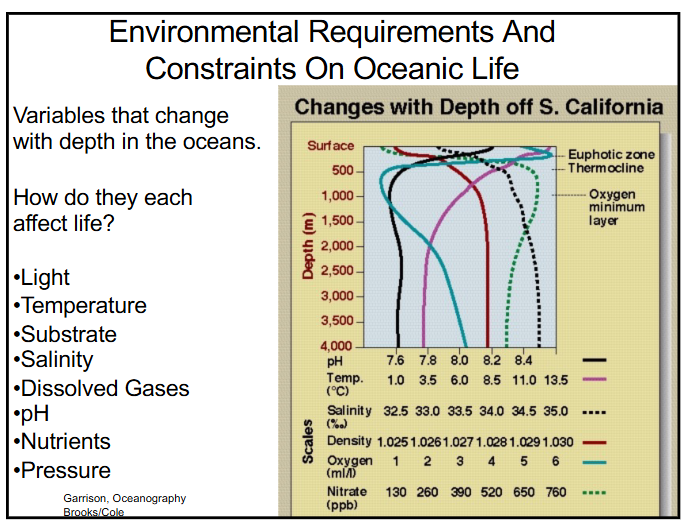
<ol><li><p>light → light penetration effects the organisms living in the photic zone and creates feedback from biological growth; light also effects sediments and nutrification. too much light creates a negative feedback loop because too many phytoplankton limit light availability at depth (too much light → UV inhibition and harm)</p></li><li><p>nutrients → nitrogen, phosphorus, and silicon (Si required by diatoms and radiolarians and Ca required for calcifying organisms)</p></li><li><p>temperature → direct: metabolic rate, survival/reproduction of temperature-sensitive organisms, viscosity/motion in water. indirect: water column mixing, nutrient and food availability</p></li><li><p>dissolved O<sub>2 </sub>→ required for all multicellular animal life; cellular respiration</p></li><li><p>substrate effects → habitat complexity/structure and surfaces for food accumulation </p></li><li><p>pressure → hydrostatic pressure increases 1 atmosphere every ~10m depth. dissolved substance solubility (generally increases with pressure) and buoyancy (gas bladders/swim bladders in marine organisms)</p></li></ol><p></p>
29
New cards

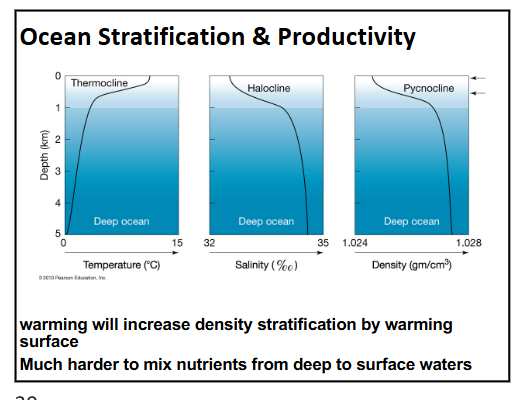
does warming increase or decrease density stratification?

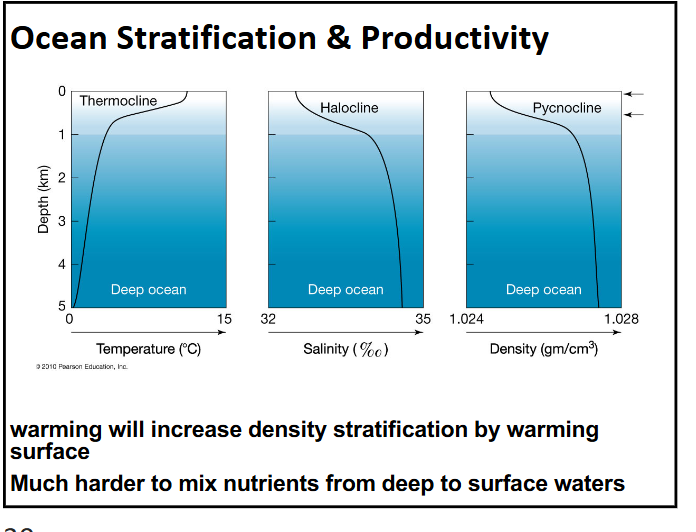
-warming will increase density stratification by warming surface

-makes it much harder to mix nutrients from deep water to surface waters

-global phytoplankton have declined over the past century to due to ocean stratification
<p>-warming will increase density stratification by warming surface</p><p>-makes it much harder to mix nutrients from deep water to surface waters</p><p>-global phytoplankton have declined over the past century to due to ocean stratification</p>
30
New cards

where is there an oxygen minimum zone?

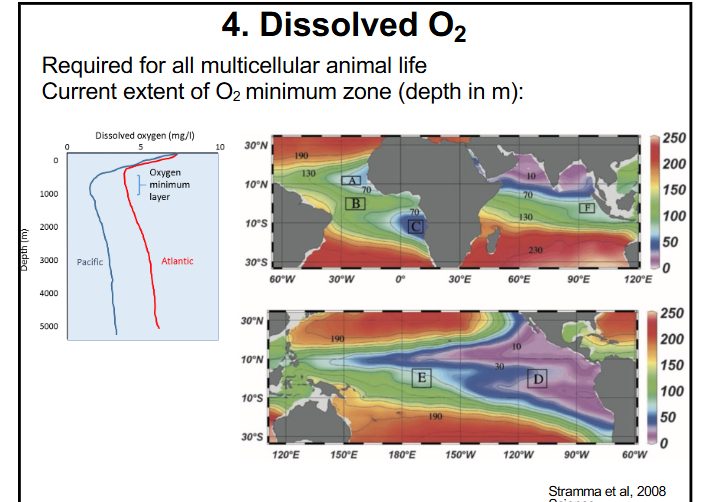
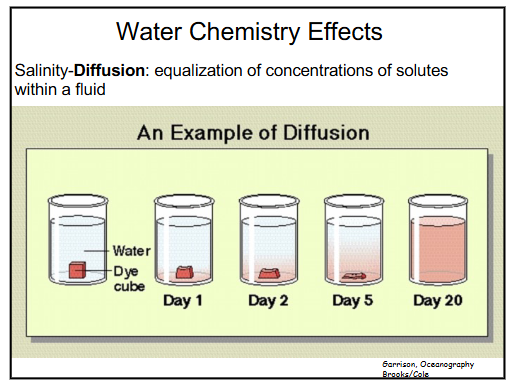
between 800-1000m of depth, right beneath photosynthesis production where organisms die and sink and decompose which uses oxygen
<p>between 800-1000m of depth, right beneath photosynthesis production where organisms die and sink and decompose which uses oxygen</p>
31
New cards
<p>what is salinity-diffusion? what is osmosis?</p>

what is salinity-diffusion? what is osmosis?

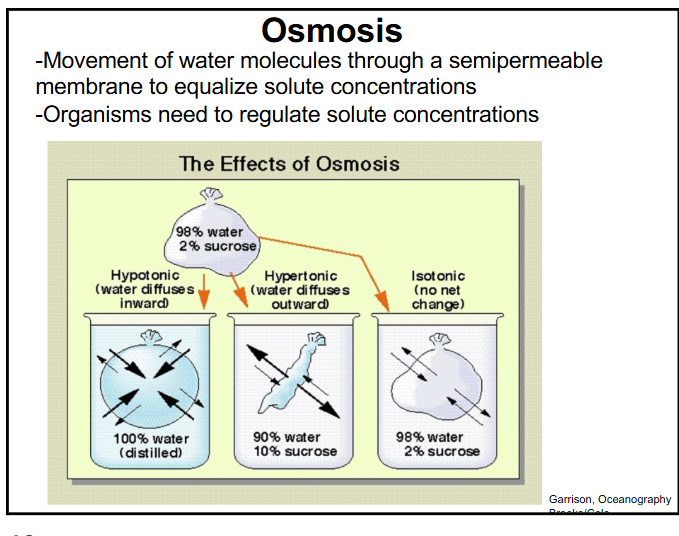
salinity-diffusion → the equalization of concentrations of solutes within a fluid

osmosis → movement of water molecules through a semipermeable membrane to equalize solute concentrations; organisms need to regulate solute concentrations
<p>salinity-diffusion → the equalization of concentrations of solutes within a fluid</p><p>osmosis → movement of water molecules through a semipermeable membrane to equalize solute concentrations; organisms need to regulate solute concentrations</p>
32
New cards

what is osmoregulation?

-the ability of organisms to self-regulate the concentration of water and salts in their bodies

-movement of water molecules through a semipermeable membrane to equalize the concentration of solutes

-marine organisms: body has higher proportion of water than surrounding seawater = osmotic water loss

-marine organisms do so by excreting excess salt through their gills
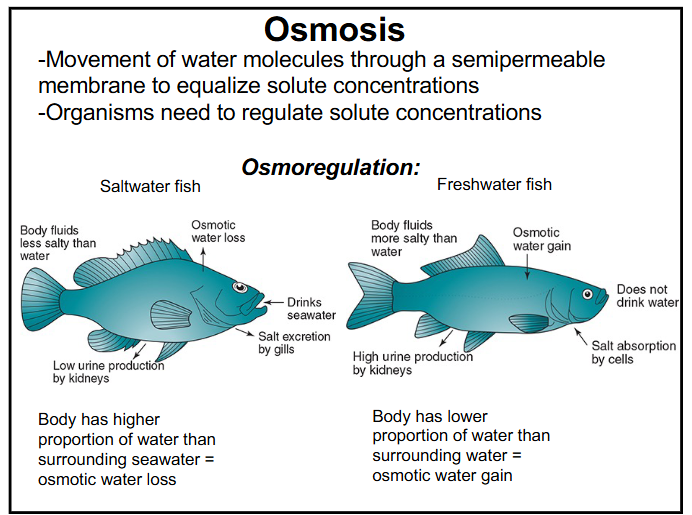
<p>-the ability of organisms to self-regulate the concentration of water and salts in their bodies</p><p>-movement of water molecules through a semipermeable membrane to equalize the concentration of solutes</p><p>-marine organisms: body has higher proportion of water than surrounding seawater = osmotic water loss</p><p>-marine organisms do so by excreting excess salt through their gills</p>
33
New cards

describe the osmotic transfer in simple marine organisms

use a semipermeable membrane to exchange nutrient and waste products
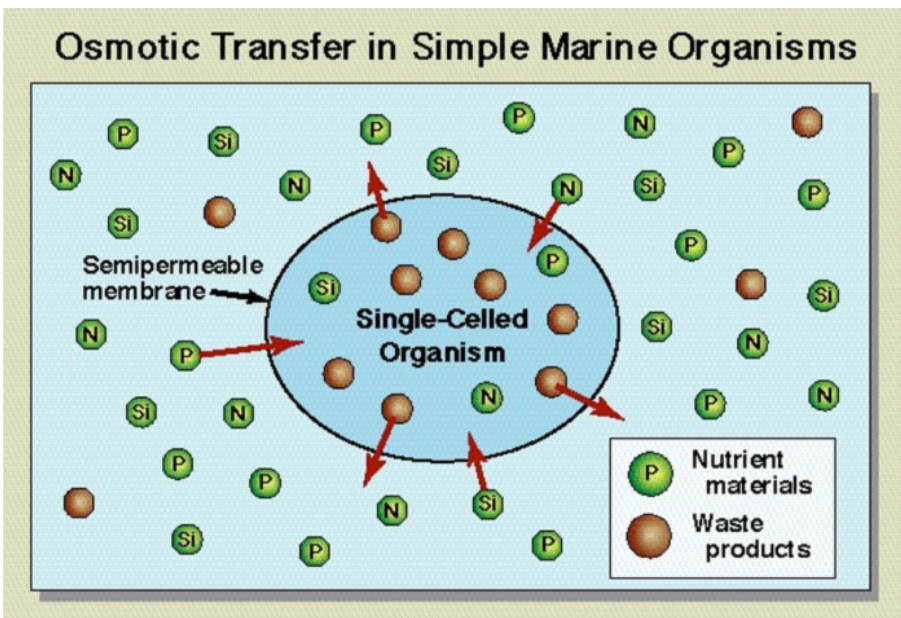
<p>use a semipermeable membrane to exchange nutrient and waste products</p>
34
New cards

why are most primary producers in the ocean small and single celled?

-they need to be buoyant to easily float and remain in the photic zone for photosynthesis

-they want to have a higher surface to volume ratio to maximize their surface area for photosynthesis while also having a small volume to remain buoyant
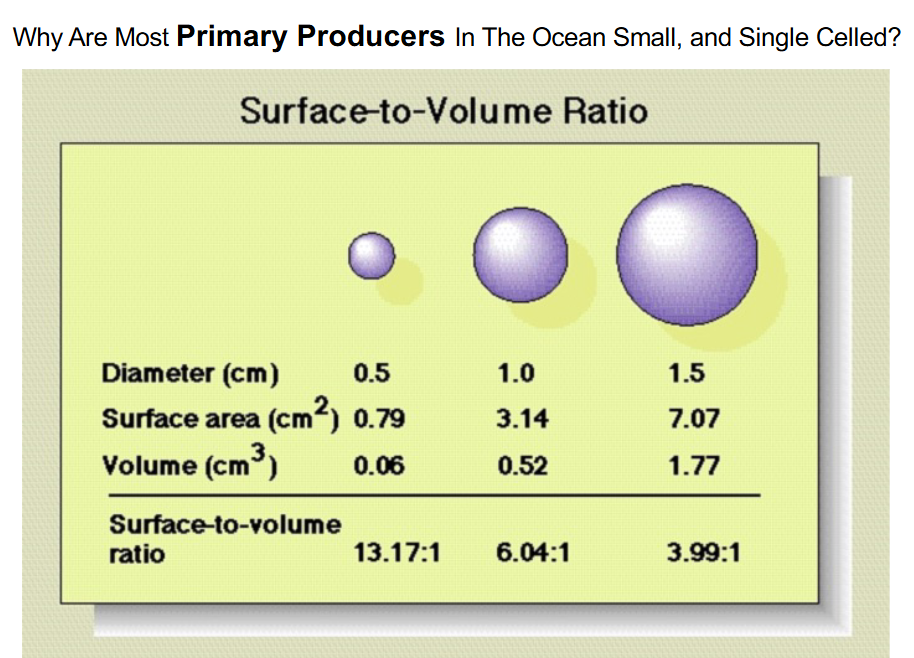
<p>-they need to be buoyant to easily float and remain in the photic zone for photosynthesis</p><p>-they want to have a higher surface to volume ratio to maximize their surface area for photosynthesis while also having a small volume to remain buoyant</p>
35
New cards

what are some adaptations used in planktonic organisms to increase drag?

-body extensions increase friction and drag so they can stay afloat easier

-maintain position in water column

-staying afloat in warmer waters (effects of viscosity, cold water is more viscous compared to warmer water)
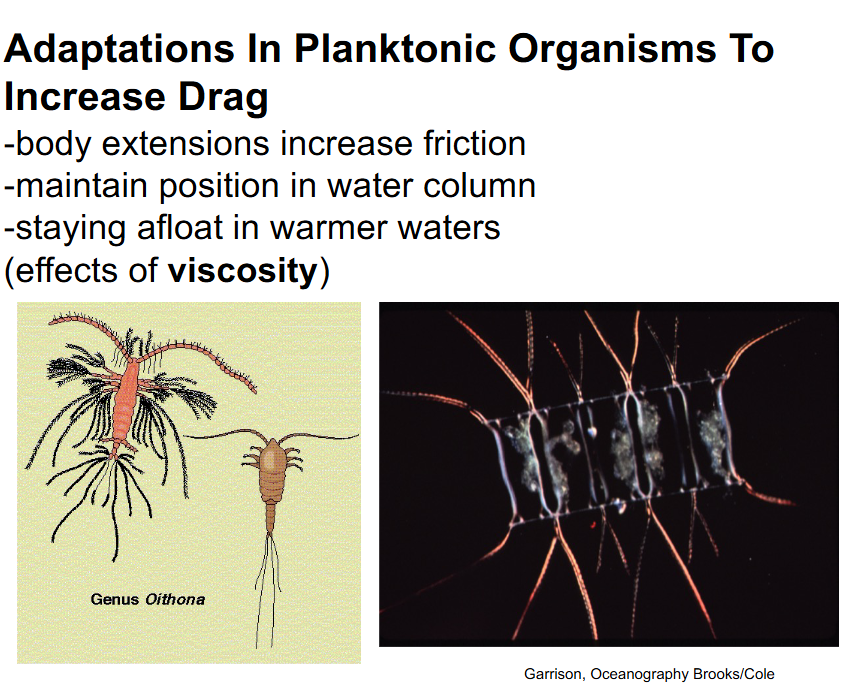
<p>-body extensions increase friction and drag so they can stay afloat easier</p><p>-maintain position in water column</p><p>-staying afloat in warmer waters (effects of viscosity, cold water is more viscous compared to warmer water)</p>
36
New cards

what are some adaptations in nektonic organisms that reduce drag?

-having a streamlined, tear-drop body form

-convergent evolutionary adaptations to the same problem (reduced turbulence // turbulent drag)
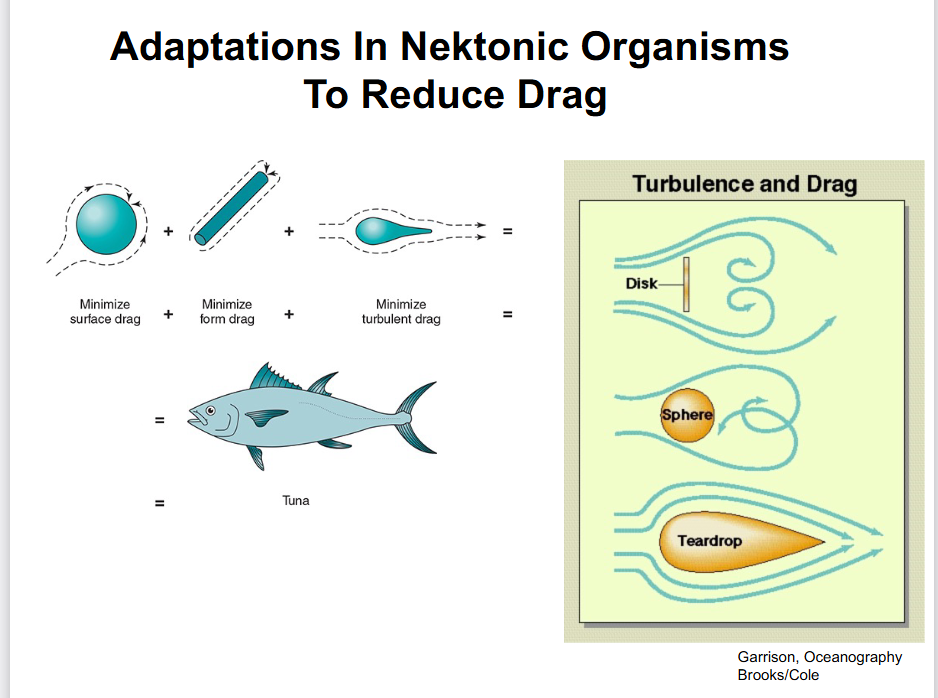
<p>-having a streamlined, tear-drop body form</p><p>-convergent evolutionary adaptations to the same problem (reduced turbulence // turbulent drag)</p>
37
New cards

describe the historical record of marine organisms

-Precambrian life in the seas (4.6 Ba - 541 ma) → unicellular or simple colonial autotrophs and heterotrophs

-Cambrian explosion (541-530 ma) → rapid diversification of numerous multicellular animal phyla over a geologically brief period

-evolution of body skeletons → major changes following extinctions
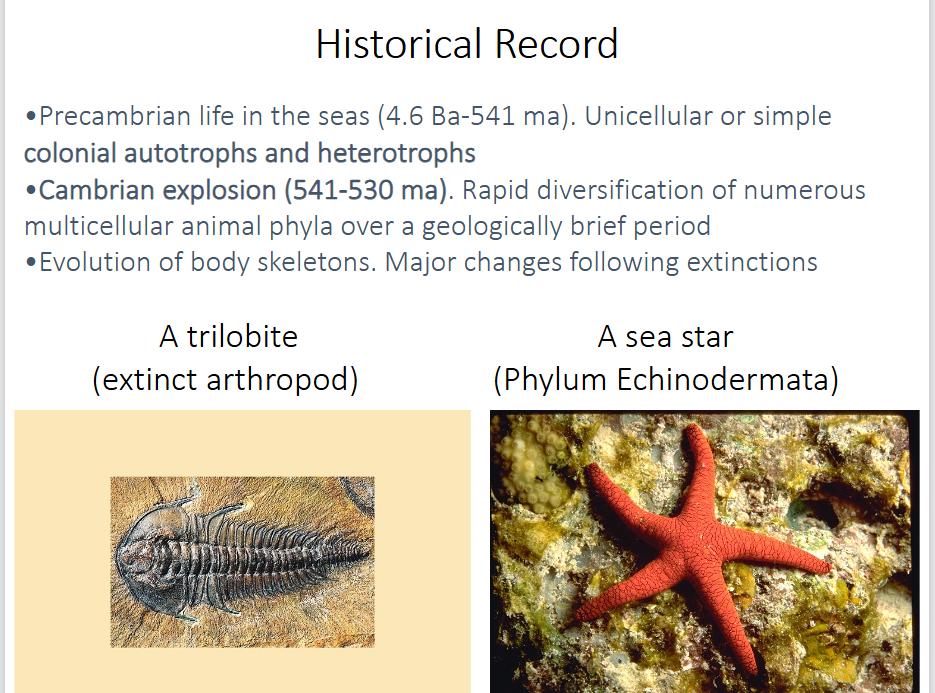
<p>-Precambrian life in the seas (4.6 Ba - 541 ma) → unicellular or simple colonial autotrophs and heterotrophs</p><p>-Cambrian explosion (541-530 ma) → rapid diversification of numerous multicellular animal phyla over a geologically brief period</p><p>-evolution of body skeletons → major changes following extinctions</p>
38
New cards

are invertebrates considered a “natural” category?

no; they’re defined by what they are not (vertebrates)

-invertebrates are very diverse and have major differences between phyla
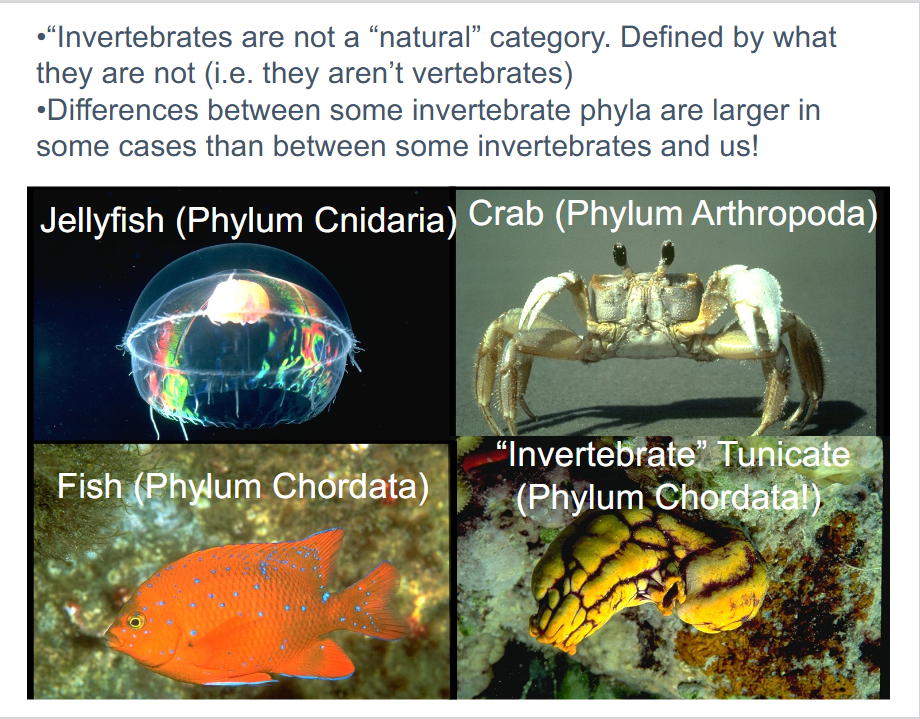
<p>no; they’re defined by what they are not (vertebrates)</p><p>-invertebrates are very diverse and have major differences between phyla</p>
39
New cards
<p>describe the phylum Porifera (sponges) </p>

describe the phylum Porifera (sponges)

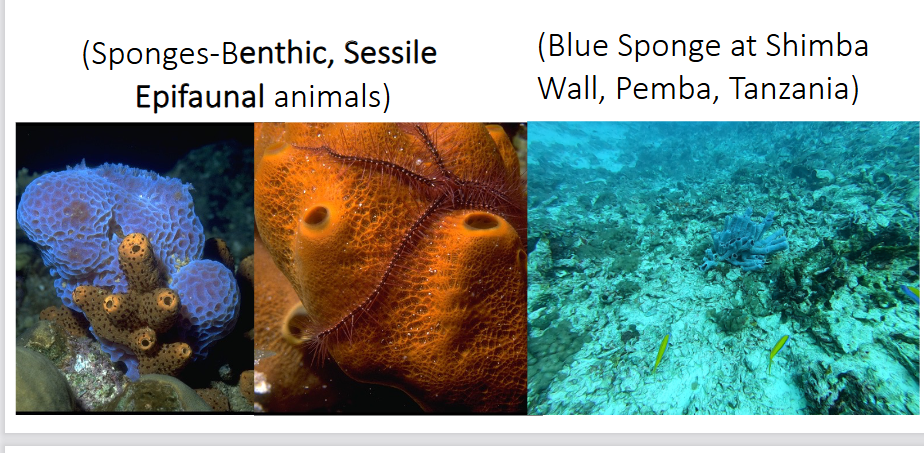
-several thousand species

-simple body organization → no true organs or tissues, no body symmetry

-benthic and sessile

-incurrent pores and ex-current chimneys

-contain spicules for structure and spongin

-most are epifaunal

-water flows through sponges

-passive system of inlet pores and outlet chimneys

-uses natural pressure gradients above sea floor
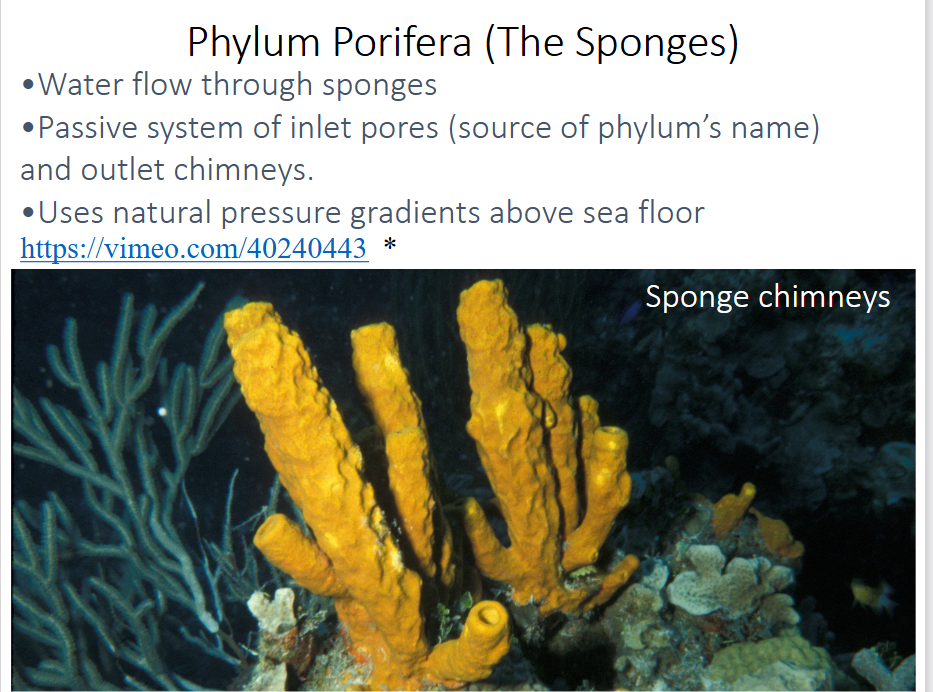
<p>-several thousand species</p><p>-simple body organization → no true organs or tissues, no body symmetry</p><p>-benthic and sessile</p><p>-incurrent pores and ex-current chimneys</p><p>-contain spicules for structure and spongin</p><p>-most are epifaunal</p><p>-water flows through sponges</p><p>-passive system of inlet pores and outlet chimneys</p><p>-uses natural pressure gradients above sea floor</p>
40
New cards

how do porifera (sponges) reproduce? how do porifera feed?

-reproduce both sexually and asexually (budding)

-filter feed (whip like collar cells line the inside of the sponge chamber)
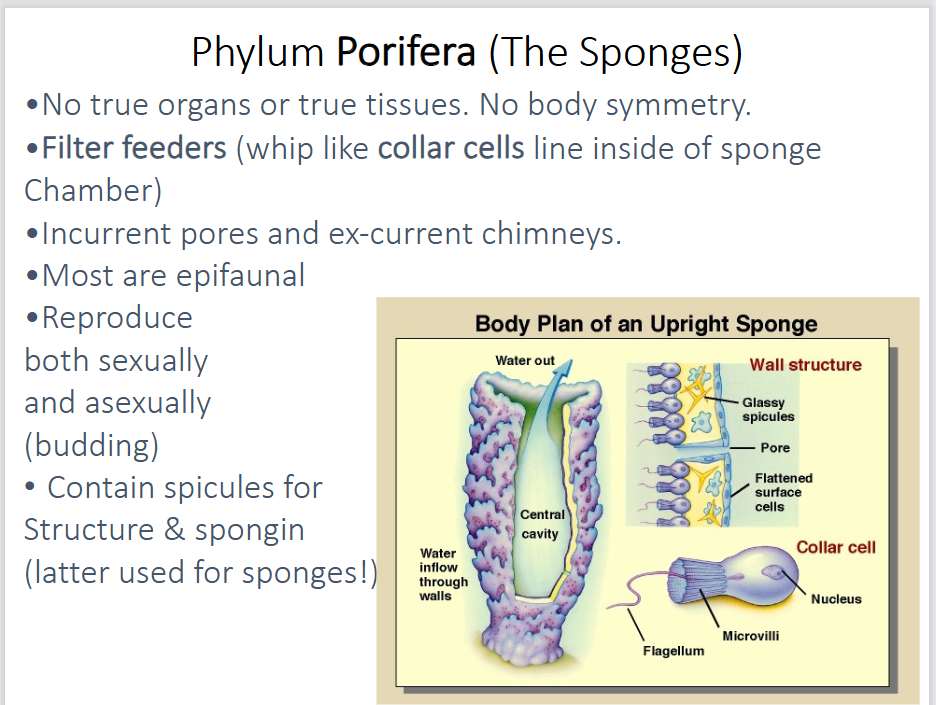
<p>-reproduce both sexually and asexually (budding)</p><p>-filter feed (whip like collar cells line the inside of the sponge chamber)</p>
41
New cards
<p>describe the phylum Cnidaria (corals, jellies, and sea anemones)</p>

describe the phylum Cnidaria (corals, jellies, and sea anemones)

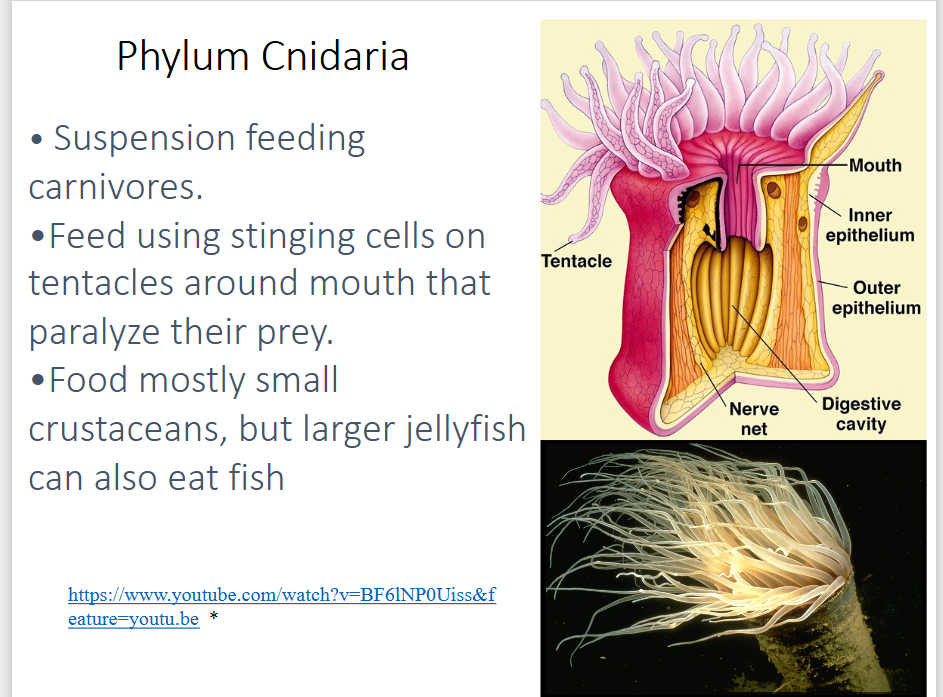
-thousands of species

-more complex body organization → body organized into tissues but not true organs

-radial symmetry → tentacle ring organized around a mouth

-single opening into digestive cavity → food enters and waste secreted through “mouth”

-symbiotic relationships are important (especially in corals)
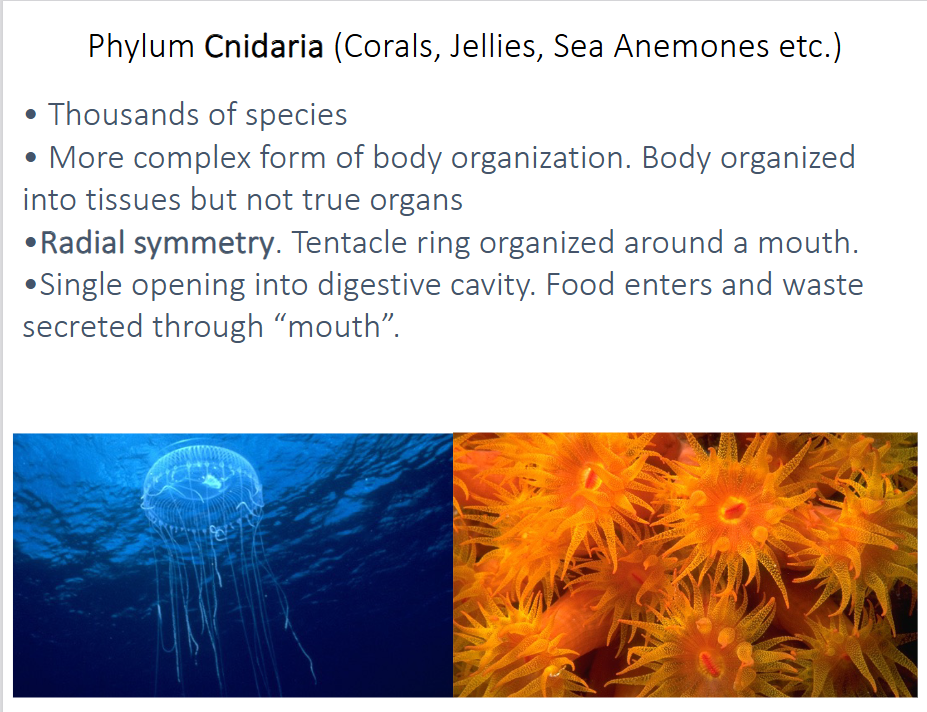
<p>-thousands of species</p><p>-more complex body organization → body organized into tissues but not true organs</p><p>-radial symmetry → tentacle ring organized around a mouth</p><p>-single opening into digestive cavity → food enters and waste secreted through “mouth”</p><p>-symbiotic relationships are important (especially in corals)</p>
42
New cards
<p>how do Cnidaria feed? how do they reproduce?</p>

how do Cnidaria feed? how do they reproduce?

-suspension feeding carnivores

-feed using stinging cells on tentacles around mouth that paralyze their prey → feed mostly on small crustaceans, but larger jellyfish can also eat fish

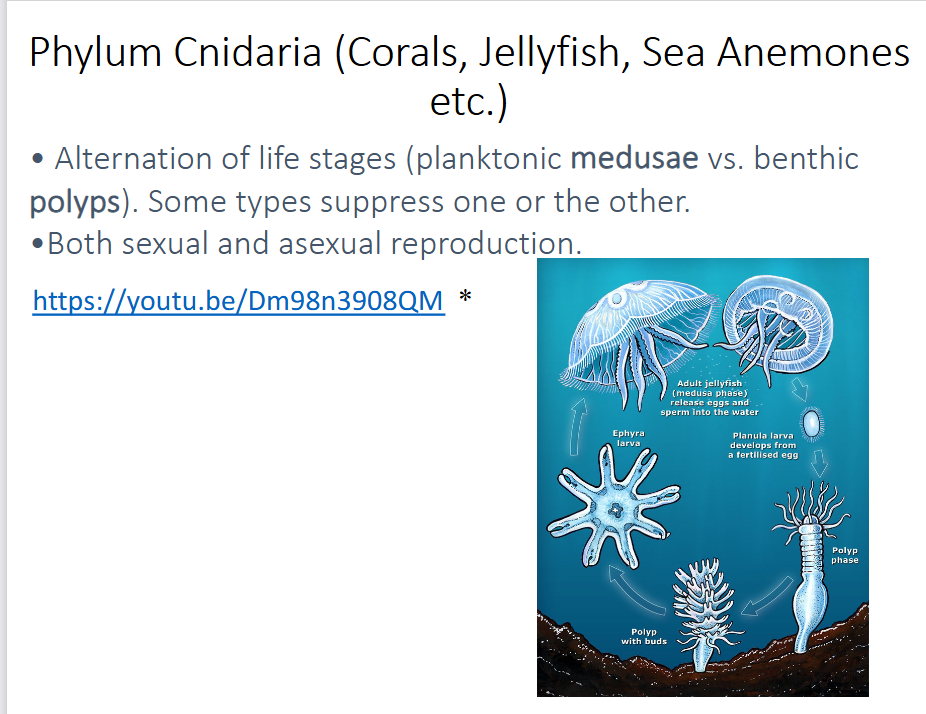
-alternation of life stages between pelagic planktonic medusae vs benthic polyps (some types suppress one or the other)

-both sexual and asexual reproduction
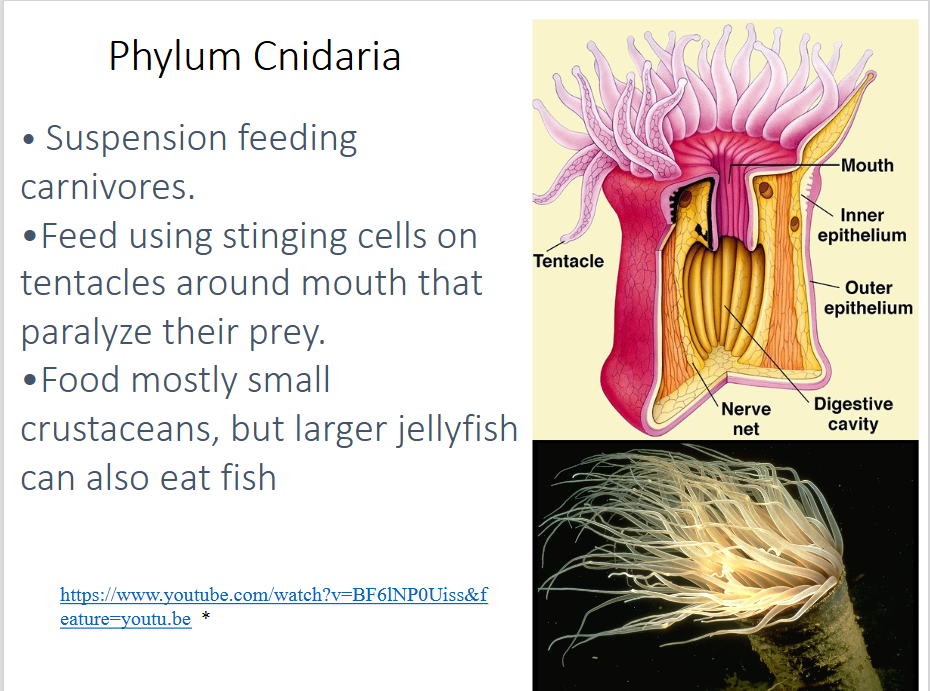
<p>-suspension feeding carnivores</p><p>-feed using stinging cells on tentacles around mouth that paralyze their prey → feed mostly on small crustaceans, but larger jellyfish can also eat fish</p><p>-alternation of life stages between pelagic planktonic medusae vs benthic polyps (some types suppress one or the other)</p><p>-both sexual and asexual reproduction</p>
43
New cards

are Cnidarians always solitary?

no, they can be either colonial (many individual polyps living together) or solitary
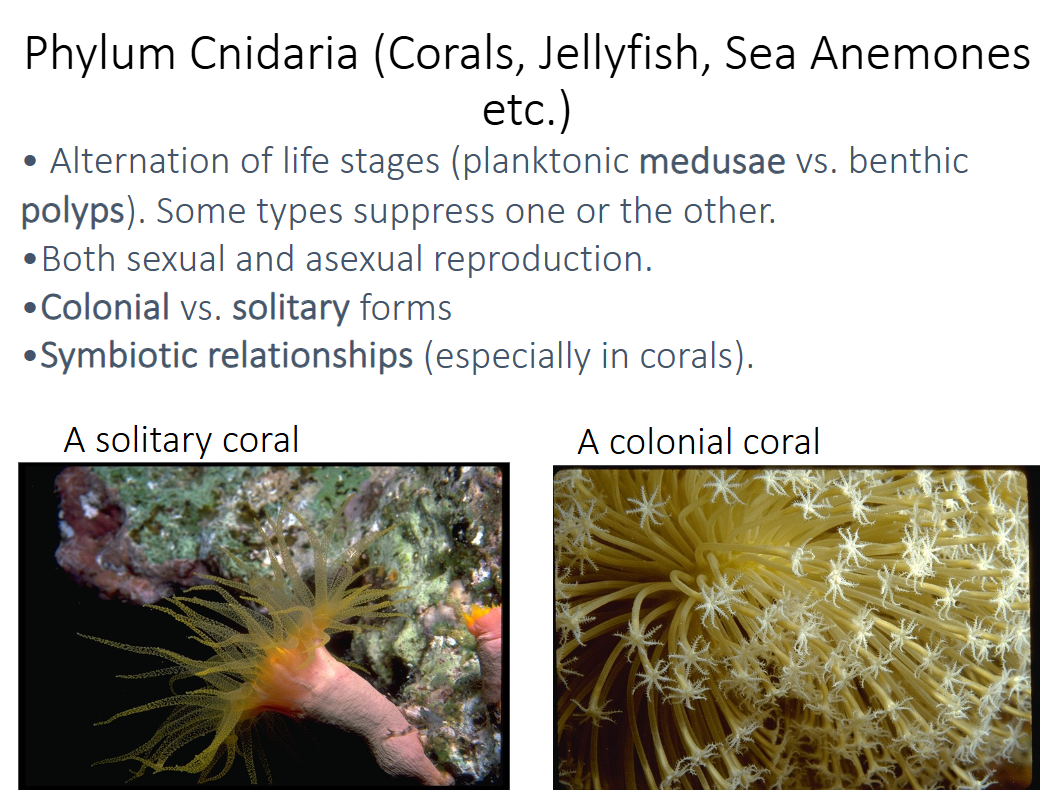
<p>no, they can be either colonial (many individual polyps living together) or solitary</p>
44
New cards

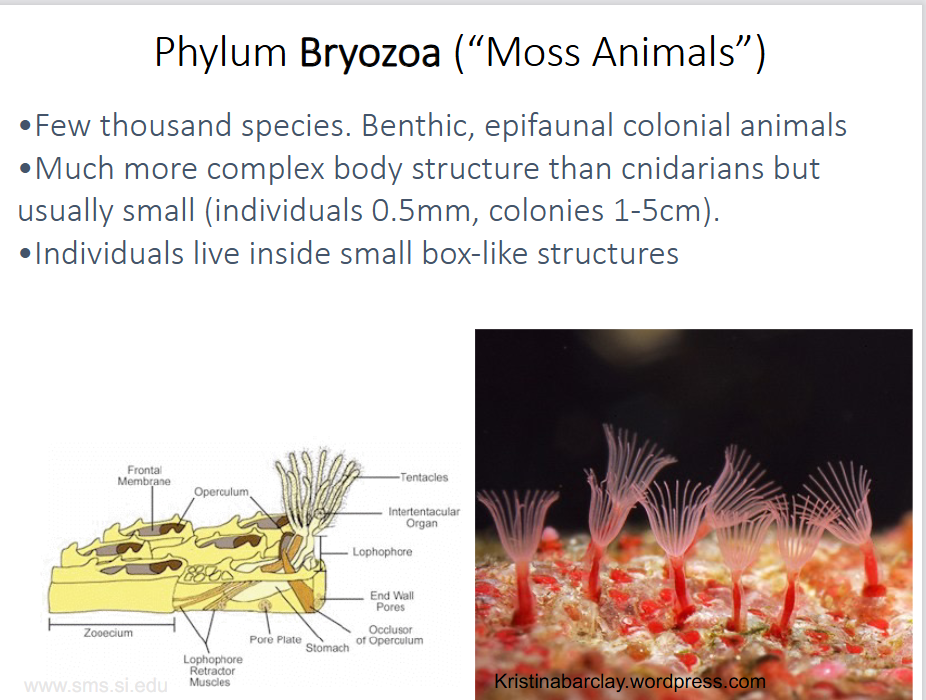
describe the phylum Bryozoa (“moss animals”)

-few thousand species → benthic, epifaunal colonial animals

-much more complex body structure than cnidarians, but usually small (colonies 1-5cm)

-individuals live inside small box-like structures

-true organ system

-can be in a colony or be individual
<p>-few thousand species → benthic, epifaunal colonial animals</p><p>-much more complex body structure than cnidarians, but usually small (colonies 1-5cm)</p><p>-individuals live inside small box-like structures</p><p>-true organ system</p><p>-can be in a colony or be individual</p>
45
New cards

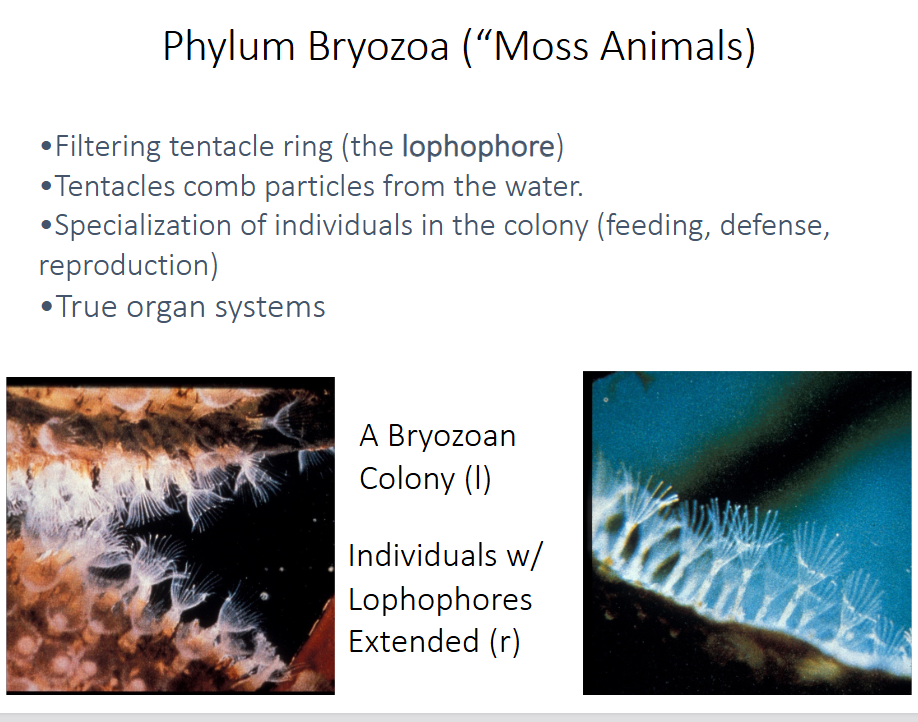
how do Bryozoans feed and reproduce?

-filtering tentacle ring (the lophophore)

-tentacles comb particles from the water

-specialization of individuals in the colony (feeding, defense, and reproduction)
<p>-filtering tentacle ring (the lophophore)</p><p>-tentacles comb particles from the water</p><p>-specialization of individuals in the colony (feeding, defense, and reproduction)</p>
46
New cards
<p>describe the phylum Echinodermata (sea stars, sea urchins, sea cucumbers, etc.)</p>

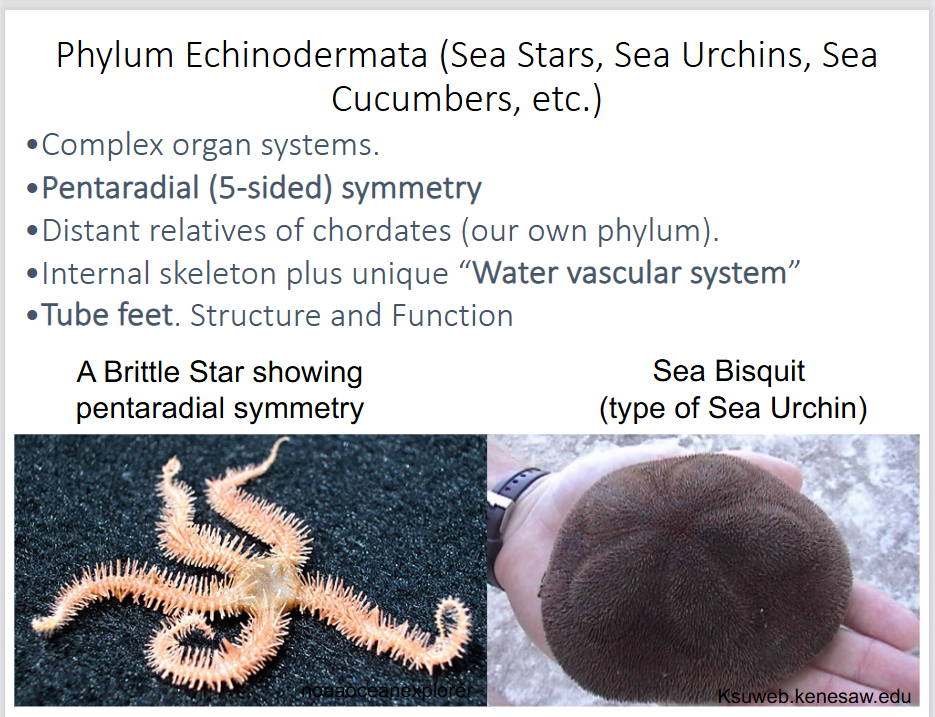
describe the phylum Echinodermata (sea stars, sea urchins, sea cucumbers, etc.)

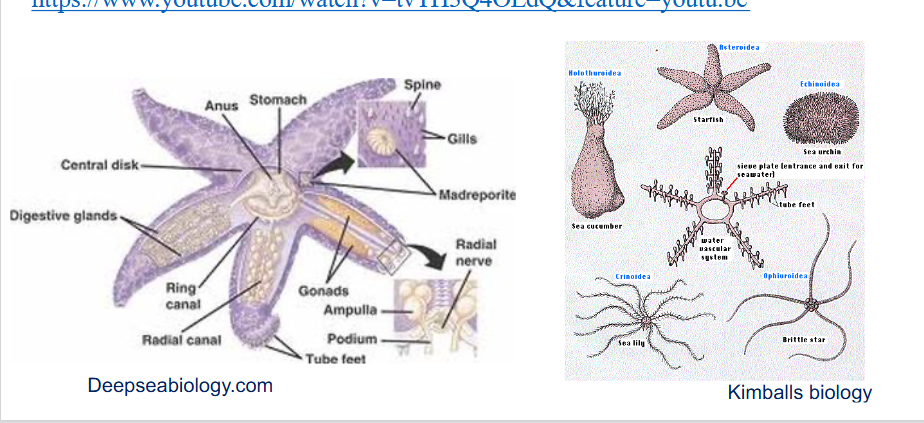
-complex organ systems

-pentaradial (5-sided) symmetry

-distant relatives of chordates

-tube feed used for movement

-internal skeleton plus unique water vascular system

-most species are benthic (planktonic larvae) and slow moving, but some can swim (crinoids)
<p>-complex organ systems</p><p>-pentaradial (5-sided) symmetry</p><p>-distant relatives of chordates</p><p>-tube feed used for movement</p><p>-internal skeleton plus unique <strong>water vascular system</strong></p><p>-most species are benthic (planktonic larvae) and slow moving, but some can swim (crinoids)</p>
47
New cards

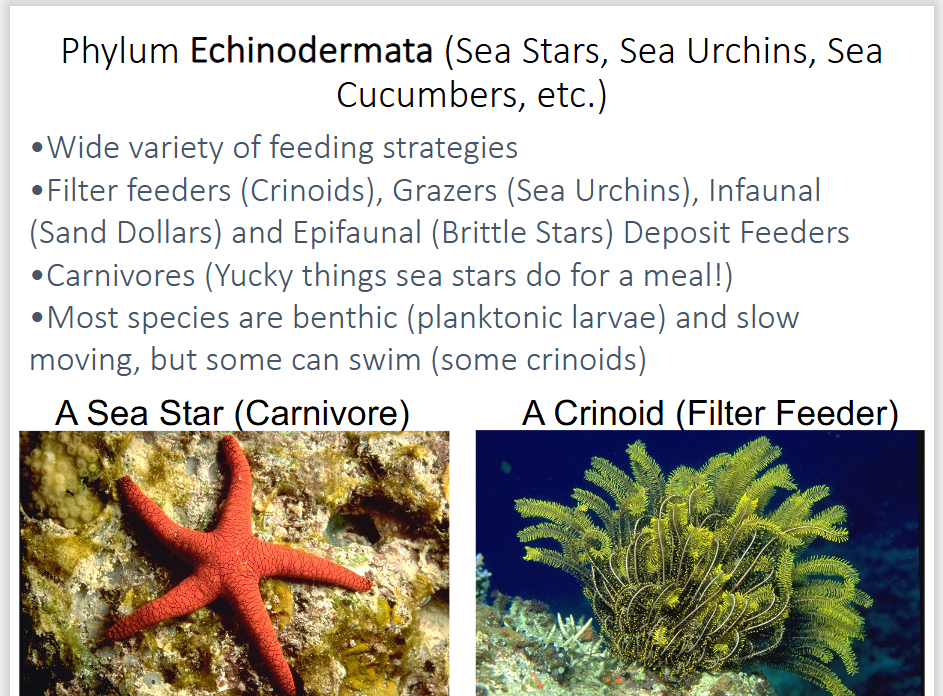
how do echinoderms feed and reproduce?

-wide variety of feeding strategies → filter feeders (Crinoids), grazers (sea urchins), infaunal (sea dollars), and epifaunal (brittle stars), deposit feeders

-carnivores (use their tube feet for predation and then invert their stomach to liquify their prey)
<p>-wide variety of feeding strategies → filter feeders (Crinoids), grazers (sea urchins), infaunal (sea dollars), and epifaunal (brittle stars), deposit feeders</p><p>-carnivores (use their tube feet for predation and then invert their stomach to liquify their prey)</p>
48
New cards

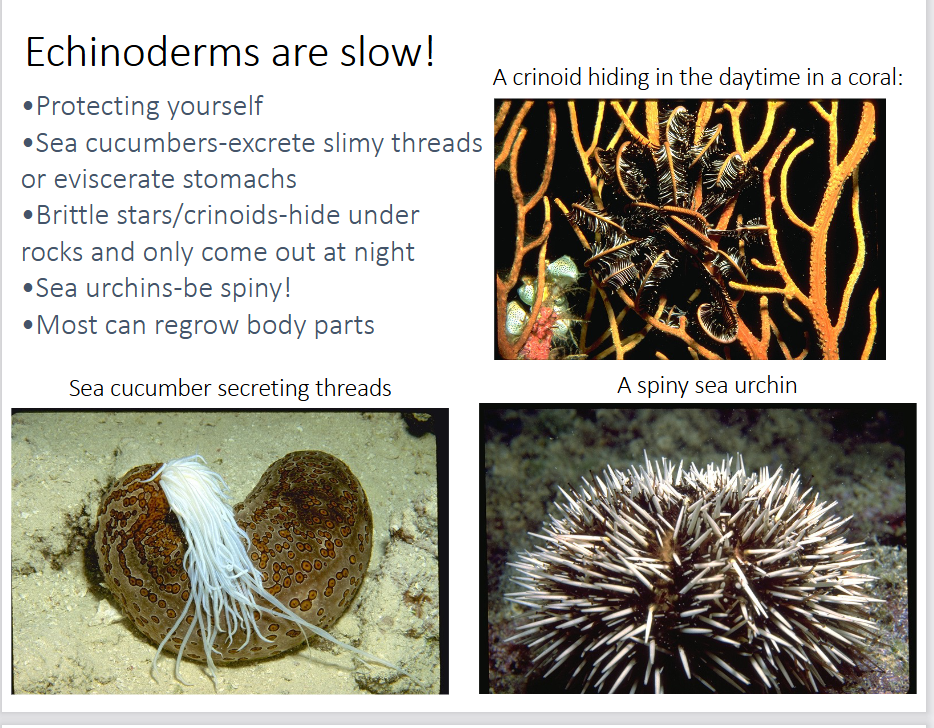
how do echinoderms protect themselves because they’re so slow?

-sea cucumbers excrete slimy threads or eviscerate their stomachs

-brittle stars/crinoids hide under rocks and only come out at night

-sea urchins are spiny

-most can regrow their body parts
<p>-sea cucumbers excrete slimy threads or eviscerate their stomachs</p><p>-brittle stars/crinoids hide under rocks and only come out at night</p><p>-sea urchins are spiny</p><p>-most can regrow their body parts</p>
49
New cards

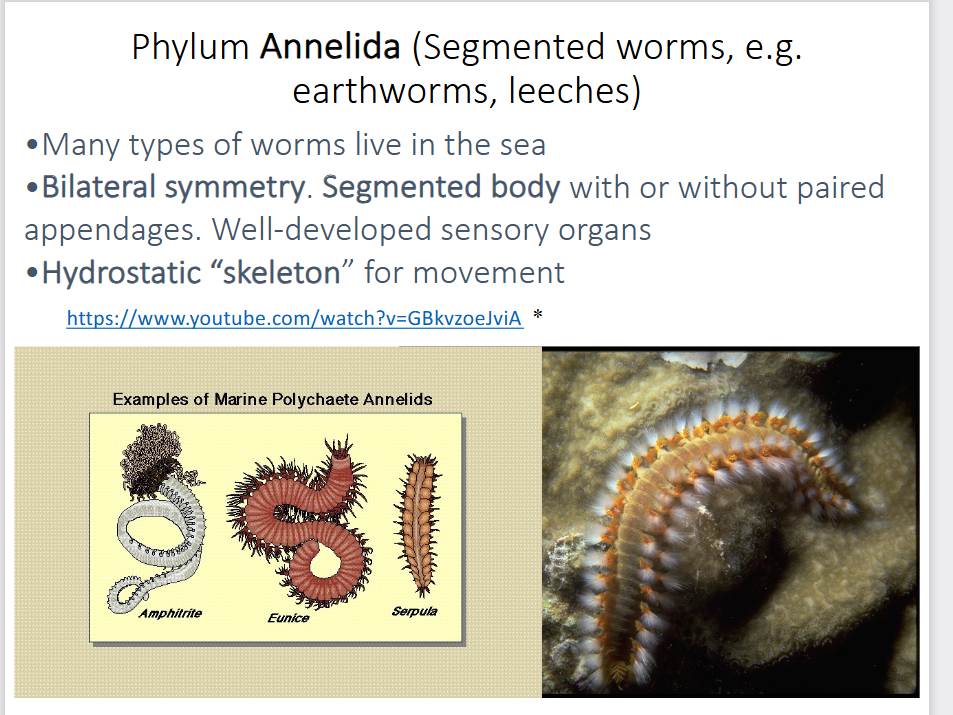
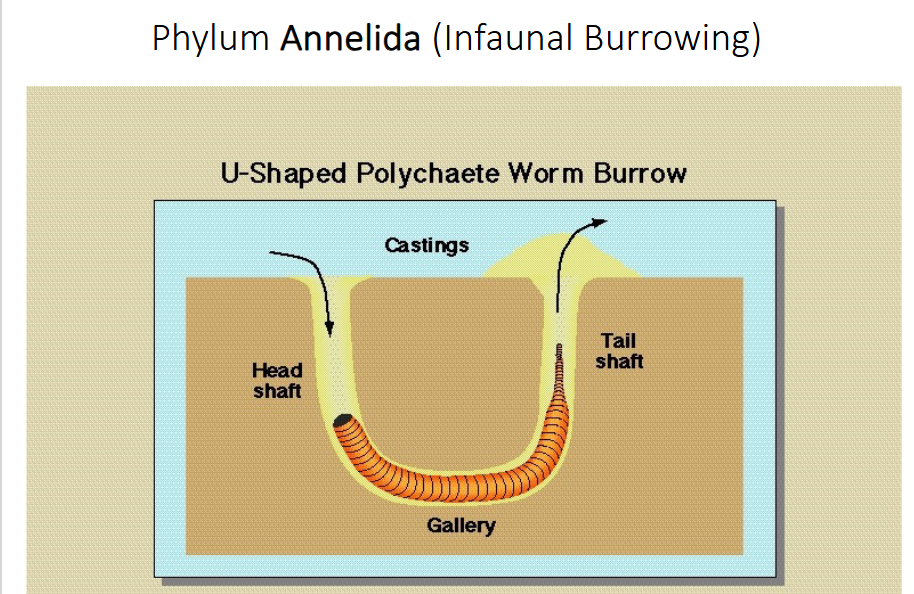
describe the phylum Annelida (segmented worms, earthworms, leeches)

-many types of worms live in the sea

-bilateral symmetry, segmented body with or without paired appendages

-well-developed sensory organs

-hydrostatic skeleton for movement

-mostly benthic infaunal or epifaunal inside tubes/hard cases, but some crawl on bottom or are planktonic
<p>-many types of worms live in the sea</p><p>-bilateral symmetry, segmented body with or without paired appendages</p><p>-well-developed sensory organs</p><p>-hydrostatic skeleton for movement</p><p>-mostly benthic infaunal or epifaunal inside tubes/hard cases, but some crawl on bottom or are planktonic</p>
50
New cards
<p>how do Annelida feed and reproduce?</p>

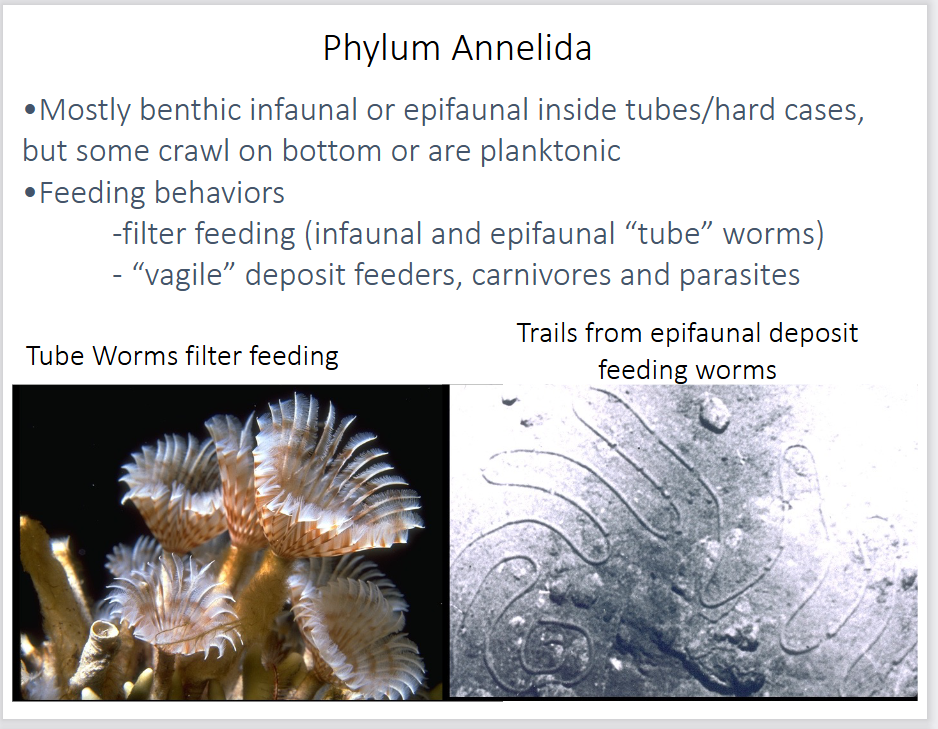
how do Annelida feed and reproduce?

-filter feeding (infaunal and epifaunal tube worms)

-“vagile” deposit feeders, carnivores and parasites
<p>-filter feeding (infaunal and epifaunal tube worms)</p><p>-“vagile” deposit feeders, carnivores and parasites</p>
51
New cards
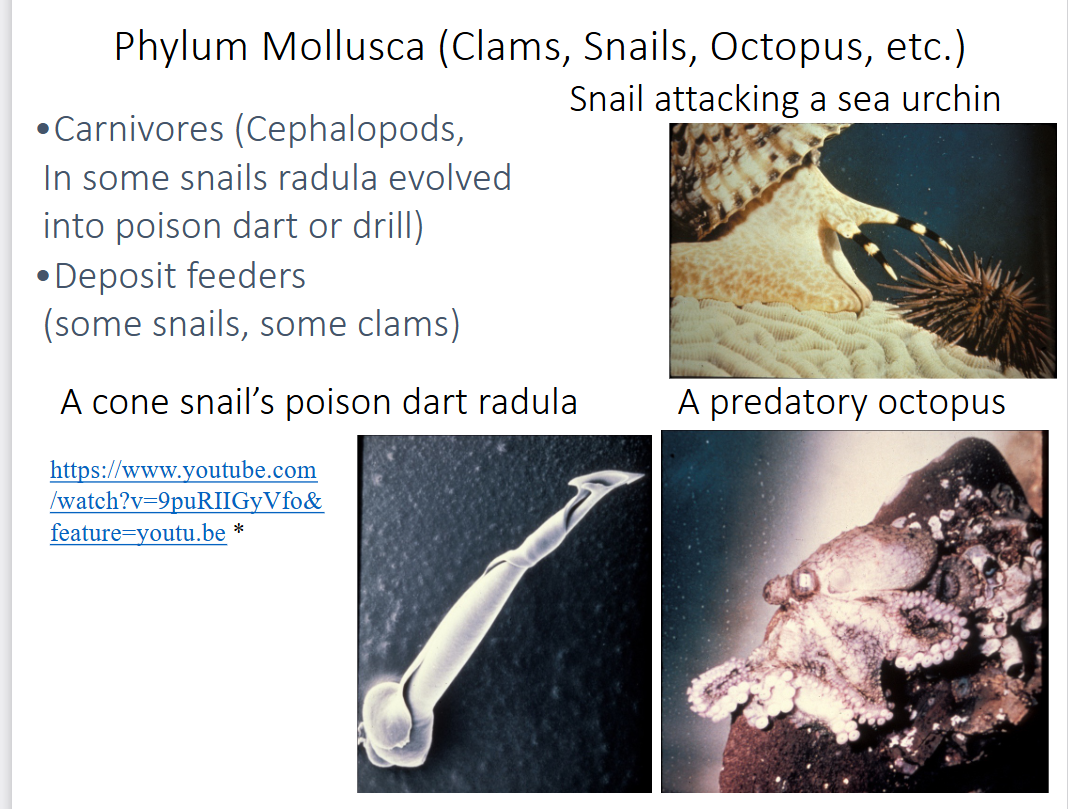
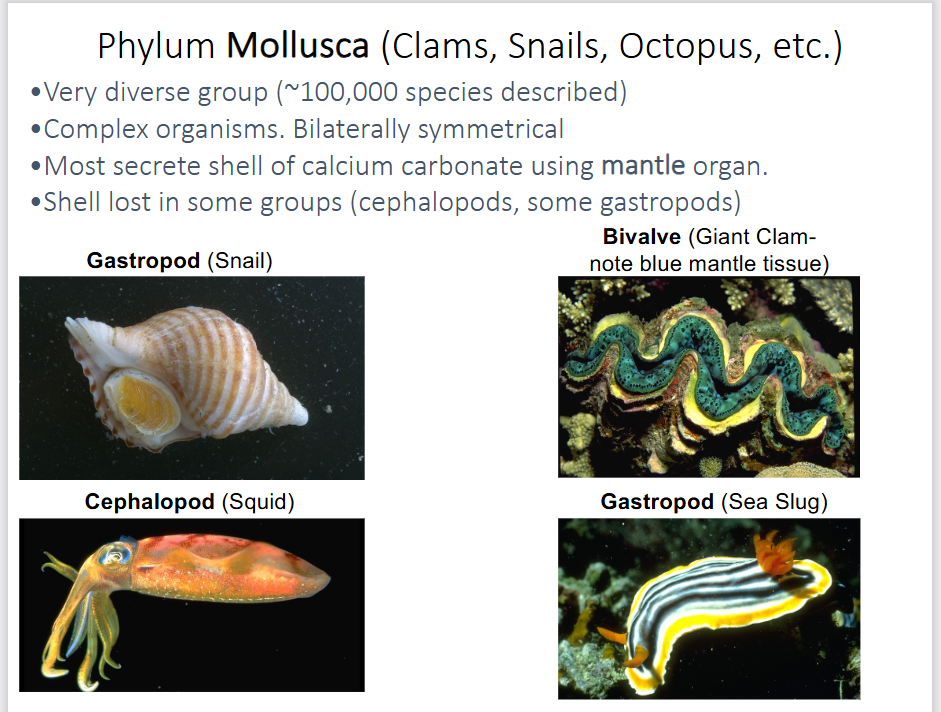
<p>describe the phylum Mollusca (clams, snails, octopus etc.)</p>

describe the phylum Mollusca (clams, snails, octopus etc.)

-very diverse group (~100,000 species)

-complex organisms

-bilateral symmetry

-most secrete shell of calcium carbonate using mantle organ

-shell lost in some groups (cephalopods, some gastropods)

-muscular foot for locomotion

-strongly modified in cephalopods (octopus and squids) into tentacles

-most with rigid exoskeleton
<p>-very diverse group (~100,000 species)</p><p>-complex organisms</p><p>-bilateral symmetry</p><p>-most secrete shell of calcium carbonate using mantle organ</p><p>-shell lost in some groups (cephalopods, some gastropods)</p><p>-muscular foot for locomotion</p><p>-strongly modified in cephalopods (octopus and squids) into tentacles</p><p>-most with rigid exoskeleton</p>
52
New cards
<p>how do Mollusca feed? </p>

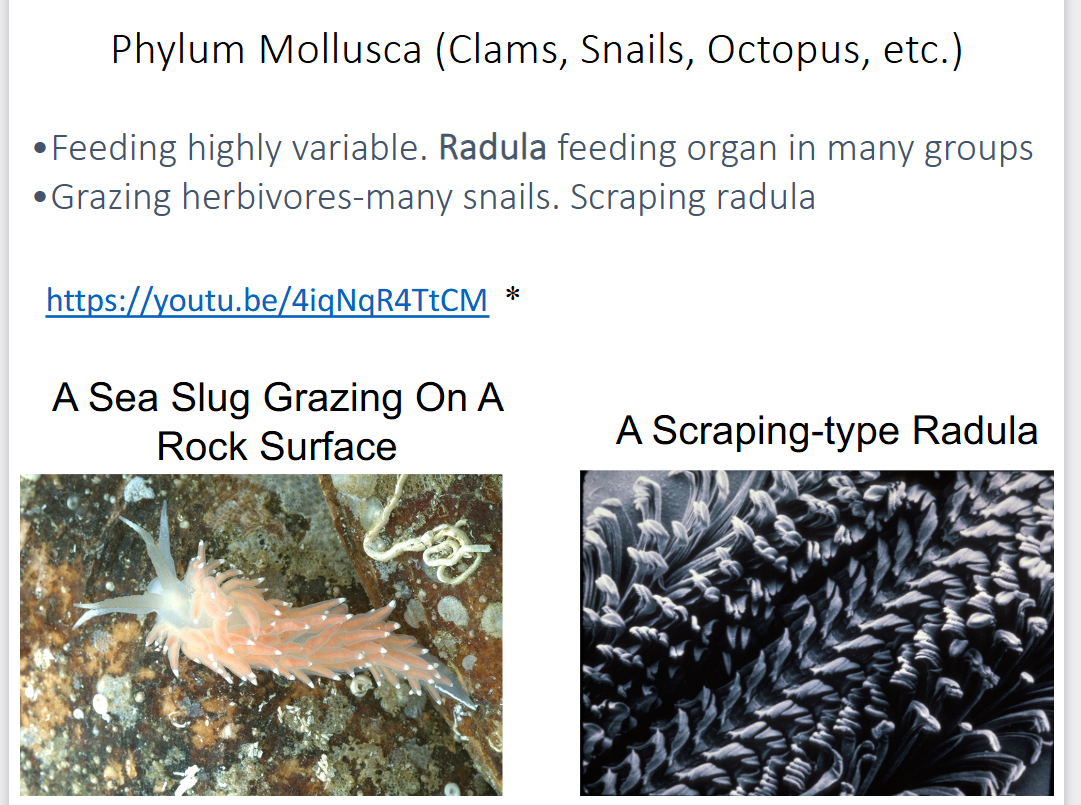
how do Mollusca feed?

-feeding is highly variable

-radula is the feeding organ in many groups

-many snails are grazing herbivores and have a scraping radula

-some are deposit feeders (some snails and clams)

-carnivores (Cephalopods, in some snail’s radula has evolved in poison dart or drill)

-some are parasites

-filter feeders (most clams, some snails)
<p>-feeding is highly variable</p><p>-radula is the feeding organ in many groups</p><p>-many snails are grazing herbivores and have a scraping radula</p><p>-some are deposit feeders (some snails and clams)</p><p>-carnivores (Cephalopods, in some snail’s radula has evolved in poison dart or drill)</p><p>-some are parasites</p><p>-filter feeders (most clams, some snails)</p>
53
New cards
<p>describe the phylum Arthropoda (insects, crustaceans and spiders)</p>

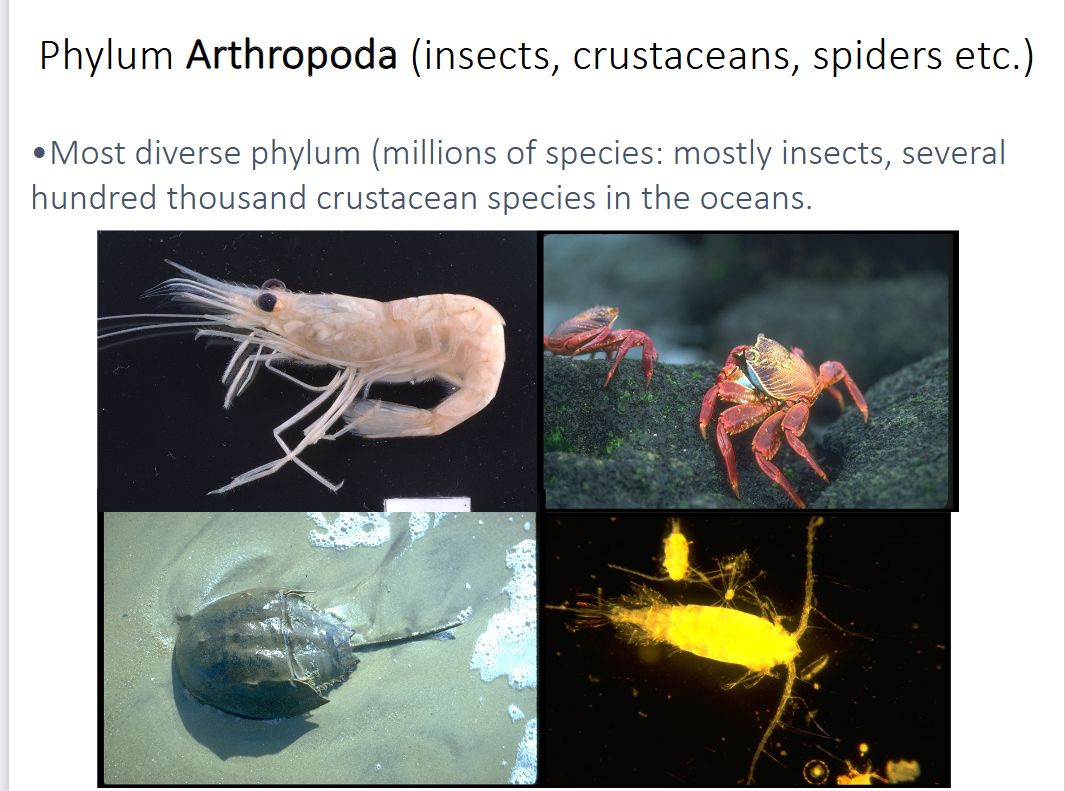
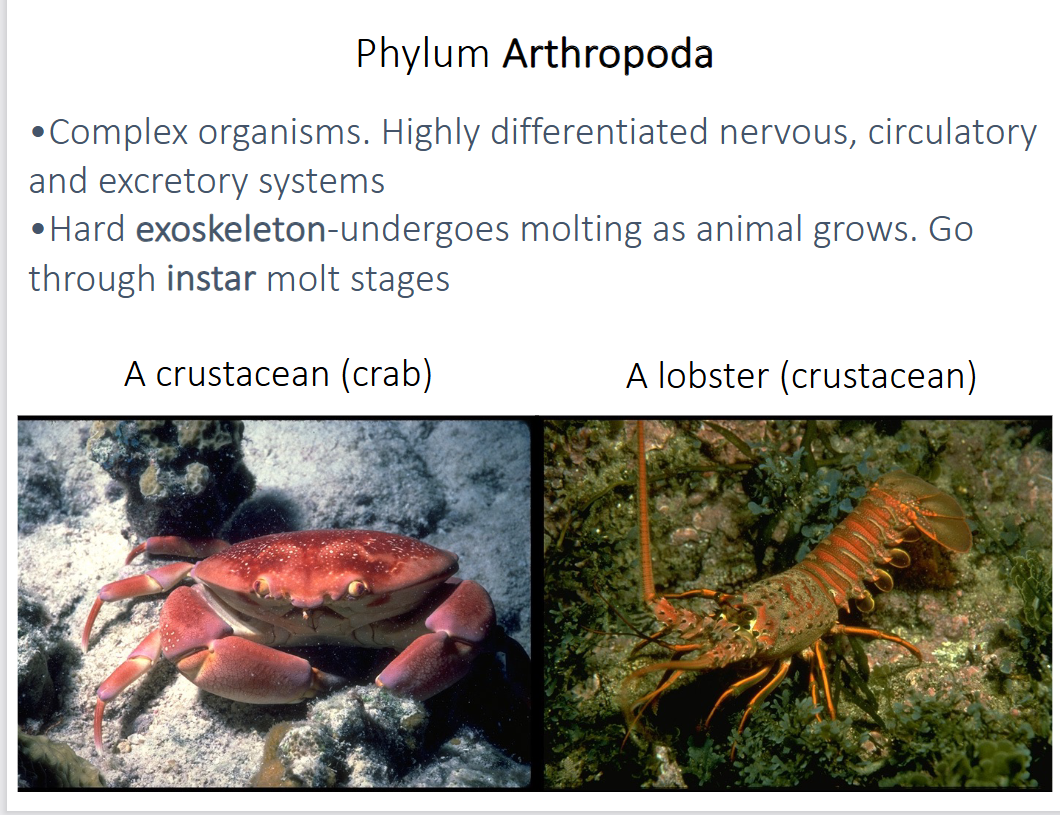
describe the phylum Arthropoda (insects, crustaceans and spiders)

-most diverse phylum (millions of species: mostly insects, several hundred thousand crustacean species in the ocean)

-complex organisms → highly differentiated nervous, circulatory and excretory systems

-hard exoskeleton → undergoes molting as the organism grows, goes through instar molt stages

-have bilateral symmetry with paired appendages (specialized for function → sensory, feeding, defense, display, locomotion and copulation)
<p>-most diverse phylum (millions of species: mostly insects, several hundred thousand crustacean species in the ocean)</p><p>-complex organisms → highly differentiated nervous, circulatory and excretory systems</p><p>-hard exoskeleton → undergoes molting as the organism grows, goes through instar molt stages</p><p>-have bilateral symmetry with paired appendages (specialized for function → sensory, feeding, defense, display, locomotion and copulation)</p>
54
New cards

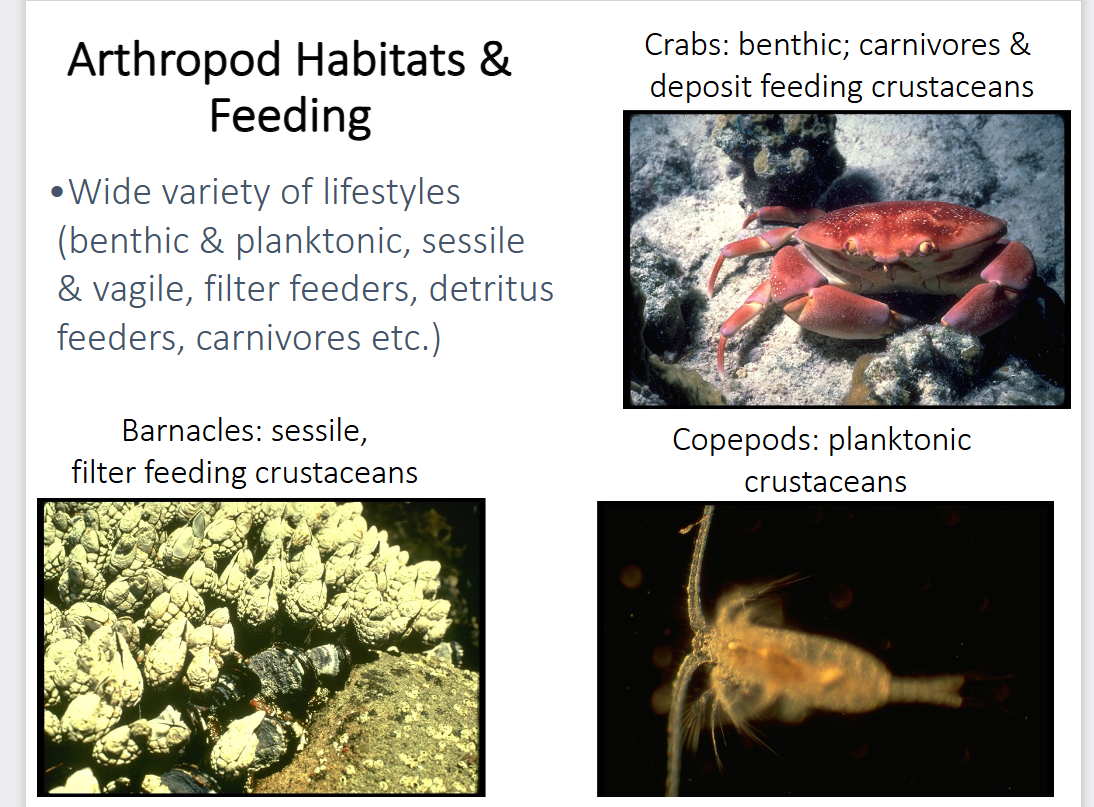
describe Arthropoda habitat and feeding

-wide variety of lifestyles → benthic and planktonic, sessile and vagile

-filter feeders, detritus feeders, carnivores, etc…
<p>-wide variety of lifestyles → benthic and planktonic, sessile and vagile</p><p>-filter feeders, detritus feeders, carnivores, etc…</p>
55
New cards

describe phylum Chordata (humans and macrofauna)

-possess notochord and paired gills at some growth stage (some chordates are invertebrates (no backbone))

-tunicates (sea squirts) → swimming larvae with notochord (filter feeders and sessile as adults)
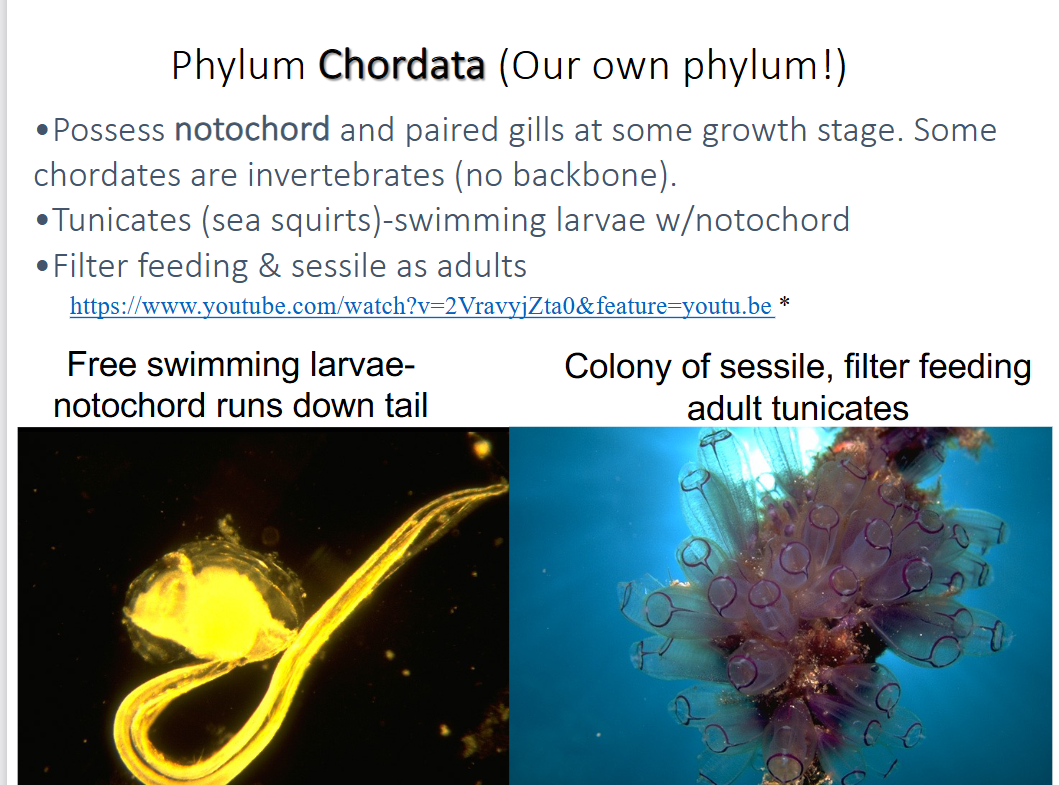
<p>-possess notochord and paired gills at some growth stage (some chordates are invertebrates (no backbone))</p><p>-tunicates (sea squirts) → swimming larvae with notochord (filter feeders and sessile as adults)</p>
56
New cards

what role do phytoplankton play in marine ecosystems?

-phytoplankton (plants) “fix” carbon (inorganic CO2 → organic carbon chains (sugars/glucose) which creates source of metabolic energy to build the base of the food chain in the complex marine food web

-primary productivity: amount of carbon fixed by plants: grams of carbon per square meter of sea surface per unit time (gC/m2/year)

-48.5 Pg C / year fixed by the ocean (56.4 Pg C / year is fixed by terrestrial plants), so nearly equal
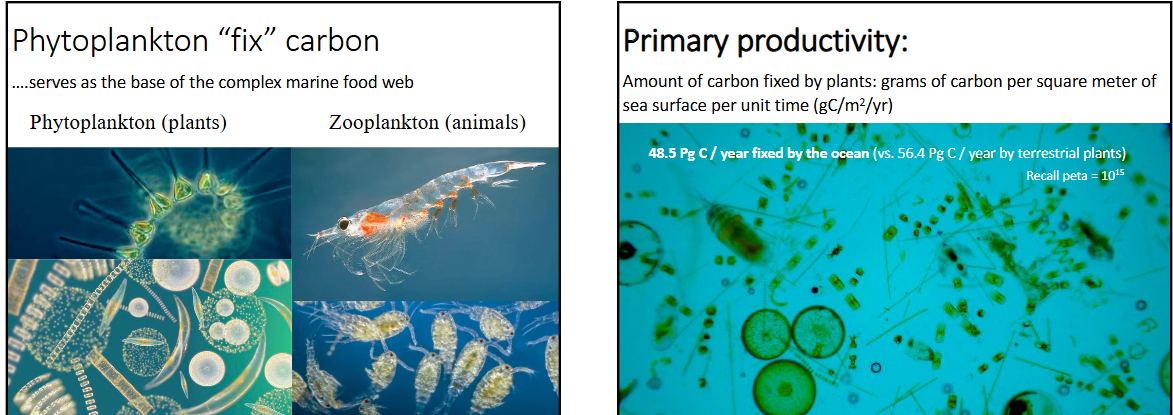
<p>-phytoplankton (plants) “fix” carbon (inorganic CO<sub>2</sub> → organic carbon chains (sugars/glucose) which creates source of metabolic energy to build the base of the food chain in the complex marine food web</p><p>-primary productivity: amount of carbon fixed by plants: grams of carbon per square meter of sea surface per unit time (gC/m<sup>2</sup>/year)</p><p>-48.5 Pg C / year fixed by the ocean (56.4 Pg C / year is fixed by terrestrial plants), so nearly equal</p>
57
New cards

describe respiration versus photosynthesis

respiration = “remineralization” of byproducts (cellular respiration), occurs in the aphotic zone

photosynthesis = “production”, occurs in the photic zone
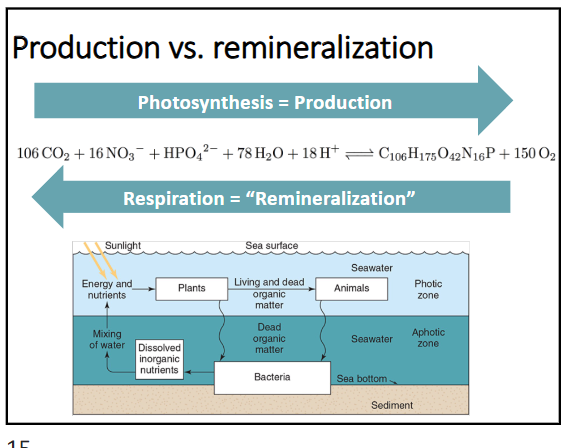
<p>respiration = “remineralization” of byproducts (cellular respiration), occurs in the aphotic zone</p><p>photosynthesis = “production”, occurs in the photic zone</p>
58
New cards

provide an example of a marine food web

primary producers → primary consumers → secondary consumers → tertiary consumers (apex predators)
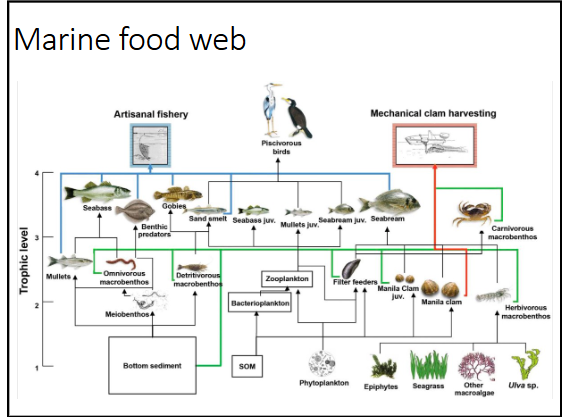
<p>primary producers → primary consumers → secondary consumers → tertiary consumers (apex predators) </p>
59
New cards

how much matter is recycled from each trophic level to the next

~90% of energy is lost between each trophic level, so only about 10% is passed on to the next level (energy is lost as heat)
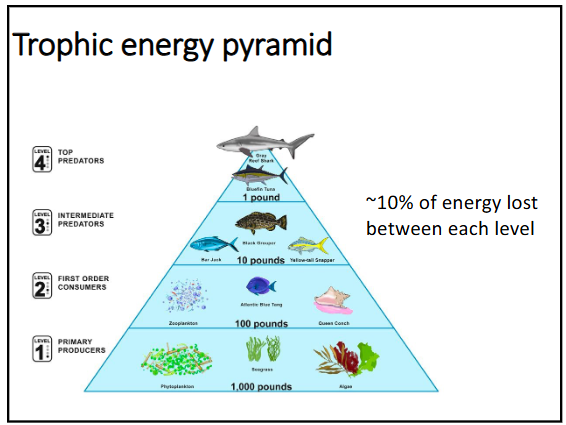
<p>~90% of energy is lost between each trophic level, so only about 10% is passed on to the next level (energy is lost as heat)</p>
60
New cards

historically, how did we measure productivity?

light-dark bottle method (oxygen) → dark bottle measures community respiration and the light bottle measures community photosynthesis and community respiration → the different between the two bottles gives you the measure of photosynthesis
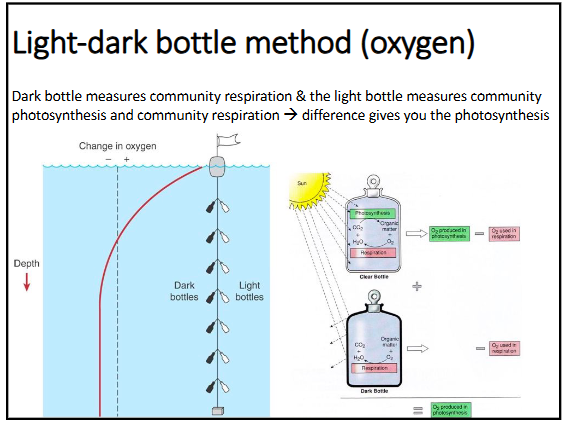
<p>light-dark bottle method (oxygen) → dark bottle measures community respiration and the light bottle measures community photosynthesis and community respiration → the different between the two bottles gives you the measure of photosynthesis </p>
61
New cards

how do we currently measure productivity?

-satellite observations (SeaWiFS)

-map of chlorophyll A at the surface of the ocean

-chlorophyll is a pigment in chloroplasts that allows plants to photosynthesis and is green in color because green wavelengths aren’t being absorbed by plants and this green color allows satellites to detect color pigments
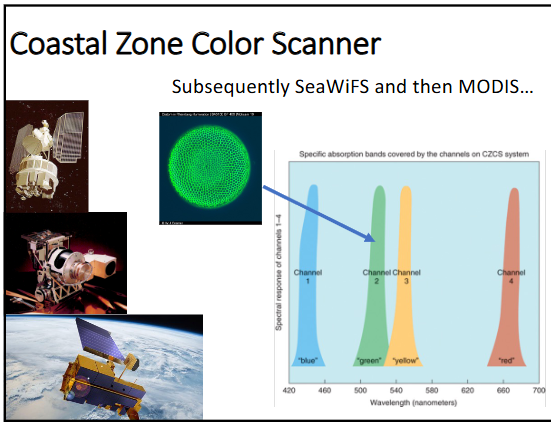
<p>-satellite observations (SeaWiFS)</p><p>-map of chlorophyll A at the surface of the ocean</p><p>-chlorophyll is a pigment in chloroplasts that allows plants to photosynthesis and is green in color because green wavelengths aren’t being absorbed by plants and this green color allows satellites to detect color pigments</p>
62
New cards

what factors determine primary productivity?

-solar radiation (light): net primary productivity → carbon fixed by photosynthesis exceeds respiration demands of plant; occurs down to “compensation depth” (~1% of surface light) (not first order importance)

-major nutrients (nitrogen, phosphorus, silicon) availability→ most important factor (where there is vertical mixing)

-coastal upwelling, equatorial upwelling, and local turbulence (waves and tides)

-with vertical mixing → productivity
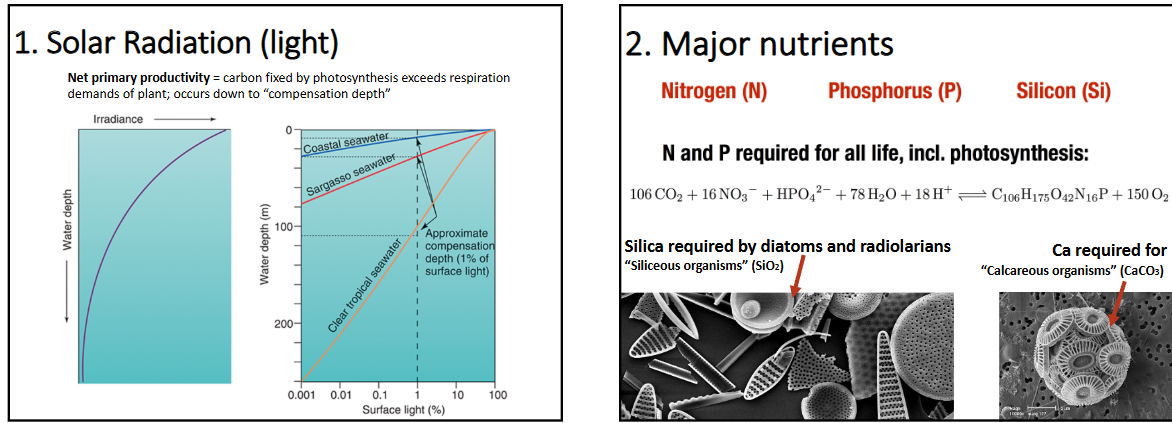
<p>-solar radiation (light): net primary productivity → carbon fixed by photosynthesis exceeds respiration demands of plant; occurs down to “compensation depth” (~1% of surface light) (not first order importance)</p><p>-major nutrients (nitrogen, phosphorus, silicon) availability→ most important factor (where there is vertical mixing)</p><p>-coastal upwelling, equatorial upwelling, and local turbulence (waves and tides)</p><p>-with vertical mixing → productivity</p>
63
New cards

what are the patterns of global primary productivity?

-regions with equatorial and coastal upwelling = high productivity

-polar regions (cold, less stratified layers) have high productivity

-center of gyres → downwelling = no productivity
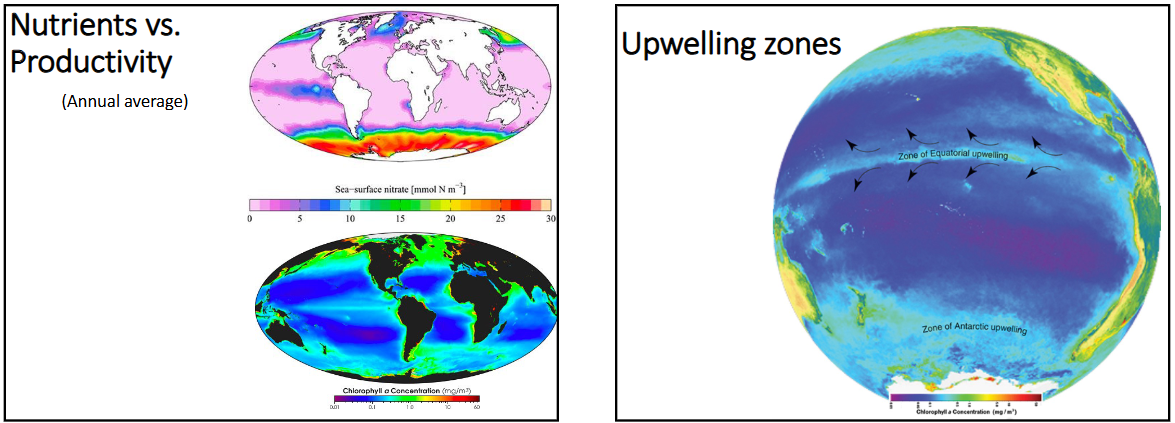
<p>-regions with equatorial and coastal upwelling = high productivity </p><p>-polar regions (cold, less stratified layers) have high productivity</p><p>-center of gyres → downwelling = no productivity </p>
64
New cards

describe nutrient seasonality

patterns for nitrate, phosphate and silicate have very similar general patterns

patterns vary seasonally:

-polar regions → water is not stratified (easier mixing) and always productive nutrient-wise because the temperature is always cold. seasonality matters → no light in the winter = no productivity, light in the spring/summer → lots of productivity (especially in the spring when the sun comes where is a bunch of nutrients readily available)

-equatorial regions → water is much more stratified because the temperature is much warmer at the surface than at depth. in the winter, the surface water is cooler so it’s less stratified than in the summer when its waters are warmer
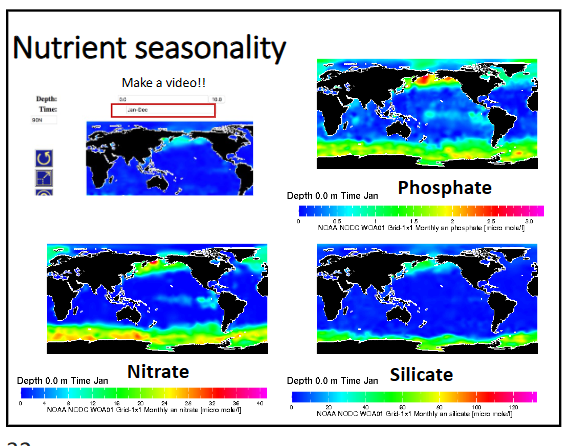
<p>patterns for nitrate, phosphate and silicate have very similar general patterns</p><p>patterns vary seasonally:</p><p>-polar regions → water is not stratified (easier mixing) and always productive nutrient-wise because the temperature is always cold. seasonality matters → no light in the winter = no productivity, light in the spring/summer → lots of productivity (especially in the spring when the sun comes where is a bunch of nutrients readily available)</p><p>-equatorial regions → water is much more stratified because the temperature is much warmer at the surface than at depth. in the winter, the surface water is cooler so it’s less stratified than in the summer when its waters are warmer</p>
65
New cards

describe oxygen availability

-high nutrient availability and high productivity as surface = low oxygen

-O2 is consumed and nutrients are recycled below the photic zone by respiration / remineralization

-depth and severity depend on productivity, stratification / mixing
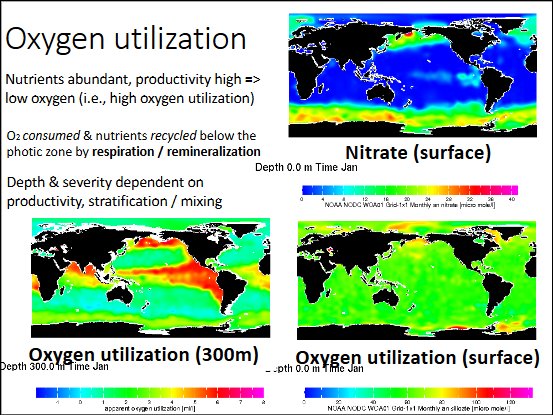
<p>-high nutrient availability and high productivity as surface = low oxygen </p><p>-O2 is consumed and nutrients are recycled below the photic zone by respiration / remineralization</p><p>-depth and severity depend on productivity, stratification / mixing</p>
66
New cards

what are the major primary producers?

cyanobacteria, green algae, coccolithophores, dinoflagellates and diatoms

dinoflagellates:

-unicellular and motile (have flagella), outer membrane with plates, some have cellulose walls called “theca” others have internal silica. often mixotrophic (also capture prey). mostly thrive in high nutrient coastal waters, and are important symbionts (corals and giant clams)

-have bioluminescence (release energy as light, not heat); are also a major driver of harmful algal blooms (“red tides”)
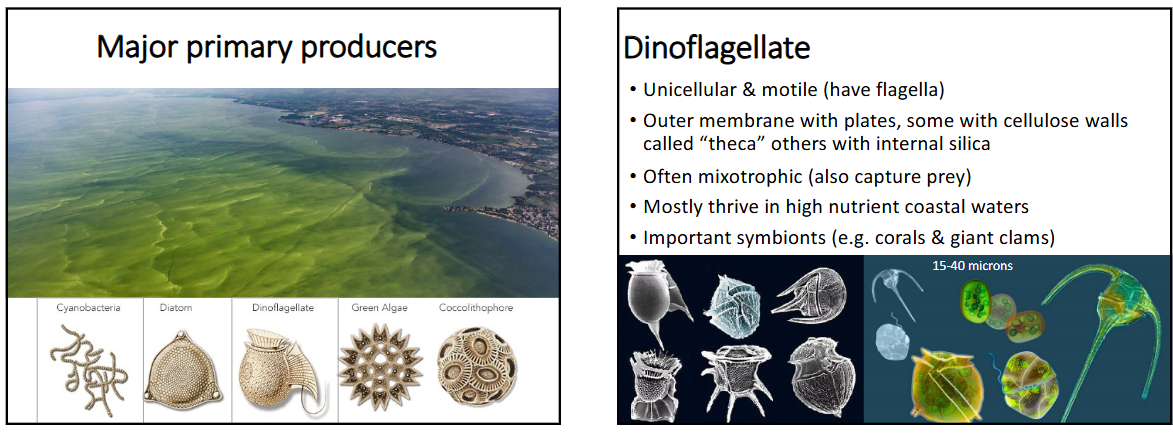
<p>cyanobacteria, green algae, coccolithophores, dinoflagellates and diatoms</p><p>dinoflagellates: </p><p>-unicellular and motile (have flagella), outer membrane with plates, some have cellulose walls called “theca” others have internal silica. often mixotrophic (also capture prey). mostly thrive in high nutrient coastal waters, and are important symbionts (corals and giant clams)</p><p>-have bioluminescence (release energy as light, not heat); are also a major driver of harmful algal blooms (“red tides”)</p>
67
New cards

what are the different types of cyanobacteria?

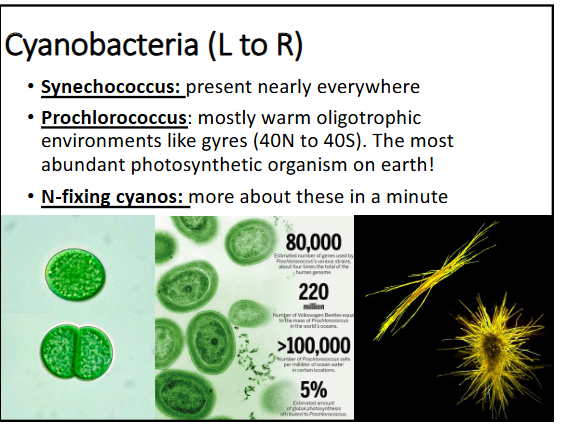
-synechococcus: present nearly everywhere
-prochlorococcus: mostly warm oligotrophic environments like gyres (40N to 40S); the most abundant photosynthetic organism on earth!
-N-fixing cyanos
<p><span style="color: rgb(0, 0, 0);">-synechococcus: present nearly everywhere</span><span style="color: rgb(0, 0, 0);"><br></span><span style="color: rgb(0, 0, 0);">-prochlorococcus: mostly warm oligotrophic environments like gyres (40N to 40S); the most abundant photosynthetic organism on earth!</span><span style="color: rgb(0, 0, 0);"><br></span><span style="color: rgb(0, 0, 0);">-N-fixing cyanos </span></p>
68
New cards

describe a simple view of nutrient cycling

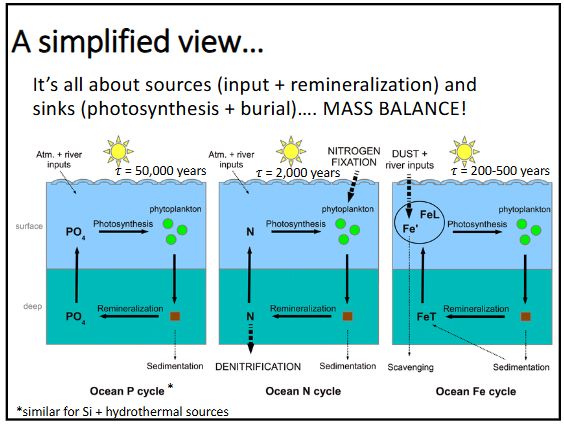
-it’s all about sources (input + remineralization) and sinks (photosynthesis and burial) … mass balance

-only ~1% gets buried into marine sediments (the only output)

-differences in residence times depend on organisms use and inputs
<p>-it’s all about sources (input + remineralization) and sinks (photosynthesis and burial) … mass balance</p><p>-only ~1% gets buried into marine sediments (the only output)</p><p>-differences in residence times depend on organisms use and inputs</p>
69
New cards

what is the residence time of nitrogen?

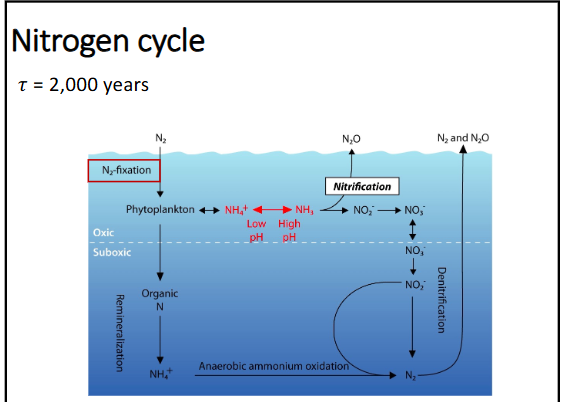
~2,000 years

-nitrogen is different from other nutrients because it needs to be converted from N2 into a usable form for organisms

-nitrogen gas N2 is turned into ammonium (NH4+) by nitrogen fixing bacteria (called “diazotrophs”)
<p>~2,000 years</p><p>-nitrogen is different from other nutrients because it needs to be converted from N<sub>2</sub> into a usable form for organisms</p><p>-nitrogen gas N<sub>2 </sub>is turned into ammonium (NH<sub>4</sub><sup>+</sup>) by nitrogen fixing bacteria (called “diazotrophs”)</p>
70
New cards

describe nitrogen redox reactions

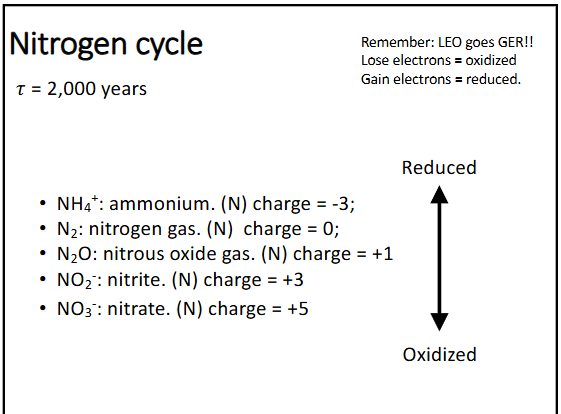
oxidation-reduction reactions act on different forms on nitrogen (ammonium, nitrogen gas, nitrous oxide gas, nitrite, and nitrate)
<p>oxidation-reduction reactions act on different forms on nitrogen (ammonium, nitrogen gas, nitrous oxide gas, nitrite, and nitrate)</p>
71
New cards

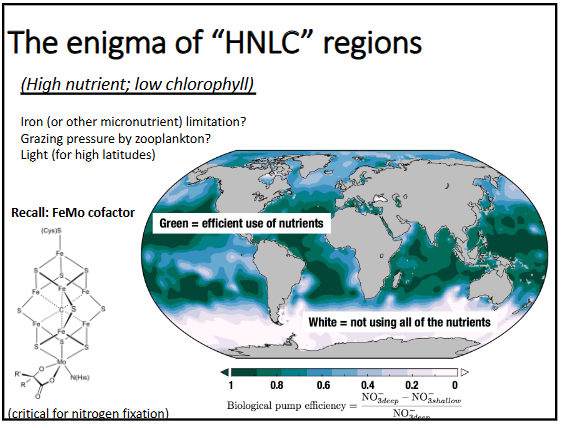
what is the enigma of “HNLC” regions (nigh nutrient; low chlorophyll)?

iron is limiting in these areas which limits nitrate production as the FeMo cofactor is crucial in nitrogen fixation processes
<p>iron is limiting in these areas which limits nitrate production as the FeMo cofactor is crucial in nitrogen fixation processes</p>
72
New cards

what is nitrification?

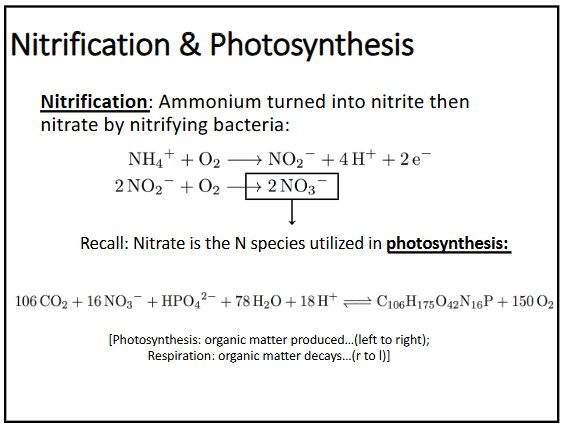
ammonium gets turned into nitrite and then into nitrate by nitrifying bacteria

(nitrate is the nitrogen form that is utilized in photosynthesis)
<p>ammonium gets turned into nitrite and then into nitrate by nitrifying bacteria</p><p>(nitrate is the nitrogen form that is utilized in photosynthesis)</p>
73
New cards

what is denitrification?

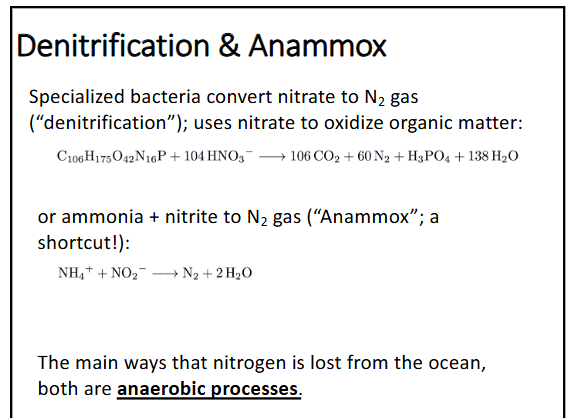
occurs when specialized bacteria convert nitrate → N2 gas; uses nitrate to oxidize organic matter
<p>occurs when specialized bacteria convert nitrate → N<sub>2 </sub>gas; uses nitrate to oxidize organic matter</p>
74
New cards

the main ways that nitrogen is lost from the ocean is what?

-ammonia and nitrite → N2 gas (“anammox”; a shortcut)

-both are anaerobic processes
<p>-ammonia and nitrite → N<sub>2 </sub>gas (“anammox”; a shortcut)</p><p>-both are anaerobic processes</p>
75
New cards

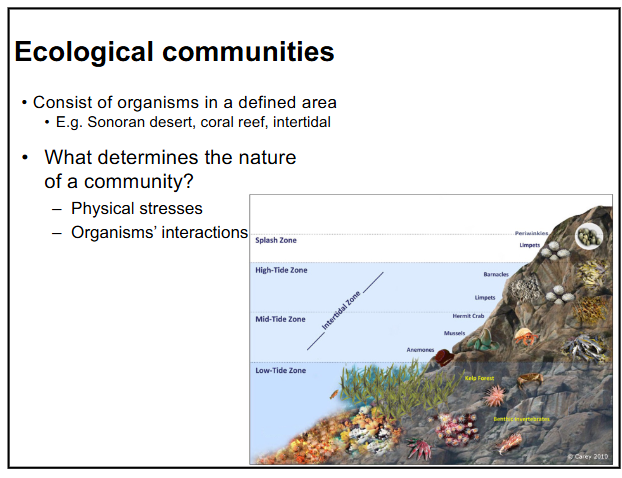
what are ecological communities? what determines the nature of a community?

-an ecological community consist of organisms in a defined area

-physical stresses and organisms’ interactions determines the nature of a community
<p>-an ecological community consist of organisms in a defined area</p><p>-physical stresses and organisms’ interactions determines the nature of a community</p>
76
New cards

what is an ecological niche?

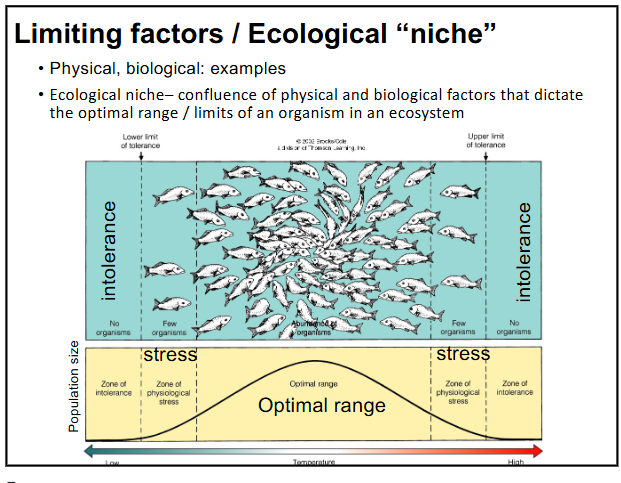
-confluence of physical and biological factors that dictate the optimal range / limits of an organism in an ecosystem

-most organisms are found in their “optimal range”, as you increase stress factors there are less organisms found in “zone of physiological stress” until there are none found in the “zone of intolerance”
<p>-confluence of physical and biological factors that dictate the optimal range / limits of an organism in an ecosystem</p><p>-most organisms are found in their “optimal range”, as you increase stress factors there are less organisms found in “zone of physiological stress” until there are none found in the “zone of intolerance”</p>
77
New cards

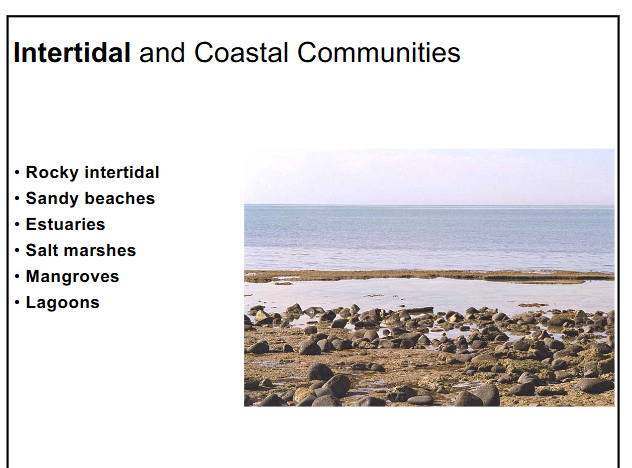
rocky intertidal, sandy beaches, estuaries, salt marshes, mangroves and lagoons are all examples of what?

intertidal and coastal communities
<p>intertidal and coastal communities</p>
78
New cards

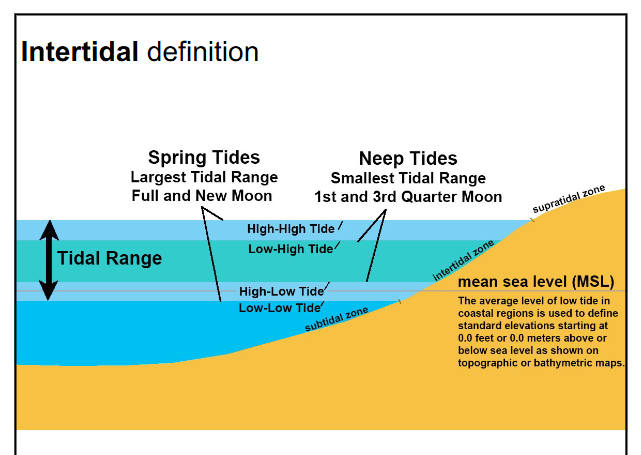
what is the definition of intertidal zones?

zone found in between the lowest low tide and the highest high tide
<p>zone found in between the lowest low tide and the highest high tide</p>
79
New cards

what are characteristic stressors of the intertidal zone?

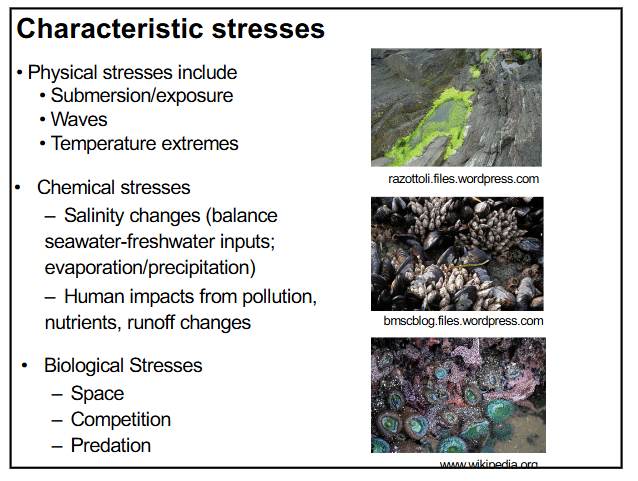
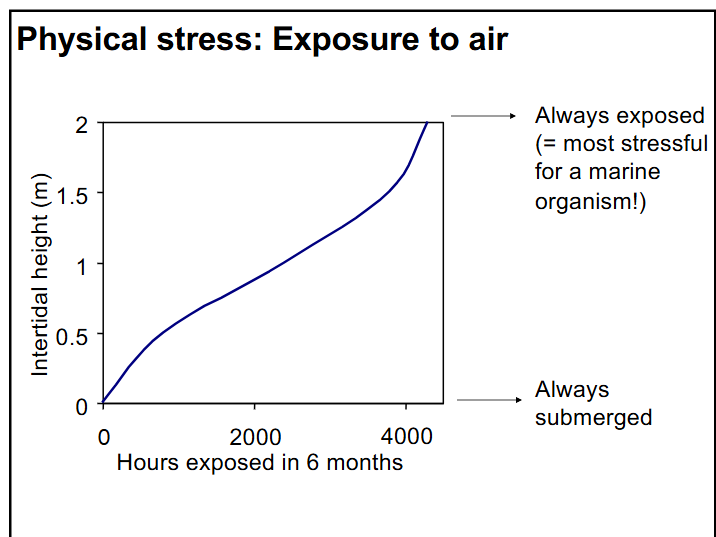
-physical stresses → submersion/exposure, waves, and temperature extremes

-chemical stresses → salinity changes (balance seawater-freshwater inputs; evaporation/precipitation) and human impacts (from pollution, nutrients and runoff changes)

-biological stresses → space, competition and predation
<p>-physical stresses → submersion/exposure, waves, and temperature extremes</p><p>-chemical stresses → salinity changes (balance seawater-freshwater inputs; evaporation/precipitation) and human impacts (from pollution, nutrients and runoff changes)</p><p>-biological stresses → space, competition and predation </p>
80
New cards
<p>how do marine organisms cope with exposure to air?</p>

how do marine organisms cope with exposure to air?

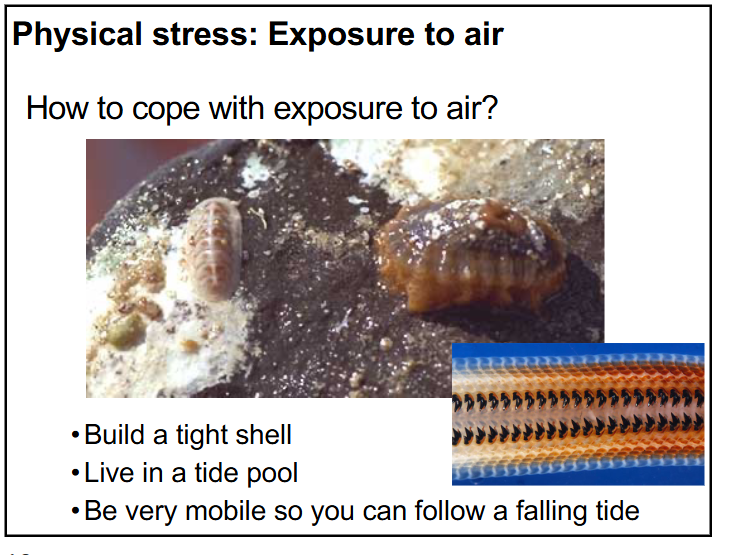
-build a tight shell

-live in a tide pool

-be very mobile so you can follow a falling tide

-use their muscular foot to firmly attach to the rocks to reduce air exposure

-use their radula to scrap the rock and create a little dividen for them to sit in
<p>-build a tight shell</p><p>-live in a tide pool</p><p>-be very mobile so you can follow a falling tide</p><p>-use their muscular foot to firmly attach to the rocks to reduce air exposure</p><p>-use their radula to scrap the rock and create a little dividen for them to sit in </p>
81
New cards

describe tide pools in rocky intertidal zones

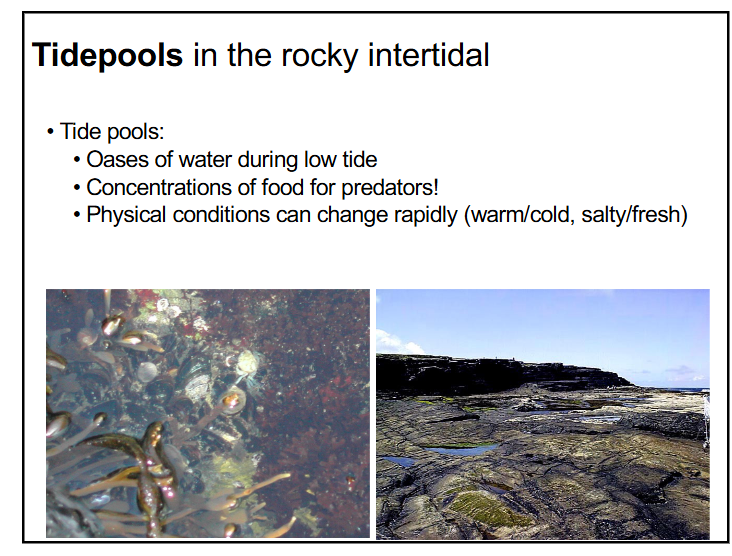
-oases of water during low tide

-concentrations of food for predators

-physical conditions can change rapidly (warm/cold, salty/fresh)
<p>-oases of water during low tide</p><p>-concentrations of food for predators</p><p>-physical conditions can change rapidly (warm/cold, salty/fresh)</p>
82
New cards

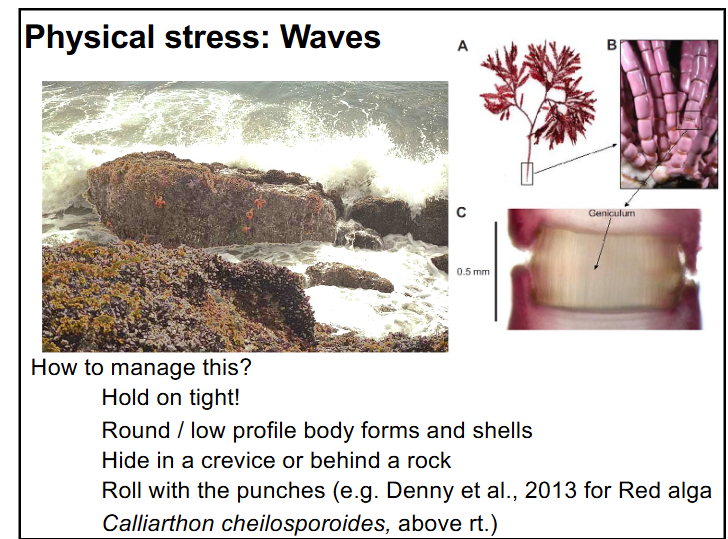
how do organisms in the rocky intertidal zone manage wave stress?

-hold on tight

-round / low profile body forms and shells

-hide in a crevice or behind a rock

-roll with the punches (marine macroalgae and coralline red algae // holdfasts with flexible stipes or geniculum)
<p>-hold on tight</p><p>-round / low profile body forms and shells</p><p>-hide in a crevice or behind a rock</p><p>-roll with the punches (marine macroalgae and coralline red algae // holdfasts with flexible stipes or geniculum)</p>
83
New cards
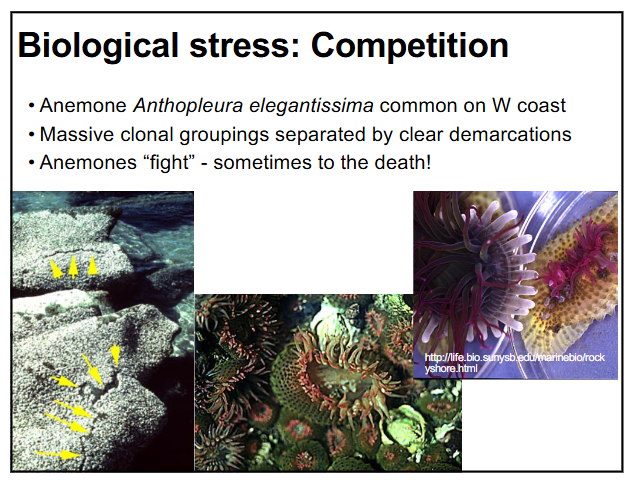
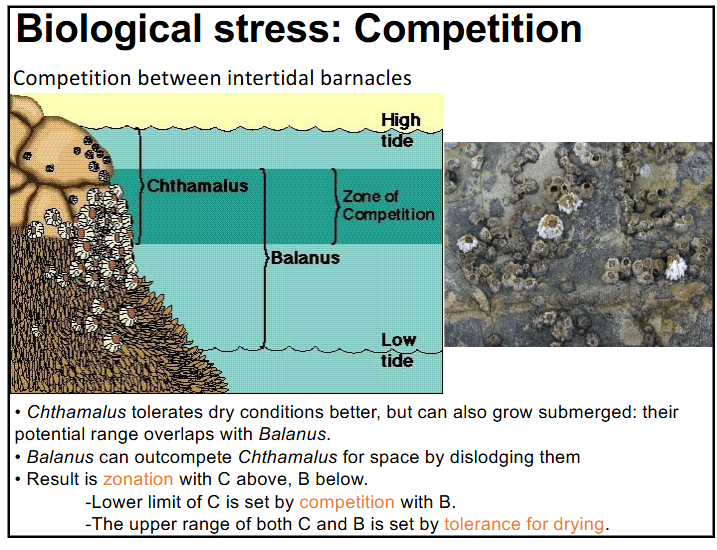
<p>how do marine organisms deal with biological competition?</p>

how do marine organisms deal with biological competition?

-anemones “fight” (sometimes to the death)

-massive clonal groupings separated by clear demarcations

-zonation: species of close competition will form a gradient based on the better competitor who can tolerate specific conditions (dry conditions for ex) better
<p>-anemones “fight” (sometimes to the death)</p><p>-massive clonal groupings separated by clear demarcations</p><p>-zonation: species of close competition will form a gradient based on the better competitor who can tolerate specific conditions (dry conditions for ex) better</p>
84
New cards

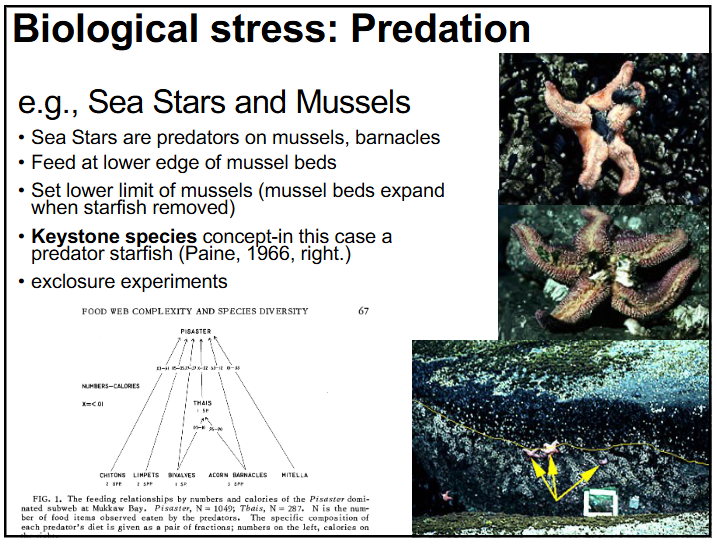
how do marine organisms deal with biological predation?

-sea stars are predators of mussels and barnacles, they feed at lower edge of mussel beds

-set lower limit of mussels (mussel beds expand greatly when starfish was removed and took over other species niches)

-keystone species concept-in this case a predator sea star

-exclusion experiments by Paine, 1966
<p>-sea stars are predators of mussels and barnacles, they feed at lower edge of mussel beds</p><p>-set lower limit of mussels (mussel beds expand greatly when starfish was removed and took over other species niches)</p><p>-keystone species concept-in this case a predator sea star</p><p>-exclusion experiments by Paine, 1966</p>
85
New cards

what is zonation?

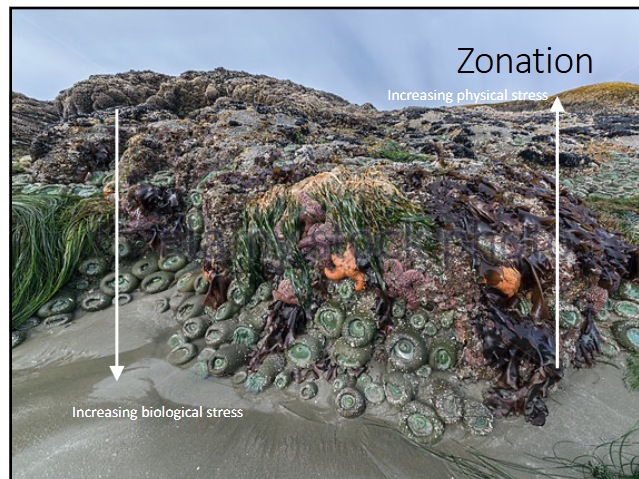
-physical stressors vary along a vertical gradient, biological stressors can also be structured vertically

-coastal/intertidal ecosystems are usually vertically zoned

-zonation is based on specific species organisms’ tolerance to both physical and biological stressors
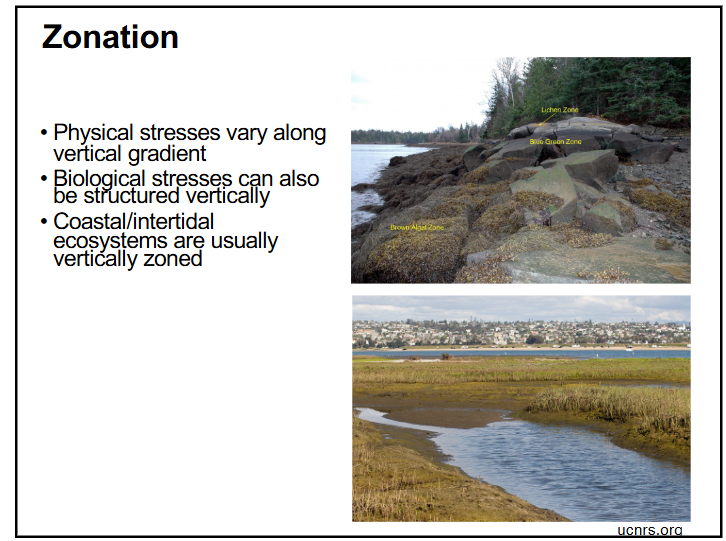
<p>-physical stressors vary along a vertical gradient, biological stressors can also be structured vertically</p><p>-coastal/intertidal ecosystems are usually vertically zoned </p><p>-zonation is based on specific species organisms’ tolerance to both physical and biological stressors</p>
86
New cards
<p>describe zonation in rocky intertidal habitats</p>

describe zonation in rocky intertidal habitats

-organisms live at specific levels in intertidal

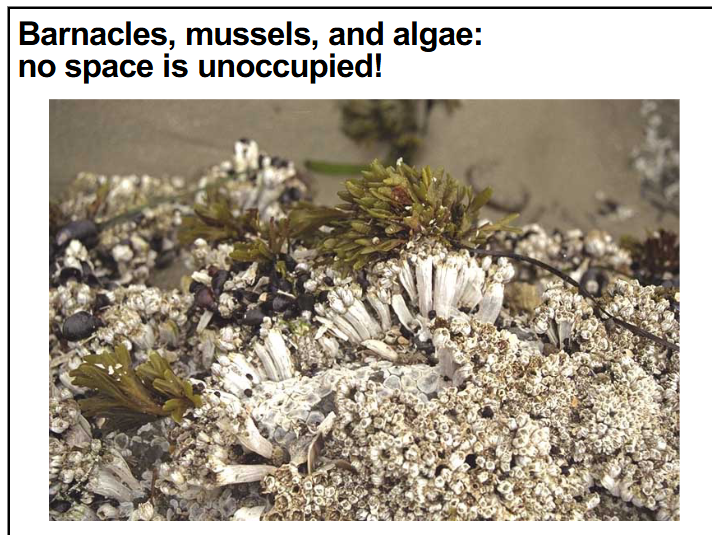
-level is determined by how the organism handles physical and biological stresses (no space is unoccupied)

-lichens and cyanobacteria → algae → mussels and barnacles → sea stars and anemones
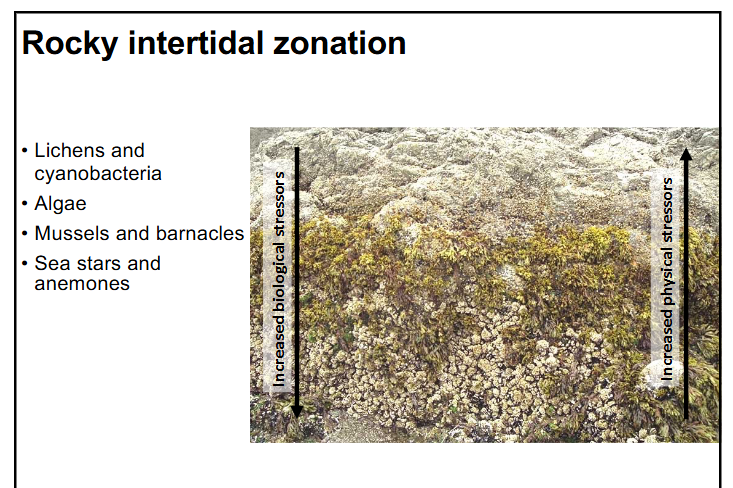
<p>-organisms live at specific levels in intertidal</p><p>-level is determined by how the organism handles physical and biological stresses (no space is unoccupied)</p><p>-lichens and cyanobacteria → algae → mussels and barnacles → sea stars and anemones</p>
87
New cards
<p>describe intertidal sandy beach habitats and life</p>

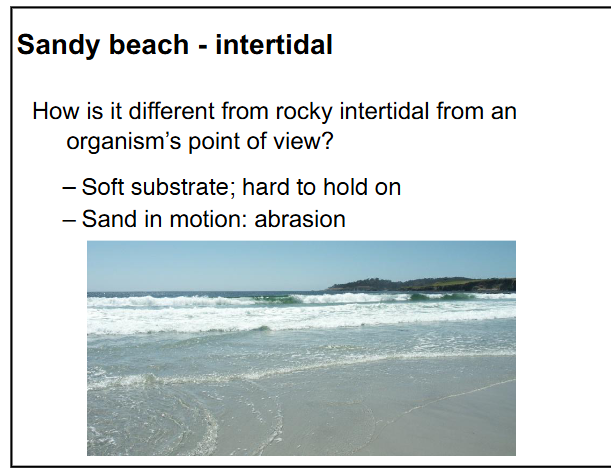
describe intertidal sandy beach habitats and life

-soft substrate → hard to hold on

-sand is in motion → abrasion (micro shards of silica)

-clams and worm’s burrow

-crabs run away from waves and burrow

-tend to have protective shells
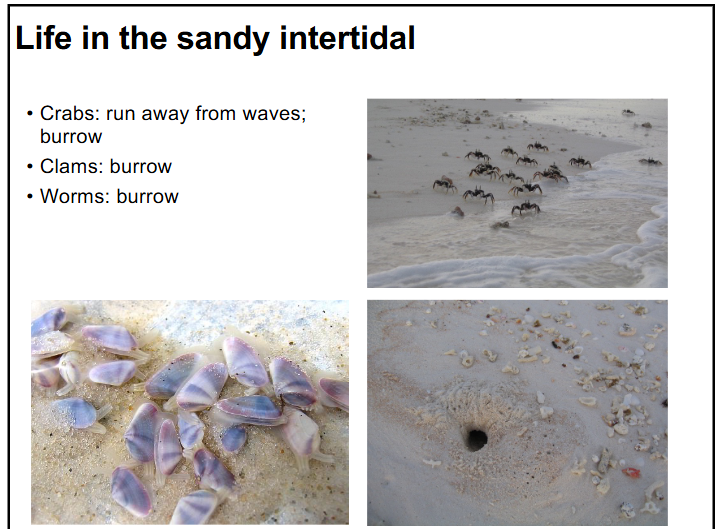
<p>-soft substrate → hard to hold on</p><p>-sand is in motion → abrasion (micro shards of silica)</p><p>-clams and worm’s burrow</p><p>-crabs run away from waves and burrow</p><p>-tend to have protective shells</p>
88
New cards
<p>describe estuaries and adaptations of organisms living in estuaries</p>

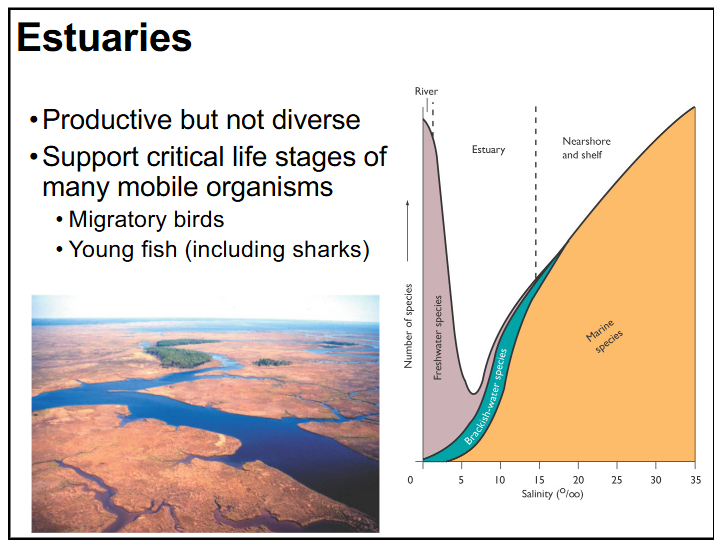
describe estuaries and adaptations of organisms living in estuaries

-estuaries → productive but not diverse; support critical life stages of many mobile organisms (young fish, sharks and migratory birds) → very important nursery habitats for fish and sequester a lot of carbon

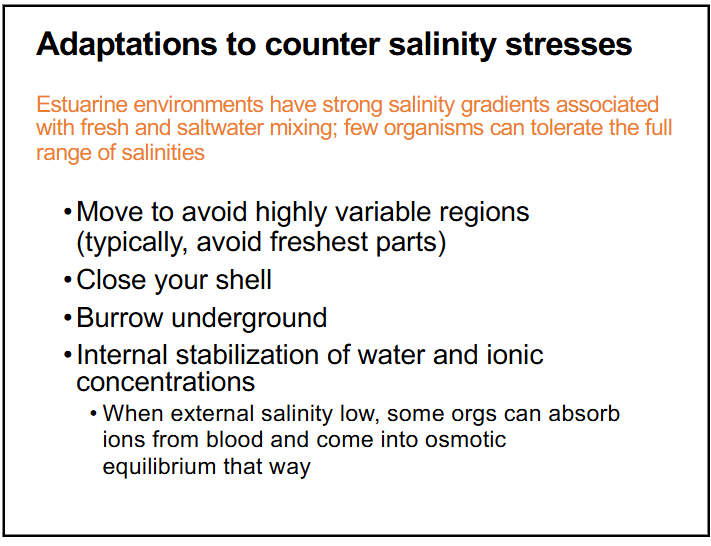
-estuarine environments have strong salinity gradients associated with fresh and saltwater mixing; few organisms can tolerate the full range of salinity

-adaptations → move to avoid highly variable regions (typically avoid freshest parts), close your shell, burrow underground, and internal stabilization of water and ionic concentrations (when external salinity is low, some organisms can absorb ions from blood and come into osmotic equilibrium that way)
<p>-estuaries → productive but not diverse; support critical life stages of many mobile organisms (young fish, sharks and migratory birds) → very important nursery habitats for fish and sequester a lot of carbon</p><p>-estuarine environments have strong salinity gradients associated with fresh and saltwater mixing; few organisms can tolerate the full range of salinity</p><p>-adaptations → move to avoid highly variable regions (typically avoid freshest parts), close your shell, burrow underground, and internal stabilization of water and ionic concentrations (when external salinity is low, some organisms can absorb ions from blood and come into osmotic equilibrium that way)</p>
89
New cards

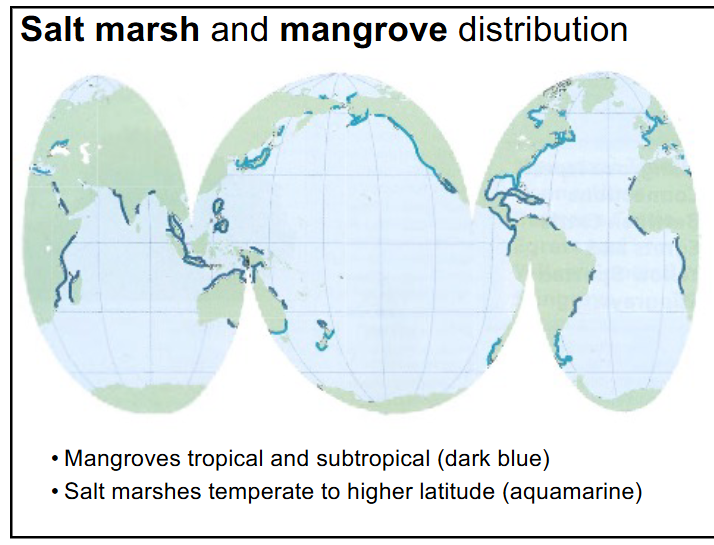
where are salt marshes and mangroves distributed?

-mangroves are tropical and subtropical

-salt marshes are temperate to higher latitudes
<p>-mangroves are tropical and subtropical</p><p>-salt marshes are temperate to higher latitudes</p>
90
New cards

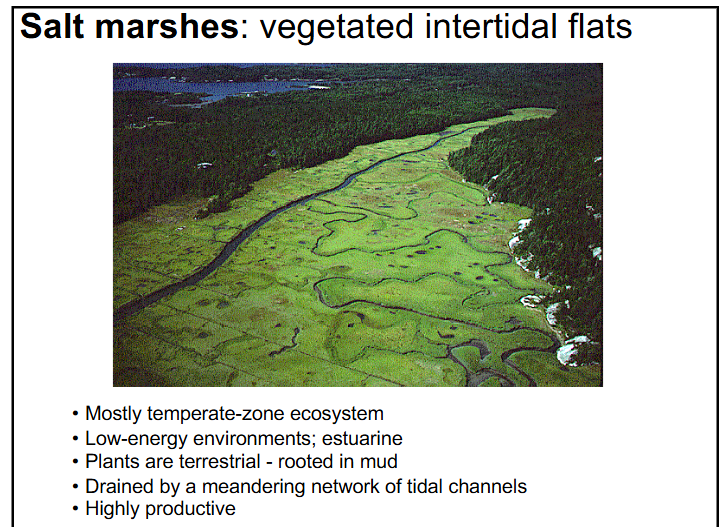
describe salt marshes (vegetated intertidal flats)

-mostly temperature-zone ecosystem

-low-energy environments; estuarine

-plants are terrestrial (rooted in mud)

-drained by a meandering network of tidal channels

-highly productive
<p>-mostly temperature-zone ecosystem</p><p>-low-energy environments; estuarine</p><p>-plants are terrestrial (rooted in mud)</p><p>-drained by a meandering network of tidal channels</p><p>-highly productive</p>
91
New cards

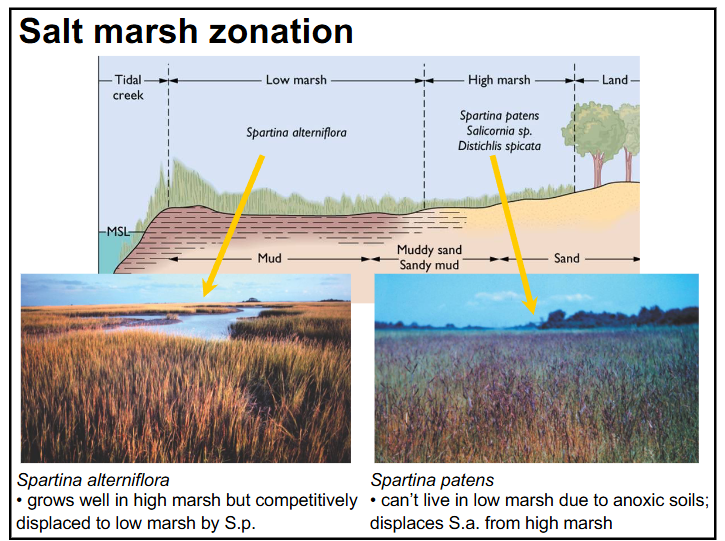
describe salt marsh zonation

the low marsh area → mud, Spartina alterniflora grows

the high marsh area → sand, Spartina patens (can’t live in low marsh due to anoxic soils; displaces S. alterniflora from high marsh)
<p>the low marsh area → mud, Spartina alterniflora grows</p><p>the high marsh area → sand, Spartina patens (can’t live in low marsh due to anoxic soils; displaces S. alterniflora from high marsh)</p>
92
New cards

what are some adaptations to salty environment by Spartina alterniflora?

-use salt and organic substrates to increase the solute concentration in their cells

-excrete excess salt from leaves and stems

-special tissues (aerenchyma) increase oxygen availability to the roots
<p>-use salt and organic substrates to increase the solute concentration in their cells</p><p>-excrete excess salt from leaves and stems</p><p><span style="color: rgb(0, 0, 0);">-</span><span style="color: rgb(0, 0, 0);">special tissues (aerenchyma) increase oxygen availability to the roots</span></p>
93
New cards
<p>what are some adaptations for marsh animals?</p>

what are some adaptations for marsh animals?

ribbed mussels (Geukensia demissa) → cluster at the base of S. alterniflora; attach to each other and substrate with threads that help stabilize the plants and sediments; filter feeders, their excretions fertilize the plants

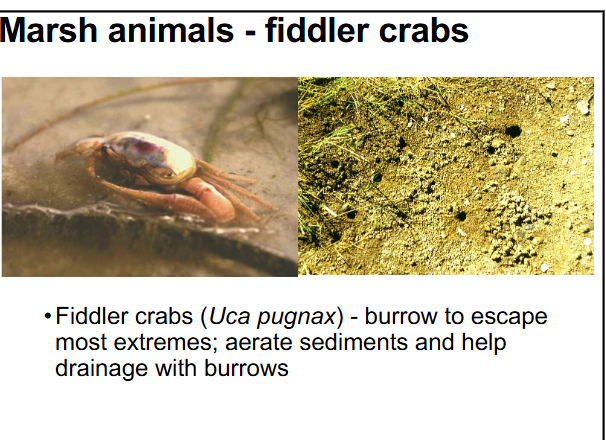
fiddler crabs (Uca pugnax) → burrow to escape most extremes; aerate sediments and help drainage with burrows
<p>ribbed mussels (Geukensia demissa) → cluster at the base of S. alterniflora; attach to each other and substrate with threads that help stabilize the plants and sediments; filter feeders, their excretions fertilize the plants</p><p>fiddler crabs (Uca pugnax) → burrow to escape most extremes; aerate sediments and help drainage with burrows</p>
94
New cards
<p>describe mangroves and mangrove adaptations</p>

describe mangroves and mangrove adaptations

-mangroves are dominant intertidal plants of tropics and subtropics; woody tree-like plants with exposed roots

-grow in soft sediments and low-energy environments

-zonation: different species dominate different zones

-3 different mangrove species → red, black and white mangroves

-adaptations → “breathing roots”, buoyant and viviparous seeds, and salt excreting leaves
<p>-mangroves are dominant intertidal plants of tropics and subtropics; woody tree-like plants with exposed roots</p><p>-grow in soft sediments and low-energy environments</p><p>-zonation: different species dominate different zones</p><p>-3 different mangrove species → red, black and white mangroves</p><p>-adaptations → “breathing roots”, buoyant and viviparous seeds, and salt excreting leaves</p>
95
New cards

describe the mangrove food web

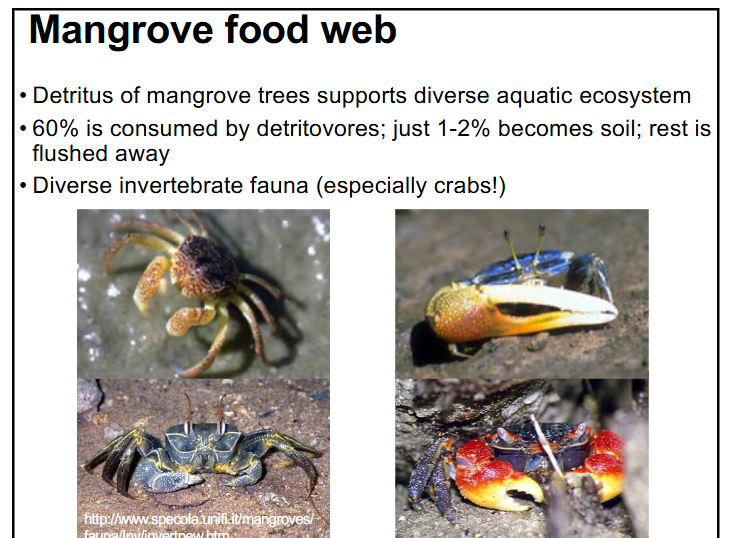
-detritus of mangrove trees supports diverse aquatic ecosystem
-60% is consumed by detritovores; just 1-2% becomes soil; rest is
flushed away
-diverse invertebrate fauna (especially crabs!)
<p><span style="color: rgb(0, 0, 0);">-detritus of mangrove trees supports diverse aquatic ecosystem</span><span style="color: rgb(0, 0, 0);"><br></span><span style="color: rgb(0, 0, 0);">-60% is consumed by detritovores; just 1-2% becomes soil; rest is</span><span style="color: rgb(0, 0, 0);"><br></span><span style="color: rgb(0, 0, 0);">flushed away</span><span style="color: rgb(0, 0, 0);"><br></span><span style="color: rgb(0, 0, 0);">-diverse invertebrate fauna (especially crabs!)</span></p>
96
New cards
<p>describe how the presence of mangroves impacts nearby ecosystems</p>

describe how the presence of mangroves impacts nearby ecosystems

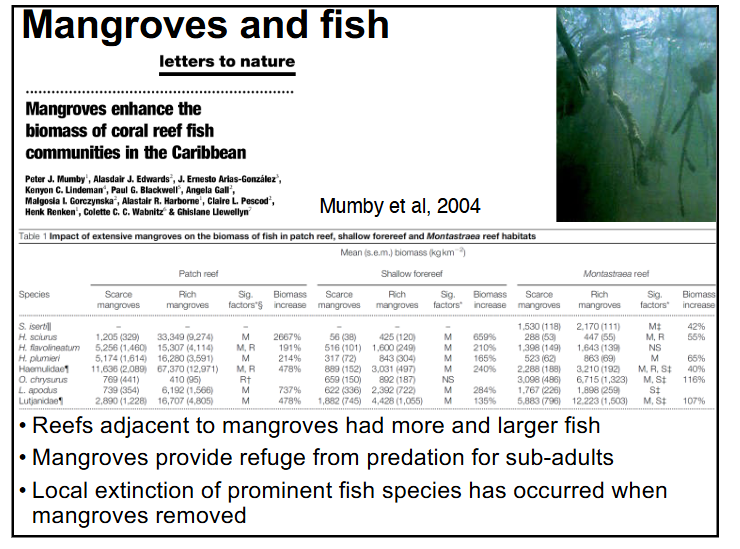
-reefs adjacent to mangroves had more and larger fish
-mangroves provide refuge from predation for sub-adults
-local extinction of prominent fish species has occurred when
mangroves removed

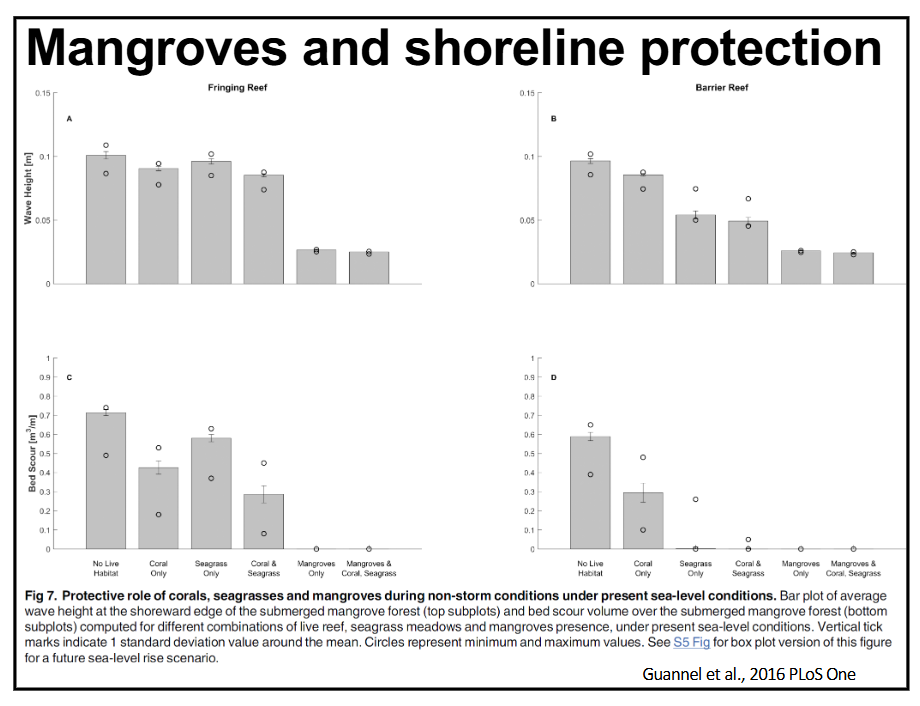
-also provide shoreline protection for humans and shore ecosystems as the plants disperse wave energy
<p><span style="color: rgb(0, 0, 0);">-r</span><span style="color: rgb(0, 0, 0);">eefs adjacent to mangroves had more and larger fish</span><span style="color: rgb(0, 0, 0);"><br></span><span style="color: rgb(0, 0, 0);">-mangroves provide refuge from predation for sub-adults</span><span style="color: rgb(0, 0, 0);"><br></span><span style="color: rgb(0, 0, 0);">-local extinction of prominent fish species has occurred when</span><span style="color: rgb(0, 0, 0);"><br></span><span style="color: rgb(0, 0, 0);">mangroves removed</span></p><p>-also provide shoreline protection for humans and shore ecosystems as the plants disperse wave energy</p>
97
New cards

what are the major current threats to mangroves?

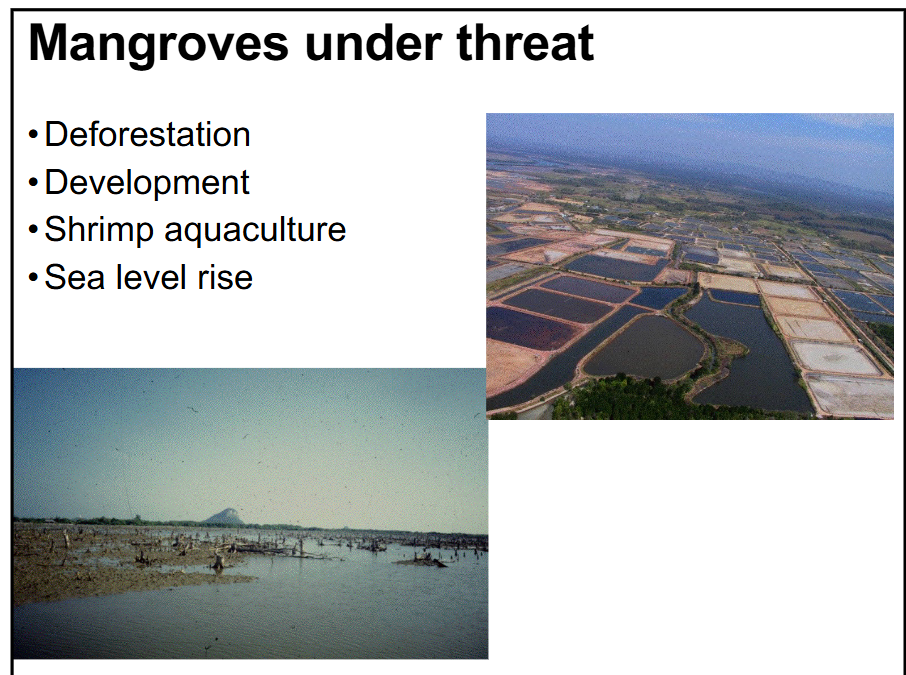
-deforestation and development

-shrimp aquaculture (and other aquaculture facilities that are close to marine ecosystems)

-sea level rise
<p>-deforestation and development</p><p>-shrimp aquaculture (and other aquaculture facilities that are close to marine ecosystems)</p><p>-sea level rise</p>
98
New cards

what are the main human impacts on coastal ecosystems?

-pollution

-nutrient overloads

-freshwater diversions

-development and aquaculture

-sedimentation increases

-invasive species

-sea level rise

over half of all coastal wetlands have been lost :(
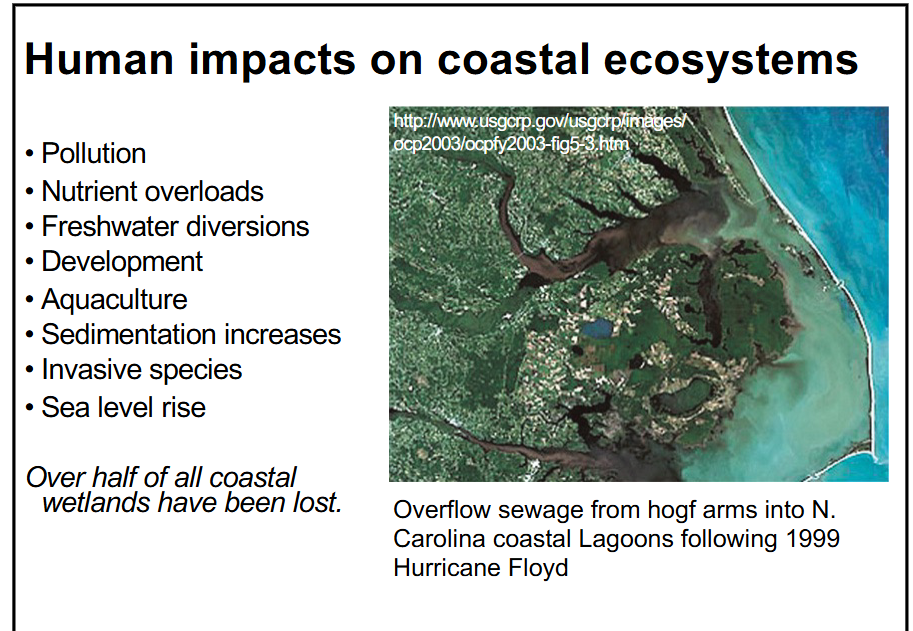
<p><span style="color: rgb(0, 0, 0);">-p</span><span style="color: rgb(0, 0, 0);">ollution</span></p><p><span style="color: rgb(0, 0, 0);">-nutrient overloads</span></p><p><span style="color: rgb(0, 0, 0);">-freshwater diversions</span></p><p><span style="color: rgb(0, 0, 0);">-development and aquaculture</span></p><p><span style="color: rgb(0, 0, 0);">-sedimentation increases</span></p><p><span style="color: rgb(0, 0, 0);">-invasive species</span></p><p><span style="color: rgb(0, 0, 0);">-sea level rise</span></p><p><span style="color: rgb(0, 0, 0);">over half of all coastal wetlands have been lost :(</span></p>
99
New cards
<p>do physical stresses always dominate upper on the zonation compared to biological stress?</p>

do physical stresses always dominate upper on the zonation compared to biological stress?

no, it is situational; either physical or biological stress is going to dominate along the “top” of a gradient or continuum, depending on what the organisms are adapted for (salt water versus freshwater for example)
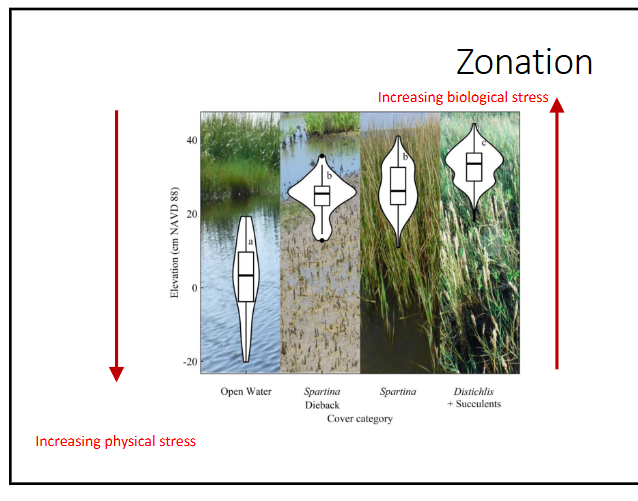
<p>no, it is situational; either physical or biological stress is going to dominate along the “top” of a gradient or continuum, depending on what the organisms are adapted for (salt water versus freshwater for example)</p>
100
New cards

describe longshore drift / sediment transport

the lateral movement of sediments along a beach resulting from waves that impact the coast at an angle
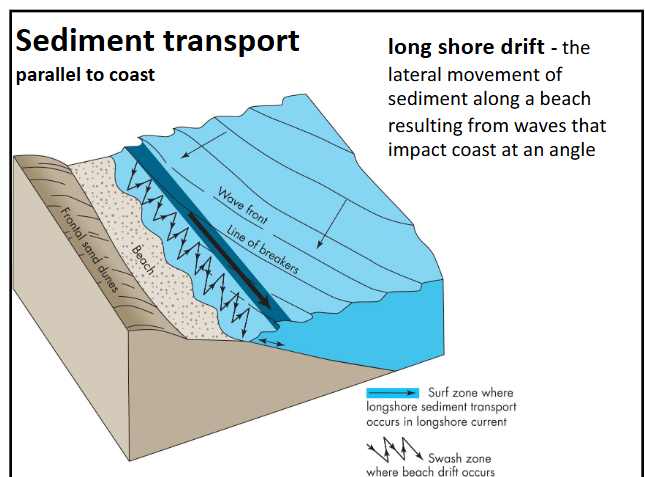
<p>the lateral movement of sediments along a beach resulting from waves that impact the coast at an angle</p>

Explore top flashcards

flashcards
ORGANIC CHEMISTRY FINALS
372
Updated 1097d ago
0.0(0)
flashcards
Azja: kraje i stolice
51
Updated 1084d ago
0.0(0)
flashcards
Midterms Vocab
215
Updated 113d ago
0.0(0)
flashcards
An Inspector Call quotes
29
Updated 28d ago
0.0(0)
flashcards
Physics - Forces in Action
22
Updated 847d ago
0.0(0)
flashcards
let's get an a in this bitch
98
Updated 555d ago
0.0(0)
flashcards
ORGANIC CHEMISTRY FINALS
372
Updated 1097d ago
0.0(0)
flashcards
Azja: kraje i stolice
51
Updated 1084d ago
0.0(0)
flashcards
Midterms Vocab
215
Updated 113d ago
0.0(0)
flashcards
An Inspector Call quotes
29
Updated 28d ago
0.0(0)
flashcards
Physics - Forces in Action
22
Updated 847d ago
0.0(0)
flashcards
let's get an a in this bitch
98
Updated 555d ago
0.0(0)