8th Grade Science Semester 1 Final
 Studied by 0 people
 Call Kai
 Learn
Learn Practice Test
 Spaced Repetition
 Match
Match Flashcards
 Knowt Play
1/58

There's no tags or description
Looks like no tags are added yet.
Name | Mastery | Learn | Test | Matching | Spaced | Call with Kai |
|---|
No analytics yet
Send a link to your students to track their progress
59 Terms
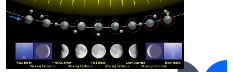
Draw and label all 8 moon phases from New Moon to New Moon
What causes seasons on Earth?
Earth’s Axis Tilt
The angle of the sun is greatest in the Summer? T or F
True
The daylight length is the longest in the Summer? T or F
True
The tilt of Earth’s axis causes the sun to be above the horizon longer in the winter than in the summer. T or F
False

Which diagram above shows the angle of the Sun hitting more directly and thus transferring mor energy to the surface?
summer
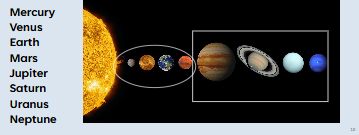
Draw a diagram that shows all 8 planets in correct order starting from the Sun, circle the inner planets, and box the outer planets.
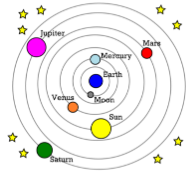
List the planets in the order they occur in this diagram from the center out.
Earth, (Moon), Mercury, Venus, (Sun), Mars, Jupiter, Saturn
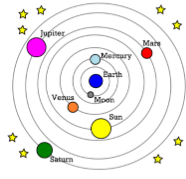
What is incorrect about the diagram above
Earth is at center
Missing Uranus
Missing Neptune
Sun orbits Earth
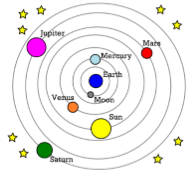
Is the diagram above in a correct distance scale?
no
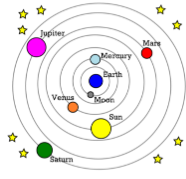
Is the diagram above in a correct size scale?
no
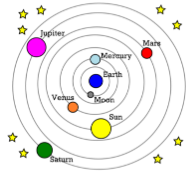
What is right in the diagram? List 3 things
Moon is orbiting Earth
The planets are in circular orbits
Mars. Jupiter, and Saturn in correct order
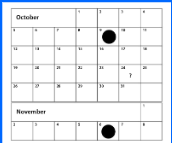
Using the calendar below, fill in the correct moon phase for the following dates:
October 8
October 16
November 8
Waning Crescent
First Quarter
Waxing Crescent
One full moon cycle takes about how long?
30 days or 1 month
There are many objects in our solar system that are larger than the planet Mercury like several moons for various planets and some large asteroids. Why are they not classified planets?
Planets are rounded by gravity, Cleared the area of their orbit, Orbit the Sun
If an object is 17 au from the Sun then it will be 17 time what?
Further away from the Sun than Earth is
Does the Sun orbit anything?
Center of the Milky Way Galaxy
Saturn’s diameter is about 8 times larger than Earth’s diameter. If Earth were modeled with a pea (0.5 cm) which would work best to create a scale model of Jupiter?
4 cm diameter object
Does our Solar System contain an asteroid belt?
Yes
Does our Solar System contain dwarf planets?
Yes
Are all telescopes found on the planet Earth?
No
What are 4 advantages of using a scale model to learn about the Solar System?
The distances in space are large compared to what we can see from Earth. Models help us understand that.
It is less expensive than sending people of spacecraft into space.
It is safer with less risk to build a model
Stars are much larger than what they appear to be in the night sky so models help put them in perspective.

What season would this diagram represent in the Northern Hemisphere?
summer

What season would this represent in the Southern Hemisphere?
winter
When creating a system model to show why we experience seasons on Earth, what interactions would need to be included?
Angle of Sunlight, Earth’s Axis Tilt, Earth’s Orbit
When creating a system model to show why we experience seasons on Earth, what components would need to be included?
Sun, Earth
What causes day and night on Earth?
Rotation of Earth
What causes the year to be 365 days long?
Revolution or Orbit of Earth around the Sun
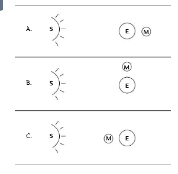
Identify the moon phase at each position
A. Full Moon
B. 3rd Quarter
C. New Moon
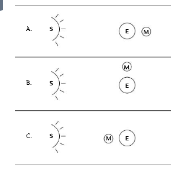
At which two points could an eclipse occur?
A, C
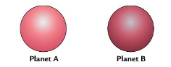
The two planets in the diagram below have the same diameter. Planet A has a mass of 150, while Planet B has a mass of 200. Which would have greater gravity? Why?
Planet B has more mass and thus more gravitational force
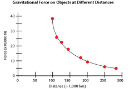
Draw a diagram that shows two objects with an equal mass that have a different force of gravity because of their distance.

Describe the relationship between mass and force of gravity
Direct relationship- objects with more mass have greater gravitational force
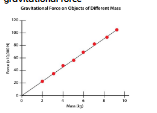
Describe the relationship between distance and force of gravity
Indirect relationship- objects closer have greater gravitational force
If the Sun’s diameter is about 10 times that of Jupiter’s, and I am using a basketball with a diameter of 75 cm, what would an object that represented the sun need to have for its diameter?
75 × 10 = 750 cm
Jupiter’s diameter is about 140,000 km. Using a scale of 1 cm = 14,000 km, what would be the scaled diameter for Jupiter? Show your math and box your answer.
140,000/14,000
140/14= 10 cm
Steps forming the Solar System
Huge cloud of gas and dust forms.
Gravity caused two opposite sides of the cloud of gas and dust to come together to form a huge spinning disk.
Nearly all the mass of the cloud (99.8%) was pulled into the center of the disk and formed the sun mor center star
The leftover 0.2% of gas and dust began to form planets, moons, asteroids, and comets.
Observation
information gathered using the 5 senses and instruments
astronomer
scientist studying space and the objects in it
galaxy
collection of stars and their solar systems that are gravitationally bound togetherm
model
any representation of a system or its components used to help understand and communicate how it works
scale
the ratio of the size of a real object to the size of a model, map, diagram of the object. can also be used to refer to the general size of objects being referred to- molecular scale
phase
shapes of the moon as seen from earth
axis
imaginary line from the North Pole to the South Pole of a planet
orbit
curved path that a space object takes around a star, planet, or moon
Earth’s Tilt
23.5
Reasoning
logical statements used to show how the evidence proves the claim
What do all inner planets have in common?
small and rocky
What do all the outer planets have in common?
large and gaseous, have rings, cold, many moons
Will planets always orbit a star in the same direction?
no
What is the difference between a moon and a planet?
a space object is a moon if it orbits a planet but a space object that is big enough and goes around a star is considered a planet
If something causes a satellite in orbit of a planet to slow down, what will happen to the satellite?
it will move closer to the plane- it may crash into it
Give an example of a trade-off between using a telescope to explore a planet or sending a space probe to the planet.
Choosing to use telescopes to make observations of space objects to save money while giving up the detailed information that could be gained by sending space probes
How many stars can one solar system have?
the norm is 2 but solar systems have been observed with up to 7 stars (suns)
What would be closer to the Earth, Neptune or the Andromeda Galaxy?
Neptune
What is an AU?
astronomical unit, the distance from the earth to the sun, 150,000,000 km, unit to measure space object distances
What are the rocky planets in our solar system and what are to gaseous planets in our Solar System?
Mercury, Venus, Earth Mars- Rocky planets
Jupiter, Saturn, Uranus, Neptune- Gaseous planets
Planet X is 4 times bigger than Planet Y. If the diameter of Planet Y is 4,200 km, what is the diameter of Planet X?
16,800 km
The rising of the sun and the setting of the sun represent what on Earth? What causes this phenomenon?
Day to night
Rotation or spinning of Earth
 Note
Note  Flashcards (133)