L-Spine and coccyx A&P 1/21/26
 Studied by 0 people
 Call Kai
 Learn
Learn Practice Test
 Spaced Repetition
 Match
Match Flashcards
 Knowt Play
1/76

There's no tags or description
Looks like no tags are added yet.
Name | Mastery | Learn | Test | Matching | Spaced | Call with Kai |
|---|
No analytics yet
Send a link to your students to track their progress
77 Terms
What are the five major parts of the vertebral column
Cervical, Thoracic, Lumbar, Sacrum, Coccyx
Which vertebrae make up the cervical region
C1 to C7
Which vertebrae make up the thoracic region
T1 to T12
Which vertebrae make up the lumbar region
L1 to L5
What is the sacrum and where is it located
Triangular bone at base of spine, formed by fused sacral vertebrae
What is the coccyx and how many vertebrae does it contain
Tailbone, 3–5 rudimentary vertebrae
What is the normal curvature of the cervical spine called
Lordotic
What is the normal curvature of the thoracic spine called
Kyphotic
What is the normal curvature of the lumbar spine called
Lordotic
What is the normal curvature of the sacral/pelvic region called
Kyphotic
What is kyphosis in terms of spinal curvature
Excessive outward curvature of the thoracic spine
What is lordosis in terms of spinal curvature
Excessive inward curvature of the lumbar spine
What is scoliosis and how does it affect the spine
Abnormal “S” shaped lateral curvature
Which part of a typical vertebra bears most of the weight
Vertebral body
Which part of a vertebra forms the posterior portion surrounding the spinal canal
Vertebral arch
What are pedicles in a vertebra and where are they located
Short bony projections connecting body to laminae
What are the superior and inferior vertebral notches and what do they form
Indentations on pedicles that form intervertebral foramina
Which part of a vertebra connects the transverse processes to the spinous process
Laminae
What are transverse processes and where do they extend from
Lateral projections from vertebral arch
What is the spinous process and where is it located
Posterior projection from vertebral arch
What are the superior and inferior articular processes and what do they articulate with
Projections that articulate with adjacent vertebrae
What is the pars interarticularis in the lumbar vertebrae
Part of lamina between superior and inferior articular processes
How does the lumbar spinous process differ from cervical or thoracic spinous processes
Short, thick, and blunt, pointing posteriorly
How many sacral segments fuse, and between what ages does fusion occur
5 segments, fuse between ages 20–30
What is the sacral canal and what does it transmit
Continuation of vertebral canal, transmits sacral nerves
What are the sacral foramina and what passes through them
Openings on sacrum, transmit sacral nerves and vessels
How many vertebrae usually make up the coccyx
3–5
What type of joint is formed between vertebral bodies
Cartilaginous (symphysis)
What is the purpose of intervertebral disks
Shock absorption and mobility between vertebrae
What are zygapophyseal joints and what do they connect
Synovial joints connecting superior and inferior articular processes
What is a herniated nucleus pulposus (HNP)
Displacement of intervertebral disk nucleus through annulus fibrosus
What is a laminectomy and why is it performed?
Surgical removal of lamina to relieve spinal cord or nerve pressure
What is spondylolysis
Defect or fracture of pars interarticularis
What is spondylolisthesis
Forward displacement of a vertebra over the one below it
How does osteoarthritis affect the vertebral joints
Degeneration of cartilage and narrowing of joint spaces
AP Lumbar Spine part position
Flex hips and knees to reduce lumbar lordosis
AP Lumbar Spine central ray
CR to MSP at level of L4 iliac crest to include pubic symphysis; if pubic symphysis not required CR at L3 one inch above iliac crest
AP Lumbar Spine structures visualized
T12 through S1
Lumbar Spine obliques part position
Rotate patient 45 degrees supported with sponge
Lumbar Spine obliques central ray
Two inches medial to elevated ASIS and one to one and a half inches above iliac crest at L3
Lumbar Spine obliques structures visualized
Articular processes and zygapophyseal joints
Lumbar Spine obliques appearance
Scotty dog sign
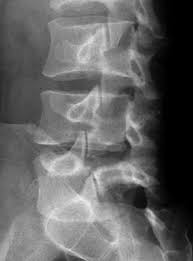
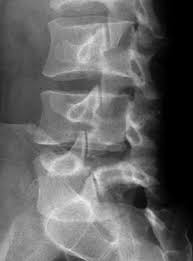
Scotty Dog ear
Superior articular process
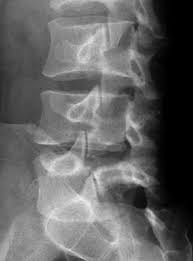
Scotty Dog nose
Transverse process
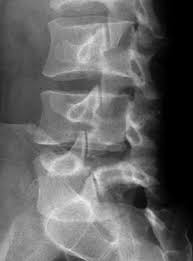
Scotty Dog eye
Pedicle
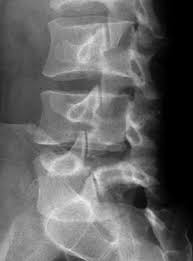
Scotty Dog neck
Pars interarticularis
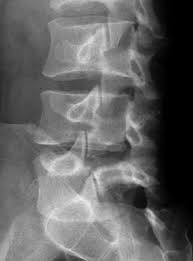
Scotty Dog body
Lamina
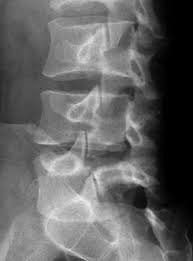
Scotty Dog front leg
Inferior articular process
Lateral Lumbar Spine patient position
Upright or recumbent
Lateral Lumbar Spine part position
Arms flexed at elbows at right angle
Lateral Lumbar Spine central ray
CR at L4 iliac crest for lumbosacral exam or at L3 one to one and a half inches above crest for lumbar only
Spot central ray male angle
Five degrees caudal
L5 S1 spot central ray female angle
Eight degrees caudal
Spot centering
2 inches posterior to ASIS and 1.5 inferior to iliac crest
Lateral hyperflexion and hyperextension patient position
Recumbent or upright
Lateral hyperflexion and hyperextension part position
Flexion bend forward extension bend backward
Lateral hyperflexion and hyperextension central ray
Perpendicular to L3 on midcoronal plane
Lateral hyperflexion and hyperextension structures visualized
Motion at spinal fusion sites and possible herniated disks
AP hyperflexion and hyper extension central ray
MSP at level of L3 one to one and a half inches above iliac crest
AP axial sacrum part position
MSP centered support knees if supine
AP axial sacrum central ray
Fifteen degrees cephalic entering midline two inches inferior to ASIS
AP axial sacrum structures visualized
Sacrum free of superimposition
Lateral sacrum part position
Knees superimposed arms at right angle pelvis and shoulders in true lateral
Lateral sacrum central ray
Perpendicular to level of ASIS three and a half inches posterior
Lateral sacrum collimation
Ten by twelve
AP coccyx part position
MSP centered support knees if supine
AP coccyx central ray
Ten degrees caudal entering midline two inches inferior to ASIS
AP coccyx structures visualized
Coccyx free of superimposition
Lateral coccyx part position
Knees superimposed pelvis and shoulders in true lateral
Lateral coccyx central ray
Two inches inferior to ASIS and three and a half inches posterior
Lateral coccyx collimation
Six by eight
Lateral sacrum and coccyx combined
Sacrum and coccyx are typically imaged together in a lateral view
Lumbar spine level at iliac crest
L4
Lumbar spine level one to one and a half inches above iliac crest
L3
Oblique lumbar spine collimation
10×12
What is the breathing for all L-Spine views?
On exhalation
What goes in the intervertebral foramina?
Nerves
 Note
Note  Flashcards (62)