EVE100 MT1
 Call Kai
 Learn
Learn Practice Test
 Spaced Repetition
 Match
Match Flashcards
 Knowt Play
1/130

Name | Mastery | Learn | Test | Matching | Spaced | Call with Kai |
|---|
No analytics yet
Send a link to your students to track their progress
131 Terms
Phylogeny
A hypothesis of the relationships among species, populations, or genes
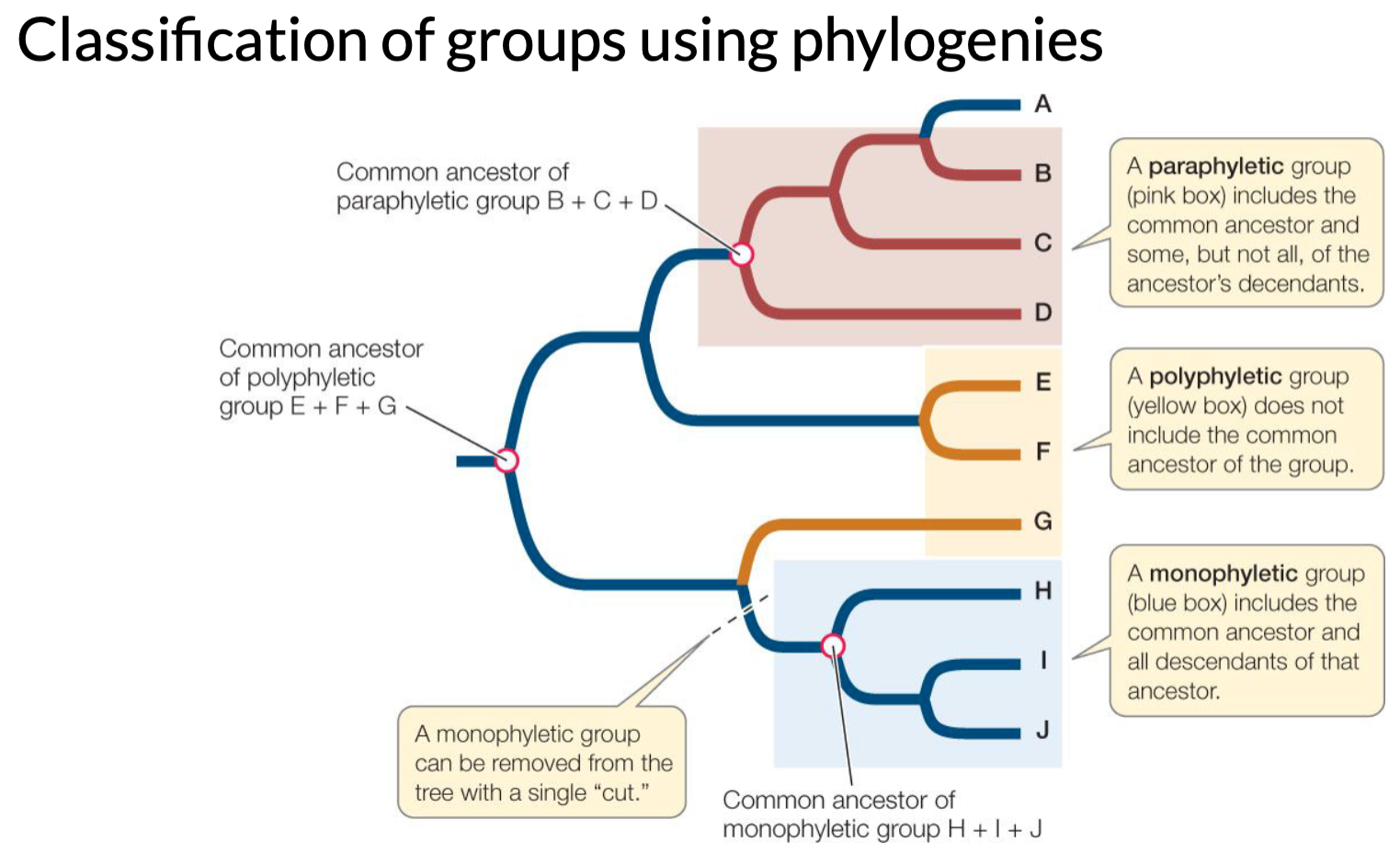
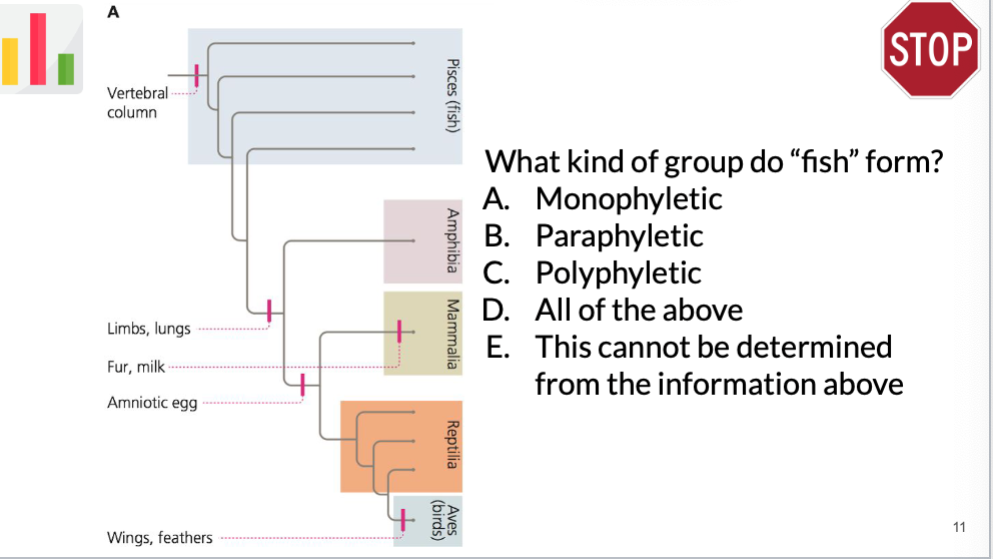
Paraphyletic group
Includes common ancestor and some, but not all, of the ancestors descendants
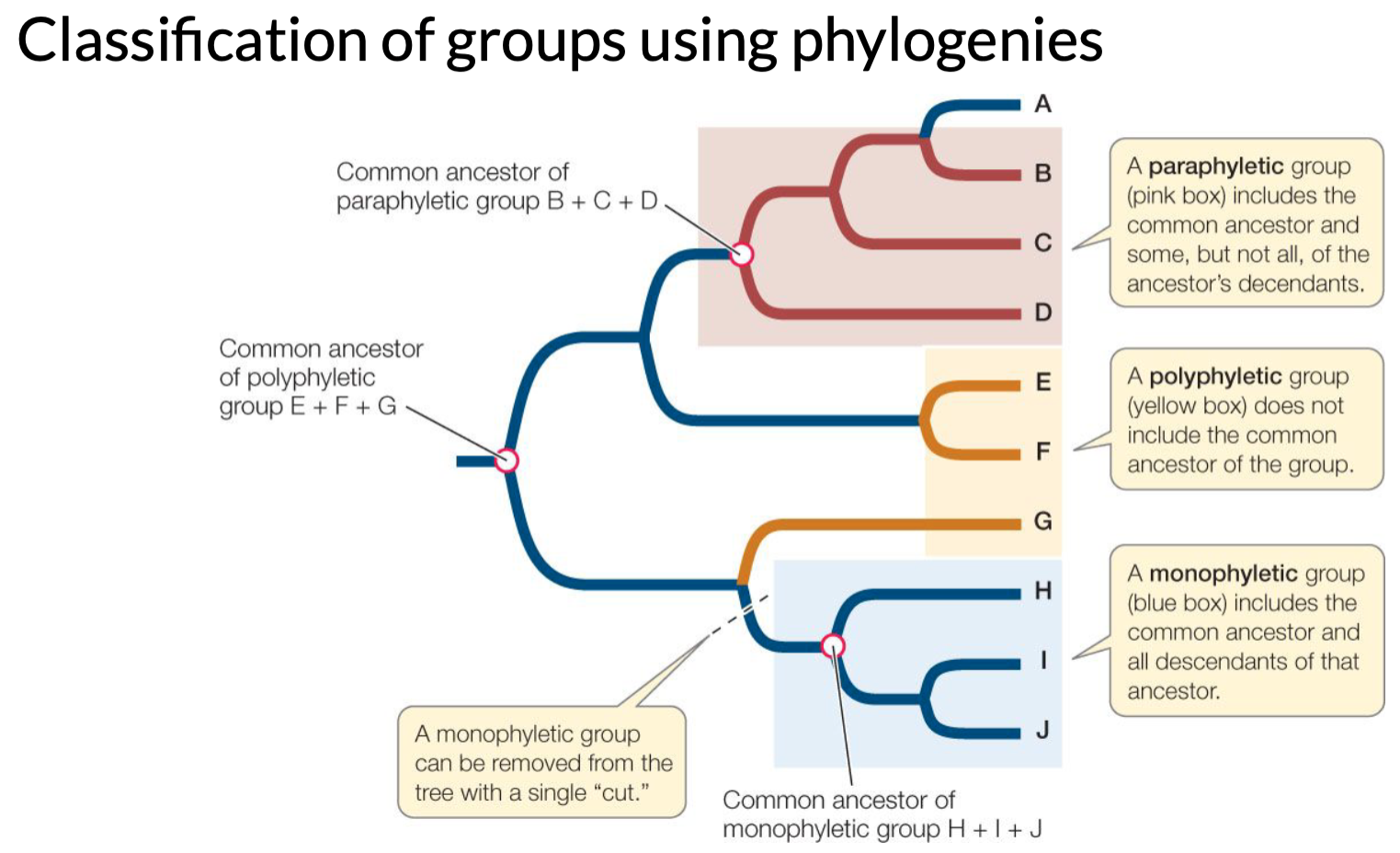
Polyphyletic group
Does not include the common ancestor of the group
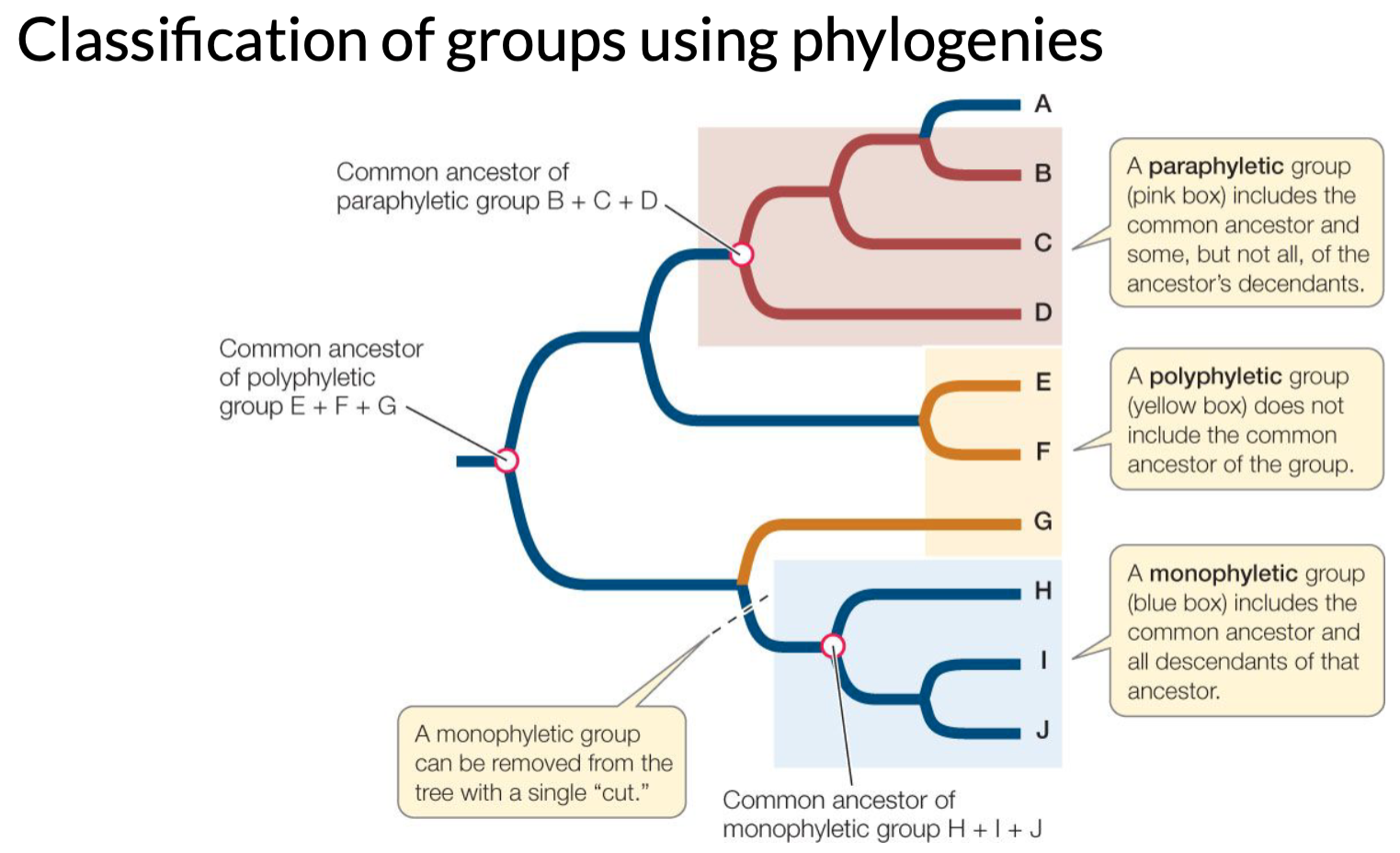
Monophyletic group
includes the common ancestor of the group
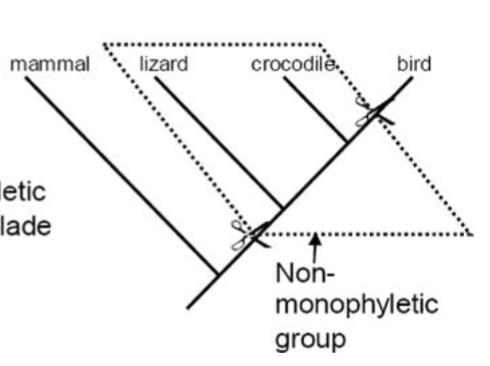
Can a monophyletic group be removed from a tree with a single “cut?”
yes
monophyletic group
triangle cut on a phylogenetic tree at the end; clade
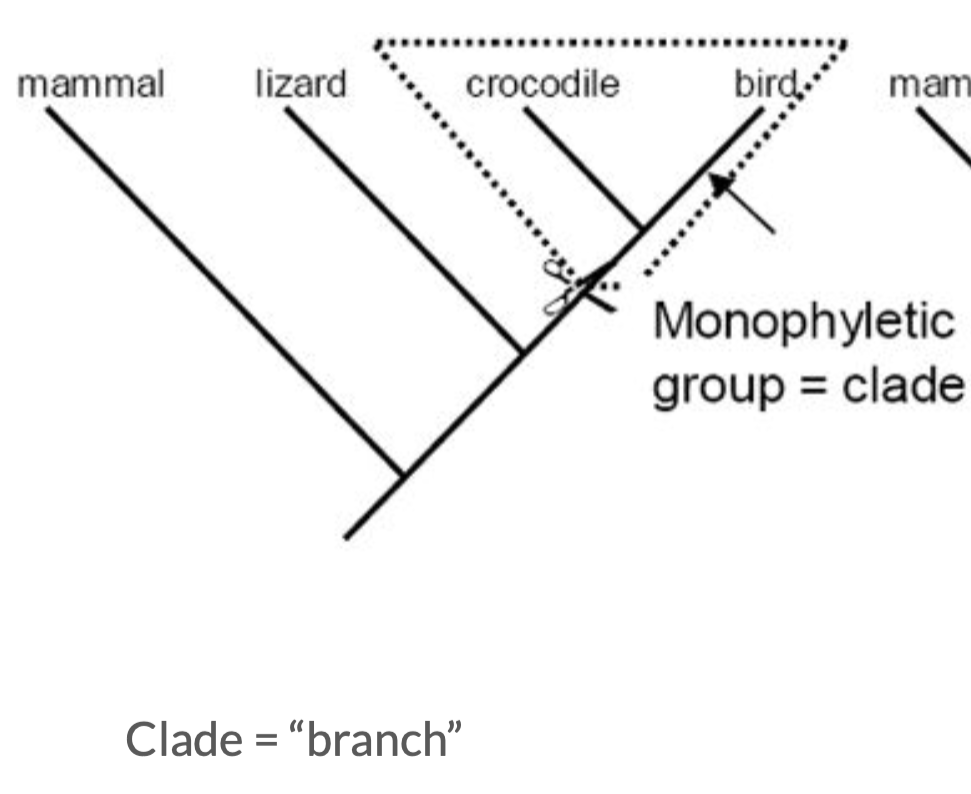
non-monophyletic group
rectangular cut on a phylogenetic tree in the middle
Solve
B
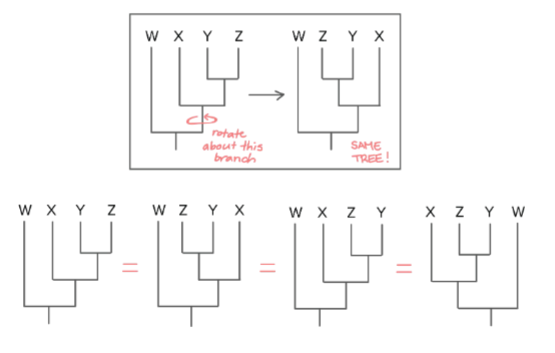
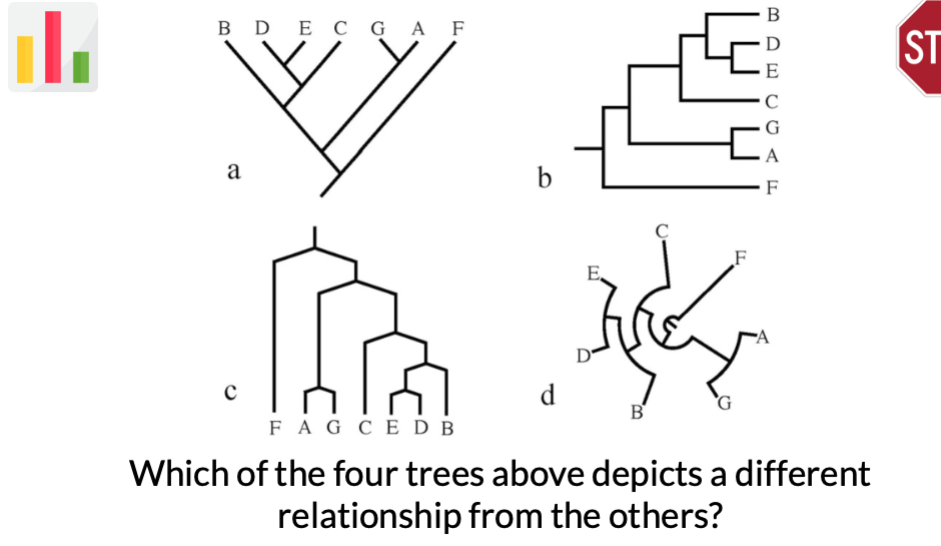
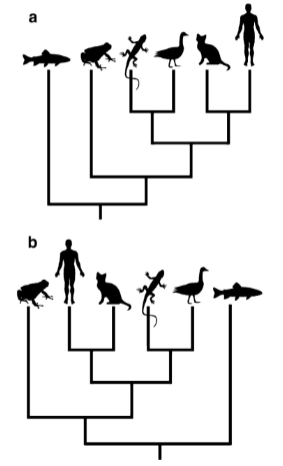
T/F: It’s possible to rotate branches around nodes without changing the evolutionary relationships depicted?
True
Solve
A
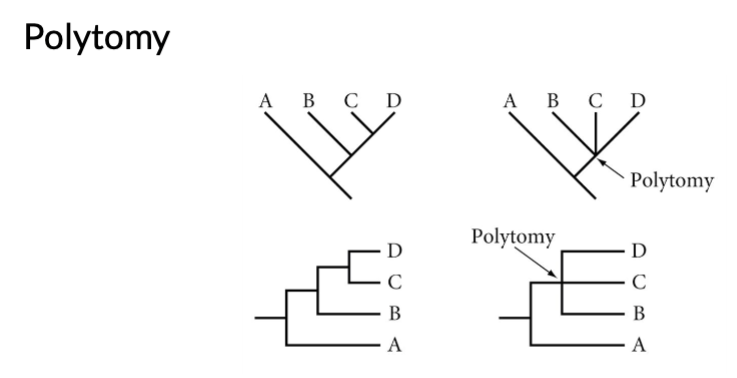
Polytomy
Used to indicate uncertainty in the correct branching pattern
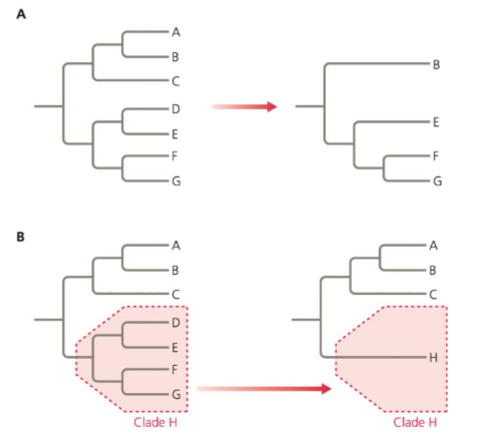
T/F: Phylogenies can be drawn with fewer species
True
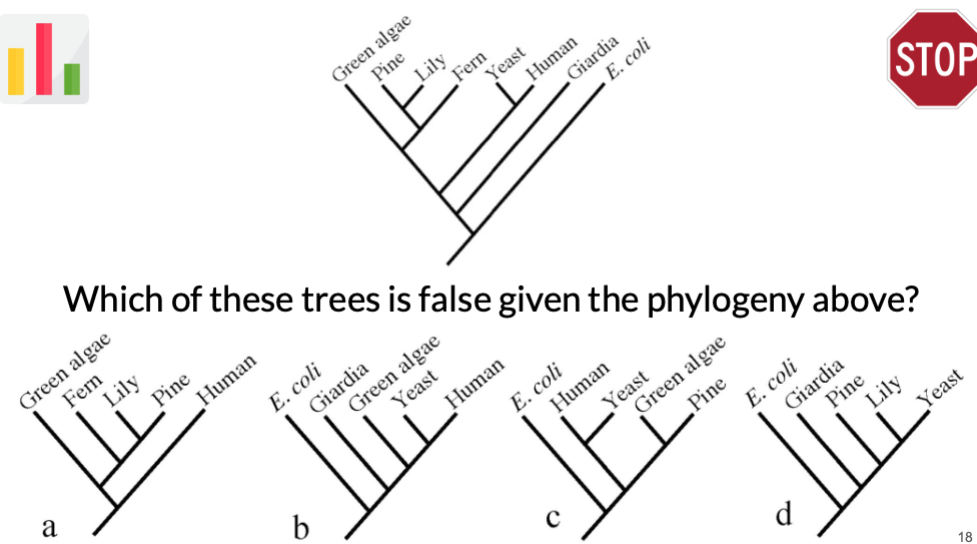
Solve
D
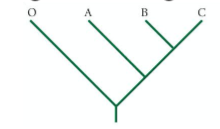
Cladogram
Only represents branching pattern; branch lengths meaningless
Phylogram
Branch lengths proportional to amount of character change
What are five common misconceptions on phylogenetic trees?
Reading across the tips
Ladder thinking
Similarity=relatedness
Long branch implies no change
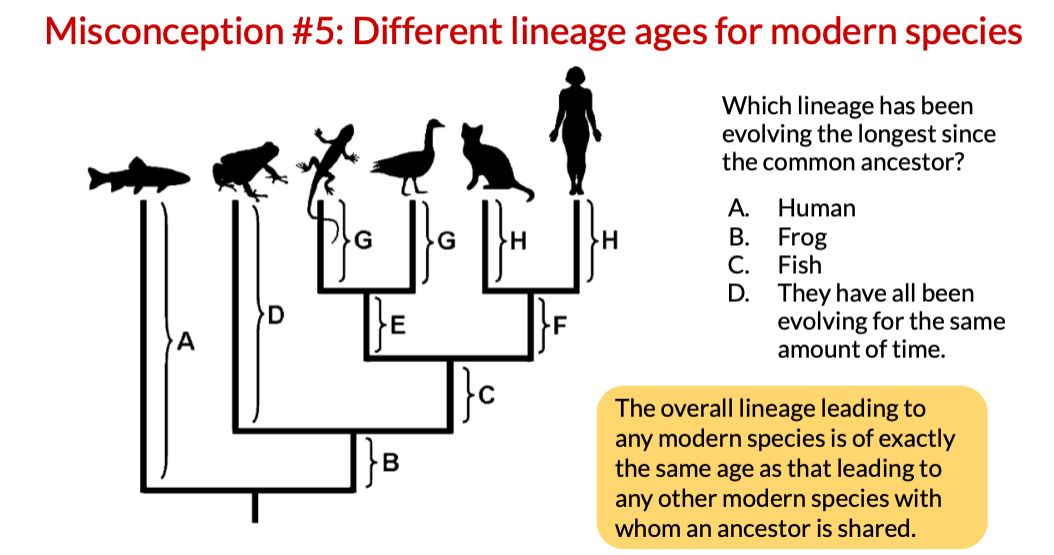
different lineage ages for modern species
Misconception #1: Reading across the tips
order of terminal nodes is meaningless
only the branching order provides information about relatedness
Taxa that share more recent common ancestors are more closely related
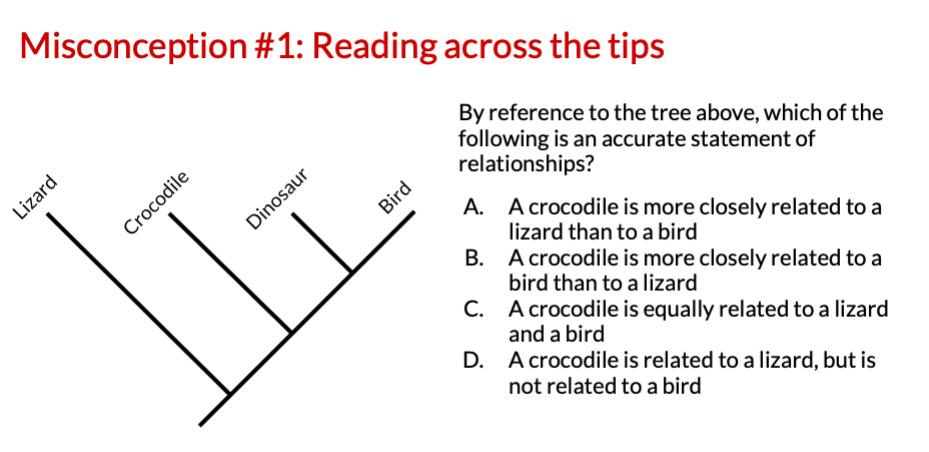
Solve
B
Misconception #2: Ladder thinking
no currently existing species is ancestral to any other species
there’s no higher or lower organisms
there are no main lines and side tracks
trees depict evolutionary relationships, not evolutionary progress
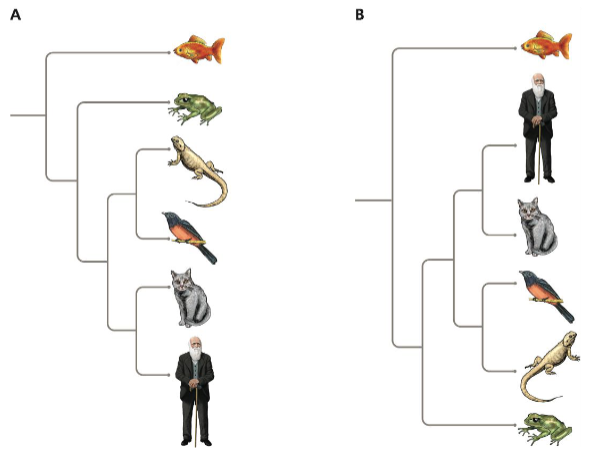
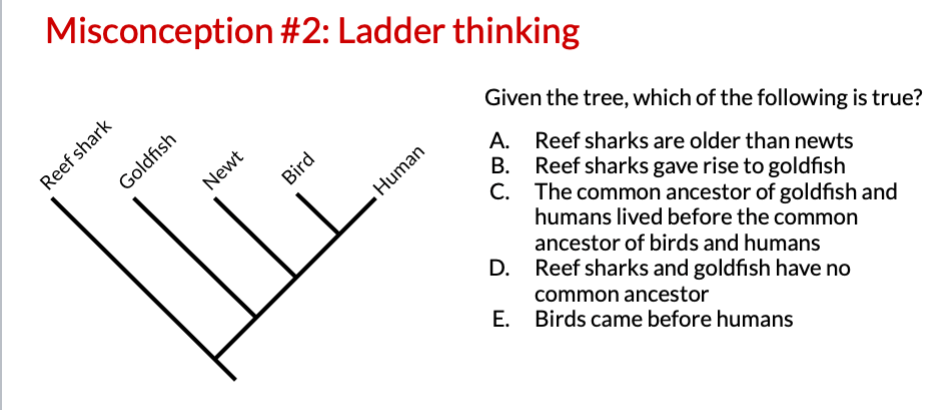
Solve
C
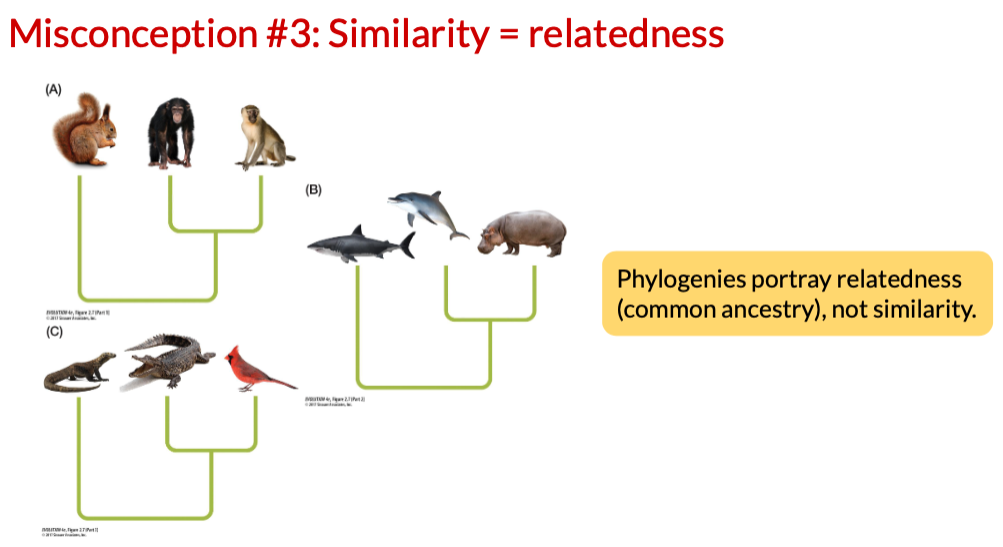
Misconception #3: Similarity=relatedness
phylogenies portray relatedness (common ancestry), not similarity
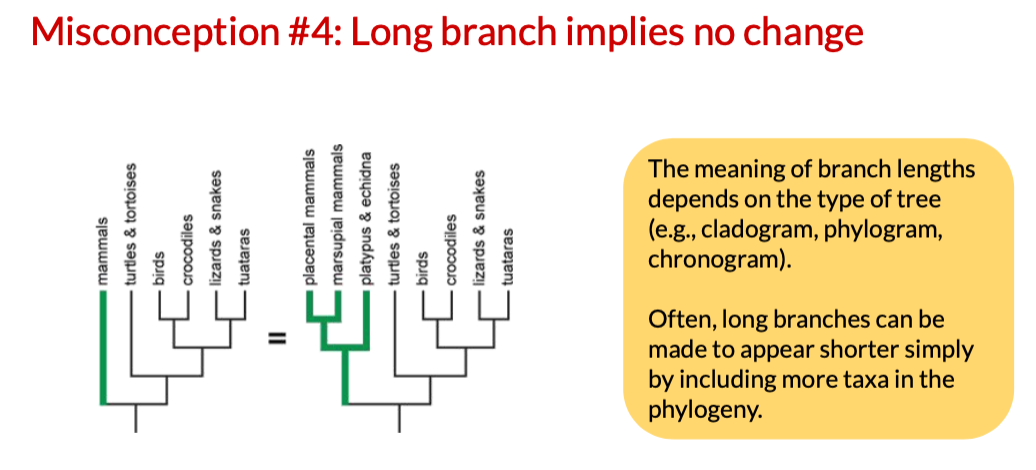
Misconception #4: Long branch implies no change
The meaning of branch lengths depends on the type of tree (cladogram, phylogram, chronogram)
Long branches can be made to appear shorter by having more taxa
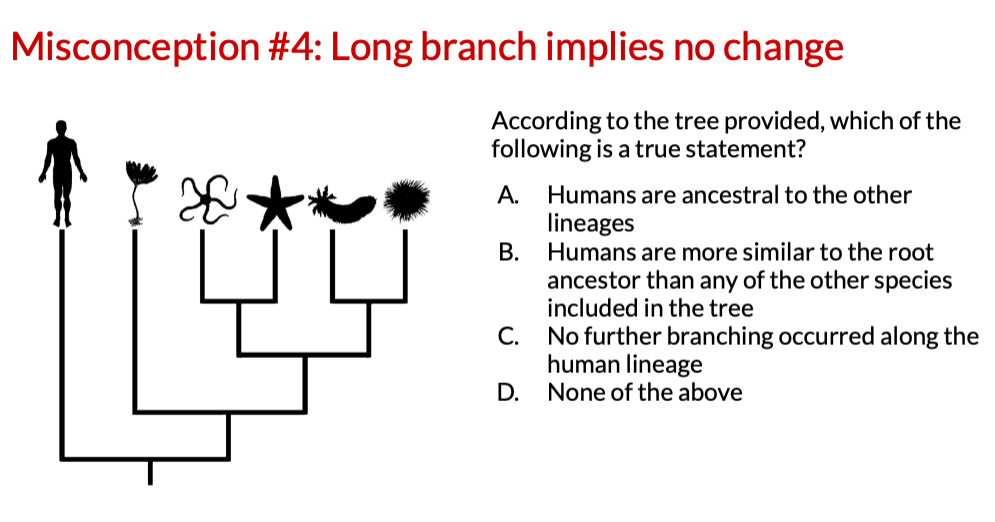
Solve
D
Misconception #5: Different lineage ages for modern species
The lineage of any modern species is just as old as the lineage of any other modern species that shares a common ancestor
Solve
D
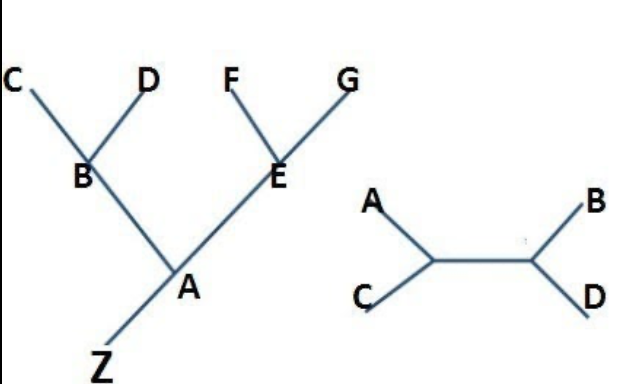
Which is the rooted tree? (1 or 2)
1
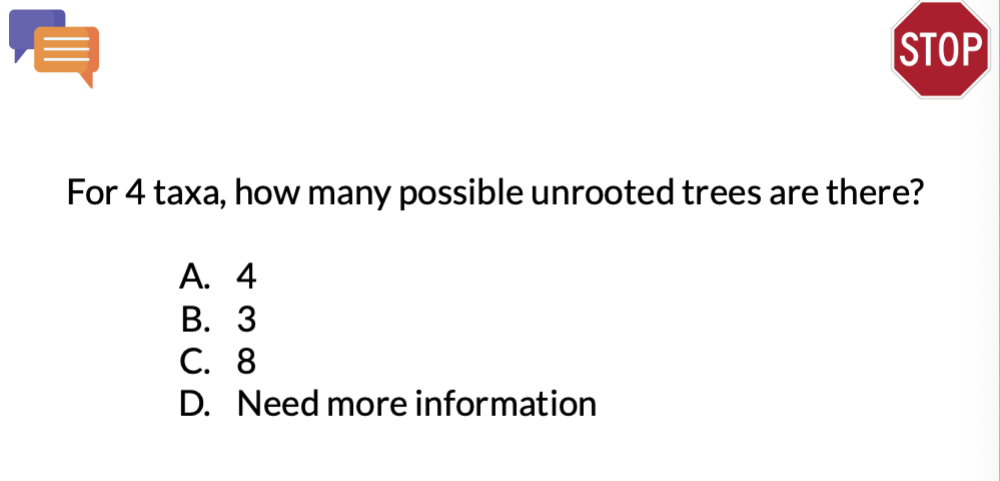
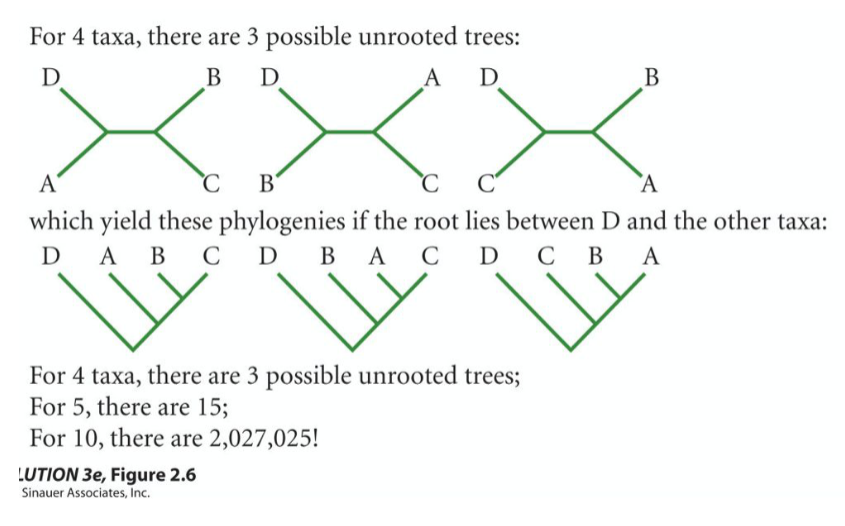
Solve
B
Parsimony
Based on traits or DNA sequences; phylogeny
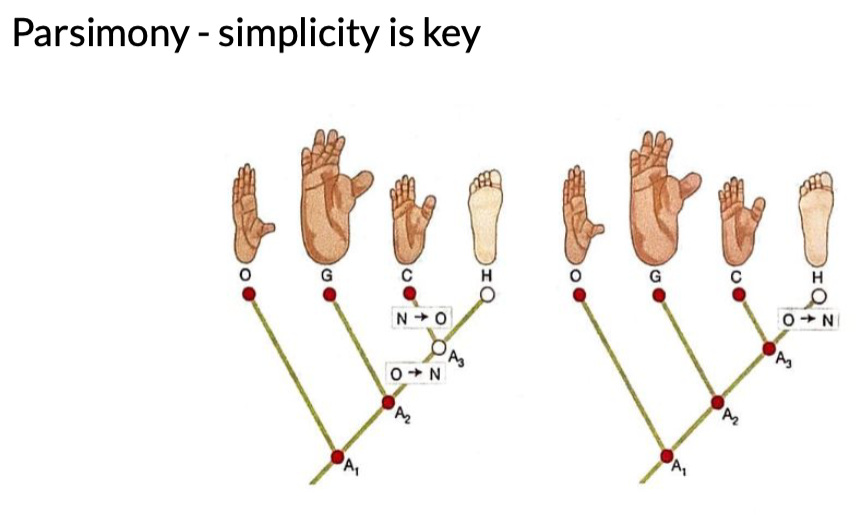
How do we construct phylogenies?
Historical (simple method): parsimony
Modern methods based on DNA sequences:
1. Maximum likelihood, 2: Bayesian inference
Why would modern methods be used to construct phylogenies?
Allows for the estimation of uncertainty
Character
A feature or trait (no specificity)
ex. Number of toes on a hindlimb
ex. Each site on one strand of DNA
Character state
One of the variant conditions of a character
ex. 5(humans), 1(horse), 3(rhinos)
ex. Identity of the nucleotide base (A,T,C,G)
Homology
possession by two or more species of a character state derived, with or without modification, from their common ancestor
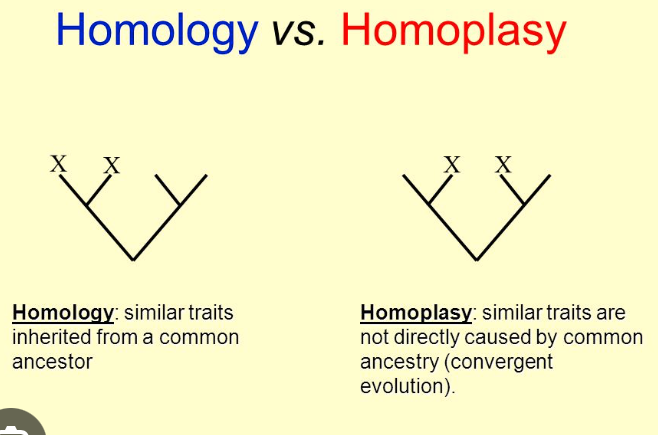
Plesiomorphy
ancestral character (having eyes)
Apomorphy
derived character state (trait loss or gained often by adaptation); (eyelessness)
Homoplasious character (Homoplasy)
similar or identical character states that were not derived from a common ancestor (convergence)
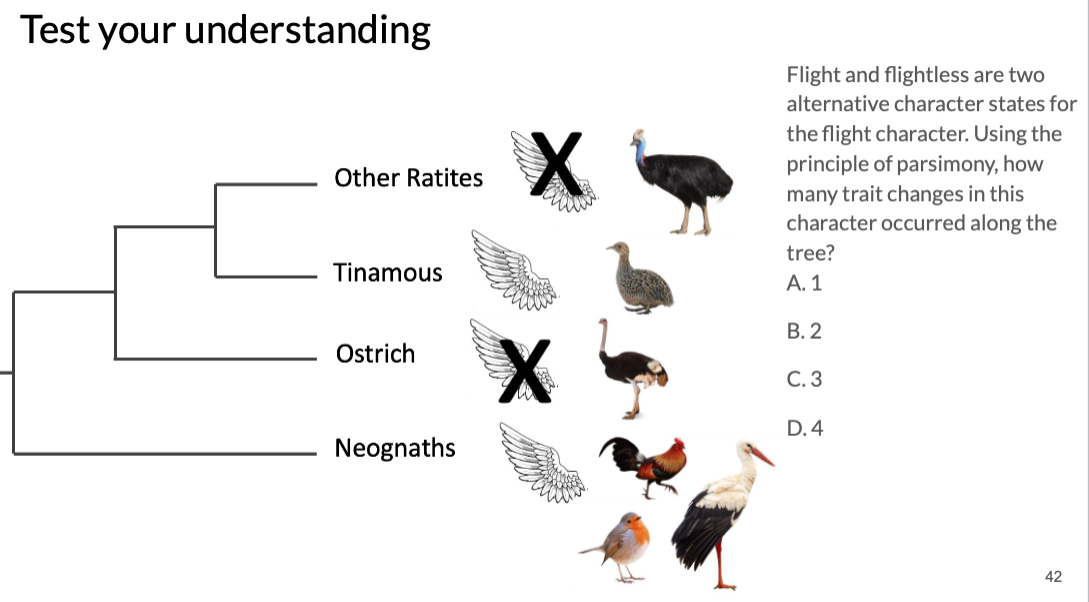
solve
2
Why are phylogenetic trees important?
used to classify organisms (Myxozoan classification)
Understand the origins of infectious agents (Cholera in Haiti)
Infer the history of character evolution
Estimate the timing and order of divergence
Understand patterns of evolution
Gustatory receptor (GR) function
heritable trait with variation
GR frequency changing
GR allele frequency changing
Variation in GR affects likelihood of eating poison
variation affects fitness
how do we know when evolution is occurring via natural selection
variation is heritable, affects fitness, and is changing
allele frequencies
proportion of a specific allele among all alleles at that loci within the population
biallelic loci
2 alleles at a locus
fixation
when an allele reaches 100% frequency in the population (indicates no genetic variation at that locus)
biallelic loci equation
p + q = 1
p is the frequency of allele 1
q is the frequency of allele 2
natural selection
consistent differences in fitness among different classes of biological entities (e.g. alleles, genotypes, populations, species)
fitness
number of offspring an individual leaves to the next generation (reproductive success)
What are the 4 conditions for evolution by natural selection?
reproduction
variation
inheritance
differential success
reproduction
individuals reproduce to create the next generation
variation
individuals vary in their traits
inheritance
individuals pass on some of their traits to their offspring
differential success
individuals with different traits differ in their survival or reproductive success (fitness)
Why do the best possible variants fall short of perfection often?
trade-offs (energy spent on one things must be spent on others)
What is a key limitation of natural selection in evolving traits?
Natural selection can only "choose" from existing genetic variants in a population at a given time. It cannot select the best possible traits if they haven't arisen yet.
“greedy algorithm”
natural selection operates to maximize fitness locally, but does not have an “end goal”
simplified: natural selection focuses on what's most helpful right now for survival and reproduction without aiming for a specific future goal.
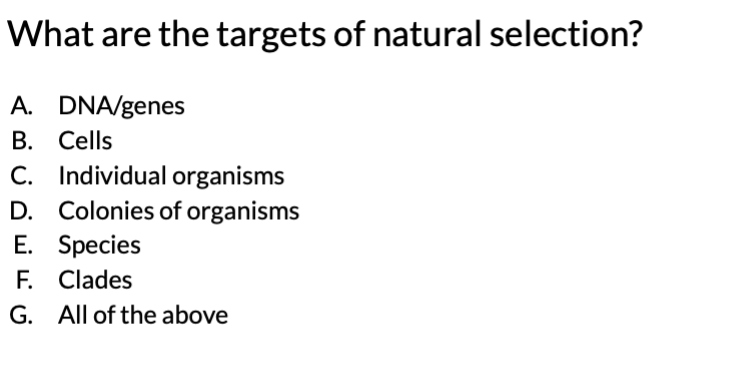
solve
G
Cancer cell
a cell lineage that has evolved a high rate of replication compared to other lineages, at the expense of host fitness
Selfish genetic elements
genetic segments that can enhance their own transmission at the expense of other genes in the genome
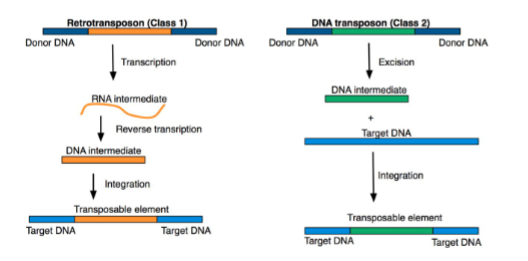
Transposable elements (TEs)
DNA sequence that can change its position within a genome
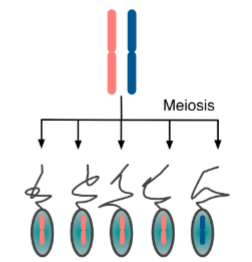
Segregation distorters
alleles that distort normal segregation in their own favor
Prion
“Proteinaceous infectious particle”
What does prion act as?
a highly stable misfiled protein that acts as an infectious agent
How do prions propagate?
transmitting a misfolded protein state, causing other proteins to misfold in the same way
What diseases are caused by prions?
mad cow disease; Creutzfedt-Jakob disease in humans
What is the methodology for prions in cell culture?
“grow” a single strain in cell culture
Impose selection: drug inhibiting protein aggregation
What does the exposure of prions to drugs in culture lead to?
evolution of drug-resistant strains
Heritable information
structure of the protein
variation in fitness example
strains grown in the presence of the drug outperform susceptible strains when exposed to the drug
fitness
the currency of selection
We often use ____ components as a proxy for absolute fitness
fitness
How to get W? (absolute fitness)
(Probability that an individual survives to maturity) x (expected # of offspring if the individual does survive)
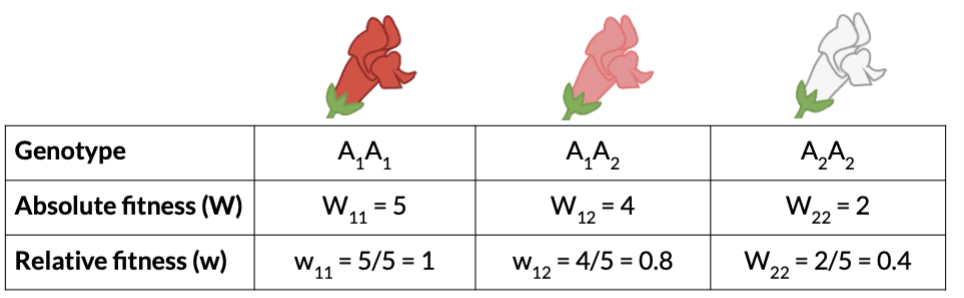
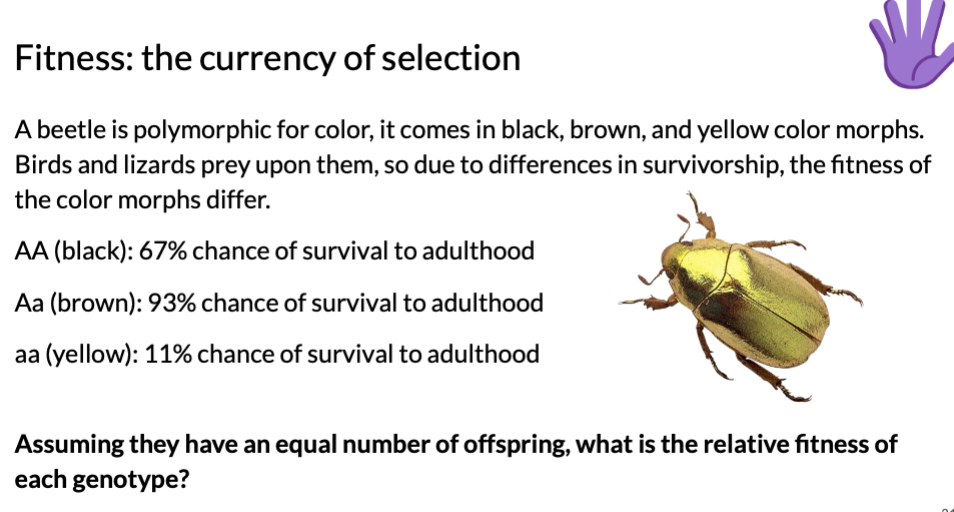
solve
AA: 0.72
Aa: 1
aa: 0.12
(divide by highest percentage)
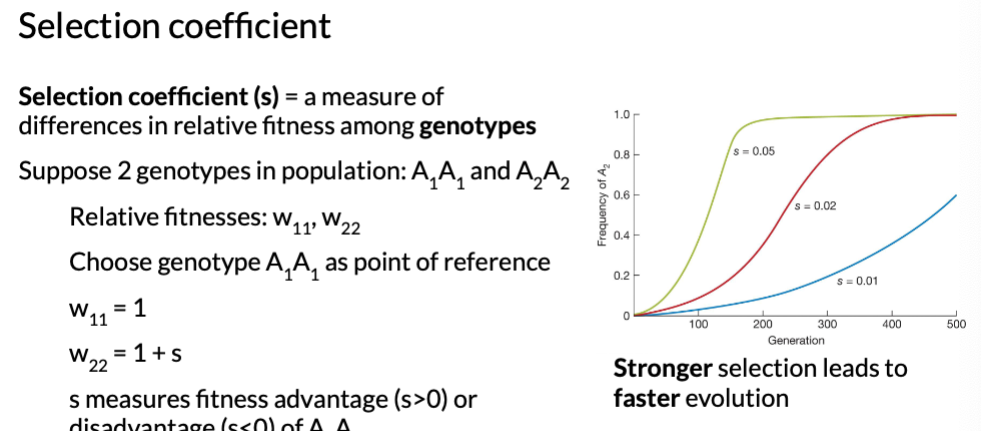
selection coefficient
measure of differences in relative fitness among genotypes
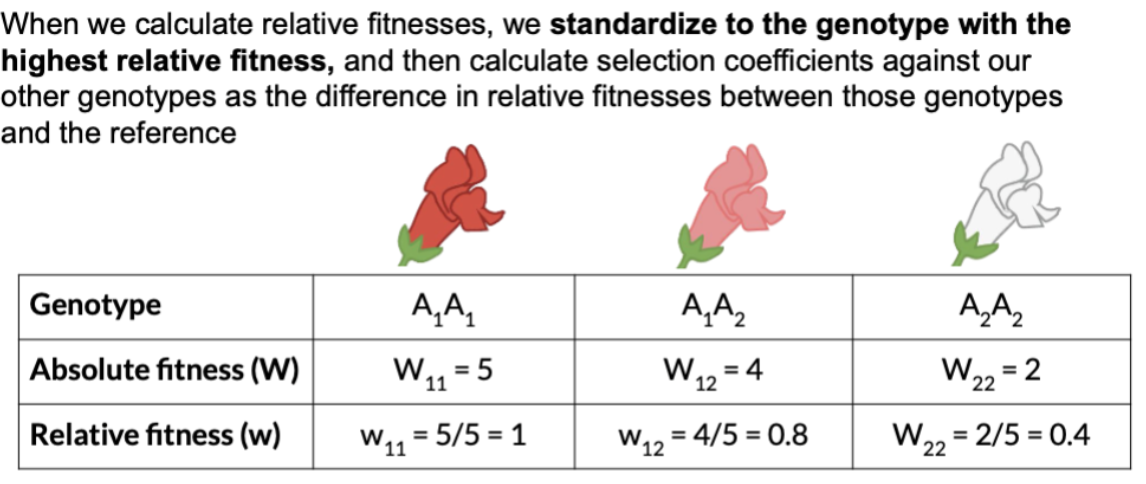
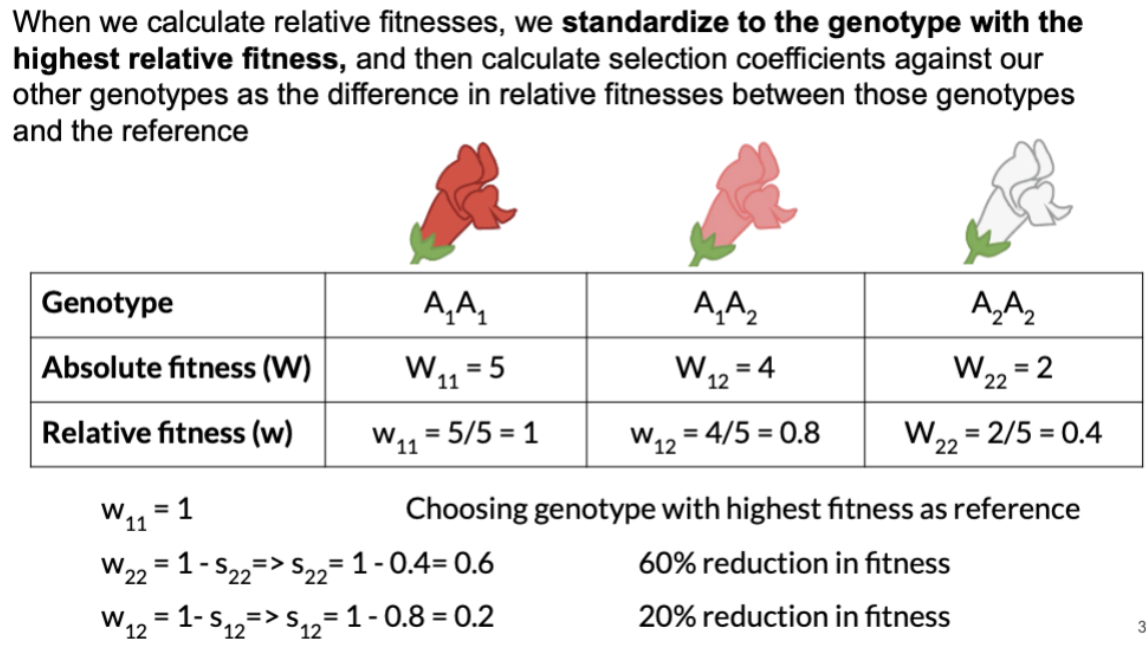
Solve:
What is the selection coefficient?
S22= 1 - w22 = 1 - 0.4 = 0.6
S12 = 1 - w12 = 1 - 0.8 = 0.2
Positive selection
selection for an allele that increases fitness
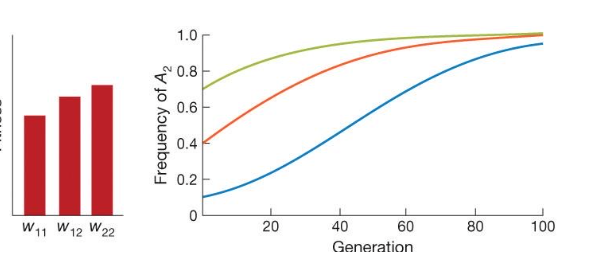
__ affects the evolutionary trajectories of beneficial alleles
dominance
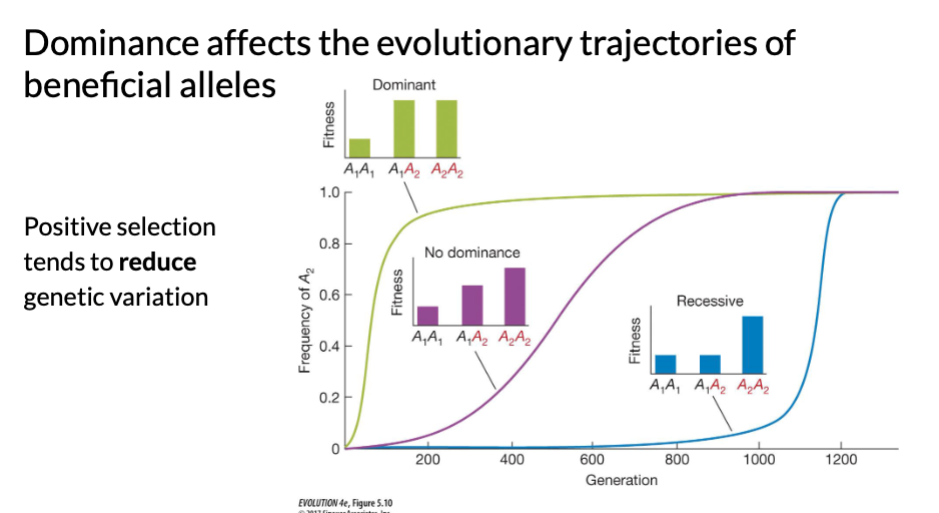
(- or + ?) selection tends to reduce genetic variation
positive
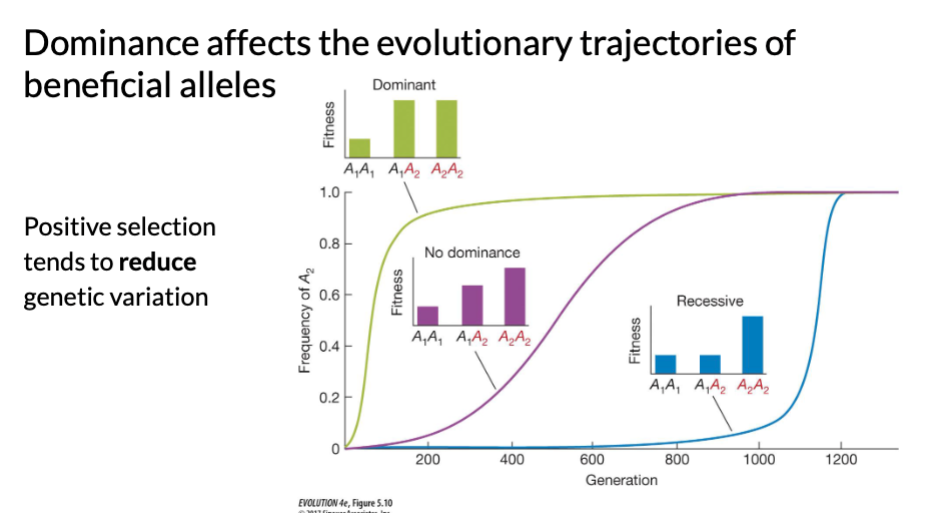
Linkage Disequilibrium (LD)
measure of non-random associations between alleles at different loci- high LD just after a sweep
*simplified: measure of how certain genetic variants (alleles) at different locations (loci) on a chromosome are inherited together more often than would be expected by chance.
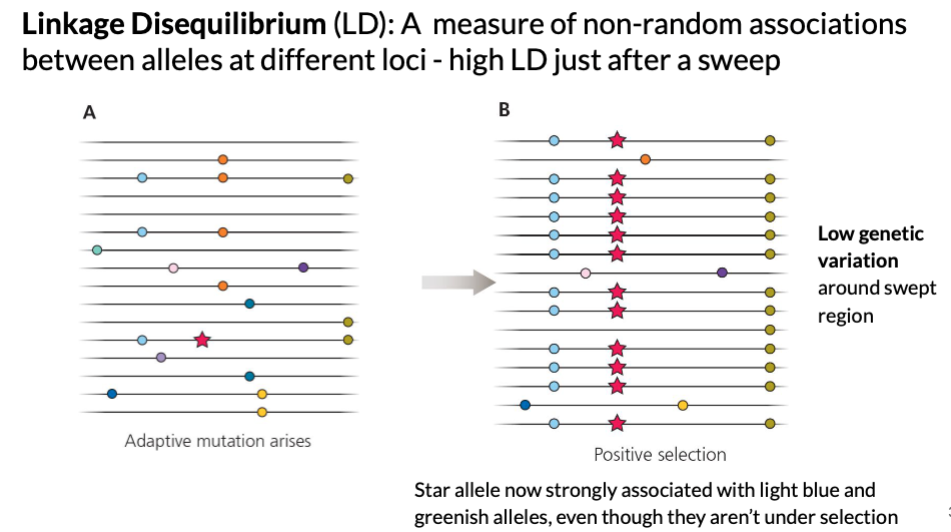
How does positive selection reduce genetic variation?
By driving adaptive alleles to fixation
How can selection maintain genetic variation? (balancing selection)
over dominance (heterozygotę advantage)
negative frequency-dependent selection
selective sweeps
process by which a new advantageous mutation eliminates or reduces variation in linked neutral sites as it increases in frequency in the population
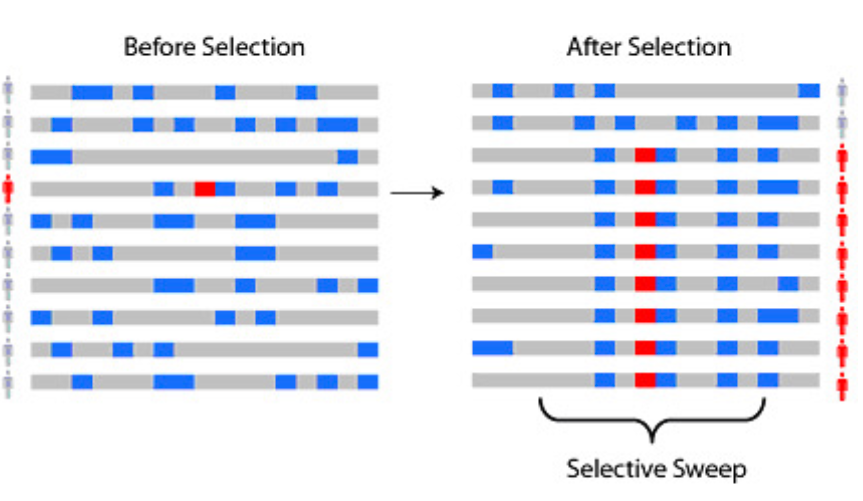
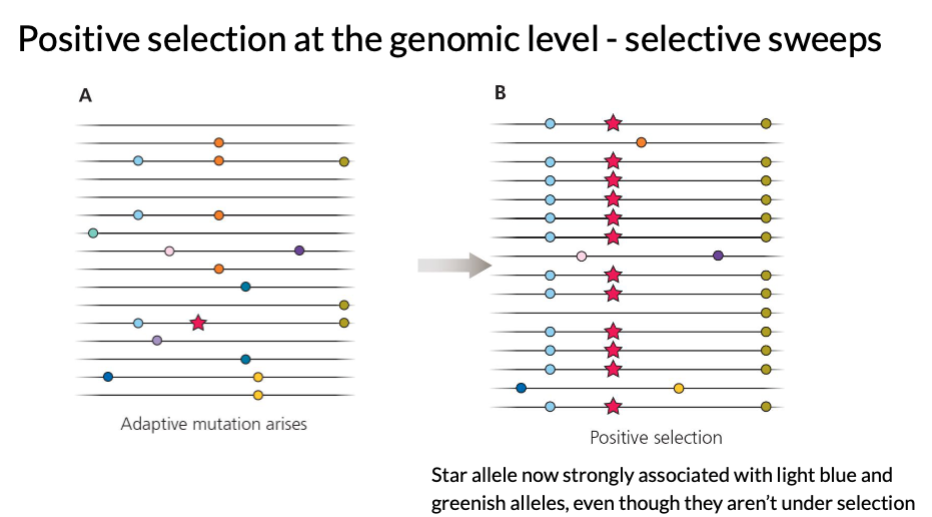
Positive selection at the genomic level-selective sweeps (explanation of what the image depicts)
Left Side: This shows a population with a variety of genetic variants (different colored dots) at different locations on the chromosome (each horizontal line represents a chromosome).
An Adaptive Mutation Arises: A new beneficial mutation appears (represented by the red star). This mutation gives the organisms carrying it an advantage, making them more likely to survive and reproduce.
Right Side: Because this mutation is so beneficial, it spreads rapidly through the population (this process is called a "selective sweep"). As it spreads, it drags along the nearby genetic variants (light blue and greenish alleles) because they are close to the beneficial mutation on the chromosome.
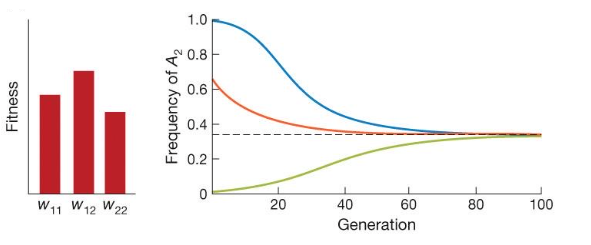
Overdominance (heterozygotę advantage)
occurs when heterozygote has a higher fitness than either homozygote
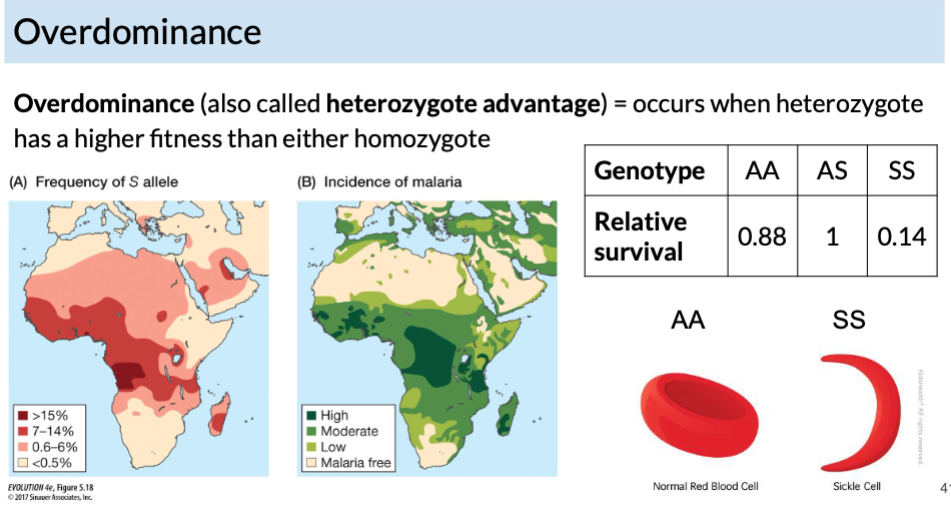
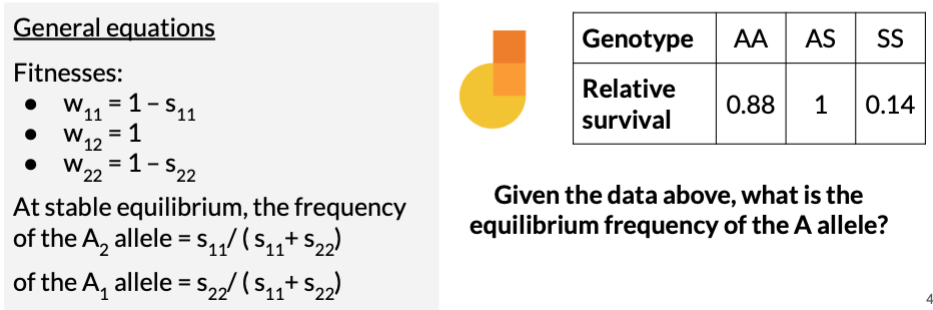
Solve
0.878
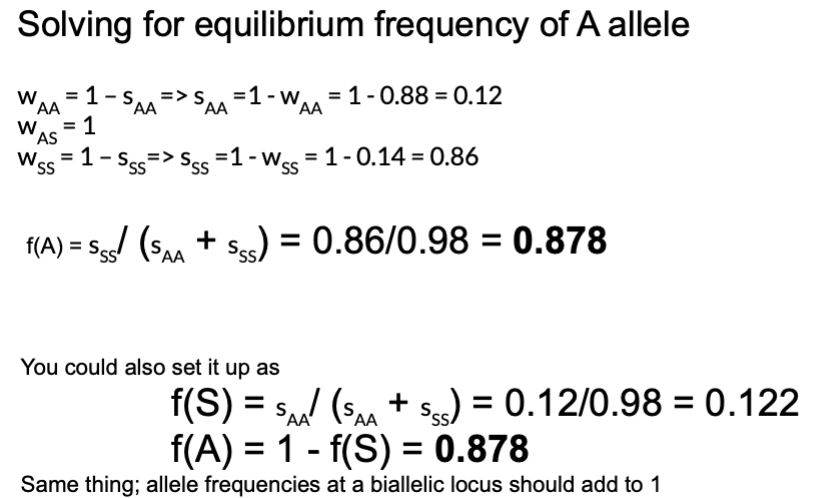
Negative frequency-dependent selection
the fitness of an allele/genotype/phenotype decreases as it becomes more common (rarity is favored)
mutation description
production of new alleles
mutation effect on genetic variation
increase by introducing new alleles
mutation effect on average fitness
most mutations with phenotypic effects lower fitness
natural selection description
certain alleles are favored and spread
natural selection effect on genetic variation
can lead to maintenance, increase, or reduction
Natural selection effect on average fitness
can increase, but not always
Pick the correct answer: Selection should (remove/introduce) deleterious alleles but mutation is always (removing/introducing) new alleles.
remove; introducing
Mutation-selection balance describes what?
equilibrium frequency q of a deleterious allele that we would expect to observe in a population
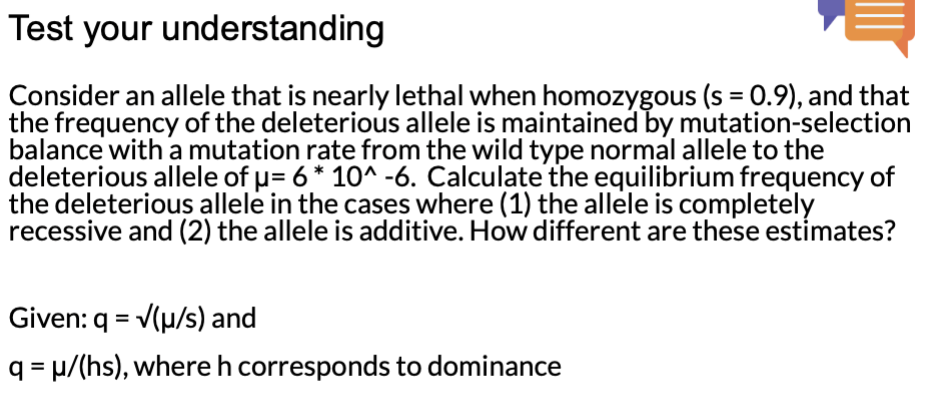
solve
recessive: sqrt((6 × 10^-6)/(0.9)) = 0.0026
Dominant: (6 × 10^-6)/(0.9 × 0.5) = 1.33 × 10^-5
evolution
heritable change in populations over generations
How do we know when evolution has occurred?
If there is change in a population’s genetic composition over time
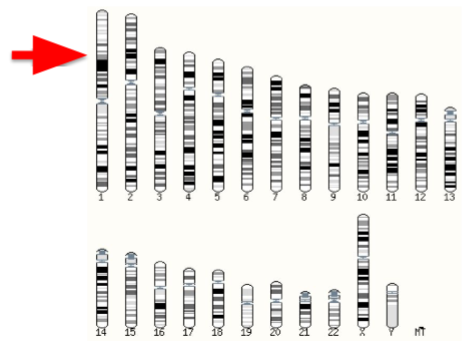
Locus
physical location in on a chromosome
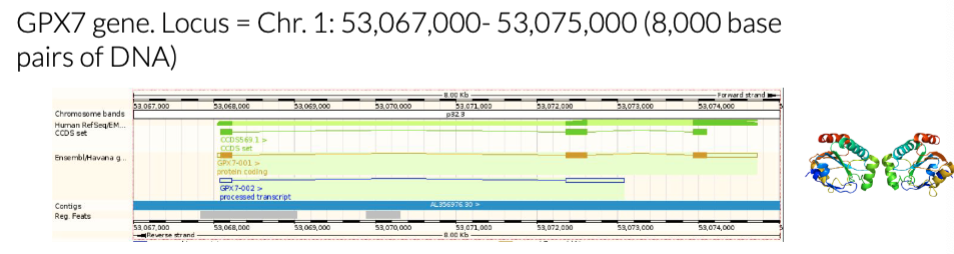
Gene
a DNA sequence that encodes a product with a distinct function
Allele
variant

