Human Population Review
 Studied by 1 person
 Call Kai
 Learn
Learn Practice Test
 Spaced Repetition
 Match
Match Flashcards
 Knowt Play
1/26

There's no tags or description
Looks like no tags are added yet.
Name | Mastery | Learn | Test | Matching | Spaced | Call with Kai |
|---|
No analytics yet
Send a link to your students to track their progress
27 Terms
What event in the mid-1700s significantly changed human population growth?
The cultural revolution
Which combination of factors creates the highest population growth?
High birth rate + low death rate
What is a population’s fertility rate?
The average number of children a woman has in her lifetime
Stage 1
Pre-industrial
Stage 2
Transitional
Stage 3
Industrial
Stage 4
Post-industrial
Why has the human population grown so rapidly recently?
Lower death rates due to better medicine, sanitation, food, and technology
Why do we look at the base of the population pyramid?
It shows the number of children who represent future population growth
How can technology affect human impact on the environment?
It can reduce impact (clean energy, efficient tech) or increase impact (pollution, resource use)
Compare India and Japan’s populations.
India is young and growing rapidly; Japan is aging and shrinking
Pronatalists
Pronatalists: Encourage having children
Examples: tax incentives, pro-family policies, cultural/religious support for large families
Antinatalists
Antinatalists: Discourage having children
Examples: one-child policies, environmental concerns, belief that life includes suffering
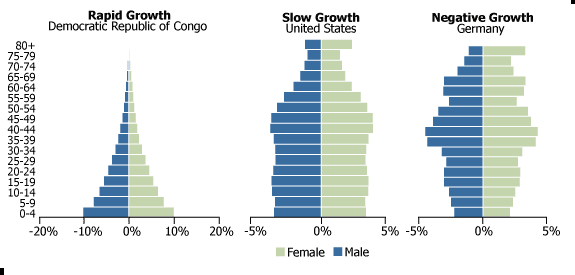
Explain what is happening in each chart
A: Growing population
B: Stable population
C: Decreasing population
How can you tell if a country is developed from a population pyramid?
Narrow base, more rectangular shape, long life expectancy, low birth & death rates.
How can you tell if a country is developing from a population pyramid?
Very wide base, steep pyramid shape, high birth rate, shorter life expectancy.
What does a wide base on a population pyramid mean?
High birth rate, high TFR, developing country, low women workforce.
What does a narrow base on a population pyramid mean?
Low birth rate, low TFR, developed country, more women in workforce.
How can you tell if women are active in the workforce using a population pyramid?
Low birth rates → narrow base → women delay childbirth to work.
How can you tell if a country is wealthy or poor from a population chart?
Wealthy: Narrow base, long bars at older ages (long life expectancy).
Poor: Wide base, early narrowing, few older adults.
How does education level appear on a population pyramid?
Educated: Lower fertility → narrow base.
Uneducated: High fertility → very wide base.
How do you identify high TFR (Total Fertility Rate)?
Very wide base (lots of children).
How do you identify low TFR?
Narrow base (few children).
How can you tell if a country has good healthcare?
Lots of older adults, wide top, low death rates.
How can you tell if a country has poor healthcare?
Few older adults, sharp narrowing at the top, higher death rates.
What does a steep pyramid shape tell you overall?
Developing, high birth rate, high TFR, low education, poor healthcare.
What does a rectangular or barrel-shaped pyramid tell you?
Developed, low birth rate, low TFR, high education, strong healthcare.
 Note
Note  Flashcards (52)