Chapter 18 - Supply Side Policies
 Call Kai
 Learn
Learn Practice Test
 Spaced Repetition
 Match
Match Flashcards
 Knowt Play
1/9

There's no tags or description
Looks like no tags are added yet.
Name | Mastery | Learn | Test | Matching | Spaced | Call with Kai |
|---|
No analytics yet
Send a link to your students to track their progress
10 Terms
What are Supply-side Policies (SSP)
They are policies designed to raise the long run aggregate supply of an economy by raising the Q&Q of the FoP
Aims of SSP
achieve long term EG by improving the productive capacity of an economy
improve competition and efficiency
raise job flexibility and lower unemployment & labour costs
inspire firms to invest by lowering costs
effect of SSPs (diagrams)
did you get it?
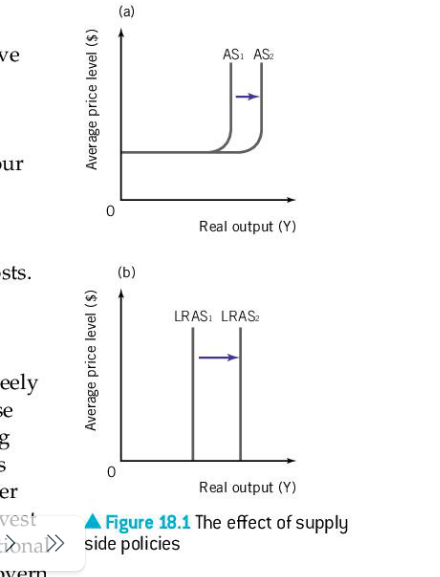
2 types of SSP
market based SSPs- designed to make markets work better and give more freedom to the private sector
state interventions - to overcome different types of market failures
what are market-based SSP (Part 1)
reductions in income tax
reduction in corporation tax
leads to increased investment (quantity)
OR more R&D and tech advancements (quality)
Labour market reforms
reduce unemployment benefits
limit trade union power
get rid of minimum wages
Deregulation (scrap things like maternity leave)
what are market-based SSP (Part 2)
Privitisation (firms are profit driven)
Policies to raise competition (anti monopoly laws) (competition raises efficiency)
Trade liberisation (removing tarrifs & subsidies promotes free trade) (dmestic firms will become more efficient to compete internationally)
What are interventionist SSPs
investing in human capital (education & training)
R&D (the G can give tax credits to incentivise investing in this)
Provision and maintenance of infrastructure (large scale capital)
Limitations of market based SSPs Part 1
lowering income tax could make people work less if they take more home
lowering income tax benefits the highest earners the most (income inequality)
if you lower corporate taxes businesses could just give more to shareholders
labour market reforms lower living standards for low income/unionised workers
Limitations of market based SSPs Part 2
Deregulation can:
increase env damage if those laws are laxed or affect working conditions if health and safety laws are laxed
Privatisation needs to be transparent to work AND if the company is a monopoly why strive to be better
Time lags (DUH)
Limitations of Interventionist SSPs
Time lags (DUH)
Opportunity cost whenever the govt spends + rise in debt servicing costs
interventionist policies change when the political party changes
Controversies (how many resources should be provided for the Sciences vs the Arta)

