NCEA Level 3 Biology - Speciation
 Studied by 0 people
 Call Kai
 Learn
Learn Practice Test
 Spaced Repetition
 Match
Match Flashcards
 Knowt Play
1/53

There's no tags or description
Looks like no tags are added yet.
Name | Mastery | Learn | Test | Matching | Spaced | Call with Kai |
|---|
No analytics yet
Send a link to your students to track their progress
54 Terms
Evolution
The change in allele frequencies in a population over time
Species
a group of individuals that interbreed/ potentially interbreed and produce fertile offspring
Population
A group of individuals that belong to the same species and live in the same area at the same time
Deme
a subset of a population that has limited gene flow with members of the main population.
Cline
a pattern of gradual variation between individuals over a geographical area, typically due to environmental differences and therefore differing selection pressures
Gene flow
When individuals migrate (move) between populations and interbreed, they introduce their alleles into other populations.
Genetic drift
The random change in allele frequencies of a population due to chance events. Genetic drift occurs in all populations, but it has a much greater effect on the gene pool when the population is small as the result of some individuals not breeding and therefore not passing on their alleles.
Bottleneck effect
a process of genetic drift in which a population is reduced to a small number of survivors resulting in a new population with an allele frequency not representative of the initial population.
Founder effect
a process of genetic drift in which a small number of individuals become isolated from their original population resulting in a new population with an allele frequency not representative of the initial population.
Natural selection
Process in which individuals that have features better suited to their environment tend to survive longer and therefore produce more offspring and pass on their favourable alleles. These alleles then become more common in the population.
Types of natural selection
- Stabilising natural selection
- Directional natural selection
- Disruptive natural selection
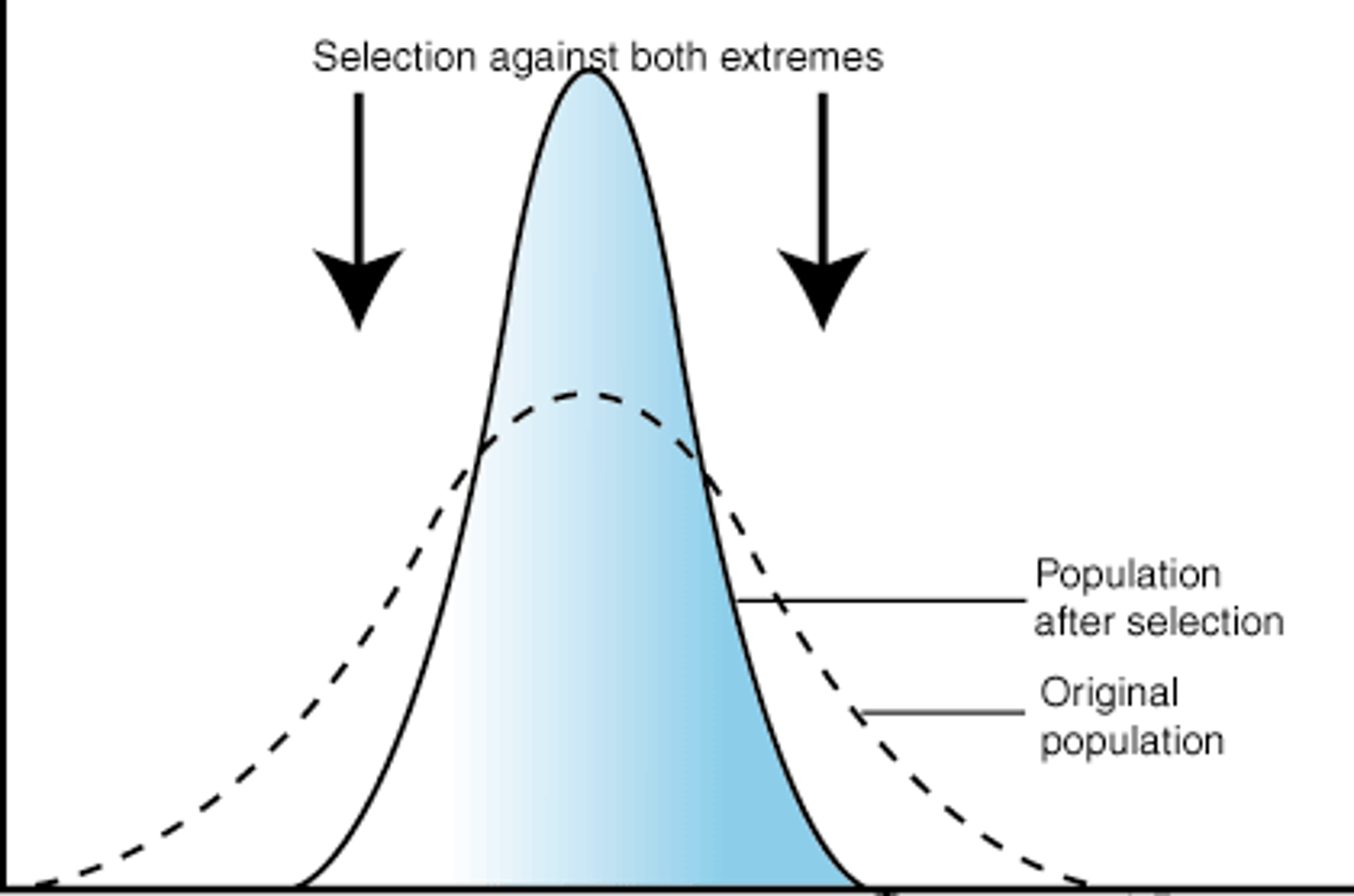
Stabilising natural selection
Evolutionary process of selection that favours the average phenotype and selects against both extremes.
Directional natural selection
Evolutionary process of selection that favours one extreme phenotype over the others.

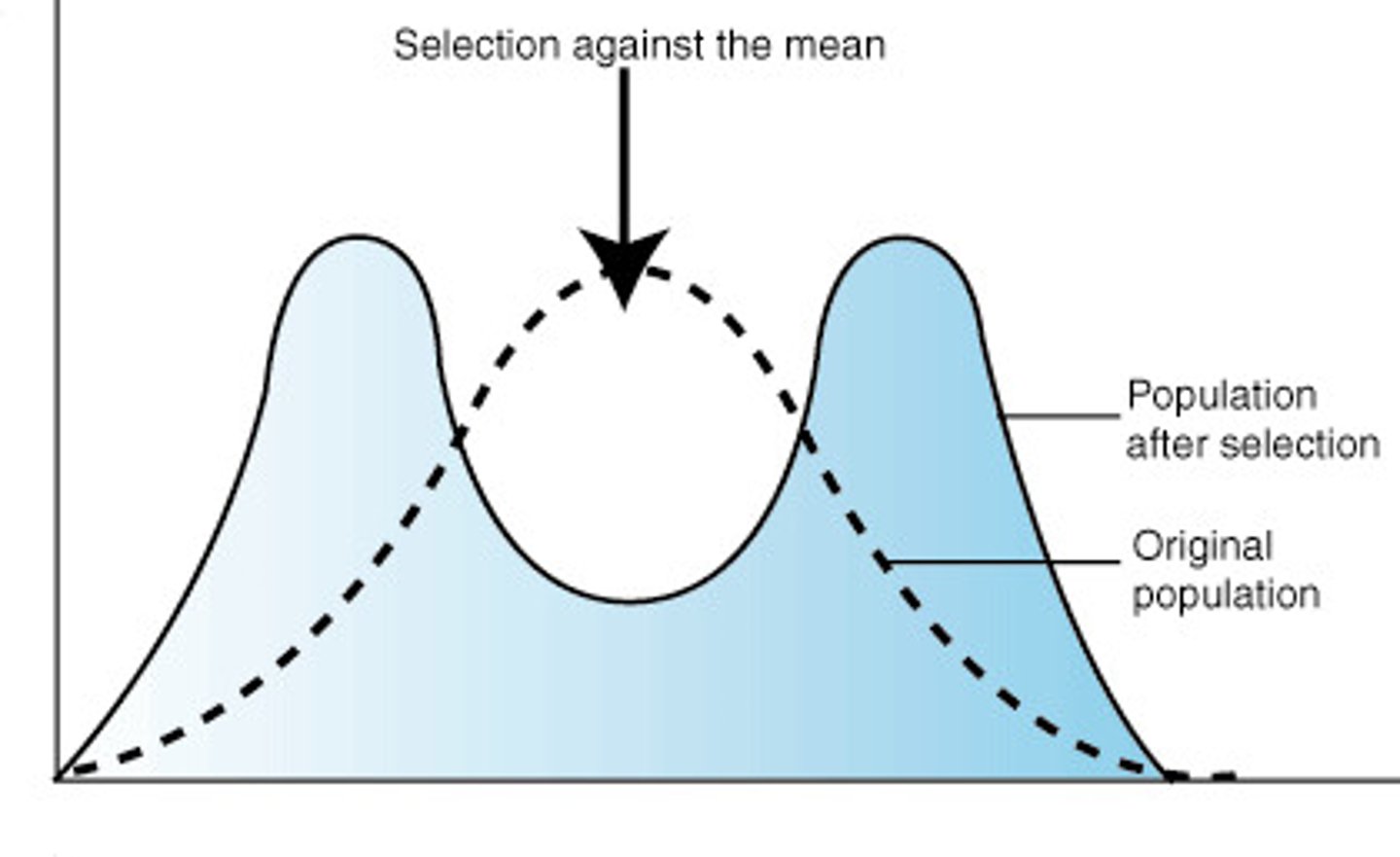
Disruptive natural selection
Evolutionary process of selection that favours both extreme phenotypes at the expense of the average and can even lead to the development of 2 or more different species from the one original species.
sexual selection
Natural selection arising through preference by one sex for certain characteristics in individuals of the other sex.
Proteins and evolutionary relationships
Proteins are made specific amino acid sequences. The more similar their proteins (the more amino acids they have in common), the more closely related 2 organisms are. This is used for identifying between more distantly related species.
Beneficial Mutations
A mutation that affects the organism in some way as to increase its chances of reproductive success, and therefore the chance of the mutation in question being passed along.
Gene mutations
A permanent change in the base sequence of DNA which can result in a new allele being formed which can lead to a new phenotype
Polyploidy
condition in which an organism has extra sets of chromosomes
Autopolyploidy
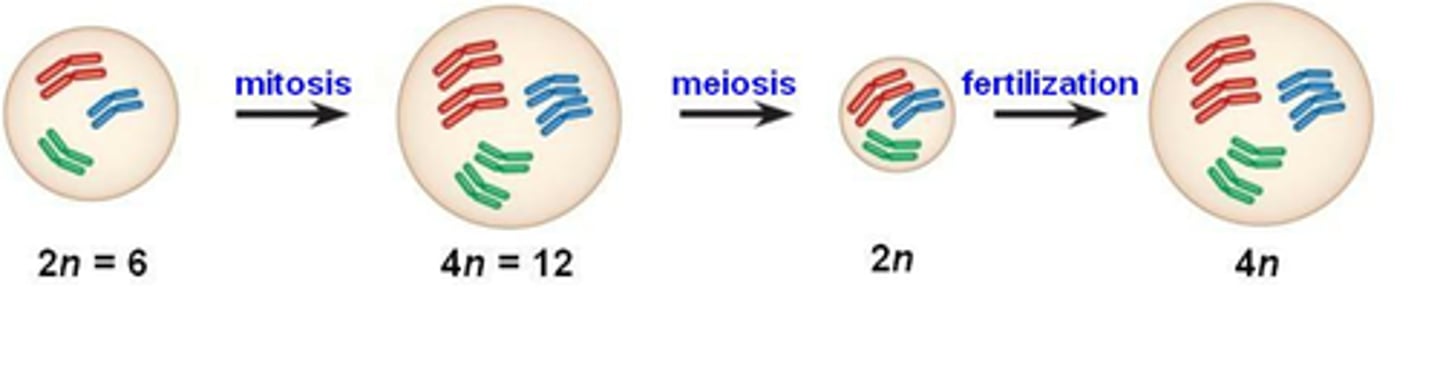
Involves the formation of a polyploid from a single parental species and results from the failure of chromosomes to separate during cell division.
Autoploidy resulting from meiosis
This can happen in the first or second division of meiosis, and results in diploid gametes. If a diploid gamete fuses with a normal haploid gamete, a triploid zygote is formed. If it instead fuses with another diploid gamete, a tetraploid zygote is produced.
Somatic doubling
In mitosis non-disjunction results in a tetraploid cell when each replicated chromosome separates, but the cell itself does not divide. The descendants of this cell will also be tetraploid.
Fertility in triploids
Triploids (produced by fertilisation between a diploid and a haploid gamete) are highly infertile, because of the very low probability that meiosis will produce cells with balanced chromosome sets.
Allopolyploidy
Results from hybridisation between species and chromosome doubling must occur for viable offspring to be produced by the hybrid.
Fertility in tetraploids
Tetraploids are usually fertile as they are able to form viable pairs of chromosomes during meiosis (each daughter nucleus can receive 2 chromosomes).
Speciation
The evolutionary process by which populations of the same species evolve and split into separate new species as a result of becoming reproductively isolated.
Sympatric species
Closely related species that live in the same geographic location
Allopatric species
Closely related species that live in different geographic locations usually they are isolated from one another
Reproductive isolating mechanism
Any factor that stops members of populations of the same species or members of different species from breeding together; it acts as a barrier to gene flow. RIMs may be:
- prezygotic: act before the egg is fertilised
- postzygotic: act after the egg is fertilised
Prezygotic isolating mechanisms
These include:
- Geographical isolation
- Structural (morphological) isolation
- Ecological isolation
- Temporal isolation
- Behavioural isolation
- Gametic isolation
Geographical isolation
Pre-zygotic isolating mechanism that results in physical barriers (e.g. rivers, mountain ranges, oceans) separating populations. If the populations come together again at a later stage, they are sufficiently different (as a result of different selection pressures in different environments, and/or possibly genetic drift) that they do not/are unable to breed.
Mechanical isolation
Pre-zygotic isolating mechanism that results in differences between the structure of external reproductive organs (genitalia) that do not allow for transfer of sperm between the sexes.
Ecological isolation
Pre-zygotic isolating mechanism that results in differences in habitat within the same geographical area, so that the populations rarely come into contact with each other.
Temporal isolation
Pre-zygotic isolating mechanism that results in breeding behaviour resulting at different, non-overlapping times. There can be daily or seasonal differences in timing of mating or pollination.
Behavioural isolation
Pre-zygotic isolating mechanism that results in differences in behaviour, typically mating behaviour such as courtship or times/places of activity
Gametic isolation
Type of pre-zygotic isolating mechanism that results from incompatibility of gametes.
Postzygotic isolating mechanisms
A reproductive isolating mechanism in which sperm may fertilise eggs of different species to form a hybrid but these are usually inviable or sterile
Hybrid inviability
The zygote, embryo or offspring is inviable (i.e. unable to survive or develop normally), so dies early in its development.
Hybrid sterility
The hybrid reaches maturity but is infertile so cannot breed.
Hybrid breakdown
Occurs when the hybrid reaches maturity and is able to breed but the next or subsequent generations are infertile or have reduced reproductive capability.
Allopatric speciation
Speciation that occurs when a population becomes divided into 2 or more populations by a geographical barrier, causing the populations to become geographically isolated and exposed to different selection pressures, and since there is no gene flow between them, the gene pools begin to diverge.
Sympatric speciation
Speciation where one species gives rise to 2 or more species without prior geographical separation. Usually due to niche or behavioural differentiation.
Biogeography
Study of past and present distribution of organisms
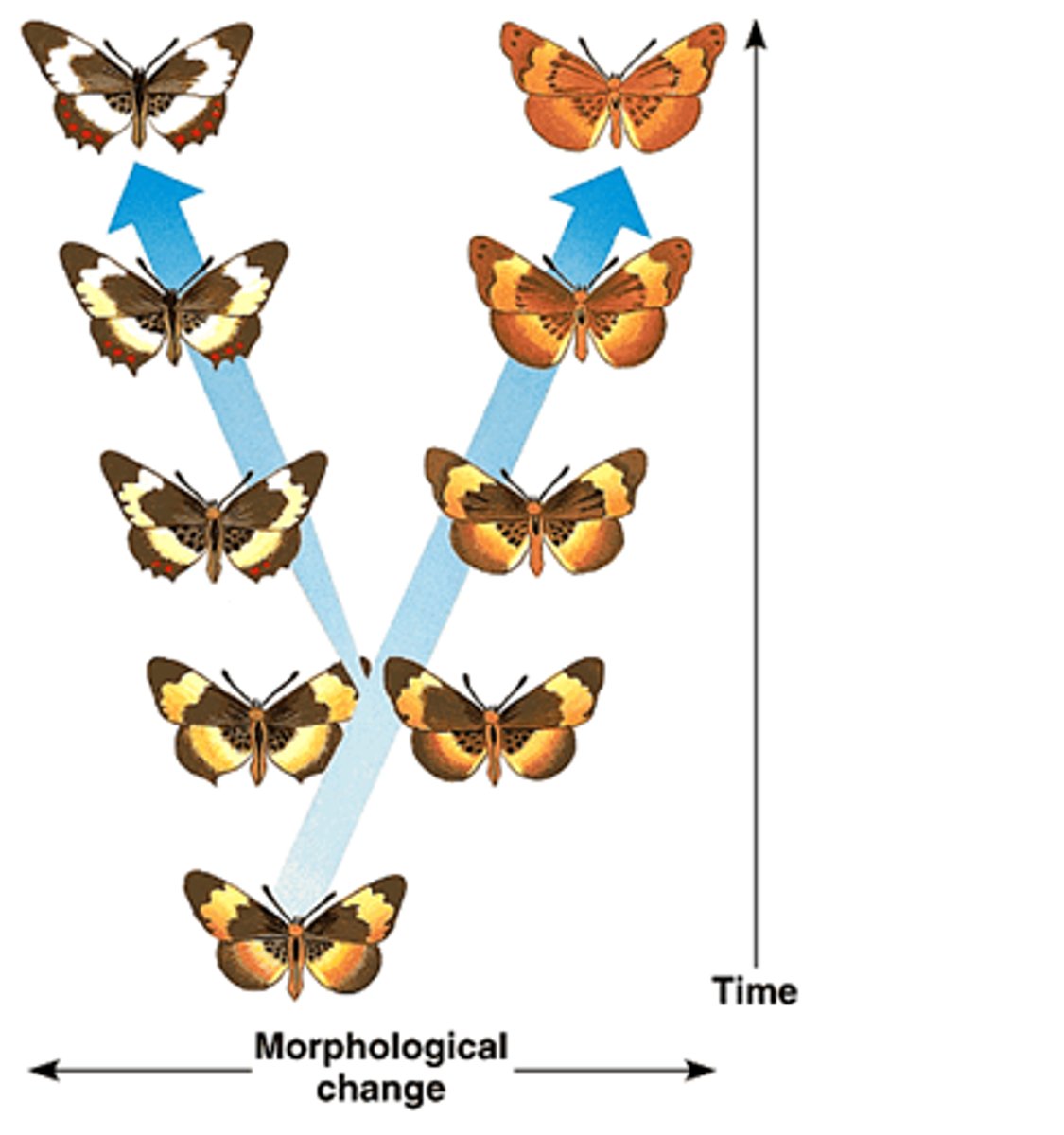
Gradualism
A rate evolutionary change in which new species arise from the result of slight modifications (mutations and resulting phenotypic changes) over many generations.
Punctuated equilibrium
A rate of evolutionary change in which there are long stable periods interrupted by brief periods of more rapid change
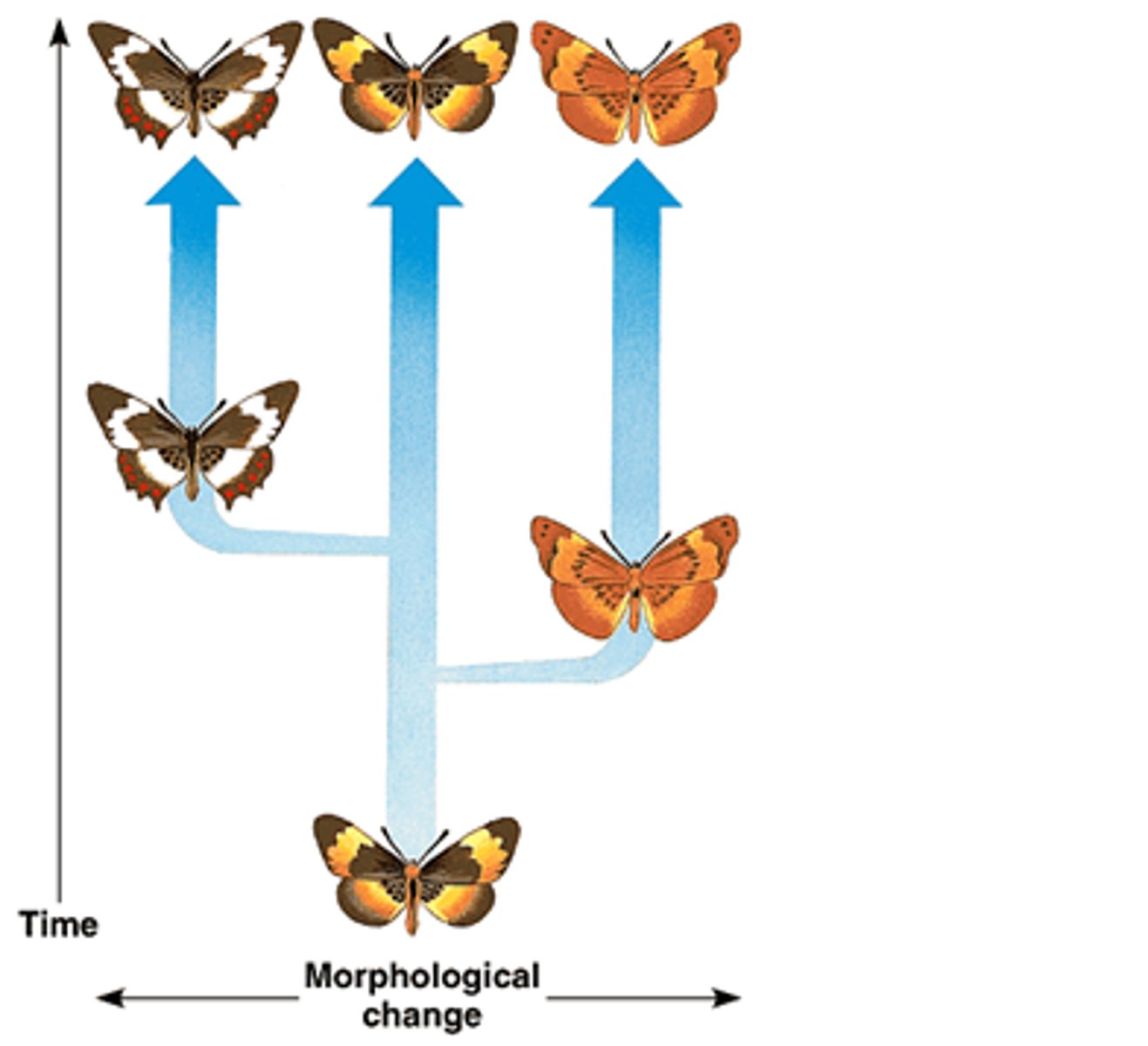
Patterns of evolution
- Divergent evolution
- Convergent evolution
- Co-evolution
- Adaptive radiation
Divergent evolution
A pattern of evolution when two or more species result from a common ancestor.
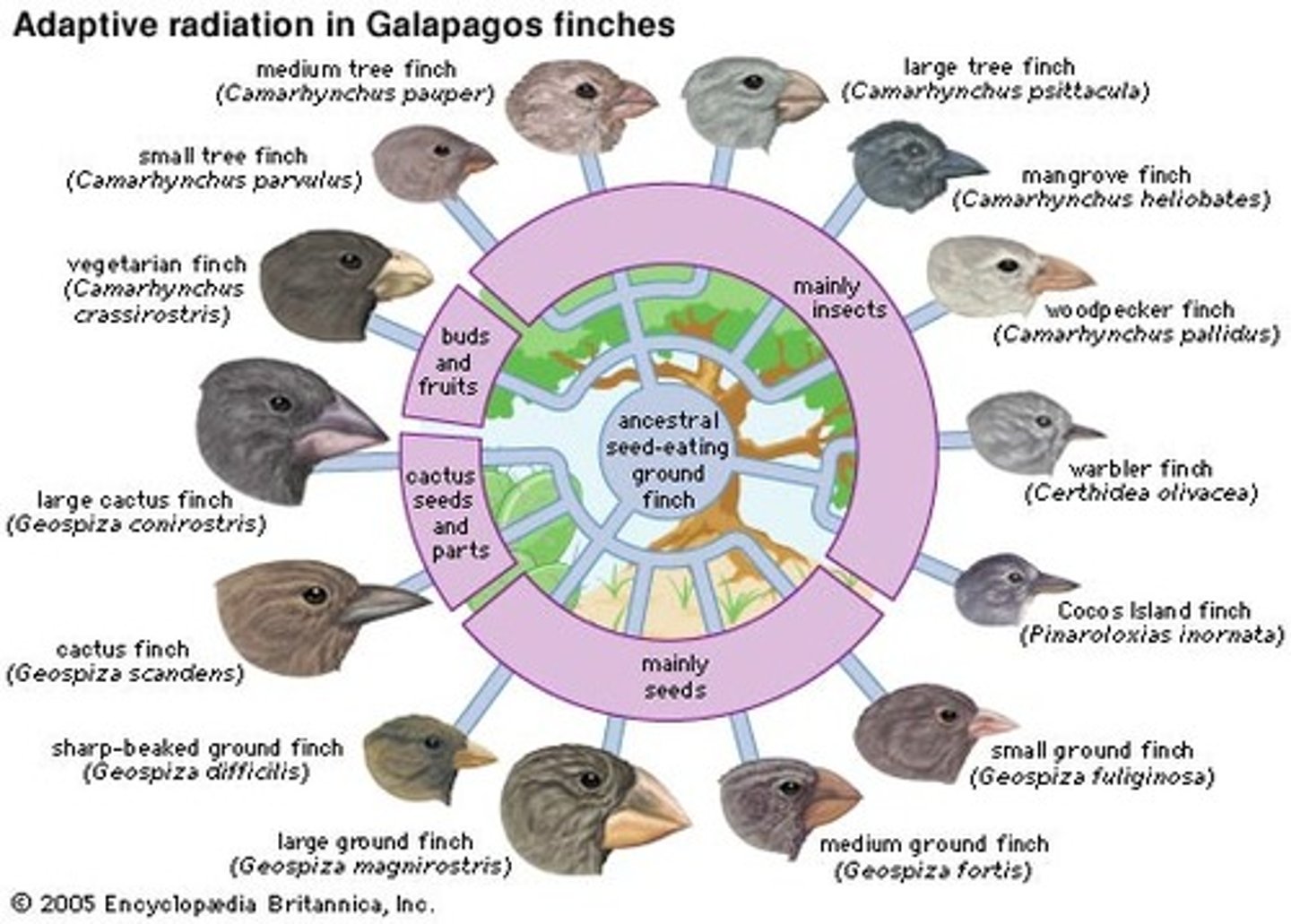
Adaptive radiation
A pattern of evolution that is a type of divergent evolution. It involves the rapid evolution of a large number of species from an ancestral group to occupy a variety of different ecological niches that may have become available suddenly.
mtDNA
Mitochondria contain DNA that does not undergo any recombination events - any changes in mtDNA are due to gene mutation and can therefore be used as a molecular "clock" as gene mutations occur at a steady, fairly rapid rate.
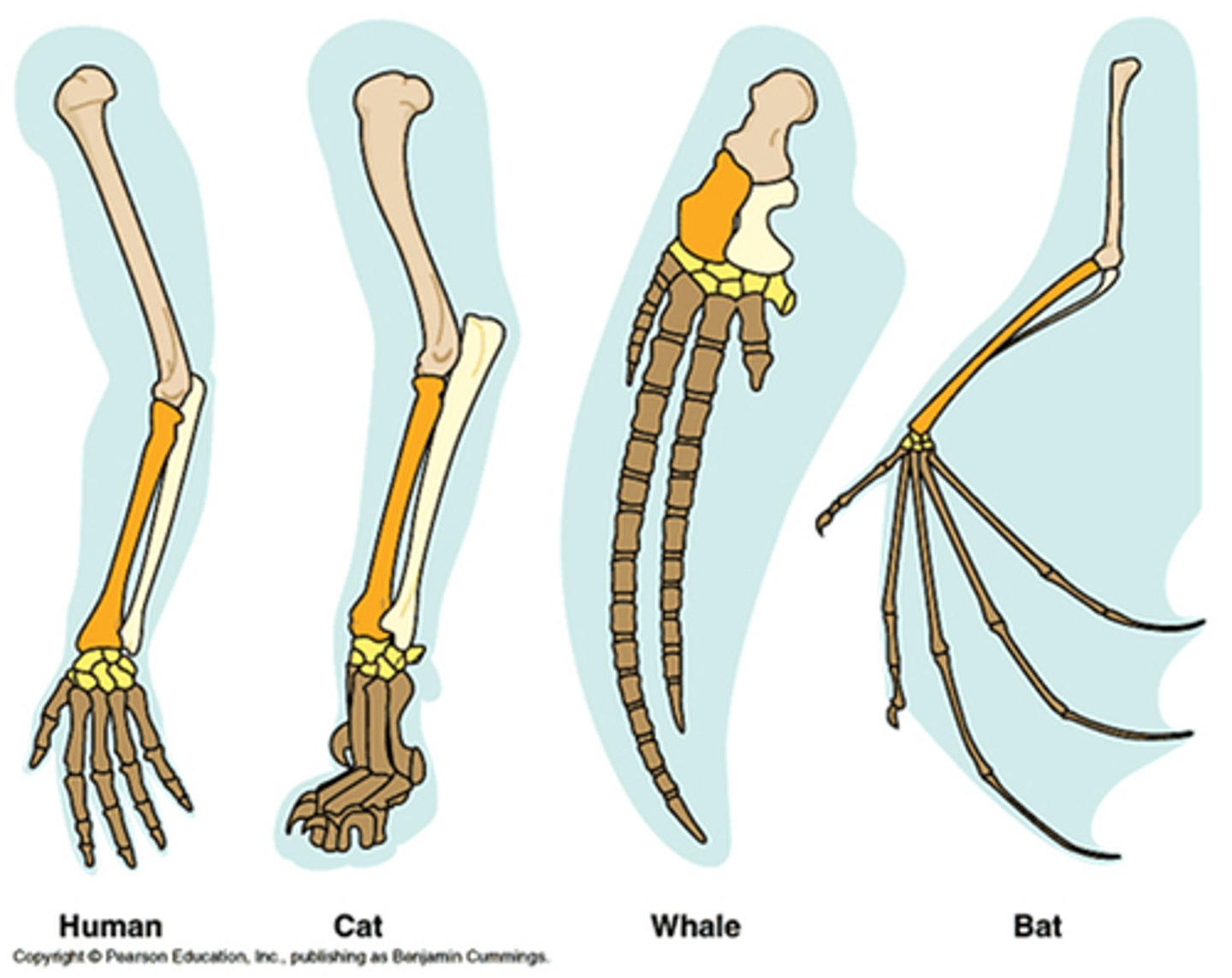
Homologous structures
Features similar in structure and origin but possibly different in function. The similarity in structure indicates common ancestry, while difference in function indicates adaptation to different selection pressures in different environments. It is an important source of evidence for divergence and adaptive radiation.
Convergent evolution
Pattern of evolution that occurs when two or more unrelated species evolve to resemble each other as a result of being subject to similar selection pressures.

Co-evolution
A pattern of evolution in which reciprocal evolutionary change in which a change in a feature of a species acts as a selection pressure for a change in the feature of another (unrelated species); both species have a strong ecological relationship with each other e.g. often be seen in the relationship between predator and prey, parasite and host, mimic and model, pollinators and flowering plants.
Clinal Variation
Gradient of variation caused by an environmental gradient. There are 2 different mechanisms by how this could occur:
- It could be due to environmental differences that affect the phenotype
- It could be due to genetic differences resulting from selection in different environmental conditions
Analogous structures
Structures with different evolutionary origins that appear very similar because they carry out the same or similar functions.
 Note
Note  Flashcards (32)