Phyics B michaelmas: EM
 Call Kai
 Learn
Learn Practice Test
 Spaced Repetition
 Match
Match Flashcards
 Knowt Play
1/91

There's no tags or description
Looks like no tags are added yet.
Name | Mastery | Learn | Test | Matching | Spaced | Call with Kai |
|---|
No analytics yet
Send a link to your students to track their progress
92 Terms
Stokes's theorem
∫F·dr = ∫∫∇×F·dS
Divergence Theorem
∫F·dS = ∫∫∇·F·dV
torque and potential energy of:
a dipole in a uniform electric field
a magnetic dipole in a uniform magnetic field
G = p × E
U = -p·E
G = m × B
U = -m·B
force on:
a dipole in a non-uniform electric field
a magnetic dipole in a non-uniform magnetic field
net force and torque:
electric: F = ∇[p·E]
magnetic: F = ∇ [m · B]
Maxwell's Equations diffrential form
∇·D = ρ_free
∇ · B = 0
∇ × E = − ∂B / ∂t
∇ × H = J_free + ∂D / ∂t
Maxwell's Equations integral form
∮ D · dA = Q_enc
∮ B · dA = 0
∮ E · dl = − d/dt ∫ B · dA
∮ H · dl = I_enc + d/dt ∫ D · dA
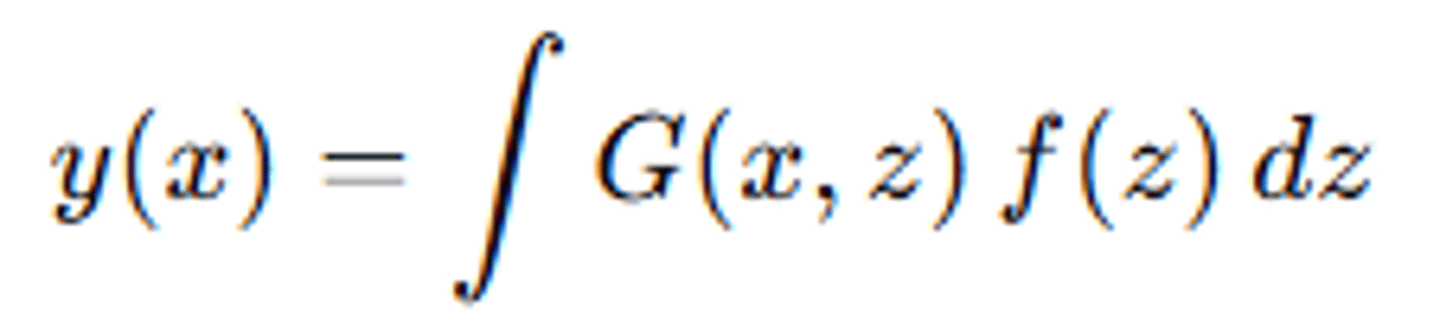
potential expression using Green's function, and the four conditions necessary to find G
V(r) = (1/ε₀)∫ρ(r')G(r',r) d³r'
2 BC or 1 IC, G⁻ = G⁺ , dG⁻ /dr - dG⁺ /dr
stored magnetic energy
and density
1/2∫B(r)·H(r)dV
density: 1/2 B(r)·H(r)
Lorentz force law (full)
F = q(E + v × B)
E in terms of V
E = -grad(V)
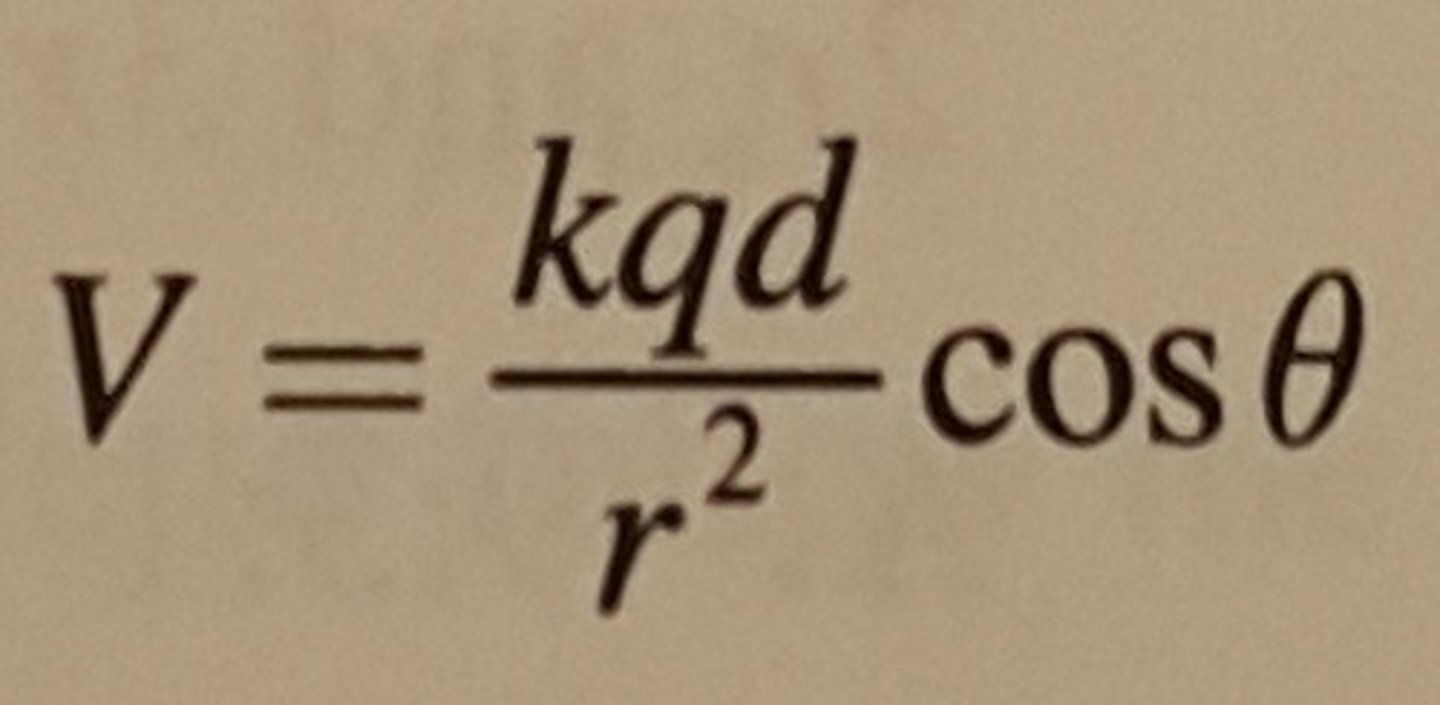
potential due to a dipole in spherical polar coordinates (far)
V(r, θ) = p cos θ / (4πε₀ · r² )
electric dipole moment?
p = qa
couple G acting on a dipole in a uniform electric field?
G = p × E
potential energy of a dipole in a uniform electric field
U = -p · E
What is the work done dW when increasing the angle θ of a dipole in a uniform field?
dW = |G(θ)|dθ, where G(θ) is the couple acting on the dipole.
force using potential energy
F(r) = -∇U(r)
electric flux
Φ = ∫∫dS · E(r).
continuity equation in electrostatics (conservation of charge)
∂ρ/∂t + ∇·J = 0
E of a uniform sheet of charge?
E = σ/(2ε₀)
E of a uniform line of charge?
E(r) = λ/(2πε₀r)
Poisson's equation
∇²V(r) = -ρ(r)/ε₀
Laplace's equation and when is it applicable
∇²V(r) = 0, applicable when only the surface is charged
types of boundary conditions
Dirichlet: the quantity of interest is specified over a boundary (eg V_surface is given)
Neumann: normal derivative of the quantity of interest is specified over a boundary
Cauchy: mixed
Green's function in free space
G(r, r′) = 1/(4π | r - r′ | )
point source, infinite boundaries
potential between parallel plates
V = Ez
Dipole moment defined through polarisability (α)
p = αE0
voltage and surface charge of a (neutral) conducting sphere in a uniform electric field
V(r) = E₀ cos θ (s³/r² - r)
σ = 3ε₀ E₀ cos θ
E₀ is the external field.
What is the relationship between the radius of a conducting sphere in a uniform field and the strength of the dipole it is equivalent to?
p = 4πε₀s³E₀
What is the capacitance of two parallel cylindrical conductors separated by distance 2D?
C/L = πϵ0 / ln(2D/a)
energy required to assemble a discrete system of charges?
U_N = (1/2) Σ (q_j V_j)
energy stored in a capacitor and inductor
U = (1/2) CV^2
U = (1/2) LI^2
electric potential energy from charge density?
U = (1/2) ∫ d^3r ρ(r)V(r).
electric energy density
UE(r) = 1/2 D(r) · E(r).
force between charged parallel plates?
F = Q²/(2ϵ0A).
Capacitance of Coaxial Cable
C/L = πε₀ / ln(r₁/r₂)
electric displacement
definition
formula in linear ( P proportional to E) dielectrics
in non linear dielectrics
free charge is the source of D, and both free and bound charges are the source of E
linear: D = εε₀E
non linear: D = ε₀E + P
magnetic field in terms of magnetic field strength:
linear and non linear materials
non linear: B = µ0(H + M)
linear: B = µµ₀H
Polarization/ magnetization of a dielectric: definition and formula using χ:
dipole moment(electric/ magnetic) per unit volume
linear: P = ε₀χE , M = χ_m H
where 1 + χ = ε , 1 + χ_m = µ
volume and surface polarization of a dielectric
describes the effective charge:
σ = P · n^
ρ= −∇⋅P
capacitance of a capacitor filled with dielectric
C = ε₀εA/d
what component (parallel or perpendicular) of H, B, D, E is conserved across boundaries
D and B : perpendicular
H and E : parallel
electric field INSIDE a dielectric sphere in a uniform field
Ein = 3/(ε+2)E₀
derived by conservation od D across boundary + assuming Ein in unniform + that the external field is the original uniform field plus a dipole field generated by the surface polarisation
Force on current element due to magnetic field.
dF = Idl × B
Biot-Savart law
dB = (µ₀I)/(4πr²) dl × r^
magnetic force between two parallel wires
F = (µ₀I₁I₂)/(2πd)
B on the axis of a current loop
B = (µ₀Ia²)/( 2(a²+x²)^(3/2) )
B in the middle of a long solenoid
µ₀ N/D I
Magnetic dipole moment
m = I∫dS
Magnetic scalar potential
H(r) = −∇φm(r)
Magnetic scalar potential of a current loop
dφ using magnetic dipole
φ using solid angle
dφ = |dm|cosθ /4πr²
φ = IΩ/4π
where the solid angle Ω = dS·r/r³ of a sphere
Ampere's law
∮dl · B = µ₀I = µ₀∫dS·J
magnetic field for a long wire
B(r) = µ₀I/ 2πr
B defined with Magnetic vector potential
B(r) = ∇ × A(r)
Poisson equation for magnetic vector potential A
−∇²A = µ₀J
Ohm's law
resistance with conductivity
J = σE
R = l / Sσ
dipole moment and Magnetisation relationship
m= ∫ M dV
current density:
Magnetisation current density
Magnetisation surface current density
Ordinary (free) electrical current density
J_m = ∇ × M (quivalent currents that reproduce the correct magnetic field, no charge carrying)
J_s=M×n^ (Appears as a current flowing along the surface)
I=∫J⋅dS (actual motion of free charges)
magnetic field strength in a sphere in a uniform magnetic field
H_in = 3H₀/(µ + 2)
B_ gap in a toroidal core: how to derive it and what is the final answer
use B_gap = B_in since the perpendicular component is conserved, ampere's law on the loop, and B_gap = µ₀H_gap.
B_gap = µ₀NI / l
Faraday's law of magnetic induction
ε = − d/dt ∫ dS · B(r) = − dΦ/dt
self inductance
L = Φ/I
Self-inductance of long solenoid
n²LSµ₀
Self-inductance of coaxial cylinders: formula or how to derive it
µ0L/ 2π ln(b/a)
derive by constructing a surface from the center to the edge and finding the flux through it
Self-inductance of a pair of wires: formula or how to derive it
µ0l/π ln (2D/a )
2D is the distance between the wires
derive by constructing a rectangular loop between the centers.
how are sparks across switches created
V_gap=L dI/dt
where V is a voltage across the switch. When the switch is opened dI/dt goes to very large (negative) numbers and the voltage across the switch grows. Derived by applaying faraday's law to a current loop.
Mutual inductance
M = M21 = Φ2/I1 = M12 = Φ1/I2
total energy stored using mutual and self inductance
U = 1/2 I₁² L₁ + 1/2 I₂² L₂ +1/2 I₁ I₂ M
coupling coefficient
M = k(L₁ L₂)½
ideal transformer coupling coefficient and voltage ratio
k=1
V2/V1 = N2/N1
Load impedance ratio across a transformer: full expression/ how to derive it
Z₁ = [ jωL₁Z₂(N₁/N₂)² ]/ [ jωL₁+ Z₂(N₁/N₂)² ]
same as jωL₁ in parallel with Z₂(N₁/N₂)²
typically: Z₁ ≈ Z₂(N₁/N₂)²
derived by M = (L₁ L₂)½ combined with the expressions for V1 and V2 from faraday's law and complex representation.
Z1 is the equivalent input impedance seen by the source
Magnetic energy of discrete circuits
U = 1/2 sum Φ_i I_i
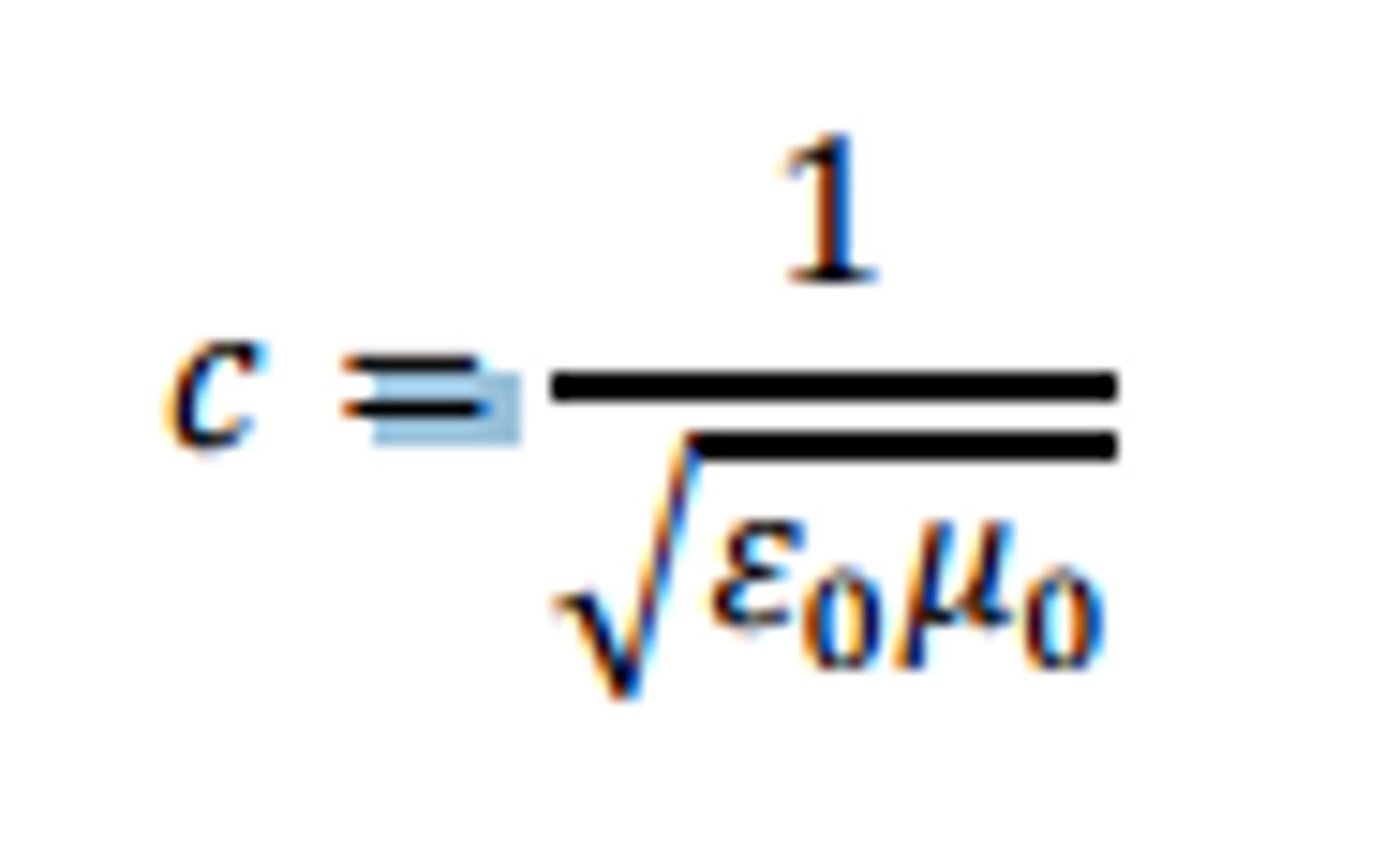
speed of light (in terms of free space permeability/permittivity)
c = 1/ √(ε₀µ₀)
refractive index
n=c/v = √(εµ)
(in non magnetic materials: √ε )
k in terms of wavelength and frequency
k = 2π/λ = ω/c
impedance of free space
in terms of permeability and permittivity
numerical value
in term of electric and magnetic field componenets
Z₀ = √(µ₀/ε₀) = Ex / Hy = 377Ω
relationship between Ex and By in free space wave propagating in the z direction
Ex = cBy
relationship between H₀ and E₀ in plane waves using k
H₀ = 1/Z₀ k^ × E₀
k^ is the unit vector pointing in the direction of propagation
Poynting vector:
formula
what does it signify
imaginary and real component sugnificance
N(r) = E(r) × H(r)
The magnitude of N gives the power flow per unit area, and the direction of N gives the direction in which the power is flowing. Can be complex if H and E are out of phase
real: instantaneous power flow per unit area at a given point
imaginary: time-averaged power flow per unit area at a point
Radiation pressure and how to derive it
R = N/c
Consider now the radiation incident normally on area A of a surface in time dt, In terms of the Poynting vector N. Find energy density. Dividing by the volume per photon the energy density is related to the radiation momentum density g by U = |g|c. radiation pressure is the rate of change of momentum per unit area.
Complex power
P = 1/2 I V∗
(half because of time average)
Snell's law
see image

power Reflection coefficient in terms of
refractive index
impedance
R = ( (n₂ − n₁)/(n₂ + n₁) )²
Γ = ( (Z₂ − Z₁)/(Z₂ + Z₁) )²
relative permittivity in plasma using the plasma frequency and how is the plasma frequency derived
ε = 1 - ω²_p/ω²
where ω²_p = Ne²/(ε₀ m_e)
derived from:
m_e d²r/dt² = −e (E + v × B)
p = -er
N p = P = ε₀χE
Effective dielectric constant in conducting media
ε' = ε + iσ/ωε₀
where ε is negligable in metals where σ is large
skin depth in conducting media:
what is it
formula / how to derive it
relation to the wavevector
The distance into a metal at which an alternating E falls to E₀/e
δ = √(2/σωµ₀µ)
derive by: n = √(ε'µ) , where the real term in ε' can be neglected. k = ω/(c/n) = ( 1 + i )/ δ by definition.
k = ( 1 + i )/ δ
The effective resistance per unit length of a wire considering skin effect
R/L = 1/2πaδσ
effectively the current is assumed to flow uniformly in a thin shell of thickness δ
characteristic impedance of the transmission line
Z = √(L/C)
Voltage reflection and transmission coefficient on a transmission line
r = V2/V1 = (Zt − Z)/(Zt + Z)
t = Vt/V1 = 2Zt/(Zt + Z)
Zt is the load impedance, Z is the line impedance
effective Zin/Z of a transimission line terminated with an impedance Zt, and source impedance = transmittion line impedance = Z , or how to derive it
Zin / Z = (Zt cos ka + iZ sin ka)/ (Z cos ka + iZt sin ka)
derive using the formula for r, and the definition Zin = (Vi+Vr)/(Ii+Ir) at distance z=-a, sub the expression for r, expand to cos and sin
Quarter-wavelength line Zin formula
Zin = Z²/ Zt
Waveguide equation
where k²_g = ω²/c² - m²π²/a² - n²π²/b² = k²₀ -k²_c
where K_c is the cut-off frequency below which we'll get evanescent waves
phase velocity and group velocity in a Waveguide
v_p = ω / k_g
v_g = dω/dk
for vacuum: v_g* v_p = c^2

