Problem solving sessions Week 2 answers
 Studied by 0 people
 Call with Kai
 Learn
Learn Practice Test
 Spaced Repetition
 Match
Match Flashcards
 Knowt Play
1/9

There's no tags or description
Looks like no tags are added yet.
Name | Mastery | Learn | Test | Matching | Spaced | Call with Kai |
|---|
No study sessions yet.
10 Terms
What could be a short-term vs. long-term response for a cell? Does the response of the signaling pathway signify short-term response of long-term? Explain
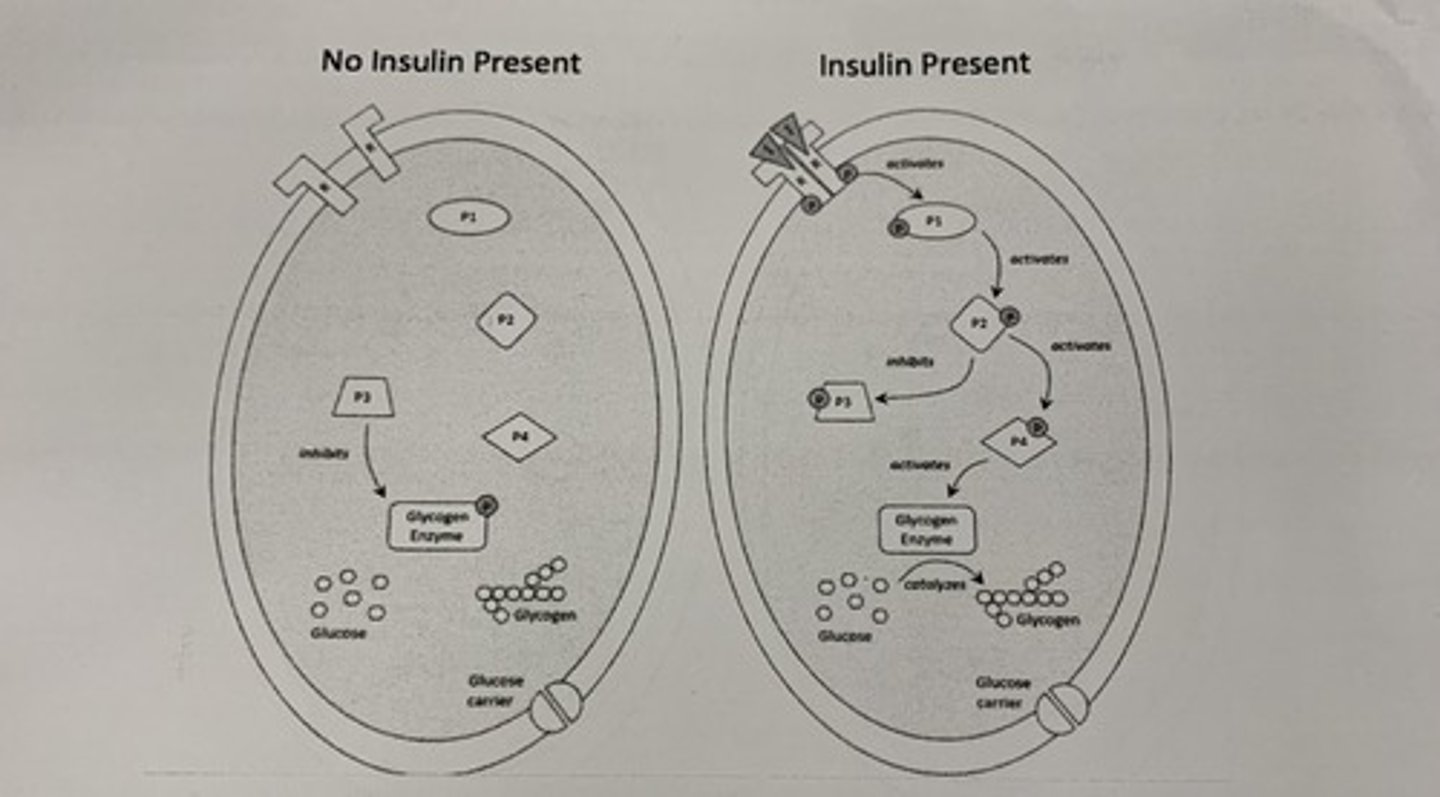
An example of a short-term response is neuron response to stimuli. An example of a long-term response is gene expression or the producton of hormones. (picture of the insulin cell with insulin present and insulin not present) this is a long-term response as insulin is critical to produce throughout life.
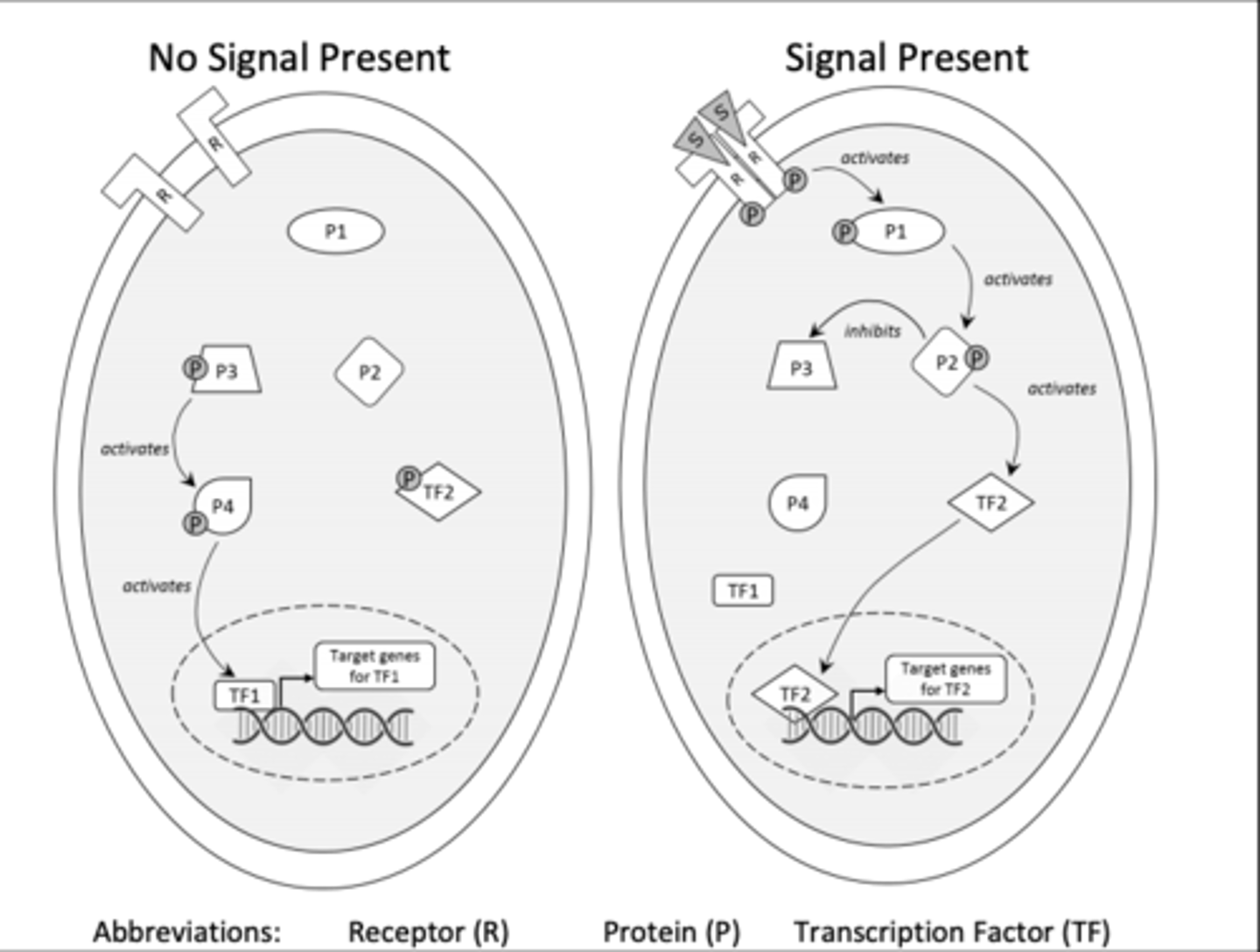
Based on the model which proteins are kinases. RR, P1, P2, P3, P4, TF1, or TF2.
RR is a kinase as this is present in a Receptor Tyrosine kinase pathway, meaning that the receptor acts as a kinase and donates a phosphate (through hydrolysis of ATP) to a desired substrate (in this case it donates to P1 protein). P1 is a kinase as it catalyzes the transfer of a phosphate group by the use of ATP onto the P2 protein. P3 is a kinase in the No signal molecule because it catalyzes the transfer of a phosphate group by use of ATP to attach the phosphate to protein P4.
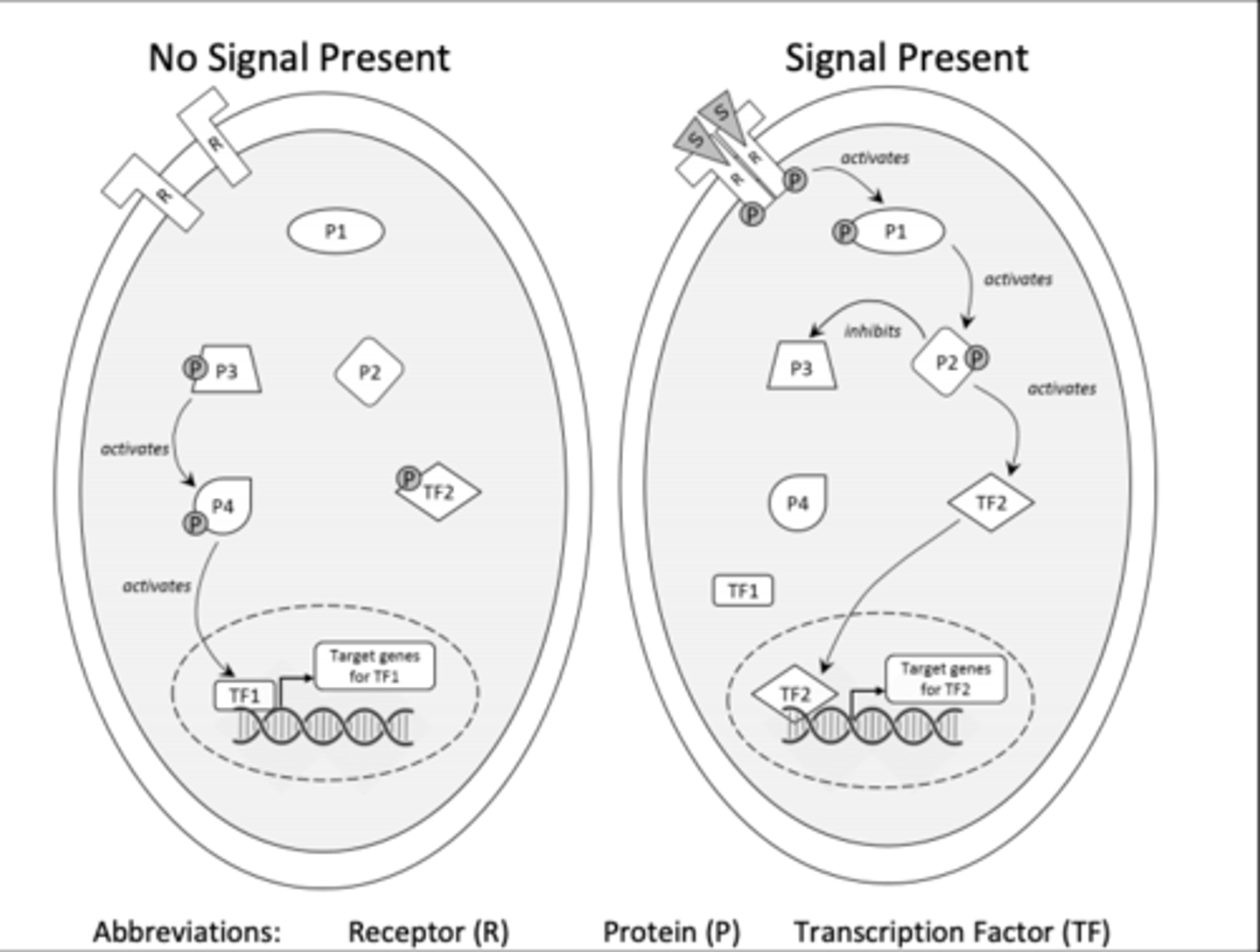
In general, activation and inactivation of proteins can only be completed by either phosphorylation or dephosphorylation events.
False, this isn't true because we see that signal molecules act as activators attaching to certain receptors on cells.
In the model the activated receptor transfers it's own phosphate bond directly to P1.
False, the activated receptor doesn't transfer it's own phosphate group to bond directly to P1 rather it creates the ATP that binds onto P1. The receptor hydrolyzes the ATP and attaches a phosphate to P1 as to activate it. It does not sacrifice it's own phosphate.
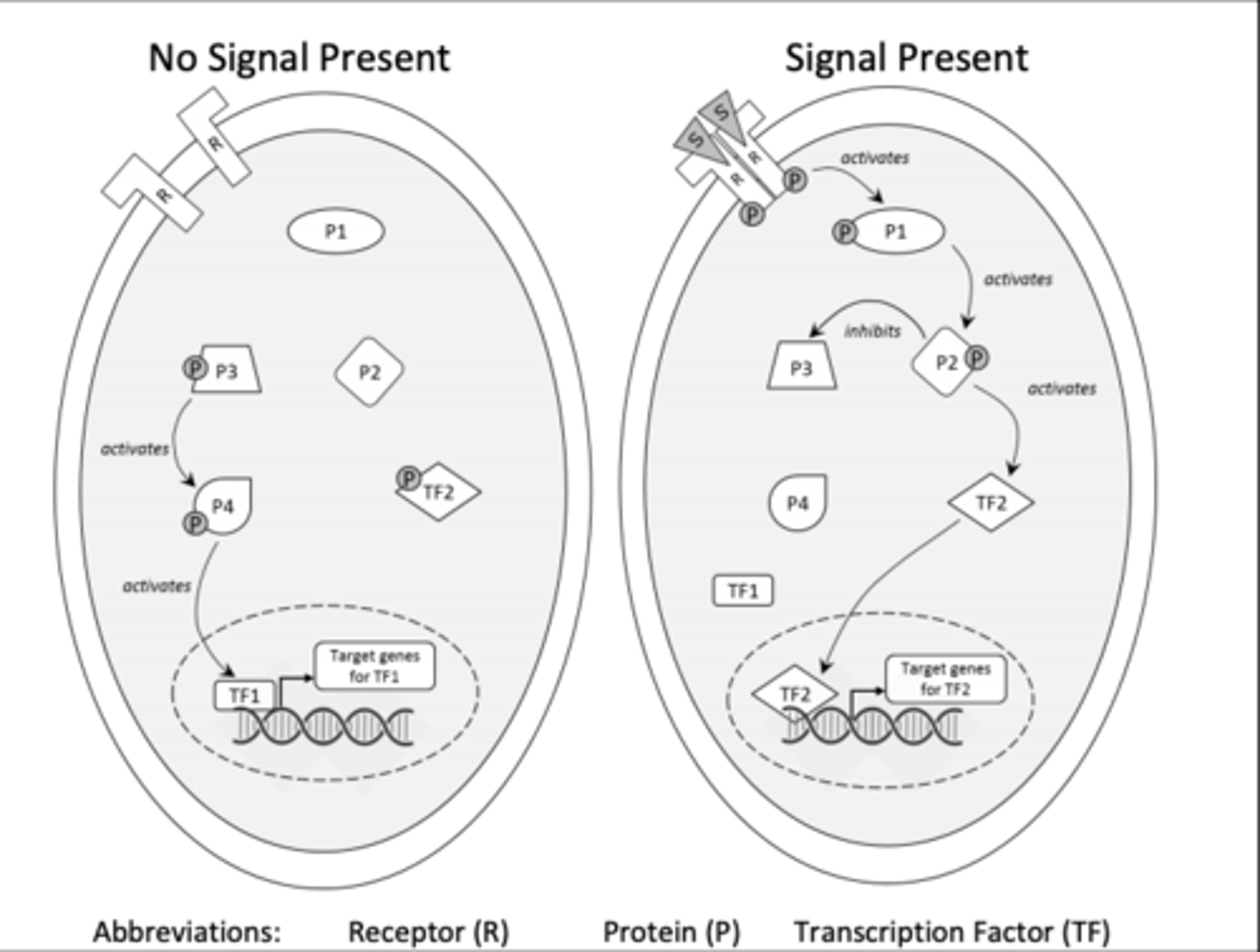
Transcription factors (TF1 and TF2) bind the same exact promoter sequences.
False, rather each gene has it's own separate promoter. We can see in the picture that the promotor for TF2 gene is in a different position on the DNA than the TF1 gene.
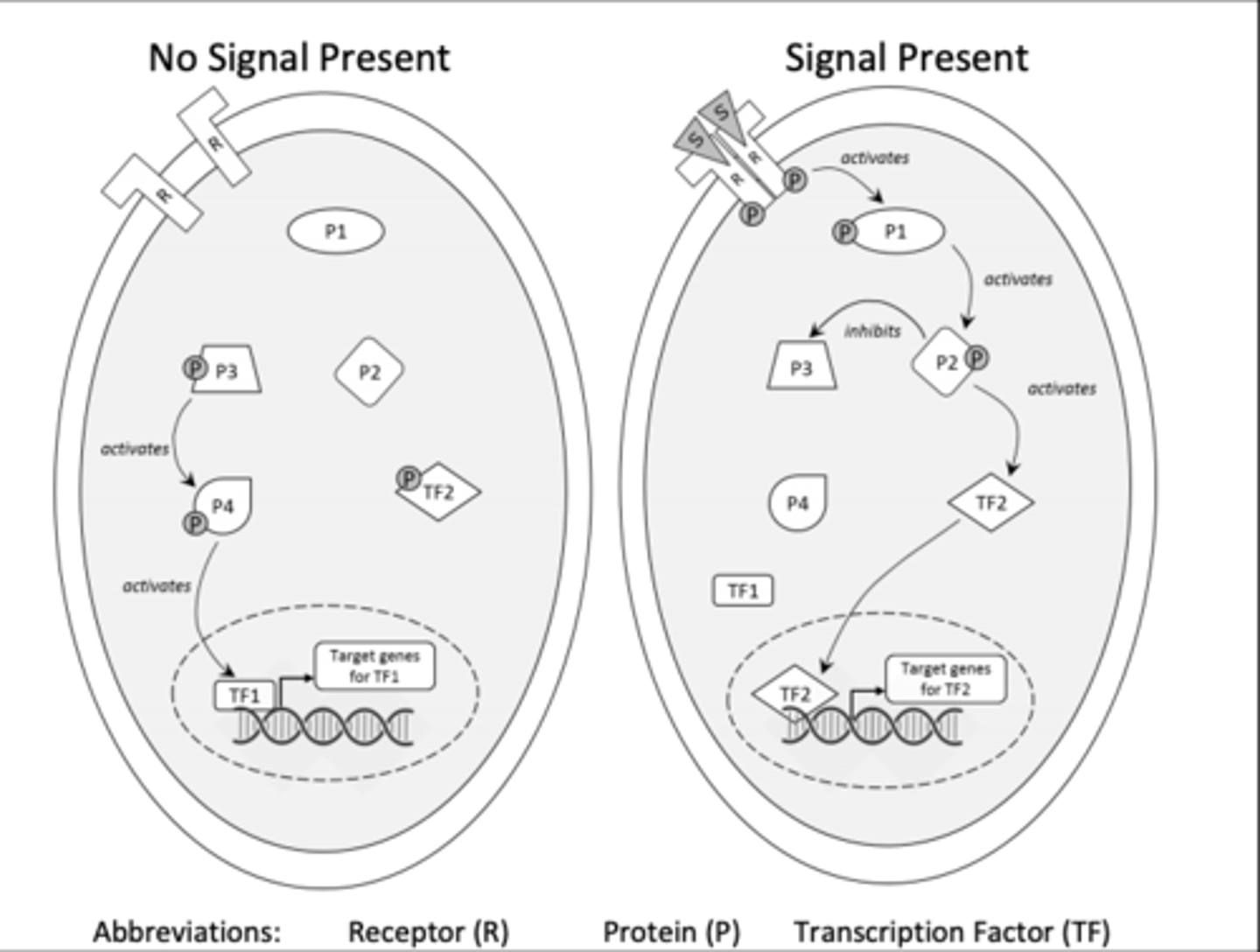
Explain a mechanism in which both TF1 and TF2 genes could be expressed simultaneously. (Mechanisms can be natural to the signaling pathway or result from a loss or gain of function mutation).
If there was a mutation in P3 that made it stay activated even if P2 (a protein acting as a phosphatase) took it's phosphate to deactivate it. This would be a gain of function mutation and would lead to the production of both TF1 and TF2 genes being expressed.
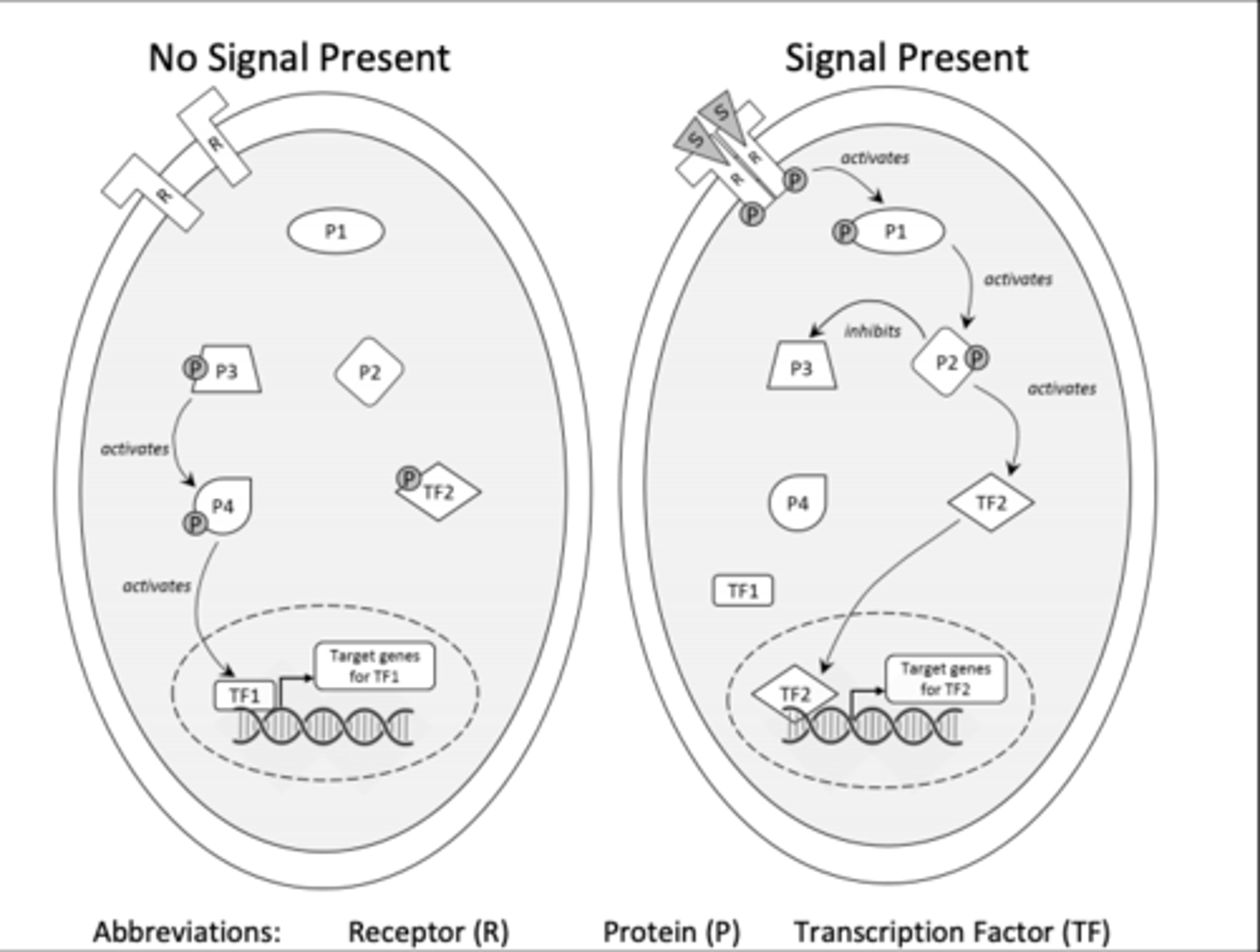
What type of receptor is present in this signaling pathway?
Receptor tyrosine kinase as there is no G-protein that wishes to attach itself to the receptor. Its strictly, the signal molecule attaching, activation of the receptor protein, and than phosphorylation of the receptor by use of ATP.
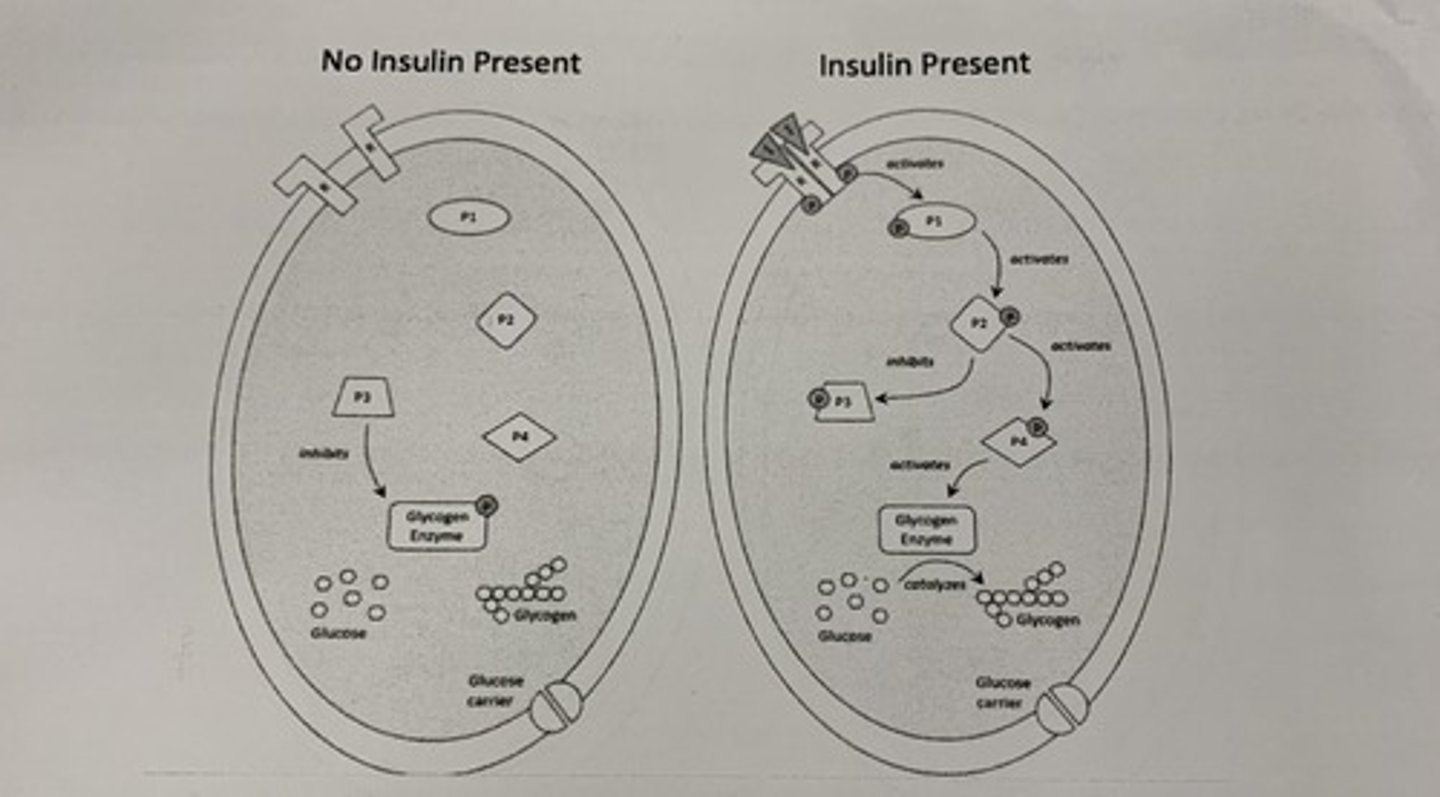
When there is no signal present, the distance between the receptor monomers will be ----------------- compared to when a signal is present.
Greater than. The reason why is because each half of the receptor will come together when the signal molecule is present, become activated and phsophorylated, it will hydrolyze ATP, and act as a kinase catalyzing the transfer of the phosphate group onto the P1 protein making it active.
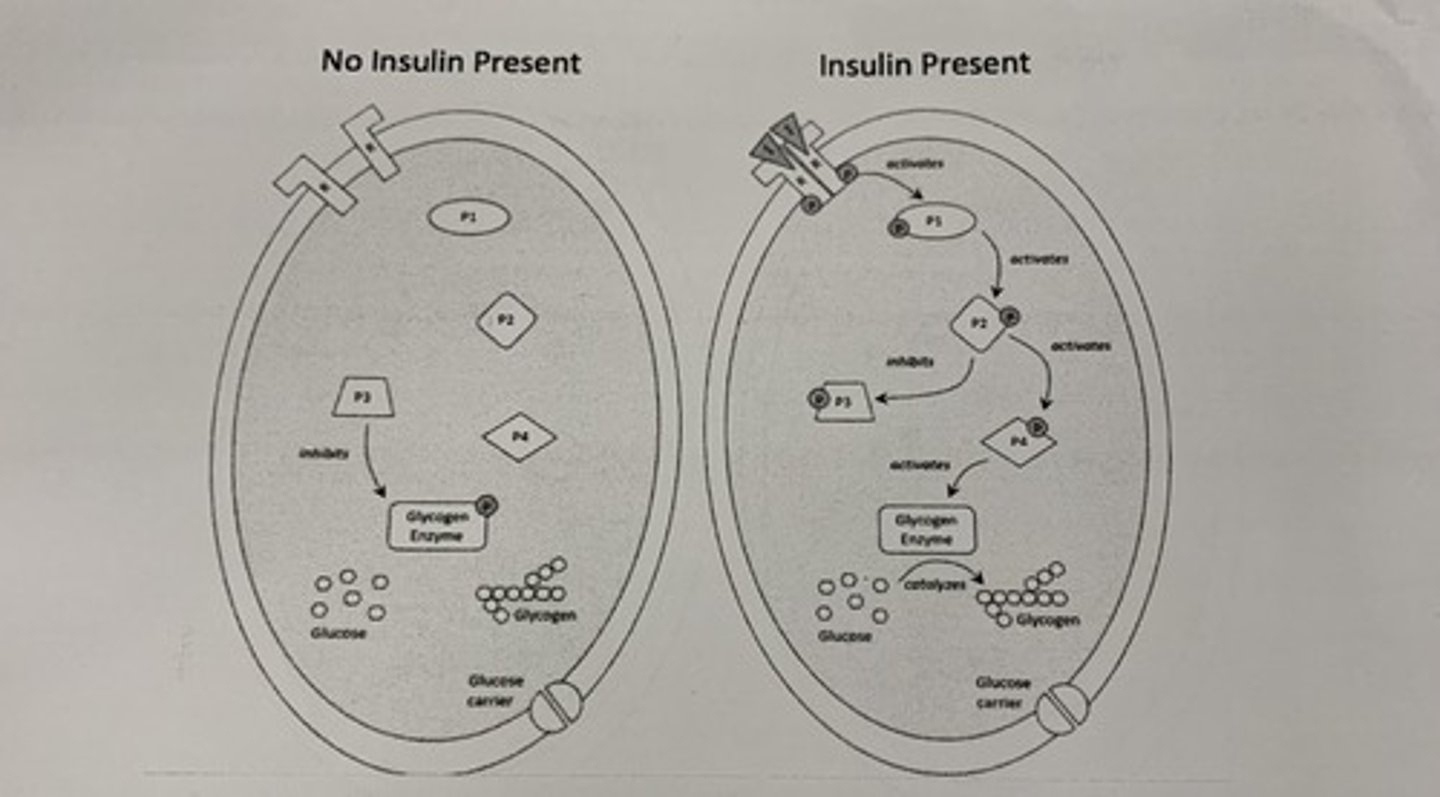
When P4 is dephosphorylated the intracellular concentration of glucose will be ---------------- when P4 is phosphorylated.
Greater than. The reason the concentration of glucose will be higher when the signal isn't present is because when the signal isn't present, P3 acts as an inhibitor by phosphorylating the enzyme, preventing Glycogen Enzyme from catalyzing Glucose into Glycogen. This means Glucose is in abundance. While in the Insulin present cell we see that Protein phosphorylates P3 to inhibit it (this prevents it from acting as an inhibitor to the Glycogen enzyme), it activates protein P4 which acts as a phosphatase, taking the phosphate from the Glycogen Enzyme, activating it, which catalyzes Glucose into Glycogen. Using a large amount of Glucose up.
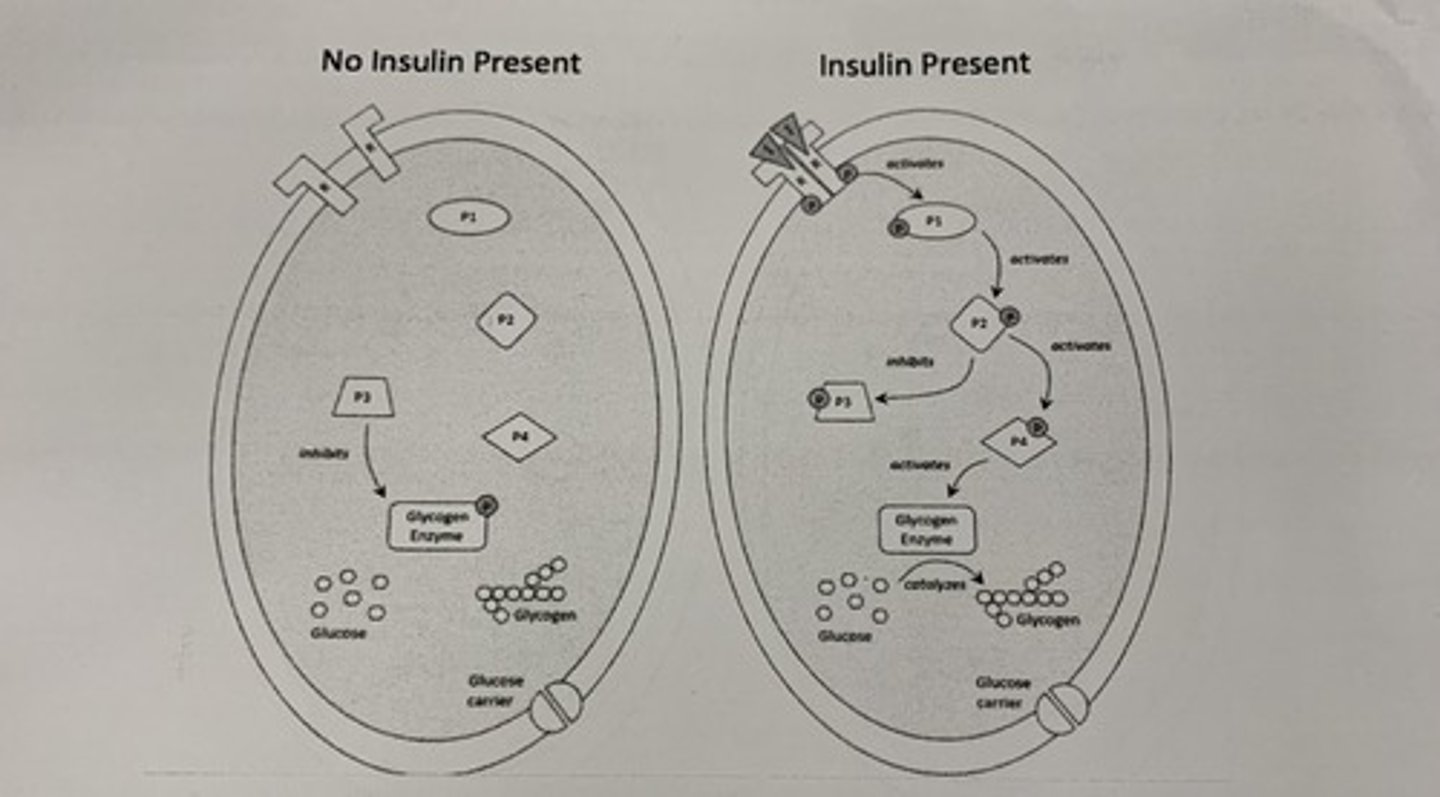
If the extracellular concentration of insulin was high and there was a sudden loss-of-function mutation in P2, the intracellular concentration of glycogen will be ------------------- compared to without the mutation.
Less than. The reason it will be less than is because if P2 isn't active Glycogen can't be produced. P2 in the signal molecule would'nt be able to activate P4 protein (phosphatase) to activate the Glycogen enzyme to make the Glycogen. Instead it would be a similar pathway to the No insulin present pathway, in that P3 wouldn't be inhibited by P2 so it would attach a phosphate to the glucose enzyme and inhibit the Glycogen enzyme. This would leave a large amount of glucose with no enzyme to catalyze it into glycogen because it is inhibited not to catalyze.
 Note
Note  Flashcards (43)