Chapter 11 - Monetary Policy
 Call Kai
 Learn
Learn Practice Test
 Spaced Repetition
 Match
Match Flashcards
 Knowt Play
1/64

There's no tags or description
Looks like no tags are added yet.
Name | Mastery | Learn | Test | Matching | Spaced | Call with Kai |
|---|
No analytics yet
Send a link to your students to track their progress
65 Terms
What is the main responsibility of the Bank of Canada?
To conduct monetary policy “in the best interests of the economic life of the nation”
Monetary Policy
The actions the BoC takes to manage the money supply and interest rates to achieve its macroeconomic policy objectives.
The 4 goals of monetary policy
Price stability
High employment
Stability of financial markets and institutions
Economic Growth
Price stability
Rising prices reduce money’s usefulness as a medium of exchange and store of value.
What are the benefits of low inflation?
More efficient resource allocation
Allows the central bank to increase aggregate demand during recessions
High employment (or low rate of unemployment)
Unemployed workers and underused factories/office buildings reduce gross domestic product (GDP) below its potential level.
Hence, high employment is essential
What are the effects of unemployment?
Financial distress
Lower self-esteem for workers
Stability of financial markets and institutions
Firms often need to borrow funds as they design, develop, produce, and market their products
What is the role of stable financial systems?
Ensure efficient flow of funds from savers to borrowers
Economic Growth
Raises the living standards
How can policy promote economic growth?
Encourage saving (more investment capital)
Provide incentives for business investment
Support stable growth for better planning
Money demand
The amount of money that households and firms choose to hold at a given interest rate.
Need to understand the money market
What are the Bank of Canada’s key monetary policy tools?
Open market buyback operations
Lending to financial institutions.
What percentage does the BoC try to keep inflation between?
1-3%
(however, the BoC can’t affect the inflation rate directly)
Monetary policy targets
Variables the central bank can directly control (like money supply or interest rates) to influence inflation, GDP, and employment.
What do monetary policy targets affect?
Inflation, real GDP, and employment.
Money Market
Which brings together the demand and supply for money.
Demand for Money Graph
The vertical axis = interest rate.
Horizontal axis = Quantity of money
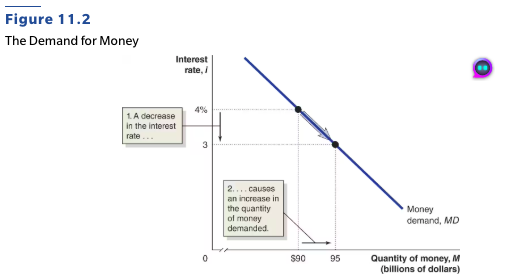
Why is the demand for money curve downward sloping?
Households have a choice between holding money and holding other financial assets, such as Canada bonds
Desirable and undesirable characteristics of money that households take into account:
Desirable characteristics: You can use it to buy goods, services, or financial assets.
Undesirable characteristics: It earns either a zero interest rate or a very low interest rate
Why does money have an opportunity cost?
Money earns little/no interest, so its opportunity cost is the interest rate
The relation between money demand and interest rates
Interest rate ↑ → money demand ↓
Interest rate ↓ → money demand ↑
The 3 variables that cause the money demand curve to shift
Real GDP
The price level
Technology
Money demand curve to shift - Real GDP
Real GDP ↑ → more transactions → money demand ↑ (shift right)
Real GDP ↓ → fewer transactions → money demand ↓ (shift left)
Money demand curve to shift - Price Level
Price level ↑ → need more money for purchases → money demand ↑ (shift right)
Price level ↓ → need less money → money demand ↓ (shift left)
Money demand curve to shift - Technology
(e.g., digital payments) → reduces need for cash → money demand ↓ (shift left)
How does the Bank of Canada manage the money supply?
The BoC changes the money supply by buying or selling government securities.
Money Supply - Buys securities
Increases bank reserves → more lending → money supply ↑
Money Supply - Sell securities
Decreases bank reserves → less lending → money supply ↓
Equilibrium in the Money Market
Equilibrium occurs where money demand = money supply, which determines the equilibrium interest rate.
Increases and decreases in the money supply
Increase in money supply → shifts supply right → interest rate ↓
Decrease in money supply → shifts supply left → interest rate ↑
Money Supply Graph
Money supply is fixed by the Bank of Canada (vertical curve)
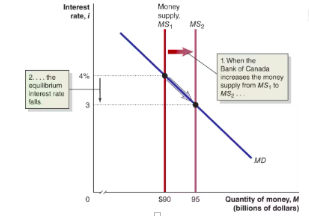
What happens when the money supply increases or decreases?
Increase: excess money → buy assets → interest rate ↓ → money demand ↑ → equilibrium restored
Decrease: too little money → sell assets → interest rate ↑ → money demand ↓ → equilibrium restored
Two interest rate models
Two different models that explain interest rates, depending on the context:
Loanable funds model
Money market model
Loanable funds model
Long-term real interest rate (savings and investments).
Relevant for saving, investing, and borrowing for long-term projects (e.g., mortgages, factories)
Money market model
Focuses on the short-term nominal interest rate (policy-driven)
Directly influenced by the Bank of Canada's monetary policy
What target does the Bank of Canada mainly use and why?
It mainly targets the overnight interest rate to influence real GDP, inflation, and overall economic activity.
What is the overnight interest rate?
Rate banks charge each other for short-term (overnight) loans of reserves
Why is the overnight rate important?
BoC targets it using an operating band and open market operations
Changes in this rate affect other interest rates and the entire economy
(Formula) Real interest rate
Nominal interest rate − Inflation rate
How do interest rates affect aggregate demand?
They affect consumption, investment, and net exports (not including government spending).
How do interest rates impact consumption?
Low rates → more borrowing & spending; high rates → less
How do interest rates impact investment?
Low rates → more business & housing investment; high rates → less
How do interest rates impact net exports?
High rates → stronger currency → exports ↓; low rates → weaker currency → exports ↑
How does monetary policy affect real GDP and the price level?
By changing interest rates, which shift aggregate demand (AD).
Expansionary monetary policy
Actions by the Bank of Canada to increase the money supply and lower interest rates to boost spending, increase real GDP, and reduce unemployment (especially during a recession).
Contractionary monetary policy
(used to reach its goal of price stability)
The BoC’s increasing interest rates to reduce inflation.
Decreasing the money supply and increasing interest rates
Can the Bank of Canada Eliminate Recessions?
The BoC cannot completely eliminate recessions, but it can reduce their severity and duration through monetary policy.
The Taylor Rule
Explains how the Bank of Canada sets the overnight interest rate.
It starts with the equilibrium real interest rate (≈2%) and adds:
Inflation gap – difference between current inflation and target inflation
Output gap – difference between real GDP and potential GDP
Taylor Rule - Equation

Taylor Principle
When inflation rises, the Bank of Canada raises the overnight rate by more than the increase in inflation to keep the real interest rate positive and stabilize the economy.
What happens if interest rates rise less than inflation?
Real interest rates fall → spending increases → inflation rises further.
Inflation targeting
Committing the central bank to achieve an announced level of inflation.
Average-inflation targeting
Keeping inflation close to the target on average over time, not every year.
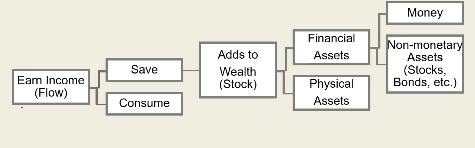
Income/Money "Decision Tree"
Households earn income → consume or save → savings add to wealth → wealth held as physical assets (house, jewelry) or financial assets (money or stocks/bonds).
Market Diagram (Shell)
Vertical Axis: Nominal interest rate (i)
Horizontal Axis: Quantity of money (M)
Demand for money has a negative slope.
Higher interest rates = the quantity of money goes down.
The money supply "set" by the Bank of Canada
Vertical
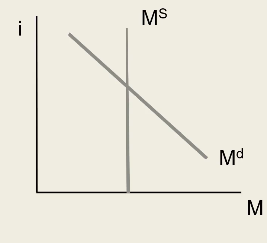
Suppose that Y (income) increases. What happens to the quantity of money and the interest rate?
When income increases, consumption will also increase, and people will want to have more money to pay for all of this extra stuff that they're buying
Monetary Policy - Recession
High unemployment
BoC wants to shift AD out to the right to restore long-run equilibrium
Monetary Policy - Expansion
Risk of coming inflation
BoC wants to shift AD to the left
What would the BoC do to prevent inflation?
Shift the AD curve to the LEFT (reduce spending)
What would the BoC do to fight a recession?
Shift the AD curve to the RIGHT (increase spending)
Bank Panic
When many banks simultaneously experience large withdrawals by depositors.
How does the Government of Canada influence the conduct of monetary policy?
It determines the objectives of monetary policy jointly with the Bank of Canada.
How can investment banks be subject to liquidity problems?
They often borrow short term, sometimes as short as overnight, and invest the funds in longer-term investments.
When the government established the Bank of Canada in 1934, what was its main responsibility?
Prevent bank panics by making loans to banks.

