Protein Three-Dimensional Structure - Chapter #4 Biochemistry

0.0(0)
studied byStudied by 0 people
call kaiCall Kai
learnLearn
examPractice Test
spaced repetitionSpaced Repetition
heart puzzleMatch
flashcardsFlashcards
GameKnowt Play
Card Sorting

1/24

encourage image

There's no tags or description

Looks like no tags are added yet.

Last updated 12:57 PM on 2/3/26
Name
Mastery
Learn
Test
Matching
Spaced
Call with Kai

No analytics yet

Send a link to your students to track their progress

25 Terms

1
New cards

Primary Structure

- Amino Acids Are

Linked by Peptide Bonds to Form Polypeptide

Chains

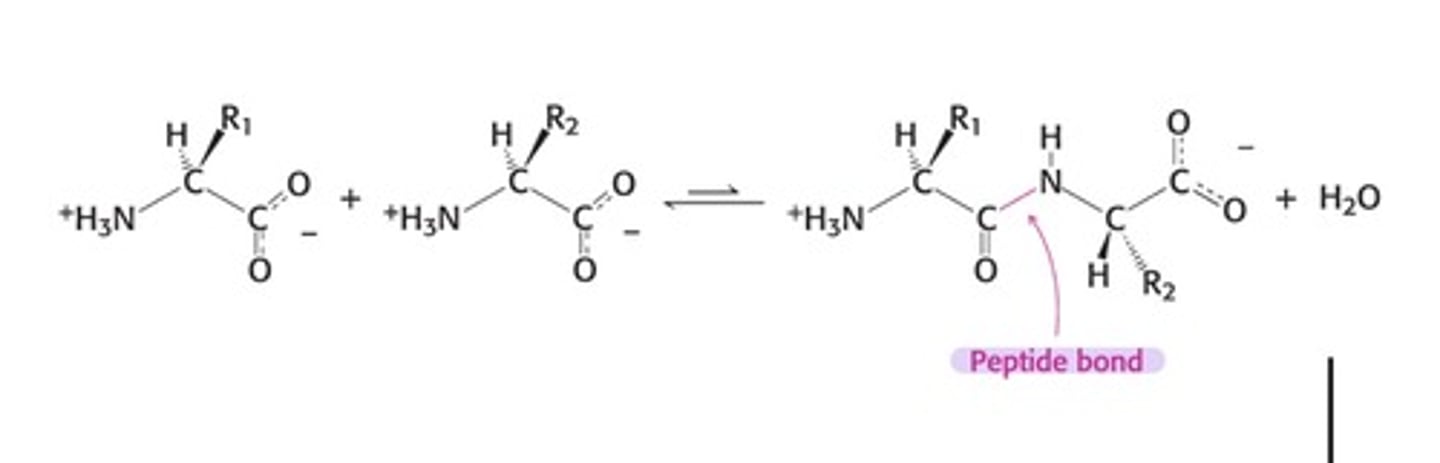
- Polypeptides consist of amino acids linked by a peptide bond

- The peptide bond is also called an amide bond

- Each amino acid in a protein is called a residue

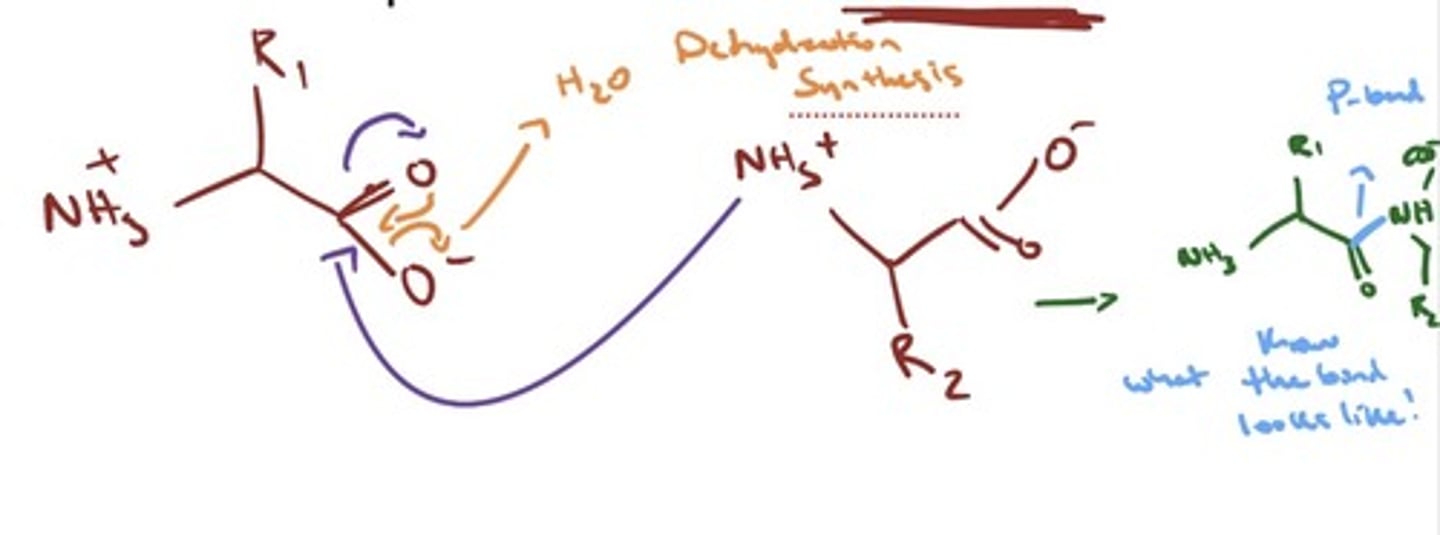
- dehydration synthesis achieves this bond
<p>- Amino Acids Are</p><p>Linked by Peptide Bonds to Form Polypeptide</p><p>Chains</p><p>- Polypeptides consist of amino acids linked by a peptide bond</p><p>- The peptide bond is also called an amide bond</p><p>- Each amino acid in a protein is called a residue</p><p>- dehydration synthesis achieves this bond</p>
2
New cards

Peptide Bond Formation

- get rid of O and two hydrogens from N
<p>- get rid of O and two hydrogens from N</p>
3
New cards

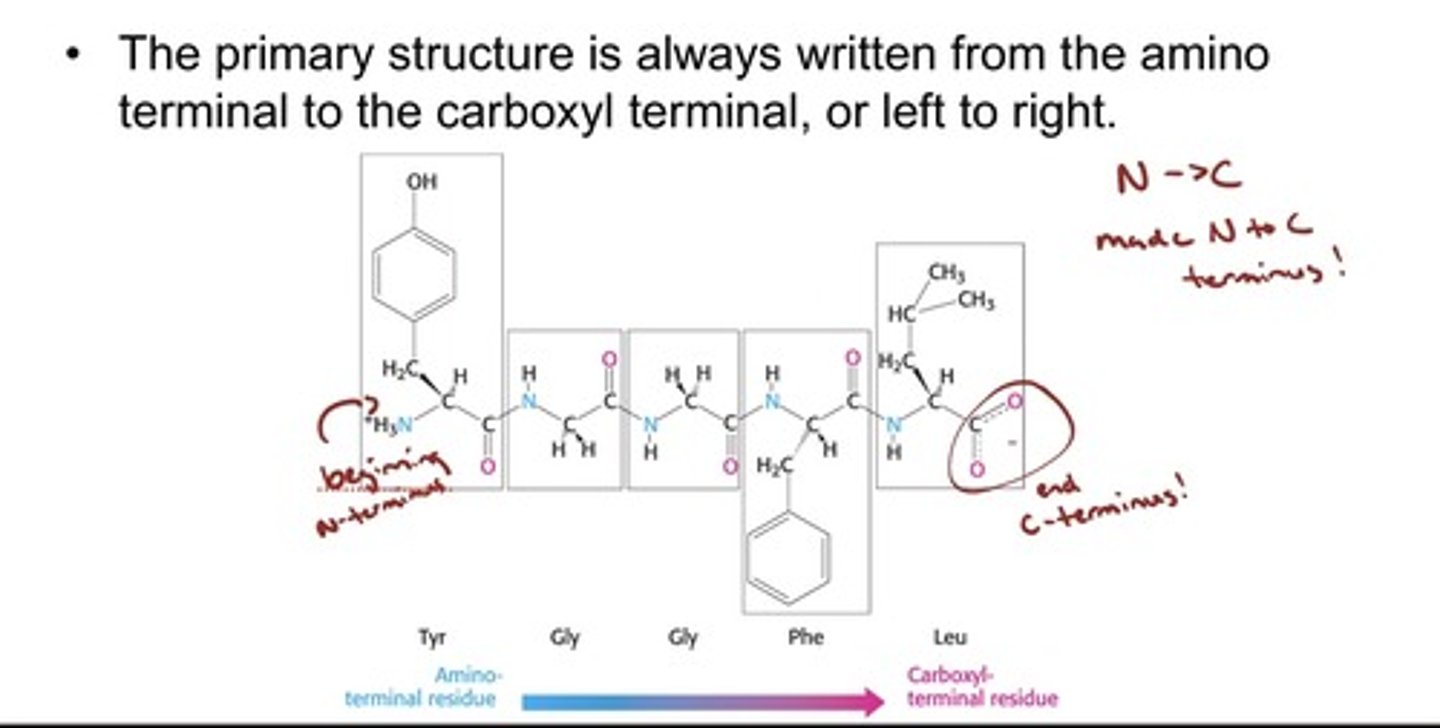
Polypeptide Chains Have Directionality - what group is at the beginning and at the end

- The amino terminal (N-terminus) end is taken as the beginning of the polypeptide chain, and the Carboxyl terminal (C-terminus) end is the end of the polypeptide chain

- N on the left and C on the right
<p>- The amino terminal (N-terminus) end is taken as the beginning of the polypeptide chain, and the Carboxyl terminal (C-terminus) end is the end of the polypeptide chain</p><p>- N on the left and C on the right</p>
4
New cards

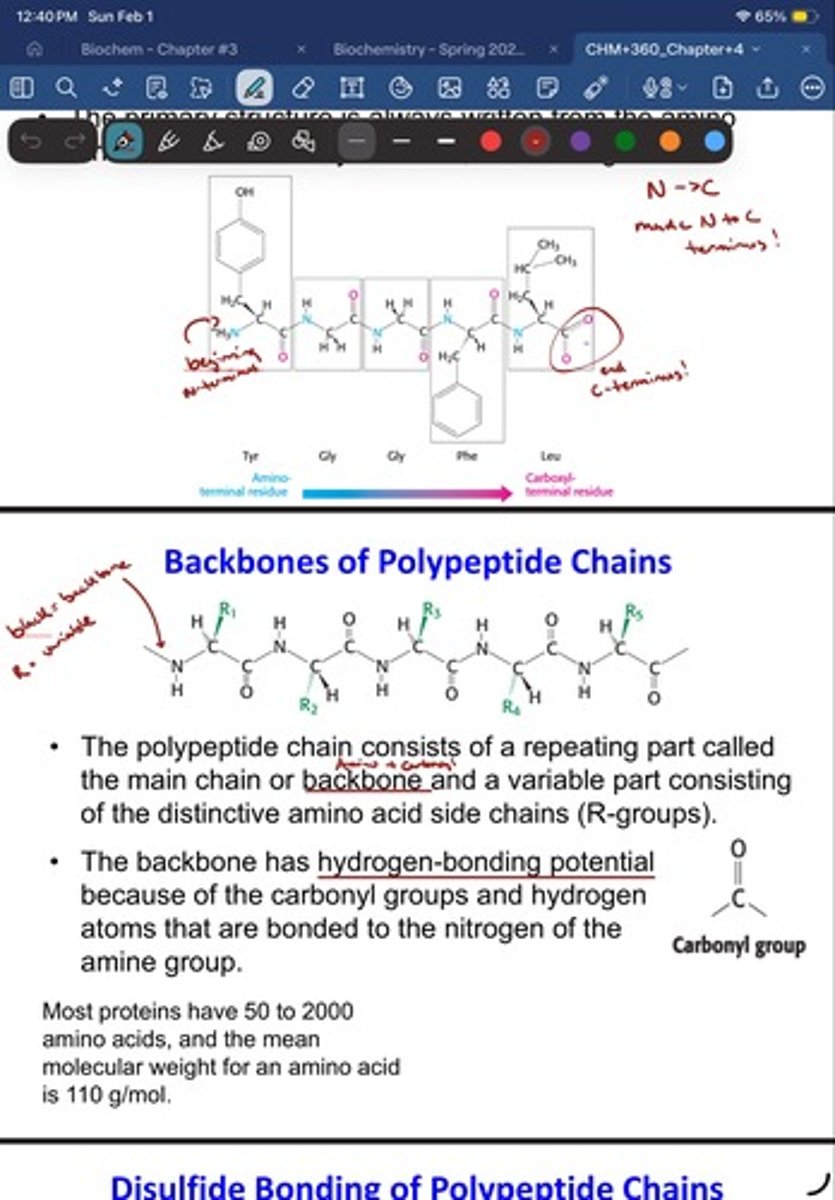
Backbones of polypeptides

- the polypeptide chain consists of a repeating part called

the main chain or backbone and a variable part consisting

of the distinctive amino acid side chains (R-groups).

- The backbone has hydrogen-bonding potential

because of the carbonyl groups and hydrogen

atoms that are bonded to the nitrogen of the

amine group
<p>- the polypeptide chain consists of a repeating part called</p><p>the main chain or backbone and a variable part consisting</p><p>of the distinctive amino acid side chains (R-groups).</p><p>- The backbone has hydrogen-bonding potential</p><p>because of the carbonyl groups and hydrogen</p><p>atoms that are bonded to the nitrogen of the</p><p>amine group</p>
5
New cards

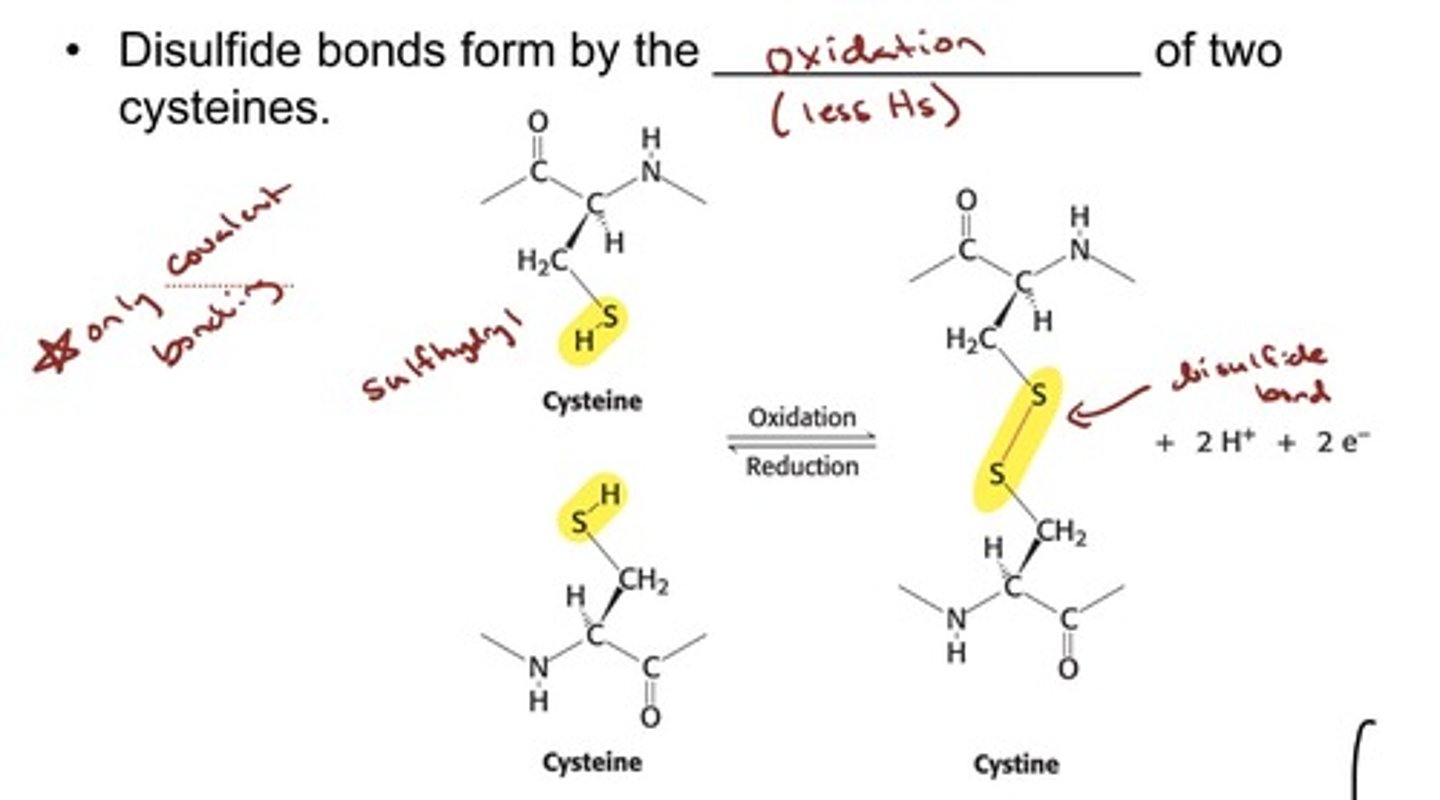
Disulfide Bonding of Polypeptide Chains

• In some proteins, the polypeptide chain can be cross-

linked by disulfide bonds.

• Disulfide bonds form by the oxidation of two

cysteines
<p>• In some proteins, the polypeptide chain can be cross-</p><p>linked by disulfide bonds.</p><p>• Disulfide bonds form by the oxidation of two</p><p>cysteines</p>
6
New cards

Proteins Have Unique Amino Acid Sequences

Specified by Genes - Inter and Intra bonds of cysteine
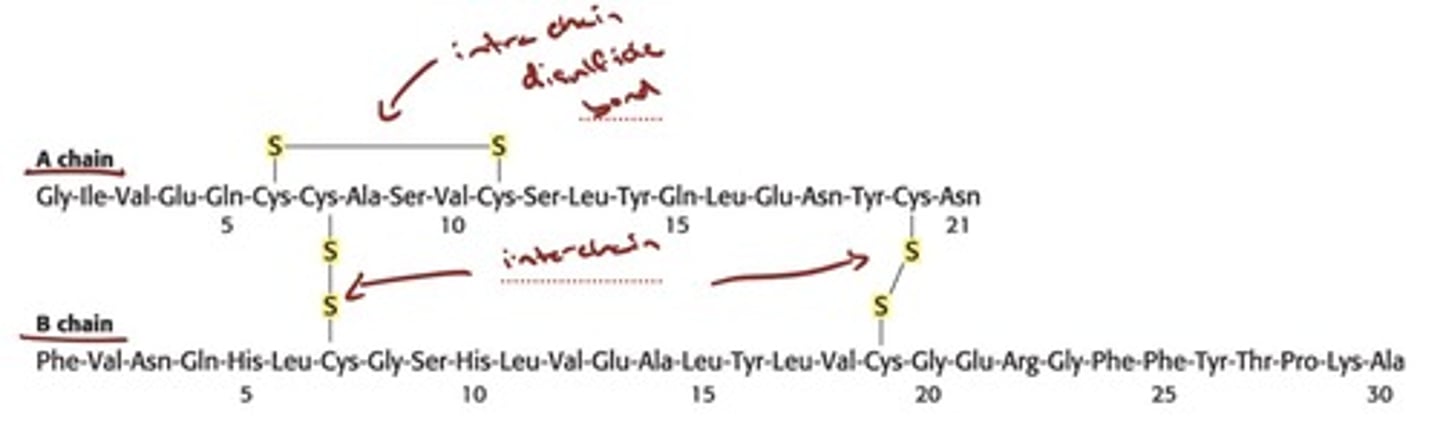
knowt flashcard image
7
New cards

Polypeptide Chains Are Flexible Yet

Conformationally Restricted

- The peptide bond has partial double-bond character

because of resonance; thus, rotation about the bond

is prohibited.

- knwo either form of peptide bond!
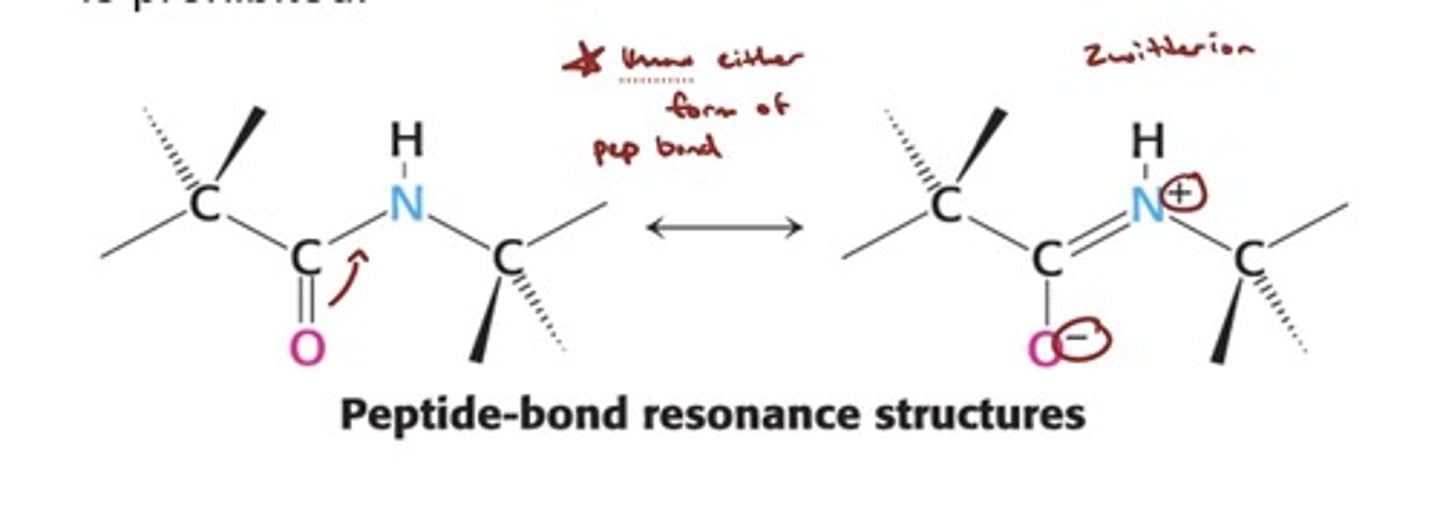
<p>- The peptide bond has partial double-bond character</p><p>because of resonance; thus, rotation about the bond</p><p>is prohibited.</p><p>- knwo either form of peptide bond!</p>
8
New cards

trans VS cis for AA chains

- Most peptide bonds are in the trans configuration so as

to minimize steric clashes between neighboring R

groups.
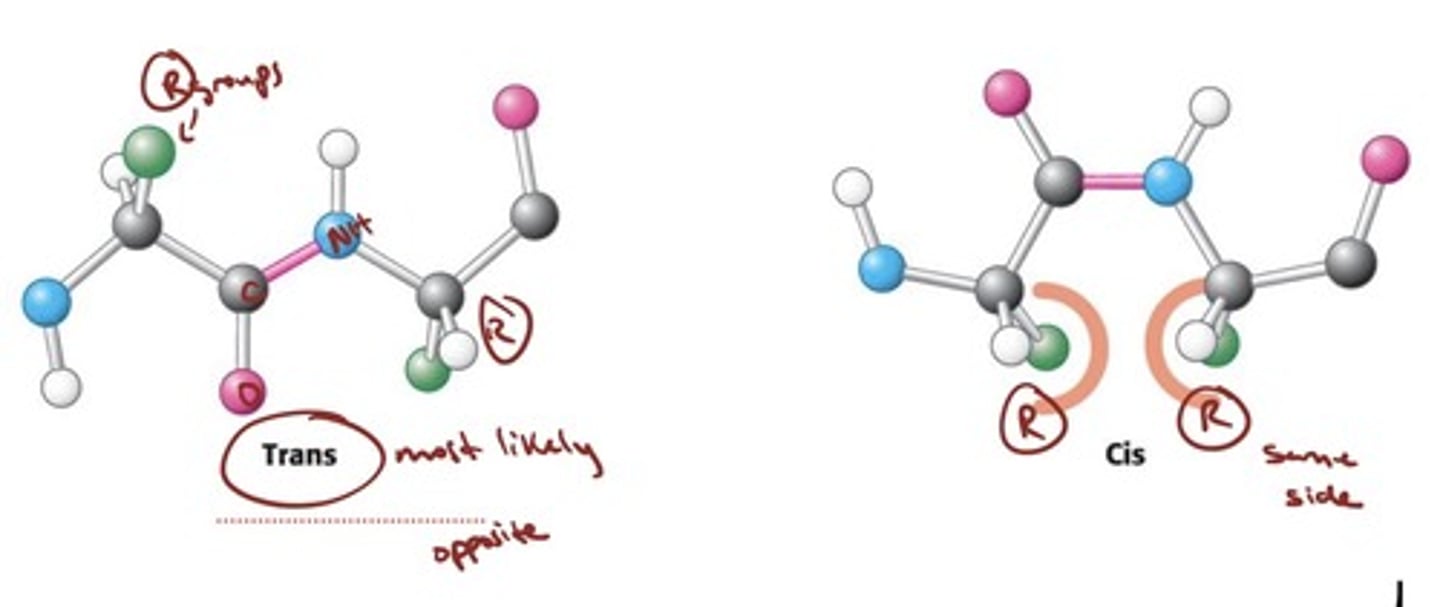
<p>- Most peptide bonds are in the trans configuration so as</p><p>to minimize steric clashes between neighboring R</p><p>groups.</p>
9
New cards

Secondary Structure

- Secondary structure is the three-dimensional structure

formed by hydrogen bonds between peptide NH

and CO groups of amino acids that are near one another in

the primary structure

- The α helix, β sheets, and turns are prominent examples

of secondary structure
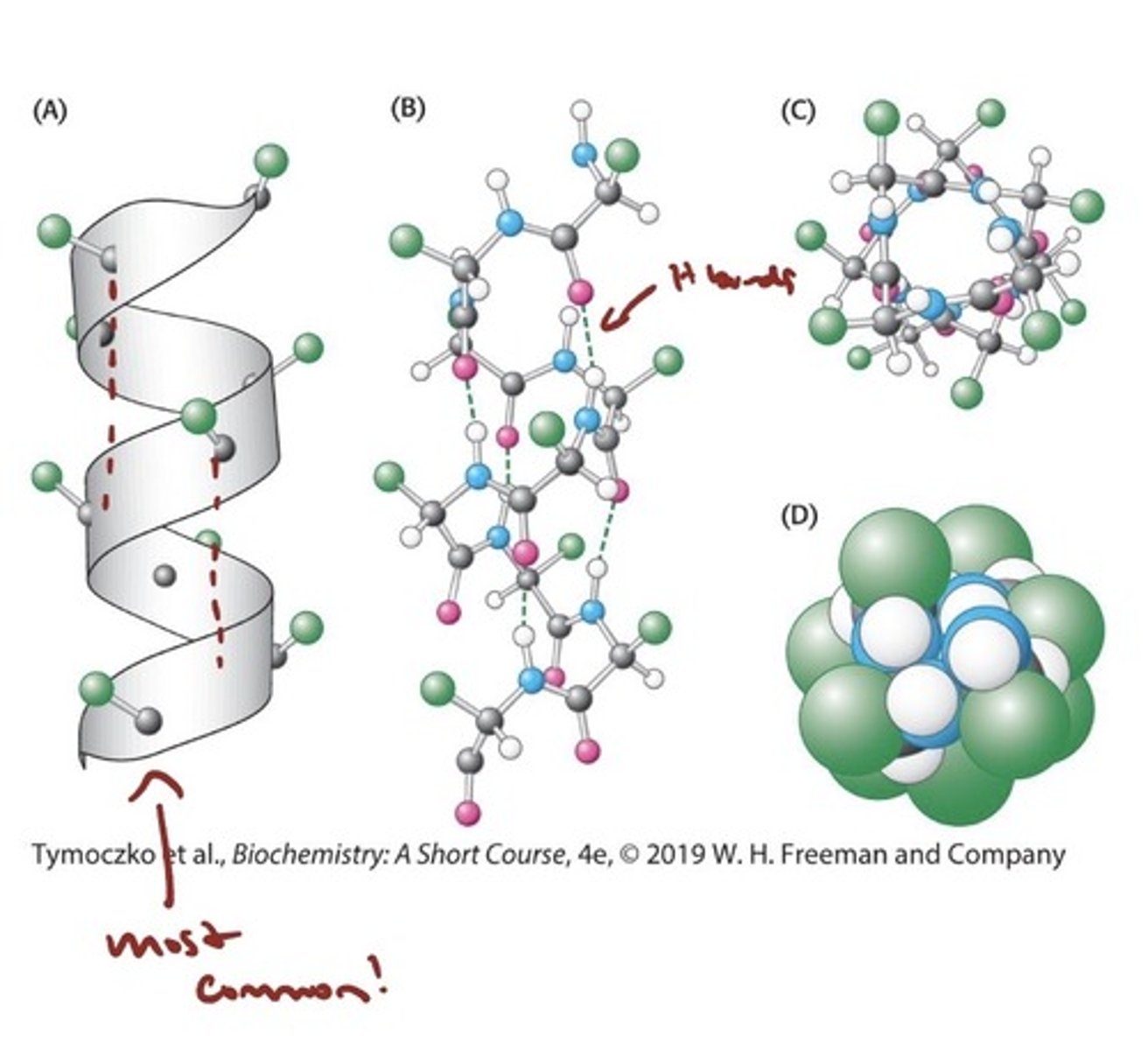
<p>- Secondary structure is the three-dimensional structure</p><p>formed by hydrogen bonds between peptide NH</p><p>and CO groups of amino acids that are near one another in</p><p>the primary structure</p><p>- The α helix, β sheets, and turns are prominent examples</p><p>of secondary structure</p>
10
New cards

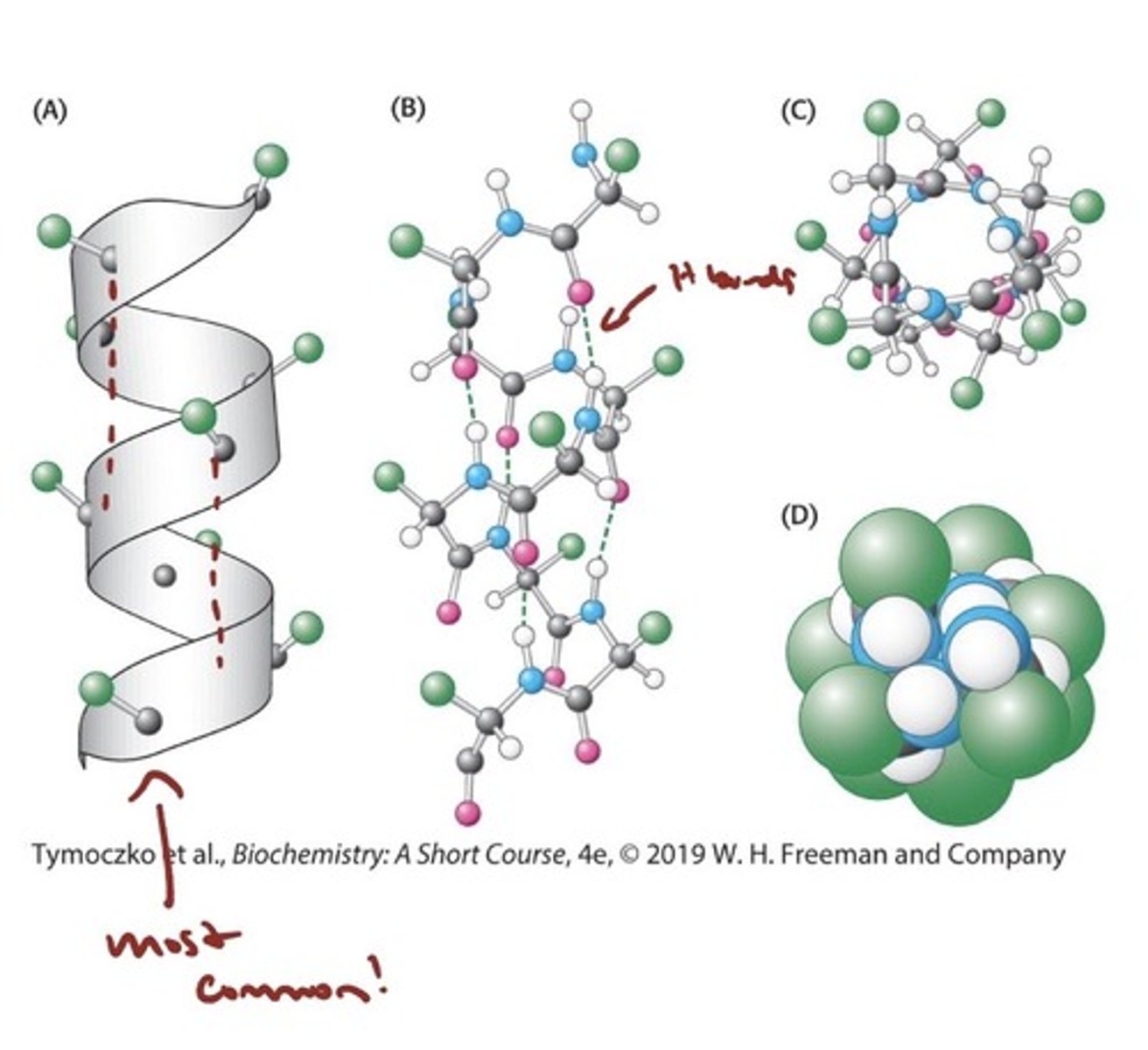
The Alpha Helix

- a Coiled Structure Stabilized

by Intrachain Hydrogen Bonds

- The α helix is a tightly coiled structure, with the R groups

bristling out from the axis of the helix

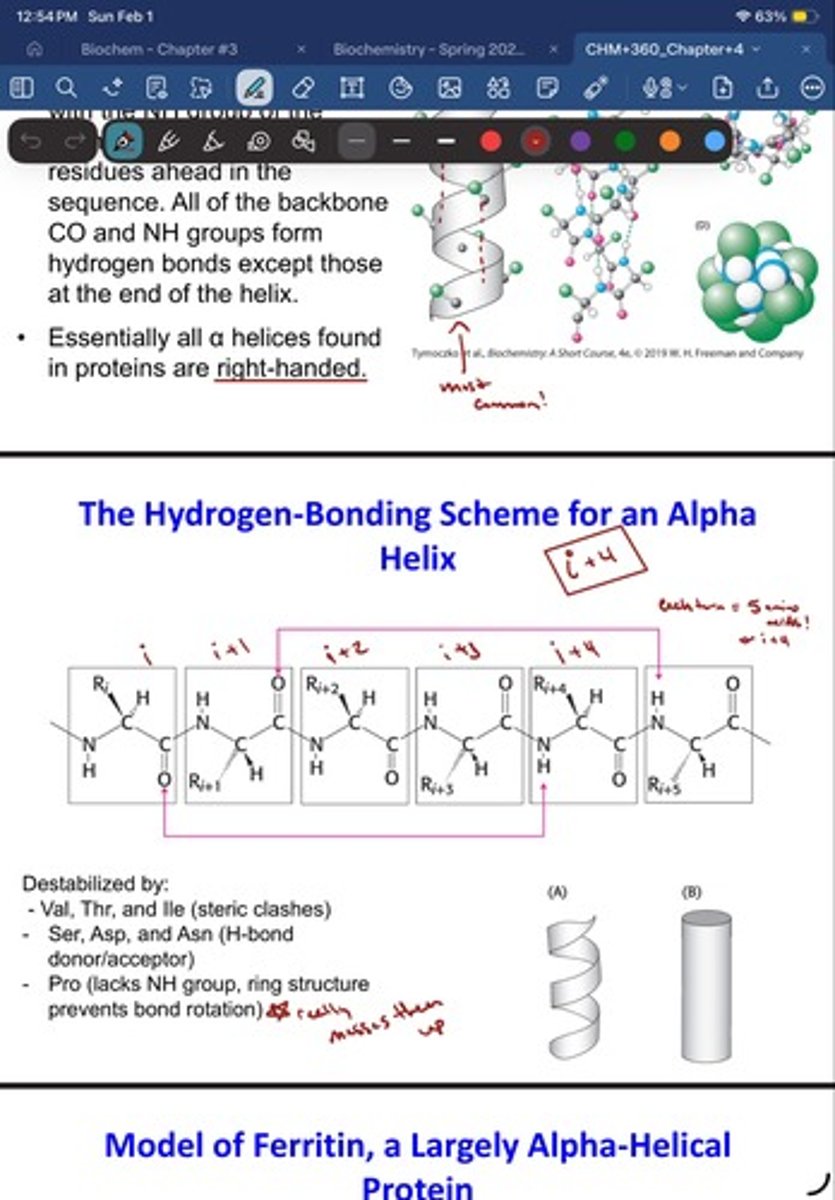
- The CO group of each amino acid forms a hydrogen bond with the NH group of the amino acid that is situated four residues ahead in the sequence (i + 4)

- All of the backbone CO and NH groups form hydrogen bonds except those at the end of the helix.

- all found are right handed
<p>- a Coiled Structure Stabilized</p><p>by Intrachain Hydrogen Bonds</p><p>- The α helix is a tightly coiled structure, with the R groups</p><p>bristling out from the axis of the helix</p><p>- The CO group of each amino acid forms a hydrogen bond with the NH group of the amino acid that is situated four residues ahead in the sequence (i + 4)</p><p>- All of the backbone CO and NH groups form hydrogen bonds except those at the end of the helix.</p><p>- all found are right handed</p>
11
New cards

The Hydrogen-Bonding Scheme for an Alpha

Helix - what destabalizes it?

- Val, Thr, and Ile (steric clashes)

- Ser, Asp, and Asn (H-bond

donor/acceptor)

- Pro (lacks NH group, ring structure

prevents bond rotation)* really messed them up*
<p>- Val, Thr, and Ile (steric clashes)</p><p>- Ser, Asp, and Asn (H-bond</p><p>donor/acceptor)</p><p>- Pro (lacks NH group, ring structure</p><p>prevents bond rotation)* really messed them up*</p>
12
New cards

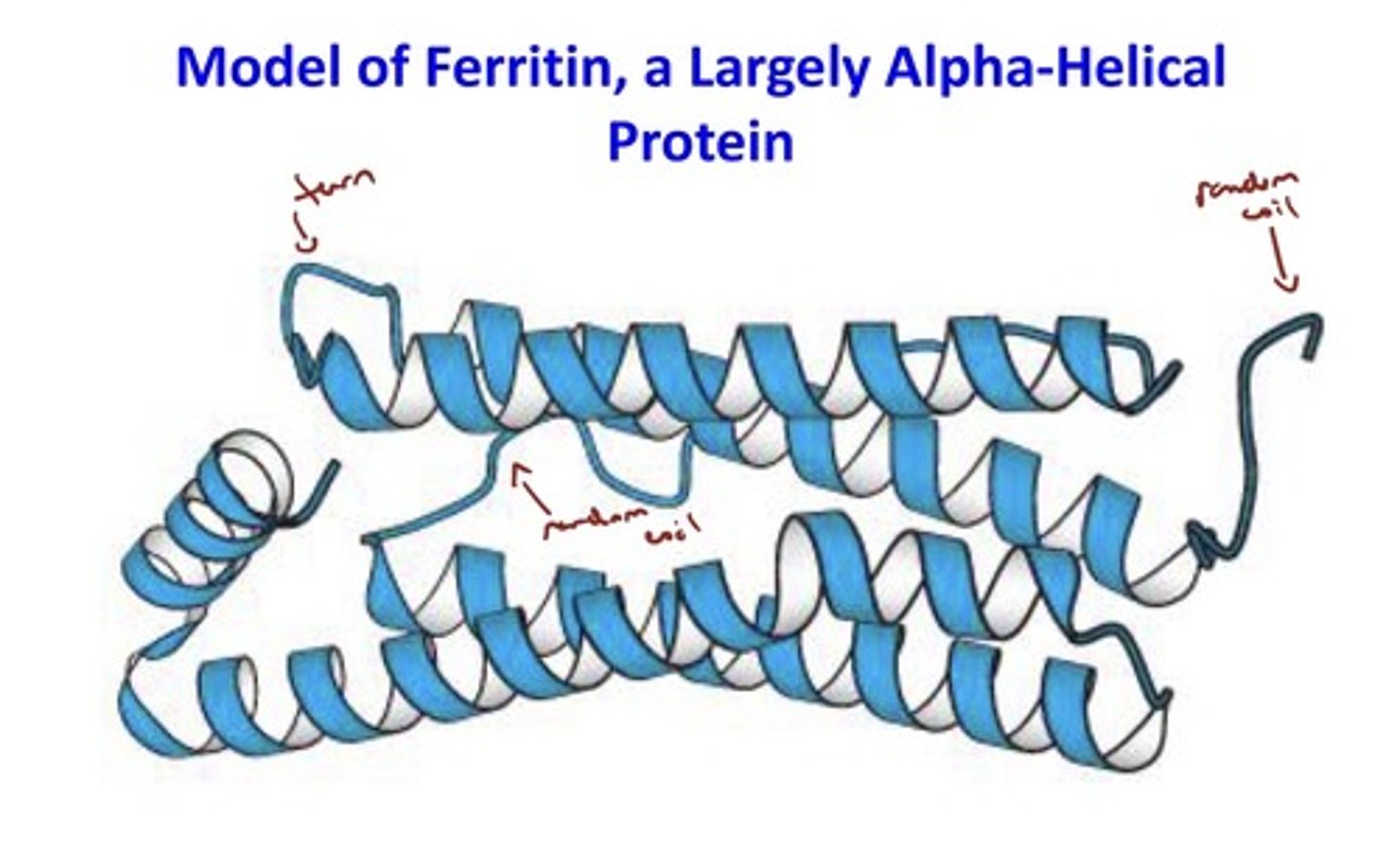
Image of Ferritin

knowt flashcard image
13
New cards

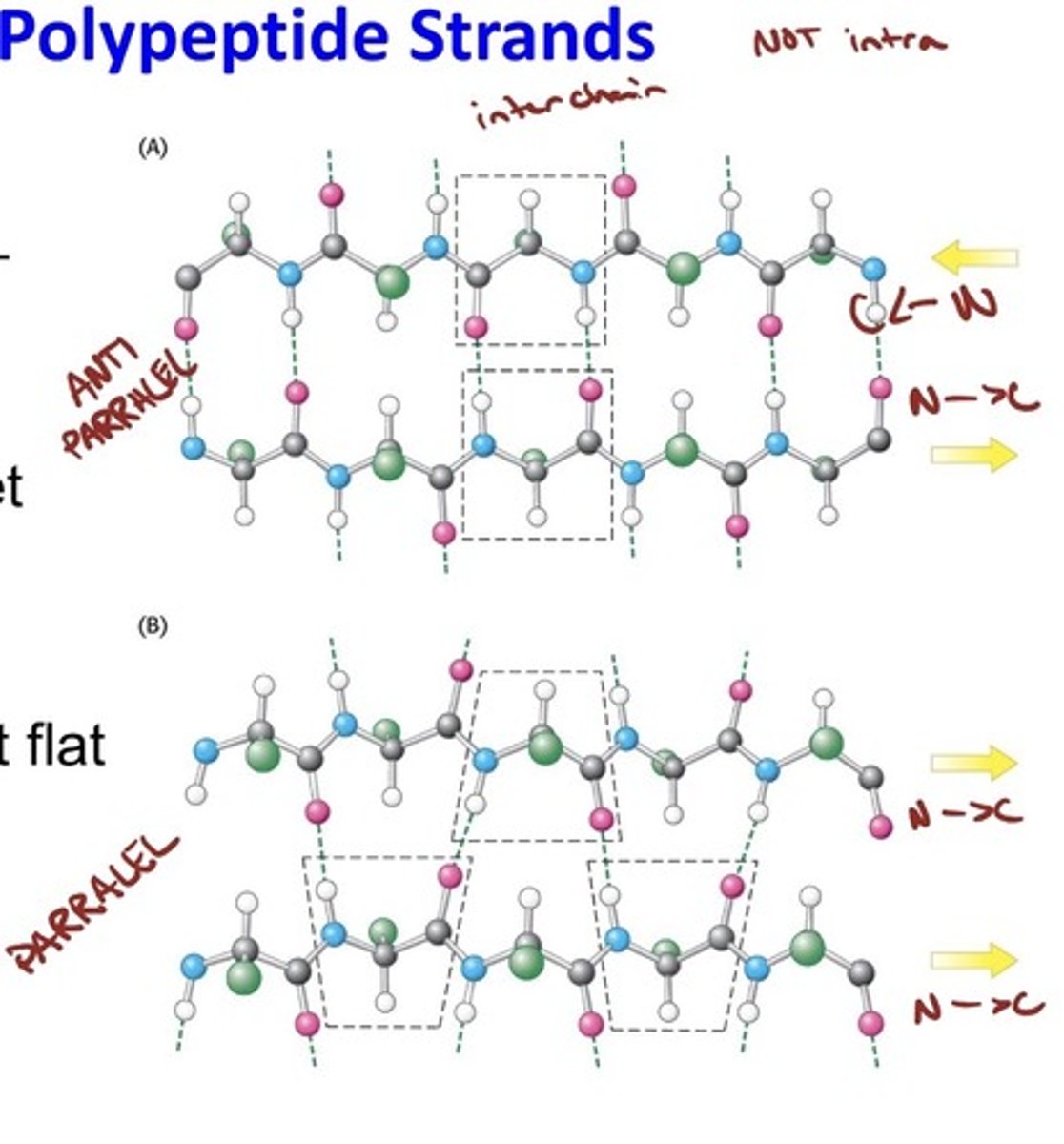
Beta Sheets

- Stabilized by Hydrogen Bonding Between Polypeptide Strands

- The β sheet is another common form of secondary

structure.

• Beta sheets are formed by adjacent β strands.

• In contrast to an α helix, the polypeptide in a β strand is

fully extended.

- Hydrogen bonds link the strands in a β sheet.

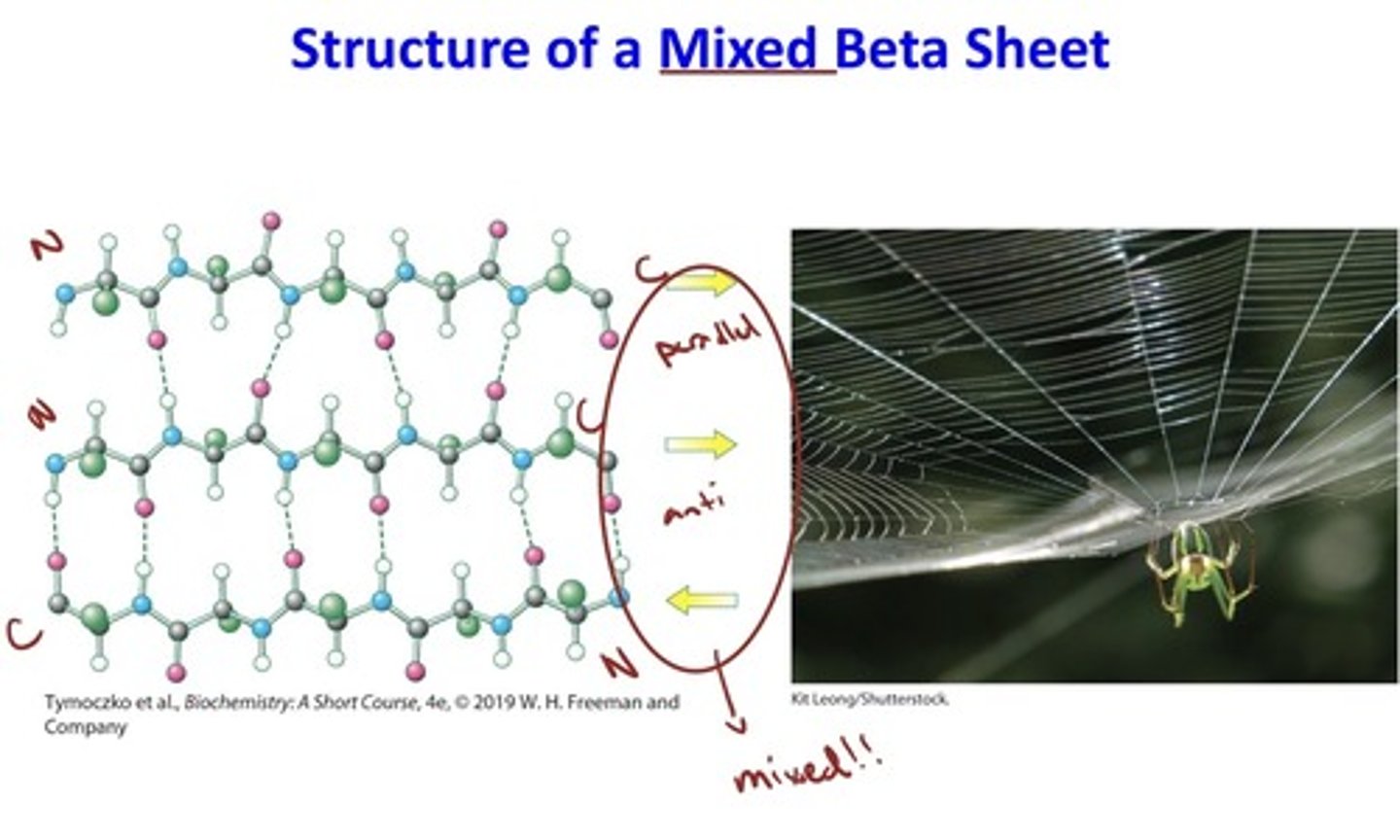
• The strands of a β sheet may be parallel, antiparallel, or mixed.

• β sheets may be almost flat or adopt a twisted conformation.
<p>- Stabilized by Hydrogen Bonding Between Polypeptide Strands</p><p>- The β sheet is another common form of secondary</p><p>structure.</p><p>• Beta sheets are formed by adjacent β strands.</p><p>• In contrast to an α helix, the polypeptide in a β strand is</p><p>fully extended.</p><p>- Hydrogen bonds link the strands in a β sheet.</p><p>• The strands of a β sheet may be parallel, antiparallel, or mixed.</p><p>• β sheets may be almost flat or adopt a twisted conformation.</p>
14
New cards

structure of a mixed beta sheet

knowt flashcard image
15
New cards

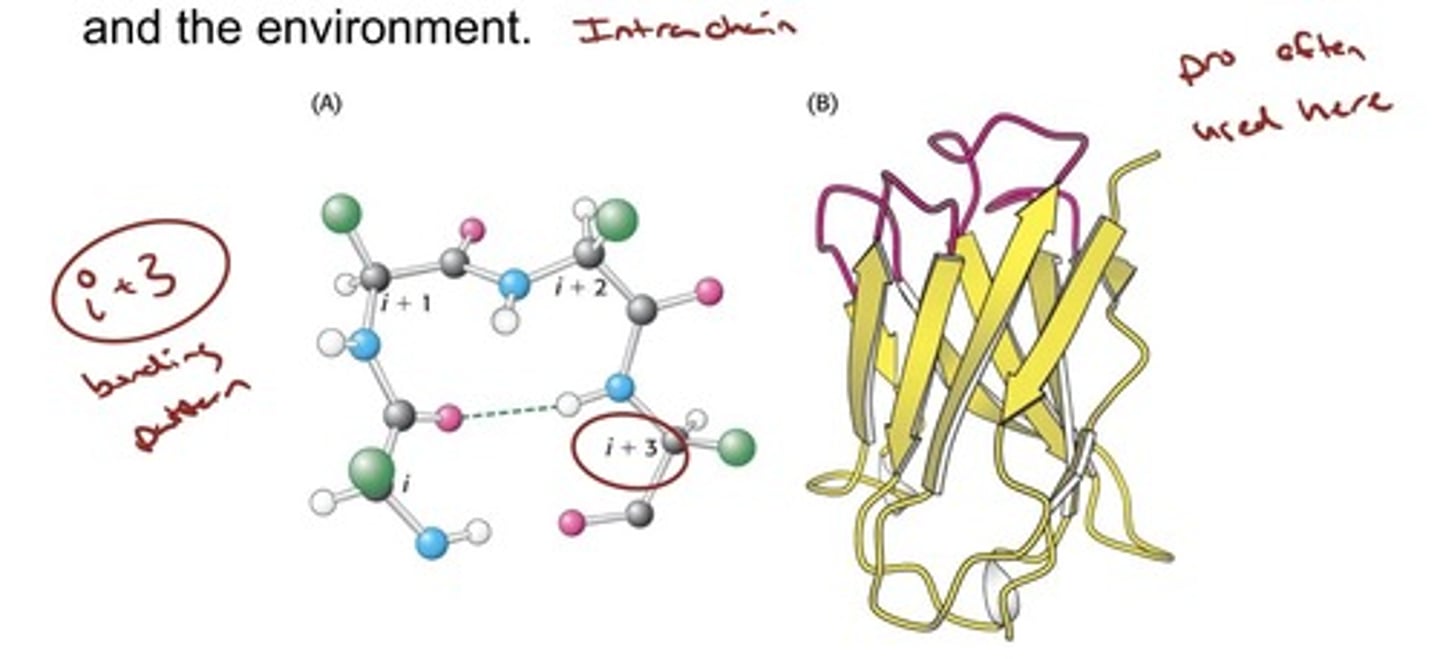
Polypeptide Chains Can Change Direction by

Making Reverse Turns and Loops

- Turns and loops invariably lie on the surfaces of proteins and thus often participate in interactions between other proteins and the environment.
<p>- Turns and loops invariably lie on the surfaces of proteins and thus often participate in interactions between other proteins and the environment.</p>
16
New cards

Fibrous Proteins Provide Structural Support for

Cells and Tissues: keratin

- α-Keratin, a structural protein found in wool and hair, is

composed of two right-handed α helices intertwined to

form a left-handed superhelix called a coiled coil

- The helices interact with ionic interactions or van der Waals

forces.
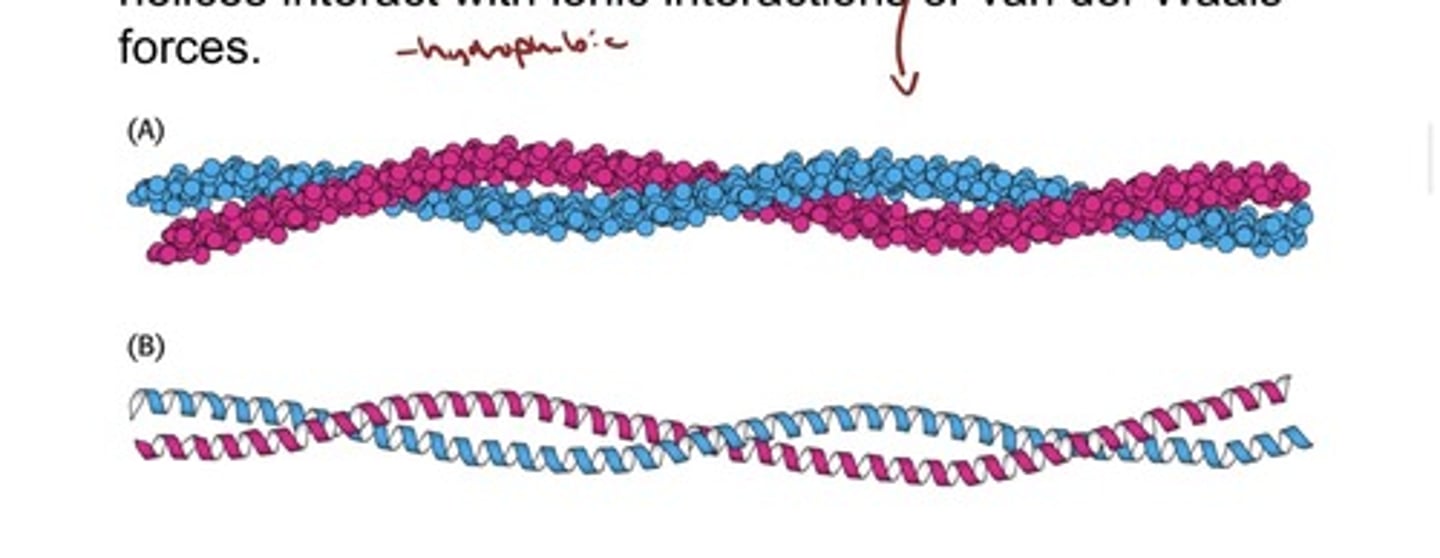
<p>- α-Keratin, a structural protein found in wool and hair, is</p><p>composed of two right-handed α helices intertwined to</p><p>form a left-handed superhelix called a coiled coil</p><p>- The helices interact with ionic interactions or van der Waals</p><p>forces.</p>
17
New cards

Fibrous Proteins Provide Structural Support for

Cells and Tissues: Collagen

- Collagen is a structural protein that is a component of skin,

bone, tendons, cartilage, and teeth.

• Collagen consists of three intertwined helical polypeptides

chains that form a superhelical cable

- The helical polypeptide chains of collagen are not α helices
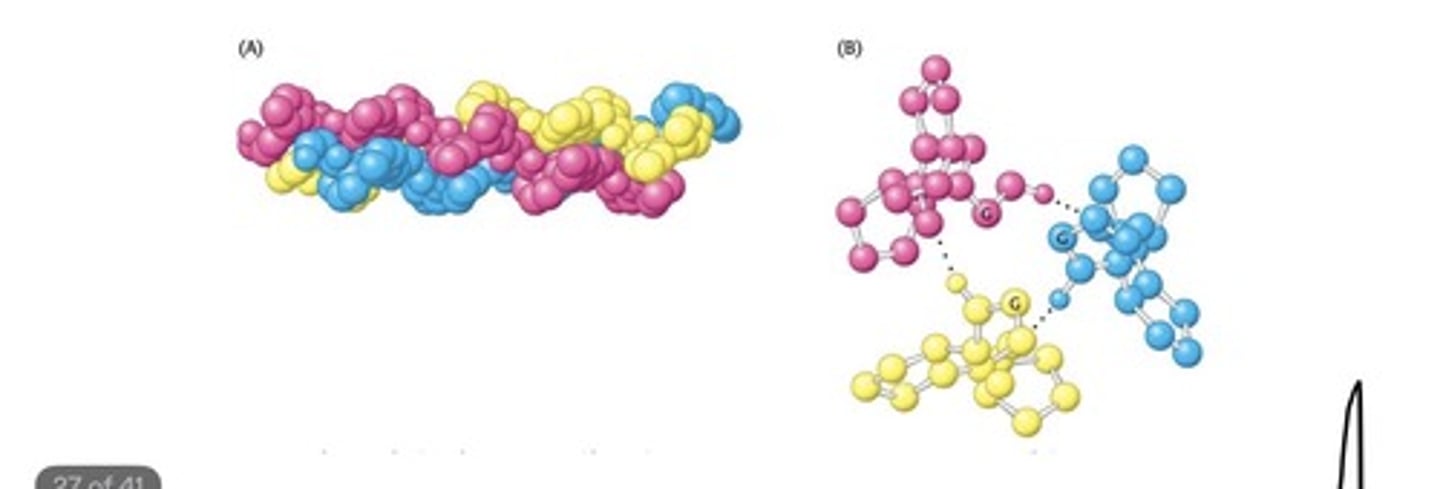
<p>- Collagen is a structural protein that is a component of skin,</p><p>bone, tendons, cartilage, and teeth.</p><p>• Collagen consists of three intertwined helical polypeptides</p><p>chains that form a superhelical cable</p><p>- The helical polypeptide chains of collagen are not α helices</p>
18
New cards

The Amino Acid Sequence of a Part of a

Collagen Chain

- The helices in collagen are not stabilized by

hydrogen bonds. Rather, they are stabilized by

steric repulsion of the pyrrolidine rings of

proline.

- The three intertwined chains interact with

one another with hydrogen bonds
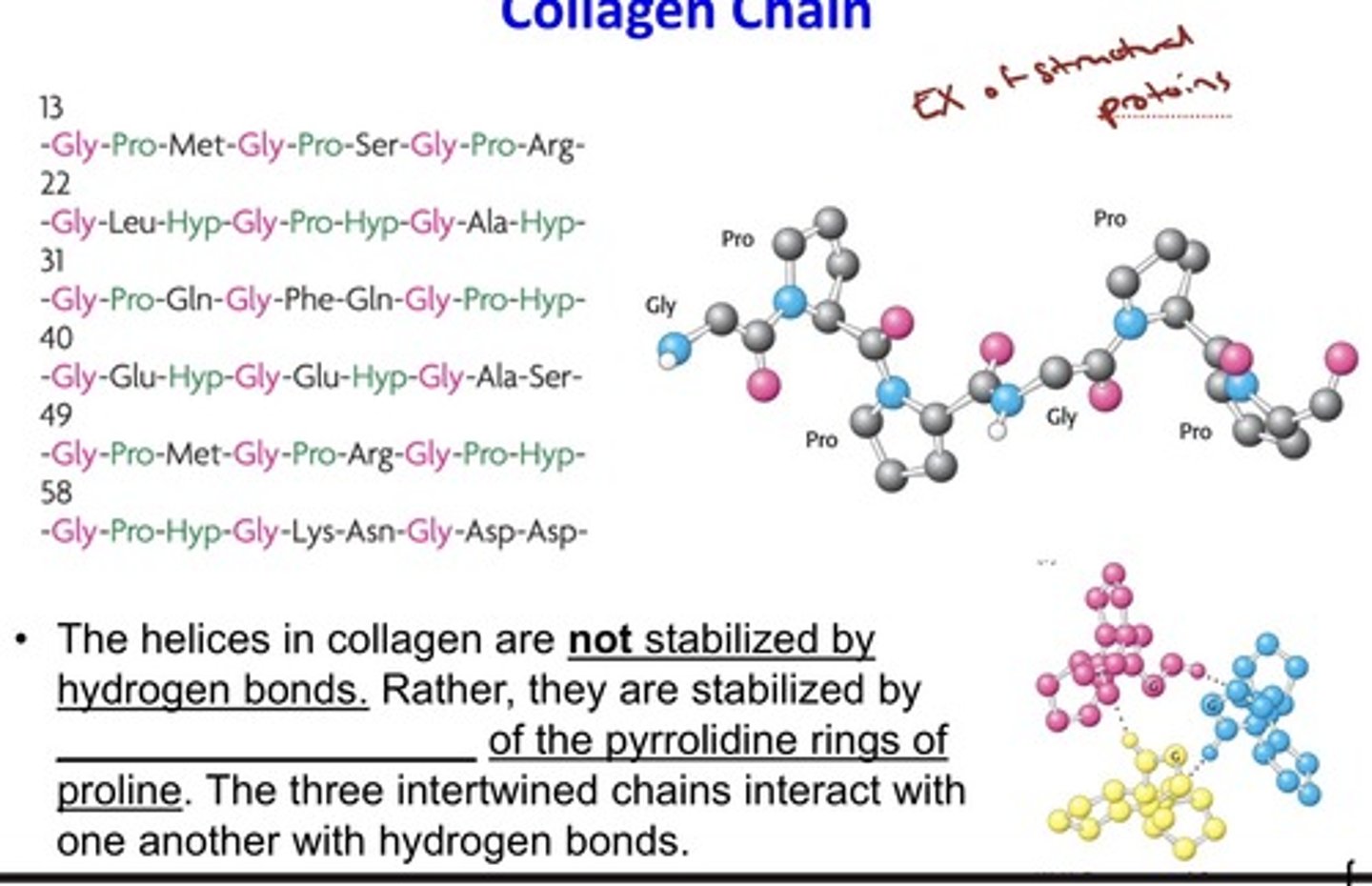
<p>- The helices in collagen are not stabilized by</p><p>hydrogen bonds. Rather, they are stabilized by</p><p>steric repulsion of the pyrrolidine rings of</p><p>proline.</p><p>- The three intertwined chains interact with</p><p>one another with hydrogen bonds</p>
19
New cards

Tertiary Structure

- Water-Soluble Proteins Fold into Compact Structures

- refers to the spatial arrangement of

amino acids that are far apart in the primary structure and

to the pattern of disulfide bond formation

- This level of structure is the result of interactions between

the R groups of the peptide chain.

– Salt bridges (electrostatic)

– Disulfide bonds (cysteine residues)
<p>- Water-Soluble Proteins Fold into Compact Structures</p><p>- refers to the spatial arrangement of</p><p>amino acids that are far apart in the primary structure and</p><p>to the pattern of disulfide bond formation</p><p>- This level of structure is the result of interactions between</p><p>the R groups of the peptide chain.</p><p>– Salt bridges (electrostatic)</p><p>– Disulfide bonds (cysteine residues)</p>
20
New cards

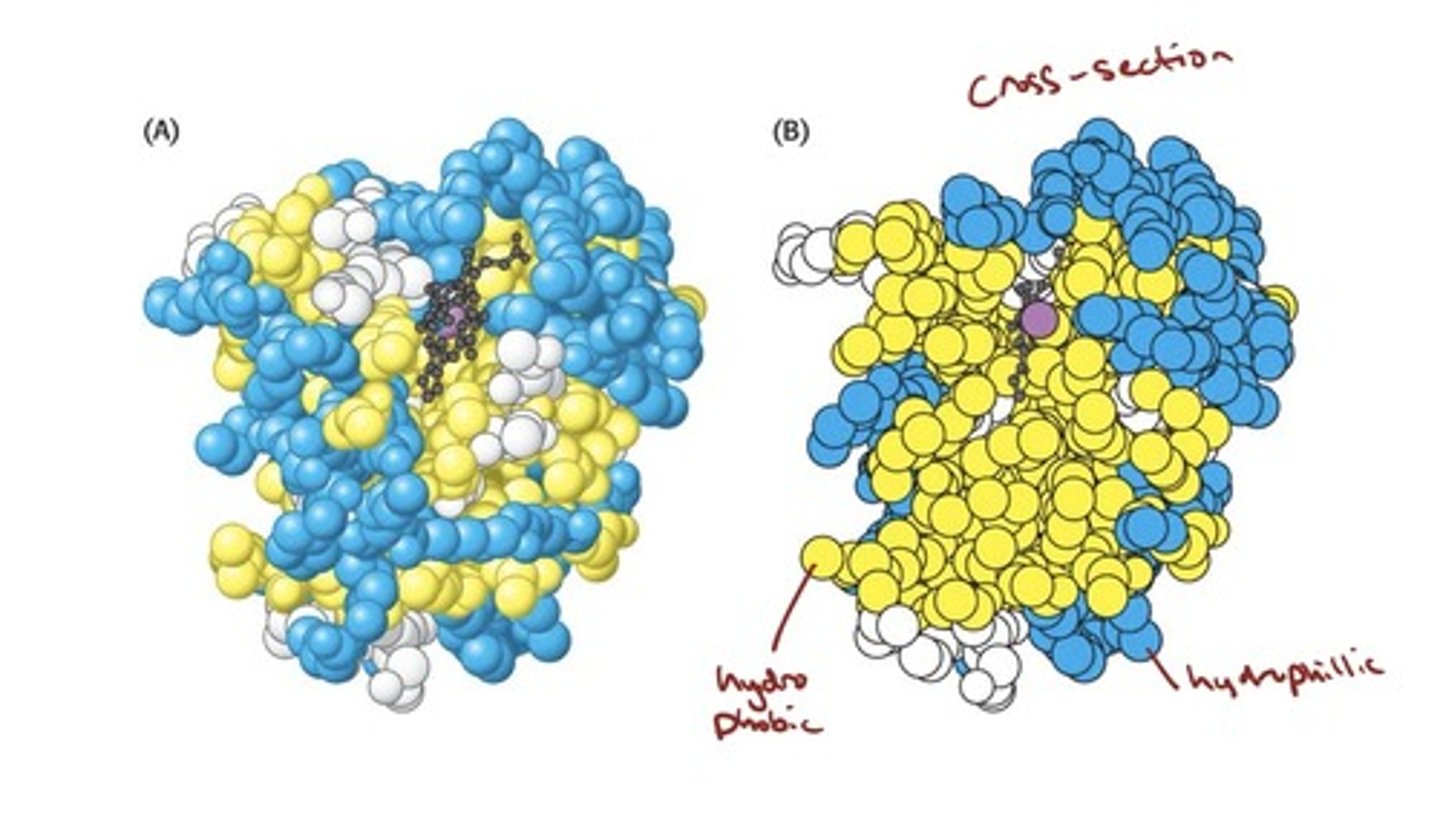
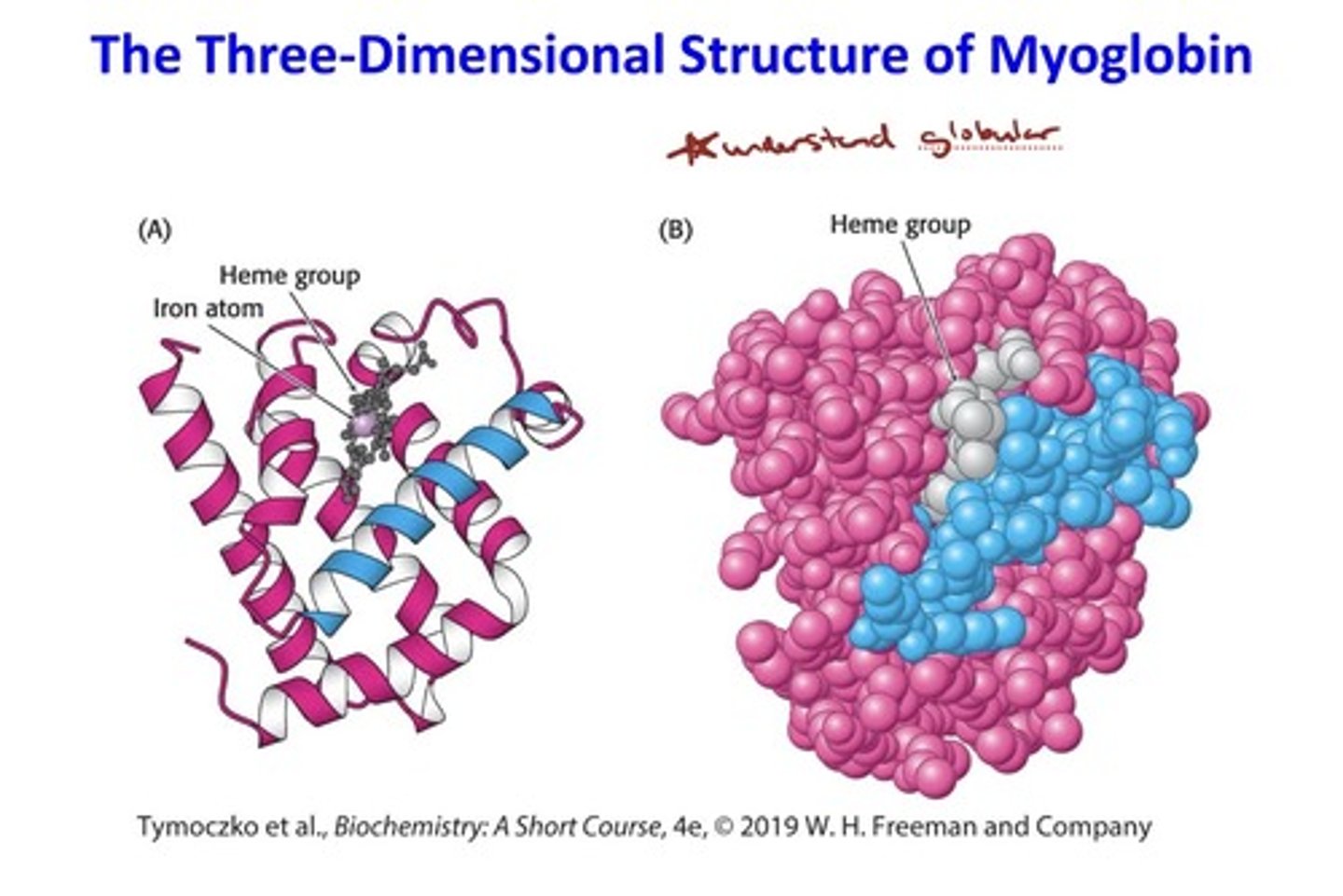
Myoglobin Illustrates the Principles of Tertiary

Structure

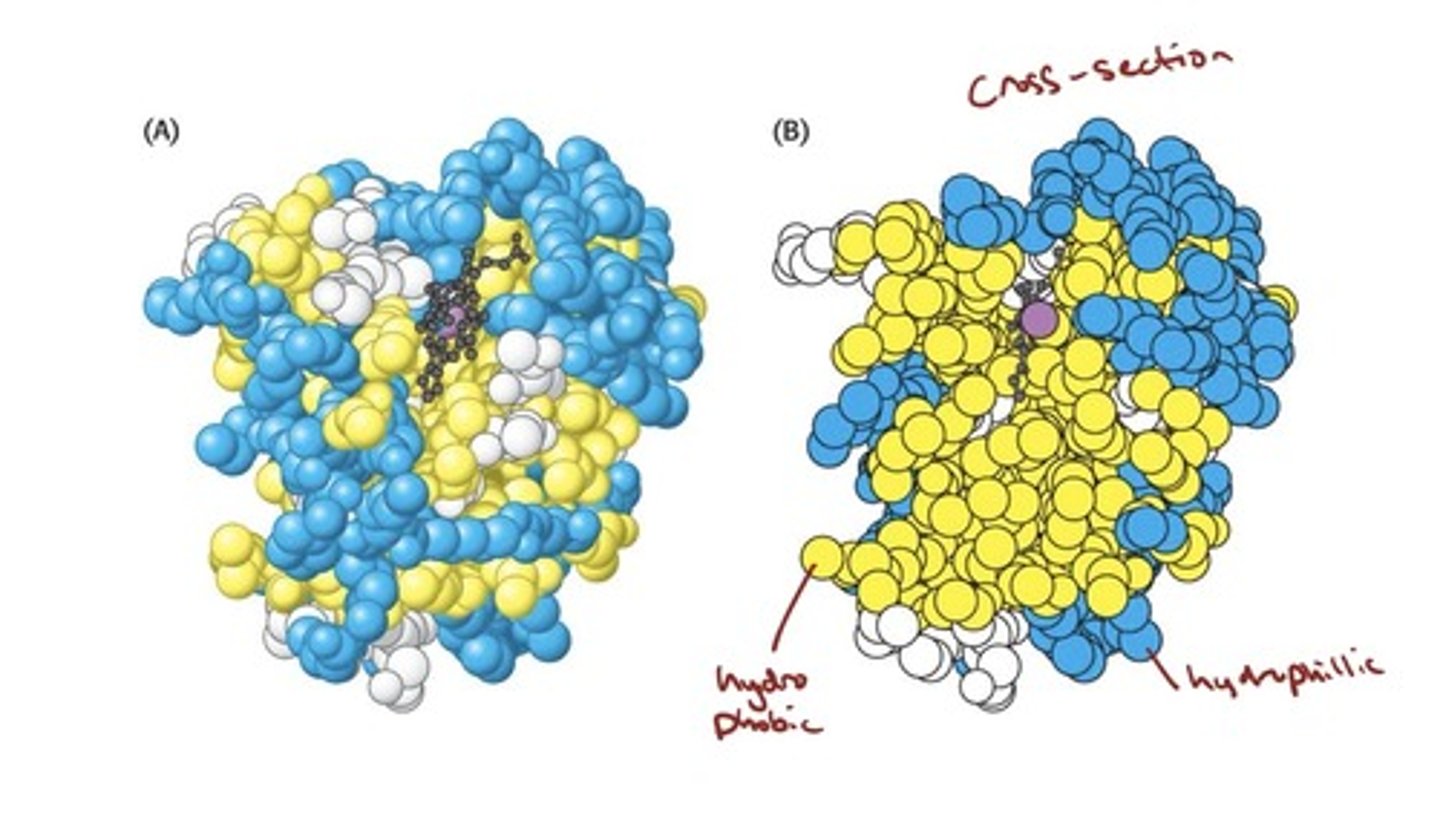
- Globular proteins, such as myoglobin, form complicated

three-dimensional structures.

• Globular proteins are very compact; there is little or no

space in the interior of globular proteins.

• The interior of globular proteins consists mainly of

hydrophobic amino acids.

• The exterior of globular proteins consists of charged

and polar amino acids.
<p>- Globular proteins, such as myoglobin, form complicated</p><p>three-dimensional structures.</p><p>• Globular proteins are very compact; there is little or no</p><p>space in the interior of globular proteins.</p><p>• The interior of globular proteins consists mainly of</p><p>hydrophobic amino acids.</p><p>• The exterior of globular proteins consists of charged</p><p>and polar amino acids.</p>
21
New cards

three-dimensional structure of myoglobin
knowt flashcard image
22
New cards

The Tertiary Structure of Many Proteins Can Be

Divided into Structural and Functional Units

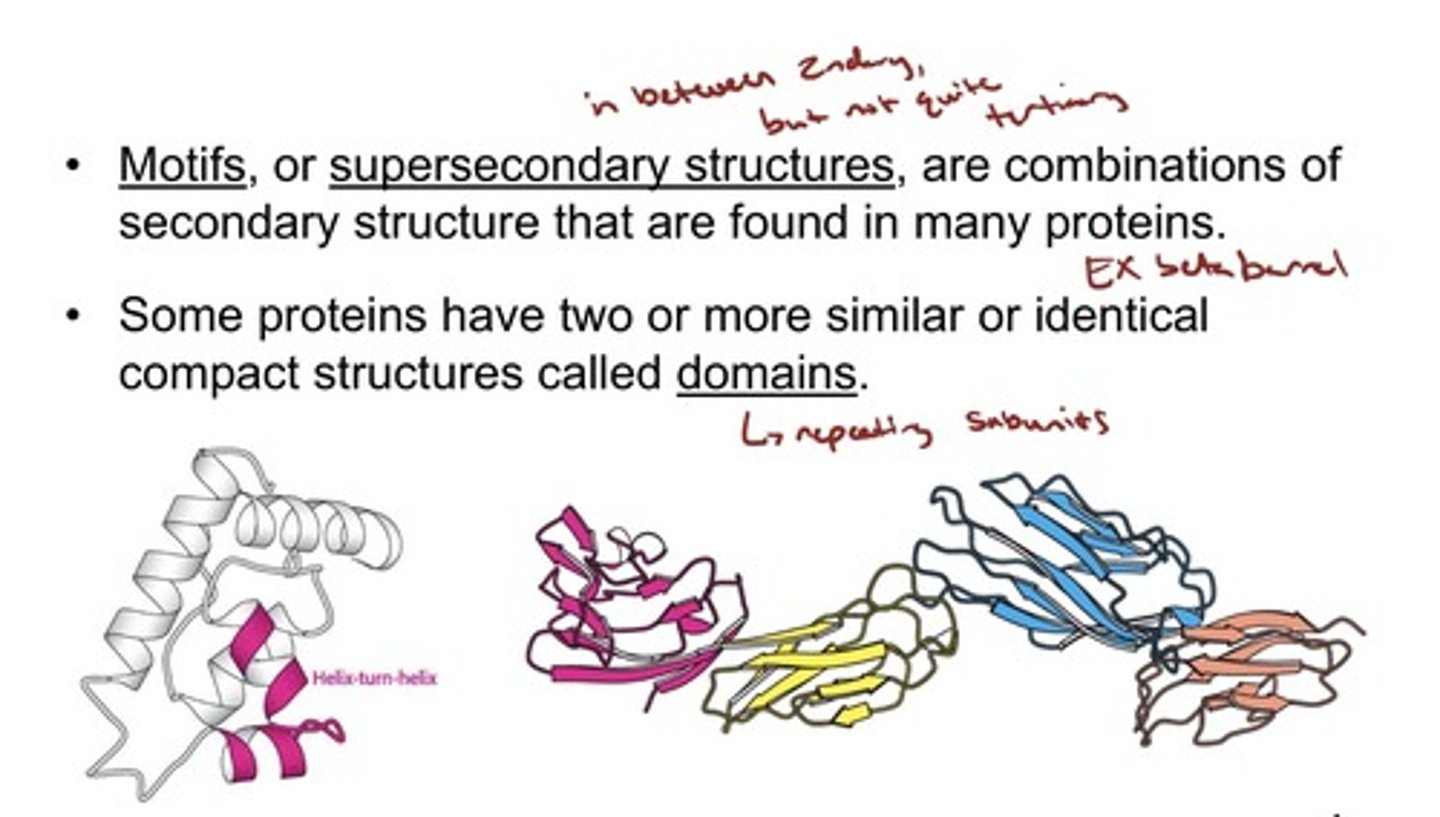
- Motifs, or supersecondary structures, are combinations of

secondary structure that are found in many proteins.

• Some proteins have two or more similar or identical

compact structures called domains.
<p>- Motifs, or supersecondary structures, are combinations of</p><p>secondary structure that are found in many proteins.</p><p>• Some proteins have two or more similar or identical</p><p>compact structures called domains.</p>
23
New cards

Quaternary Structure

- Multiple Polypeptide Chains Can Assemble into a Single Protein

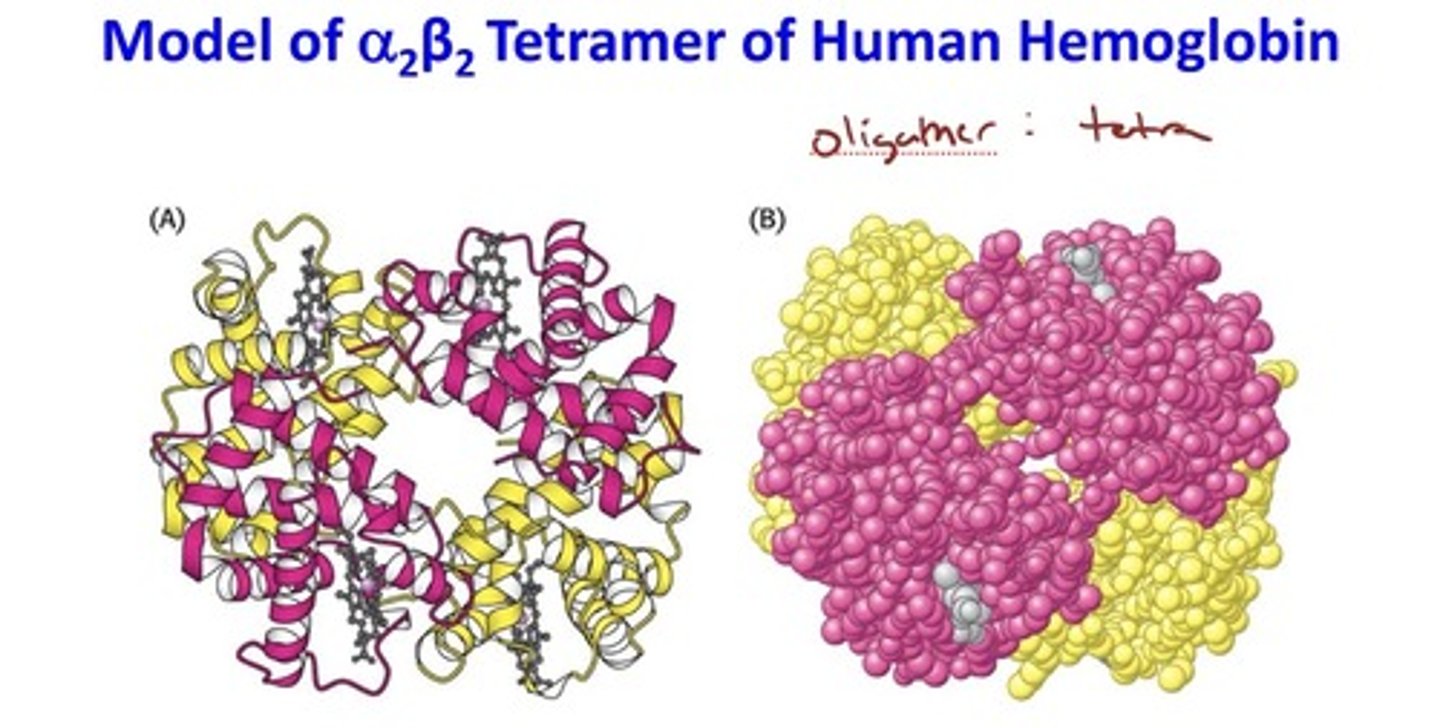
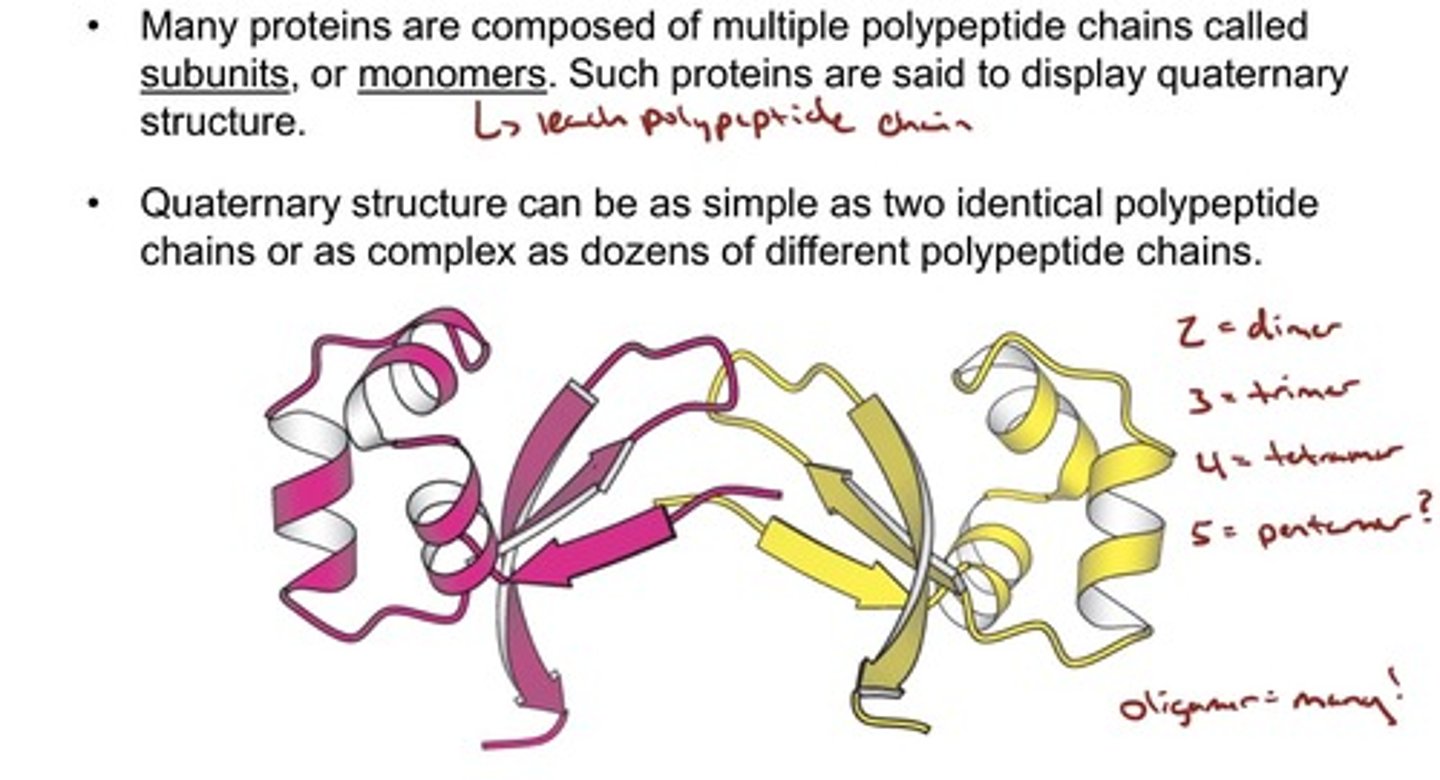
- Many proteins are composed of multiple polypeptide chains called subunits, or monomers; Such proteins are said to display quaternary structure.

• Quaternary structure can be as simple as two identical polypeptide chains or as complex as dozens of different polypeptide chains.
<p>- Multiple Polypeptide Chains Can Assemble into a Single Protein</p><p>- Many proteins are composed of multiple polypeptide chains called subunits, or monomers; Such proteins are said to display quaternary structure.</p><p>• Quaternary structure can be as simple as two identical polypeptide chains or as complex as dozens of different polypeptide chains.</p>
24
New cards

Tetramer of human hemoglobin

knowt flashcard image
25
New cards

The Amino Acid Sequence of a Protein

Determines Its Three-Dimensional Structure: Anfinsen Experiment

- urea disrupts noncovalent bonds (between H-bonds and salt bridges)

- Mercaptoethanol disrupts disulfide bridges
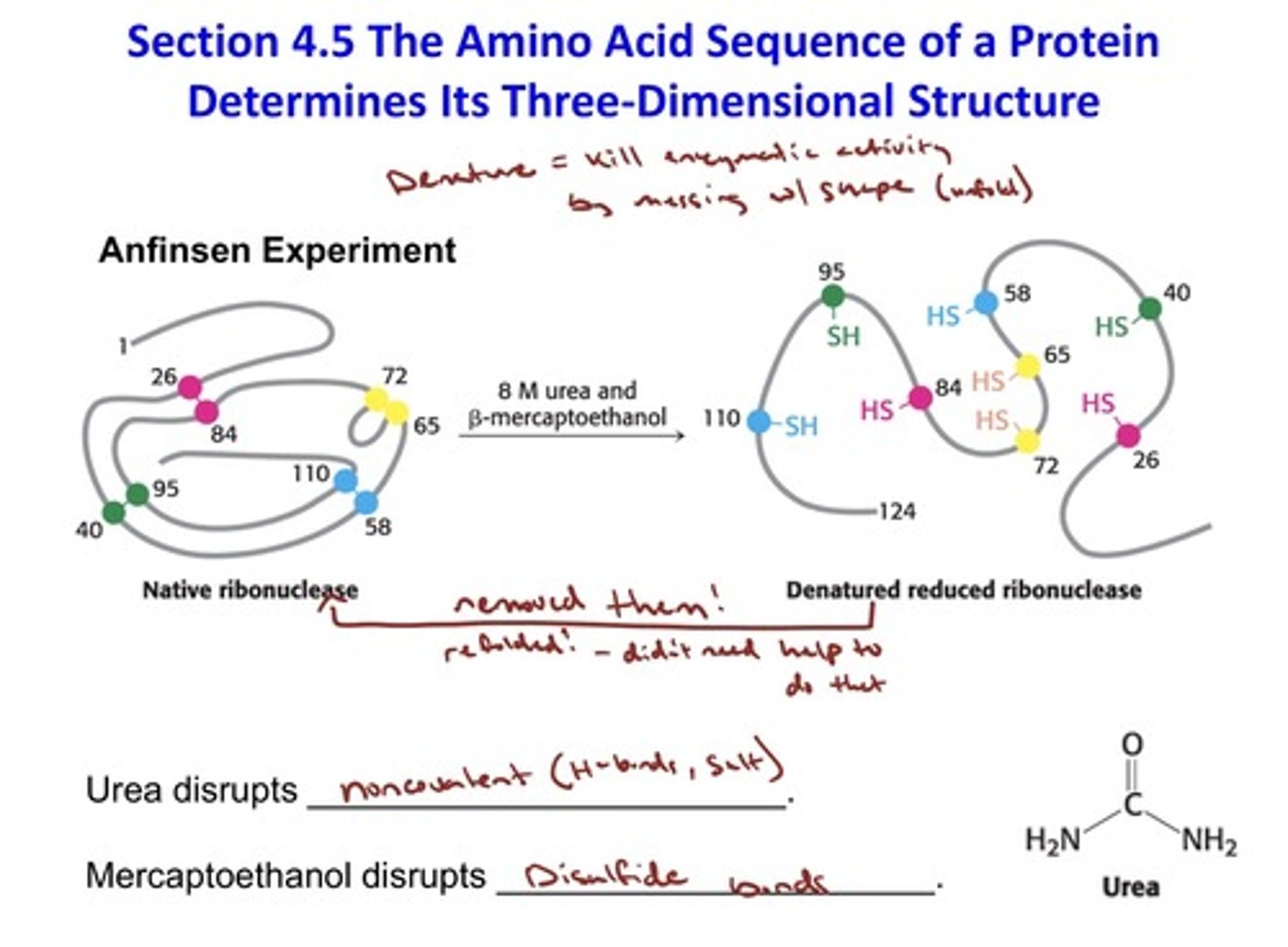
<p>- urea disrupts noncovalent bonds (between H-bonds and salt bridges)</p><p>- Mercaptoethanol disrupts disulfide bridges</p>

Explore top flashcards

AP Psych: Unit 0
Updated 529d ago
flashcards Flashcards (78)
BIOL 460 Exam 1
Updated 1111d ago
flashcards Flashcards (69)
Science exam
Updated 966d ago
flashcards Flashcards (167)
Vocab. 251-300
Updated 1013d ago
flashcards Flashcards (50)
ICT
Updated 1107d ago
flashcards Flashcards (55)
AP Psych: Unit 0
Updated 529d ago
flashcards Flashcards (78)
BIOL 460 Exam 1
Updated 1111d ago
flashcards Flashcards (69)
Science exam
Updated 966d ago
flashcards Flashcards (167)
Vocab. 251-300
Updated 1013d ago
flashcards Flashcards (50)
ICT
Updated 1107d ago
flashcards Flashcards (55)