⚡ Contraction + Fiber Types

0.0(0)
Studied by 0 people
call kaiCall Kai
learnLearn
examPractice Test
spaced repetitionSpaced Repetition
heart puzzleMatch
flashcardsFlashcards
GameKnowt Play
Card Sorting

1/15

encourage image

There's no tags or description

Looks like no tags are added yet.

Last updated 11:41 PM on 3/30/26
Name
Mastery
Learn
Test
Matching
Spaced
Call with Kai

No analytics yet

Send a link to your students to track their progress

16 Terms

1
New cards

Muscle Contraction – Action Potential

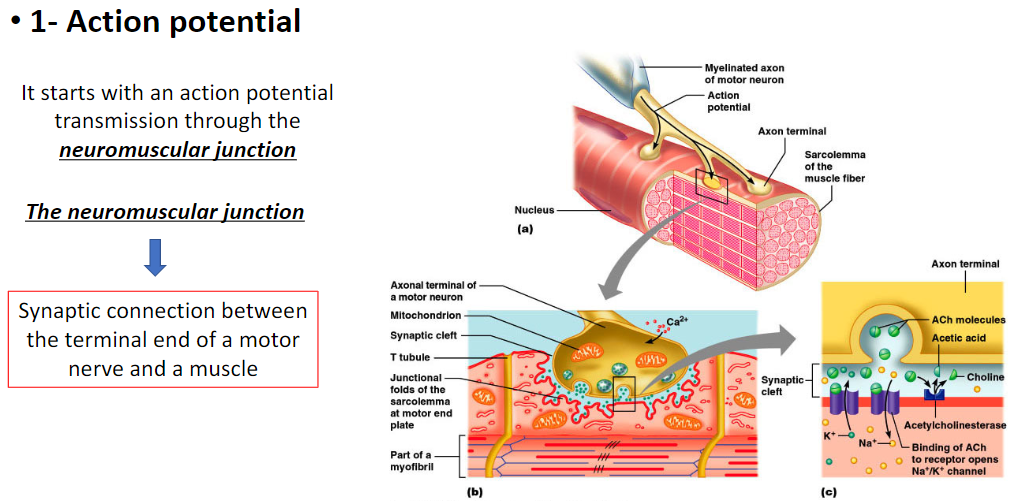
Neuromuscular Junction
 Synaptic connection between the terminal end of a motor nerve and a muscle fiber

Action Potential
 Muscle contraction begins with an action potential
 Signal is transmitted through the neuromuscular junction to the muscle fiber

Key Point
Neuromuscular junction converts nerve signals into muscle activation)
<p><strong>Neuromuscular Junction</strong><br> Synaptic connection between the <strong>terminal end of a motor nerve</strong> and a <strong>muscle fiber</strong></p><p><strong>Action Potential</strong><br> Muscle contraction begins with an <strong>action potential</strong><br> Signal is transmitted through the <strong>neuromuscular junction</strong> to the <strong>muscle fiber</strong></p><p><strong>Key Point</strong><br> <strong>Neuromuscular junction</strong> converts <strong>nerve signals into muscle activation</strong>)</p>
2
New cards

Muscle Contraction – Action Potential Transmission

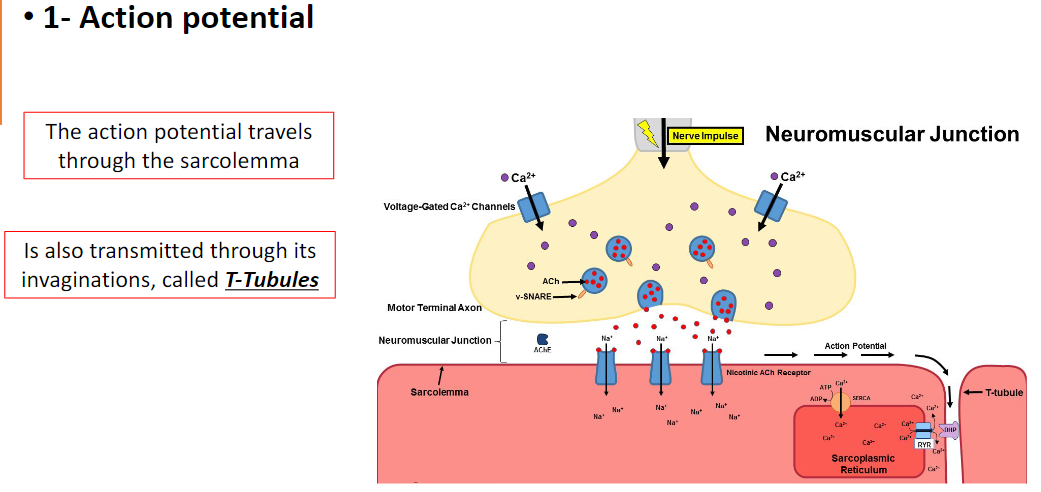
Sarcolemma
 Action potential travels along the muscle cell membrane (sarcolemma)

T-Tubules
 Action potential is also transmitted through invaginations of the sarcolemma called T-tubules
 Allows signal to reach deep into the muscle fiber

Key Point
T-tubules ensure the action potential rapidly reaches the interior of the muscle fiber for coordinated contraction)
<p><strong>Sarcolemma</strong><br> Action potential travels along the <strong>muscle cell membrane (sarcolemma)</strong></p><p><strong>T-Tubules</strong><br> Action potential is also transmitted through <strong>invaginations of the sarcolemma called T-tubules</strong><br> Allows signal to <strong>reach deep into the muscle fiber</strong></p><p><strong>Key Point</strong><br> <strong>T-tubules ensure the action potential rapidly reaches the interior of the muscle fiber</strong> for <strong>coordinated contraction</strong>)</p>
3
New cards

Muscle Contraction – Calcium Release

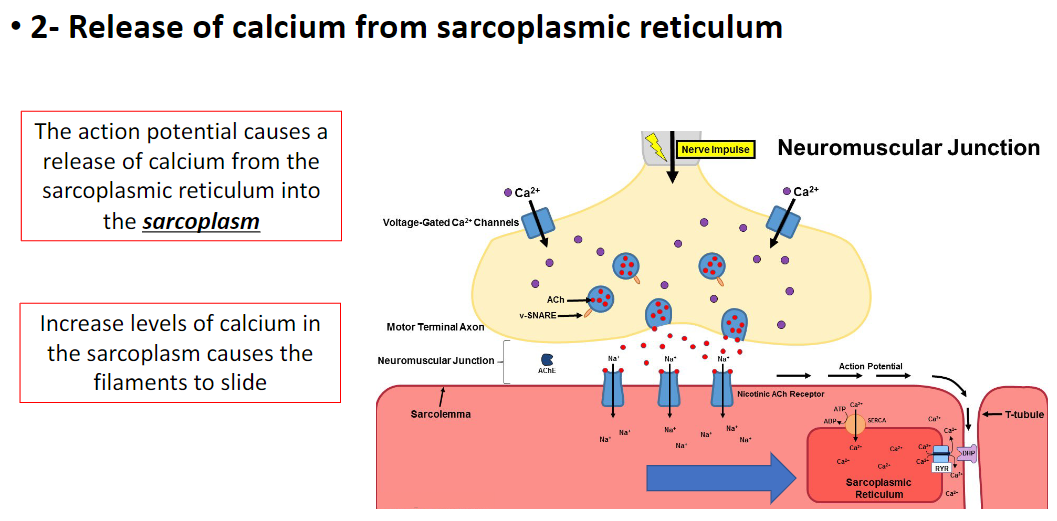
Sarcoplasmic Reticulum (SR)
 Action potential triggers release of calcium (Ca²⁺) from the SR into the sarcoplasm (cytoplasm of skeletal muscle cell)

Effect on Filaments
 Increased Ca²⁺ levels in the sarcoplasm cause actin and myosin filaments to slide

Key Point
Calcium release from SR is essential for initiating filament sliding and muscle contraction)
<p><strong>Sarcoplasmic Reticulum (SR)</strong><br> Action potential triggers <strong>release of calcium (Ca²⁺)</strong> from the <strong>SR</strong> into the <strong>sarcoplasm (cytoplasm of skeletal muscle cell)</strong></p><p><strong>Effect on Filaments</strong><br> Increased <strong>Ca²⁺ levels</strong> in the sarcoplasm cause <strong>actin and myosin filaments to slide</strong></p><p><strong>Key Point</strong><br> <strong>Calcium release from SR</strong> is essential for <strong>initiating filament sliding and muscle contraction</strong>)</p>
4
New cards

Muscle Contraction – Thin Filament Activation

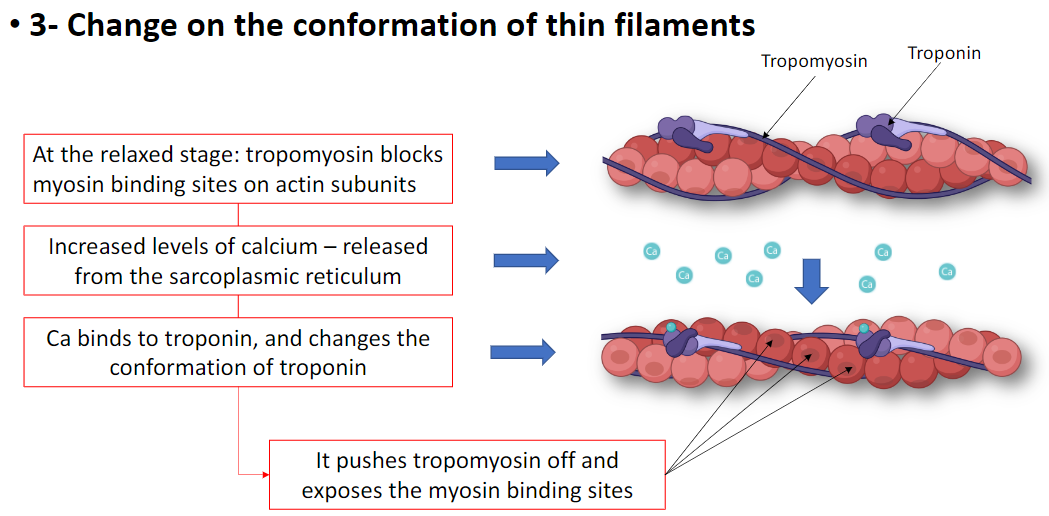
Relaxed Stage
Tropomyosin blocks myosin binding sites on actin subunits

Calcium Effect
Ca²⁺ released from the sarcoplasmic reticulum binds to troponin
 Changes troponin conformation
 Pushes tropomyosin off myosin binding sites

Key Point
Calcium binding to troponin exposes actin sites for myosin attachment, enabling contraction)
<p><strong>Relaxed Stage</strong><br> <strong>Tropomyosin</strong> blocks <strong>myosin binding sites</strong> on actin subunits</p><p><strong>Calcium Effect</strong><br> <strong>Ca²⁺ released</strong> from the sarcoplasmic reticulum binds to <strong>troponin</strong><br> Changes <strong>troponin conformation</strong><br> Pushes <strong>tropomyosin</strong> off <strong>myosin binding sites</strong></p><p><strong>Key Point</strong><br> <strong>Calcium binding to troponin</strong> exposes <strong>actin sites</strong> for <strong>myosin attachment</strong>, enabling contraction)</p>
5
New cards

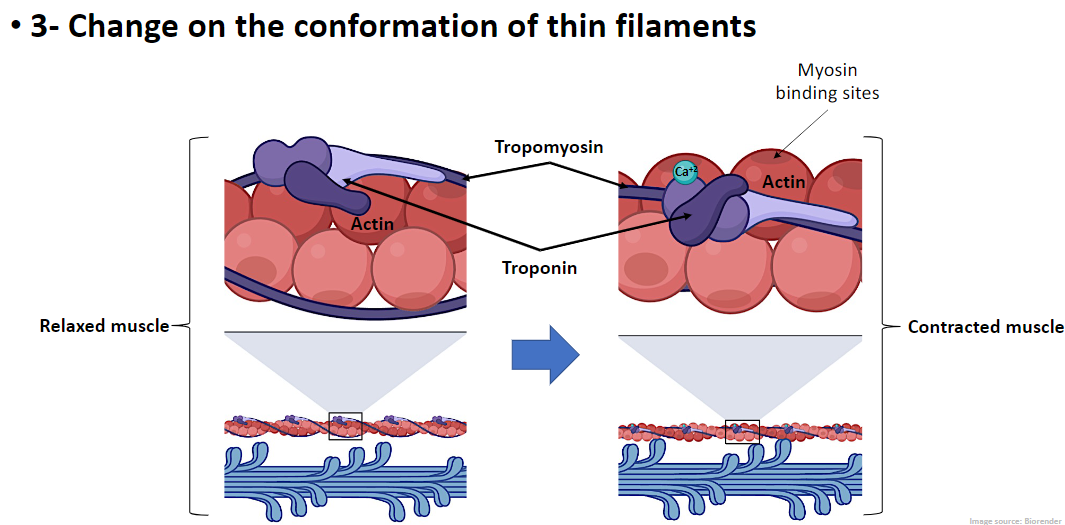
Muscle Contraction – Thin Filament Conformation

Relaxed Muscle
Tropomyosin covers myosin binding sites on actin
Myosin cannot bind, muscle remains relaxed

Contracted Muscle
Ca²⁺ binds to troponin
Troponin changes conformation and pulls tropomyosin away
Tropomyosin moves, exposing myosin binding sites on actin
Myosin heads attach, initiating contraction

Key Point
Calcium-induced conformational change in thin filaments allows myosin–actin interaction for muscle contraction)
<p><strong>Relaxed Muscle</strong><br> <strong>Tropomyosin</strong> covers <strong>myosin binding sites</strong> on <strong>actin</strong><br> <strong>Myosin cannot bind</strong>, muscle remains relaxed</p><p><strong>Contracted Muscle</strong><br> <strong>Ca²⁺ binds to troponin</strong><br> <strong>Troponin changes conformation and pulls tropomyosin away</strong><br> <strong>Tropomyosin moves</strong>, exposing <strong>myosin binding sites</strong> on <strong>actin</strong><br> <strong>Myosin heads attach</strong>, initiating contraction</p><p><strong>Key Point</strong><br> <strong>Calcium-induced conformational change</strong> in thin filaments allows <strong>myosin–actin interaction</strong> for <strong>muscle contraction</strong>)</p>
6
New cards

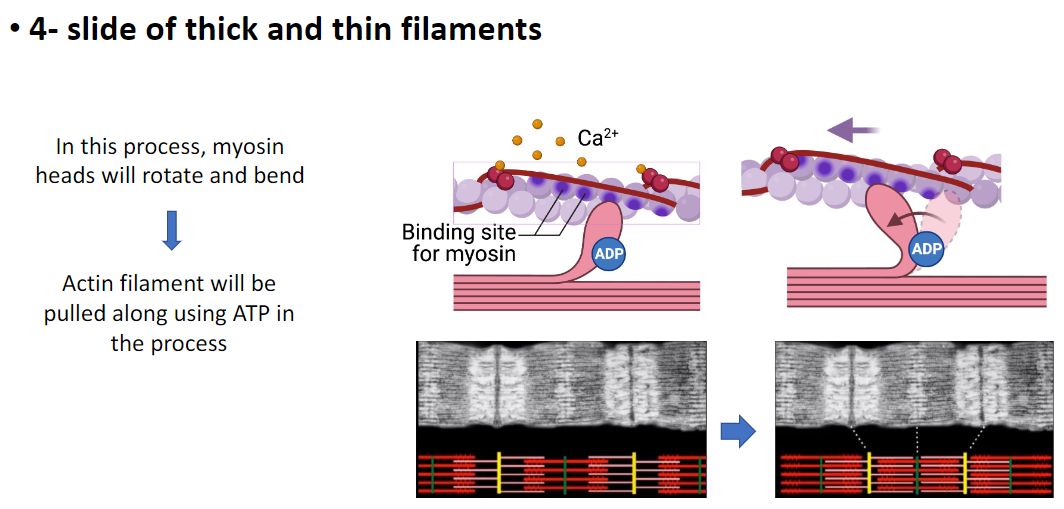
Muscle Contraction – Filament Sliding

Myosin Action
Myosin heads rotate and bend during contraction
 Attach to actin filaments and pull them

ATP Role
ATP provides the energy for myosin movement and filament sliding

Effect on Filaments
Thin (actin) and thick (myosin) filaments slide past each other
 Shortens the sarcomere, generating muscle contraction

Key Point
ATP-powered myosin movement causes actin–myosin sliding, which shortens the sarcomere and contracts the muscle)
<p><strong>Myosin Action</strong><br> <strong>Myosin heads</strong> rotate and bend during contraction<br> Attach to <strong>actin filaments</strong> and pull them</p><p><strong>ATP Role</strong><br> <strong>ATP</strong> provides the <strong>energy</strong> for myosin movement and filament sliding</p><p><strong>Effect on Filaments</strong><br> <strong>Thin (actin) and thick (myosin) filaments slide past each other</strong><br> Shortens the <strong>sarcomere</strong>, generating <strong>muscle contraction</strong></p><p><strong>Key Point</strong><br> <strong>ATP-powered myosin movement</strong> causes <strong>actin–myosin sliding</strong>, which <strong>shortens the sarcomere and contracts the muscle</strong>)</p>
7
New cards

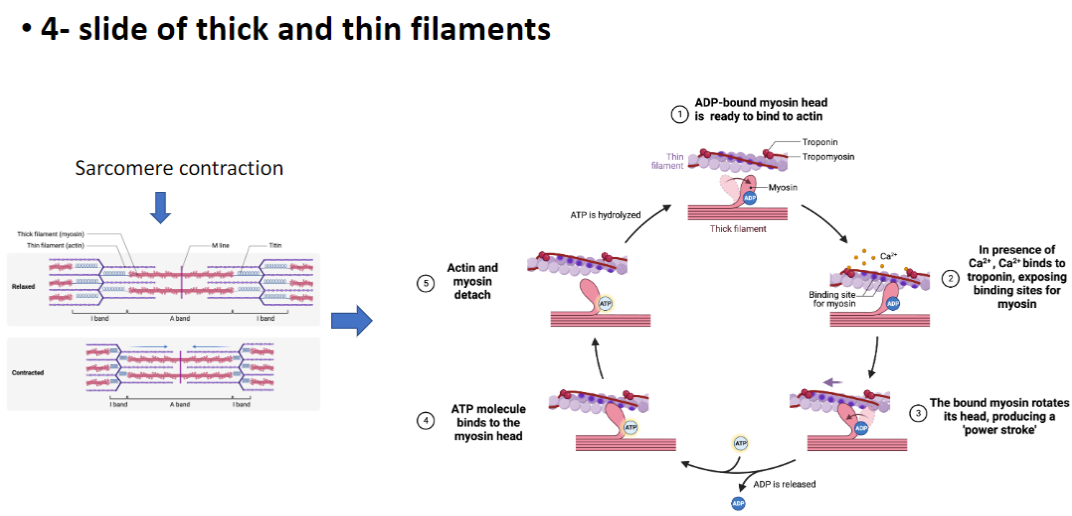
Muscle Contraction – Sarcomere Sliding

Relaxed Sarcomere
Actin (thin filaments) and myosin (thick filaments) are not bound
Tropomyosin blocks myosin binding sites on actin

Activation
Ca²⁺ binds to troponin
Troponin changes conformation, moves tropomyosin, exposing myosin binding sites

Myosin Binding and Power Stroke
ADP-bound myosin heads attach to actin
Myosin head rotates, producing a power stroke
Thin filaments are pulled past thick filaments, shortening the sarcomere

ATP Role
ADP is released and ATP binds to myosin head, causing detachment from actin
ATP hydrolysis re-cocks the myosin head for the next power stroke

Key Point
Cycle of Ca²⁺ binding, myosin attachment, power stroke, and ATP hydrolysis drives sarcomere shortening and muscle contraction)
<p><strong>Relaxed Sarcomere</strong><br> <strong>Actin (thin filaments)</strong> and <strong>myosin (thick filaments)</strong> are not bound<br> <strong>Tropomyosin</strong> blocks <strong>myosin binding sites</strong> on actin</p><p><strong>Activation</strong><br> <strong>Ca²⁺ binds to troponin</strong><br> <strong>Troponin changes conformation</strong>, moves <strong>tropomyosin</strong>, exposing <strong>myosin binding sites</strong></p><p><strong>Myosin Binding and Power Stroke</strong><br> <strong>ADP-bound myosin heads</strong> attach to <strong>actin</strong><br> <strong>Myosin head rotates</strong>, producing a <strong>power stroke</strong><br> <strong>Thin filaments are pulled past thick filaments</strong>, shortening the <strong>sarcomere</strong></p><p><strong>ATP Role</strong><br> <strong>ADP is released and ATP binds to myosin head</strong>, causing <strong>detachment from actin</strong><br> <strong>ATP hydrolysis</strong> re-cocks the myosin head for the <strong>next power stroke</strong></p><p><strong>Key Point</strong><br> <strong>Cycle of Ca²⁺ binding, myosin attachment, power stroke, and ATP hydrolysis</strong> drives <strong>sarcomere shortening and muscle contraction</strong>)</p>
8
New cards

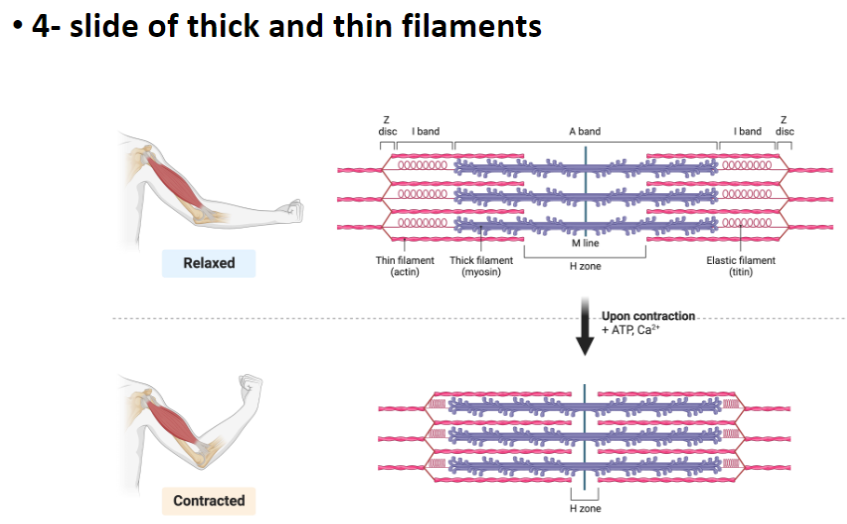
Muscle Contraction – H Zone

H Zone
 Central region of the A band containing only thick filaments (myosin)
Shortens during contraction as filaments slide

ATP and Ca²⁺ Role
Ca²⁺ exposes myosin binding sites on actin by binding to troponin which moves tropomyosin
ATP powers myosin head movement and detachment

Key Point
H zone shortens, titin maintains alignment, and ATP + Ca²⁺ enable contraction)
<p><strong>H Zone</strong><br> Central region of the <strong>A band</strong> containing <strong>only thick filaments (myosin)</strong><br> <strong>Shortens during contraction</strong> as filaments slide</p><p><strong>ATP and Ca²⁺ Role</strong><br> <strong>Ca²⁺</strong> exposes <strong>myosin binding sites</strong> on actin by binding to <strong>troponin</strong> which moves <strong>tropomyosin</strong><br> <strong>ATP</strong> powers <strong>myosin head movement and detachment</strong></p><p><strong>Key Point</strong><br> <strong>H zone shortens</strong>, <strong>titin maintains alignment</strong>, and <strong>ATP + Ca²⁺ enable contraction</strong>)</p>
9
New cards

Muscle Contraction – Stepwise Process (Structural Hierarchy & ATP Role)

1 – Action Potential Initiation
 Signal starts at motor neuron
 Transmitted through the neuromuscular junction to the muscle fiber (cell)

2 – Action Potential Propagation
 Travels along the sarcolemma (muscle membrane)
 Also transmitted deep into the fiber via T-tubules
 Ensures signal reaches interior of muscle fiber

3 – Calcium Release from Sarcoplasmic Reticulum (SR)
 Action potential triggers Ca²⁺ release from SR into the sarcoplasm (cytoplasm of muscle cell)
Inside the muscle fiber surrounding the myofibrils

4 – Thin Filament Activation
Ca²⁺ binds troponin on the thin filament (actin)
 Troponin changes conformation, moves tropomyosin
 Exposes myosin binding sites on actin

5 – Cross-Bridge Formation
ADP-bound myosin heads on thick filament attach to exposed actin sites
Inside the sarcomere, thick and thin filaments begin interaction

6 – Power Stroke
Myosin heads rotate and bend, pulling actin filaments toward sarcomere center
 Shortens the sarcomere, A band remains constant, H zone and I band shorten

7 – ATP Role in Detachment
ATP binds myosin head, causing it to detach from actin
ATP hydrolysis re-cocks the myosin head into a ready position (ADP + Pi-bound)
 Cycle can repeat as long as Ca²⁺ and ATP are present

8 – Sarcomere Shortening
Multiple myofibrils within the muscle fiber shorten
Muscle fiber contracts, generating force

9 – Relaxation
Ca²⁺ pumped back into SR
 Troponin/tropomyosin re-block myosin binding sites
 Sarcomere returns to resting length, H zone and I band lengthen

Key Point
Muscle contraction is a coordinated process:
  Signal (T-tubules) → Ca²⁺ release (SR) → thin filament activation → myosin cross-bridge cycling → sarcomere shortening
ATP controls myosin attachment/detachment and resets the head, enabling repeated cycles of contraction)

10
New cards

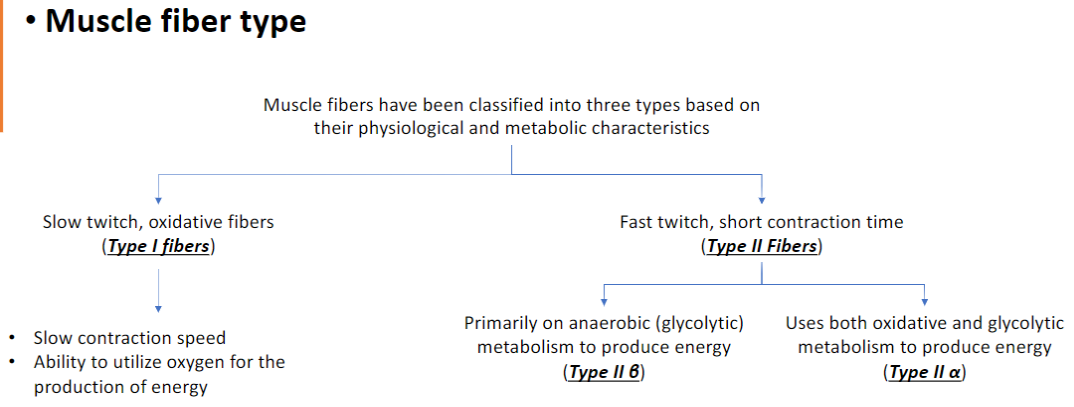
Muscle Fiber Types – Classification and Characteristics

Type I – Slow Twitch, Oxidative Fibers
 Contract slowly
 Use oxygen for energy production (aerobic metabolism)
 Resistant to fatigue, suited for endurance activities

Type II – Fast Twitch Fibers

Type II β – Fast Glycolytic
  Contract quickly
  Rely primarily on anaerobic (glycolytic) metabolism for energy
  Fatigue rapidly, suited for short, intense bursts

Type II α – Fast Oxidative-Glycolytic
  Use both aerobic and anaerobic metabolism
  Intermediate speed and fatigue resistance
<p><strong>Type I – Slow Twitch, Oxidative Fibers</strong><br> Contract <strong>slowly</strong><br> Use <strong>oxygen</strong> for <strong>energy production (aerobic metabolism)</strong><br> Resistant to <strong>fatigue</strong>, suited for <strong>endurance activities</strong></p><p><strong>Type II – Fast Twitch Fibers</strong></p><p> <strong>Type II β – Fast Glycolytic</strong><br>  Contract <strong>quickly</strong><br>  Rely primarily on <strong>anaerobic (glycolytic) metabolism</strong> for energy<br>  Fatigue <strong>rapidly</strong>, suited for <strong>short, intense bursts</strong></p><p> <strong>Type II α – Fast Oxidative-Glycolytic</strong><br>  Use <strong>both aerobic and anaerobic metabolism</strong><br>  Intermediate <strong>speed and fatigue resistance</strong></p>
11
New cards

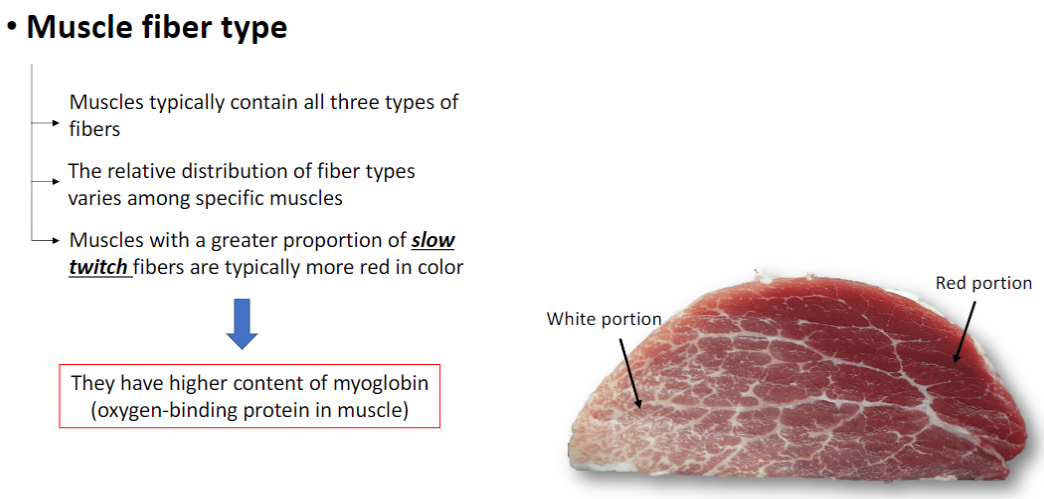
Muscle Fiber Distribution – Characteristics

Mixed Fiber Composition
 Most muscles contain all three fiber types
Relative distribution varies among specific muscles

Slow Twitch Fibers (Type I)
 Muscles with more slow twitch fibers appear red
 High myoglobin content (oxygen-binding protein)
 Suited for endurance and continuous activity

Fast Twitch Fibers (Type II)
 Muscles with more fast twitch fibers appear white
 Lower myoglobin content
 Suited for short, intense bursts of activity
<p><strong>Mixed Fiber Composition</strong><br> Most muscles contain <strong>all three fiber types</strong><br> <strong>Relative distribution</strong> varies among <strong>specific muscles</strong></p><p><strong>Slow Twitch Fibers (Type I)</strong><br> Muscles with <strong>more slow twitch fibers</strong> appear <strong>red</strong><br> High <strong>myoglobin content</strong> (oxygen-binding protein)<br> Suited for <strong>endurance and continuous activity</strong></p><p><strong>Fast Twitch Fibers (Type II)</strong><br> Muscles with <strong>more fast twitch fibers</strong> appear <strong>white</strong><br> Lower <strong>myoglobin content</strong><br> Suited for <strong>short, intense bursts of activity</strong></p>
12
New cards

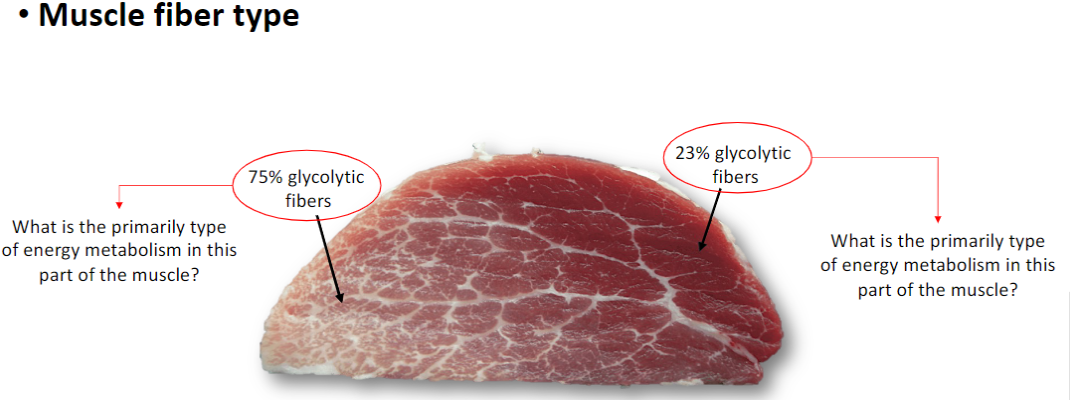
Muscle Fiber Energy Metabolism – Glycolytic Proportion

23% Glycolytic Fibers (77% Oxidative)
 Majority are oxidative fibers (Type I, slow twitch)
 Primary energy metabolism is aerobic (oxidative)

75% Glycolytic Fibers
 Majority are glycolytic fibers (Type II, fast twitch)
 Primary energy metabolism is anaerobic (glycolytic)
<p><strong>23% Glycolytic Fibers (77% Oxidative)</strong><br> Majority are <strong>oxidative fibers (Type I, slow twitch)</strong><br> Primary energy metabolism is <strong>aerobic (oxidative)</strong></p><p><strong>75% Glycolytic Fibers</strong><br> Majority are <strong>glycolytic fibers (Type II, fast twitch)</strong><br> Primary energy metabolism is <strong>anaerobic (glycolytic)</strong></p>
13
New cards

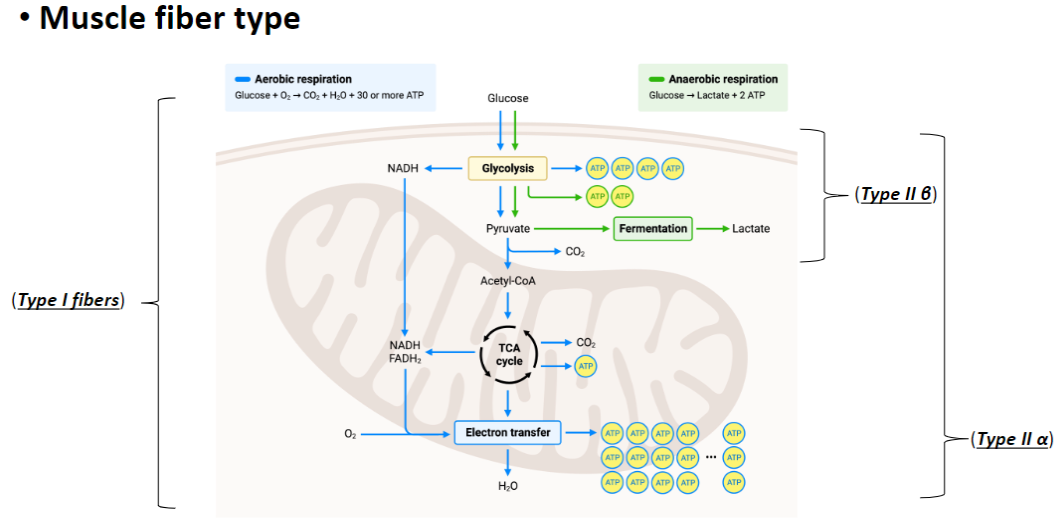
Muscle Fiber Energy Metabolism – Aerobic vs Anaerobic

Type I Fibers – Slow Twitch, Oxidative
 Use aerobic respiration
 Glucose + O₂ → CO₂ + H₂O + ~30 ATP
 Pathway: Glycolysis → Pyruvate → Acetyl-CoA → TCA cycle → Electron Transport Chain
 High ATP yield, fatigue-resistant

Type IIa Fibers – Fast Oxidative-Glycolytic
 Use both aerobic and anaerobic metabolism
 Intermediate ATP yield
 Can sustain moderate force and activity

Type IIb Fibers – Fast Glycolytic
 Use anaerobic respiration
 Glucose → Lactate + 2 ATP
 Pathway: Glycolysis → Fermentation to Lactate
 Rapid energy production, fatigues quickly

Key Point
Fiber type determines energy pathway:
  Type I → aerobic (needs O2), oxidation of glucose
  Type IIa → mixed metabolism, aerobic oxidation of glucose / anaerobic fermentation
  Type IIb → anaerobic fermentation to lactate
<p><strong>Type I Fibers – Slow Twitch, Oxidative</strong><br> Use <strong>aerobic respiration</strong><br> Glucose + O₂ → CO₂ + H₂O + ~30 ATP<br> Pathway: <strong>Glycolysis → Pyruvate → Acetyl-CoA → TCA cycle → Electron Transport Chain</strong><br> High <strong>ATP yield</strong>, <strong>fatigue-resistant</strong></p><p><strong>Type IIa Fibers – Fast Oxidative-Glycolytic</strong><br> Use <strong>both aerobic and anaerobic metabolism</strong><br> Intermediate <strong>ATP yield</strong><br> Can sustain moderate <strong>force and activity</strong></p><p><strong>Type IIb Fibers – Fast Glycolytic</strong><br> Use <strong>anaerobic respiration</strong><br> Glucose → Lactate + 2 ATP<br> Pathway: <strong>Glycolysis → Fermentation to Lactate</strong><br> Rapid energy production, <strong>fatigues quickly</strong></p><p><strong>Key Point</strong><br> <strong>Fiber type determines energy pathway</strong>:<br>  Type I → aerobic (needs O<sub>2</sub>), oxidation of glucose<br>  Type IIa → mixed metabolism, aerobic oxidation of glucose / anaerobic fermentation<br>  Type IIb → anaerobic fermentation to lactate</p>
14
New cards

Muscle Fiber Types – Summary

Type I (Slow Twitch)
Slow contraction speed
 Uses aerobic metabolism
Highest myoglobin content
Low glycogen concentration (since glycogen is used to make the glucose)
Red color

Type IIβ (Fast Glycolytic)
Fast contraction speed
 Uses anaerobic metabolism
Least myoglobin
High glycogen content
White color

Type IIα (Fast Oxidative-Glycolytic)
Fast contraction speed
 Uses both aerobic and anaerobic metabolism
Intermediate myoglobin
Intermediate glycogen
Intermediate (pink) color
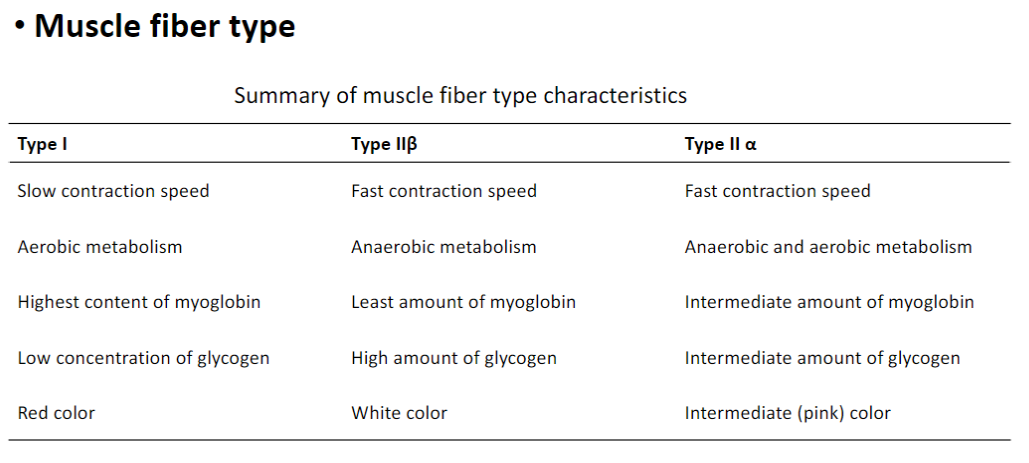
<p><strong>Type I (Slow Twitch)</strong><br> <strong>Slow contraction speed</strong><br> Uses <strong>aerobic metabolism</strong><br> <strong>Highest myoglobin content</strong><br> <strong>Low glycogen</strong> concentration (since glycogen is used to make the glucose)<br> <strong>Red color</strong></p><p><strong>Type IIβ (Fast Glycolytic)</strong><br> <strong>Fast contraction speed</strong><br> Uses <strong>anaerobic metabolism</strong><br> <strong>Least myoglobin</strong><br> <strong>High glycogen</strong> content<br> <strong>White color</strong></p><p><strong>Type IIα (Fast Oxidative-Glycolytic)</strong><br> <strong>Fast contraction speed</strong><br> Uses <strong>both aerobic and anaerobic metabolism</strong><br> <strong>Intermediate myoglobin</strong><br> <strong>Intermediate glycogen</strong><br> <strong>Intermediate (pink) color</strong></p>
15
New cards
16
New cards

Explore top notes

note
ap bio unit 8 review
Updated 1089d ago
0.0(0)
note
Chapter 6: Microbial Growth
Updated 1281d ago
0.0(0)
note
Chapter 15: Reconstruction
Updated 1281d ago
0.0(0)
note
A&P Exam 2
Updated 657d ago
0.0(0)
note
The Living World
Updated 903d ago
0.0(0)
note
ap bio unit 8 review
Updated 1089d ago
0.0(0)
note
Chapter 6: Microbial Growth
Updated 1281d ago
0.0(0)
note
Chapter 15: Reconstruction
Updated 1281d ago
0.0(0)
note
A&P Exam 2
Updated 657d ago
0.0(0)
note
The Living World
Updated 903d ago
0.0(0)

Explore top flashcards

flashcards
Set 11 Spanish
55
Updated 710d ago
0.0(0)
flashcards
AP Gov Chapter 6 Vocab
30
Updated 1160d ago
0.0(0)
flashcards
Intro to American Law Exam #1
89
Updated 899d ago
0.0(0)
flashcards
Kinesiology Exam 1
122
Updated 539d ago
0.0(0)
flashcards
Descubre 1: chapter 8, week 2
38
Updated 1118d ago
0.0(0)
flashcards
gov chapter 1
60
Updated 546d ago
0.0(0)
flashcards
Set 11 Spanish
55
Updated 710d ago
0.0(0)
flashcards
AP Gov Chapter 6 Vocab
30
Updated 1160d ago
0.0(0)
flashcards
Intro to American Law Exam #1
89
Updated 899d ago
0.0(0)
flashcards
Kinesiology Exam 1
122
Updated 539d ago
0.0(0)
flashcards
Descubre 1: chapter 8, week 2
38
Updated 1118d ago
0.0(0)
flashcards
gov chapter 1
60
Updated 546d ago
0.0(0)



