bsci160 - population genetics
 Call Kai
 Learn
Learn Practice Test
 Spaced Repetition
 Match
Match Flashcards
 Knowt Play
1/21

There's no tags or description
Looks like no tags are added yet.
Name | Mastery | Learn | Test | Matching | Spaced | Call with Kai |
|---|
No analytics yet
Send a link to your students to track their progress
22 Terms
allele
alternative forms of a gene (A or a)
genotype
in diploid organisms, the combination of alleles presents for a gene (AA, Aa, aa)
frequency
a proportion/percentage usually expressed as a decimal fraction (< 1)
1/100
0.01
1%
population
a group of individuals of the same species that live in the same area & interbreed
population genetics
describing the gene pool of a population
use allelic & genotypic frequencies
ex. frequency of the yellow allele is 90% (90% of all alleles are yellow)
allele frequency
the proportion of total alleles composed of a particular allele
have 2 alleles of every gene
for diploid (Aa)
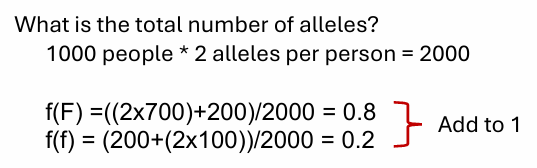
A = (# A allele) / (# A allele + # a allele)
a = (# a allele) / (# A allele + # a allele)
should add to 1 → alleles are either one or the other
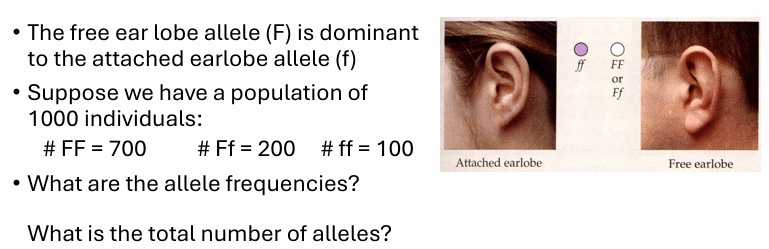
calculating allele frequency example
genotypic frequency
proportion of the total # of individuals composed of a particular genotype
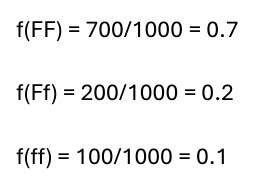
AA = (# AA) / (total # individuals)
Aa = (# Aa) / (total # individuals)
aa = (# aa) / (total # individuals)
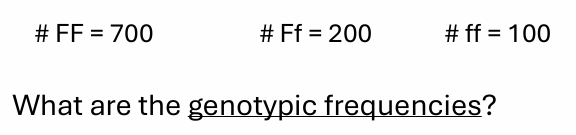
calculating genotypic frequencies example
Hardy-Weinberg Equilibrium (HWB)
used to estimate frequencies using a null model
allele & genotype frequencies should remain constant unless evolutionary force is acting upon the population
nonevolving populations
null model
assumes something is not happening
constant frequency
infinitely large population
random mating
no mutation
no gene flow → isolated from other populations
no natural selection → all individuals equally likely to survive & reproduce
HWB equilibrium formula
p + q = 1
p → dominant allele frequency
q → recessive allele frequency
p2 + 2pq + q2 = 1
p2 → homozygous dominant genotype frequency
q2 → homozygous recessive genotype frequency
2pq → heterozygous genotype frequency
HWB benefits
can calculate allele frequency if assuming in HWB equilibrium
rarely true, but estimate may be close
can determine if evolutionary agents are acting, provided you know allele frequencies
multiplication rule
the probability of 2 independent events A & B both occurring is:
P(A and B) = P(A) x P(B)
tossing a coin → probability of landing on either side is 50%
Probability landing same side 3x in a row is 0.5*0.5*0.5 = 0.125
inheriting allele
> prob. inheriting more common allele
prob inheriting allele = frequency of that allele in pop.
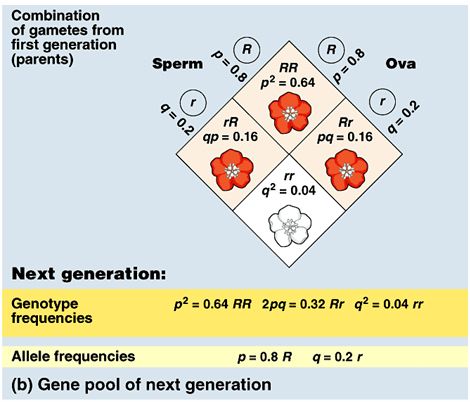
recessive allele freq. (p) = 0.8 → 80% chance inheriting single allele
dominant allele freq. (p) = 0.2 → 20% chance “ “
4 allele combinations
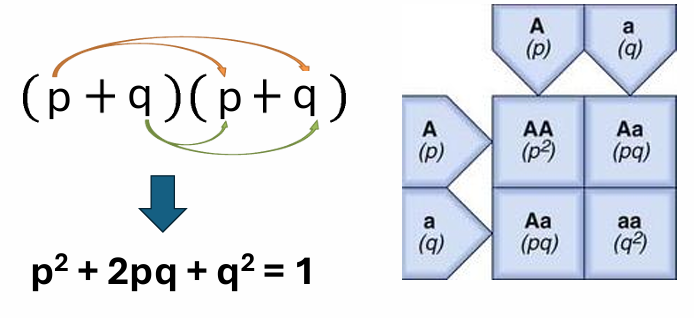
homozygous chances
probability of getting 2 dominant/recessive alleles in a row
heterozygous chances
probability of getting 1 of each allele
doesn’t matter which from which parent
2 heterozygotes for every heterozygote cross
population in HWE?
determine allele freq. of pop by hand
use allele freq. you calculated to find expected genotype freq. (p2 + 2pq + q2 =1)
compare expected & observed genotype freq.
if don’t match → not in HWE
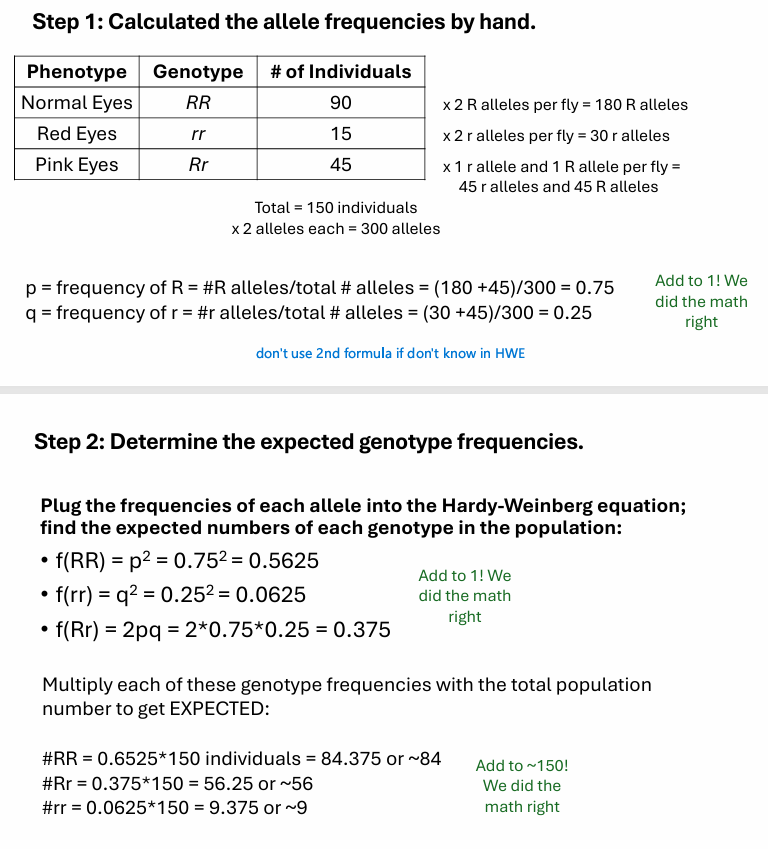
determining HWE example
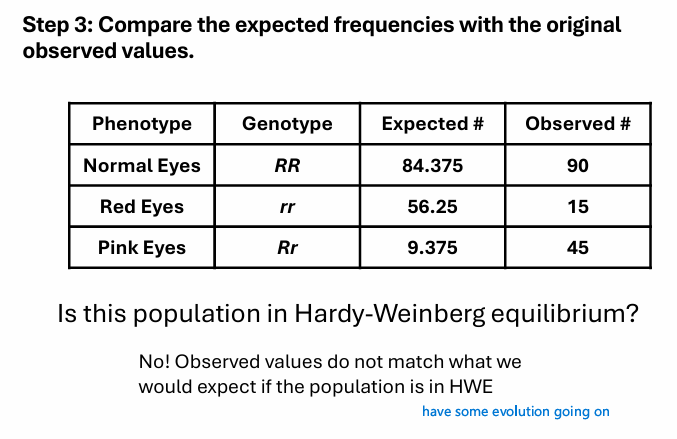
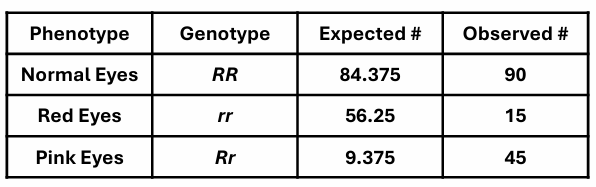
Why might this population not be in HW equilibrium?
evolutionary forces are at play
genetic drift
gene flow
etc

