CV pharma
 Call Kai
 Learn
Learn Practice Test
 Spaced Repetition
 Match
Match Flashcards
 Knowt Play
1/38

There's no tags or description
Looks like no tags are added yet.
Name | Mastery | Learn | Test | Matching | Spaced | Call with Kai |
|---|
No analytics yet
Send a link to your students to track their progress
39 Terms
Starting info :
Whaat can we change to alter heart rate / rhythm?
AP conduction
refractory period length
Starting info : what can we alter to change contractility of cardiac muscle
intracellular Ca2+
Starting info : what two factors affect preload
circulting volume + vscular resistance
Starting info : what affects afterload?
vascular resistance
Starting info: what affects perfusion ?
compensatory vasoconstriction of organs
Starting info : what can effect arterial pressure?
baroreceptors
What is an inotrope
a drug tht alters the strength of muscular contractions
What is a lusitrope?
a drug effecting myocardial relaxtion
What is a chronotrope?
a drug effecting the heart rate
Describe the control of heart rate and rhythm.
ANS and CV centre in medulla oblongata regulate rate + rhythm.
AP conduction is essential
Na+, K+, Ca++ channels
ion levels
correct function of intercalated disks
What is a tachyarhythmia and why are these a problem?
Very fast heart rate!
decreased diastolic filling time → reduced EDVV → reduced SV → reduced CO!
can cause myocardial hypertrophy
What is the name of the classification system for antidysrhythmics?
Name and describe the classes
vaughan - williams
drugs that block na channels
beta blockkers
drugs that prolong AP by blocking some K channels
drugs that block Ca channels
miscellaneous
Describe class 1 (Vaughan-Williams) antidysrhythmics
Bind to and block FAST NA CHANNELS
this slows AP, and therefore HR.
They only affect tachyarthymias, not normal HR. Why?
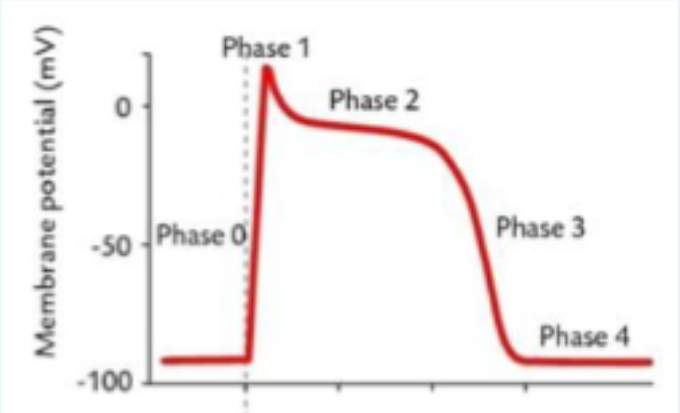
use dependent Na channel blockade - more channels = faster HR = drug binds to those
Describe class 1 (Vaughan-Williams) antidysrhythmics, classes 1a, 1b and 1c giving examples.
a) old drugs. immediatly dissociate from Na channels.
Quinidine (horses). Oral drug.
b) bind during phase 0, dissociate for next AP, so prevents premature beats.
Lidocane. Parenteral.
c) bind and dissociate slowly and reach a steady state.
flecainide
Describe class 2 (Vaughan-Williams) antidysrhythmics. Give an example
Beta blockers! (B1)
selective (not at higher doses tho)
if hit b2 can causse vasoconstriction
Slow pacemakercell potential by slowing Ca influx, slows conduction through AV bunde.
Causes negative inotropy and negative lucitropy.
Atenolol.
Describe class 3 (Vaughan-Williams) antidysrhythmics. Give an example
Multiple MOAs, prolong cardiac AP and block K+ channels.
Sotalol, non-slective betablocker AND inhibits K channels, has adverse ffects of bradycardia and hypotension
Describe class 4 (Vaughan-Williams) antidysrhythmics. Give an example
Block Ca++ channels in cardiomyocytes, nodal tissue and vasculr smooth muscle.
slower conduction in SA and AV nodes.
basically an AV block
Negative inotrope, positive lusiotrope, vasodialator.
Diltiazem.
coronary + systemic vasodialator
can cause myocrdial depression, hypotension, AV block
Describe digoxin (antidysrhythmic)
Negative chronotrope, increases vagal outflow.
slows concuction through AV node
What is a bradyarythmia?
slow heart beat
Why are bradyarythmis hard to treat?
usually cuases by a break in the bodys normal pathways to increase HR. require pacemakers instead.
Give some autonomic drugs tht can treat bradyarhythmias
Sympthomimetics
B1 agonists eg dobutamine
B2 agonists eg terbutline
Anticholinergics
Atropine, muscarinic antagonist.
What other types of drug can treat bradyarythmias? give examples.
Methylxanthines
non-selctive PDE inhibition - theophylline
PDE III inhibitors
pimobendan
In general, how do postivite inotropes increase strength of muscular contraction?
Endogenous - symapthetic NS
Pharmacologically - symptic stim, increase Ca++ intracellularly,
How do PDE III inhibitors work?
inhibits pde3 enzyme from degrading intracellular cAMP → incresed cAMP causes ^ activate ProKinA → more Ca++ phosphotlytion → more Ca++ into cardiac myocyte.
What are the other effects of PDEIII inhibitors?
vasodialation, tachycardia.
Give an example of a PDE3 inhibitor and how it works
Pimobendan
calcium sensitiser, positive inotrope, vasodialator
adverse effects : inappetence, lethargy, dyspnoea, azotaemia
Give an example of a cardiac glycoside and how this works.
Digoxin
+ inotrope, - chronotrope
inhibits Na/K pump to decrese intracellular Na
reduces Ca extrusion from cell
What MOAs can negative inotrope have?
sympathetic antagnonists
b blockers
cholinergics
antagonises sympathetic M2 receptors on cariomyocytes
calcium channel blockers
redcues ca influc into cell
List some direct vasodilators
nitrates, ca channel blocker, pde3 inhibitors, hydralazine
How do nitrates (drug) cause vasodilation, give examples
Nitric oxide action
cGMP → inactivates K channels → inhibits Ca entry + activates PK-G → activates MLCP. ( relaxed bvs )
Sodium nitroprusside
Nitroglycerine
venodiltor
What is the action of Ca++ channel blockers and give an example.
antidysrhythmics + vasodilators
Almodipine
What is hydralazine used for
arteriodilator, decreases afterload,
What are PDEIII and V inhibitors used for? give an exam-le of a pde5 inhibitor
3- CHF
5- arteriodialtion
sildenafil (viagra) inhibt breakdown of cGMP
What body systems can we activate to trigger indirect vasodilation?
Symapthetic NS
RAAS
list some sympathetic antagonist that can act as idirect vasodilators
a1 adrenoreceptor blockade
prazosin
phenooxybenzamide
What three classes of drugs effect the RAAS and can be used as indirect vasodilators
ACE inhibitors
AII receptor agonists
Aldersterone agonists
Give examples of ace inhibitors,what is their MOA
enalapril remairil, benzapril
vasodilation, reduced circulating volume
give an example of a A II inhibitor and its MOA
telmisartan
inhibit A II to stop vasoconstriction
Give examples of aldersterone antagonists adn their MOA
spironolactone
cardalis
reduce Na + H2O retention
reduce cardiac remodelling
potassiu sparing diuretic

