Psychobio Theme 3 (Evolutionism)
 Studied by 0 people
 Call Kai
 Learn
Learn Practice Test
 Spaced Repetition
 Match
Match Flashcards
 Knowt Play
1/25

There's no tags or description
Looks like no tags are added yet.
Name | Mastery | Learn | Test | Matching | Spaced | Call with Kai |
|---|
No analytics yet
Send a link to your students to track their progress
26 Terms
Evolutionism
Theory that all living things have developed gradually from simpler forms through NATURAL processes (especially by evolution)
Creationism
Two Principles:
creationists REJECT any explanation of the natural world that doesn’t contain the intervention of a supernatural entity (God)
Creationism INVOKES the intervention of a divine agent as the cause of creation and conceives the world as something immutable and static
Creationism vs. Evolutionism
Creationism: all species were created at the same time and have not changed since their creation
a) Some versions admit variations
[not all have same survivability, some extinct earlier (left) than others (center)]
Evolutionism: living things developed by natural processes
b) Lamarck’s model: species change during their evolutionary history, but NO genealogical (family descent) relationship between species, with different origins
c) Darwin’s theory: species descend from shared ancestors and experiment changes
d) Vision of Darwin’s evolutionary tree: links between branches symbiogenetic processes (two species merge) and lateral gene transfer between lineages
![<p><span style="color: purple;"><strong>Creationism</strong></span>: all species were created at the same time and have not changed since their creation</p><p><strong>a)</strong> Some versions admit variations</p><p>[not all have same survivability, some extinct earlier (left) than others (center)]</p><p></p><p><span style="color: green;"><strong>Evolutionism</strong></span>: living things developed by natural processes</p><p><strong>b) Lamarck’s model</strong>: species change during their evolutionary history, but NO genealogical (family descent) relationship between species, with different origins</p><p><strong>c) Darwin’s theory</strong>: species descend from shared ancestors and experiment changes</p><p><strong>d) Vision of Darwin’s evolutionary tree</strong>: links between branches symbiogenetic processes (two species merge) and lateral gene transfer between lineages</p>](https://knowt-user-attachments.s3.amazonaws.com/685394f4-f30e-46ea-9e34-4857ff6a1b11.png)
Schools of Creationism
Biological Evolution (non-theistic): old earth, normal geology & evolution, NO religion
Theistic Evolution (Gradual): old earth, normal geology & evolution, evolution is GOD’s way of making diversity — creation is origin of life and continues at any moment
Progressive Evolution (Old-Earth Creationism): old earth and normal geology but only LIMITED EVOLUTION, like Gradual but accepts evolution only within groups
Quick Creation (Young-Earth Creationism): Earth is only a few thousand years old, diversity arose from a limited number of "kinds" created by God, with variations occurring only within those kinds, rejects most physical & biological science
Essentialism
Typological thinking: categorizing into types based on structure rather than development
Essentialism: any natural system can be classified in natural categories, each one defined by a fixed essence that differentiates it from any other system
from Aristotle: every natural kind (species) has a fixed “essence” (unchanging inner nature that defines it)
—> all members of a species share same essence, differences are minor imperfections
—> ladder of nature: model showing hierarchical order of living things based on their complexity and perfection (humans at top)
Pre-Darwin Evolutionism
tried to make typological thinking and evolutionism compatible
Transmutationism/saltationism: explains evolution as a discontinuous process (mutation or jump) which occurs in different stages
Transformationism/uniformitarianism: evolution is a gradual process, the sum of little changes accumulated over time
External Causes: emphasizes role of environment & assumes genetic material is soft (traits can be changed by use, disuse, environment, and passed on)
Internal causes: defends finalism: systems tend to change and evolve to more perfect states
3 Pre-Darwin Theories of biological change
Essentialism (typological thinking)
Creationism
Transformism (Lamarckism)
BUT
Interindividual variability: each species is constituted by unique individuals —> individuals are different —> some are better adapted to survive and reproduce
Evidence for Evolution
Fossil Records
Homologous traits
Analogous traits
Molecular similarities
Vestigial/atavistic traits
Embryo development
Biogeography
Fossil Records
fossils in continuous strata are more like each other — arising of certain characteristics and timeline follow theory of evolution
Homologous Traits
Homologous traits: characteristics shared by different species that may live in DIFF ENVIRONEMENTS — may function differently but have SIMILAR underlying STRUCTURE
—> similarity due to the species inheriting the trait from a common ancestor
—> over time, trait evolved in form and function, but basic structural pattern remained
Ex: organelles shared in plant & animal cells, swimming: dolphin, seal
Analogous traits
characteristics shared by diff species in SIMILAR ENVIRONMENTS
same function but DIFF internal STRUCTURE
traits inherited from DIFF ancestors
Ex: wings and fins
Molecular Similarities
when DNA molecules, amino acids, etc are compared, there are similarities and differences that can only be explained based on EVOLUTIONARY history of lineages
All living cells share some functional biochem similarities:
all cells carry genetic info in DNA
all cells use RNA, ribosomes, same genetic code to translate DNA to proteins
all cells use about the same 20 aa to make proteins
all cells use AYP to carry energy
Vestigial/Atavistic traits
traits that lack any function or that have been adapted for a new function
Ex: disease often leads to loss of organ or its original function
Vestigial: present in ALL individuals or current species
Atavistic: only present in a FEW in an exceptional way (ex: tails in humans)
Embryo Development
Theory of evolution and the tree of life: all species are related by common ancestry.
Embryonic development: during early stages of development, embryos of diff species often show similar characteristics
(ex: fish, birds, and humans all have gill slits and tails in their early stages)
—> Similarities suggest a shared common ancestor
—> Diffs in adults arise from adaptations to diff environments over time
Biogeography
Biogeography: study of the geographical distribution of living & extinct species
Fossils: scientists can det the relative ages of rocks and correlate sediment layers across regions —> shows which organisms lived at same time & how they changed over time
Wallace: species on islands and continents were similar but slightly diff —> suggesting common ancestry and adaptation to local environments
Wegener: continental drift (connected continents allowed species to spread and evolve separately even after the continents drifted apart)
Facts and inferences that underlie Darwin’s theory of evolution
Superfecundity: organisms produce more offspring necessary to replace parents
Stable population size
Resources are limited: populations cant get everything they need —> competition —> struggle for existence
Uniqueness of each: every individual is genetically and phenotypically unique —> affect ability to compete for survival and reproduction
Heritability: traits that give an individual a survival or reproductive advantage can be passed to offspring — only heritable traits can contribute to evolutionary change
6 Hypotheses of Darwin’s Evolutionary Theory
Evolution: species have experienced changes since their origin and will until their extinction —> changes occurred at diff levels of organization and along with environmental changes
Common Ancestor: all the organisms that exist (or have existed) all share a common ancestor
Gradual Change: evolutionary change is continuous and gradual —> big scale change
Natural Selection: main agent for evolutionary change — variability among traits —> advantageous traits —> differential survival and reproduction
Speciation: evolution does not only occur vertically (parents to offspring) but also DIVERGES (one species splits into two or more) —> accumulate differences —> distinct species (tree of evolution forms more branches)
Inheritance: traits must be passed from parents to offspring for natural selection to work — Darwin believed inheritance was somewhat “soft” (changes acquired during life might sometimes be passed on — idea influenced by Lamarck)
(Later, Mendel clarified that heredity is based on stable genetic material (DNA), not soft inheritance)
Modern Evolutionary Synthesis
The Modern Synthesis is the integration of Darwin’s theory of Natural Selection with Mendel’s law of Heredity (genetics)
(Before, Darwin didn’t know how traits were inherited, and geneticists didn’t know how mutations explained gradual change)
(mutations = agent of evolution VS natural selection = agent of evolution)
Now:
Evolution is gradual & due to mutations (random)
Natural selection (non-random) acts on genetic variation in populations
Main source of genetic variation: mutation & recombination
Units of evolution: populations
Speciation occurs when populations become reproductively isolated
Microevolution explained by small changes (mutation, selection, drift, migration) Macroevolution explained by large-scale changes
Fundamental Principles of Evolution
Evolution can be defined in terms of:
changes in frequency of alleles (gene variants) in pop (anagenesis)
changes in number of species (cladogenesis), across generations
Evolution is gradual and due to accumulation of small changes over time
Natural selection is the main mechanism for evolutionary change and the adaptions that define an organism’s design
Microevolution (phyletic evolution) and macroevolution (speciation) are governed by similar mechanisms
Micro vs Macroevolution
Micro: small-scale evolution within a pop or species over a short period of time (changes in alleles// gene frquency)
—> Due to: mutation, natural selection, genetic drift, gene flow
—> Ex: antibiotic resistance, industrial rev color variation in moths
Macro: large-scale evolutionary changes that lead to the FORMATION OF A NEW SPECIES over long geological timescales
—> Due to: accumulated microevolutionary changes + speciation events
—> Ex: birds evolving from dinosaurs
Neutralist Theory (of molecular evolution)
most evolutionary changes at molecular level (DNA and protein sequences) are NOT caused by natural selection, but by random genetic drift of neutral mutations — mutations that neither help nor harm the organism
Evolutionary change at the molecular level is due to GENETIC DRIFT (random and neutral) NOT natural selection
Evolution of pseudogenes (DNA segments that don’t code for amino acids) is faster than evolution of genes (DNA segments that DO code for proteins) bc mutations in them are neutral (no functional consequence, don’t affect fitness, spread randomly)
Punctuated Evolutionary Theory’s fundamental principles:
Microevolution (phyletic/anagenesis) and Macroevolution (speciation/cladogenesis) are the outcome of DIFF processes
Phyletic evolution can be gradual, it’s a process of relative ABSENCE of CHANGE, stasis (stasis does NOT follow any recognizable pattern)
many traits are NOT ADAPTATIONS, but exaptation (trait that evolved for a purpose or no particular purpose but was later co-opted for a new function)
Its existence is NOT the result of natural selection
—> due to genetic drift, allometry, etc
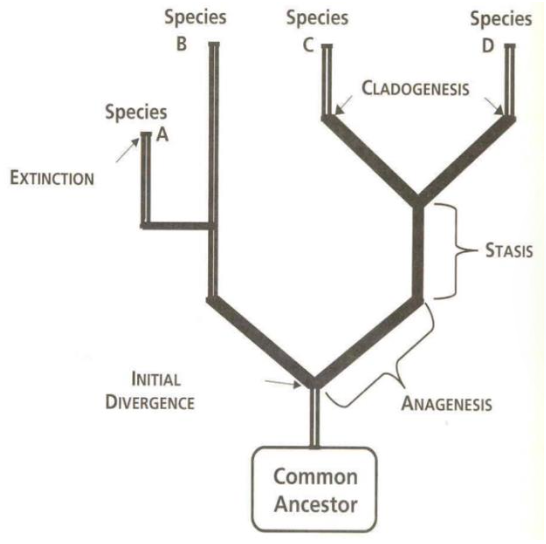
Extended Evolutionary Synthesis
(Expands on Modern Synthesis)
Rejection of Gradualism: (evolution was seen as a slow, gradual process) EES recognizes that evolution can also occur through sudden or discontinuous changes due to genome evolution, phenotypic plasticity, epigenetics, non-genetic inheritance, etc
Rejection of Externalism: EES says organisms themselves actively influence their own evolution through development bias (the way they grow influences which variations occur), plasticity, and niche construction (traditional Darwinian (externalism) assumed evolution happens mainly bc external environment selects among random variations)
EcoEvoDevo framework (ecological evolutionary developmental bio)
Rejection of Gene Centralism: (modern synthesis focused mainly on genes as the unit of inheritance & evolution) EES includes parental effects, epigenetic, ecological, and cultural inheritance

Evolutionary Principles for Mental Health Sciences:
bio traits need BOTH proximate and ultimate EXPLANATIONS
traits that make bodies vulnerable to disease need EVOLUTIONARY EXPLANATIONS
testing evolutionary hypotheses about diseases can be challenging
selection is WEAK at levels ABOVE THE GENE and the individual
kin selection (nat selec that increases reproductive success of relatives) is important
conflicts among genes can cause diseases
pleitropy (single gene affects more than one trait) is the rule (norm), not the exception
Heterozygote (two diff alleles) advantage (overdominance — heterozygote has higher fitness than either of the two homozygotes) is rare, good for evolutionary reasons
having one copy of each allele is BETTER than two of the same
migrations, mutation, drift, and nat selec all shape evolution and selection changes some traits slower than many expect
nat selec doesn’t guarantee rapid change — some traits are constrained (e.g. by genetics, environ, randomness
Selection changes some traits faster than many expect
signals of selection reflect recent evolution at a locus (position on a chromosome)
signs of selection at a gene = evidence that nat selec acted there in recent past
variations in many complex traits (traits influenced by many genes) arise from myriad polymorphisms (genetic variant) with small effects
complex traits are usually the result of many small-effect genetic variants (polymorphisms) acting together
genes can influence phenotypes by many indirect routes
organic complexity is fundamentally diff from complexity in machines (linear, predictable)
Why natural selection has made bodies vulnerable to disease
Constraints on what natural selection can do
mutation and path dependence (evolutionary history) = constraints on nat selec
Mismatch with environments
nat selec too slow to adapt populations to rapid changes in environ — many traits ill-suited to modern environs — many common diseases due to environ factors, NOT defective genes
Co-evolution with fast-evolving pathogens
microbes regenerate way faster than we do — can’t evolve against infections fast enough — mechanisms to defend from infection are expensive and prone to hurt health
Trade-offs that leave every trait suboptimal
no trait is perfect — changes that make one trait better will usually make others worse
Reproductive success at the expense of health
alleles that incr reproductive success will spread even if they harm health
Defenses and their special cost
many symptoms we experience are adaptive defense mechanisms, not malfunctions
Ex: fever helps fight infections
Aversive nature is useful
these defenses feel bad —> motivation to avoid harm
Why does natural selection favor those better adapted?
natural selection operates with raw material
no organism exists in isolation: all live in pops or communities where they interact —> conflicts of interest are inevitable —> nat selec acts on individuals —> advantage —> mismatches & tension
nat selec promotes individuals to make copies of themselves, favor high reproductive rate, but often face trade-offs between living long and reproduction
when something is wrong, it is harder to maintain, to maintain a more sophisticated individ, it takes more energy from it
evolution —> balance complexity, survival and reproduction rathe than maxing one thing
 Note
Note  Flashcards (81)