Mark-recapture & biodiversity
 Call Kai
 Learn
Learn Practice Test
 Spaced Repetition
 Match
Match Flashcards
 Knowt Play
1/13

There's no tags or description
Looks like no tags are added yet.
Name | Mastery | Learn | Test | Matching | Spaced | Call with Kai |
|---|
No analytics yet
Send a link to your students to track their progress
14 Terms
ecosystem
a group of interacting organisms living in a particular area & their abiotic environment
biotic factors
living components of the ecosystem
abiotic factors
non-living components of the ecosystem
what both affects an ecosystem’s biodiversity & abundance of species
biotic & abiotic factors
trophic level
feeding level that an organism belongs to
trophic levels
primary, secondary, tertiary, quaternary (rarely)
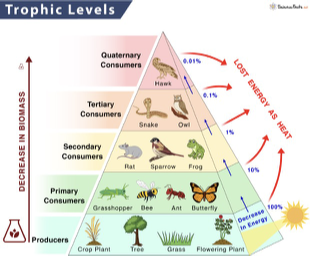
fun fact abt trophic levels
~ 10% of energy at any level is transferred to the next level → rest is lost as heat
net primary productivity (NPP)
plant biomass in a given area
gives an indication of carrying capacity
food webs
Represent relationships between biotic factors of an ecosystem
Interacting groups of species in a specific area make up communities
Arrow always points toward the predator
Mark & recapture
Estimate the size of a population where it is impractical to count every individual
Capture a small number of individuals, put a harmless marker on them, and release them back into the population
This can be used to calculate the population density
Mark and Recapture: Calculate population
lincoln-petersen method: N=MC/R
N = estimate of total population size
M = # of animals captured & marked initially
C = # of animals captured 2nd time (including recaptures)
R = # of animals that were found to be marked the 2nd time
species richness
total count of diff species w in a specific area
focusing solely on variety, counts “how many” types
species evenness
the equality of individuals across those species
assesses how equally “balanced” their populations are
Shannon-Weiner Index (H)
a widely used ecological metric that measures species diversity by combining richness and evenness
Higher values indicate greater diversity and complexity within a community
It is commonly used to quantify ecosystem health, with typical values ranging between 1.5 and 3.5.

