Organisation of the Nervous System
 Studied by 0 people
 Call Kai
 Learn
Learn Practice Test
 Spaced Repetition
 Match
Match Flashcards
 Knowt Play
1/207

Earn XP
Description and Tags
Flashcards covering key definitions and concepts related to the organization of the nervous system, including its divisions, major structures, cell types, and historical milestones, based on the provided lecture notes.
Name | Mastery | Learn | Test | Matching | Spaced | Call with Kai |
|---|
No analytics yet
Send a link to your students to track their progress
208 Terms
Nervous System Divisions
Includes the brain, spinal cord, and peripheral nervous system.
Sympathetic Nervous System
A division of the autonomic nervous system responsible for 'Fight or Flight' responses, characterized by thoraco-lumbar outflow.
Parasympathetic Nervous System
A division of the autonomic nervous system responsible for 'Rest and Digest' functions, characterized by cranio-sacral outflow.
Neuroglia (CNS)
Main cell types in the Central Nervous System including ependymal cells, oligodendrocytes, astrocytes, and microglia.
Neuroglia (PNS)
Main cell types in the Peripheral Nervous System including satellite cells and Schwann cells.
Neuron
The basic structural and functional unit of the nervous system, responsible for transmitting electrical and chemical signals.
Myelin
A fatty sheath that insulates axons, increasing the speed of nerve impulse transmission.
Synapse
The junction between two neurons where electrical or chemical signals are transmitted from one neuron to another.
Broca's Area
A region in the left frontal lobe of the brain crucial for speech production.
Phineas Gage
A railway worker whose personality and character dramatically changed after a tamping iron passed through his frontal lobe in 1848, providing early insights into brain localization.
Phrenology
An 1800s theory proposed by Franz Joseph Gall, suggesting that brain regions are specialized and their growth could be observed on the skull surface.
Cerebral Cortex
The outermost layer of the cerebrum, responsible for higher brain functions like thought and voluntary action.
Gyrus
A ridge or fold on the surface of the cerebral cortex.
Sulcus
A groove or furrow on the surface of the cerebral cortex.
Brainstem
Connects the cerebrum and cerebellum to the spinal cord, responsible for vital functions such as breathing and heart rate. Comprises midbrain, pons, and medulla.
Cerebellum
Located at the back of the brain, primarily involved in motor control, coordination, and balance.
Spinal Cord
A long, thin, tubular bundle of nervous tissue and support cells that extends from the brainstem to the lumbar region, transmitting signals between the brain and the rest of the body.
Grey Matter
Composed primarily of neuron cell bodies, dendrites, and unmyelinated axons, involved in processing information.
White Matter
Composed primarily of myelinated axons, connecting different regions of grey matter and facilitating communication.
Ventricles
Fluid-filled cavities within the brain that produce and circulate cerebrospinal fluid (CSF).
Frontal Lobe
Responsible for personality characteristics, decision-making, movement, smell recognition, and speech (Broca's area).
Parietal Lobe
Processes sensory information, involved in identifying objects, spatial awareness, pain/touch sensation, and understanding speech (Wernicke’s area).
Occipital Lobe
Primarily responsible for processing visual information.
Temporal Lobe
Involved in short-term memory, speech, musical rhythm, and smell recognition.
Corpus Callosum
A large bundle of nerve fibers connecting the two cerebral hemispheres, allowing them to communicate.
Thalamus
A major relay station for sensory information reaching the cerebral cortex.
Hypothalamus
Regulates vital bodily functions such as temperature, hunger, thirst, and hormone release.
Medulla Oblongata
The lowest part of the brainstem, controlling essential involuntary functions like heart rate and breathing.
Cerebrospinal Fluid (CSF)
A clear fluid that cushions the brain and spinal cord, absorbs shocks, and facilitates nutrient and waste exchange. Produced by the choroid plexus and ependymal cells.
Central Nervous System (CNS)
Consists of the brain and spinal cord.
Peripheral Nervous System (PNS)
Encompasses all nervous tissue outside the brain and spinal cord, including cranial nerves, spinal nerves, ganglia, enteric plexuses, and sensory receptors.
Somatic Nervous System
A division of the PNS responsible for voluntary control of skeletal muscles and relaying sensory information from the body to the CNS.
Autonomic Nervous System (ANS)
A division of the PNS that controls involuntary visceral functions, maintaining the body's internal environment (homeostasis).
Homeostasis
The ability of an organism to maintain stable internal conditions despite changes in the external environment, controlled by the ANS.
Rostral
Directional term meaning towards the front or head end.
Caudal
Directional term meaning towards the tail or posterior end.
Dorsal
Directional term meaning towards the back (or top in the brain).
Ventral
Directional term meaning towards the belly (or bottom in the brain).
Yes—e.g.amoebae live without one, but they can’t perform complex tasks like playing tennis
No you’re born with them and they last a lifetime (unless damaged).
They are long-livedform complex connections, and can’t easily be replaced if lost
No the number of neurones stays constant, but their connections change
Forward thinking planning decision-making, and goal-directed behavior.
They line the ventricles produce cerebrospinal fluid (CSF), create a barrier, and move CSF with cilia.
Basic Structure of a Neuron
Consists of a cell body (soma), dendrites (receive signals), an axon (transmits signals), and axon terminals (form synapses with other neurons).
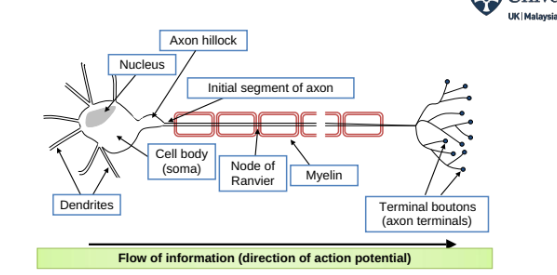
When a neurone fires an action potentialwhere does the signal go?
Down the axon and into all of its branches, sending the message to all connected targets.
 Note
Note  Flashcards (62)