FINAL Luke jeske
 Studied by 0 people
 Call with Kai
 Learn
Learn Practice Test
 Spaced Repetition
 Match
Match Flashcards
 Knowt Play
1/115

There's no tags or description
Looks like no tags are added yet.
Name | Mastery | Learn | Test | Matching | Spaced | Call with Kai |
|---|
No study sessions yet.
116 Terms
Islam's spread to West Africa
created new connections across the continent and into Asia
Islam also accompanied what?
the rise of new major kingdoms/empires, which were partially defined by entrenching Islam in Africa
Mansa Musa
ruler of Mali, exemplified Medieval African wealth and power as well as the challenges we face in studying these histories
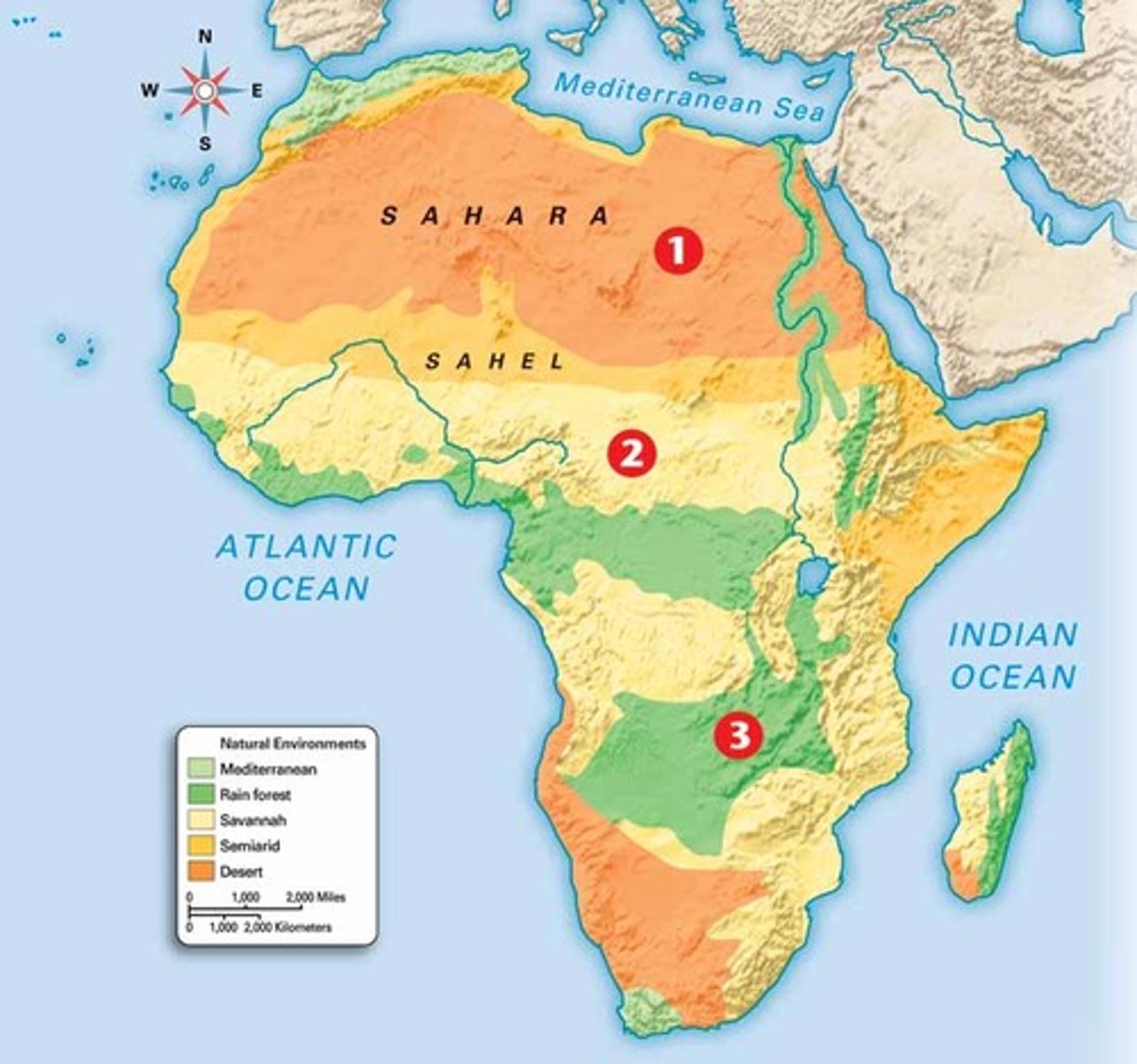
West African Environmental Geography
- Rainforests
• Biodiversity
• Sahel (transition zone)
• Sahara Desert
Bantu Culture
• Stateless or decentered politics based around kinship
• Dominated until c. 700s
• Mixture of agriculture and cattle/livestock culture
Spread of Islam
• Islam reached northern Africa c. 7-8th centuries
• Islam spread to Ghana and Western Africa c. 11-12th centuries
o Almoravid and Amazigh peoples considered central to this process
Ghana and Mali
• Ghana major power in West Africa
• Mali: successor to Ghana
• Both were empires of immense wealth and power
Ghana Empire, 6-13th centuries
• Salt and gold trade
• Trans-Saharan trade routes
• Between the desert and the gold fields
• Brought down by shifts in gold mining and trade
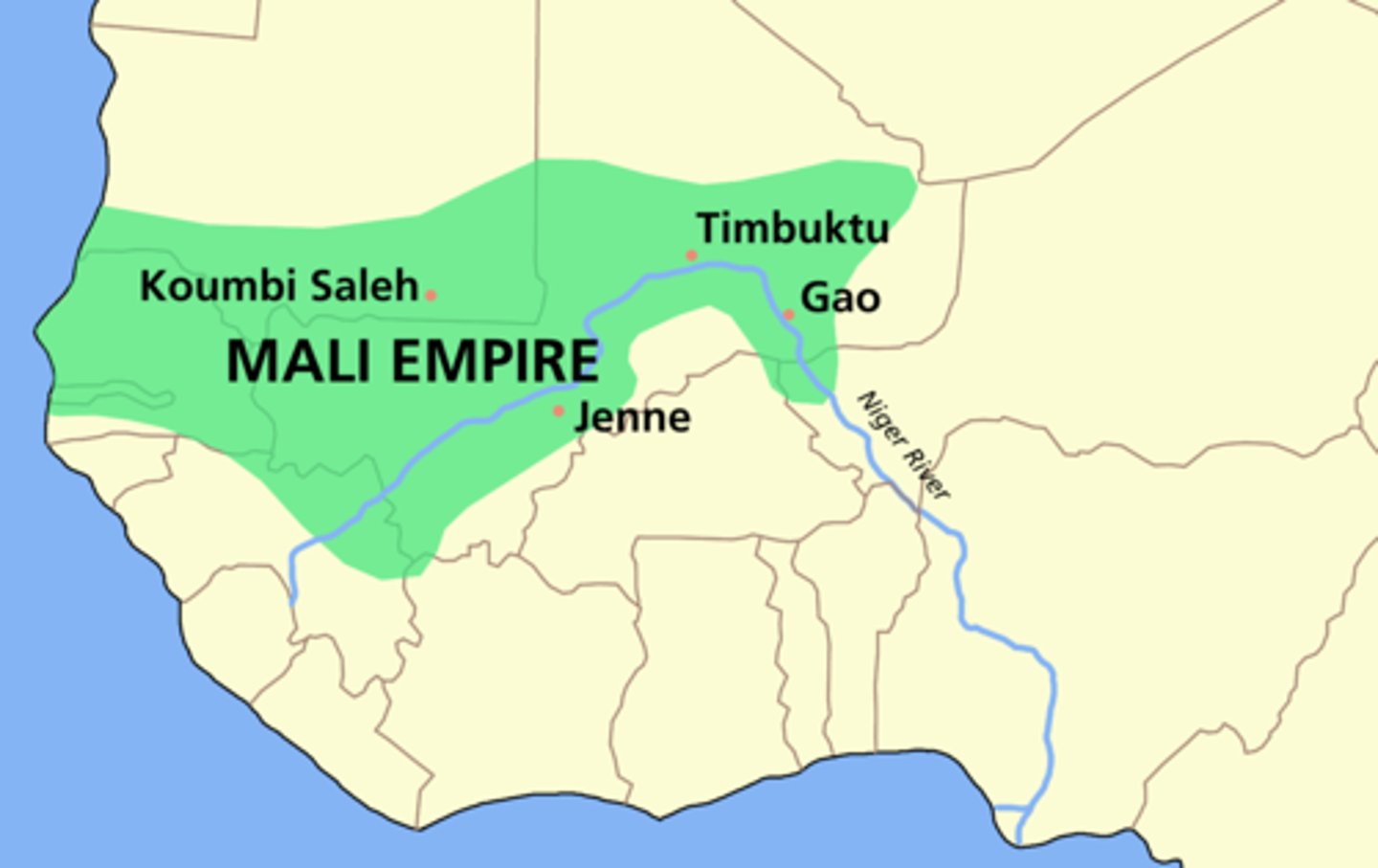
mali empire
• Founded c. 1235 by Sundiata Keita
• Initially left semi-independent vassals (rulers subject to a higher-ranking ruler or state) until he became the sole mansa (king)
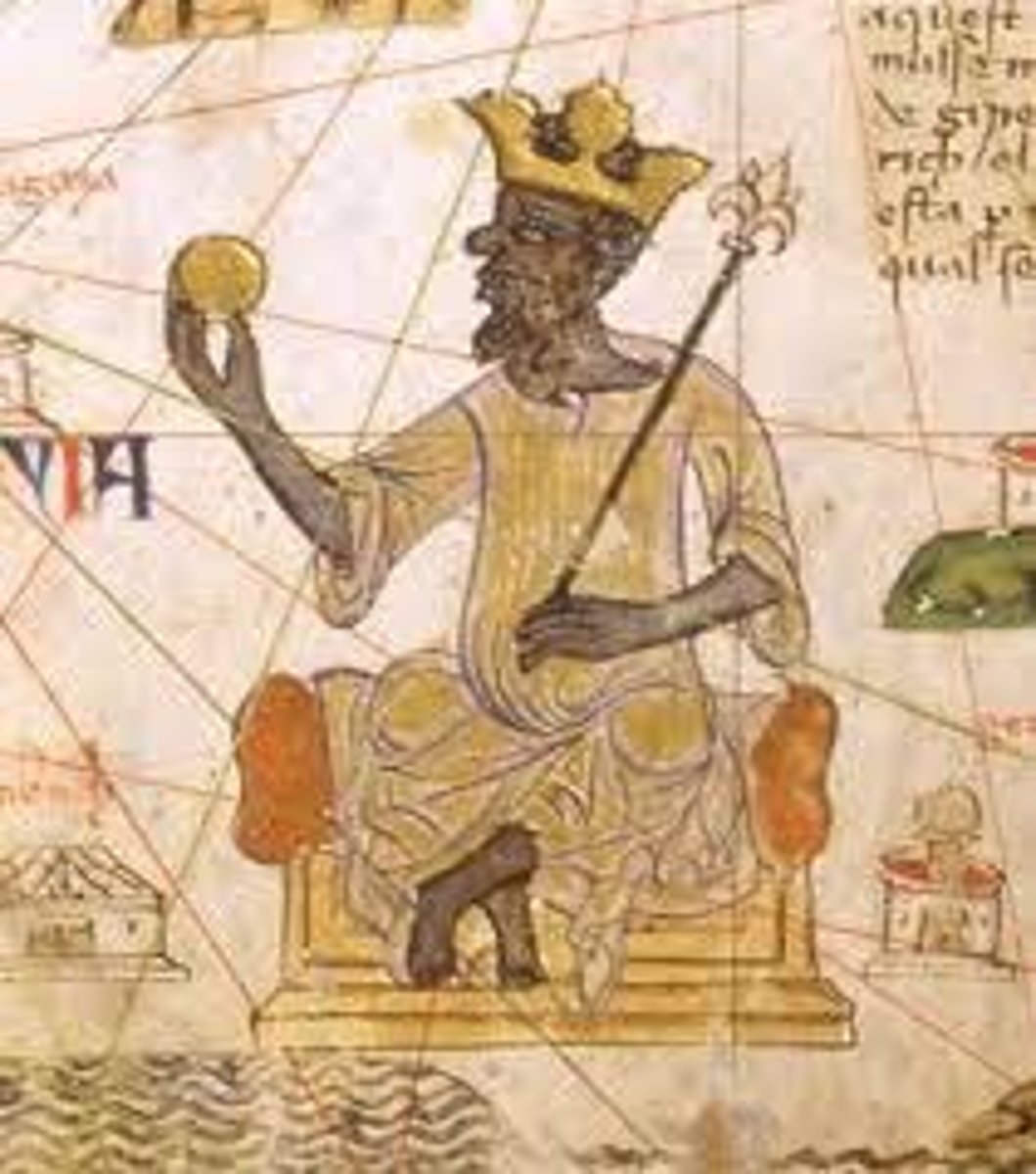
Mansa Musa (r. 1312-1337)
The greatest, wealthiest ruler of all time?
Mansa Musa's Hajj
• Spread mythic quantities of gold
• Intimately linked to the Islamization of West Africa
• Underscored new and intense links across Africa and into Western Asia
The Mongols
a Central Asian Turkic people who used the warfare and politics of the steppe to conquer huge territories
What fueled the Mongol success?
The speed and mobility of nomadism as well as a high degree of tolerance suited to steppe diversity
what did the Mongols create?
lasting connections, institutions, and practices that would dominate Eurasia for centuries to come
The Mongols c. 1100
• Mobile nomadic pastoralists who relied on livestock: sheep, goats, cows, Bactrian camels, yaks, horses
• Lived in gers/yurts
• Between Tatars to the east and Turks to the west
• Claimed lineage to the Huns (nomads of Inner Asia)
Temujin
• Born in 1162, Temujin survived a turbulent childhood on the steppe
• Family or friendship? Temujin most closely allied with Jamuka, his blood brother, until 1181
From Temujin to Khan
• Battled many challengers, including Jamuka, for control and authority from 1181-early 1200s
• In 1204, Temujin finally defeated Jamuka. In 1206, he called a khuriltai (council) to install himself as sole leader of the Mongols
• He took the new name/title Chinggis Khan (Pers. Genghis Khan)--TheStrong/Unshakable Khan
The New Khanate
• Compiled and refined the Great Law of Genghis Khan, which aimed to defuse internal tensions
o Prohibited kidnapping of women, deemed all children legitimate, forbid enslavement of Mongols
o Declared complete religious toleration (!)
• Installed loyal family, soldiers, civil servants to rule regions within his already sprawling empire
• Fashioned an advanced postal system to relay messages acrossthe steppe
• Approved of a new Mongol script for writing
Military (mongol)
• All able-bodied Mongols were conscripted into the cavalry
• Conquered peoples supplied the infantry and artillery forces
• Acquired Trebuchets (Sling shots) from China
• Psychological warfare
o Genghis permitted (perhaps enabled) horrid tales to spread widely
o This spread fear, but also complicates historical study of the Mongols
• Mongol forces obtained a reputation for ruthless brutality and utter destructiveness
Mongol Violence in Context
• 1099-on Christian Crusaders slaughtered Jews and Muslims throughout the Holy Land
• European rulers such as Frederick Barbarossa (Holy Roman Empire) publicly beheaded enemies and defiled the bodies
• 1305 sultan of Delhi squashed Mongol captives under elephants
Mongol Rule
• Genghis Khan established a vital new custom of "rule through difference"
• Rather than forcibly assimilate conquered peoples, the Mongols tolerated different religious beliefs, local customs, and some degree of local politics
• Peace was ensured as long as local rulers remained loyal to the khan
• This custom would be central to the longevity of the Russian and Ottoman Empires
Mongol Legacies
• Administrative rule: thriving bureaucracy
• Mongol Language: Syriac letters, vertical script
• Religious tolerance: Christianity, Buddhism,Taoism, Islam
• Commerce: increasing use of paper money, which is easily transported across an enormous empire
The "Mongol Yoke"
the name for the Mongolian rule over eastern Slavs for more than two hundred years.
Ögödei: A New Leader
• Chinggis did not fully clarify matters of succession before his death in 1227
• Ögödei, Chinggis' third son, emerged as the new khan in 1230
• Ögödei established Karakorum, the new capital city
• He may have prioritized Christianity (a Christian wife and favorite grandson) but kept his city and empire open to all faiths
Pushing Westward
• The Mongols had easily marched into some portions of southern Russia, Ukraine and the Caucasus in the early 1220s but largely left them alone
• Desperate to replenish imperial coffers, Ögödei ordered preparations for an attack on Europe in 1235
• 1236 campaign on the Volga
• 1238 conquest of Riazan included building an outer wall to prevent reinforcements from arriving
• 1240 fall of Kyiv (Kiev)
• In 1241, General Batu and Subutai took Kiev, invaded Poland, and occupied Hungary but the Mongols retreated to only the grassland areas of Europe and Eurasia
The Mongol Mandate of Heaven
• The conquest of Song China (1235-1279) encouraged Chinese officials to legitimate the Mongol conquest by declaring that Mongols' success was proof that now possessed the Mandate of Heaven
Fragmentation
• Death of Ögödei followed by division until 1251 when Möngke, Chinggis's grandson, became khan
• Möngke's death yielded further fragmentation
• The unified Mongol Empire would now exist as four separate entities:
• Chagatai Khanate (Central Asia)
• Khanate of the Golden Horde (Russia)
• Khanate of the Great Khan (Yuan Dynasty, China)
• Ilkhanate (Persia)
The Secret History of the Mongols
• Unknown origins during Mongol period (1200s?)
• Texts discovered in 1800s in Beijingo Scholars could only decipher the Chinese-language summaries as the medieval Mongolian was unknown to (western) scholars
• Only fully translated over the 1970s-1980s
Medieval warriors
came from varying backgrounds, but most tended to be temporary soldiers and only a few were warriors by profession/class
Who advanced themselves as important political and religious actors?
Warriors
Most warriors used what
similar weapons and had similar aims (survival and profit)
Vikings
• Who: Danish, Norwegian, and Swedish warriors
• What they did: raided, marauded, plundered, and traded BY BOAT
• Where: based in northern Europe, but expanded across Eastern, Northern, and Western Europe while even reaching Spain and North Africa
• When: c. 750-1100 CE
Vikings at home
• Most were farmers, fisherman, or craftsman who joined voluntary seasonal raids abroad
• Based around small farms or lands and nuclear family
Exploration and Expansion (vikings)
• Possibly motivated by the limited land offerings in Scandinavia
• Settled Iceland from the 860s
• Settled Greenland in earnest from the 930s (thanks to Eric the Red)
o Inuit already there
Warfare (vikings/warriors)
• Used a mix of swords, axes, spears, knives, bows and arrows
• Northern Europeans produced high-carbon steel blades from the 9th century, making them more effective on the battlefield
• Brutal and violent
Warfare pt. 2 (vikings/warriors)
• Organized into bands of warriors (hird or huskarls) under a chieftain
o Mutual obligation
o Markers of inclusion (filed teeth, tattoos)
• Warfare was celebrated: Odin (god of war) and Valhalla (afterlife, hall of the slain)
Crusades: Origins
• Byzantine Emperor Alexius I aimed to check challenges to his south in Syria and Palestine
• The church and papacy saw an opportunity to shore up their power and influence in Europe
First Crusade, 1095-99
• Launched by a 1095 council declaring:
o "Whoever for devotion alone, not to gain honor or money, goes to Jerusalem to liberate the Church of God can substitute this journey for all penance."
• Pope Urban II himself conducted a preaching tour to bolster recruitment
• Tens of thousands of soldiers
• Ends with massacres of locals in Jerusalem, 1099
• Most soldiers quickly return home in 1099-1100
Crusaders
• Who: pilgrims, aristocrats, kings
• What: fought to "retake" the Holy Land (Syria and Palestine)
• Where: Europe, Syria, Palestine
• When: 1095-1300s
The Appeal
• Crusaders were mobilized by: faith; fear of damnation; material, social, supernatural profit; military glory; seeing the Holy Land
• Most crusaders began by taking a vow (a promise to God) and embracing the image of the cross
Muslim Fighters
• Ghazi—title for elite military fighter (against non-Muslims)
• Jihad—Muslim concept of "struggle" for Islam
o Can be used to refer to military campaigns
o Unclear relationship with Christian "just war"
• "Counter Crusades"—resistance fighting
• Effective and famous leaders (e.g. Saladin, defender of Jerusalem c. 1190s)
Subsequent Crusades
• Multiple campaigns aimed at defending, restoring, or expanding European Christian holdings in Syria and Palestine
• Often had limited military success
• Second Crusade (1145-9)
• Third Crusade (1182-92)
• Fourth Crusade (1198-1204)
• Fifth Crusade (1213-29)
• Crusade of Louis IX of France 1248-54
European Crusades
• European leaders also launched numerous crusades against non-Christians and "schismatics" in Europe
• Also used heavily in Spain in the early 1200s to push back Muslim rulers
o Reconquista (reconquest)
Ends
• The rise of the Hundred Years' War (1337-1453) splintered Europe
• The rise of Ottoman power from the 1400s put the Holy Land out of reach
Samurai
• "Samurai" generally refers to a distinct military class forged in the early modern period (1400s-1800s)
• Most medieval fighters had other titles such as bushi (warrior)
Japanese Warriors
• Military servants who policed nobles' lands or served the emperor
• Political power rested in the hands of the emperor in Kyoto and aristocrats (nobles)
Japanese Warriors
• Who: soldiers for hire or, rarely, warrior-aristocrats (political and social elites)
• What: fighters
• Where: Japan
• When: 1000s-1400s
Warfare (Japanese warriors)
• Swords: huge, dull, blunt
• Bows and arrows to avoid closecombat
• Pikes, crossbows, shields, battle axes
• Basic personal armor, huge shields
• NO written codes of conduct or tactics for the battlefield
Rise of the Warriors
• The Gempei (Genpei) War (1180-85 CE)
• Launched by Taira Kiyomori, a disaffected descendant of the emperor
• War won by Minamoto no Yoritomo
• Generated the Kamakura Shogunate (1185-1333)
oShogunate: a military government
Kamakura Shogunate (1185-1333)
• Military government ruled by a shogun
• Hojo Masako, a widow who helped raise Yoritomo, played an instrumental role in negotiating between her father, son, and brother in the quest for control of this new entity
• Survived brief incursions from Mongols (1274, 1281)
• Disintegrated at warriors created new bands and clans of their own
what inspired travel?
Religious ideals, trade, exploration, and politics
What did travelers balance
"reality" with literary and intellectual flair
Medieval travel
• Significant mobility and connections across Eurasia, 1000-1500
• Resistance from church (fears of monastics abandoning their vows, believers giving into temptations, spread of heresy)
• Some wariness from family and state (costs, dangers, time)
• "Nasty, brutish, and long"
• Enlightening
Medieval travel
• Travel was "literate labor"
• Travelers took great pains to read and write extensively before, during, and after their journeys
• Tying travel to literacy enhanced writers' authority and importance
• "Travel was increasingly understood as an ennobling, taxing form of work, at once physical and intellectual."
William of Rubruck
• Franciscan missionary
• Left his posting in Acre (Palestine) to try to convert Mongke Khanof the Mongols
• 1253-55
• As thanks for his partial patronage of the journey, William compiled his notes into a report for Louis IX of France
• Itinerarium fratris Willielmi de Rubruquis de ordine fratrum Minorum, Galli, Anno gratiae 1253 ad partes Orientaleso Itinerary of Brother William of Rubruck to the Areas of the East 1253
Marco Polo
• His father and uncle first went to the Mongol court in the 1260s
• Marco returned with them in 1274
• He remained close to Kubilai Khan (Yuan Dynasty, Great Khanate) for 17 years
• He distilled his travels into a co-authored book: Livre des Merveilles du Mondeor Devisement du Mondeo Wonders of the World (c. 1300)
Marco Polo
• Polo focused on the Mongol court and their focus on the exotic (foreign, unusual)
• The exotic and exoticism (highlighting the exotic) were highly valued in the medieval "prestige economy of long-distance knowledge"
• EX: "The great lord [Khan], whenever anyone tells him about the existence of a beautiful tree, has it taken with all of its roots and much earth and has it carried to that mountain by elephants."
Ibn Battuta
• Born in 1304 in Tangier, Morocco, as Abū ՙ Abd Allāh Muḥammad ibn-ՙAbd Allāh al-Lawātī al-Tanji ibn Battūtah
• Trained in Islamic theology and law because his family were religious judges (kadis)
Ibn Battuta world traveler
• Began with the 1325 hajj to Mecca
• He traveled widely across North Africa, the Middle East, India, China, and even into Europe
• He distilled his adventures into Tuḥfat al-nuzzār fi gharaՙ ib al-amsar wa-ՙajaՙ ib al-asfar (1357-1358)
o Travels of Ibn Battuta, also known as the Rihlah (Journey)
o In his lifetime, he may have traveled as much as 75,000 miles
Ghiyyath al-Din Naqqash
• A painter attached to a 1419-22 embassy from the Timurid Empire (Iran, Afghanistan, Central Asia) to the Ming court in Beijing
• Focused on Chinese religion and culture, court life, the emperor, Chinese law, international relations
• Claimed hundreds of thousands attended feasts and ceremonies
• Pleasantly noted the mosque in Beijing for foreign diplomats and merchants
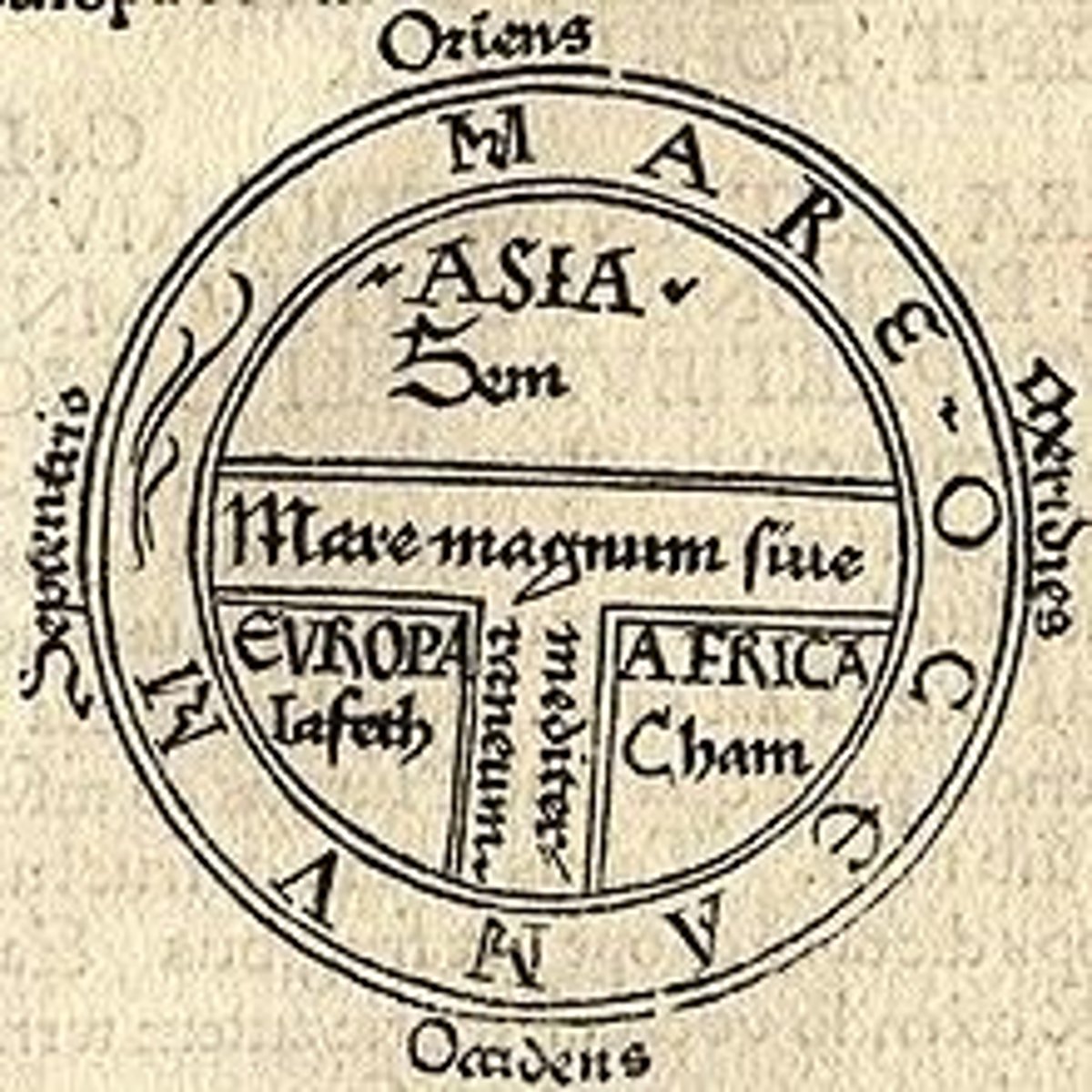
T-O world map
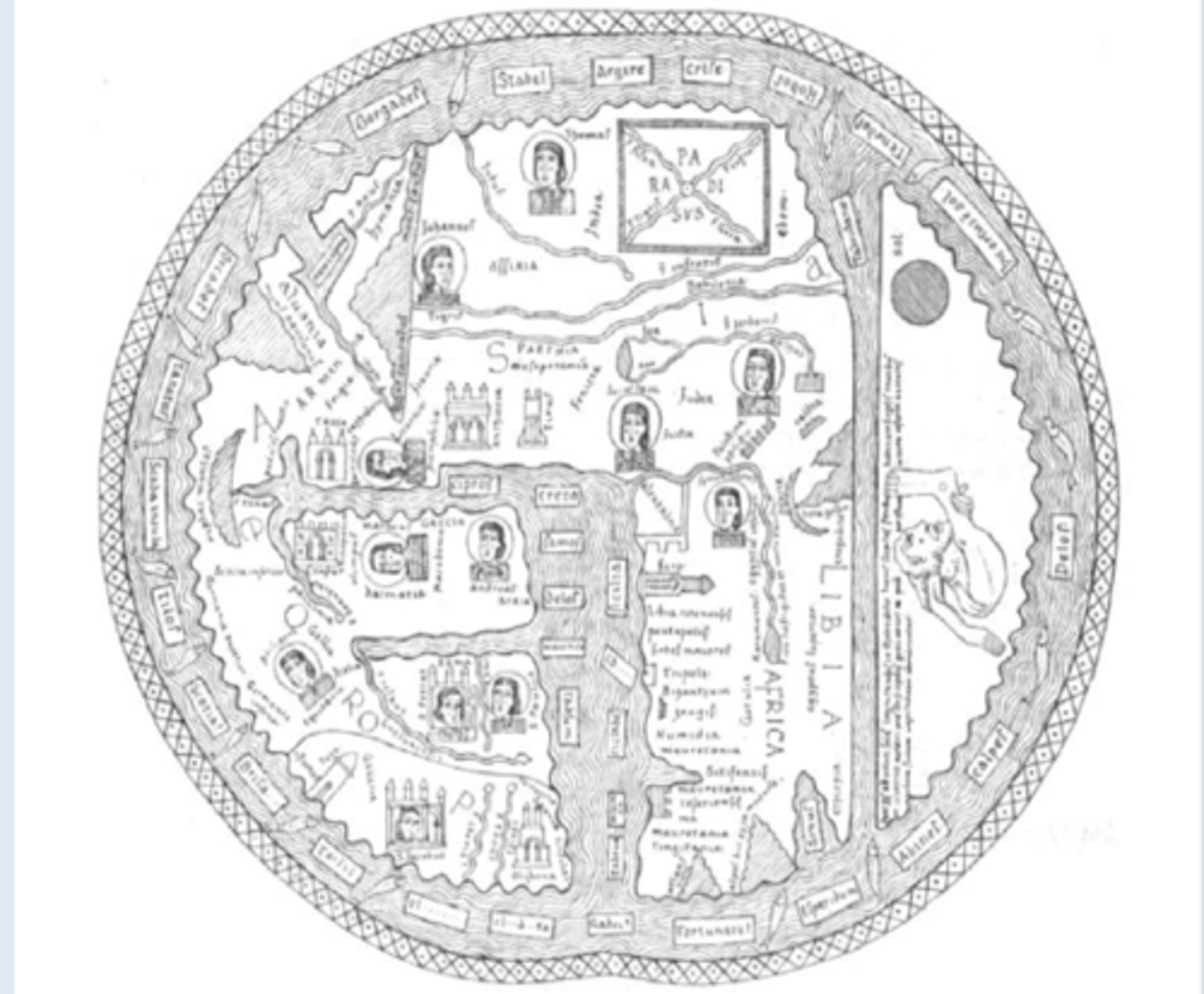
Osma Beatus World Map
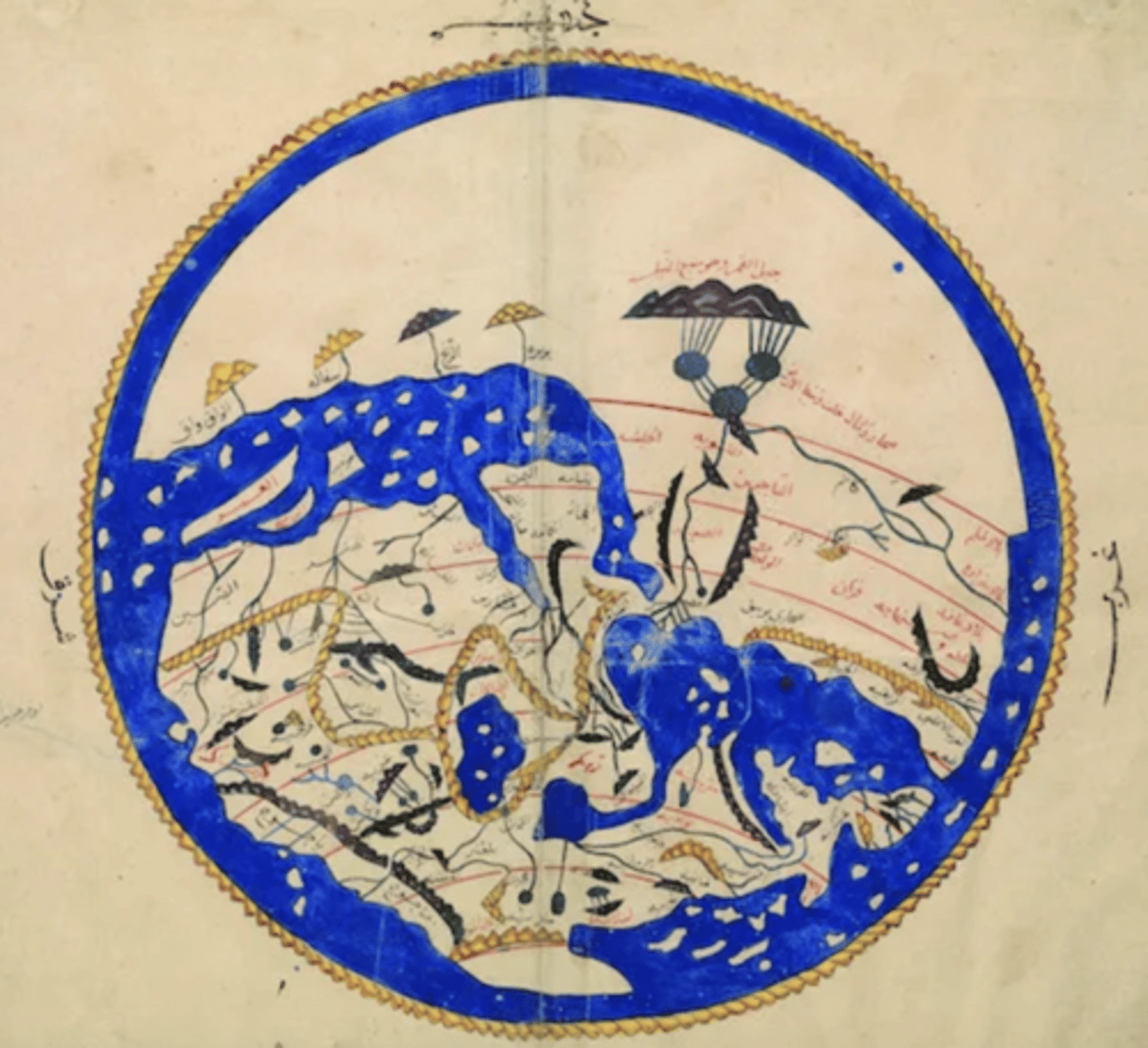
Al-Idrisi World Map
Black Death
- an extremely deadly bacterial disease that shocked Medieval Europe
- killed millions, inspired religious responses, and reconfigured social and economic life
similar to covid (although way more deadly and uncontrolled)
Black Death (Bubonic Plague)
• Bacterium Yersinia pestis
• Blood-born pathogen
• Originated in Central Asia / Western China
• Transmitted from rodents to fleas to humans
• 3 major strains
• All forms kill quickly (from a few hours to a few days)
Confirming Plague
• Scholars long debated the causes and origins of the plague
• Important advances in understanding came thanks to studies of plague outbreaks in China and India, 1890s-1900s
• Confirmation that Europe suffered from Y. pestis came in 2000s-2010s thanks to paleomicrobiology
o the study of ancient diseases by means of the recovery of pathogenic DNA
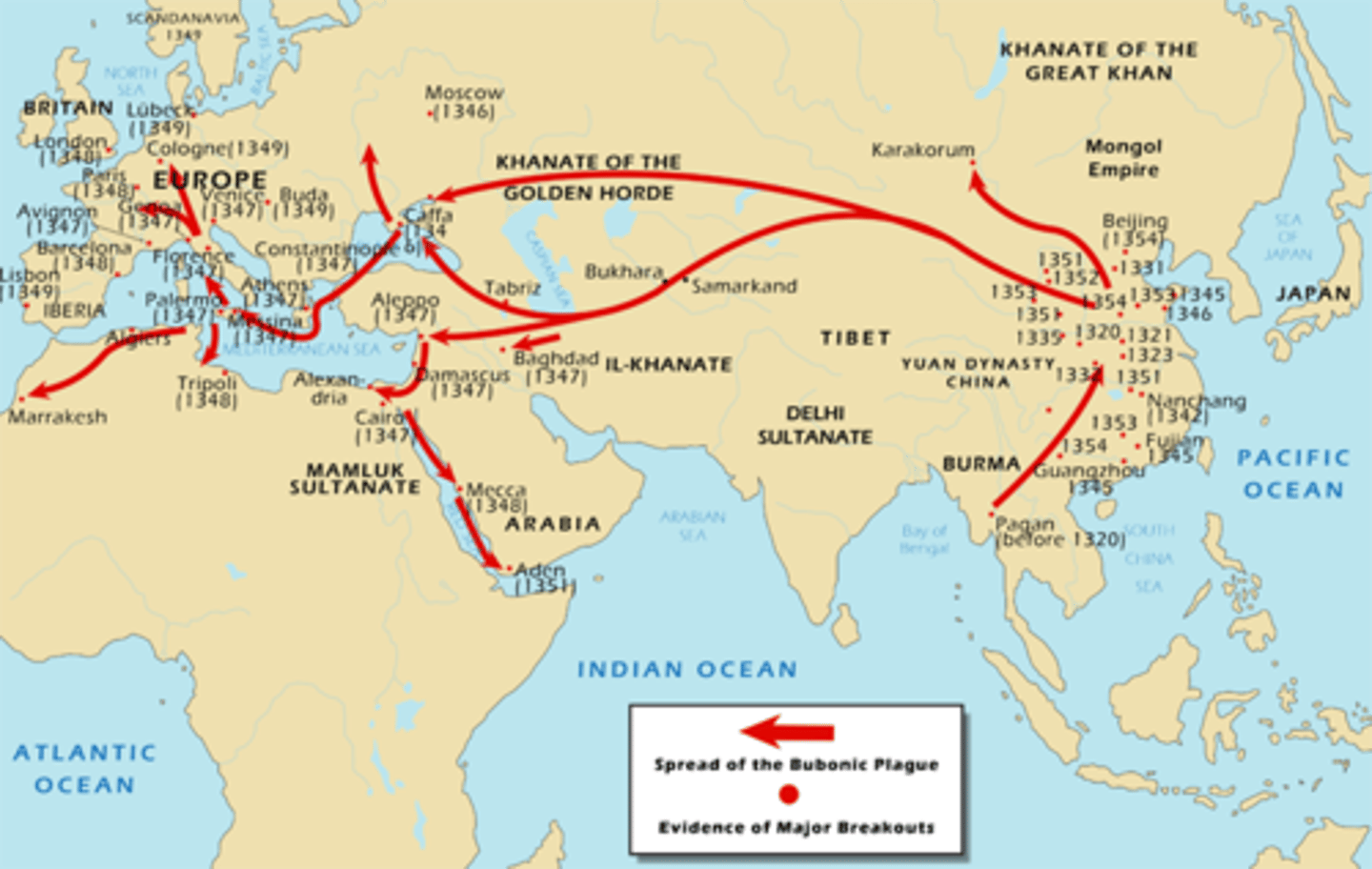
Spread of Black Death
• Likely origins in Central Asia / Western China
• Spread through Mongol Empire and Silk Road
• Spread extensively through rural areas because of the higher rat : human ratios there
• Spread through Europe facilitated by long-distance grain trade built over the 13th century
• Maps can help us visualize, but may distort the haphazard and multi-step processes of spread
Mortality (Black Death)
• Contemporary scholarship puts the overall average mortality around 50-60%
• Black Death claimed its most victims in Europe in 1347-53
• Subsequent outbreaks (1360s-1500) could be just as deadly
• It seems to have subsided for a number of reasons: improved responses and communication, improved rodent immunity
Environment (Black Death)
• Doctors sought environmental explanations for the plague
• Many focused on potential sources of miasma/"bad airs" (earthquakes, swamps)
• Seasonal variation was recognized (reflecting reduced rat activity in winter)
• Responses reflected the fear of "stenches": cleaning waste areas, use of wooden coffins
Medical Responses (Black Death)
• Medieval medicine understood disease as the result of miasmas ("bad airs") or poisons. Both theories applied to Black Death
• Doctors pinpointed swollen lymph nodes as a major symptom
• Recommended prevention was fleeing infected areas or bleeding
• Doctors knew their cures were ineffective. Suggestions varied from eating to sweating to bleeding
• Many doctors and others died giving care. The best care was hygiene
COVID-19
• Virus: Severe Acute Respiratory Syndrome Coronavirus 2 (SARS-CoV-2)
• Origins in China
• Global spread
• Mortality: 1.2 million+ in the US
• Treatments: medicines such as Paxlovid
• Vaccinations
Religious Responses (Black Death)
• Religion was a primary lens for viewing the plague
• Cult of St. Sebastian
• Medieval Christians sought church rites as part of their death
• Muslims had many similar experiences, but built on scholastic traditions that may have inhibited some from fleeing
• The decline in the priestly population and challenges in administering last rites may have fueled criticisms of the church eventually leading to the Protestant Reformation in the 15th century
Flagellant Movement (Black Death)
• Believed self-flagellation would appease God, prevent disease
• Popular around Germany, 1348-9
• Performed publicly in large groups
• "Red knights of Christ" or "Martyrs of the Devil"?
• Suppressed through 1349 papal bull
COVID Religiosity
• Rise in religious participation
• Religious institutions as centers of lockdown resistance
• Miracle "cures"
Social Issues (Black Death)
• Many feared abandonment as families fled the infected
• Nearly all feared being forgotten (surge in memorial paintings 1360s)
• The poor—laborers, farmers—suffered the most
COVID's Social Impacts
• Disproportionate impact on lower/laboring classes
• Social isolation
o Political radicalization (?)
• Huge educational setbacks
Economics (Black Death)
• Continual waves of plague over the 14th century severely decreased the labor pool and overall economic demand
• This enabled workers to attain higher wages as prices fell
• Some areas still saw "sticky" wages/prices
• The demographic shifts led toward the end of serfdom in Western Europe (but the rise of serfdom in Eastern Europe)
COVID-nomics
• Decreased/altered labor pool, decreased demand, clogged supply lines, governmental stimulus
• Rising wages, rising savings
• Bled into inflation
Conspiracies (Black Death)
• Seeking to blame someone—anyone—for the plague, Europeans turned to the marginalized
• Accusations of "poisoning" (spreading plague)
• Jews were the biggest target
• Poor beggars and vagabonds were also accused
• Hundreds were killed
COVID Conspiracies
• An "engineered" "bioweapon"
• A "planned" pandemic overseen by "global elites"
• "Herd immunity" is easy to achieve
• Vaccines kill more than they save
• Correlation with antisemitism
The papacy
- traced its origins to St. Peter and used that history to claim significant spiritual power in the church
- continually involved in efforts to exert its authority over religious and political affairs
Popes
saw their powers wax and wane, but generally developed centralized control over the parts of the church they controlled
St. Peter and the Early Church
• Jesus gave Peter the "keys to the kingdom of heaven"
• Peter established the "Apostolic succession" of the bishops of Rome
• This was especially important for putting down charismatic leaders and heretics in the 1st-2nd centuries
Imperial Embrace
• Constantine's conversion in 312 transformed the church from marginalized institution to state partner
• It also increased the rivalry between the sees (religious jurisdictions) of Rome and Constantinople
• The patriarchate of Constantinople (capital of the empire) sought to assert itself within church affairs
Papacy and the Late Roman Empire
• Even as the western Roman Empire crumbled, the popes asserted themselves as leaders of a spiritual empire defined by "one tradition, one discipline"
• Loyal subjects of Eastern Rome, popes styled themselves the "sacred authority" that ruled even over the "august emperor," signaling a key tension for centuries to come
• This was shown by Martin I'srejection of Monotheletism in 649 and Gregory III's excommunication of iconoclasts in 731
Papal Monarchy
• It is during this early medieval period that centralized, monarchical power began to characterize the papacy in Rome
• This unitary, sweeping authority would persist as a major component of the papacy, even as clerics and secular rulers would regularly challenge it
Patriarchs of the East
• Many Christians remained under the jurisdiction of the ancient patriarchs of the East
• Antioch: founded by Peter
• Alexandria: founded by Mark
• Constantinople: the self-styled "universal patriarch" from the 500s
• Jerusalem: recognized as a patriarchate in 451
Church and State Reordered
• Pope Stephen II established a monumental new relationship with the Carolingian Dynasty (France) from 754
• The papacy gained a new political and military ally, the Franksgained a spiritual leader
• Again trying to claim broad leadership over Christians, the papacy embraced the forged Donation of Constantine, which pressed the case that Rome had "supremacy" over the Eastern sees and "all the churches of God in the whole world"
Church and State Reordered
• As the Carolingian Empire declined in the 9th century, the papacy had to address practical and political challenges on its own
• Cardinals (leading bishops) emerged as a vital source of support
• Papal attempts to interfere in succession issues in Constantinople spurred a war of anathematizing, 860s-70s
Beginnings of a Reform Movement
• Papal leaders displayed the sins, ambitions, and nepotism of church and state leaders in the 9-10th centuries, diminishing Rome's standing
• Seeking to restore the papacy's image in Europe, Pope Leo IX (1049-54) led a series of synods targeting clerical corruption and violations of marriage rules among the laity
West-East Divisions
• Long-simmering tensions between Rome and Constantinople erupted in 1054, when disputes over the Eucharist, clerical marriage, and the filioque led to mutual excommunications
• Though peace was restored, the rifts would deepen with time
o This is often seen as the roots of Catholic-Orthodox divisions
Investiture Conflict
• Pope Gregory VII (1073-84) warred with German/Holy Roman Emperor Henry IV over the right to invest bishops in their offices
• Initially, Gregory won the PR campaign
• But exhausted nobles came to side with Henry and his antipope in the 1080s
• A rough agreement was made through the 1122Concordat of Worms, which affirmed Rome's right to invest bishops while ensuring German rulers would get oaths of allegiance from bishops
Crusades
• The efforts to "liberate" Jerusalem from Muslim rule weaved together the piety and power driving papal reforms over the 11-12th centuries
• Likewise, they had unintended consequences just as other reform efforts did
o Soldiers of the Fourth Crusade sacked Constantinople
Twelfth-century Growth and Challenges
• The machinery of the papacy further developed, allowing it to increase its income and expand its reach
o Chamber (finances), chancery (documents), chapel (liturgical duties)
• Various councils and decrees used this moment to affirm Rome's primacy over the church and the world
• However, the disappointing Second Crusade and conflicts with Frederick I of Germany showed the limitations of papal power and influence
Governing the World
• Seizing on a moment of papal preeminence, Rome doubled-down on its claims to power
• Pope Innocent III (1198-1216) called himself the "Vicar of Christ," who governed the church and the "whole world"
• Popes embraced these titles when eradicating "heresy" in Europe via the Inquisition
• Popes also sent Franciscans to missionize in Africa and Asia
14th-century Crises
• Efforts to check Frederick II left Rome drained by the early 14th century
• Various areas of the church were internally divided
o Franciscans
o Appointment of bishops
14th-century Crises
• Pope Clement V moved the papacy to Avignon, France, in 1309 and it remained there until 1376
• The papal "captivity" in "Babylon" significantly undercut its standing
The Great Schism (1378-1417)
when dueling popes presided at Avignon and Rome, further underscored the turbulence within the church
15th-century Restoration
• Following the many internal crises of the previous century, popes sought to secure their power and right the church in the 15th
• Martin V (1417-31) began this process by stabilizing relations with secular rulers, working to push back the conciliar movement, and ensuring papal control in Italy
• His successors largely continued those efforts
Renaissance
a rebirth or revival
 Note
Note  Flashcards (50)