CT exam 2
 Call Kai
 Learn
Learn Practice Test
 Spaced Repetition
 Match
Match Flashcards
 Knowt Play
1/38

There's no tags or description
Looks like no tags are added yet.
Name | Mastery | Learn | Test | Matching | Spaced | Call with Kai |
|---|
No analytics yet
Send a link to your students to track their progress
39 Terms
communication barriers seen in a healthcare setting
misreading body language, language, preconceptions, cultural differences, receiver distortion
What type of info does BUN lab test provide before a CT exam?
Provides info about kidney function (important for patients receiving IV contrast)
What type of info does PT, PTT, and platelet count lab tests provide before a CT exam?
Provides info about blood's coagulation ability (important in exams that carry risk for excessive bleeding)
True or False: Consent is always needed prior to a CT exam.
True
When do technologists start monitoring vital signs of patients scheduled for CT exams?
upon initial contact
What vital signs do we look at when assessing patients schedule for CT exam?
pulse, BP, body temp, respiration, pain, pupil size, O2
True or False: Contrast media is metabolized by the human body.
False
True or False: It is possible to overdose with contrast media.
True
True or False: Contrast media can NOT be administered to pregnant or breast feeding patients.
False
True or False: Acute reactions to contrast media can be mild, moderate, or severe.
True
What is the best way we estimate renal function?
Glomerular filtration rate
Effective renal plasma flow
What volume of urine is produced when a patient is said to be "nonoliguric"?
500-6,000mL in 24hrs
True or False: It is acceptable to give patients on temporary dialysis contrast media.
false
True or False: It is acceptable to give patients on permanent dialysis contrast media.
true
What should you do if you suspect a perforation of the GI tract for a patient who is supposed to receive barium sulfate contrast?
Do not administer the contrast
Substitute barium sulfate with water-soluble iodinated contrast
Which of the following are types of contrast administration methods?
intraarticular injection
Ingestion
Intrathecal injection
IV injection
True or False: The use of metal needles should be avoided in conjunction with a mechanical "power" injection.
True
Which of the following are needed when documenting IV contrast administration?
Adverse reactions
Name of contrast agent
Contrast volume and concentration
Injection site
Flow rate(s)
Which factors affect contrast enhancement?
patient factors, equipment factors, and pharmokinetic factors
True or False: PICC lines must be flushed with heparinized saline to maintain patency.
true
True or False: Closed-end catheters lines must be flushed with heparinized saline to maintain patency.
false
all of the supplies needed for starting a peripheral IV line.
Tape
Plastic cath & hub w/ beveled needle
Sterile gauze
Disposable gloves
Antiseptic swab or applicator
Saline flush
tourniquet
Bolus phase
immediately following IV bolus injection
non-equilibrium phase
1 min after starting bolus injection and lasting a short time
equilibrium phase
as early as 2 min after bolus injection
Which of the following are exceptions to having peak organ enhancement occurring 5-15 seconds after peak aortic enhancement?
brain, kidneys, liver
True or False: It is important to ensure the injection lines are primed after hooking up the power injection system to the patient.
false
Arrival time of contrast media can be described as which of the following?
When contrast is likely to first be present in an organ or vessel
Advantage of drip infusion
inexpensive
advantage of hand bolus
increased flow rate and can be used with all PICCs and CVADs
advantage of the machine injection system
consistent images/reproducible, precise flow rates and volumes, and programmable for uniphasic, biphasic or multiphasic injection protocols.
Is the dose more uniform in general radiography or CT?
CT
True or False: Total dose is impacted by the amount of scatter.
True
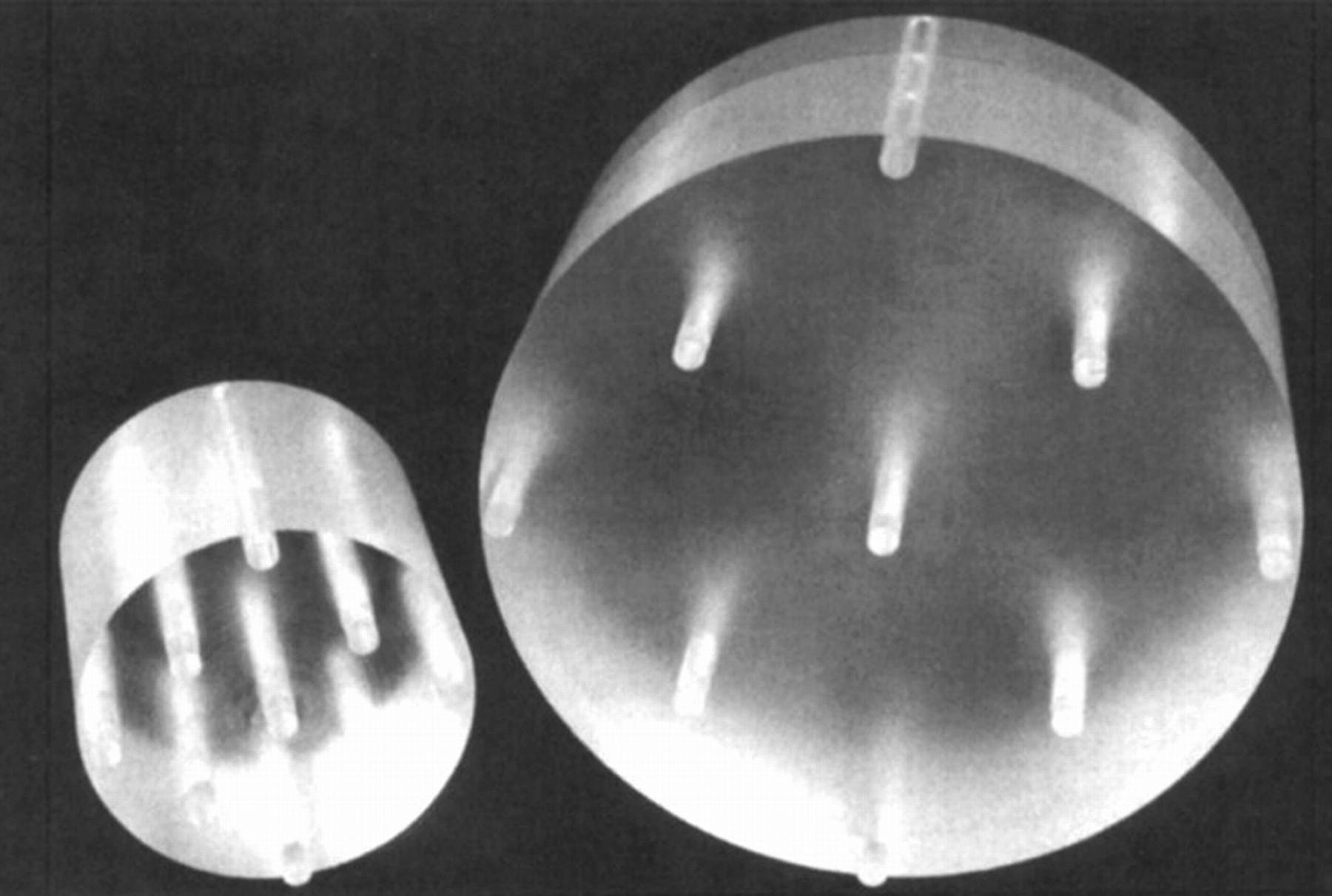
This is a CT QC phantom that helps to quantify MSAD. What is it made out of?
Plastic
Select the factors that affect radiation dose from CT.
Radiographic technique
Localization scans
Pitch
Slice width and spacing
Scan field diameter
Patient size and body part thickness
Radiation beam geometry
Collimation
Repeat Scans
Filtration
Detector efficiency
_________ can occur due to radiation exposure.
cancer, detrimental short-term effects, and detrimental long-term effects
On a single-row detector scanner, if CT slices overlap:
MSAD > CTDI
If we increase _______, we would reduce the dose to the patient, assuming all other parameters and variables are held constant.
Pitch
True or False: Pediatric patients have lower effective dose than adult patients due to their smaller size.
False
Explore top notes

