2.4.1 NATIONAL INCOME
 Studied by 0 people
 Call Kai
 Learn
Learn Practice Test
 Spaced Repetition
 Match
Match Flashcards
 Knowt Play
1/37

There's no tags or description
Looks like no tags are added yet.
Name | Mastery | Learn | Test | Matching | Spaced | Call with Kai |
|---|
No analytics yet
Send a link to your students to track their progress
38 Terms
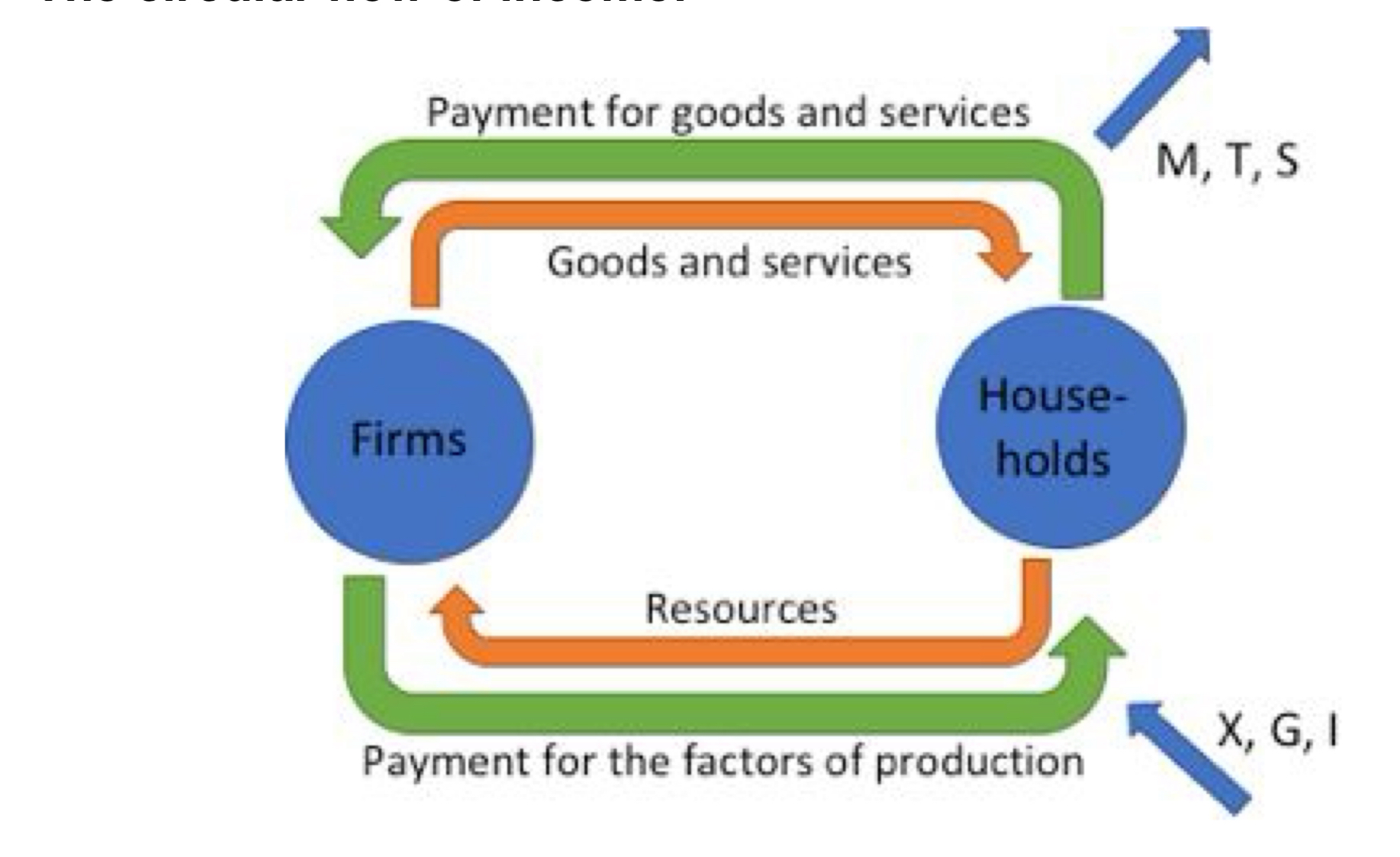
What is the circular flow of income?
A model showing how money, resources, and goods/services move between households and firms in an economy.
What are the 2 main agents in the basic circular flow model?
Households and firms.
What do households provide in the circular flow model?
Factors of production — labour, land, capital, and enterprise.
What do firms provide in the circular flow model?
Goods and services to households.
What payments flow from firms to households?
Factor incomes — wages, rent, interest, and profit.
What payments flow from households to firms?
Consumption spending on goods and services.
What are factor incomes?
Income earned from supplying factors of production: wages, rent, interest, and profit.
What are injections in the circular flow?
Additions to the economy’s income stream — investment (I), government spending (G), and exports (X).
What are withdrawals (leakages) in the circular flow?
Removals from the income stream — savings (S), taxes (T), and imports (M).
What happens when injections equal withdrawals?
National income is in equilibrium and remains stable.
What happens when injections are greater than withdrawals?
National income increases.
What happens when withdrawals are greater than injections?
National income decreases.
What is investment (I) in the circular flow?
Spending by firms on capital goods such as machinery, factories, and technology.
What is saving (S) in the circular flow?
Income not spent on consumption by households.
What are taxes (T) in the circular flow?
Payments to government that reduce household and firm spending power.
What is government spending (G) in the circular flow?
Government expenditure on goods, services, and public projects.
What are exports (X)?
Goods and services sold to other countries — money flows into the economy.
What are imports (M)?
Goods and services bought from other countries — money flows out of the economy.
What is the 5-sector circular flow model?
A model including households, firms, government, financial sector, and foreign sector.
Why is the circular flow model important?
It shows how income is generated and distributed and how changes affect national income.
How does increased saving affect the circular flow?
It increases withdrawals and may reduce national income unless matched by investment (I).
How does increased government spending affect the circular flow?
It acts as an injection and increases national income.
How do exports (X) affect the circular flow?
They inject money and increase national income.
How do imports (M) affect the circular flow?
They withdraw money and reduce national income.
What is income in economics?
A flow of earnings received over a period of time.
Give examples of income.
Wages, salaries, rent, interest, dividends, profit, and transfer payments.
What is wealth in economics?
A stock of assets owned at a point in time.
Give examples of wealth.
Property, shares, savings, land, businesses, and valuable possessions.
What is the key difference between income and wealth?
Income is a flow over time; wealth is a stock at a moment in time.
Is income measured per period or at a point in time?
Per period of time (e.g., per year).
Is wealth measured per period or at a point in time?
At a specific point in time.
Can wealth generate income?
Yes — assets like property or shares can produce rent, dividends, or interest.
Can someone have high income but low wealth?
Yes — if they earn a lot but save little or have few assets.
Can someone have high wealth but low income?
Yes — if they own valuable assets but earn little regular income.
What is an example of wealth generating income?
Owning a rental property that produces rental income.
Why is the income vs wealth distinction important in economics?
Because inequality can exist in both income distribution and wealth distribution.
Which is usually more unequal — income or wealth distribution?
Wealth distribution is usually more unequal.
Does national income measure wealth?
No — it measures the flow of income generated in an economy over a period.
 Note
Note  Flashcards (20)