Lecture 3 -- Feline Coronaviruses and Feline Infectious Peritonitis
 Call Kai
 Learn
Learn Practice Test
 Spaced Repetition
 Match
Match Flashcards
 Knowt Play
1/20

Earn XP
Description and Tags
These flashcards cover key concepts about Feline coronaviruses, particularly FIP, as outlined in the lecture notes.
Name | Mastery | Learn | Test | Matching | Spaced | Call with Kai |
|---|
No analytics yet
Send a link to your students to track their progress
21 Terms
What are the two types of Feline coronavirus biotypes?
Feline enteric coronavirus (FECoV)
Mild or subclinical
Only infect enterocytes
Feline infectious peritonitis virus (FIPV)
Mutated form of FECoV
Infect enterocytes and macrophages → Case systemic disease
What virus FECoV and FIP caused by?
An feline coronavirus, alpha coronavirus
NO direct link to human COVID-19, which is caused by beta coronavirus
What are key structural features of feline coronaviruses?
Obligate intracellular parasites: Require a host cell to replicate
Enveloped RNA virus:
RNA genome: Prone to mutations
RNA polymerase has no proofreading
Unlike retrovirues, it does not make provirus (DNA copy) in the host genome
Lipid envelope
Susceptible to soap and alcohol-based disinfectants → Fragile and short-lived in the environment
Surface proteins
Give the virus a crown like appearance (hence the name coronavirus)
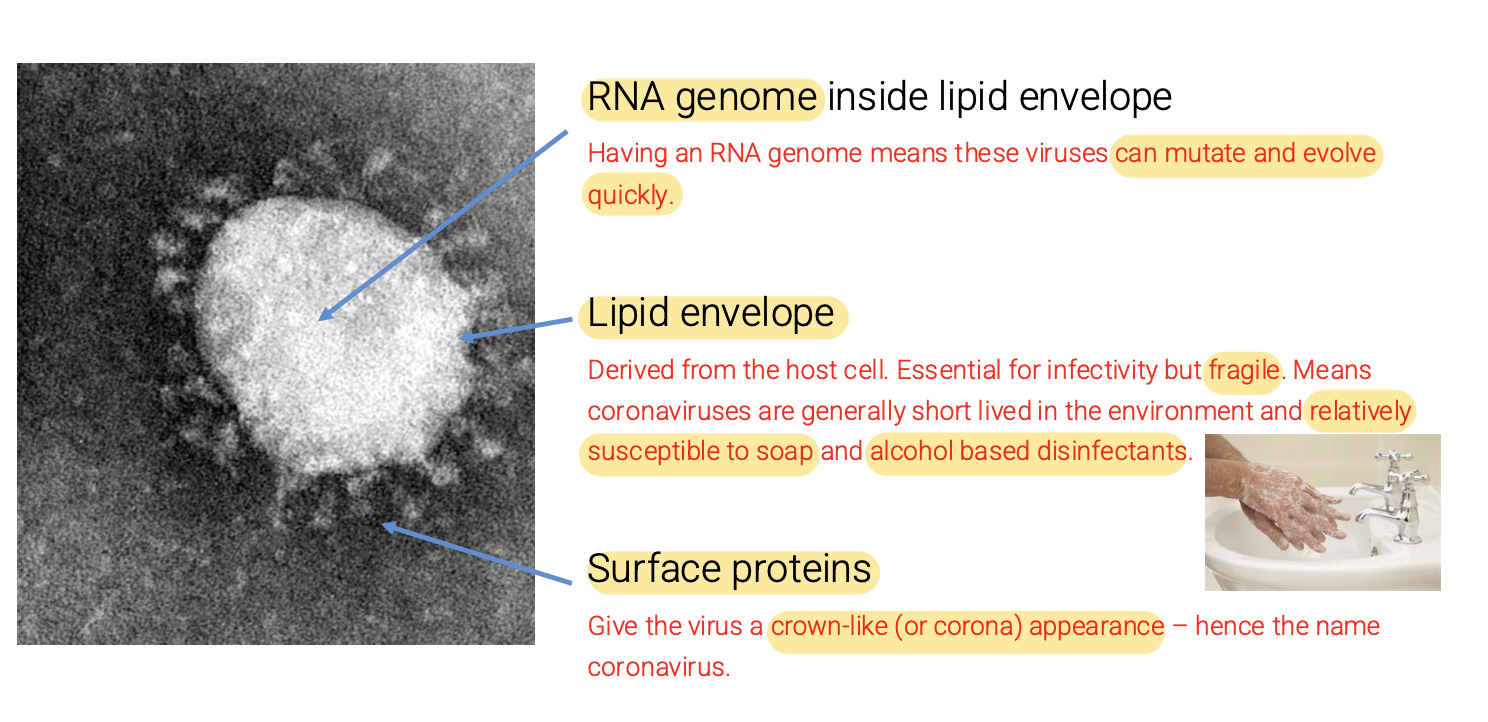
What are the key differences between retroviruses and coronaviruses, given that both are RNA viruses?
Retroviruses:
Single-stranded RNA
Use reverse transcriptase to covert their RNA genome into DNA (= Provirus)
Envelope with glycoproteins for entering the host cell (BUT not crown-like)
Coronaviruses:
Single-stranded RNA
RNA genome remains RNA
Use RNA polymerase for replication
NO Provirus (DNA)
Large spike glycoproteins, forming a crown-like appearance
Which groups of cats are at highest risk for FIP?
Young kittens (immature immune system)
Cats kept in groups e.g. rescue shelters
How is FCoV transmitted?
Mainly via faeco-oral route
Shed in faeces and saliva → Infected by ingestion of virus
Trans-placental spread is possible
NOT respiratory transmission like COVID-19
Can FIP itself be transmitted between cats?
No FIP is not directly contagious.
Controlling FIP requires preventing FeCoV infection, not FIP itself.
Are FIP or FECoV zoonotic?
No
What is the pathogenesis of FCoV (How does FIP develop from FCoV) ?
Cats infected with FECoV shed the virus in their faeces
Other cats get infected via faeco-oral route → High prevalence of endemic FECoV → Mutation of FECoV to FIP
Antibody binds to FIP antigen → Opsonisation → Enhance uptake by macrophages
Instead of acting as a phagocyte, macrophages are the main host of FIP = Macrophages facilitate FIV replication and systemic spread
FIV enter the systemic circulation
Outcome depends on immune response:
Good cell-mediated immunity: Recovery
Partial cell-mediated immunity: Dry FIP
Poor cell-mediated immunity: Wet FIP
What are the major clinical signs of FIP?
Wet FIP
Virus antigen antibody complement complexes deposit in walls of small blood vessels → Vasculitis → Makes blood vessels leaky → Fluid accumulates in body cavities
Symptoms depends on which body cavity is affected
Dyspnea
Ascites
Muffling of heart sounds
Other clinical signs:
Fluctuating fever
Inappetence + Weight loss
Jaundice
Dry FIP
Immune-mediated lesions in organs
Signs dependant on organ involved
Eyes: Ocular changes e.g. iritis, uveitis
Abdominal organs: Jaundice
CNS: Paresis (Muscle weakness), Ataxia (Inability to control muscle movement), behavioural changes
What is the gold standard for definitive FIP diagnosis?
Histopathology of granulomatous lesions associated with vasculitis.
Obtained via exploratory laparotomy or tissue biopsy
What is the stepwise approach to diagnosing FIP in cats?
Step 1: Clinical signs and history evaluation
Young cats?
In muticat environments e.g. shelter?
Consistent signs e.g. fluctuating fever, jaundice, ocular signs
Step 2: Blood test (CBC, biochemistry) + Rule out other diseases (Retrovirus e.g. FeLV and FIV)
CBC:
Mild anemia
Neutrophila
Lymphopenia
Biochemistry:
Hyperproteinaemia (because of increased globulin)
Low albumin to globulin ratio
Increased liver enzymes
Increase bilirubin
Azotemia
Step 3: Supportive diagnostic tests
Wet FIP:
Imaging: X-ray or ultrasound to detect effusions or organ changes
Aspiration: High protein, low cellularity of FIP fluid
Dry FIP
Histopathology: Granulomatous lesions with vasculitis (Gold standard)
Aspiration: Even dry FIP can have small amount of fluid accumulation
Step 4: Confirmatory testing
RT-PCR to detect FCoV virus
What are typical haematology and blood biochemistry findings in FIP?
Neutrophilia
Lymphopaenia
Mild non-regenerative anaemia
Hyperproteinaemia due to raised globulins (antibodies)
Decreased albumin/globulin ratio (because of increased globulin)
Other parameter changes depending on the organ that is affected (FIP may affect kidney and liver):
↑ liver enzymes (ALT in dogs; GLDH in large animal), bilirubin, urea
What are characteristic features of FIP fluid?
Viscous, straw-colored
High protein content (IgG > IgA)
Froths 奶泡 when shaken
Forms clots on standing because of high protein
What is Rivalta’s test?
Put a drop of FIP fluid into dilute vinegar, it forms a stable clot → That clot then gradually sinks through that fluid
P.S. Other fluid would just dissolve into solution
How does immunofluorescence (IF) testing for FCoV/FIP work?
Test for ANTIBODY
Lab cells are deliberately infected with FCoV = Contain viral antigens
Cat serum is added
If the cat is infected with FCoV = Antibodies to FCoV are present, they bind to the viral antigens in the lab cells
Fluorescein-labeled anti-cat antibody is added → Binds the cat antibodies → Fluorescence is visualised under a microscope.
To quantify antibody levels, the serum is serially diluted → Fluorescence disappears when the antibodies are too few to bind enough viral antigen to produce a visible signal
Low antibody titres (Fluorescence disappears at lower dilutions) = FECoV exposure
High antibody titres (Fluorescence may still exist even at high dilutions) = FIP exposure
What are the uses of immunofluorescence (IF) testing in FIP, apart from quantifying antibodies?
FCoV antigen inside macrophages can be stained and visualised under a microscope, supporting the diagnosis of FIP
P.S. Helps support diagnosis but not definitive.
Can feline coronavirus serology e.g. IF, ELISA or PCR distinguish FIP or FECoV?
No
Antibody positivity can only indicates they were infected with alphacoronavirus
BUT does not distinguish whether the cat has FECoV or FIP
Is there an effective treatment for FIP?
Historically, no effective treatment
Interferon and steroids:
There was a study suggested they might be useful in treating FIP
BUT discredited because at that time, there was no way of diagnosing FIP → Other researchers believed that the ones that survived in that study probably didn’t have FIP
Remdesivir / GS-441524:
Nucleoside analogue
Developed after COVOID
Cure rates 80–100% if treated ≥12 week
Available in Australia and the UK
Expensive
Is there a FIP vaccine?
Licensed in the USA, not in the UK
Highly controversial due to antibody dependant enhancement = Vaccination can worsen the disease
75-100% of cats from breeding households seropositive. How can FIP be controlled in endemically infected households?
Prevent kitten infection:
Isolate queens 1–2 weeks prepartum
Early weaning of kittens
Confirm kittens are seronegative from 10 weeks
Hygiene: adequate litter trays, cleaning, reducing viral load
Population management:
Reduce numbers of cats and kittens

