Intro to Molecular Cell Bio Exam 2
 Call Kai
 Learn
Learn Practice Test
 Spaced Repetition
 Match
Match Flashcards
 Knowt Play
1/136

There's no tags or description
Looks like no tags are added yet.
Name | Mastery | Learn | Test | Matching | Spaced | Call with Kai |
|---|
No analytics yet
Send a link to your students to track their progress
137 Terms
c
A neuron and a white blood cell have very different functions. For example, a neuron can receive and respond to electrical signals while a white blood cell defends the body against infection. This is because ______.
(a) the proteins found in a neuron are completely different from the proteins found in a white blood cell.
(b) the neuron and the white blood cell within an individual have the same genome.
(c) the neuron expresses some mRNAs that the white blood cell does not.
(d) neurons and white blood cells are differentiated cells and thus no longer need to transcribe and translate genes.
b
The distinct characteristics of different cell types in a multicellular organism result mainly from the differential regulation of the _________________.
(a) replication of specific genes.
(b) transcription of genes transcribed by RNA polymerase II.
(c) transcription of housekeeping genes.
(d) proteins that directly bind the TATA box of eukaryotic genes.
c
The human genome encodes about 21,000 protein-coding genes. Approximately how many such genes does the typical differentiated human cell express at any one time?
(a) 21,000—all of them
(b) between 18,900 and 21,000—at least 90% of the genes
(c) between 5000 and 15,000
(d) less than 2100
d
Which of the following is not a good example of a housekeeping protein?
(a) DNA repair enzymes
(b) histones
(c) ATP synthase
(d) hemoglobin
d
Which of the following statements about differentiated cells is true?
(a) Cells of distinct types express nonoverlapping sets of transcription factors.
(b) Once a cell has differentiated, it can no longer change its gene expression.
(c) Once a cell has differentiated, it will no longer need to transcribe RNA.
(d) Some of the proteins found in differentiated cells are found in all cells of a multicellular organism.
b
Investigators performed nuclear transplant experiments to determine whether DNA is altered irreversibly during development. Which of the following statements about these experiments is true?
(a) Because the donor nucleus is taken from an adult animal, the chromosomes from the nucleus must undergo recombination with the DNA in the egg for successful development to occur.
(b) The embryo that develops from the nuclear transplant experiment is genetically identical to the donor of the nucleus.
(c) The meiotic spindle of the egg must interact with the chromosomes of the injected nuclei for successful nuclear transplantation to occur.
(d) Although nuclear transplantation has been successful in producing embryos in some mammals with the use of foster mothers, evidence of DNA alterations during differentiation has not been obtained for plants.
B, C
Which of these method(s) of controlling eukaryotic gene expression is NOT employed in prokaryotic cells?
A. controlling how often a gene is transcribed
B. controlling how an RNA transcript is spliced
C. controlling which mRNAs are exported from the nucleus to the cytosol
D. controlling which mRNAs are translated into protein by the ribosomes
E. controlling how rapidly proteins are destroyed once they are made
a
Which of the following statements about transcriptional regulators is false?
(a) Transcriptional regulators usually interact with the sugar-phosphate backbone on the outside of the double helix to determine where to bind on the DNA helix.
(b) Transcriptional regulators will form hydrogen bonds, ionic bonds, and hydrophobic interactions with DNA.
(c) The DNA-binding motifs of transcriptional regulators usually bind in the major groove of the DNA helix.
(d) The binding of transcriptional regulators generally does not disrupt the hydrogen bonds that hold the double helix together.
c
Operons ___________________________.
(a) are commonly found in eukaryotic cells.
(b) are transcribed by RNA polymerase II.
(c) contain a cluster of genes transcribed as a single mRNA.
(d) can only be regulated by gene activator proteins.
b
The tryptophan operator ___________________________.
(a) is an allosteric protein.
(b) binds to the tryptophan repressor when the repressor is bound to tryptophan.
(c) is required for production of the mRNA encoded by the tryptophan operon.
(d) is important for the production of the tryptophan repressor.
a
Which of the following statements about the Lac operon is false?
(a) The Lac repressor binds when lactose is present in the cell.
(b) Even when the CAP activator is bound to DNA, if lactose is not present, the Lac operon will not be transcribed.
(c) The CAP activator can only bind DNA when it is bound to cAMP.
(d) The Lac operon only produces RNA when lactose is present and glucose is absent.
b
What do you predict would happen if you replace the Lac operator DNA from the Lac operon with the DNA from the operator region from the tryptophan operon?
(a) The presence of lactose will not cause allosteric changes to the Lac repressor.
(b) The Lac operon will not be transcribed when tryptophan levels are high.
(c) The lack of glucose will no longer allow CAP binding to the DNA.
(d) RNA polymerase will only bind to the Lac promoter when lactose is present.
a
You are interested in examining the regulation of the gene that encodes an enzyme, Tre-ase, important in metabolizing trehalose into glucose in bacteria. Trehalose is a disaccharide formed of two glucose units. It is known that two DNA-binding proteins, TreA and TreB, are important for binding to the promoter of the Tre-ase gene and are involved in regulating the transcription of the Tre-ase gene: TreA binds to the "A" site in the promoter region, and TreB binds to the "B" site. You make mutations in the TreA and TreB genes to create cells lacking these genes, observe what happens to transcription of the Tre-ase gene, and obtain the results in Table Q8-16.
b
How are most eukaryotic transcription regulators able to affect transcription when their binding sites are far from the promoter?
(a) by binding to their binding site and sliding to the site of RNA polymerase assembly
(b) by looping out the intervening DNA between their binding site and the promoter
(c) by unwinding the DNA between their binding site and the promoter
(d) by attracting RNA polymerase and modifying it before it can bind to the promoter
c
Which of the following statements about nucleosomes is true?
(a) Nucleosomes activate transcription when bound to the promoter.
(b) Although RNA polymerase can access DNA packed within nucleosomes, the general transcription factors and transcriptional regulators cannot.
(c) Histone acetyltransferases affect transcription by both altering chromatin structure to allow accessibility to the DNA and by adding acetyl groups to histones that can bind proteins that promote transcription.
(d) Histone deacetylases remove lysines from histone tails.
c
In principle, how many different cell types can an organism having four different types of transcription regulator and thousands of genes create?
(a) up to 4
(b) up to 8
(c) up to 16
(d) thousands
b
Combinatorial control of gene expression __________________________.
(a) involves every gene using a different combination of transcriptional regulators for its proper expression.
(b) involves groups of transcriptional regulators working together to determine the expression of a gene.
(c) involves only the use of gene activators used together to regulate genes appropriately.
(d) is seen only when genes are arranged in operons.
a
You are studying a set of mouse genes whose expression increases when cells are exposed to the hormone cortisol, and you believe that the same cortisol-responsive transcriptional activator regulates all of these genes. Which of the following statements below should be true if your hypothesis is correct?
(a) The cortisol-responsive genes share a DNA sequence in their regulatory regions that binds the cortisol-responsive transcriptional activator.
(b) The cortisol-responsive genes must all be in an operon.
(c) The transcriptional regulators that bind to the regulatory regions of the cortisol-responsive genes must all be the same.
(d) The cortisol-responsive genes must not be transcribed in response to other hormones.
b
Which of the following statements about iPS cells is false?
(a) iPS cells are created by adding a combination of transcription regulators to a fibroblast.
(b) iPS cells created from mouse cells can differentiate into almost any human cell type.
(c) Stimulation by extracellular signal molecules causes iPS cells to differentiate.
(d) During the de-differentiation process to become an iPS, the fibroblast will undergo changes to its gene expression profile.
c
Which of the following statements about how fruit flies can develop an eye in the middle of a leg is true?
(a) When the Ey gene is expressed in adult leg cells, these cells de-differentiate and become eye cells.
(b) The Ey gene encodes a transcription regulator that is the only transcription regulator used to produce a fruit-fly eye.
(c) When the Ey gene is introduced into cells that would normally give rise to a leg, the transcription regulators used to control its expression in the leg are different from those that are normally used to control Ey expression in the eye.
(d) All the eye cells found in the adult leg are a single cell type and have identical characteristics.
b
Which of the following statements about the Ey transcriptional regulator is false?
(a) Expression of Ey in cells that normally form legs in the fly will lead to the formation of an eye in the middle of the legs.
(b) The Ey transcription factor must bind to the promoter of every eye-specific gene in the fly.
(c) Positive feedback loops ensure that Ey expression remains switched on in the developing eye.
(d) A homolog of Ey is found in vertebrates; this homolog is also used during eye development.
c
The MyoD transcriptional regulator is normally found in differentiating muscle cells and participates in the transcription of genes that produce muscle-specific proteins, such as those needed in contractile tissue. Amazingly, expression of MyoD in fibroblasts causes these cells derived from skin connective tissue to produce proteins normally only seen in muscles. However, some other cell types do not transcribe muscle-specific genes when MyoD is expressed in them. Which of the following statements below is the best explanation of why MyoD can cause fibroblasts to express muscle-specific genes?
(a) Unlike some other cell types, fibroblasts have not lost the muscle-specific genes from their genome.
(b) The muscle-specific genes must be in heterochromatin in fibroblasts.
(c) During their developmental history, fibroblasts have accumulated some transcriptional regulators in common with differentiating muscle cells.
(d) The presence of MyoD is sufficient to activate the transcription of muscle-specific genes in all cell types.
a
In mammals, individuals with two X chromosomes are female, and individuals with an X and a Y chromosome are male. It had long been known that a gene located on the Y chromosome was sufficient to induce the gonads to form testes, which is the main male-determining factor in development, and researchers sought the product of this gene, the so-called testes-determining factor (TDF). For several years, the TDF was incorrectly thought to be a zinc finger protein encoded by a gene called BoY. Which of the following observations would most strongly suggest that BoY might not be the TDF? Explain your answer.
(a) Some XY individuals that develop into females have mutations in a different gene, SRY, but are normal at BoY.
(b) BoY is not expressed in the adult male testes.
(c) Expression of BoY in adult females does not masculinize them.
(d) A few of the genes that are known to be expressed only in the testes have binding sites for the BoY protein in their upstream regulatory sequences, but most do not.
d
Which of the following is not a general mechanism that cells use to maintain stable patterns of gene expression as cells divide?
(a) a positive feedback loop, mediated by a transcriptional regulator that activates transcription of its own gene in addition to other cell-type-specific genes
(b) faithful propagation of condensed chromatin structures as cells divide
(c) inheritance of DNA methylation patterns when cells divide
(d) proper segregation of housekeeping proteins when cells divide
d
Which of the following statements about DNA methylation in eukaryotes is false?
(a) Appropriate inheritance of DNA methylation patterns involves maintenance methyltransferase.
(b) DNA methylation involves a covalent modification of cytosine bases.
(c) Methylation of DNA attracts proteins that block gene expression.
(d) Immediately after DNA replication, each daughter helix contains one methylated DNA strand, which corresponds to the newly synthesized strand.
b
Which of the following statements about mRNA half-life is false?
(a) The half-life of mRNAs produced from different genes will vary more than the half-life of mRNAs produced from the same gene.
(b) The half-life of most eukaryotic-cell mRNAs is >24 hours.
(c) The half-life of most bacterial mRNAs is shorter than the half-life of a typical eukaryotic mRNA.
(d) The 5′ and 3′ untranslated regions of an mRNA often contain specific sequences that determine the lifetime of the mRNA molecule.
d
Using genetic engineering techniques, you remove the sequences that code for the ribosome-binding sequences of the bacterial LacZ gene. The removal of these sequences will lead to ___________.
(a) more LacZ protein produced due to faster ribosome movement across the LacZ mRNA.
(b) transcriptional repression, resulting in fewer mRNA molecules produced from this gene.
(c) a longer half-life for the LacZ mRNA.
(d) translational inhibition of the LacZ mRNA.
a
miRNAs, tRNAs, and rRNAs all _____________.
(a) do not code for proteins.
(b) act in the nucleus.
(c) are packaged with other proteins to form RISC.
(d) form base pairs with mRNA molecules.
c
Which of the following is not involved in post-transcriptional control?
(a) the spliceosome
(b) Dicer
(c) Mediator
(d) RISC
a
MicroRNAs ____________________.
(a) are produced from a precursor miRNA transcript.
(b) are found only in humans.
(c) control gene expression by base-pairing with DNA sequences.
(d) can degrade RNAs by using their intrinsic catalytic activity
a
The extent of complementarity of a miRNA with its target mRNA determines ___________________________.
(a) whether the mRNA will be immediately degraded or whether the mRNA will first be transported elsewhere in the cell before degradation.
(b) whether the mRNA will be transported to the nucleus.
(c) whether RISC is degraded.
(d) whether the miRNA synthesizes a complementary strand.
c
Which of the following statements about miRNAs is false?
(a) One miRNA can regulate the expression of many genes.
(b) miRNAs are transcribed in the nucleus from genomic DNA.
(c) miRNAs are produced from rRNAs.
(d) miRNAs are made by RNA polymerase.
b
Which of the following statements about RNAi is true?
(a) The RNAi mechanism is found only in plants and animals.
(b) RNAi is induced when double-stranded, foreign RNA is present in the cell.
(c) RISC uses the siRNA duplex to locate complementary foreign RNA molecules.
(d) siRNAs bind to miRNAs to induce RNAi.
b
The owners of a local bakery ask for your help in improving a special yeast strain they use to make bread. They would like you to help them design experiments using RNA interference to turn off genes, to allow them to test their hypothesis that certain genes are important for the good flavors found in their bread. Of the components in the following list, which is the most important to check for in this yeast strain if you'd like this project to succeed?
(a) the presence of foreign double-stranded RNA
(b) the presence of genes in the genome that code for RISC proteins
(c) the presence of miRNA genes in the genome
(d) the presence of single-stranded siRNAs within the cell
Which of the following statements is false?
(a) A mutation that arises in a mother's somatic cell often causes a disease in her daughter.
(b) All mutations in an asexually reproducing single-celled organism are passed on to progeny
(c) In an evolutionary sense, somatic cells exist only to help propagate germ line cells
(d) A mutation is passed on only if it is present in the germ line
(a) A mutation that arises in a mother's somatic cell often causes a disease in her daughter
If this hypothesis is true, which of the following types of genetic change would most likely lead to this situation?
(a) a mutation within an upstream enhancer of the gene
(b) a mutation within the transcription factor gene that leads to a premature stop codon after the third amino acid
(c) a mutation within the transcription factor gene that leads to a substitution of a positively charged amino acid for a negatively charged amino acid\
(d) a mutation in the TATA box of the gene
(a) a mutation within an upstream enhancer of the gene
What type of genetic change causes this phenotypic change?
1. A protein normally localized in the nucleus is now localized in the cytoplasm
2. A protein acquires a DNA-binding domain
3. Tandem copies of a gene are found in the genome
4. A copy of a bacterial gene is now found integrated on a human chromosome
5. A protein becomes much more unstable
6. A protein normally expressed only in the liver is now expressed in blood cells.
A. mutation within a gene
B. gene duplication
C. mutation in a regulatory region
D. exon shuffling
E. horizontal gene transfer
1. A protein normally localized in the nucleus is now localized in the cytoplasm=mutation within a gene
2. A protein acquires a DNA-binding domain=exon shuffling
3. Tandem copies of a gene are found in the genome=gene duplication
4. A copy of a bacterial gene is now found integrated on a human chromosome=horizontal gene transfer
5. A protein becomes much more unstable=mutation within a gene
6. A protein normally expressed only in the liver is now expressed in blood cells.=mutation in a regulatory region
(A,D,B,E,A,C)
Sexual reproduction in a multicellular organism involves specialized reproductive cells called ____________s, which come together to form a _____________ that will divide to produce both reproductive and ______________ cells. A point mutation in the DNA is considered a _____________ mutation if it changes a nucleotide that leads to no phenotypic consequence; a point mutation is considered __________ if it changes a nucleotide within a gene and causes the protein to be nonfunctional.
gametes, zygote, somatic, neutral, deleterious
You discover that the underlying cause of a disease is a protein that is now less stable than the non-disease-causing version of the protein. This change is most likely due to ______________.
(a) a mutation within a gene
(b) a mutation within a regulatory DNA of a gene
(c) gene duplication
(d) horizontal gene transfer
(a) a mutation within a gene
This newly discovered antibiotic resistance in E Coli is most likely due to ____________.
(a) a mutation within a gene
(b) a mutation within the regulatory DNA of a gene
(c) gene duplication
(d) horizontal gene transfer
(d) horizontal gene transfer
What is the most likely explanation of why the overall mutation rates in bacteria and in humans are roughly similar?
(a) Cell division needs to be fast
(b) Most mutations are silent
(c) There is a narrow range of mutation rates that offers an optimal balance between keeping the genome stable and generating sufficient diversity in a population
(d) It benefits multicellular organisms to have some variability among its cells
(c) There is a narrow range of mutation rates that offers an optimal balance between keeping the genome stable and generating sufficient diversity in a population
True or false?
To meet a challenge or develop a new function, evolution essentially builds from first principles designing from scratch to find the best possible solution
False It only happens through gradual mutational change
True or False
Nearly every instance of DNA duplication leads to a newly functional gene
False it rarely becomes a new gene
True or false
A pseudogene is very similar to a functional gene but cannot be expressed because of mutations
true
True or false
Most genes in veterbrates are unique and only a few genes are members of multigene families
false a large portion are members of multigene families
True or false
Horizontal gene transfer is very rare and this has had little influence on the genomes of bacteria
false 20% of the genomic DNA in some bacterial species arose by HGT
What is the chance that individual 2 will inherit the mutation in individual 1?
(a) 100%
(b) 50%
(c) 1 in 100000
(d) none
(b) 50%
Most variation between individual human is in the form of _____________________________.
single-nucleotide polymorphisms
_____________________ may arise by recombination within introns and can create proteins with novel combinations of domains.
Exon Shuffling
Scientists and government regulators must be very careful when introducing herbicide-resistant transgenic corn plants into the environment because if resistant weeds arise from _________________________ then the herbicides could become useless.
horizontal gene transfer
Families of related genes can arise from a single ancestral copy by _____________________ and subsequent __________________.
gene duplication, divergence
About how many colonies would you expect to see on the plates lacking histidine if you were to assay 10^11 cells from the culture for their ability to form colonies?
100
Which of the following changes is least likely to arise from a point mutation in a regulatory region of a gene?
(a) a mutation that changes the subcellular localization of a protein
(b) a mutation that changes the time in an organisms life during which a protein is expressed
(c) a mutation that eliminates the production of a protein in a specific cell type
(d) a mutation that increases the level of protein production in a cell
(a) a mutation that changes the subcellular localization of a protein
Which of the following statements about gene families is false?
(a) Because gene duplication can occur when crossover events occur, genes are always duplicated onto homologous chromosomes
(b) Not all duplicated genes will become functional members of gene families
(c) Whole genome duplication can contribute to the formation of gene families
(d) Duplicated genes can diverge in both their regulatory and coding regions
(a) Because gene duplication can occur when crossover events occur, genes are always duplicated onto homologous chromosomes
Which of the following statements about the globin gene family is true?
(a) The globin protein which can carry oxygen molecules throughout an organisms body was first seen in ancient veterbrae species about 500 million years ago
(b) The gene duplication that led to the expansions of the globin gene family led to the separation of globin
(c) Some of the duplicated globin genes that arose during vertebrate evolution acquired inactivating mutations and become pseudogenes in modern vertebrates
(c)
Which of the following statements of pseudogenes is false?
(a) they code for microRNAs
(b) They share significant nucleotide similarity with functional genes
(c) They are no longer expressed in the cell
(d) There are estimated to be around 20,000 in the human genome
(d) There are estimated to be around 20,000 pseudogenes in the human genome
Given this information which of the following statements is true?
(a) The ancestral globin gene arose 500 million years ago
(b) the a-globin gene is more closely related to the e-globin gene than to the s-globin gene
(c) The nucleotide sequences of the two y-globins will be most similar because they are closest together on the chromosome
(d) The fetal B-globins arose from a gene duplication that occured 200 million years ago which gave rise to a B globin expressed in the fetus and a B globin expressed in the adult
(d)
Will panels C and D be faithfully transmitted during cell division?
C will be segregated to progeny properly
D will not be because one product has 2 centromeres that will cause severe damage to it during mitosis and the other product does not have one at all and will cause the chromosome to be rapidly lost
Which of the following would contribute most to successful exon shuffling?
(a) shorter introns
(b) a haploid genome
(c) exons that code for more than one protein domain
(d) introns that contain regions of similarity to one another
(d) introns that contain regions of similarity to one another
Which of the following statements is true?
(a) The intron structure of most genes is conserved among vertebrates
(b) the more nucleotides there are in a genome, the more genes there will be in its genome
(a) The intron structure of most genes is conserved among vertebrates
which of the following statements about homologous genes is true?
(a) For protein coding genes, homologous genes will show more similarity in their amino acid sequences than in their nucleotide sequences
(b) Fewer than 1% of human genes have homologs in the nematode and the fruit fly
(c) Most homologous genes arose by gene duplication
(a) For protein coding genes, homologous genes will show more similarity in their amino acid sequences than in their nucleotides sequences
Which of these statements is consistent with these sequence-comparison data?
(a) The gorilla sequence is more similar to the chimp sequence than to the human sequence
(b) since these sequences are so similar this protein must also be found in invertebrates
(c) The chimp DNA sequence has likely diverged at the DNA coding for amino acid 15 from the sequence found in the last common ancestor of humans and chimps
(d) The last common ancestor of chimps and gorillas most likely used AAA to code for the amino acid number 3
(c) The chimp DNA sequence has likely diverged at the DNA coding for amino acid 15 from the sequence found in the last common ancestor of humans and chimps
Given the evolutionary relationship between higher primates shown the picture which of the following statements is false?
(a) The last common ancestor of humans, chimps,gorillas and orangutans lived about 14 million years ago
(b) Chimpanzees are more closely related to gorillas than humans
(c) Humans and chimps diverged 6 million years ago
(d) Orangutans are most divergent of the four species
(b) Chimpanzees are more closely related to gorillas than humans
Which species would be best to examine to determine what the sequence was in the last common ancestor of species X and S. cerevisiae?
(a) Species V
(b) species W
(c) species Y
(d) species Z
(c) species Y
Which of the following is false?
(a) The human genome is more similar to the orangutan genome than it is to the mouse genome
(b) A comparison of genomes shows that 90% of the human genome shares regions of conserved synteny with the mouse genome
(c) Primates, dogs, mice and chickens all have the same number of genes
(d) Genes that code for ribosomal RNA share significant similarity in all eukaryotes except are much more difficult to recognize in archaea
(d) Genes that code for ribosomal RNA share significant similarity in all eukaryotes except are much more difficult to recognize in archaea
The pufferfish, fugu rubripes, has a genome that is one-tenth the size of mammalian genomes. Which of the following is not a possible reason for this size difference?
(a) Fugu has lost many genes that are part of gene families
(b) intron sequences in Fugu are shorter than those in mammals
(c) Fugu lacks the repetitive DNA found in mammals
(d) The fugu genome seems to have lost sequences faster than it has gained them over evolutionary times
(a) Fugu has lost many genes that are part if gene families
Which of the following regions of the genome is the least likely to be conserved over evolutionary time?
(a) the upstream regulatory region of a gene that encodes the region conferring tissuse specificity
(b) the upstream regulatory region of a gene that binds to RNA polymerase
(c) The portion of the genome that codes for protein
(d) The portion of the genome that codes for RNAs that are not translated into protein
(a) the upstream regulatory region of a gene that encodes the region conferring tissue specificity
Given this information, which of the following is false?
(a) These are all highly related species because the sequence divergence between the most divergent species is 3%
(b) Species M is just as related to species G as it is to species J
(c) Species N is more closely related to the last common ancestor of all these species than to any of the other species shown in the diagram
(d) Species G and H are as closely relateed to each other as species J and K are to each other
(c) Species N is more closely related to the last common ancestor of all these species than to any of species in the diagram
For each of the following pairs of gene functions, choose the one that is more likely to be highly reserved.
A. genes involved in sexual reproduction/genes involved in sugar metabolism
B. DNA replication/ developmental pathways
C. hormone production/ lipid synthesis
genes involved in sugar metabolism, DNA replication, lipid synthesis
How many years ago did species M and N diverge from their last common ancestor?
10 million years ago
How much nucleotide divergence is there on average between species M and N?
2.0%
In looking for functionally important nucleotide sequences is it more informative to compare the genome sequences of species M and N or species M and Q?
species M and Q
T or F?
All highly conserved stretches of DNA in the genome are transcribed into RNA.
False, many are not transcribed and contain information for regulation of gene expression
TorF?
To find functionally important regions of the genome, it is more useful to compare species whose last common ancestor lived 100 million years go rather than 5 million years ago
True
T or F?
Most mutation and genome alterations have neutral consequences
True
T or F?
Proteins required for growth, metabolism, and cell division are more highly conserved than those involved in development and in response to the environment.
True
T or F? Introns and transposons tend to slow the evolution of new genes.
False they can act as sites where recombinational crossovers occur and transposons also catalyze genetic rearrangements
Describe a mechanism that might drive evolution toward small introns or loss of introns and could account for the evolutionary loss of introns according to the introns early hypothesis.
spontaneous deletion or selection pressure
Describe a mechanism that might drive evolution toward more or larger introns and could account for the introns late hypothesis.
Exon shuffling and acquisition of intron sequences as binding sites for crossovers
Which of the following do you not expect to find in the set of genes found in all organisms on Earth?
(a) DNA replication
(b) DNA repair
(c) protein production
(d) RNA splicing
(d) RNA splicing
Which of the following generalities about genomes is true?
(a) All vertebrate genomes contain roughly the same number of genes
(b) all unicellular organisms contain the same number of genes
(c) the larger the organism, the more genes it has
(d) the more types of cell an organsim has the more genes it hs
(a) all verterbrate genomes contain roughly the same number of genes
Which of the following about mobile genetic elements is true?
(a) DNA-only transporons do not code for proteins but instread rely on transposases found in the cells that are infected by viruses
(b) The two major families pf transposable sequences found in the human genome are DNA only transposons that move by replicative transoposition
(d) During cut-and-paste transposition, the donor DNA will no longer have the mobile genetic element embedded in its sequence when transposition is complete
(d) During cut-and-past transpositon, the donor DNA will no longer have the mobile genetic element embedded in its sequence when transposition is complete
Mobile genetic elements are sometimes called "jumping genes" because they move from place to place throughout the genome. The exact mechanism by which they achieve this mobility depends on the genes contained within the mobile element. Which of the following mobile genetic elements carries both a transposase and a reverse transcriptase gene?
L1
Which of the following is true of a retrovirus but not the Alu retrotransoposion?
(a) It encodes its own reverse transcriptase
(b) it requires cellular enzymes to make copies
(c) it can be excised and moved to a new location in the genome
(a) It encodes its own reverse transcriptase
Which of the following DNA sequences is not commonly carried on a DNA only transposon?
(a) transposase gene
(b) reverse transcriptase gene
(c) recognition site for transposase
(d) antibiotic-resistance gene
(b)
Which protein is not encoded in the HIV genome?
(a) reverse transcriptase
(b) envelope protein
(c) RNA polymerase
(d) capsid protein
(c) RNA polymerase
In humans and in chimps, 99% of the Alu retrotransposons are in corresponding positions. Which of the following is most likely explanation for this similarity?
(a) The Alu retrotransposon is not capable of transposition in humans
(b) Most of the Alu sequences in the chimps genome underwent gene duplication and divergence before humans and chimps diverged
(b)
Viral genomes _________________.
(a) can be made of DNA
(b) can be made of RNA
(c) can be either double stranded or single
(d) all of the above
(d)
Which of the following about retroviruses is false?
(a) They are packed with a few molecules of reverse t. in each virus particle
(b) They use the host-genome integrase enzyme to create provirus
(c) The production of viral RNAs can occur long after the initial infection of the host cell by the retrovirus
(d) viral RNAs are translated by host cell ribosomes to produce the proteins required for the production of viral particles
(b) They use the host-genome integrase enzyme to create provirus
A finished draft of the human genome was published in ___________.
2004
Which of the following is false about the human genome?
(a) about 1.5% of the human genome codes for exons
(b) Only the exons are conserved between the genomes of humans and other mammals
(b) Only the exons are conserved between the genomes of humans and other mammals
The nucleotide sequences between individuals differ by 0.1% yet the human genome is made up of about 3x10^9 nucleotide pairs. Which of the following is false?
(a) In most human cells the homologous autosomes differ from each other by 0.1%
(b) All changes between human individuals are single-nucleotide polymorphisms
(b) All changes between human individuals are single-nucleotide polymorphisms
Which of the following is not thought to contribute to diversity in the genome of human individuals?
exon shuffling
The number of distinct protein species found in humans and other organisms can vastly succeed the number of genes. This is largely due to ______________ ______________.
alternative splicing
How many different splice isoforms could be produced for this gene?
120
Alternative exons can arise through the duplication and divergence of existing exons. What type of mutation below would be least tolerated during the evolution of a new exon?
(a) a nucleotide change of A to G
(b) a deletion of three consective bases
(c) mutation of the first nucleotide in the intron
(c) mutation of the first nucleotide in the intron
Which of the statements about what we have learned by comparing modern-day human genome to other genomes is true?
(a) Modern humans whose ancestors are from Europe or Asia share up to 4% of their genome with Neanderthals
(b) The human genome is far more gene-dense than the yeast genome
(a) Modern humans whose ancestors are from Europe or Asia share up to 4% of their genome with Neanderthals
In a DNA double helix, _____________________.
the two DNA strands run antiparallel
You are a virologist interested in studying the evolution of viral genomes. You are studying two newly isolated viral strains and have sequenced their genomes. You find that the genome of strain 1 contains 25% A, 55% G, 20% C, and 10% T. You report that you have isolated a virus with a single-stranded DNA genome. Based on what evidence can you make this conclusion?
Double-stranded genomes have equal amounts of A and T
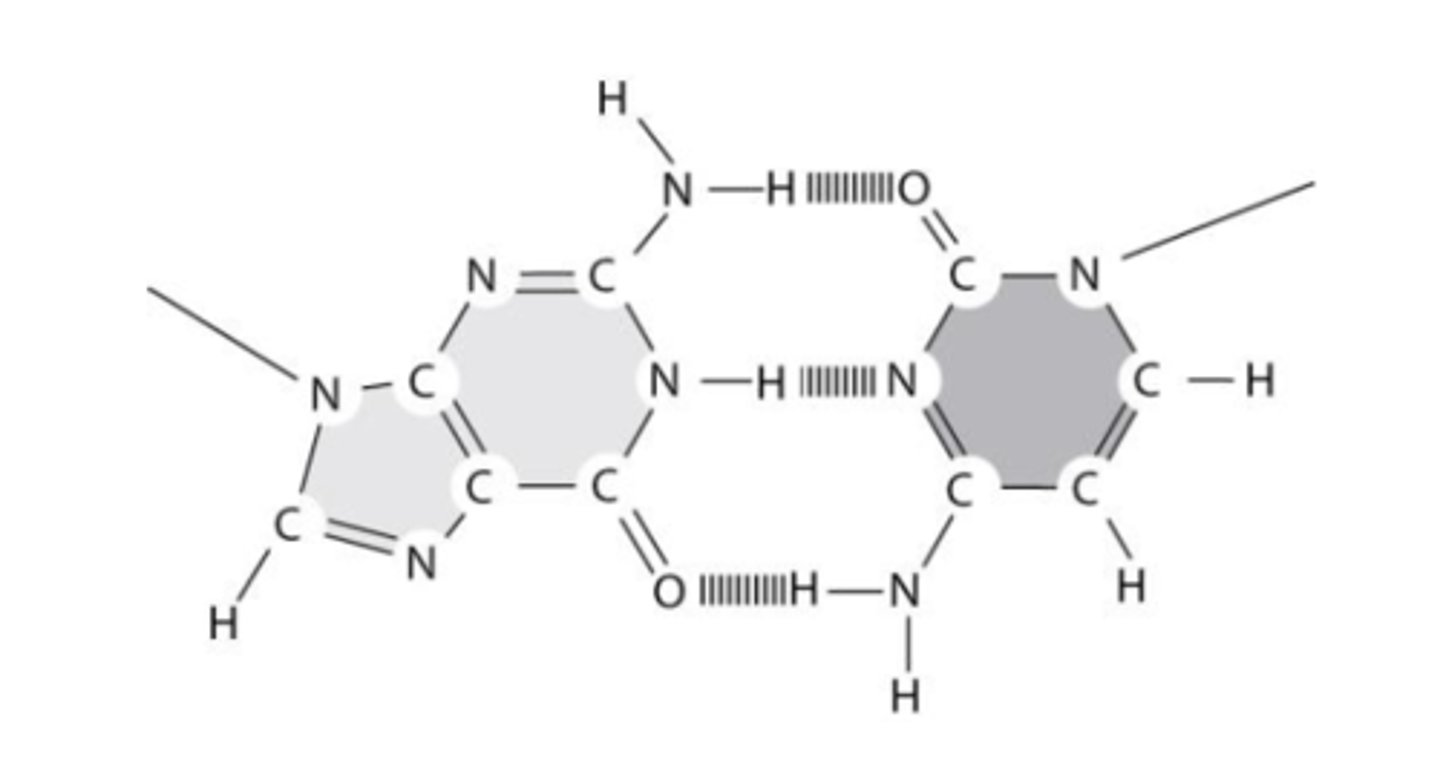
Which DNA base pair is represented in this Figure?
G-C
Explore top notes

Explore top flashcards
