Soils 101 Finals Material
 Studied by 0 people
 Call Kai
 Learn
Learn Practice Test
 Spaced Repetition
 Match
Match Flashcards
 Knowt Play
1/190

There's no tags or description
Looks like no tags are added yet.
Name | Mastery | Learn | Test | Matching | Spaced |
|---|
No study sessions yet.
191 Terms
Why are soil resources shrinking?
-Catastrophic loss from climate change displaces soil
-Water pushes soil aside
6 Roles of Soil
-Plant growth
-Organic waste system
-Modifier of carbon cycle
-Habitat for organisms
-Building surface
-Water purification
Difference between limestone and sandstone
-Limestone is more neutral
-Sandstone is acidic
Difference between rock and mineral
-Mineral is a single substance
-Rock is made of 2/more minerals
Difference between primary and secondary mineral
-Primary: mineral present when rock formed
-Secondary: Mineral created through chemical weathering
Difference between chemical and physical weathering
-Physical: Done by external pressures
-Factors: (temp fluctuations, fire, freezing, salt crystals, root pressure, unloading/exfoliation, wind/water erosion)
-Chemical: Chemical reactions with water or biological activity
-Factors: hydration, hydrolysis, dissolution, redox, carbonation, complexation
Is quartz or calcite more resistant to weathering
Quartz is more resistant
What types of climate promotes weathering
Warmer=faster (reaction rates double every 10 degrees C)
Types of Chemical Weathering
-Hydration: yummy water
-Hydrolysis: water breaks shit up (dissolution + change composition)
-Carbonation: Carbonic acid dissolves shit (causes caves)
-Redox: oxidation and reduction that fluctuates redox features (red and black blotches)
-Dissolution: Limestone and salty rocks dissolving in water
-Complexation: shit combines into a larger molecule
What soil environments promote redox reactions
-Oxidation: aerobic
-Reduction: Anaerobic
What is the general progression of horizon development
Unweathered bedrock → parent material → soil
Difference between eluviation and illuviation
-Eluviation: remove nutrients and organic material from superficial horizons
-Illuviation: deposits that stuff
4 Basic processes of soil formation
-Transformation: Chemical/Physical alterations or destructions of soil to form other stuff
-Translocation: Movement of materials laterally or vertically by water/animals
-Additions: material input from outside sources
-Losses: material lost from soil
How does clay content change as soils become weathered
-Color: more distinct between horizons
-Gets darker and more compact
What are the 6 horizons
O: Organic material
A: Top horizon that has minerals. Has some organic material
E: Zone of maximum leaching, bleached almost white
B: Zone of illuviation, parent material cant be discerned
C: Unconsolidated material below A and B
Transition Horizons
Occur when boundaries between horizons are gradual
What types of structure for each horizon
O
A: Granular, platy if compacted
E: Granular
B: Subangular Blocky, occasionally prismatic
C: Structureless/Massive
How to read Munsell chart
-Sun behind you, place chart on top of soil
-Column is value, row is chroma, different pages is hue
Ex: 5 YR (hue) 6(value)/4(chroma)
Color results from Fe, Mn, Humus
Fe: yellow, red, brown
Mn: Black
Humus: Black
Field method for determining soil texture
Texture by feel, ribbon test for clay (10% per inch), ball to determine sand composition, texture pyramid for silt
Soil vs coarse fragment size difference
soil<2mm
Different types of redox features and how to identify them
-Redox Concentrations: Iron and manganese accumulations, mottled appearance
-Redox Depletions: Areas without iron and manganese, pale
-Redox matrices: low soil colors, results in lines
5 Soil Forming Factors (CLOPRT)
Climate
Organisms
Relief
Parent Material
Time
2 Most important parts of climate related to soil formation
Temperature and Precipitation
Soil Temperature Regime of Central PA
Mesic
Soil Moisture Regime of Central PA
Udic
Grasslands vs Forest Soils
-Grasslands: Less acidic, no O, deep A, less acidic leaching
-Forests: More acidic, o horizon, shallow A, more acid leaching
Floodplain vs Terrace Soil
-Floodplains: More soil, further from original rock formation, younger
-Terrace: Less soil, closer to original rock formation, older
Name the 6 Physiographic Regions of PA
Central Lowlands.
Appalachian Plateaus.
Ridge and Valley.
New England.
Piedmont.
Atlantic Coastal Plain.
How time affects soil development
Soil development can take many years, time it takes to develop is affected by the other factor
How to read map units
Codes
Soil series, soil phases, slope phases, dominant surface texture, second series
What info can be found in web soil survey
Soil characteristics, boundaries, soil classifications
What is soil taxonomy
A hierarchical system-groups soil individuals based on soil properties
Epipedon
-Surface pedons, mostly organic material overlying non organic material
-Mollic/Melanic/Histic
Subsurface
-Subsurface pedons, mostly mineral with chemical weathering
Argillic, Oxic, Spodic, Fragipan
Order for soil taxonomy from largest to smallest
Order →Suborder→Great Group→Subgroup→Family→Series
6 soil orders
Entisol, inceptisol, mollisol, ultisol, afisol, oxisol
Entisol
Has no horizons. Formed very recently, catch all
Inceptisol
Inception of soil development, Cambic B horizon maybe
Mollisol
Intermediate Weathering, grasslands, semi-arid to moist, mollic, epipedon
Afisol
Moist, mildly acidic, clay accumulation, intermediate weathering
Utisol
Wet tropical and subtropical, acid silicate, Fe and Al oxides, Strongly weathered
Oxisol
wet tropical forests, extreme weathering, low activity clays, Al and Fe oxides
PA State Soil
Hazelton
Summit
Top, residual material,easy to differentiate horizons
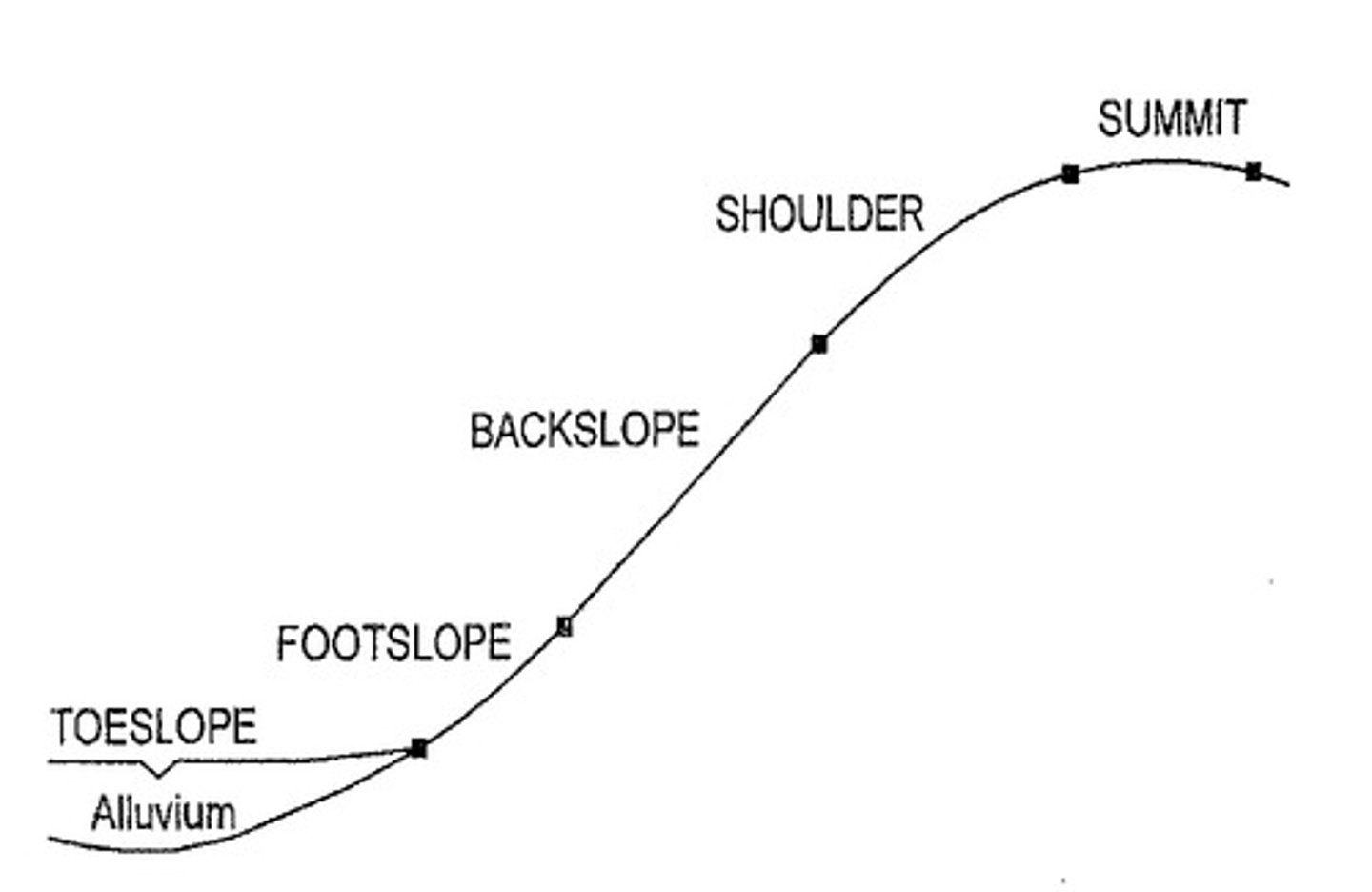
Shoulder
Residual Material, not deep, difficult to see horizons
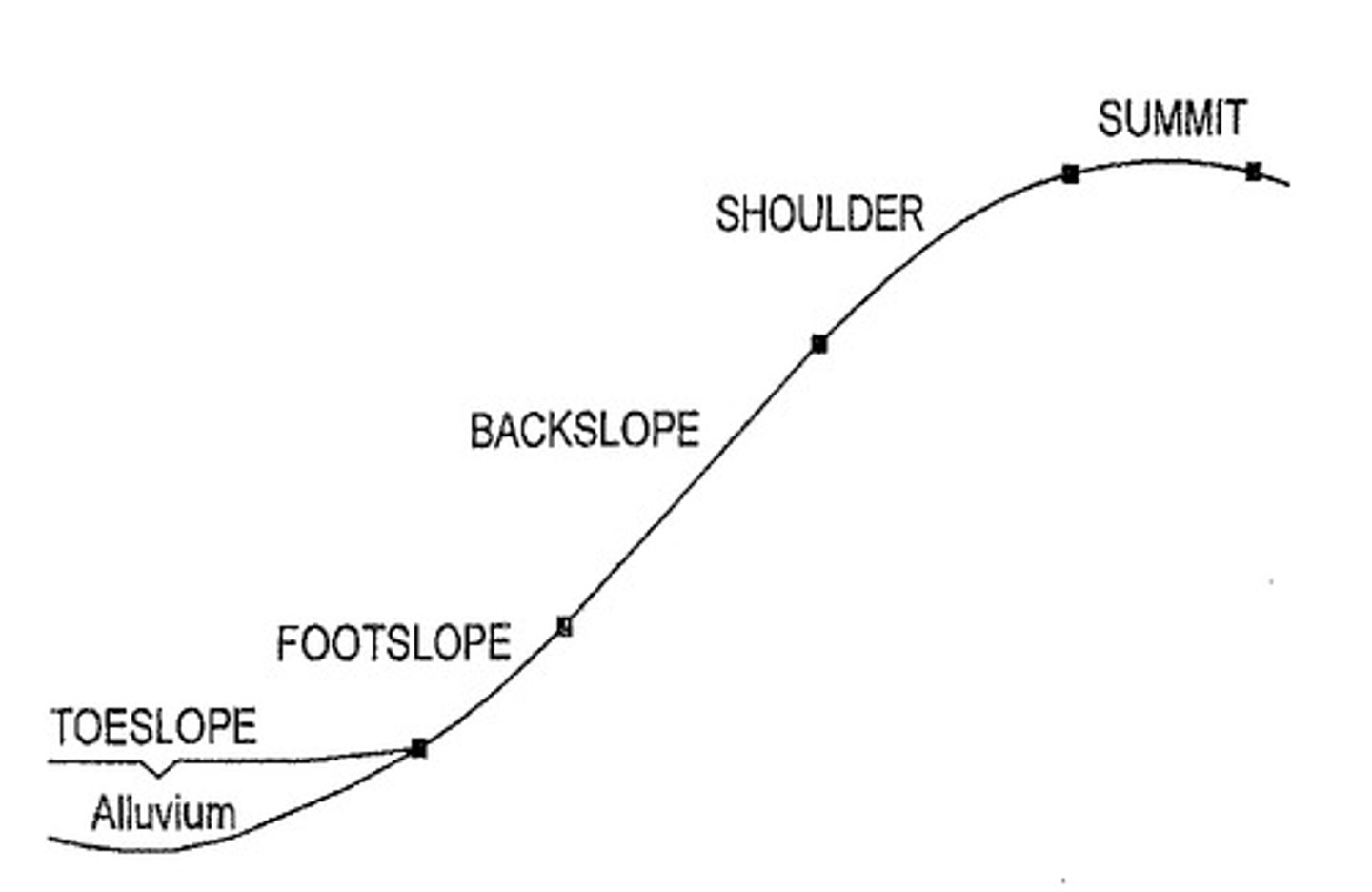
Backslope
Colluvial Material, lots of rock fragments w/ distinguishable horizons
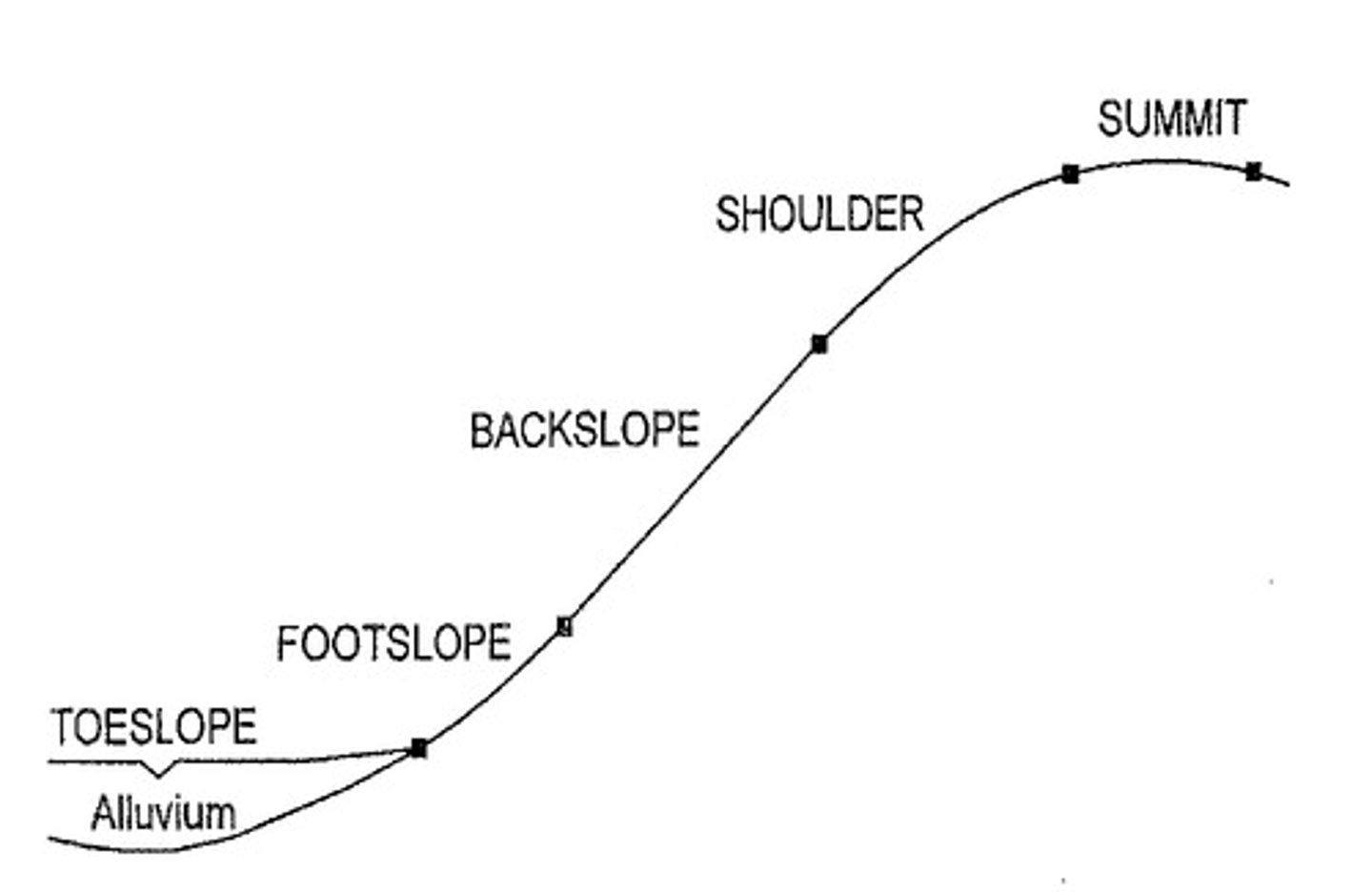
Terrace
Alluvium material, very flat w/ restricted soil, difficult to see horizons
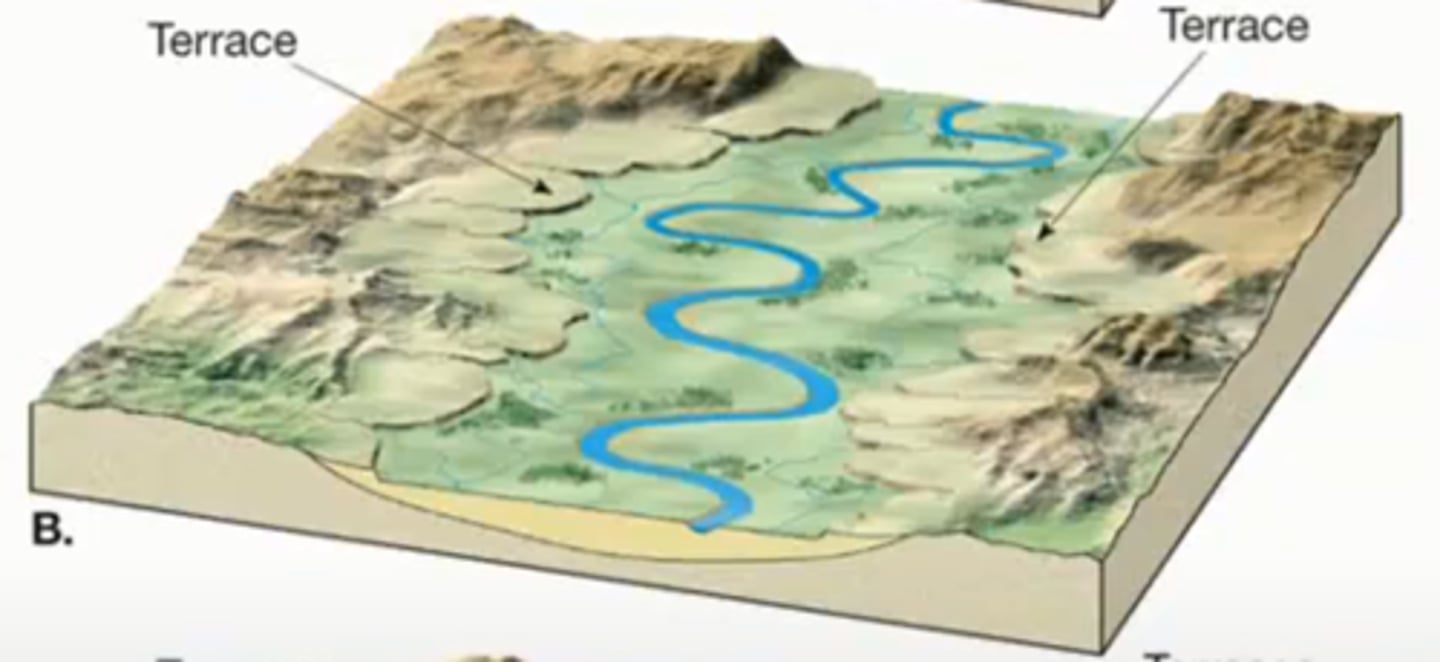
Floodplain
Alluvial material, distinct layers, net to water and very moist
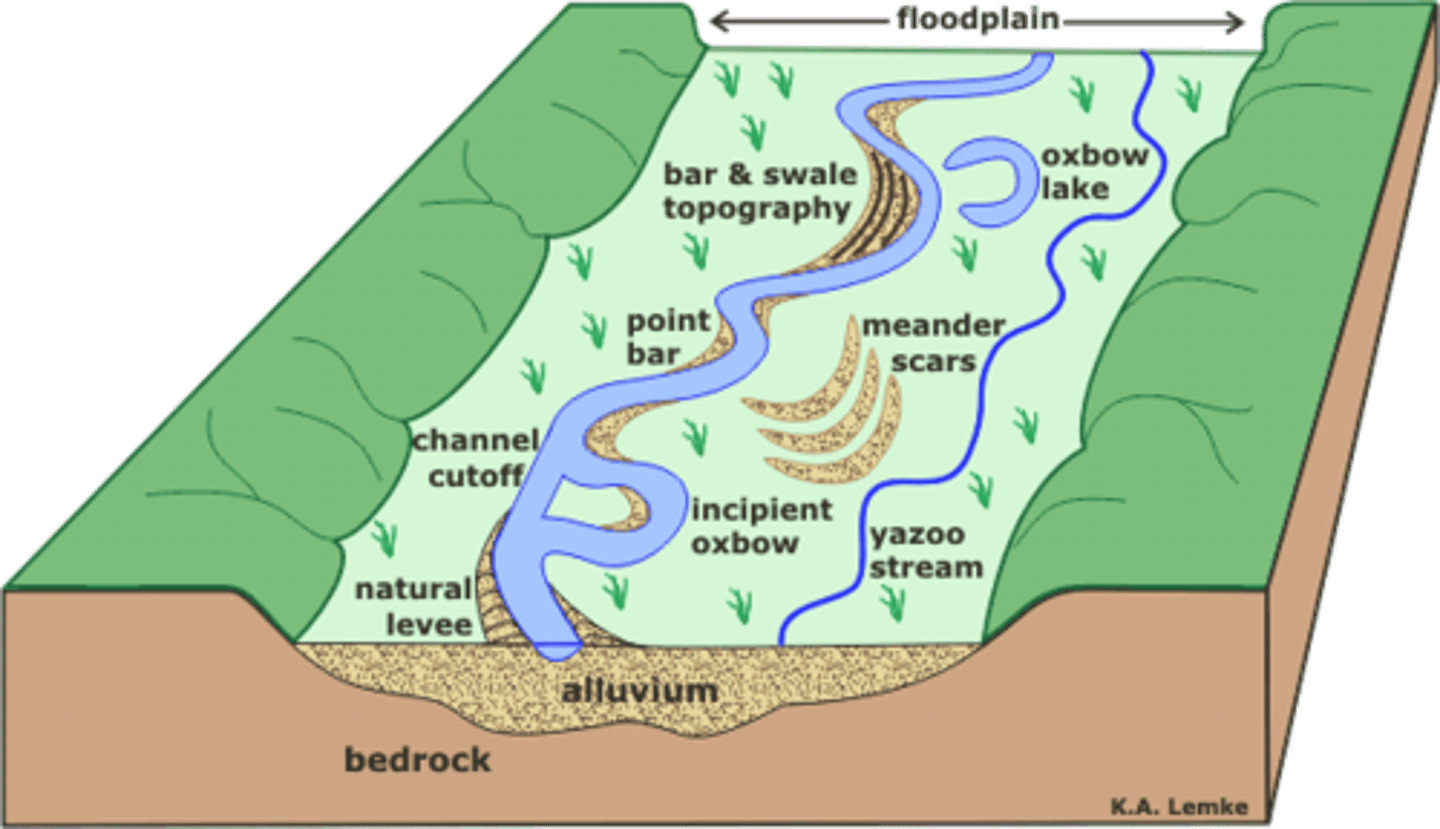
Residuum
Hasn't moved, residual underlying material
ID: no particle sorting, C horizon shows bedrock
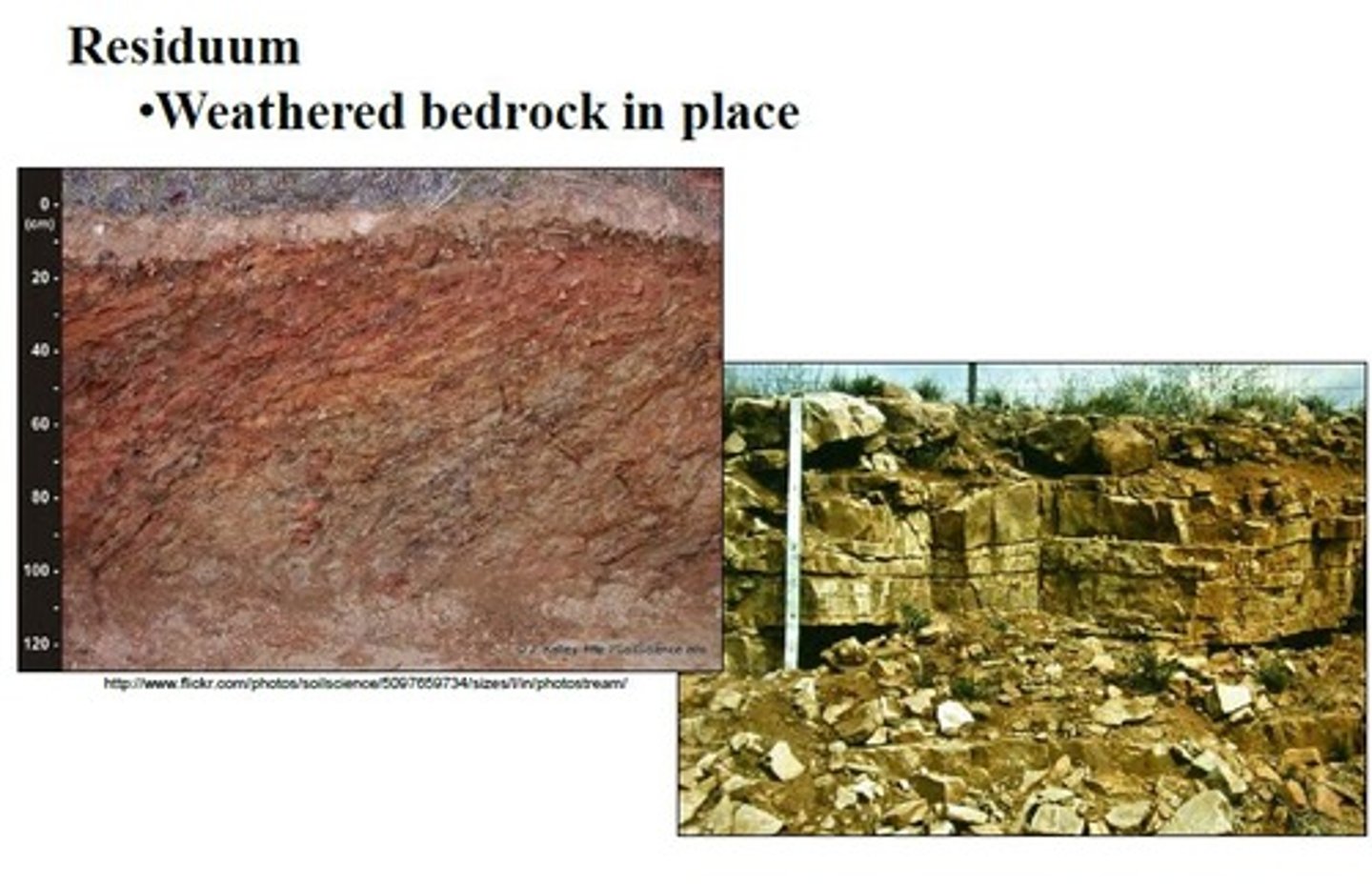
Colluvium
Transported Downhill by gravity
ID: mix of rock types, no sorting or rounding, buried horizon, RE not in original position
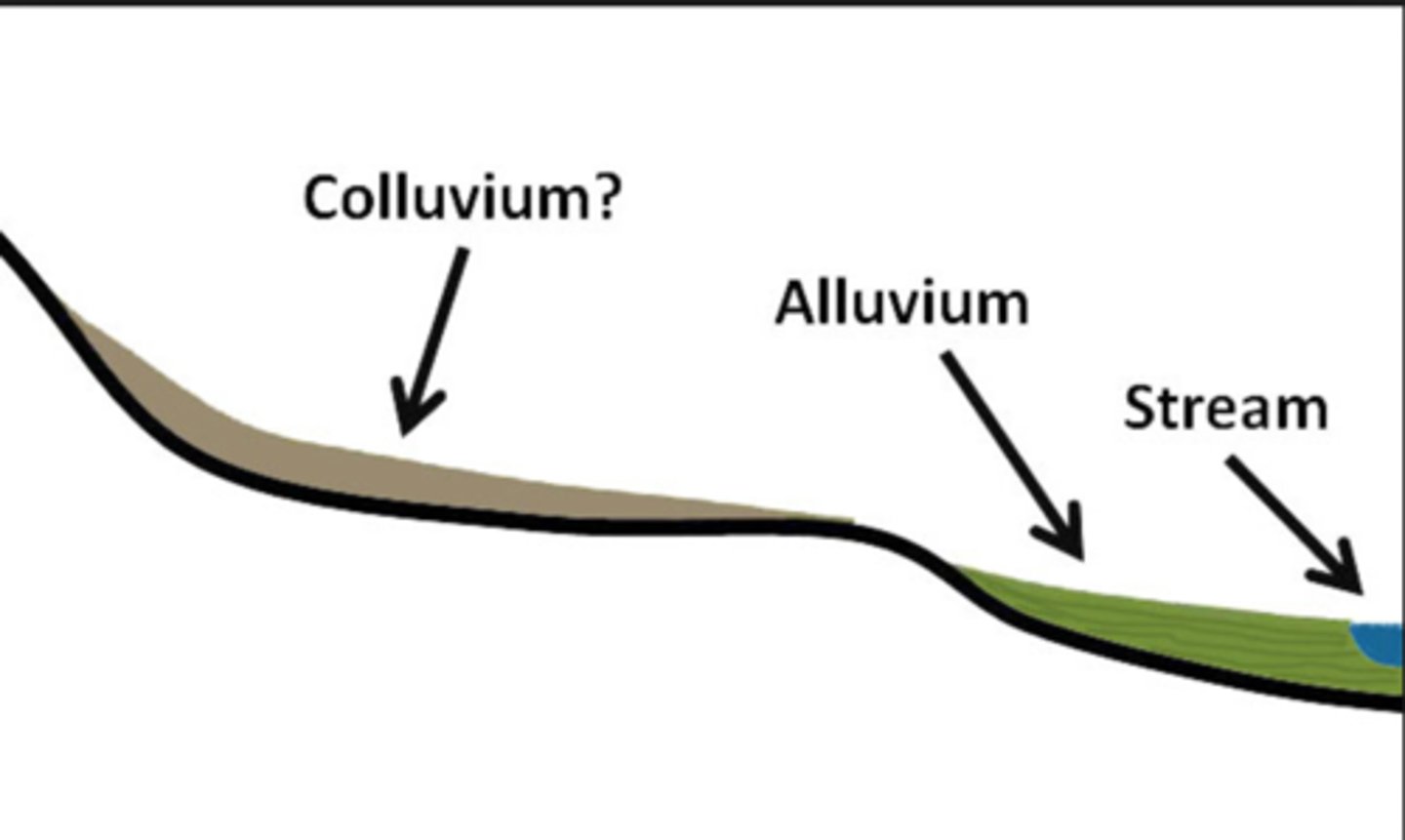
Alluvium
Transported by water
Mix of rock types with rounding and sorting, buried horizons
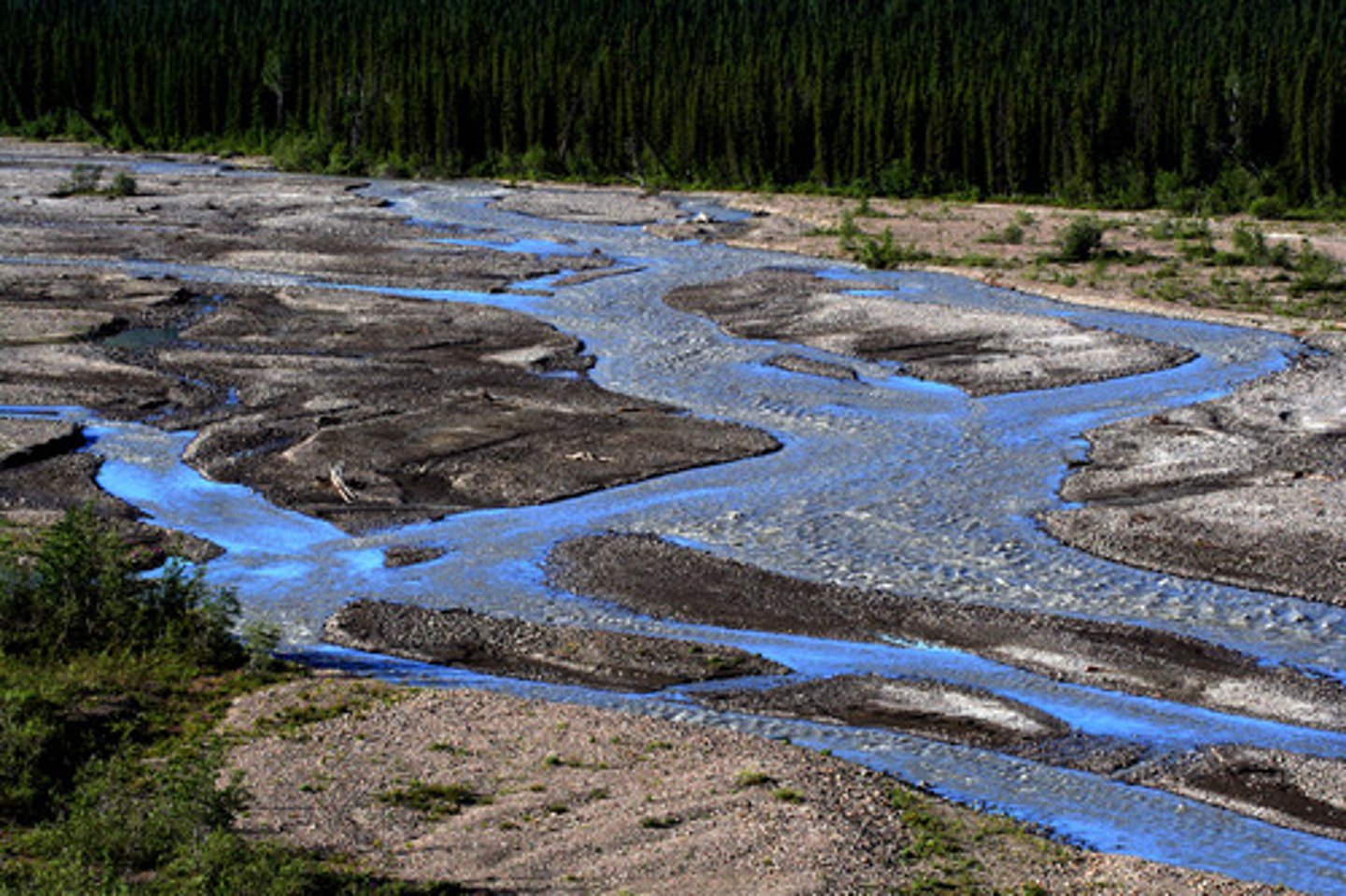
Other Parent Material
Lacustrine, Coastal marine sediments, eolian, loess
EXAM 2 Material
Starts here if you go in order
What is the difference between sand, silt and clay?
Sand: Grains are very visible
Silt: can be seen, but is extremely small
Clay: Invisible to the naked eye
Size Range in mm for sand, silt, and clay?
Sand: 2-0.05 mm
Silt: 0.05-0.002 mm
Clay: <0.002 mm
What is a "soil sized" particle? Course/rock fragments?
Soil Sized: 0.002-2mm
Course Fragment/Rock: >2 mm
Use % sand, silt, clay to read soil triangle
I mean...just use your eyes
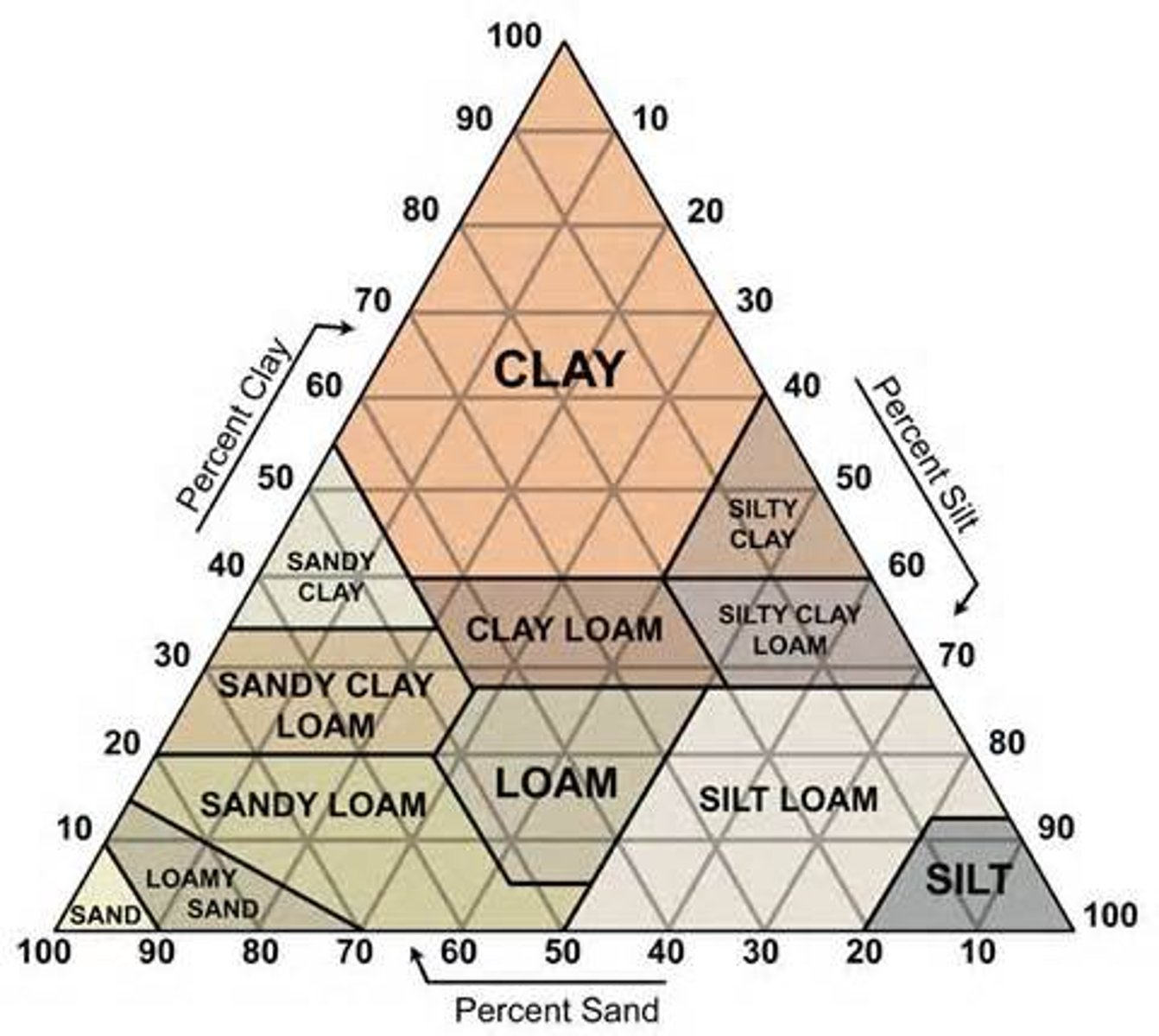
How to determine soil texture in field (% clay, %sand)
Ribbon test: 10% clay per inch of ribbon, 5% for high organic matter, 20% if bright red
Sand % estimation: Form 2 pea sized balls of soil, palm cupped to hold water, spray water, let drain, estimate % sand grains by comparing what's left to og size
How to determine soil texture in lab
Put soil in sieves of increasingly small sizes (4.75-2-0.6-0.25- 0.15-0.075-0.053mm), separates out sand and gravel, then weigh to find %
Hydrometer: Take 50g <2 mm soil, place in water w sodium hexametaphosphate, let settle for specific times, measure what remains for clay and silt %
Why add sodium hexametaphosphate?
Disperses clay particles
Stokes Law
Describes: Velocity of particle falling through fluid
General Idea: Combined with hydrometer, lets us figure out what time it will take for each size particle to settle
Do clayey or sandy soils have larger pores? Greater porosity?
Larger Pores: Sandy
Higher porosity: Clay
Volumetric Composition of a Loamy Soil:
50% soil, 20-30% air, 20-30% water, 0% organic
Why is soil structure also important in addition to soil texture?
Soils Structure aggregates come in different types that will impact permeability/infiltration.
Ex: more compaction (platy, blocky)=slower water movement
Units for Bulk Density
Mg/m3=g/cm3=t/m3
What is the common assumed particle density?
2.65 g/cm3
How is Bulk Density calculated?
Dry weight/volume
What is the common range for bulk density?
Undisturbed: 1-1.4 g/cm3
Does compaction increase or decrease Bulk Density?
Increase
Does compaction increase or decrease porosity?
Decrease
Root limiting bulk density for clayey soils.
1.39-1.49 g/cm3
Are soils more compactable when wet or dry?
Wet (unless too wet, which can cause difficulties due to pores being overfull of water. Dry has too much friction.)
What is a soil proctor test?
A test to determine the optimal moisture content that a soil can be most effectively compacted at
Effects of extensive tillage/plowing.
Bulk Density: Increases
Aggregate Size: Decreases
Crop Yield: Decreases
Porosity: Decreases
How can you improve soil tilth?
Minimize tillage
Stay off wet soil
Dedicated traffic lanes
Mulch
Add organic matter
Cover crops
Return crop residues to fields
tillage/ forage radishes alleviate compaction
How to calculate gravimetric moisture content?
Gravimetric Moisture= (Mw/Ms) x 100
Mw = mass of water, Ms = mass of soil (dry)
Lab method for measuring/calculating gravimetric moisture content
Time domain reflectometry and gravimetric method (gravimetric moisture equation)
Approximate soil potential at Saturation
0 kpa
Approximate soil potential at Field Capacity
-33 kpa
Approximate soil potential at wilting point
-1500 kpa
What potentials make up the total soil water potential? What forces do each of these account for?
Matric Potential: Cohesion + adhesion (connectivity of H2O to soil particles)
Osmotic Potential: Salt (negligible unless dry, fertilizers increase it thought)
Gravitational Potential: Force of gravity, only important in saturated soils (pulls water down rapidly)
What is capillary rise?
Water rising upwards from soil particles acting on its molecules
Is capillary rise higher in clayey or sandy soil?
Clayey
What is field capacity?
Amount of water held in soils after excess has drained away
What is wilting point?
Water content where plants wilt in the daytime
Do sandy, silty, or clayey soils hold the most water?
Clayey
Do sandy, silty, or clayey soils have the most plant available water?
Silty Clay
Does organic matter generally hold low or high amounts of water? Is that water plant available?
High
It is plant available due to the charge
Darcy's Law
Equation: (G x L)/(A x t x(Ѱ₁-Ѱ₂)
Describes: Saturated hydraulic conductivity
General Idea: The larger the macropores (>0.05 mm) the higher the potential pressure head driving water down, the faster the flow rate
Does water move faster through sandy or clayey soils?
Sandy
In addition to texture, what other soil properties affect the rate of water movement?
Soil structure (ex: Prismatic and platy will slow the movement of water, granular will not)
What is the perching effect and what does it cause?
It's where water gathers, usually at a point of abrupt texture change. Occurs due to unsaturated periods where capillary action is the driving force.
What are soil colloids?
Solid soil particles <2 um with extremely large surface areas. They are the most "active" chemical component.
What are the different types of soil colloids?
Phyllosilicate Clays (1:1, 2:1, 2:1:1)
Non Crystalline silicate clays
Fe and Al oxides
Humus
What is the centrally coordinated action in the tetrahedral layer of phyllosilicate clays? Octahedral?
Refer to the photo

What is the difference between a 1:1 and a 2:1 phyllosilicate?
1:1 Clay: 1 tetrahedral layer and 1 octahedral
2:1 Clay: 2 Tetrahedral layers and 1 octahedral
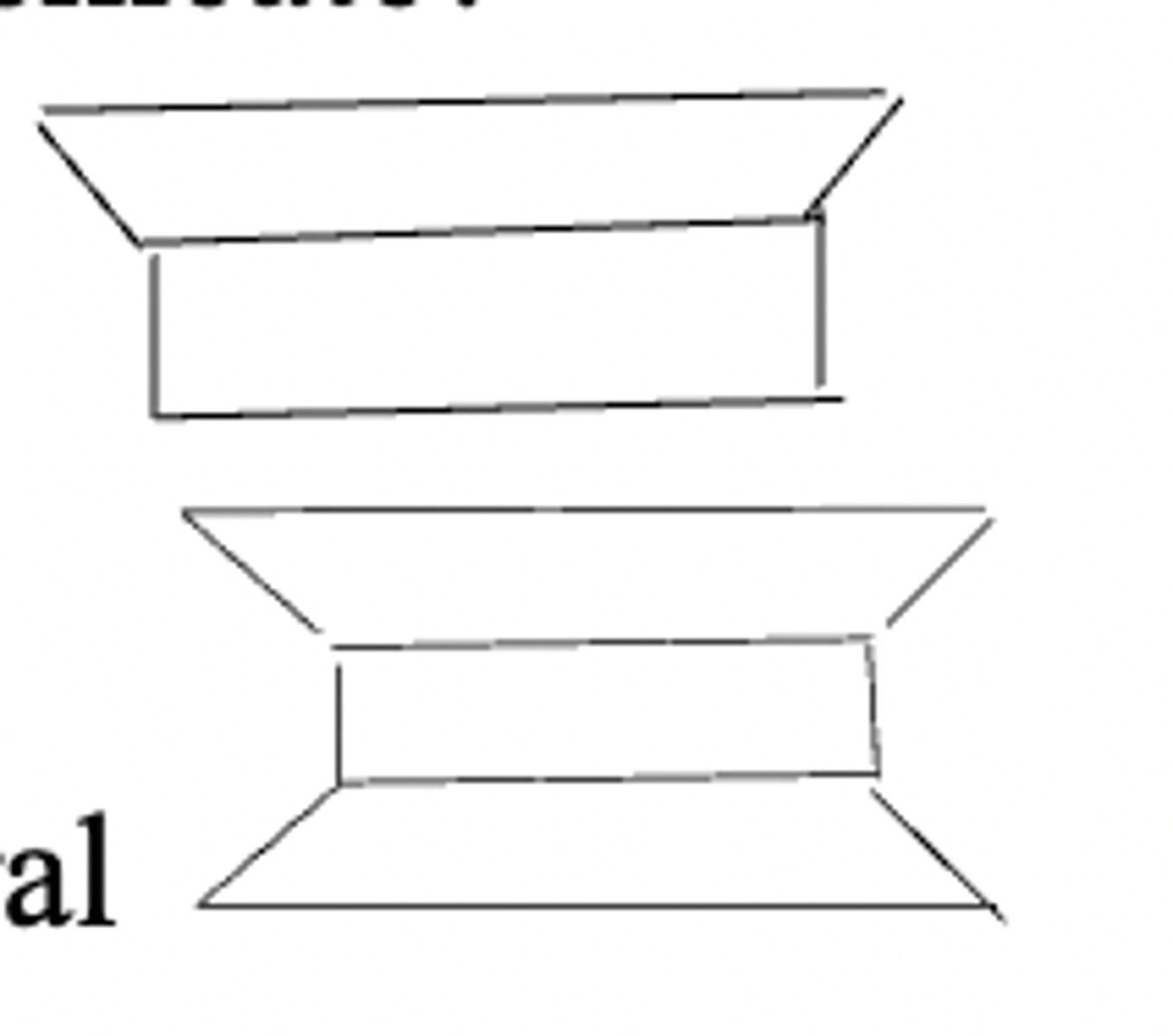
What is the isomorphic substitution?
-Substitution of one element for another of equal size
-Happens in formation of both sheet types
-Al2+ for Si4+ in tetra
-Fe2+, Mg 2+, Ni 2+, Zn2+, Cu 2+ for Al 3+ in octa
Are soils general + or - charged?
Negative
How is internal/external surface area, total surface area, and Caption Exchange Capacity related?
Caption exchange capacity (CEC) is the sum total of exchangeable cations a soil can absorb. More surface area=more stored nutrients=more exchange
 Note
Note  Flashcards (45)