The Changing Consumer Study Guide
 Call Kai
 Learn
Learn Practice Test
 Spaced Repetition
 Match
Match Flashcards
 Knowt Play
1/37

There's no tags or description
Looks like no tags are added yet.
Name | Mastery | Learn | Test | Matching | Spaced | Call with Kai |
|---|
No analytics yet
Send a link to your students to track their progress
38 Terms
Stages of the Perceptual Process
1) Exposure to stimuli 2) Attention to the object 3) Interpretation of what the object means and what you want to do with it
Sensory Marketing - Use Example
5 sensory elements and how we use them to understand the world. For example, we use color and size in marketing to stimulate people’s vision. Using the IPhone ad as an example, you can see that “PRO” is very large and is right in the middle. Our eyes are draw towards this. We can also see the contrast between the dark background and the rust color, which draws our eyes to the text and to the iphone itself
Article - When Sensory Marketing Works and When it Backfires
People want sincere brands to stay the same and exciting brands to change
Sensory Threshold
Absolute threshhold: minimum amount of stimulation that can be detected
Differential Threshold: the ability of the sensory system to detect differences
Principles of Interpretation: Gestalt
People tend to perceive an incomplete picture as complete, filling in the blanks based on past experiences
One object will dominate the front while the other will dominate the background, for example, while looking at the iphone ad, when looking at the phone, the word pro fades into the background and vice versa
Principles of Similarity
People group objects based on physical similarities
Article - Authentically Fake? How Consumers Respond to the Influence of Virtual Influencers - 6 Factors
Six primary motivations emerged from our analysis: novelty (AI influencers are new and interesting), information (people want more information on AI), entertainment (they are fun to watch), surveillance (knowing what the influencer is doing), aesthetics (visually appealing), and integration and social interaction (bonded with AI influencer).
Intrinsic vs. Extrinsic Motivation
One’s own internal drives and desires vs. external forces
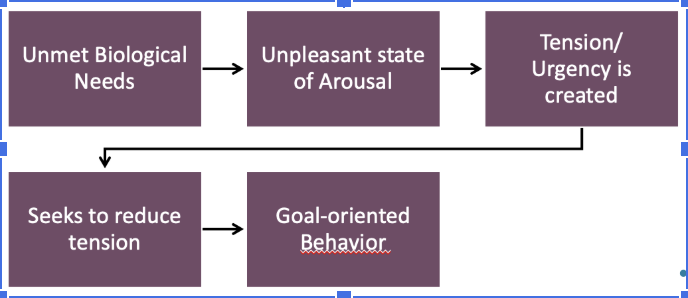
Drive Theory - 5 Steps
Behavior is motivated by internal biological needs. For example, the iphone ad emphasizes the camera, and the word pro. Apple is trying to convince the consumer that they need this new phone and that they need this new camera. They are creating a tension that will drive the consumer to consume.
Classification of Needs
Need for achievement
Need for affiliation
Need for power
Need for uniqueness
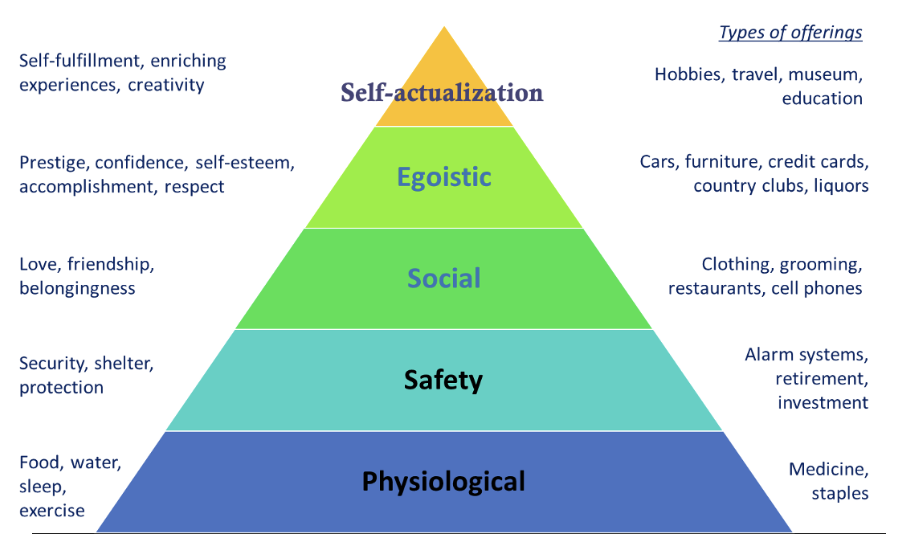
Maslow’s Hierarchy
Self-actualization
Egoistic
Social
Safety
Physiological
Motivational Conflict
Approach-aproach conflict: a person must choose bwteen two desirble things
Avoidance-avoidance conflict: a person must choose between two undesirable things
Aproach-avoidance conflict: a person must choose something good that then leads to negative consequences, like a higher paying job but you must work more hours
Types of Consumer Involvement
Product involvement is related to a consumer’s level of interest in a particular product.
Message-response involvement (or advertising involvement), refers to the consumer’s interest in processing marketing communications.
Situational involvement refers to differences that may occur when buying the same object for different contexts.
Learning and Memory - Conditioning
Classical conditioning occurs when a stimulus that elicits a response is paired with another stimulus that does not initially elicit a response on its own (AKA we start associating coke with the color red, and if we see a red soda we might just assume it is coke)
Instrumental conditioning (operant conditioning) occurs as the individual learns to perform behaviours that produce positive outcomes and to avoid those that yield negative outcomes.
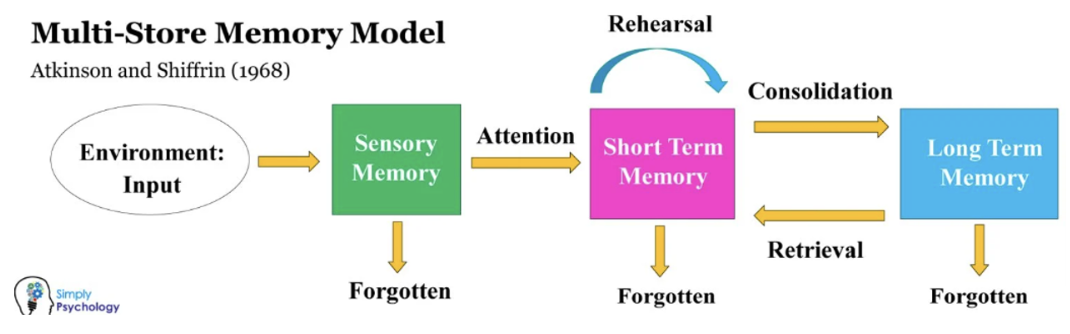
MultiStore Memory Model
Describes memory as a linear process involving three distinct, sequential stores: the sensory register, short-term memory (STM), and long-term memory (LTM).
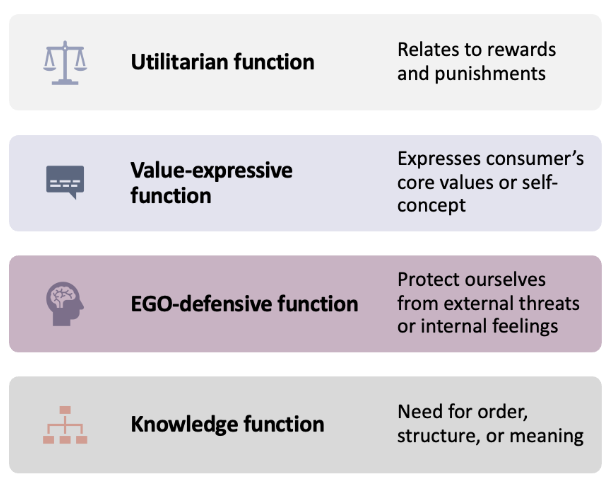
Functional Theory Attitude - 4 Types
Attitudes exist because they serve some function for the person - determined by a person’s motives.
People can have different attitudes towards the same thing
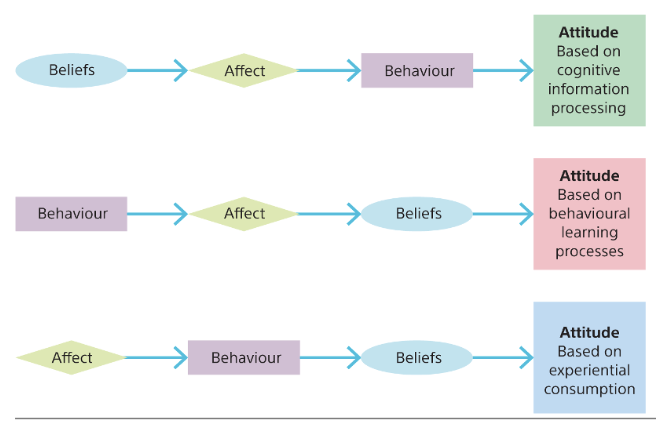
ABC Model
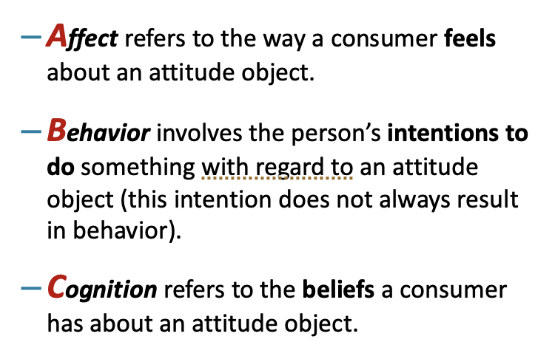
In the ABC model, how do all these processes interact with each other and what types of attittudes do they create?
Theory of Cognitive Dissonance
When a person is confronted with inconsistencies among attitudes or behaviours, he or she will take some action to resolve this ‘dissonance’, perhaps by changing an attitude or modifying behaviour.
This can be done by eliminating, adding or changing elements.
Balance Theory
Considers how people perceive relations among different attitude objects
How they might alter their attitudes so that these remain consistent (or ”balanced”)
Each triad contains:
A person and their perceptions (consumer)
An attitude object (entity)
Some other person or object (brand)
A balanced state (odd number of positive relations) creates positive brand attitudes, while unbalanced states cause discomfort, motivating attitude changes to restore harmony.
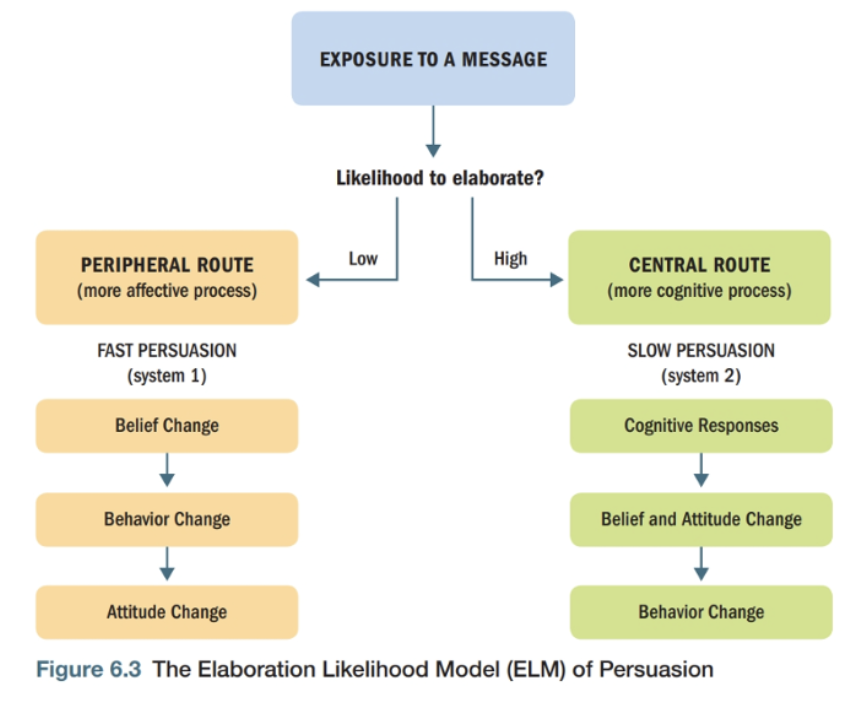
ELM (elaboration likelihood model)
The ELM assumes that once a consumer receives a message, he or she begins to process it.
Depending on the personal relevance of this information, one of two routes to persuasion will be followed.
The routes are as follows:
Under conditions of high involvement, the consumer takes the central route to persuasion.
Under conditions of low involvement, a peripheral route is taken.
New Technological Advancements
Aspects of virtual influencer marketing
AI chatbots
Typology of virtual influencers, some more realisitc, some less so
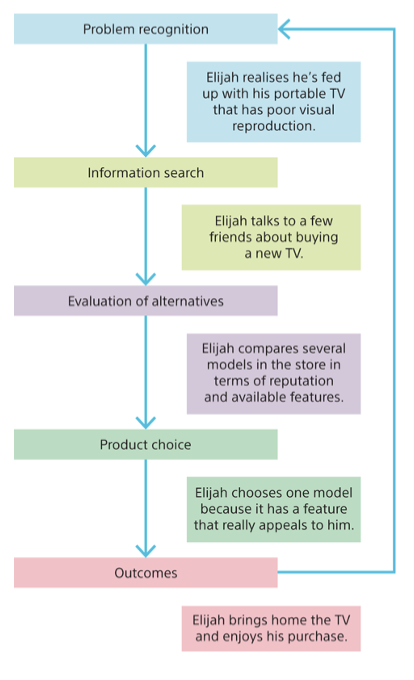
5 stages of consumer decision making (map to example, cognitive decision making process)
1) Problem recognition occurs whenever we see a significant difference between our current state of affairs and some desired or ideal state.
2) Information search is the process in which the consumer surveys his or her environment for appropriate data to make a reasonable decision.
3) We call the alternatives a consumer knows about his or her evoked set; and the ones he actually considers his consideration set. The evoked set is composed of those products already in memory (the retrieval set), plus those prominent in the retail environment.
4) Product Choice: We choose one thing based on 1) Prior experience with the product 2) Information present at the time of purchase 3) Beliefs about the brands that have been created by advertising
5) Outcomes - Post purchase evaluation closes the loop; it occurs when we experience the product or service we selected and decide whether it meets (or maybe even exceeds) our expectations.
Types of consumer decisions
Extended problem-solving – there is a fair degree of risk and we use internal search and external sources.
Limited problem-solving – this is a simple, straightforward decision process.
Habitual decision-making refers to choices that we make with little or no conscious effort. This form is characterised by automaticity.
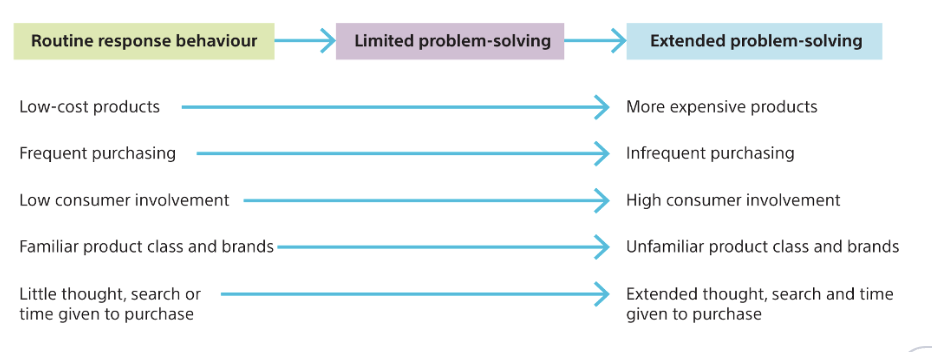
Fast or Slow thinking
Habitual decision making, or fast decision making, describes the choices we make with little or no conscious effort.
Slow decision-making is necessary when high stakes are involved, requiring intensive analysis and consideration. Deliberate, analytical, and thoughtful decisions.
Types of consumer decisions
Affective→ Decisions based on emotions, feelings, or moods rather than logic.
Cognitive→ A methodical, rational process involving significant research and evaluation of alternatives. This corresponds to "extended problem solving”
Habitual→ Decisions made with little to no conscious effort or thought, often based on habits, routine, or brand loyalty
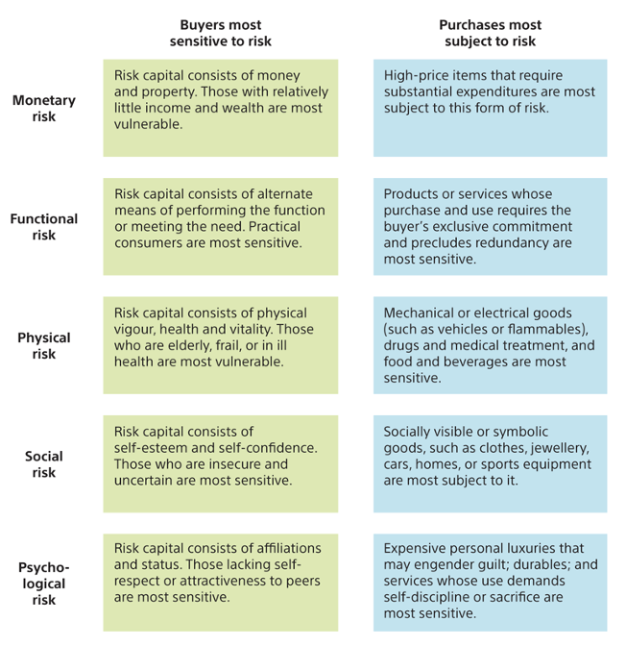
5 types of risk
1) Monetary Risk
2) Functional Risk
3) Physical Risk
4) Social Risk
5) Psychological Risk
Evaluation of alternative
The alternatives that the consumer is aware of but would not consider buying are his or her inept set.
Those products not entering his or her consideration comprise the inert set.
We call the alternatives a consumer knows about his or her evoked set; and the ones he actually considers his consideration set.
Product categorisation is how consumers organise their beliefs about products or services.
Products in a consumer’s evoked set are likely to be those that share some similar features.
There are several levels of categorisation:
Superordinate level: abstract concepts, like a big idea (ex. I want a phone).
Basic level: items have much in common but a number of alternatives exist (ex. I want a phone with a good camera, but multiple phones have good cameras)
Subordinate level: individual brands (ex. I really care about this one brand or this one feature).
ARTICLE - The Marketing Message That Works with Republicans but Not Democrats
conservative shoppers are more likely to buy luxury goods when they believe the purchase will help them preserve — but not necessarily advance — their status
Conservative people are mroe likely to want to preserve the hierarchy or the status quo, thereby reinforcing their own status. This means that wealthy conservatives are more likely to buy luxury goods while similarly wealthy democrats are not as likely to buy luxury goods.
STEPPS
Six key factors that drive word-of-mouth and make content or products "contagious"
Social Currency (Status by Association): People share things that make them look good, smart, or "in the know" to others.
Triggers (Top of Mind, Tip of Tongue): Associating a product with common, everyday cues keeps it top-of-mind, making people talk about it more frequently.
Emotion (When We Care, We Share): High-arousal emotions—such as awe, excitement, humor, or even anger—drive sharing, whereas low-arousal emotions (sadness) do not.
Public (Built to Show, Built to Grow): Making a product or behavior visible allows others to imitate it.
Practical Value (News You Can Use): People share useful information that helps others save time, money, or gain knowledge.
Stories (Information Under the Guise of Idle Chatter): Embedding a message within a compelling narrative makes it memorable and easy to pass on
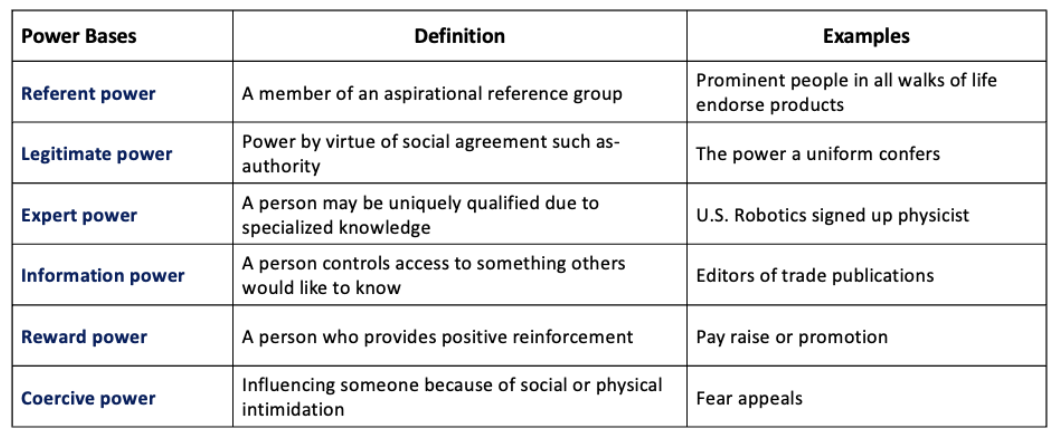
Social Power (specifically in relation to celebrity/influencers and office life, like we talked about in class)
Social Power from Celebrities: Celebrities have Referent power, because people look up to them. They are able to influence people who revere them. They might also have expert power if they are advertising some make-up brand or clothing, so a viewer is more likely to trust someone who uses lots of makeup and has experience with fashion for advice.
Social Power in the Work Place: In a workplace, your boss will have legitimate power, which is a power that says they are above you on the corporate hierarchy and can therefore control you. They also have Reward power, like the power to provide good feedback or give you a raise, and they have coercive power, where they can intimidate you into doing certain things because they have the ability to punish or demote you. A coworker might have expert power, because they specialize in one department that you are reliant on and therefore you rely on them, or information power, where they control who gets what information when.
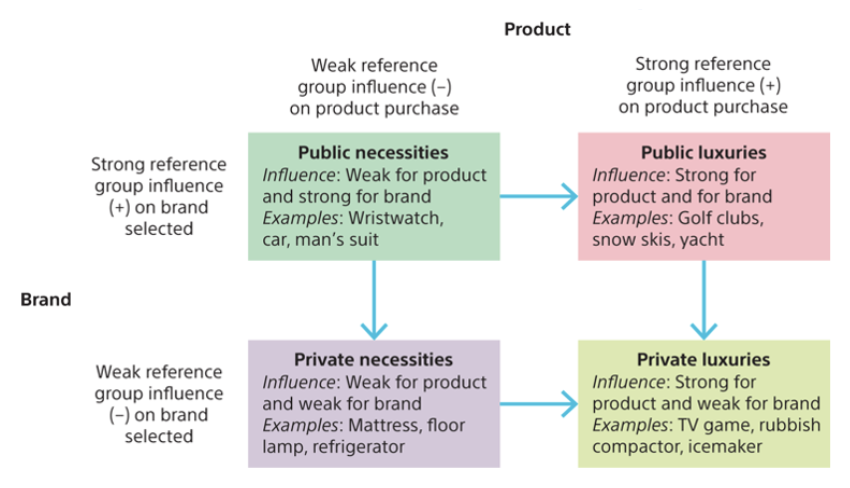
Reference Groups
‘an actual or imaginary individual or group conceived of having significant relevance upon an individual’s evaluations, aspirations or behaviour’.
Formal reference groups are structured with defined roles, rules, and goals (e.g., professional associations, unions).
Informal reference groups are spontaneous, close-knit social groups based on shared interests
Membership (associative) reference groups are groups an individual currently belongs to and interacts with (friends, family, coworkers), influencing behavior through shared norms.
Aspirational reference groups are those an individual admires and hopes to join (celebrities, successful professionals), shaping behavior through emulation of their lifestyle and purchases
Conformity
Conformity study
In order for a society to function, its members develop norms or informal rules that govern behaviour.
People want to fit into the group, and generally do not wnat to disagree. If many people say that one thing is correct, another person will agree publicly even if they privately disagree.
Conformity in consumption—aligning purchasing behavior with the majority—is a way to gain social acceptance, validate choices, and simplify complex choices in a crowded marketplace.
Family Life-cycle 4 stages
1) Families before children
2) Families with young children
3) Families with grown/indepedndent children (teenagers, and young adults who are dependent)
4) Families with independent children/no children - adult independents, empty nesters,
Social class - How does class affect consumer behavior?
People of higher SES will consume more and consume more luxury goods. They might care more about getting status symbols, like fancy purses.
Your SES defines how price sensitive you are, what brands you are drawn too, how brand loyalty can impact you, and how you try to fit in with your peers
Dimensions of culture
Ecology: Refers to the way a system adapts to its habitat. This includes the technology used to obtain and distribute resources needed for daily life (e.g., food, shelter).
Social Structure: Refers to the way orderly social life is maintained. This includes domestic and political groups that dominate the culture, such as the nuclear family, extended family, or government institutions.
Ideology: Refers to the mental characteristics of a people and the way they relate to their environment and social groups. It encompasses shared beliefs, values, and a common worldview, including ideas about principles of order and fairness.
Enculturation: The process of learning the beliefs, values, and behaviors endorsed by one’s own culture. It is the learning process that happens from birth.
Acculturation: The process of learning the value system and behaviors of a foreign or different culture. It occurs when groups of individuals having different cultures come into continuous first-hand contact, resulting in changes to the original cultural patterns of either or both groups.
6 dimensions of National Culture
Power Distance Index (PDI): Measures the extent to which less powerful members of organizations expect and accept that power is distributed unequally. High PDI indicates a preference for hierarchy, while low PDI supports equal rights.
Individualism vs. Collectivism (IDV): Individualistic societies value personal achievement and individual rights, whereas collectivist societies prioritize group harmony and loyalty.
Masculinity vs. Femininity (MAS): Masculine cultures value competitiveness, assertiveness, and material success. Feminine cultures emphasize caring, modesty, quality of life, and interpersonal relationships.
Uncertainty Avoidance Index (UAI): Reflects the degree to which members of a society feel uncomfortable with ambiguity and uncertainty. High UAI leads to stricter rules and lower tolerance for unconventional behavior.
Long-Term vs. Short-Term Orientation (LTO): Focuses on the prioritization of future rewards (long-term) versus valuing tradition and immediate gratification (short-term).
Indulgence vs. Restraint (IVR): Measures the degree to which a society allows relatively free gratification of basic human drives related to enjoying life (indulgence) versus suppressing gratification through strict social norms (restraint).
Social cause-related marketing
When a brand allies themselves with a social cause, it drives sales. For example, when you buy a pair of Tom’s shoes, they donate a pair. Therefore, the customer feels good about buying this pair of shoes and it feels like an act of charity.
Brands can also align themselves with a charity by saying that they will give away some amount of money, which has the same affect of increasing the reputation of the brand and encouraging consumption.

