Physics H - Ch 13 Light/Mirrors
 Call Kai
 Learn
Learn Practice Test
 Spaced Repetition
 Match
Match Flashcards
 Knowt Play
1/47

There's no tags or description
Looks like no tags are added yet.
Name | Mastery | Learn | Test | Matching | Spaced | Call with Kai |
|---|
No analytics yet
Send a link to your students to track their progress
48 Terms
Light waves
____________ do not require a medium to travel
Reflection of light
______________ is a change in direction of the light.
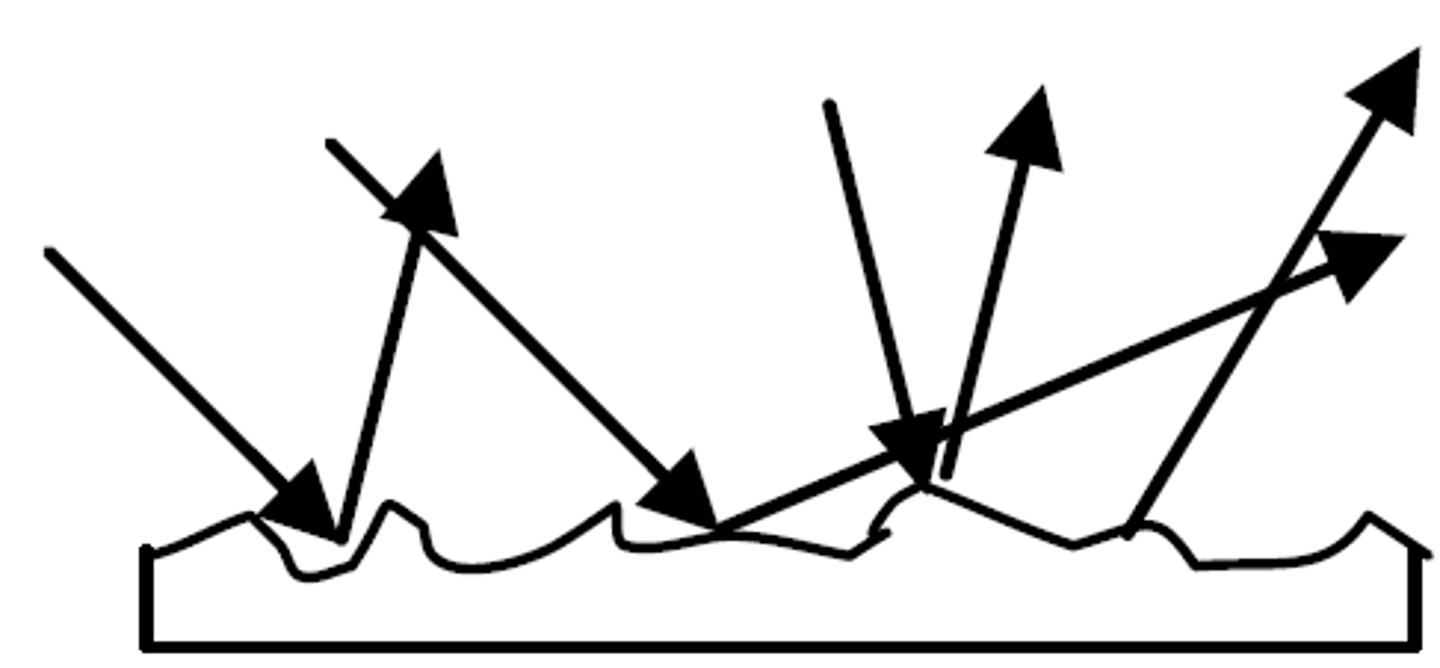
diffuse reflection
If light strikes a rough surface, the light is reflected in many different directions, called ___________________.
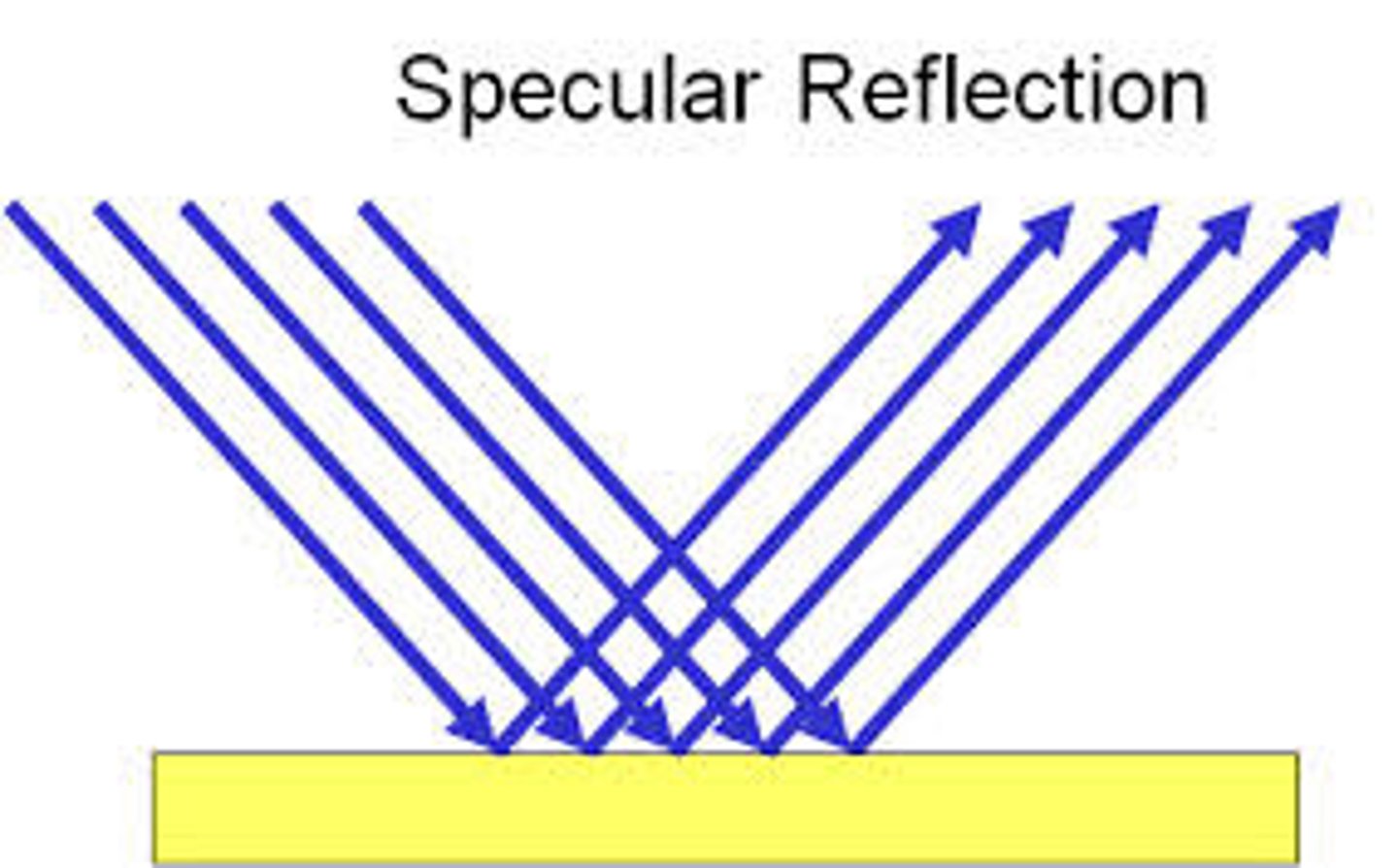
specular reflection
If light strikes a smooth surface, the light is directed in one direction, called __________________________.
angle of incidence
The angle that light strikes a surface is called the ______________________.
angle of reflection
The angle that light is reflected is called the___________________________.
normal
Angles of incidence and reflection are measured from the ____________, and are always equal.
normal line
the line that is perpendicular to a surface
flat mirrors
The simplest type of mirror
upright, same size, virtual
describe flat mirror image
sphere
A curved mirror is part of a ___________.
inward
Concave mirrors curve __________.
radius of curvature
the radius of the sphere that the curved mirror is a part of is called the ___________________.
real image
an image formed by the intersection of light rays. Can be projected on a screen
real and virtual
concave mirrors can produce __________ images.
Focal Length
a distance that is half of radius of curvature
real image at f, a point
Concave mirror, object at infinity - Describe image
Real image between c and f, inverted, smaller
Concave mirror, object outside c- Describe image
real image at c, inverted, same size
Concave mirror, object at c - Describe image
real image behind c, inverted, bigger
Concave mirror, object between c and f - Describe image
image at infinity (no image)
Concave mirror, object at f - Describe image
virtual, upright image at c, bigger
Concave mirror, object inside f (between f and mirror) - Describe image
Object inside f
What is the only case that a concave mirror produces a virtual image?
convex mirrror
A spherical mirror in which light is reflected from the outer surface, also called a diverging mirror.
virtual; reduced; upright
Convex mirrors always produce a ___________ image ______________ in size. The image is always __________ in orientation.
convex
This mirror has a negative image distance and a negative focal length, and the image is upright.
Spherical aberration
a situation in which parallel rays far from the principal axis converge aways from the focal point. This produces a blurred image.
parabolic mirrors
curved mirrors with a small diameter. These mirrors reduce spherical aberration.
diffuse, rough
Snow reflects almost all of the light incident upon it. However, a single beam of light is not reflected in the form of parallel rays. This is an example of ____ reflection off a ____ surface.
smooth, specular
A highly polished finish on a new car provides a _____ surface for ______ reflection.
close to the mirror's surface
When incoming rays of light strike a flat mirror at an angle close to the surface of the mirror, the reflected rays are
the angles of incidence and reflection are equal.
When a straight line is drawn perpendicular to a flat mirror at the point where an incoming ray strikes the mirror's surface, the angles of incidence and reflection are measured from the normal and
27° from the normal
If a light ray strikes a flat mirror at an angle 27° from the normal, the reflected ray will be
the same size as the object
The image of an object in a flat mirror is always
virtual, upright, and magnification equal to one
Which of the following best describes the image produced by a flat mirror?
magnification
the ratio of an object's image size to its real size
convex mirror
What type of mirror is used whenever a magnified image of an object is needed?
30 cm
If a virtual image is formed 10.0 cm along the principal axis from a convex mirrow with a focal length of -15.0cm, what is the object's distance from the mirror.
-12 cm
A convex mirror with a focal length of -20.0 cm has an object 30.0 cm in front of the mirror. What is the value of q for the corresponding image?
diffuse reflection
specular reflection
52°, accodring to the law of refleciton, the angle of incidence is equal to the angle of reflection
If a light ray strikes a flat mirror with an angle of incidence equal to 52°, what is the angle of reflection?
the law of reflection
the angle of incidence is equal to the angle of reflection
Flat mirrors will always form a virtual image that appears to originate behind the mirror.
When drawing a ray diagram of a flat mirror, why are the reflected rays traced back to a point behind the mirror?
principal axis
The focal point and center of curvature of a spherical mirror all lie along the ____________________.
back along itself through c
A line is ran from the object to a spherical mirror and passes through the center of curvature. How should the reflected ray be drawn?
virtual
What kind of images do flat mirrors always form?
real images can be displayed on a surface; virtual ones can't.
What is the main difference between real and virtual images?

