PEU: The European Council
 Studied by 2 people
 Call Kai
 Learn
Learn Practice Test
 Spaced Repetition
 Match
Match Flashcards
 Knowt Play
1/15

There's no tags or description
Looks like no tags are added yet.
Name | Mastery | Learn | Test | Matching | Spaced | Call with Kai |
|---|
No analytics yet
Send a link to your students to track their progress
16 Terms
Summit diplomacy
highest diplomatic and political level
Level of heads of states and governments
European council: created + treaties
Created to provide leadership and sometimes quick response
Summit in Paris in 1974: institutionalize the gatherings
Lisbon treaty made European council a formal institution of the EU
European Council outline
The European Council shall provide the Union with the necessary impetus for its development and shall define the general political directions and priorities thereof. It shall not exercise legislative functions.
The European Council shall consist of the Heads of State or Government of the Member States, together with its President and the President of the Commission. The High Representative of the Union for Foreign Affairs and Security Policy shall take part in its work.
The European Council shall meet twice every six months, convened by its President. When the agenda so requires, the members of the European Council may decide each to be assisted by a minister and, in the case of the President of the Commission, by a member of the Commission. When the situation so requires, the President shall convene a special meeting of the European Council.
Except where the Treaties provide otherwise, decisions of the European Council shall be taken by consensus.
Rarely votes
European council: power
Huge importance as it brings heads of states and governments of member states together —> no legal power
Large impact on the other institutions
Council largely politically influenced by European council as if something is decided by head of state it will be passed on to ministers in the Council
European Council: Functions
confidence-building at the highest political level
Identifying medium and long term EU goals
Initiating policies and setting the general guidelines
Contributes to coordination of policy goals
It is a political decision-maker (not a legislative decision maker)
Examples of Constitutional and Institutional matters on the agenda
treaty development and reform
Institutional matters such as the number of seats in the EP
Personnel decisions such as appointing its President, theHRVP, President of the ECB, formally appointing the Commission, etc.
European Council: when do they meet
4 times a year in Brussels (since 2003)
2 times per 6 months
Before that meetings were held in the capital of the current sitting president
Extraordinary and informal meetings over two days including dinner, fireside chats and a family photo (group photo)
Who sits in the E Council?
Members:
heads of states OR governments
Prime ministers/presidents
European council president
President of the European Commission
Non-members
High representative for Foreign Affairs and Security Policy (HRVP) attends for external relations agenda
Since Seville: restriction of two participants per member state
Since Lisbon: more sessions with only Heads of states or governments
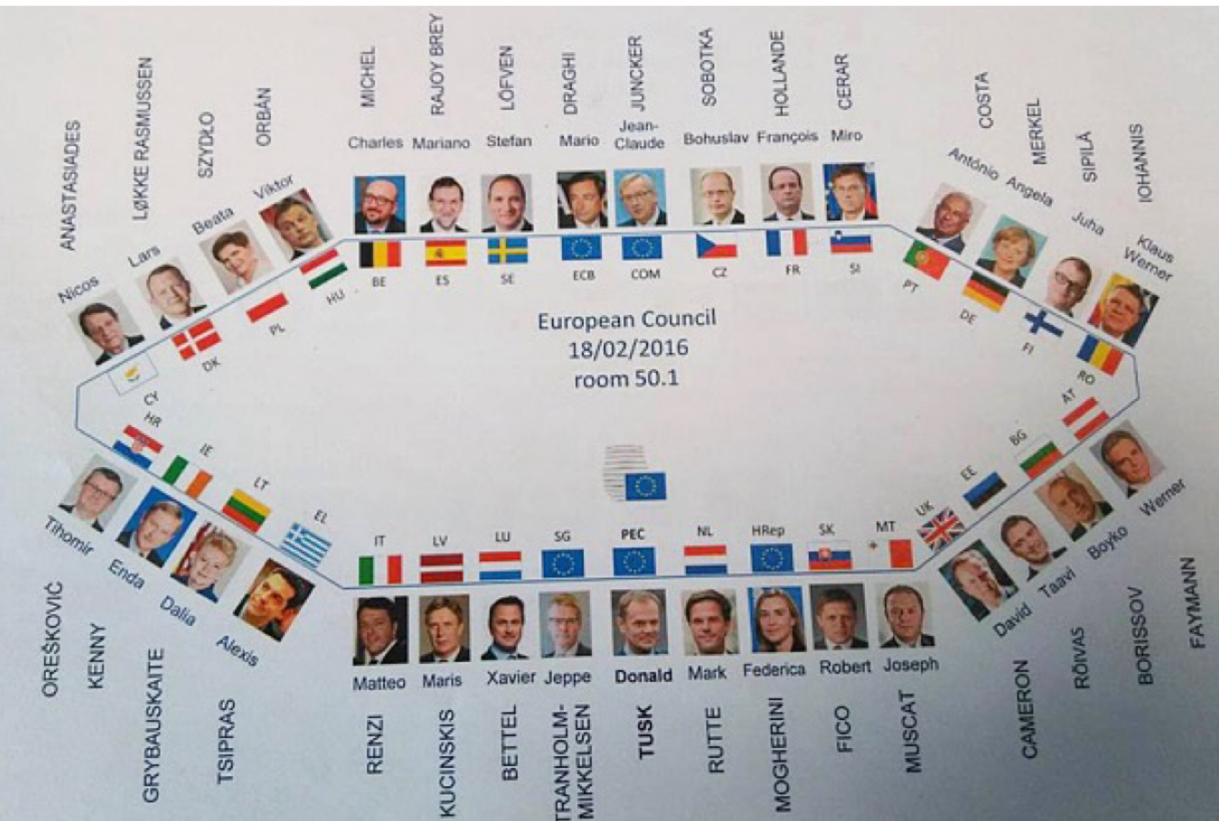
E Council: seating order
President and Secretariat General sit next to each other
Directly across from them, President of Commission and European Central Bank (ECB)
Around them sits the heads of state/government from the member states
E Council: decision making
Results = European Council conclusions
Political decision made by European Council but actual action will be taken by other institutions like the Council and Commission as they can create legislation
Dynamics of negotiations: doorstep comments
Signals to public and the other member states what their position is on topics that will be discussed —> very thought out and purposeful
Ex. Main question of 2019 Brexit was if the UK was going to be given an extension
How does the E Council meet?
Meet formally - around the table
Meet informally - through dinners, etc
Sometimes informal meetings can be more productive/easier
President of the European Council
elected for 2.5 years by the European Council by QMV
Can be re-elected once → president for 5 years
External representation
Meet with external leaders → outside of Europe
Semi-permanent Chair of the European Council
Facilitates cohesion and consensus
Convenes extraordinary meetings of the European Council
Clear ambitions in the area of external relations
Informal tradition that president should come from ones that have been around the table —> heads of state (prime ministers) (not current ones)
Should have already been at the table not first getting there as president
Should the Candidate for President always have support of her/his member state? Poland example
No it does not
Tusk was supported by the Polish government his first term as European Council president, however when reelection came the government in Poland had changed and they did not support him
Created a lot of discussion around support from ‘home’ country needed or not to be president
Decision was that the support was not needed —> their role is outside and above their home country
Each country still gets representation through their heads of state/gov
Is the position of the President being politicized?
Inside the European Council the president needs to be a broker (no position taken)
Outside though it can be good for a political view to be taken —> contributes to more people becoming interested, contributed to EU polity
Examples of politicized role of President
Tusk uniting and creating/finding consensus with the member states is the role of the president and he was able to do that with a more political view point
Examples of what the president does through politics (politicization)
External relations
Media statements
Traveling to speak to other heads of states
 Note
Note  Flashcards (61)