L4 Processes in the biosphere
 Studied by 0 people
 Call Kai
 Learn
Learn Practice Test
 Spaced Repetition
 Match
Match Flashcards
 Knowt Play
1/48

There's no tags or description
Looks like no tags are added yet.
Name | Mastery | Learn | Test | Matching | Spaced | Call with Kai |
|---|
No analytics yet
Send a link to your students to track their progress
49 Terms
What is a biosphere?
Biosphere: part of Earth in which life exists including all living and non-living parts (land, water, and air)
The biosphere consists of several physical layers that contain…
• Air
• Water
• Soil
• Minerals
• Life

Levels of organization
in the biosphere:
biome
ecosystems
communities
population
individual
Ecotone
A region containing a mixture of species from adjacent ecosystems and often species not found
in either of the bordering ecosystems.
A transitional zone between ecosystems
What sustains life on earth?
Energy from the sun through materials and living things in food webs then into the environment as long as low quality energy (mostly heat) and then back into space as heat
The earth is an OPEN system from energy
The Cycling of matter through parts of the biosphere.
The earth is a CLOSED system for matter.
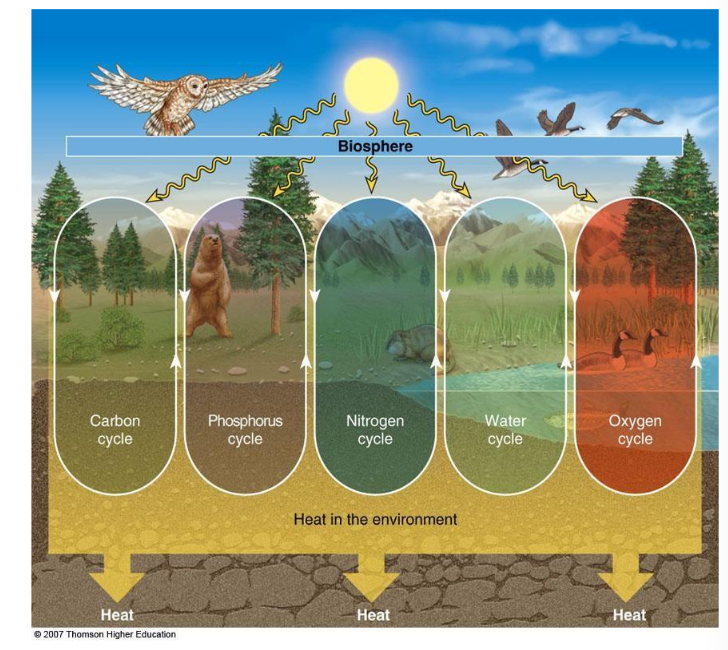
Gravity
which allows the planet to hold on to its atmosphere and causes the downward movement of chemicals in the matter cycles.
ENERGY FLOW AND BIOGEOCHEMICAL CYCLES
An ecosystem survives by a combination of energy flow and matter recycling.
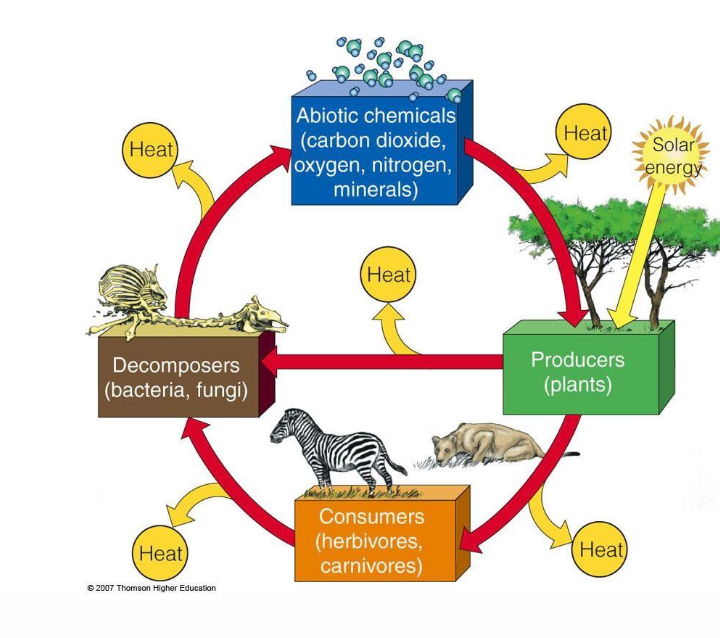
What is energy flow?
Energy flow is the flow of energy through living things within an ecosystem.
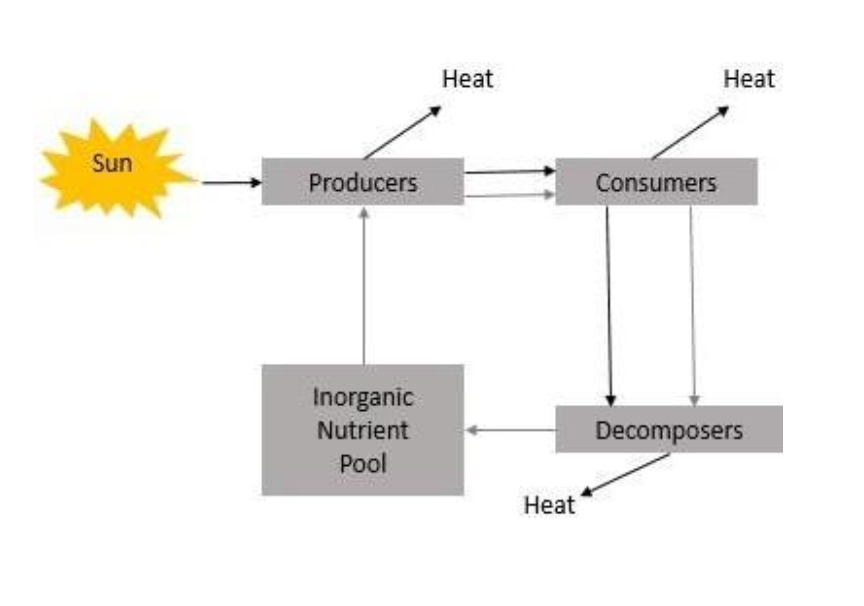
Biogeochemical cycles
The biogeochemical cycle involves the movement of elements and compounds among the land (lithosphere), organisms, air (atmosphere) and the oceans (hydrosphere).
Human activities can affect these cycles
Producers or autotrophs
Make their own food from compounds obtained from their environment.
ex: green plants on land, algae and plants near shorelines, phytoplankton in open water
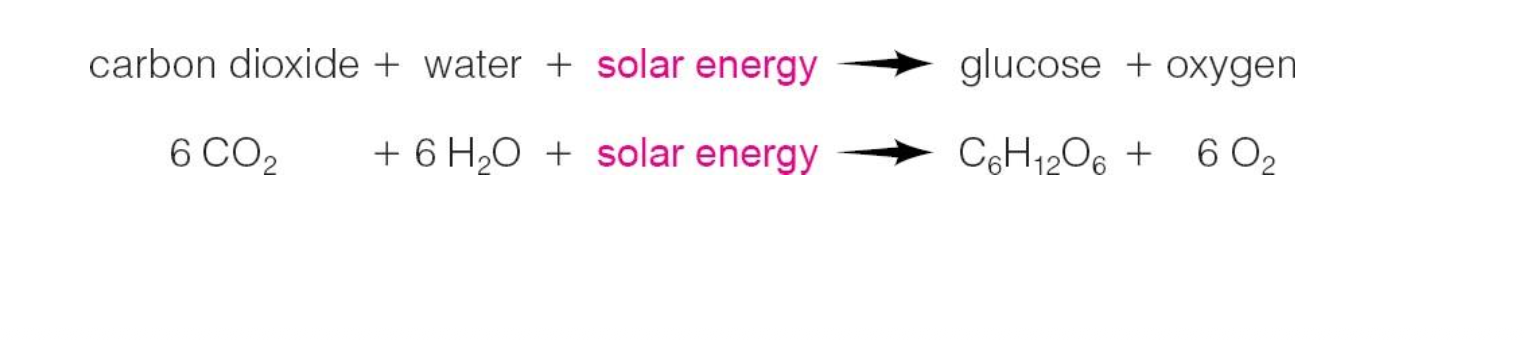
Most producers capture sunlight to produce carbohydrates by photosynthesis.
But…..Some organisms such as deep ocean bacteria draw energy from hydrothermal vents and produce carbohydrates from hydrogen sulphide (H2S) gas. (chemosynthesis)
Anaerobic respiration or fermentation:
Some decomposers get energy by breaking down glucose (or other organic compounds) in the absence of oxygen.
The end products vary based on the chemical reaction
Methane gas
Ethyl alcohol
Acetic acid
Hydrogen sulfide
Type of heterotrophs
that consume organic material for energy, relying on other organisms for food.
Herbivores
consume only plants
Omnivores
consume both plants and animals
Detritivores
consume plant and animal remains (earthworms, mites, crabs)
Decomposer
breaks down organic matter to obtain energy (bacteria & fungi)
Energy flow in ecosystem
Energy in an ecosystem flows in one direction (from sun to the heterotrophs)
Food chain- a series of steps in which organisms transfer energy by eating and being eaten
Only about 10% of energy is transferred to organisms at the next trophic level: 10% --> 1% --> 0.1%
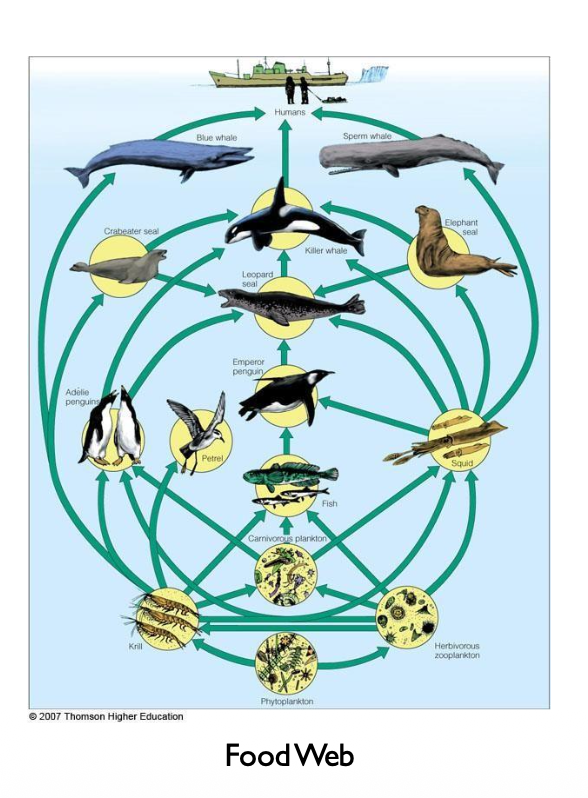
Ecological efficiency
Percentage of useable energy transferred as biomass from one trophic level to the next.
Gross primary production (GPP)
Rate at which an ecosystem’s producers convert solar energy into chemical energy as biomass.
Biomass
the dry weight of all organic matter contained in the organisms at
each trophic level in a food chain or web.
Net primary production (NPP)
is the amount of biomass or carbon produced by primary producers per unit area and time.
NPP = GPP – R
Rate at which producers use photosynthesis to store energy minus the rate at which they use some of this energy through respiration (R).
Nature’s three most productive and three least productive systems
Terrestrial and aquatic
swamps and marshes, tropical rainforest, temperate forest
Estuaries, lakes and streams, continental shelf
Key questions for biomes and biodiversity
WHY should we protect the planet’s biological diversity?
….but first, a look at the world’s major biomes
HOW should we protect the planet’s biological diversity?
What is a biome
are broad types of biological, flora and fauna, communities with characteristic types of environments that occur in different conditions of temperature and precipitation.
5 major types of biomes
Tundra, desert, grassland, forest, aquatic
Tropical Rainforests have a Moisture Surplus
Tropical rainforests occur where rainfall is abundant—more than 200 cm (80 in.) per year— and temperatures are warm to hot year-round.
Tropical Savannas and Grasslands are Dry Most of the Year
Primary plant life is grass. Occurs in variety of climates.
Where there is too little rainfall to support forests, we find open grasslands or grasslands with often sparse tree cover, which we call savannas.
Deserts are Hot or Cold, but Always Dry
Arid environment, little precipitation, four types: hot, semi-arid, coastal, and cold
Deserts occur where precipitation is uncommon and slight, usually with less than 30 cm of rain per year.
Temperate Grasslands have Rich Soils
As in tropical latitudes, temperate (midlatitude) grasslands occur where there is enough rain to support abundant grass but not enough for forests.
Temperate Forests can be Evergreen or Deciduous
Include deciduous forests and rain forests. Temperate deciduous forests have hot summers and cold winters. Deciduous trees are the dominant plant species
These forests are grouped by tree type, broad-leaved deciduous (losing leaves seasonally) or evergreen coniferous (cone-bearing).
Temperate Rainforests
Warm temperatures, abundant precipitation all year, lush forests
The coniferous forests of the Pacific coast grow in extremely wet conditions. The wettest coastal forests are known as temperate rainforest, a cool, rainy forest often enshrouded in fog.
Boreal Forests (Taiga) Lie North of the Temperate Zone
Because conifers (針葉樹) can survive winter cold, they tend to dominate the boreal forest.
Boreal forests are found in Siberia, Canada, and the western United States.
Tundra Can Freeze in Any Month
Far northern latitudes with long winters (10 months) limited precipitation, permafrost
Compared to other biomes, tundra has relatively low diversity.
Temperatures are below freezing most of the year, making water unavailable to plants.
Tundra occurs at high latitudes or on mountaintops.
Ecological diversity
different habitats, niches, species interactions
Species diversity
different kinds of organisms, relationships among species
Genetic diversity
different genes & combinations of genes within populations
What happens when the species population gets too small?
It can lead to inbreeding depression, reduced genetic diversity, and increased vulnerability to extinction.
Biodiversity hot spots
Most of the world’s biodiversity concentrations are near the equator, especially tropical rainforests and coral reefs.
Of all the world’s species, only 10 to 15 percent live in North America and Europe.
Many of the organisms in megadiversity countries have never been studied by scientists.
Why should we protect the planet’s biological diversity?
What threatens biodiversity?
Habitat destruction, climate change, invasive species, and overexploitation.
BENEFITS OF BIODIVERSITY: ECOSYSTEM STABILITY
High diversity may help biological communities withstand environmental stress better and recover more quickly than those with fewer species
Keystone species: Sometimes, removing just one key species can severely disrupt the ecological balance
Maintaining biodiversity is essential to preserving ecological services
ex: Food, Medicine, Aesthetic and Existence Values
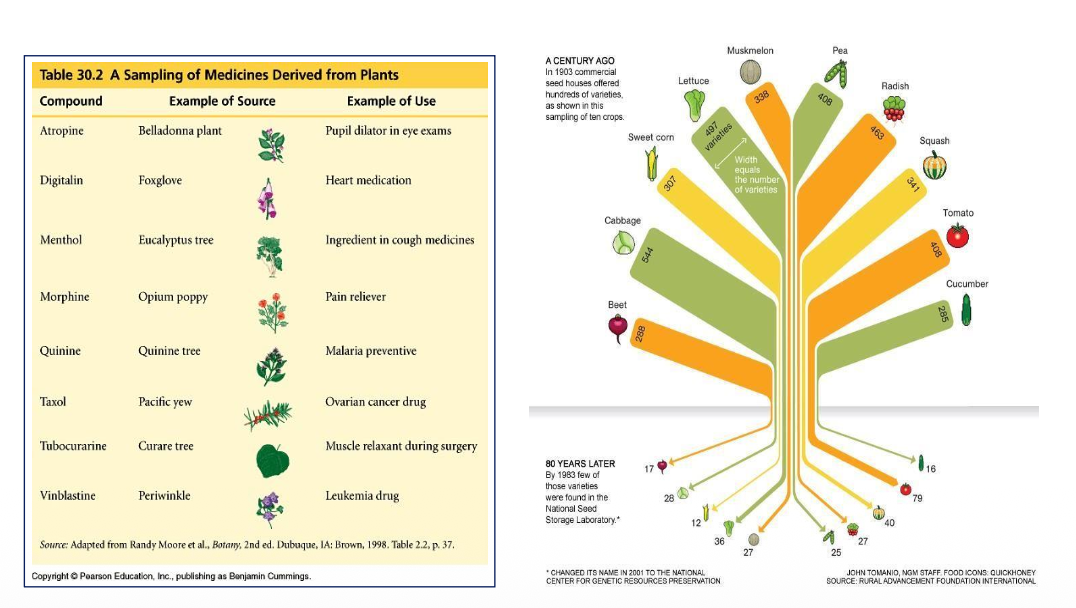
What threatens biodiversity?
Extinction, the elimination of a species, is a normal process of the natural world
However, we are in the midst of a sixth wave of mass extinction (the Anthropocene?)
Current threats
Habitat destruction
Fragmentation
Invasive species
Pollution
Human population growth
Overharvesting
Predator and pest control
To stop it we must
Stop overharvesting
Sustainable yield
Hunting & fishing laws (every state?) in developing nations?
Protect habitat
Refuges, parks, preserves
Endangered Species Act
McArthur & Wilson “Theory of Island Biogeography”
colonization rate
extinction rate (local)
generation of new species
Island Biogeography
Island size predicts number of species
Everyplace is an island
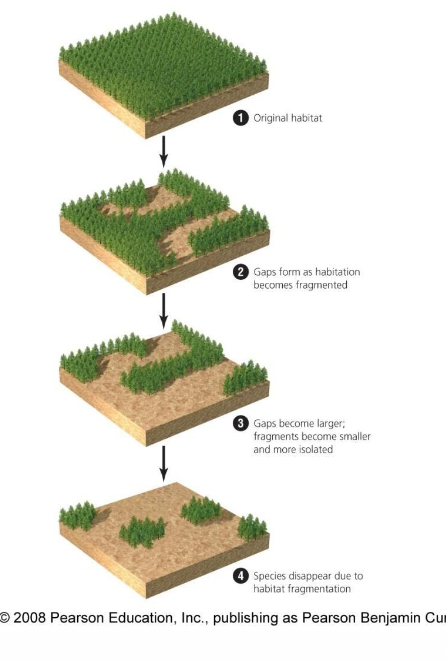
Habitat fragmentation
Smaller fragments hold fewer species
Amazon Rainforest
20 million people
60-70% urban
500k indigenous (a hotspot for cultural diversity)
Contains largest rainforest in world (1.4 billion acres)
Most biodiverse area in the world
Largest carbon sink
Settling the frontier
building roads
timber harvesting
slash and burn agriculture (shifting cultivation)
burning the remaining forest
large scale agriculture and cattle ranching
making the land productive “Most deforestation is occurring due to conversion for agriculture and cattle”
PROTECTINGTHE FRONTIER:AMAZON REGION PROTECTED AREAS PROGRAM (ARPA)
ARPA sets aside vast tracts of land for both preservation and sustainable use.
Works with local communities
Deforestation has increased in recent years due to rising commodity prices and a weakening of the Forest
 Note
Note  Flashcards (25)