Honors Global Citizenship & Service - Unit 2 Test L1-10
 Studied by 1 person
 Call Kai
 Learn
Learn Practice Test
 Spaced Repetition
 Match
Match Flashcards
 Knowt Play
1/202

There's no tags or description
Looks like no tags are added yet.
Name | Mastery | Learn | Test | Matching | Spaced | Call with Kai |
|---|
No analytics yet
Send a link to your students to track their progress
203 Terms
(U2 L1: The United Nations Goal #1 - Human Rights) Goals of the United Nations
Human Rights
Sustainable Development
Peace and Security
(U2 L1: The United Nations Goal #1 - Human Rights) What is the DEFINITION of humans rights?
Rights inherent to all human beings, regardless of race, sex, nationality, ethnicity, language, religion, or any other status
(U2 L1: The United Nations Goal #1 - Human Rights) The Universal Declaration of Human Rights: WHO
UN, Committee of human rights
(U2 L1: The United Nations Goal #1 - Human Rights) The Universal Declaration of Human Rights: WHAT
An international document adopted by the UN General Assembly in 1948
Foundational text in the history of human and civil rights
(U2 L1: The United Nations Goal #1 - Human Rights) The Universal Declaration of Human Rights: WHERE
Everywhere, not country-specific
Most translated text
(U2 L1: The United Nations Goal #1 - Human Rights) The Universal Declaration of Human Rights: WHEN
1945
(U2 L1: The United Nations Goal #1 - Human Rights) The Universal Declaration of Human Rights: WHY
To protect human rights worldwide
Inspire national human rights protection
Saw how people were treated in WW2
(U2 L1: The United Nations Goal #1 - Human Rights) Eleanor Roosevelt
Strong connection to people due to her travels during the war
Offered a spot in UN delegation
Chairperson on UN Committee for human rights and helped write Declaration
She was ostracized at first
“All men” → “All human beings”
(U2 L1: The United Nations Goal #1 - Human Rights) Article Analysis: Read each article of the Universal Declaration of Human Rights. Next to each article, draw:
+ (Plus sign) if the article secures or grants a right — something people should have or be able to do.
- (Minus sign) if the article is preventative — something that protects people from harm, abuse, or unfair treatment.
We are born free and equal, and should treat others in the same way.
+
(U2 L1: The United Nations Goal #1 - Human Rights) Article Analysis: Read each article of the Universal Declaration of Human Rights. Next to each article, draw:
+ (Plus sign) if the article secures or grants a right — something people should have or be able to do.
- (Minus sign) if the article is preventative — something that protects people from harm, abuse, or unfair treatment.
We have all these rights in the Declaration, no matter who we are, where we’re from or what we believe in.
+
(U2 L1: The United Nations Goal #1 - Human Rights) Article Analysis: Read each article of the Universal Declaration of Human Rights. Next to each article, draw:
+ (Plus sign) if the article secures or grants a right — something people should have or be able to do.
- (Minus sign) if the article is preventative — something that protects people from harm, abuse, or unfair treatment.
We have the right to life, and to be free and feel safe.
+
(U2 L1: The United Nations Goal #1 - Human Rights) Article Analysis: Read each article of the Universal Declaration of Human Rights. Next to each article, draw:
+ (Plus sign) if the article secures or grants a right — something people should have or be able to do.
- (Minus sign) if the article is preventative — something that protects people from harm, abuse, or unfair treatment.
Nobody has any right to make us a slave. We cannot make anyone else our slave.
-
(U2 L1: The United Nations Goal #1 - Human Rights) Article Analysis: Read each article of the Universal Declaration of Human Rights. Next to each article, draw:
+ (Plus sign) if the article secures or grants a right — something people should have or be able to do.
- (Minus sign) if the article is preventative — something that protects people from harm, abuse, or unfair treatment.
Nobody has any right to hurt, torture or humiliate us.
-
(U2 L1: The United Nations Goal #1 - Human Rights) Article Analysis: Read each article of the Universal Declaration of Human Rights. Next to each article, draw:
+ (Plus sign) if the article secures or grants a right — something people should have or be able to do.
- (Minus sign) if the article is preventative — something that protects people from harm, abuse, or unfair treatment.
Everyone has the right to be protected by the law.
+
(U2 L1: The United Nations Goal #1 - Human Rights) Article Analysis: Read each article of the Universal Declaration of Human Rights. Next to each article, draw:
+ (Plus sign) if the article secures or grants a right — something people should have or be able to do.
- (Minus sign) if the article is preventative — something that protects people from harm, abuse, or unfair treatment.
The law is the same for everyone. It must treat us all fairly.
+
(U2 L1: The United Nations Goal #1 - Human Rights) Article Analysis: Read each article of the Universal Declaration of Human Rights. Next to each article, draw:
+ (Plus sign) if the article secures or grants a right — something people should have or be able to do.
- (Minus sign) if the article is preventative — something that protects people from harm, abuse, or unfair treatment.
We can all ask for the law to help us when we are not treated fairly.
+
(U2 L1: The United Nations Goal #1 - Human Rights) Article Analysis: Read each article of the Universal Declaration of Human Rights. Next to each article, draw:
+ (Plus sign) if the article secures or grants a right — something people should have or be able to do.
- (Minus sign) if the article is preventative — something that protects people from harm, abuse, or unfair treatment.
Nobody has the right to put us in prison, or to send us away from our country, without good reasons.
-
(U2 L1: The United Nations Goal #1 - Human Rights) Article Analysis: Read each article of the Universal Declaration of Human Rights. Next to each article, draw:
+ (Plus sign) if the article secures or grants a right — something people should have or be able to do.
- (Minus sign) if the article is preventative — something that protects people from harm, abuse, or unfair treatment.
If we are accused of breaking the law, we have the right to a fair and public trial.
+
(U2 L1: The United Nations Goal #1 - Human Rights) Article Analysis: Read each article of the Universal Declaration of Human Rights. Next to each article, draw:
+ (Plus sign) if the article secures or grants a right — something people should have or be able to do.
- (Minus sign) if the article is preventative — something that protects people from harm, abuse, or unfair treatment.
Nobody should be blamed for doing something until it has been proved that they did it.
-
(U2 L1: The United Nations Goal #1 - Human Rights) Article Analysis: Read each article of the Universal Declaration of Human Rights. Next to each article, draw:
+ (Plus sign) if the article secures or grants a right — something people should have or be able to do.
- (Minus sign) if the article is preventative — something that protects people from harm, abuse, or unfair treatment.
Nobody has the right to enter our home, open our letters or bother us or our families without a good reason.
-
(U2 L1: The United Nations Goal #1 - Human Rights) Article Analysis: Read each article of the Universal Declaration of Human Rights. Next to each article, draw:
+ (Plus sign) if the article secures or grants a right — something people should have or be able to do.
- (Minus sign) if the article is preventative — something that protects people from harm, abuse, or unfair treatment.
We all have the right to go where we want to in our own country and to travel abroad as we wish.
+
(U2 L1: The United Nations Goal #1 - Human Rights) Article Analysis: Read each article of the Universal Declaration of Human Rights. Next to each article, draw:
+ (Plus sign) if the article secures or grants a right — something people should have or be able to do.
- (Minus sign) if the article is preventative — something that protects people from harm, abuse, or unfair treatment.
If someone hurts us, we have the right to go to another country and ask for protection.
+
(U2 L1: The United Nations Goal #1 - Human Rights) Article Analysis: Read each article of the Universal Declaration of Human Rights. Next to each article, draw:
+ (Plus sign) if the article secures or grants a right — something people should have or be able to do.
- (Minus sign) if the article is preventative — something that protects people from harm, abuse, or unfair treatment.
We all have the right to belong to a country.
+
(U2 L1: The United Nations Goal #1 - Human Rights) Article Analysis: Read each article of the Universal Declaration of Human Rights. Next to each article, draw:
+ (Plus sign) if the article secures or grants a right — something people should have or be able to do.
- (Minus sign) if the article is preventative — something that protects people from harm, abuse, or unfair treatment.
When we are legally old enough, we have the right to marry and have a family.
+
(U2 L1: The United Nations Goal #1 - Human Rights) Article Analysis: Read each article of the Universal Declaration of Human Rights. Next to each article, draw:
+ (Plus sign) if the article secures or grants a right — something people should have or be able to do.
- (Minus sign) if the article is preventative — something that protects people from harm, abuse, or unfair treatment.
Everyone has the right to own things or share them.
+
(U2 L1: The United Nations Goal #1 - Human Rights) Article Analysis: Read each article of the Universal Declaration of Human Rights. Next to each article, draw:
+ (Plus sign) if the article secures or grants a right — something people should have or be able to do.
- (Minus sign) if the article is preventative — something that protects people from harm, abuse, or unfair treatment.
We all have the right to our own thoughts and to believe in any religion.
+
(U2 L1: The United Nations Goal #1 - Human Rights) Article Analysis: Read each article of the Universal Declaration of Human Rights. Next to each article, draw:
+ (Plus sign) if the article secures or grants a right — something people should have or be able to do.
- (Minus sign) if the article is preventative — something that protects people from harm, abuse, or unfair treatment.
We can all think what we like, say what we think and share ideas and information with other people.
+
(U2 L1: The United Nations Goal #1 - Human Rights) Article Analysis: Read each article of the Universal Declaration of Human Rights. Next to each article, draw:
+ (Plus sign) if the article secures or grants a right — something people should have or be able to do.
- (Minus sign) if the article is preventative — something that protects people from harm, abuse, or unfair treatment.
We all have the right to meet our friends and work together in peace to defend our rights. It is wrong to force someone to belong to a group.
+
(U2 L1: The United Nations Goal #1 - Human Rights) Article Analysis: Read each article of the Universal Declaration of Human Rights. Next to each article, draw:
+ (Plus sign) if the article secures or grants a right — something people should have or be able to do.
- (Minus sign) if the article is preventative — something that protects people from harm, abuse, or unfair treatment.
We all have the right to take part in the government of our country. Every grown up should be allowed to vote to choose their own leaders.
+
(U2 L1: The United Nations Goal #1 - Human Rights) Article Analysis: Read each article of the Universal Declaration of Human Rights. Next to each article, draw:
+ (Plus sign) if the article secures or grants a right — something people should have or be able to do.
- (Minus sign) if the article is preventative — something that protects people from harm, abuse, or unfair treatment.
The place where we live should help us to develop and to make the most of all the advantages (culture, work, social welfare) on offer. Music, art, craft and sport are for everyone to enjoy.
+
(U2 L1: The United Nations Goal #1 - Human Rights) Article Analysis: Read each article of the Universal Declaration of Human Rights. Next to each article, draw:
+ (Plus sign) if the article secures or grants a right — something people should have or be able to do.
- (Minus sign) if the article is preventative — something that protects people from harm, abuse, or unfair treatment.
Every grown up has the right to a job, to a fair wages and to join a trade union.
+
(U2 L1: The United Nations Goal #1 - Human Rights) Article Analysis: Read each article of the Universal Declaration of Human Rights. Next to each article, draw:
+ (Plus sign) if the article secures or grants a right — something people should have or be able to do.
- (Minus sign) if the article is preventative — something that protects people from harm, abuse, or unfair treatment.
We all have the right to rest and free time.
+
(U2 L1: The United Nations Goal #1 - Human Rights) Article Analysis: Read each article of the Universal Declaration of Human Rights. Next to each article, draw:
+ (Plus sign) if the article secures or grants a right — something people should have or be able to do.
- (Minus sign) if the article is preventative — something that protects people from harm, abuse, or unfair treatment.
We all have the right to a decent living standard, including enough food, clothing, housing and medical help if we are ill. Mothers and children and people who are old, out of work or disabled have the right to be cared for.
+
(U2 L1: The United Nations Goal #1 - Human Rights) Article Analysis: Read each article of the Universal Declaration of Human Rights. Next to each article, draw:
+ (Plus sign) if the article secures or grants a right — something people should have or be able to do.
- (Minus sign) if the article is preventative — something that protects people from harm, abuse, or unfair treatment.
We all have the right to education.
+
(U2 L1: The United Nations Goal #1 - Human Rights) Article Analysis: Read each article of the Universal Declaration of Human Rights. Next to each article, draw:
+ (Plus sign) if the article secures or grants a right — something people should have or be able to do.
- (Minus sign) if the article is preventative — something that protects people from harm, abuse, or unfair treatment.
We have the right to share in our community’s arts and sciences, and any good they do.
+
(U2 L1: The United Nations Goal #1 - Human Rights) Article Analysis: Read each article of the Universal Declaration of Human Rights. Next to each article, draw:
+ (Plus sign) if the article secures or grants a right — something people should have or be able to do.
- (Minus sign) if the article is preventative — something that protects people from harm, abuse, or unfair treatment.
There must be peace and order to protect these rights and freedoms, and we can enjoy them in our country and all over the world.
+
(U2 L1: The United Nations Goal #1 - Human Rights) Article Analysis: Read each article of the Universal Declaration of Human Rights. Next to each article, draw:
+ (Plus sign) if the article secures or grants a right — something people should have or be able to do.
- (Minus sign) if the article is preventative — something that protects people from harm, abuse, or unfair treatment.
We have a duty to other people, and we should protect their rights and freedoms.
+
(U2 L1: The United Nations Goal #1 - Human Rights) Article Analysis: Read each article of the Universal Declaration of Human Rights. Next to each article, draw:
+ (Plus sign) if the article secures or grants a right — something people should have or be able to do.
- (Minus sign) if the article is preventative — something that protects people from harm, abuse, or unfair treatment.
Nobody can take away these rights and freedoms from us.
-
(U2 L1: The United Nations Goal #1 - Human Rights) Article Analysis:
After reviewing the entire document, which type of article did you find more of — those that secure rights or those that prevent injustice? Why do you think the authors of the UDHR made that balance, considering the historical context in which it was written?
There are more that secure rights to grant more rights that should be given for protection rather than restrict them from people.
This was written after WWII/holocaust → not many rights, so we need them to be provided.
(U2 L1: The United Nations Goal #1 - Human Rights) Article Analysis:
Why do you think the UDHR begins with equality and dignity before listing specific rights? What does that reveal about the authors’ intentions?
They begin with equality and dignity to show how equality and dignity are the foundation and each right will clarify how everyone will be treated equally.
(U2 L1: The United Nations Goal #1 - Human Rights) Article Analysis:
In articles 4, 5, and 6, what three rights are guaranteed to all citizens of all nations?
4: freedom from slavery
5: freedom from torture
6: right to be protected by the law
(U2 L1: The United Nations Goal #1 - Human Rights) Article Analysis:
Comparison: The US Bill of Rights grants the right to a speedy public trial when we are accused of breaking the law. What article grants similar rights?
10
(U2 L1: The United Nations Goal #1 - Human Rights) Article Analysis:
If this includes specific rights for people, what can be assumed was (or was not) happening around the world?
We can assume that some of these things, like slavery or torture, were happening around the world so violations had to be addressed.
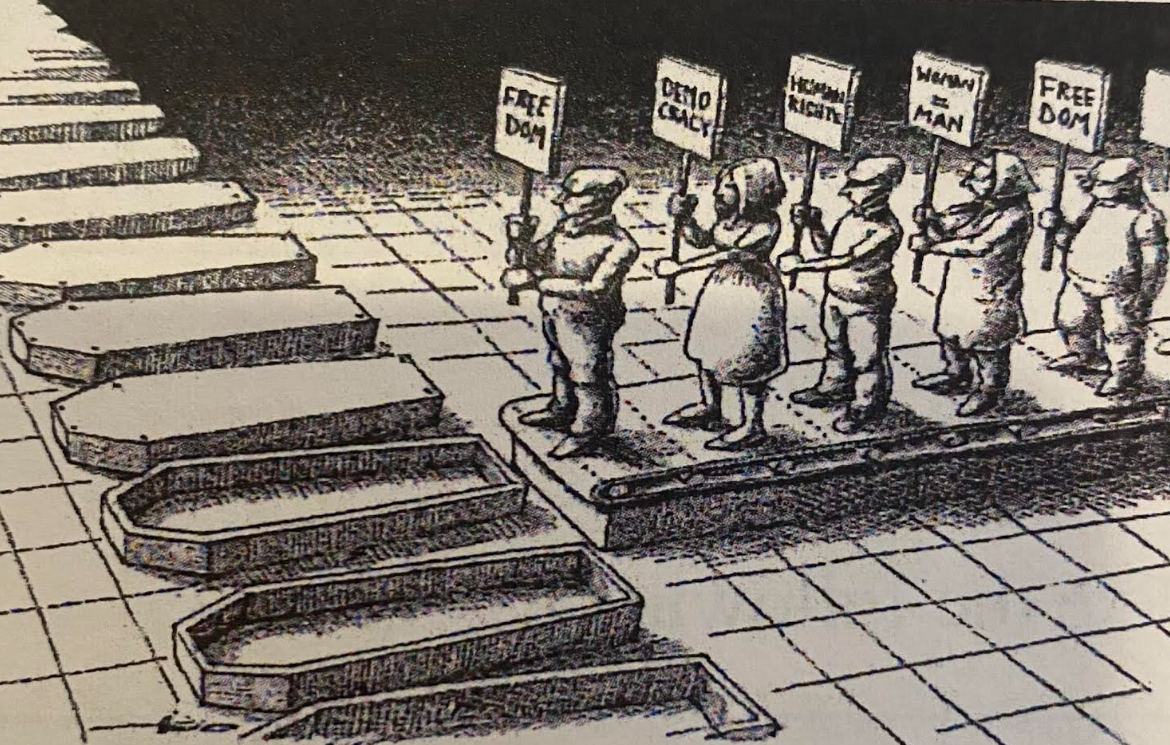
(U2 L2: Tracking Human Rights) Reflection: Political Cartoon Analysis
These human rights are established but aren’t carried out and eventually die.
People are willing to fight for rights till death.
→ In the end, rights 😵
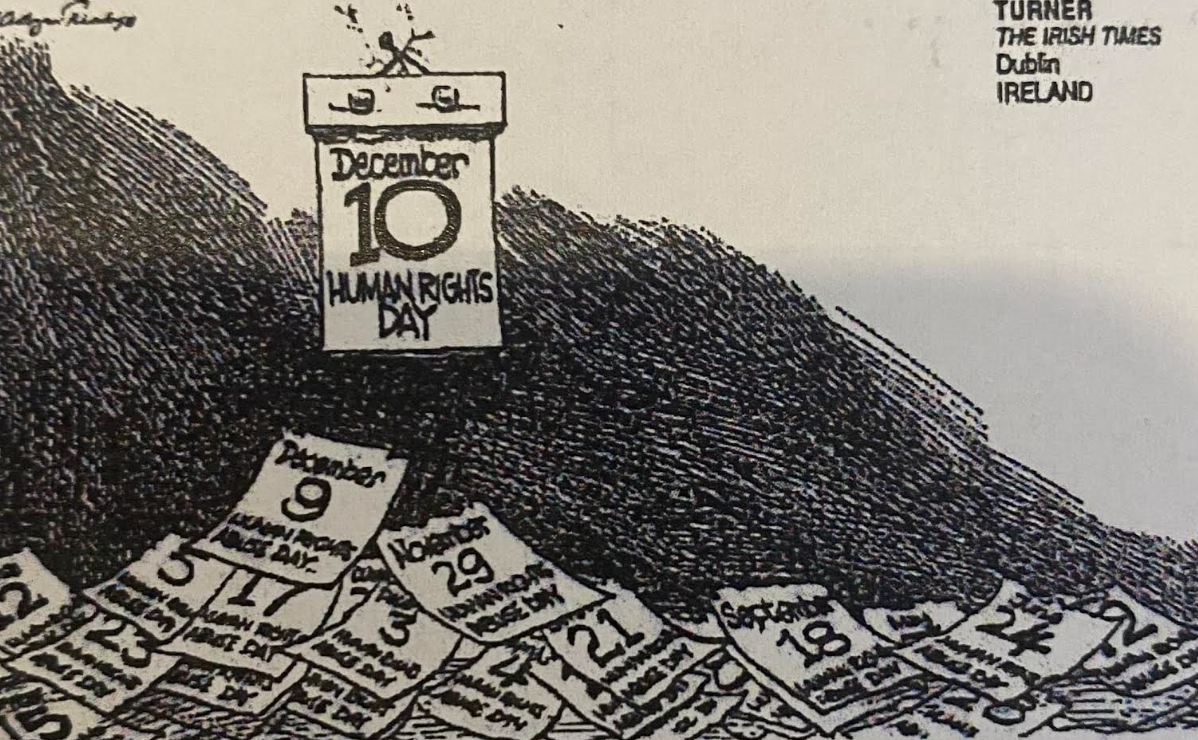
(U2 L2: Tracking Human Rights) Reflection: Political Cartoon Analysis
Everyday should be about human rights, not just one day because the days we are not celebrating, human rights are forgotten. Even the rights we do celebrate, they are barely granted.
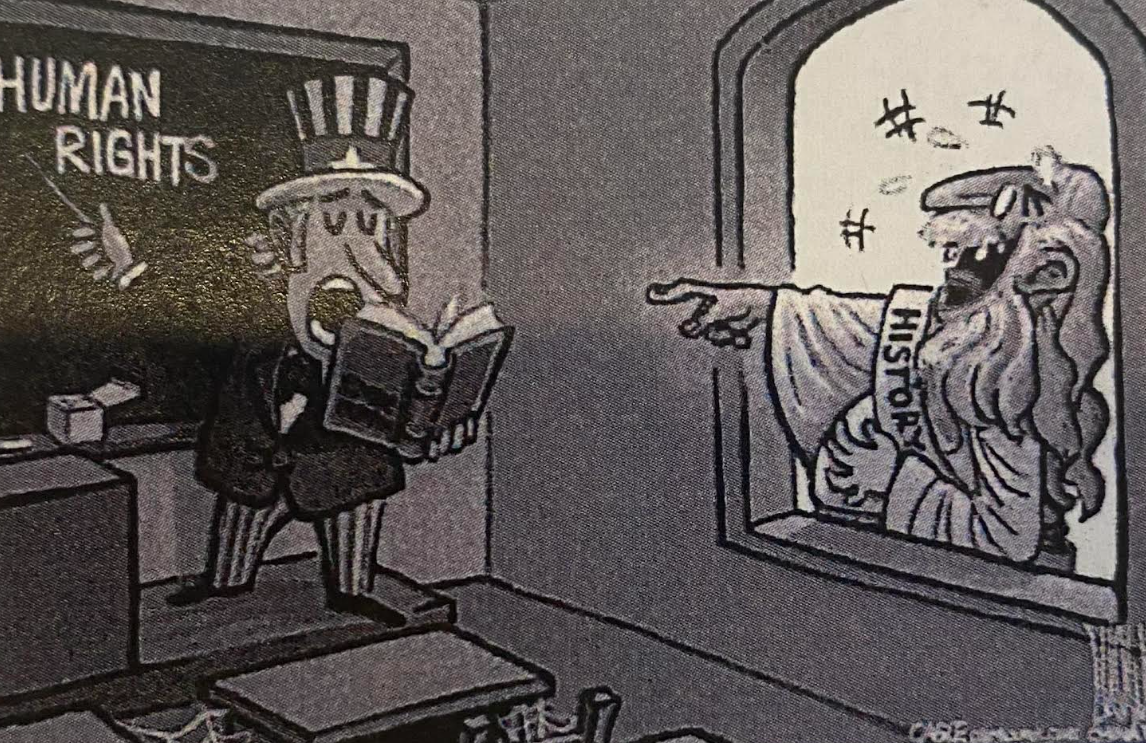
(U2 L2: Tracking Human Rights) Reflection: Political Cartoon Analysis
We talk about human rights but no one is listening and we haven’t learned from the lessons of the past.
Ex> slavery is mocking us…
(U2 L2: Tracking Human Rights) Means of Protection: Conventions
Convention on the Prevention and Punishment of the Crime of Genocide
Year: 1948 (Universal Declaration of Human Rights, after WWII/holocaust)
WHAT IT DID:
criminalize genocide (term didn’t exist until Holocaust)
allows forcing of countries to get involved if there are signs of genocide (approves punishments)
(U2 L2: Tracking Human Rights) Means of Protection: Conventions
The International convention on the Elimination of All Forms of Racial Discrimination
Year: 1965 (Civil Rights Movement in US and other countries)
WHAT IT DID:
crime to… have hate speech (targeting group w/ identifying feature) + joining hate group/racist organizations (KKK)
(U2 L2: Tracking Human Rights) Means of Protection: Conventions
The Convention on the Elimination of All Forms of Discrimination Against Women
Year: 1979
WHAT IT DID:
lists what is expected to be provided/what can’t be taken away to women in all countries (AKA Bill of Rights for women)
Ex> Taliban
(U2 L2: Tracking Human Rights) Means of Protection: Conventions
The Convention on the Rights of the Child
Year: 1989
WHAT IT DID:
<18 = child → special time in life where you’re protected
children = individuals with rights
Ex> child labor
(U2 L2: Tracking Human Rights) Means of Protection: Conventions
The Convention on the Rights of Persons with Disabilities
Year: 2006
WHAT IT DID:
disabled = people with rights, not objects for charity
Ex> school → IEP, wheelchair ramps
(U2 L2: Tracking Human Rights) Means of Protection: Positions
Human Rights Council (UNHRC): WHEN
Established in 2006, replaced an old commission
(U2 L2: Tracking Human Rights) Means of Protection: Positions
Human Rights Council (UNHRC): WHO
47 state representatives
(U2 L2: Tracking Human Rights) Means of Protection: Positions
Human Rights Council (UNHRC): WHY
to strengthen promotion & protection of human rights, make recommendations
(U2 L2: Tracking Human Rights) Means of Protection: Positions
Human Rights Council (UNHRC): HOW
Universal Periodic Review every 4 years → any violations through studying of country/data that should be addressed?
(U2 L2: Tracking Human Rights) Means of Protection: Positions
UN High Commissioner for Human Rights: WHY
principal responsibility
(U2 L2: Tracking Human Rights) Means of Protection: Positions
UN High Commissioner for Human Rights: HOW
mandated to respond to violations and take preventative action (increase police presence)
Office of the High Commissioner for Human Rights (OHCHR)
(U2 L2: Tracking Human Rights) Facts & Statistics - Reading: Human rights have become much more protected around the world
Compared to one or two centuries ago, human rights today are ______ _________.
better protected
(U2 L2: Tracking Human Rights) Facts & Statistics - Reading: Human rights have become much more protected around the world
During the 18th century or 1700s, the average score was only ___. During the 19th century or 1800s there were slow improvements, but these were largely undone by the _____ ____. Thankfully, despite setbacks, overall the 20th century or 1900s saw improvements.
0.3
world wars
(U2 L2: Tracking Human Rights) Facts & Statistics - Description & Human Rights Index Charts (Map / Marimekko)
Read the description of the chart. Things that are considered when determining human rights are being FREE FROM…
government torture
political killings
forced labor
(U2 L2: Tracking Human Rights) Facts & Statistics - Description & Human Rights Index Charts (Map / Marimekko)
Things that are considered when determining human rights are being GIVEN…
freedoms of movement, religion, expression, & association
property rights
(U2 L2: Tracking Human Rights) Facts & Statistics - Description & Human Rights Index Charts (Map / Marimekko)
The map shows variables ranging from 0 (least rights) to 1 (most rights). The countries we are most likely studying during this unit are listed below. What are their scores?
Iran
China
Russia
Nepal
United Arab Emirates
Pakistan
Nigeria
Iran: 0.26
China: 0.19
Russia: 0.26
Nepal: 0.76
United Arab Emirates: 0.35
Pakistan: 0.45
Nigeria: 0.68
(U2 L2: Tracking Human Rights) Facts & Statistics - Description & Human Rights Index Charts (Map / Marimekko)
Then, click on +3 and “Marimekko” and record four observations.
Sweden has the highest civil liberties index of 0.96.
North Korea has the lowest civil liberties index of 0.02.
Europe had the highest % of countries ranked well.
Everywhere else is dispersed in their ranking of human rights, which goes against stereotypes that countries like Africa have no rights.
(U2 L2: Tracking Human Rights) Facts & Statistics - Description & Human Rights Index Charts (Map / Marimekko)
After finding the United States, I can see it has a score of ___, which means that overall people have ____ ______.
0.92
many rights
(U2 L3: Women’s Rights in Iran) Iran Over Time: Before vs. After the Revolution
Using Article & Photos: “Iranian Women Before and After the Islamic Revolution,” describe BEFORE THE REVOLUTION.
more women were able to attend university (freedom of education, access to STEM subjects)
many women wore hijabs but also western-style clothes (mini-skirts)
men and women interact more (Friday picnics with family and friends)
more inclusive hairdressers (men and women in one salon)
less modesty (no need to wear coat down to knees or scarf)
(U2 L3: Women’s Rights in Iran) Iran Over Time: Before vs. After the Revolution
Using Article & Photos: “Iranian Women Before and After the Islamic Revolution,” describe AFTER THE REVOLUTION.
all women had to wear the veil regardless of religion or nationality
protests of hijabs and the US as a whole
woman and men must be separate for prayer
parties, like weddings, for men and women would be separate (mixed-sex parties would have bouncers to avoid the police)
can’t go to a beach in a bathing suit, so they would have to wear long pieces (those with money would rent a boat to go far out into sea)
refused entry to stadiums (would have to watch on top of garage, etc.)
(U2 L3: Women’s Rights in Iran) Iran Over Time: Before vs. After the Revolution
Video: Before & After the 1980s
Before 1980: lots of makeup, hair done, western-influenced
After: covered hair w/ veils, less makeup, slowly show more hair in front to present day
(U2 L3: Women’s Rights in Iran) Case Study: Mahsa Amini - WHERE
Tehran, Iran (big city → center of protest)
(U2 L3: Women’s Rights in Iran) Case Study: Mahsa Amini - WHEN
September 2022
(U2 L3: Women’s Rights in Iran) Case Study: Mahsa Amini - WHO
Mahsa, Amini, 22 yr old Iranian woman who was arrested by the morality police (ethics, following proper religion, ethnic/cultural traditions)
(U2 L3: Women’s Rights in Iran) Case Study: Mahsa Amini - WHY
not wearing hijab according to government standards → showing hair, veil not covering entire head
(U2 L3: Women’s Rights in Iran) Case Study: Mahsa Amini - WHAT
died under suspicious circumstances
(U2 L3: Women’s Rights in Iran) Case Study: Mahsa Amini - HOW
Iran Government Perspective: heart attack in police station due to pre-existing condition → coma → hospital
Eyewitness Perspective: eyewitnesses said she was severely beaten by the police → Iranian officials denied it
(U2 L3: Women’s Rights in Iran) Case Study: Mahsa Amini - RESULT
mass protests ex. removing hijab & publicly cutting hair (hair = symbol)
→ security forces beat and shot protestors → 500+ deaths
(U2 L3: Women’s Rights in Iran) Article: Current Conditions
Introduction: What is the current situation in Iran regarding the compulsory hijab law? Provide evidence.
There is a growing number of women and girls who have stopped covering their head in public in direct defiance of the law. For example, Iranian journalist Rahimi has refused to wear the hijab for over 2 years even though she could be arrested and imprisoned.
(U2 L3: Women’s Rights in Iran) Article: Current Conditions
Turning Point: As we learned, the hijab has been mandatory since the Islamic Revolution of 1979. Then, the turning point was Mahsa Amini’s death in 2022. What change happened last year in 2024?
In 2024, a new law enforced the hijab, which became controversial. Violators would be imprisoned, receive hefty fines, and faced travel bans.
(U2 L3: Women’s Rights in Iran) Article: Current Conditions
Turning Point: What was the response to the 2024 change? Provide evidence.
Iran’s Supreme National Security Council suspended implementation of the law. For example, Mohammad Reza Bahonar said that there was essentially no hijab law to enforce anymore.
The law still exists but is not enforced!
(U2 L3: Women’s Rights in Iran) Article: Current Conditions
Irreversible Changes: Even women who decided to protest and not wear a hijab recognized the risk and took steps to protect themselves. What did they do in case they were caught?
In case they were caught, women would keep a head scarf in their bag or around their shoulders in case they are approached by the morality police.
(U2 L3: Women’s Rights in Iran) Article: Current Conditions
Irreversible Changes: What is the difference in how women are responding to these laws in smaller cities and towns like Yasuj compared to bigger cities like Tehran?
In Yasuj, the percentage of women going out without a hijab is much smaller than in Tehran. Protests are more significant/stark in the bigger cities.
(U2 L3: Women’s Rights in Iran) Article: Current Conditions
Irreversible Changes: How do Ilanlou’s statements highlight the complex balance between public pressure and government resistance regarding the hijab?
The law is still in place, but no one is following it, so how can authorities enforce it? Women want to protect their achievement of wearing what they want.
(U2 L4: Incarceration in Russia) For each piece of evidence from the article, identify the statement that is supported.
a. A 42-year old Russian opposition activist must serve 25 years for treason after speaking out against the war in Ukraine.
b. At least 680 people were imprisoned for their personal conviction (prisoners of conscience) and views without committing a violent crime.
Political prisoners in Russia are often incarcerated for non-violent dissent rather than violent crimes.
(U2 L4: Incarceration in Russia) For each piece of evidence from the article, identify the statement that is supported.
a. Nadya Tokonnikova, a member of a feminist protest group, sewed (making uniforms for soldiers/workers) for 18 hours everyday for 22 months.
b. Prisoners are paid $5/month when they are required to be receiving $324/month.
In the penal colonies, prisoners are subjected to extreme physical and psychological conditions that resemble forced labour.
(U2 L4: Incarceration in Russia) For each piece of evidence from the article, identify the statement that is supported.
a. Navalny has had near-fatal poisonings and polyneuropathy, a condition that deadens the feelings in limbs.
b. Gorinov went into prison with a chronic respiratory condition and became unable to sit up in a chair or speak due to solitary confinement. He eventually died.
c. Sleep deprivation is inflicted on purpose.
Many inmates experience a sharp decline in health due to inadequate medical care, harsh environments, and neglect.
(U2 L4: Incarceration in Russia) For each piece of evidence from the article, identify the statement that is supported.
a. Pivovarov must clean his solitary cell for many hours per day and listen to a recording of all prison rules. Tasks would be asked to be done that weren’t possible. For example, an inmate being asked to clean their room when they don’t have hands.
b. Inmates would also be abused by guards for breaking rules, so they couldn’t finish their tasks early and rest.
The regime inside Russia’s penal system uses arbitrary rules and punishment to deliberately break the spirit of prisoners.
(U2 L5: Minority Rights in China) Uyghur Discrimination in China - WHERE
Xinjiang Province, China
(U2 L5: Minority Rights in China) Uyghur Discrimination in China - WHO
11 million Uyghurs (minority)
(U2 L5: Minority Rights in China) Uyghur Discrimination in China - WHAT
1+ million detained
(U2 L5: Minority Rights in China) Uyghur Discrimination in China - HOW
“re-education camps”
(U2 L5: Minority Rights in China) Uyghur Discrimination in China - WHY
Turkish ethnic groups, believe in Islam, threaten China’s integrity
religion is opposed in China
(U2 L5: Minority Rights in China) Uyghur Discrimination in China - WHEN
2014 - present
2019 they “closed” but evidence proves not
(U2 L5: Minority Rights in China) China’s Camp Video - Documentary: “China’s Vanishing Muslims: Undercover in the Most Dystopian Place in the World”
Given the undeniable tension in Xinjiang, how did the journalists even end up filming there?
as travel bloggers (not journalists) with hidden cameras to film secretly and capture Uyghur life while staying under the radar
(U2 L5: Minority Rights in China) China’s Camp Video - Documentary: “China’s Vanishing Muslims: Undercover in the Most Dystopian Place in the World”
What efforts are made in Xinjiang to identify Uyghurs?
security checkpoints (even to enter stores) where passports would be checked
surveillance technology listening to conversations and scanning bodies/faces that are hidden with lights on ceilings
(U2 L5: Minority Rights in China) China’s Camp Video - Documentary: “China’s Vanishing Muslims: Undercover in the Most Dystopian Place in the World”
When traveling on the train, they speak to two people with very different perspectives on the situation. Explain what each of them said.
The Woman
farmer, doesn’t interact with Uyghurs
the Uyghurs cause trouble, are manipulative, and are taking over the country so government must protect
doesn’t feel bad for them
Han population is better
(U2 L5: Minority Rights in China) China’s Camp Video - Documentary: “China’s Vanishing Muslims: Undercover in the Most Dystopian Place in the World”
When traveling on the train, they speak to two people with very different perspectives on the situation. Explain what each of them said.
The Man
explains prisons/vocational camps and how Uyghurs are being forced there
scared to be arrested for speaking out on camera
(U2 L5: Minority Rights in China) China’s Camp Video - Documentary: “China’s Vanishing Muslims: Undercover in the Most Dystopian Place in the World”
In what ways is life in Xinjiang different due to the tension between Han Chinese and Uyghurs? What did they see, hear about, and experience themselves?
Uyghurs kept to themselves and were secretive about their identity (didn’t say hi for fear of getting caught)
security drills to practice killing (that even shopkeepers took part in)
unable to go to randoms for interviews
(U2 L5: Minority Rights in China) China’s Camp Video - Documentary: “China’s Vanishing Muslims: Undercover in the Most Dystopian Place in the World”
Why did the journalists have to leave Kashgar, Xinjiang earlier than intended?
police asked for reporter ID during interview, saying that you can’t have an interview without government approval
suspected as journalists by police, so they left to avoid putting Uyghurs who had spoken to them at risk with association
(U2 L5: Minority Rights in China) China’s Camp Video - Documentary: “China’s Vanishing Muslims: Undercover in the Most Dystopian Place in the World”
6a. When spending time with the group of former detainees in Istanbul, what do they share about their experience in the camps?
DNA samples
recorded face, body, voice
urine test to terminate pregnancies
solitary confinement → mental strain
Chinese forced living in houses of family
shackled feet
Tiger Chair → arms and legs tied
sing to eat, no singing → torture
(U2 L5: Minority Rights in China) China’s Camp Video - Documentary: “China’s Vanishing Muslims: Undercover in the Most Dystopian Place in the World”
6b. What about the reasons that they were sent there?
studied the Qu’ran / being Muslim
learned Arabic
organizing/sheltering terrorists
opening Uyghur schools for kids
(U2 L5: Minority Rights in China) China’s Camp Video - Documentary: “China’s Vanishing Muslims: Undercover in the Most Dystopian Place in the World”
Then they speak to a Uyghur woman in detail about her family’s experience. What happened to her family?
the woman was pregnant with another child on the way, so she left Xingiang with her husband to protect her new baby
her kids didn’t have a passport, so the husband went back to get the kids, but he was arrested after being accused as a terrorist for traveling overseas
one daughter was sent to reeducation camp
the mother still hasn’t seen her kids in so long
(U2 L5: Minority Rights in China) China’s Camp Video - Documentary: “China’s Vanishing Muslims: Undercover in the Most Dystopian Place in the World”
What happens to the children of the parents sent to reeducation camps? What did the journalists observe?
many areas closed off (gated with barbed wires) with colored walls and tiles (multi-colored castle)
rise in # of kindergartens
kids are living in these kindergartens as there were kids present on Sundays → more like an orphanage
no one entered or exited the premises
 Note
Note  Flashcards (63)