PET Physics
 Call Kai
 Learn
Learn Practice Test
 Spaced Repetition
 Match
Match Flashcards
 Knowt Play
1/24

There's no tags or description
Looks like no tags are added yet.
Name | Mastery | Learn | Test | Matching | Spaced | Call with Kai |
|---|
No analytics yet
Send a link to your students to track their progress
25 Terms
What Radioisotopes are used for PET Radiopharmaceuticals
F-18
Ga-68
C-11
Positron emitters that are typically produced through a cyclotron
PET Corrections
normalization
scatter correction
random correction
attenuation correction
dead time correction
decay correction
Types of Coincidences
True Coincidences
Scatter Coincidences
Random Coincidences
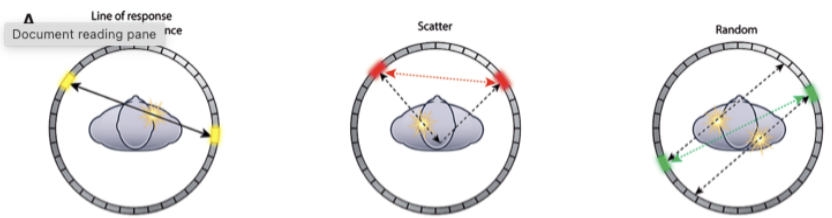
True Coincidence
Both 511keV photons originate from the same annihilation event and reach the detectors at the same time without interactions
Scatter Coincidence
One of the 511keV photons from the annihilation event undergoes Compton scattering, leading to an incorrect position for the line of response
Random Coincidence
Two separate annihilation events are detected within the same coincidence timing window creating a line of response between them
PET Imaging Process
patient is administered the radiopharmaceutical and waits for uptake
patient is positioned on the PET scanner
tracer decays via positron emission and annihilation event occurs sending two 511keV photons in opposite directions hitting the detector rings
photons arrive within the coincidence timing window (5-12 ns) and creates a line of response
PET scintillation detectors turn the photons into visible light
light photons are then converted into a electrical signal via PMT and SiPM
the electrical signal is analyzed by the pulse heigh analyzer to see whether it fits within the energy windows (around 350-650keV)
accepted signals is passed through a coincidence processor
data is recorded in views and each pixel in the sinogram corresponds to a LOR
image is reconstructed using algorithms
Annihilation Event
proton suddenly becomes a neutron and emits a positive electron (positron)
positron travels and annihilates with an electron
this reaction causes two photons of 511keV to travel in opposite directions
Noise Equivalent Count Rate (NECR)
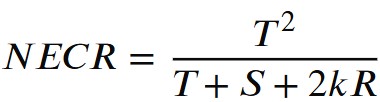
gives the equivalent count rate of the observed count rate after scatter and random coincidences are corrected.
where is true counts, is scatter, is randoms, and is the fraction of the sinogram used for scatter estimation.
What does NECR do?
a higher NECR will mean better image quality
NECR helps gives the optimal dose to give
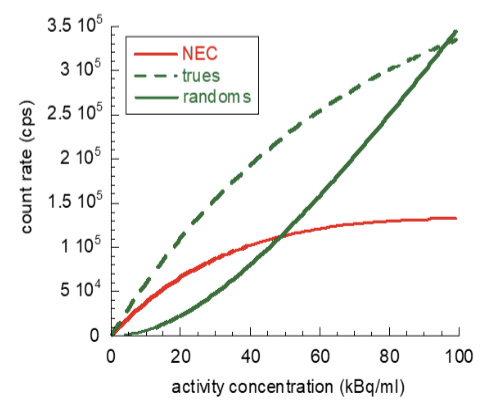
increasing the patient dose will increase the amount counts however this will also increase the amount of noise in the image from randoms and scatter. the NECR peak will show where increasing activity until it reaches a point where there’s an increase in noise causing a decrease in image quality
Cross Calibration
calibrates PET counts/ml into units of MBq/ml and against the dose calibrator that is used to measure the activity
a uniform phantom is filled with activity measured by the dose calibrator and the phantom is scanned to estimate the cross calibration factor
PET Scintillation Crystal Characteristics
high density and effective atomic number - high stopping power for interactions
high light output
fast light decay - reduces dead time and increases randoms rejection
visibile light photon matches response of PMT
low self-absorption
non-hydroscopic
examples include: BGO or LSO
Dead Time
is the time required to process individual detected events
if a second pulse occurs when the first one has not finished it will be disregarded
Non-Paralyzable System
when an event occurs during dead time, the second event is ignored and there is no effect on subsequent events
digital counters
pulse-heigh analyzers
computer interfaces
Paralyzable System
when an event occurs during another events dead time it is not counted however it still introduces its own dead time
“extendable“ dead time in most radiation detectors
Standard Uptake Value (SUV)
normalizes the activity concentration measured by the PET scanner with the injected dose and patients weight
the acitviity concentration (MBq/ml) and density of tissue (1g/ml) and estimates the activity in the tissue per mass (MBq/kg)

Limitations of SUV
physiological factors
time post injection the SUV is measured
partial volume effects for smaller tumors may result in underestimation
assumes all activity administered goes into circulation (extravasated injections)
FDG uptake in fat is usually lower than muscle or other tissue meaning there is possible overestimation in obese patients
Time of Flight
measures which of the two detectors received the annihilation photons first, and uses that tiny time difference to better localize where along the line of response the event happened
this helps improve signal-to-noise ratio
PET Sensitivity
is the ability to detect true annihilation events per unit of activity of radioactivity present in the FOV (cps/MBq)
depends on
intrinsic detector efficiency - stopping power of crystal and light yield
geometric efficiency - proportion of emitted photons that reach the detectors (influenced by detector rings diameter and axial coverage)
high sensitivity allows for shorter scan time and lower injected activity
PET/CT Daily QC
PET QC
normalization
singles, coincidence, timing, energy
sinograms
CT QC
air calibrations
uniformity with water at HU of 0
noise (standard deviation of HU)
slice thickness
Partial Volume Effect
is the loss of accuracy in small structures due to a decreased spatial resolution. it occurs when an objects size is similar to systems spatial resolution leading to underestimation of activity concentration and spill over into adjacent regions
spill-out effect - activity in hot lesions spills out into surrounding tissue
spill-in effect - activity from high uptake regions spill into nearby low uptake regions
Energy Resolution
is the ability to distinguish photons of different energies
having a tighter energy window can reduce scatter nut increases scan time
defined by full-width at half-maximum (FWHM)
you want a lower energy resolution and low energy threshold
Scatter Fraction
is the fraction of how much scatter is present in the final image
Spatial Resolution
is the ability to see small objects and measured in full-width at half-maximum (FWHM)
Temporal Resolution
is the time between each successful electrical pulse
it shows how quickly a crystal can decay light
coincidence timing window is 6–10 ns
TOF timing resolution is 300–600 ps
better timing → better localization → improved SNR

