Geometry Midterm Review RBC
 Call Kai
 Learn
Learn Practice Test
 Spaced Repetition
 Match
Match Flashcards
 Knowt Play
1/135

There's no tags or description
Looks like no tags are added yet.
Name | Mastery | Learn | Test | Matching | Spaced | Call with Kai | Chat |
|---|
No analytics yet
Send a link to your students to track their progress
136 Terms
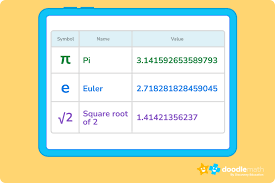
Irrational Number
Any real number that cannot be written as a fraction
Rational Number
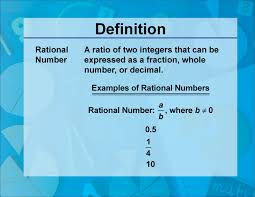
A number that can be expressed as a fraction of two integers, where the denominator is not zero
Real number
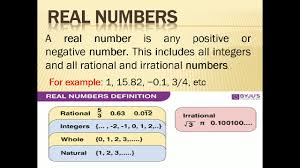
Any number that we can think of, except complex numbers
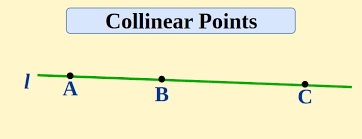
Collinear points
The points that lie on the same straight line or in a single line
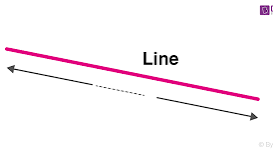
Line
A straight set of points that extend in opposite directions
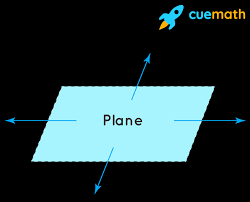
Plane
The geometrical concept of a flat surface with no edges or thickness
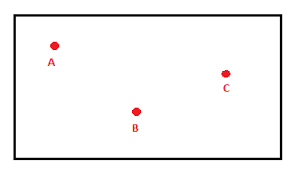
Point
An exact location on a plane
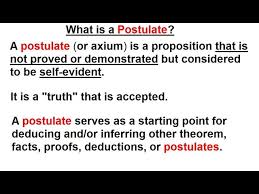
Postulate
A statement accepted to be true without proof
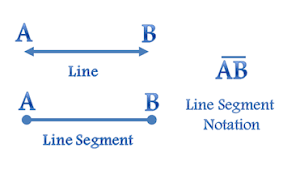
Segment
A part of a line or curve between two points
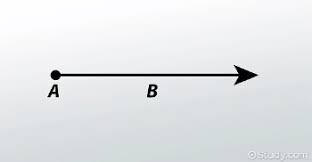
Ray
A part of the line having one fixed point and the other point does not have an end
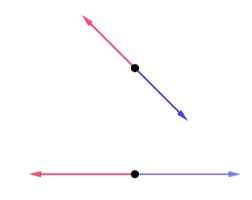
Opposite Ray
Two rays that have the same endpoint and extend in opposite directions
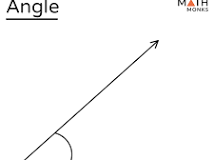
Angle
a figure which is formed by two rays or lines that shares a common endpoint
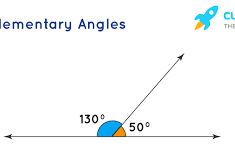
Supplementary angle
Those angles that sum up to 180 degrees
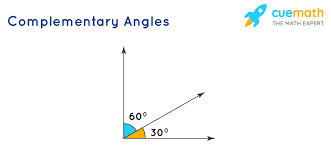
Complementary angle
Either of two angles whose sum is 90
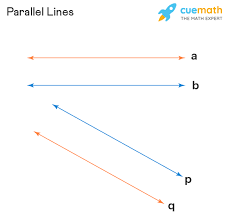
Parallel
Two or more lines that are always the same distance apart and never intersect, even if they are extended infinitely in both directions
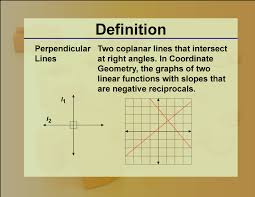
Perpendicular
A straight line that makes the right angle (90 degrees) with the other line
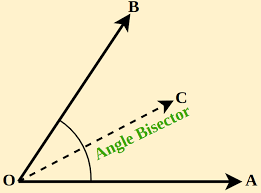
Angle Bisector
A line that splits an angle into two equal angles
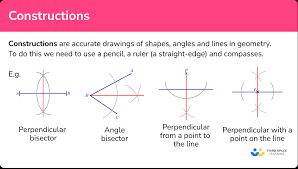
Construction
Drawing shapes, angles or lines exactly with compasses and rulers
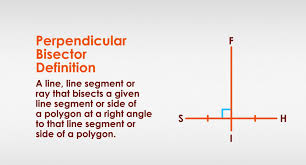
Perpendicular Bisector
A line that divides a given line segment exactly into two halves forming 90 degrees angle at the intersection point
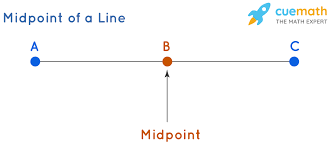
Midpoint
A point that divides the line segment into two equal halves
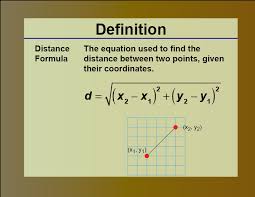
Distance
The numerical measurement of the length of a line segment, a line with a distinct starting and stopping point
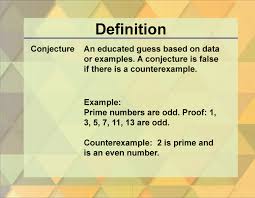
Conjecture
A mathematical statement which appears to be true, but has not been formally proven
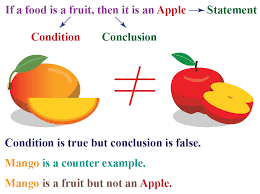
Counterexample
An example that disproves a statement, proposition, or theorem by satisfying the conditions but contradicting the conclusion
Inductive Reasoning
A specific truth which is known to be true, and then applying this truth to more general concepts
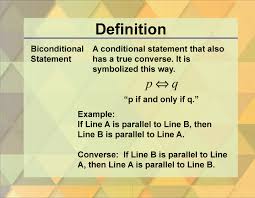
Biconditional
True statements that combine the hypothesis and the conclusion with the key words 'if and only if
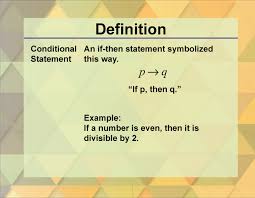
Conditional
A statement that can be written in the form “If P then Q,” where P and Q are sentences
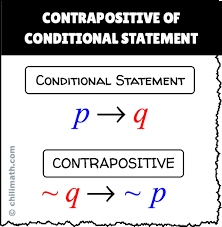
Contrapositive
"if not-B then not-A " is the contrapositive of "if A then B "
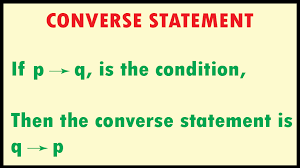
Converse
q → p
Hypothesis
A proposition that is consistent with known data, but has been neither verified nor shown to be false
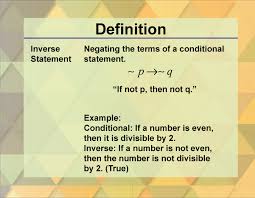
Inverse
The operation that undoes what was done by the previous operation
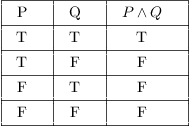
Truth table
Provides a method for mapping out the possible truth values in an expression and to determine their outcomes
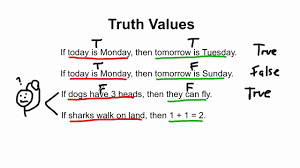
Truth value
A value indicating the relation of a proposition to truth
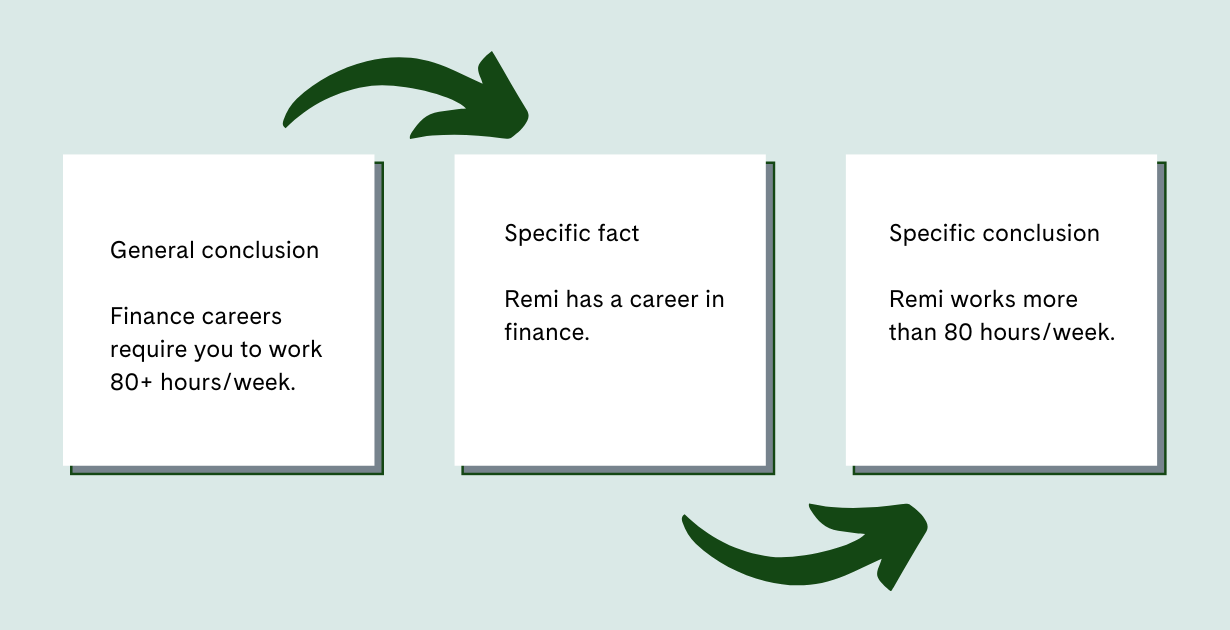
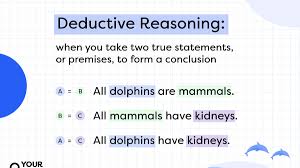
Deductive Reasoning
The process of reasoning to reach a logical conclusion from one or more statements
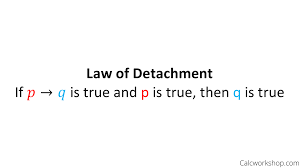
Law of Detachment
If P leads to Q and P is true, then Q must be true
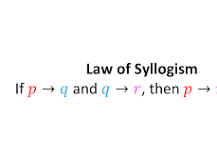
Law of Syllogism
A valid argument form of deductive reasoning that follows a set pattern. It is similar to the transitive property of equality, which reads: if a = b and b = c then, a = c
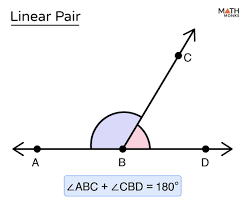
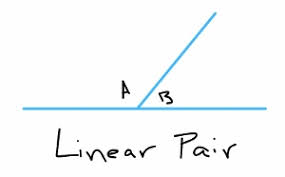
Linear Pair
Two adjacent angles that add up to 180°
Paragraph Proof
A series of logical statements proving a mathematical concept true written in paragraph form
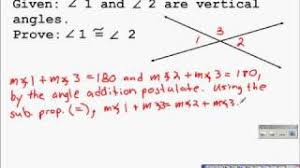
Proof
The logical way in which mathematicians demonstrate that a statement is true
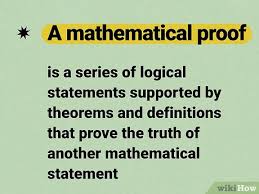
Theorem
A statement that can be proved to be true based on known and proven facts
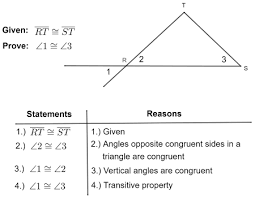
Two-column proof
A method used to present a logical argument using a table with two columns
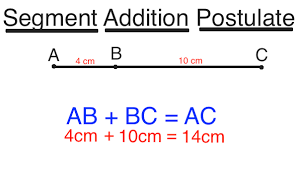
Postulate 1-2: Segment Addition Postulate
If points A, B, and C are on the same line with B between A and C, then AB + BC = AC
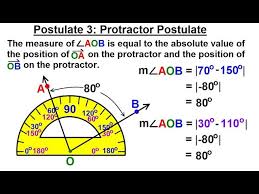
Postulate 1-3: Protractor Postulate
Given ray BA and a point C not on ray BA, a unique real number from 0 to 180 can be assigned to ray BC
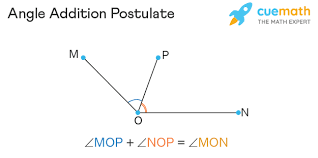
Postulate 1-4: Angle Addition Postulate
If point D is in the interior of angle ABC, then the measure of angle ABD + the measure of angle DBC = the measure of angle ABC
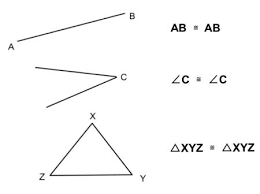
Reflexive Property of Congruence
AB=AB
Symmetric Property of Congruence
AB=CD then CD=AB
Transitive Property of Congruence
AB=CD and CD=EF then AB=EF
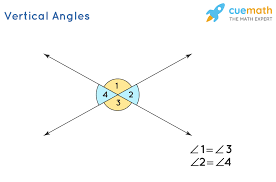
1.1 Vertical Angles Theorem
Vertical angles are congruent
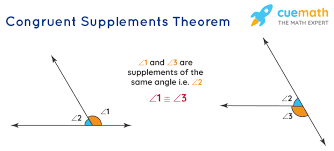
1.2 Congruent Supplements Theorem
If two angles are complementary to congruent angles (or to the same angle) then they are congruent
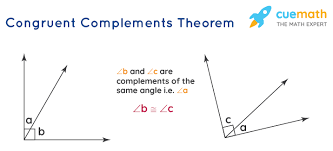
1.3 Congruent Complements Theorem
If two angles are complementary to congruent angles (or to the same angle) then they are congruent
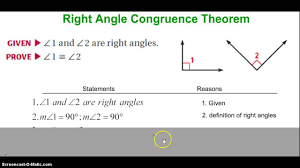
Theorem 1.4 Right Angles
All right angles are congruent
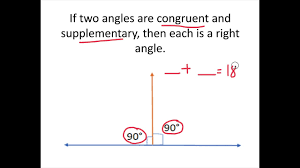
Theorem 1.5
If two angles are congruent and supplementary, then each is a right angle
1.6 Linear Pairs Theorem
The sum of the measures of a linear pair is 180
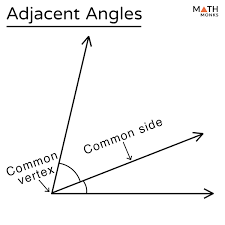
Adjacent angles
Two angles that are side by side and share a common vertex and a common side
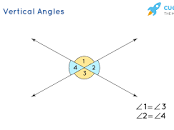
Vertical Angles
Located across from one another in the corners of the "X" formed by two straight lines
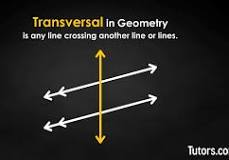
Transversal
A line that passes through two lines in the same plane at two distinct points
Same-Side Interior Angles Postulate
If a transversal intersects two parallel lines, then same-side interior angles are supplementary
Alternate Interior Angles Theorem
If a transversal intersects two parallel lines, then alternate interior angles are congruent
Corresponding Angles Theorem
If a transversal intersects two parallel lines, then corresponding angles are congruent
Alternate Exterior Angles Theorem
If a transversal intersects two parallel lines, then alternate exterior angles are congruent
Converse of the Corresponding Angles Theorem
If two lines and a transversal form corresponding angles that are congruent, then the lines are parallel
Converse of the Alternate Interior Angles Theorem
If two lines and a transversal form alternate interior angles that are congruent, then the lines are parallel
Converse of the Same-Side Interior Angles Postulate
If two lines and a transversal form same-side interior angles that are supplementary, then the lines are parallel
Converse of the Alternate Exterior Angles Theorem
If two lines and a transversal form alternate exterior angles that are congruent, then the lines are parallel
Theorem 2-8
If two lines are parallel to the same line, then they are parallel to each other
Theorem 2-9
If two lines in the same plane are perpendicular to the same line, then they are parallel to each other
Theorem 2-10
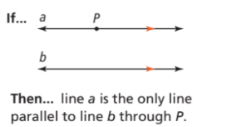
Through a point not on a line, there is one and only one line parallel to the given line
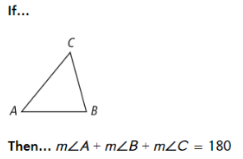
Triangle Angle-Sum Theorem
All angles in a triangle add up to be 180
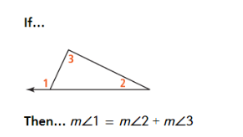
Triangle Exterior Angle Theorem
The measure of each exterior angle of a triangle equals the sum of each of the measures of its two remote interior angles
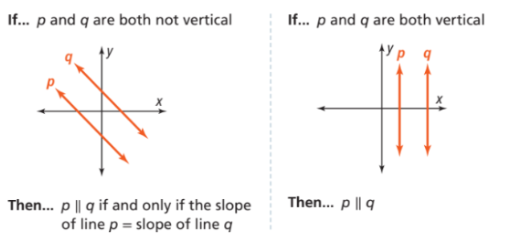
Theorem 2-13
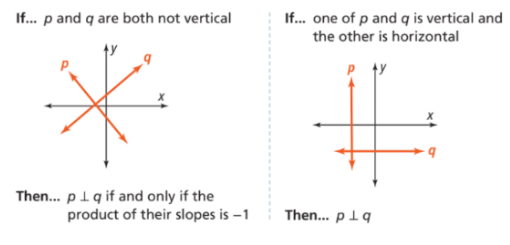
Two non-vertical lines are parallel if and only if their slopes are equal. Any two vertical lines are parallel.
Theorem 2-14
Two non-vertical lines are perpendicular if and only if the product of their slopes are -1. A vertical line and a horizontal line are perpendicular to each other.
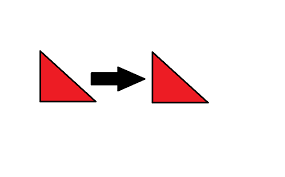
Rigid motion
Transformation that preserves length and angle measure
Reflection
An object is flipped to create a mirror or congruent image
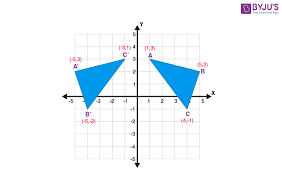
Image
The new position of a point, a line, a line segment, or a figure after a transformation
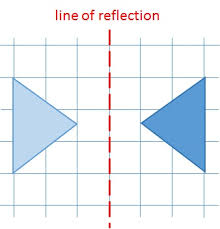
Line of reflection
An image will reflect through a line
Preimage
The image of a graph or shape before it is taken through a transformation
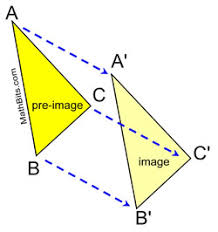
Transformation
Changing a shape's position or which way the shape points
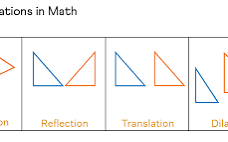
Angle of Rotation
The measure of the amount that a figure is rotated about a fixed point
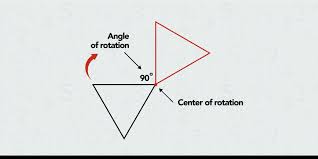
Center of rotation
The point at which a picture turns
Rotation
When an object is turned clockwise or counterclockwise around a given point
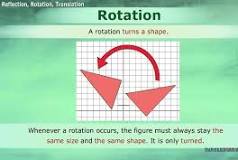
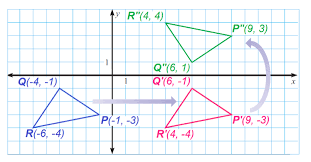
Glide Reflection
Translating a figure by sliding it along a line, then reflecting the figure over an axis of reflection
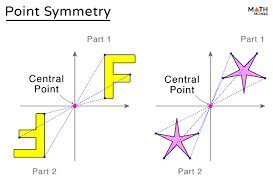
Point symmetry
When, given a central point on a shape or object, every point on the opposite sides is the same distance from the central point
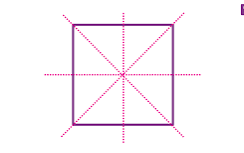
Reflectional symmetry
When a line is drawn to divide a shape in halves so that each half is a reflection of the other
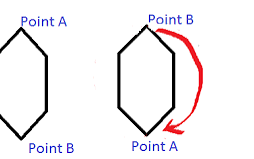
Rotational symmetry
A shape can be spun around a single point and look the same as it did before it was spun
Theorem 3-1
A tranlation is a composition of reflections across two parallel lines
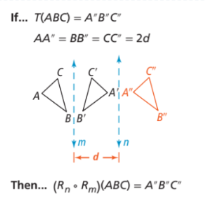
Theorem 3-2
Any rotation is a composition of reflections across two lines that intersect at the center of rotation. The angle of rotation is twice the angle formed by lines of reflection
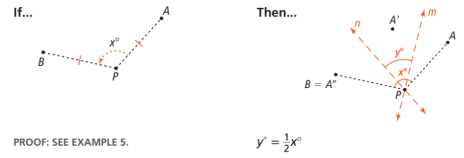
Theorem 3-3
The composition of two or more rigid motions is a rigid motion.
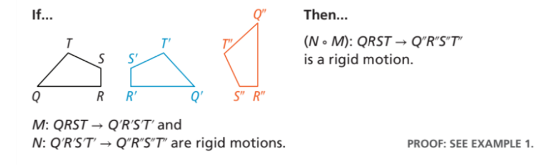
Theorem 3-4
Any rigid motion is either a translation, reflection, rotation, or glide reflection
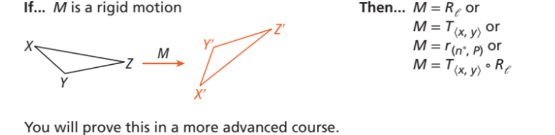
Corollary to Theorem 3-4
Any rigid motion can be expressed as a composition of reflections
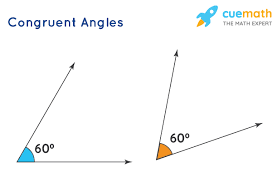
Congruent angles
Two or more angles that have the same measure
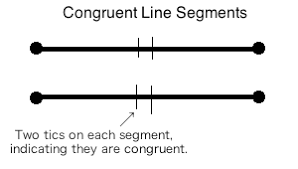
Congruent segments
Line segments that are equal in length
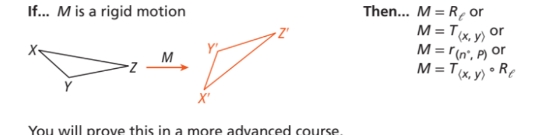
Congruence transformation
A moved figure that retains the same size, shape, angles, and side lengths of the original image
Congruent
To have the same shape and size
Equilateral triangle
A triangle that has all its sides equal in length
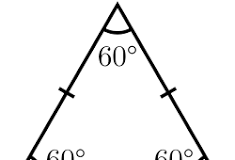
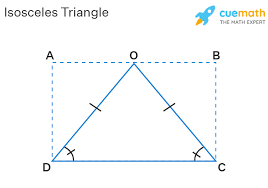
Isosceles triangle
A triangle with two equal sides
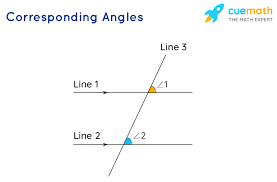
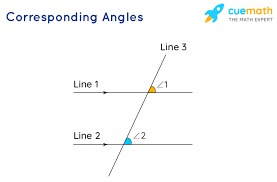
Corresponding angles
Pairs of angles formed on the same side of the transversal and in the same relative position
Hypotenuse
The longest side of a right-angled triangle compared to the length of the base and perpendicular
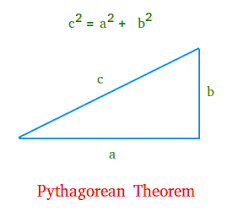
Pythagorean Theorem
The square of the length of the hypotenuse of a right triangle equals the sum of the squares of the lengths of the other two sides
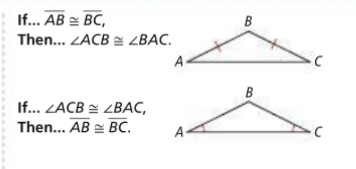
Isosceles Triangle Theorem and the Converse
If two sides are congruent, then the angles opposite those sides are congruent.
If two angles of a triangle are congruent, then the sides opposite those angles are cogruent
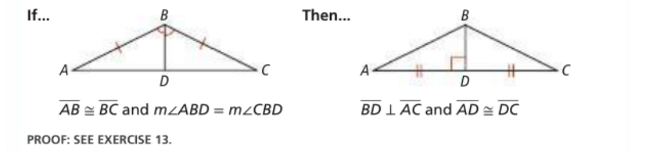
Theorem 4-2
If a line or line segment bisects the vertex angle of an isosceles triangle, then it is also the perpendicular bisector of the opposite side.
Side-Angle-Side (SAS) Congruence Criterion
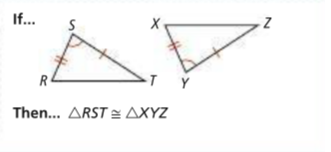
If two sides and the included angle of one triangle are congruent to two sides and the angle of another triangle, then the two triangles are congruent