Comprehensive Guide to Consequentialism, Utilitarianism, and Virtue Ethics
 Studied by 0 people
 Call Kai
 Learn
Learn Practice Test
 Spaced Repetition
 Match
Match Flashcards
 Knowt Play
1/57

There's no tags or description
Looks like no tags are added yet.
Name | Mastery | Learn | Test | Matching | Spaced | Call with Kai |
|---|
No analytics yet
Send a link to your students to track their progress
58 Terms
What are the three aspects of moral evaluation in consequentialism?
Consequences, Rules, and Character/Virtue.
Pleasure
absence of pain
INTRINSIC good
desired for it own sake
ultimate good
happiness
pleasure
INSTRUMENTAL good
conditional good means to achieve something
Career, wealth
health, relationships
Pain
Presence of suffering
ARTHUR F. HOLMES
infinite regress
4 Complex forms consequentialism
Agent- Relative Hedonism
Agent Neutral Hedonism
Agent relative non- hedonism
Agent nuetral non-hedonism
What does 'Agent Relative Hedonism' emphasize?
Self-centered pleasure and maximum pleasure to the agent.
Who are two philosophers associated with Hedonism?
Aristippus and Epicurus.
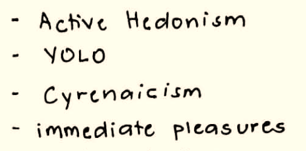
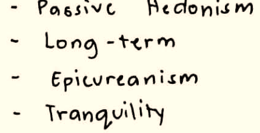
What is the difference between Active Hedonism and Passive Hedonism?
Active Hedonism seeks immediate pleasures, while Passive Hedonism focuses on long-term happiness.
Aristippus
Epicurus.






What is the 'Pleasure Principle' in consequentialism?
Pleasure is the only intrinsically and naturally good value to human beings.
What does the 'Pain Principle' state?
Pain is the only thing that is intrinsically and naturally disvaluable to human beings.
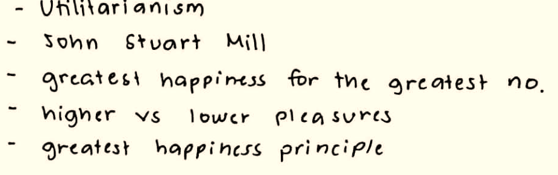
What is the 'Greatest Happiness Principle'?
The principle that aims for the greatest happiness for the greatest number of people.
What are the three basic elements of Utilitarianism?
Consequentialism, Welfarism, and Aggregationism.
What is the 'Swine Doctrine' in relation to utilitarianism?
The objection that utilitarianism reduces human life to mere pleasure-seeking, akin to swine.
What is the 'Trolley Problem' in ethical discussions?
A thought experiment that illustrates the moral dilemmas of utilitarianism.
What is the difference between Act Utilitarianism and Rule Utilitarianism?
Act Utilitarianism judges actions based on their consequences, while Rule Utilitarianism follows rules that generally lead to the greatest good.
What is 'Effective Altruism'?
The philosophy that suggests we should do the most good we can, considering time, money, and effort.
What is the principle of 'Delayed Gratification'?
Choosing to forego immediate desires for the sake of achieving more valuable long-term goals.
What is the 'Experience Machine' thought experiment?
A philosophical scenario proposed by Robert Nozick to challenge hedonism by questioning the value of simulated experiences.
What does Deontology focus on in ethical decision-making?
Deontology emphasizes duties and rules that must be followed regardless of the consequences.
What is Immanuel Kant's Categorical Imperative?
An absolute duty from which all other duties are derived, focusing on the rightness of actions.
What are the two types of imperatives Kant distinguishes?
Hypothetical Imperatives (conditional) and Categorical Imperatives (unconditional).
What is the 'Principle of Non-Contradiction' in Kant's ethics?
The principle that something cannot both be and not be at the same time.
What is the difference between intrinsic good and instrumental good?
Intrinsic good is valued for its own sake, while instrumental good is valued as a means to achieve something else.
What does 'Agent Neutral Hedonism' refer to?
A perspective that seeks maximum pleasure for everyone, not just the individual agent.
What is the 'Objection from Special Obligations' in utilitarianism?
The criticism that utilitarianism fails to account for special duties we have to individuals.
What is 'Utilitarian Slogan'?
'The greatest happiness for the greatest number.'
What is the definition of Good Will in Kantian ethics?
Good Will is the only good without qualification, performing actions for the sake of duty.
What is the difference between acting in accordance with duty and performing an action for the sake of duty?
Acting in accordance with duty may involve personal motives, while performing an action for the sake of duty is purely motivated by moral obligation.
What is the Categorical Imperative?
The Categorical Imperative is an unconditional moral law that applies to all rational beings, determining the moral status of actions.
What does the Formula of Humanity state?
Act as a treat humanity, whether in your own person or in that of any other, always as an end and never merely as a means.
What are the three features of treating humanity as an end in itself?
1. An objective end for all rational agents, 2. Possesses unconditional worth, 3. Incomparable value.
What is the Consent Principle in Kantian ethics?
It is wrong to treat anyone in any way to which they would not rationally consent.
What is a Maxim in Kantian ethics?
A Maxim is the general rule according to which an agent intends to act.
What is the Formula of Universal Law?
Act only in accordance with that maxim through which you can at the same time will that it become a universal law.
What are the four conditions for valid consent?
1. Competence Condition, 2. Voluntariness Condition, 3. Knowledge Condition, 4. Intention Condition.
What does the Kingdom of Ends represent in Kantian ethics?
A community of all rational agents governed by laws that they give to themselves collectively.
What is the difference between Conditional Deontology and Kant's ethics?
Conditional Deontology admits that duties may vary based on circumstances, while Kant's ethics emphasizes absolute moral duties.
What are Prima Facie Duties?
Duties that are immediate and apparent, such as helping a friend in need.
What is the Greatest Happiness Principle in Utilitarianism?
The principle that actions are right if they promote the greatest happiness for the greatest number.
What is Virtue Ethics focused on?
Virtue Ethics emphasizes character traits that help individuals live well and fulfill their potential.
What is Eudaimonia in the context of Virtue Ethics?
Eudaimonia is a state of human flourishing or fulfillment, achieved through virtuous living.
What is the Doctrine of the Mean in Virtue Ethics?
The idea that virtue lies between excess and deficiency, promoting balance in character traits.
What is Phronesis?
Phronesis is practical wisdom, learned through experience, crucial for making virtuous decisions.
What are the three components of virtue according to Aristotle?
1. Intellectual component, 2. Emotional component, 3. Motivational component.
What does the term 'Moral Luck' refer to?
Moral Luck refers to how factors outside a person's control can affect the moral judgment of their actions.
What is the significance of moral exemplars in Virtue Ethics?
Moral exemplars are individuals who exhibit virtuous dispositions and serve as models for ethical behavior.
What is the relationship between Rationality and Virtue Ethics?
Virtue Ethics is based on character traits exercised through reason to help individuals live fulfilling lives.
What does Kant mean by 'duty'?
Duty is the necessity to act in accordance with moral law, as determined by reason.
What is the role of emotions in Kant's ethics?
Kant believed that emotions are animalistic and that moral actions should be guided by pure reason.
What is the difference between instrumental and intrinsic goods?
Instrumental goods are means to an end, while intrinsic goods are valued for their own sake.
 Note
Note  Flashcards (32)