The Changing Earth
 Call Kai
 Learn
Learn Practice Test
 Spaced Repetition
 Match
Match Flashcards
 Knowt Play
1/30

There's no tags or description
Looks like no tags are added yet.
Name | Mastery | Learn | Test | Matching | Spaced | Call with Kai |
|---|
No analytics yet
Send a link to your students to track their progress
31 Terms
How do geologists determine how old rocks are?
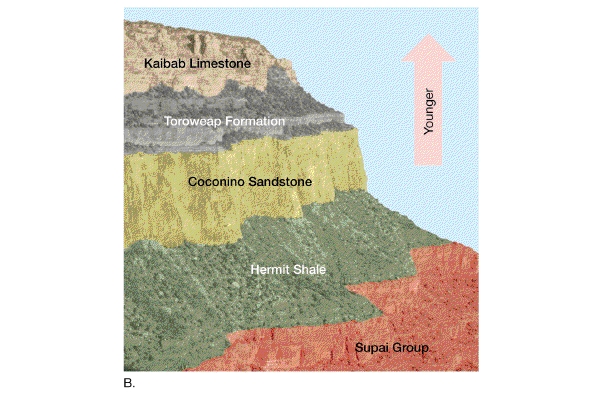
Relative dating- Determine whether the rock is older or younger than other rocks
Absolute dating- Using radiometric dating techniques to determine how long ago the rock formed in the exact number of years
What are the methods of Absolute dating?
Using natural occurring radioactive isotopes. Isotopes are a form of an element that has additional neutrons
Radioisotope; isotope that spontaneously decays, giving off radiation
How is the rate of decay measured in Radioisotopes?
The rate is measured by half-life→ time it takes for one-half of the radioactive material to decay
What are the common isotopes used in age dating?
U-Pb -- half-life of U-238 is 4.5 b.y.
K-Ar -- half-life of K-40 is 1.3 b.y.
Rb-Sr -- half-life of Rb-87 is 47 b.y.
Carbon 14 -- half-life of C-14 is 5730 yrs
Who theorized the principle of Uniformitarianism and what does this include?
James Hutton: Hutton realized that most sedimentary layers were deposited from gradual, day to day processes, and it takes a long time to form these rocks
“Present is the key to the past”
Whatever processes are occurring today(plate tectonics, volcanism, mountain building, earthquakes, sedimentation) also occurred in the past and probably at the same (or very comparable) rates.
What is the geographic Column?
Used to describe the sequence and length of the changes on Earth
Developed in the 19th century, and developed using the Law of Superposition and Fossils. The fossils in the uppermost layers were newer that are mainly plants and animals, however fossils in the lower layers are plants and animals but different from species today (determines the relative age of rock layers)
What are the divisions of geologic time?
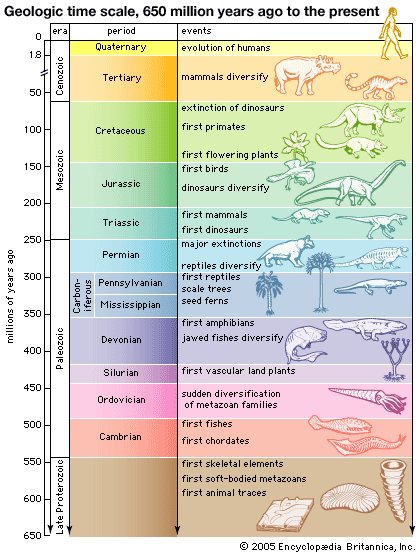
Divided into Eras, Periods, and Epochs. There are 4 eras, and which they are the largest unit of geologic time
What are the 4 eras of the divisions of Geologic time?
PreCamberian time (4.6 BYA)
Paleozoic Era (540 Mya)
Mesozoic Era (248 mya)
Cenozoic Era (65 mya)
What are periods?
Subdivision of Eras and each period is characterized by fossils
What are Epochs?
Subdivision of periods, only in two periods within the Cenozoic era, contains an extremely large amount of fossils
What characterizes the PreCamberian period?
Fossilized bacteria and Cyanobacteria show that primitive life existed at least 3,500 mya. The fossil collections in museums begin at the end of PreCamberian time.
Only multicellular life were in oceans and included some groups that have survived until the present: Jellyfish and segmented worms
Nothing in land except wind
4.6 bya to 540 mya
What are the characteristics of the age of bacteria
Since bacteria can live under a much wider variety of conditions than Eukaryotes, they use many different sources of energy and carbon, high pressure, acidic conditions
The atmosphere of the Earth was more like mars, nitrogen, carbon dioxide, water vapor, but no free oxygen
The Cyanobacteria a created the oxygen in the atmosphere , and about 2 billion years ago the oxygen level began to rise
Many bacteria are poisoned by oxygen, this event marks teh onset of the Paleozoic era and the PreCamberian era
What is the theory of Snowball Earth?
55 mya, the Earth suffered a massive Ice Age with galleries even with tropical areas
This causes a mass extinction , killing off mast life forms and leading a Cambrian explosion of new life forms
What are the periods of the Paleozoic Era
Camberin, Ordovician. Silurian, Devonian, Carboniferous (Pennsyltvanian and Mississippian) and the Permian period
What are the two mots important events in the Paleozoic (or even events in the history of animal life)
Multicellular animals underwent a dramatic explosion in diverts (most animal phyla appeared within a few million years)
Towards the end of the era, the largest mass extinction in history wiped out 90% of all marine animal species
Midway through era animals, fungi and plants colonized the land and insects took air
What were the types of life in the Cambrian period?
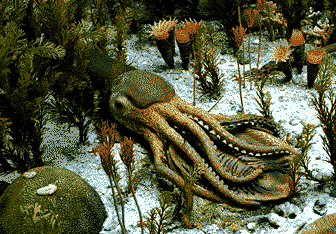
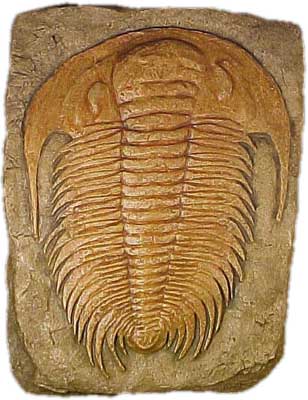
Trilobites, which are extinct ancestors to crustaceans and insects
More include Nautiloids molluscs with straight shells that later curled into nautilus
How did the Permian Exctintion occur?
Largest mass extinction event.
Large lava erupted in Siberia followed by wide spread glaciers. Volcanic dust in the atmosphere lowered temperatures drastically
Was probably caused buy an impact where 95% of all species died out
May have triggered a buildup of hydrogen sulfide (produced by bacteria) in the atmosphere that displaced most of the oxygen.
•May have caused the release of vast quantities of methane from methane hydrate deposits on the ocean bottom. This greenhouse gas might have raised the Earth’s temperature enough to kill most life.
What is another names for the Mesozoic era and what occurred?
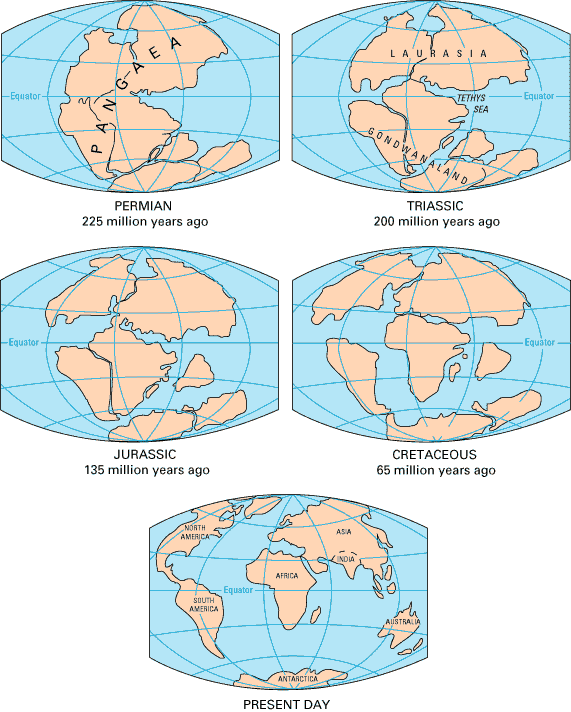
“Age of the reptiles” from 248 mya to 65 mya, to which the surface of earth changed and Pangea separated
Shallow seas and marshes formed
Large a mounts of swamp vegetation from this period were converted into coal after being buried
Reptiles were abundant but not very diverse, and to which all reptiles went extinct except birds
Dominated by ferns, Cycads and other unusual plants
Modern gymnosperms first appeared in the early Triassic
Flowering plants started to appear
End was marked by mass extinctions of dinosaurs and marine life
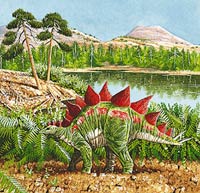
What are the characteristics of the Triassic?
No polar ice caps, generally hot and dry with monsoonal polar regions, carbon dioxide levels about three times higher than
Main dinosaurs were prosaurpods, early ornithopods and small predators
Large amount of swamp vegetation were converted to coal after being buried and compressed
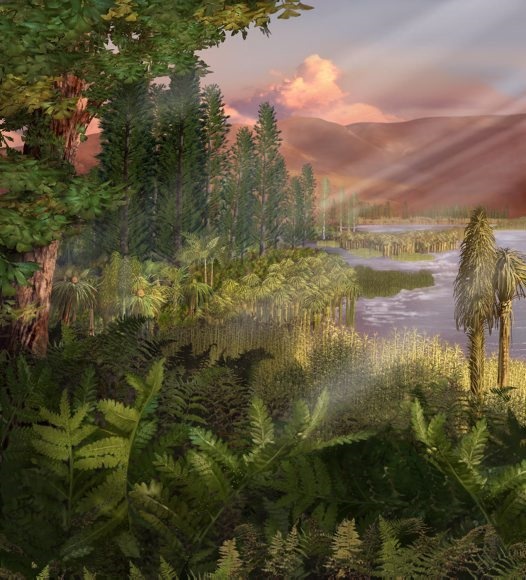
What are the Characteristics of the Jurassic era?
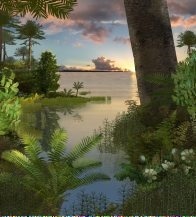
No polar ice caps, wam and humid. And carbon dioxide levels about 7 times higher than today
Main dinosaurs: theropods, sauropods, early stegosaurs
•Main plants: horsetails, club-mosses, ginkgoes, ferns, cycads and conifers
•Other animals: fishes, plesiosaurs and ichthyosaurs dominate the sea; long-tailed pterosaurs still rule the air
What are the 3 periods of the Mesozoic era?
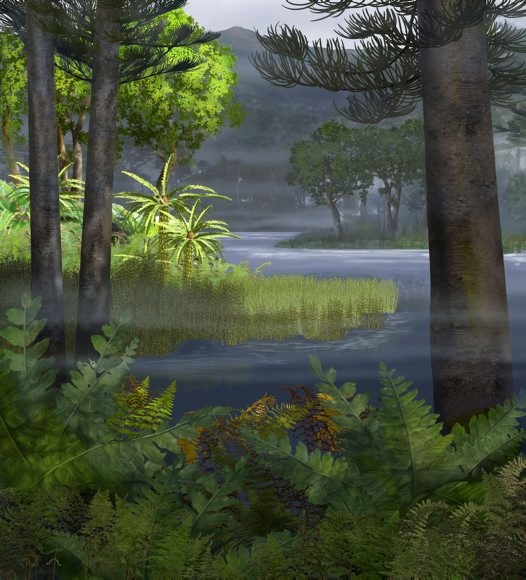
Triassic ( 245-208), Jurassic ( 208-146 mya), Cretaceous (146-65 mya)
What are the characteristics of the Cretaceous period?
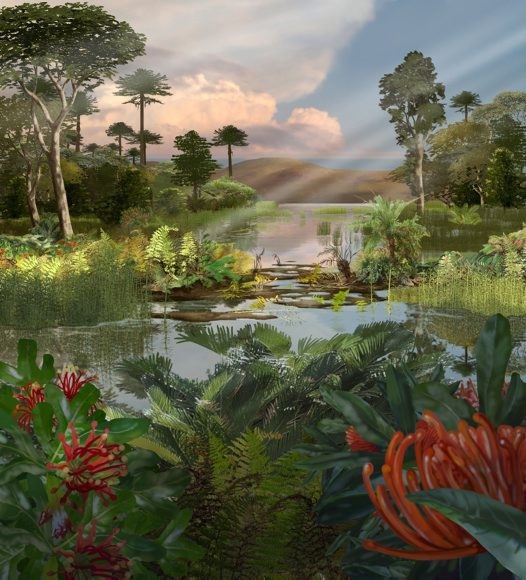
Climate: no polar ice caps, lush and warm but seasonal towards poles, rising sea levels, carbon dioxide levels about ten times higher than today
•Main dinosaurs: unique groups diversifying world-wide; birds diversify; declining numbers of sauropods, allosaurs and stegosaurs
•Main plants: Gondwanan forests of podocarps and araucarians; Laurasian forests of redwoods, cedars and pines; small flowering plants; small numbers of cycads and ferns
•Other animals: giant short-tailed pterosaurs now rule the air; fishes, ichthyosaurs, and pliosaurs still dominate the seas; mollusks like bivalves are the main reef-builders; mammals diversify; insects such as wasps and bees abound
What are the characteristics of the late Cretaceous?
Climate: no polar ice caps, world-wide variation, average temperature dropping, sea levels falling, carbon dioxide levels about four times higher than today
•Main dinosaurs: ceratopsians, pachycephalosaurs, hadrosaurs, dromaeosaurs, tyrannosaurs in the northern hemisphere; titanosaurs, abelisaurs and ornithopods in the southern hemisphere; modern lineage of birds; primitive birds
What is another term for the Cenozoic Era and what occurs?
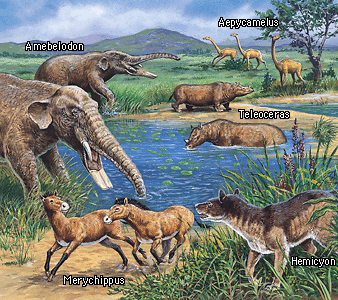
“Age of Mammals and Flowering plants”
They became the dominant life form
•Two main sub-divisions
–Tertiary
–Quaternary
•Most of the Cenozoic is the Tertiary, from 65 m.y.a to 1.8 m.y.a.
–Last major ice age
•The Quaternary includes only the last 1.8 million years.
–Pangea breaks apart
What are the “Big Five’ mass extinctions that have occurred?
–End Ordovician (440 – 450 mya)
–Late Devonian (360-375 mya)
End Permian (251mya)
–End Triassic (205 mya)
End Cretaceous (65mya)
Also the Two more mass extinctions
–Current Holocene extinction event (Present day)
–End-Ediacaran extinction at the start of the Phanerozoic eon. (488 mya)
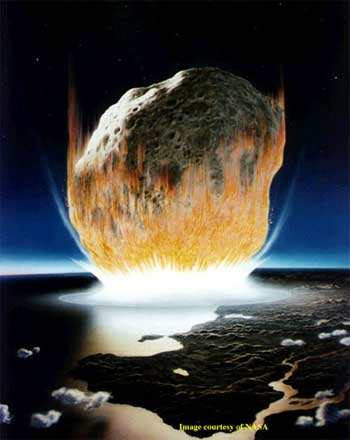
What is the Holocene extinction event?
Present day, know as the fastest ever, predict that humanity’s destruction of the biosphere could cause the extinction of one-half of all species in the next 100 years
What was the K/T Extinction?
65 million years ago
About 17% of all families and 50% of all genera went extinct. (75% species).
•It ended the reign of dinosaurs and opened the way for mammals and birds to become the dominant land vertebrates
•In the seas it reduced the percentage of sessile animals to about 33%.
•Extinction was rather uneven — some groups of organisms became extinct, some suffered heavy losses and some appear to have been only minimally affected.
What is the Triassic- Jurassic Extinction?
205 million years ago
•The Triassic-Jurassic transition about 20% of all marine families (55% genera) as well as most non-dinosaurian archosaurs, most therapsids, and the last of the large amphibians were eliminated.
•23% of all families and 48% of all genera went extinct.
What was the Permo-Triassic Extinction?
251 million years ago
–The Permian-Triassic transition, Earth's largest extinction killed 53% of marine families, 84% of marine genera, about 96% of all marine species and an estimated 70% of land species (including plants, insects, and vertebrate animals).
–57% of all families and 83% of all genera went extinct.
–The "Great Dying" had enormous evolutionary significance: on land it ended the dominance of mammal-like reptiles and created the opportunity for archosaurs and then dinosaurs to become the dominant land vertebrates; in the seas the percentage of animals that were sessile dropped from 67% to 50%.
–The whole late Permian was a difficult time for at least marine life — even before the "Great Dying".
What is the Late Devonian Extinction?
360-375 million years ago
•Eliminated about 70% of all species.
•This extinction event lasted perhaps as long as 20 million years
•19% of all families of life and 50% of all genera went extinct.
What occurred at the extinction event of 440-450 mya?
Second largest of the five major extinctions in Earth's history in terms of percentage of genera that went extinct.
–27% of all families and 57% of all genera went extinct.

