Piaget’s Theory of Cognitive Development Notes
 Call Kai
 Learn
Learn Practice Test
 Spaced Repetition
 Match
Match Flashcards
 Knowt Play
1/15

There's no tags or description
Looks like no tags are added yet.
Name | Mastery | Learn | Test | Matching | Spaced | Call with Kai |
|---|
No analytics yet
Send a link to your students to track their progress
16 Terms
stages
Development occurs in four ______
active
Children are ______ in their development, meaning that they’re always trying to understand & figure out the world around them; they are constructing & creating their knowledge
discontinuous
Piaget argued that cognitive development is ____________
Sensorimotor Stage
Birth - 2 Years
What infants can do:
Infants learn through their senses.
E.g., sucking, seeing, hearing, touching
What infants can’t do (according to Piaget):
Use mental images (mental representation)
See smth in their mind and make sense of it
CRUCIAL skill as it’s how we think critically, how we imagine what can happen when we do something
Preoperational Stage
2 - 7 Years
What children can do:
Use mental images (visualize and think about things)
Engage in pretend play
What children can’t do :
Think about another person’s POV
Egocentrism: Centering of one’s self
Can’t think about what is going on in someone else’s mind
Assumption that what they’re thinking abt is what other ppl are thinking abt too
Piaget was criticized for this part of his theory
Focus on more than one property at a time
Centration: Focusing on one property only
e.g.) Show a child a glass tube that is tall and thin, a child w/ centration will on focus on that it’s tall or that it’s thin, not both
Piaget actually got this right lol
Concrete Operations Stage
7 - 11 Years
What children can do:
Think about more than one property at a time
Pass conservation tasks
Understand class inclusion
Class Inclusion: Understanding that one thing can belong to many different categories and classes
e.g.) Dogs and cats are different, but they’re both animals. Say there’s a picture of two dogs and three cats all together, if you ask the child if there are more cats or more animals, they’ll say that there are more animals as there are 5 animals total, but only 3 cats
Think logically
More systematic thinking, having a sense of order with how they think
HOWEVER, logical thinking used for concrete information only (i.e., information that is relevant to them)
What children can’t do:
Reason about hypothetical examples
e.g.) “I want to marry Justin Bieber! He’s so cool and famous!” “Would you still want to marry him if he wasn’t famous?” “…but he is famous??”
Formal Operations Stage
12 Years and Above
What people can do:
Reason about hypothetical examples, being able to use logic in situations they might not have experienced
Think abstractly
Introduction of algebra at this age: X + 9 = 12 (X FINDS HIS VALUE MENTIONED 😍😍😍)
Thinking abstractly allows thinking to be more flexible
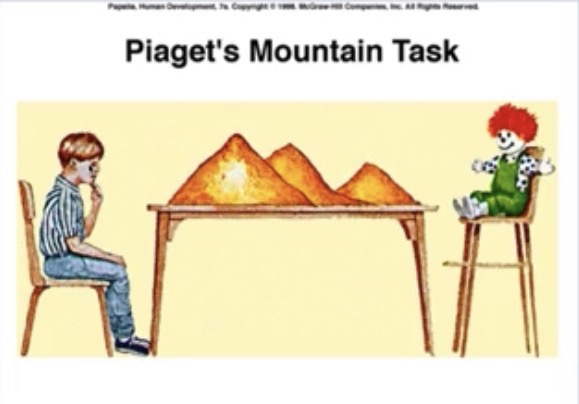
Egocentrism
Centering one’s self; being unable to think about someone else’s point of view
Why many kids in the preoperational stage fail the Three Mountain Task (unable to understand what the other person sees on the other side of the mountain)
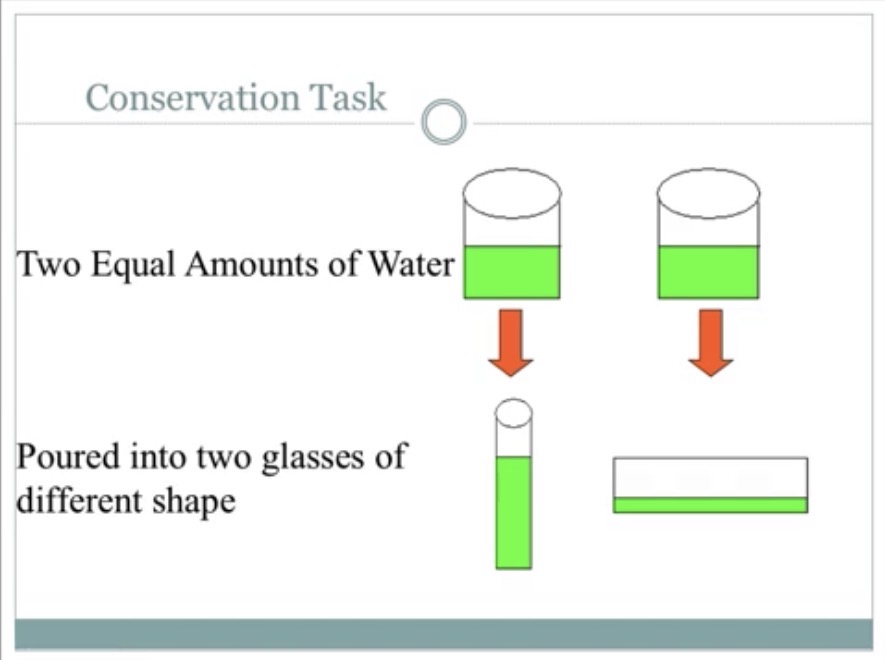
Centration
Focusing on one property only
One reason why kids in the preoperational stage have trouble with conservation tasks
e.g.) Showing a kid a glass tube, the kid will either focus on the fact that the glass is tall, or that it’s thin, they don’t understand the tube can have both properties
Scheme
Mental structures that organize information
Similar to having scripts or having a how-to list on how to do things
e.g.) How to drink from a cup: Pick up the cup, put it up to your mouth, etc…
Assimilation
Using existing schemes to understand outside information
e.g.) When you give a baby a sippy cup, they now have a scheme on how to drink from that cup, the scheme being the baby throws his head back to drink from his cup
One day, his mom leaves out a glass of juice on the coffee table and the baby sees this cup
Using the scheme the baby already knows, he applies that scheme to the juice glass, which unfortunately goes everywhere and now the carpet is stained and oh my god mom looks so upset
Took what he knew —> Applied it to a new event
Accommodation
Changing a scheme to adapt to new information
e.g.) When you give a baby a sippy cup, they now have a scheme on how to drink from that cup, the scheme being the baby throws his head back to drink from his cup
After the baby spills that glass of juice, he’ll eventually come to realize that applying his scheme to the glass isn’t working
He’s going to have to change how he approaches drinking from that glass in order to drink from it correctly and without so much of a mess
Throw head back for sippy cup vs. Keep head still for adult cup
Creating a new scheme
Taking what he knows now —> Understanding new information
Object Permanence
Understanding that objects still exist even when you can’t see them
mental representation
Infants aren’t able to understand the idea of object permanence because they are unable to think about mental images, also known as ______ ______________
concrete information
In the concrete operations stage, logical thinking is only utilized for ________ ___________, information that is relevant to them; these kids cannot reason with hypothetical examples
constructivist view
Piaget’s theory is a ______________ ____; children understand information based on their prior experiences and knowledge

