Orbital Energy and Equilibrium in Space
 Call Kai
 Learn
Learn Practice Test
 Spaced Repetition
 Match
Match Flashcards
 Knowt Play
1/10

There's no tags or description
Looks like no tags are added yet.
Name | Mastery | Learn | Test | Matching | Spaced | Call with Kai |
|---|
No analytics yet
Send a link to your students to track their progress
11 Terms
Motion
Gravity
Orbital energy,circular & elliptical orbits
Kinetic energy from ______
Potential Energy from _______
bound orbit
circular or elliptical
parabolic and hyperbolic
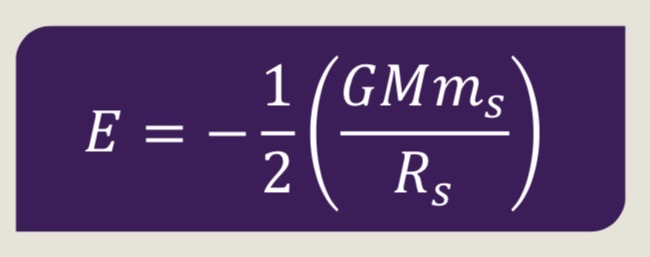
WHY NEGATIVE?
When the total energy (E) is negative, the orbit is called a _________, meaning the satellite is gravitationally bound to a planet or mass.
Bound orbits are closed, either ________ or _______.
In contrast, ________ and ________ trajectories have positive energy, meaning the object escapes the gravitational field.
Three Body Problem
Lagrange points.
In the restricted __________, a small object of negligible mass can remain in a fixed position relative to two more massive orbiting bodies if placed at specific locations where the gravitational and centrifugal forces balance.
These locations are known as __________
1 (L1)
SOHO
Langrange point ____ (__)
This point lies along the line connecting the two massive bodies, between them.
The point is commonly used for solar observatories, such as the _____ spacecraft, because it provides an uninterrupted view of the Sun
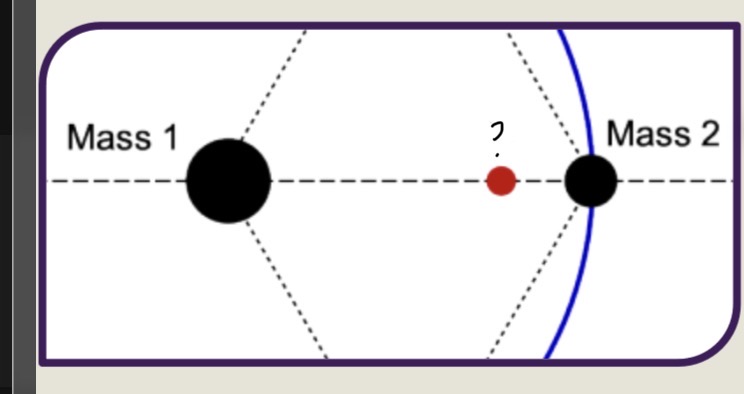
Lagrange Point point 2 (L2)
James Webb Space Telescope
Langrange point ____ (__)
This point is ideal for deep space telescopes, such as the ___________________, because it offers a stable thermal environment and minimal interference from the Sun or Earth.
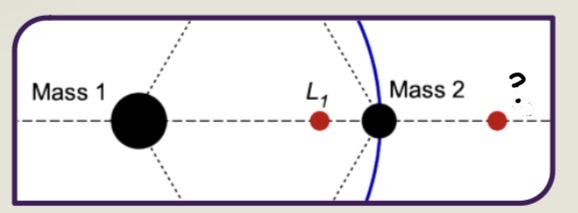
Langrange point 3 (L3)
opposite side
Langrange point ____ (__)
This point lies on the ________ of the larger body, directly opposite the smaller one. It is the least accessible of the colinear points and has no current practical use in mission design.
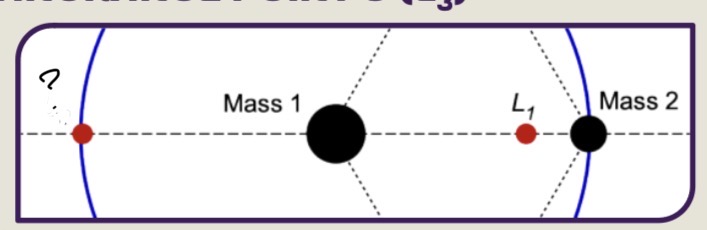
equilateral triangles
24.96
Sun-Jupiter
Langrange point 4 & 5 (L4)
The points L4 and L5 form _________ with the two massive bodies and lie ahead of and behind the smaller body in its orbit, respectively.
These points are stable for systems in which the mass ratio between the primary bodies exceeds approximately ______, as in the Sun -Earth and ________ system
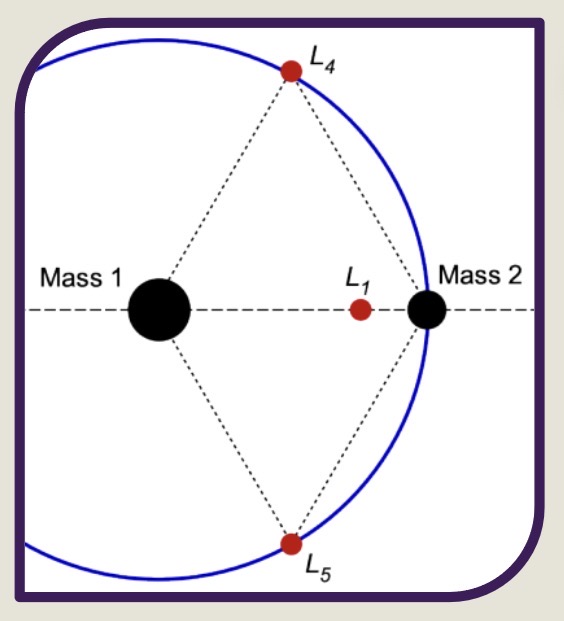
L 1, L2, and L3
station -keeping
halo orbit
Lissajous orbit.
The colinear points __________ are dynamically unstable. A spacecraft placed at these points requires continuous ________ or may instead occupy a stable periodic or quasi -periodic orbit around the point, such as a ______ or ________
Halo Orbit
unstable point
Solar and Heliospheric Observatory
__________ is a three -dimensional periodic orbit around a collinear Lagrange point such as L1 or L2 Lagrange Point.
Instead of staying exactly at the ___________, a spacecraft orbits around it in a large looping path above and below the orbital plane. For example, the _______________ (SOHO) operates in a halo orbit around L 1.
Lissajous orbit
looping pattern
flexible trajectory
Wilkinson Microwave Anisotropy Probe (WMAP)
__________ is a quasi-periodic orbit around a collinear Lagrange point.
The spacecraft follows a complex ________ caused by oscillations in multiple directions.
Unlike halo orbits, the path does not exactly repeat, creating a more __________. Requires less precise insertion compared to halo orbits but still needs small station -keeping maneuvers.
For example,
________________ at L 2.
Lagrange points
Joseph-Louis Lagrange
________ are significant in mission planning, as they enable spacecraft to remain in stable or quasi - stable positions relative to the Earth and Sun with minimal propellant usage, thereby supporting continuous observation, communication, and deep space exploration objectives.
Proposed by ________

