PT7031 - Spine: Vocabulary and Definitions for Understanding Spinal Anatomy and Movement
 Studied by 0 people
 Call Kai
 Learn
Learn Practice Test
 Spaced Repetition
 Match
Match Flashcards
 Knowt Play
1/117

There's no tags or description
Looks like no tags are added yet.
Name | Mastery | Learn | Test | Matching | Spaced | Call with Kai |
|---|
No analytics yet
Send a link to your students to track their progress
118 Terms
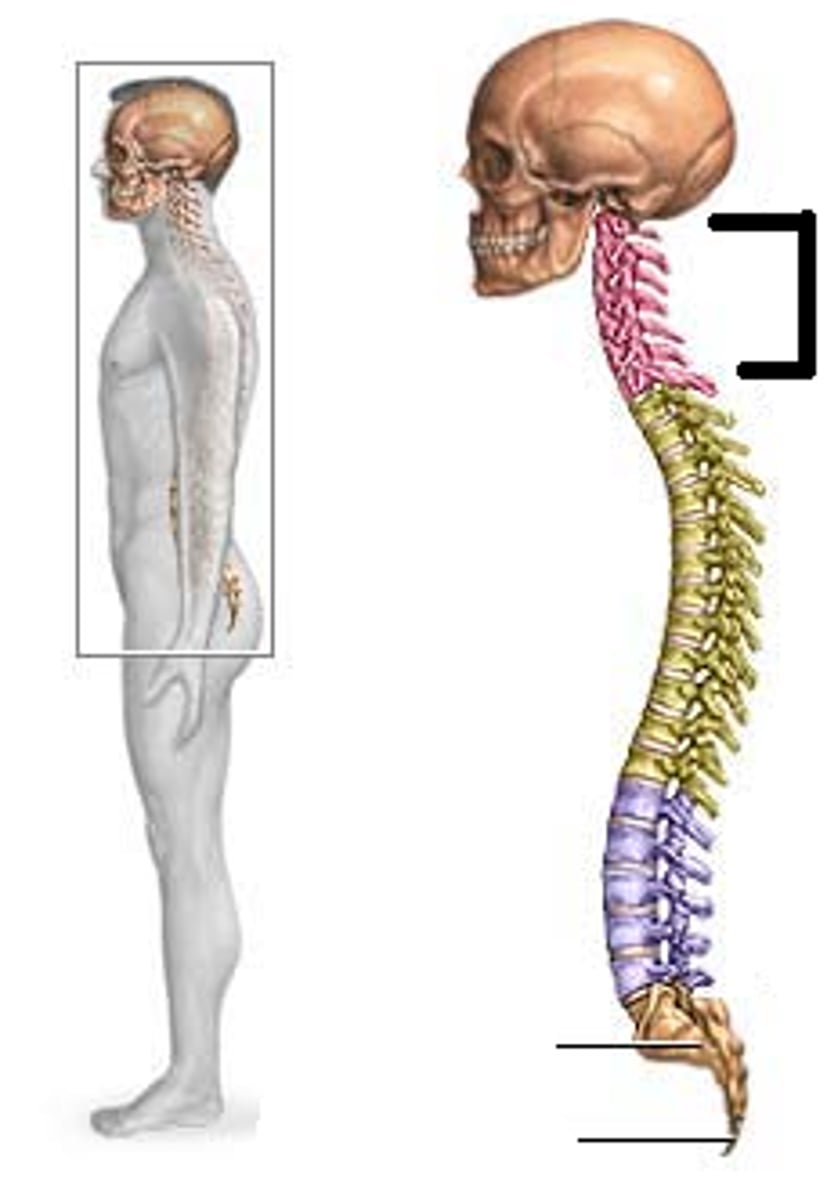
Cervical lordosis
Natural extension of the spine.
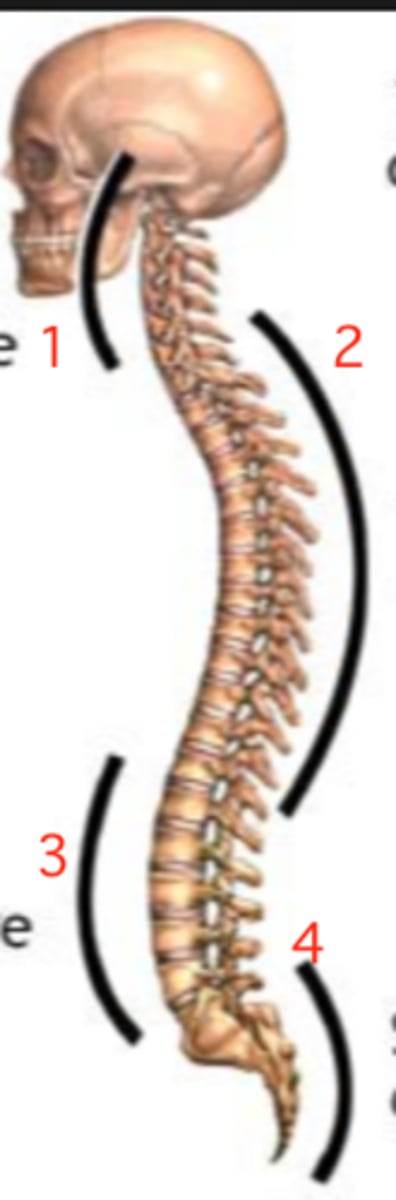
Thoracic kyphosis
Natural flexion of spine (2 in image).
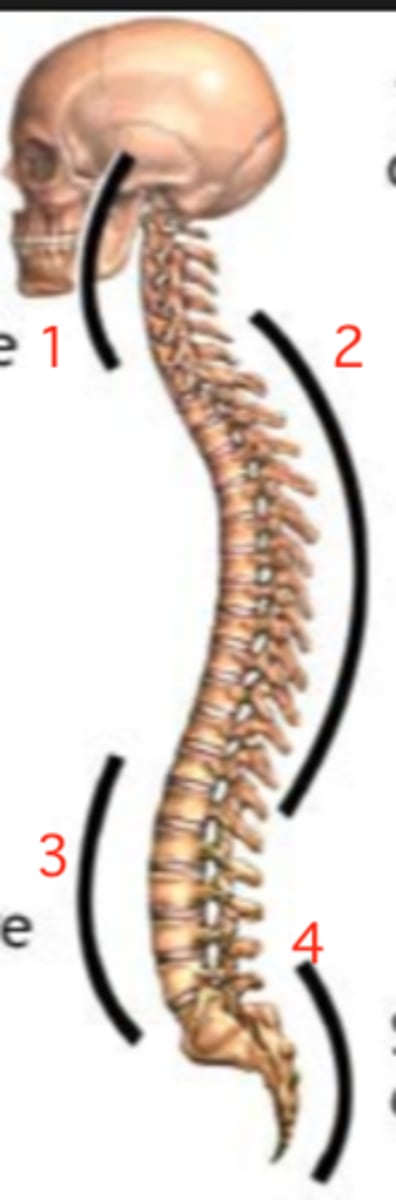
Lumbar lordosis
Natural extension of spine (3 in image).
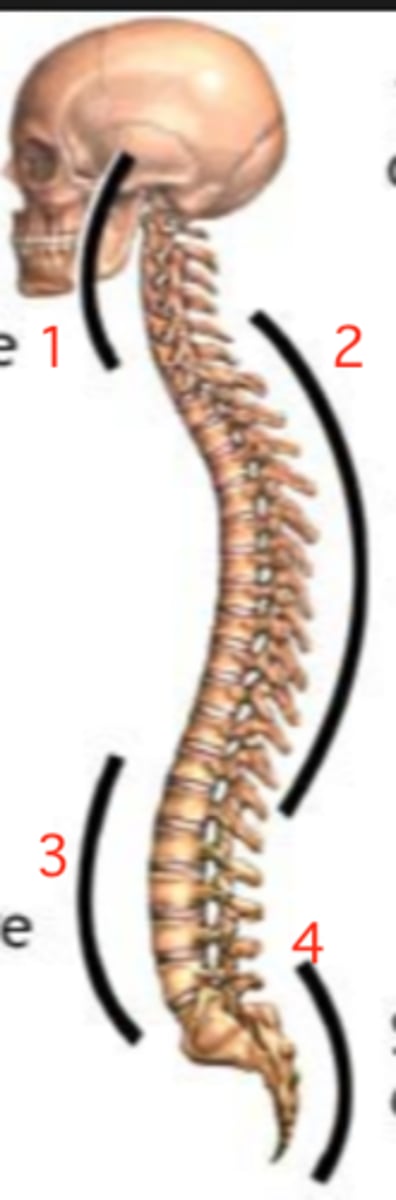
Sacrococcygeal kyphosis
Natural flexion of spine (4 in image).
S2
Center of mass is located at _____________________________, anterior to PSIS.
Line of gravity
__________________________________ is predominantly through vertebral bodies.
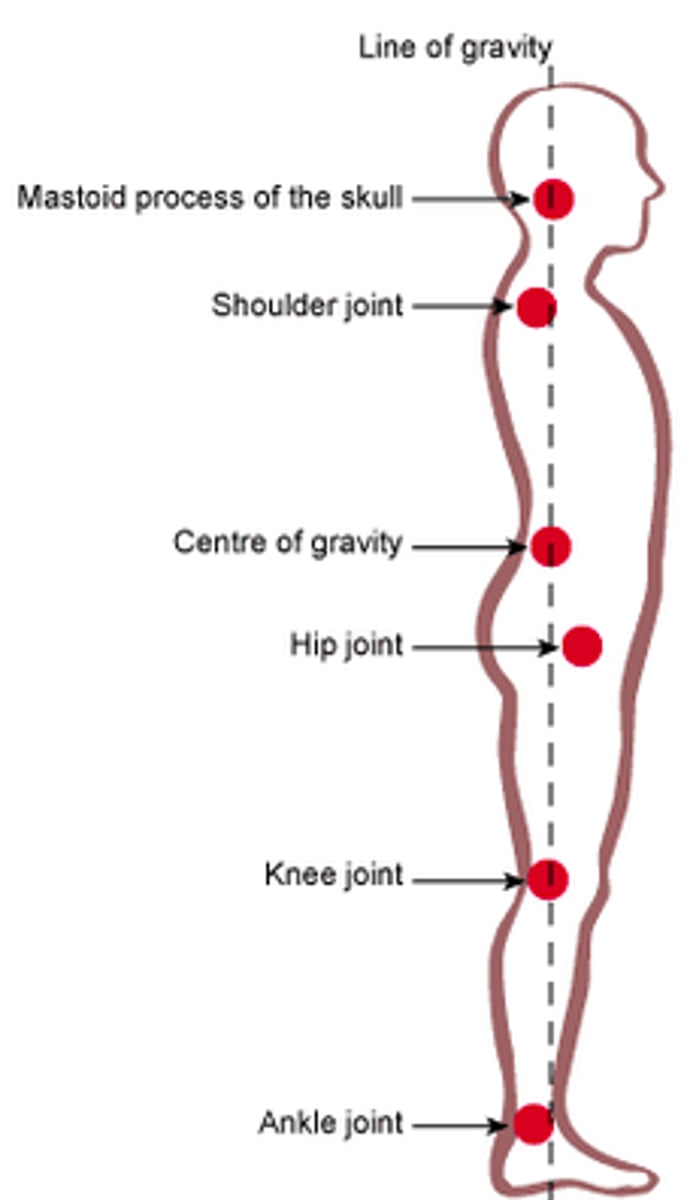
1. Vertebral bodies and IV discs
2. Ligaments
3. Facet (zygapophyseal) joints
What structures provide stability to vertebral column?
Vertebral bodies
Spine gains bony stability from ______________________________.
Intervertebral discs
Fibrocartilage pads that separate and cushion the vertebrae.
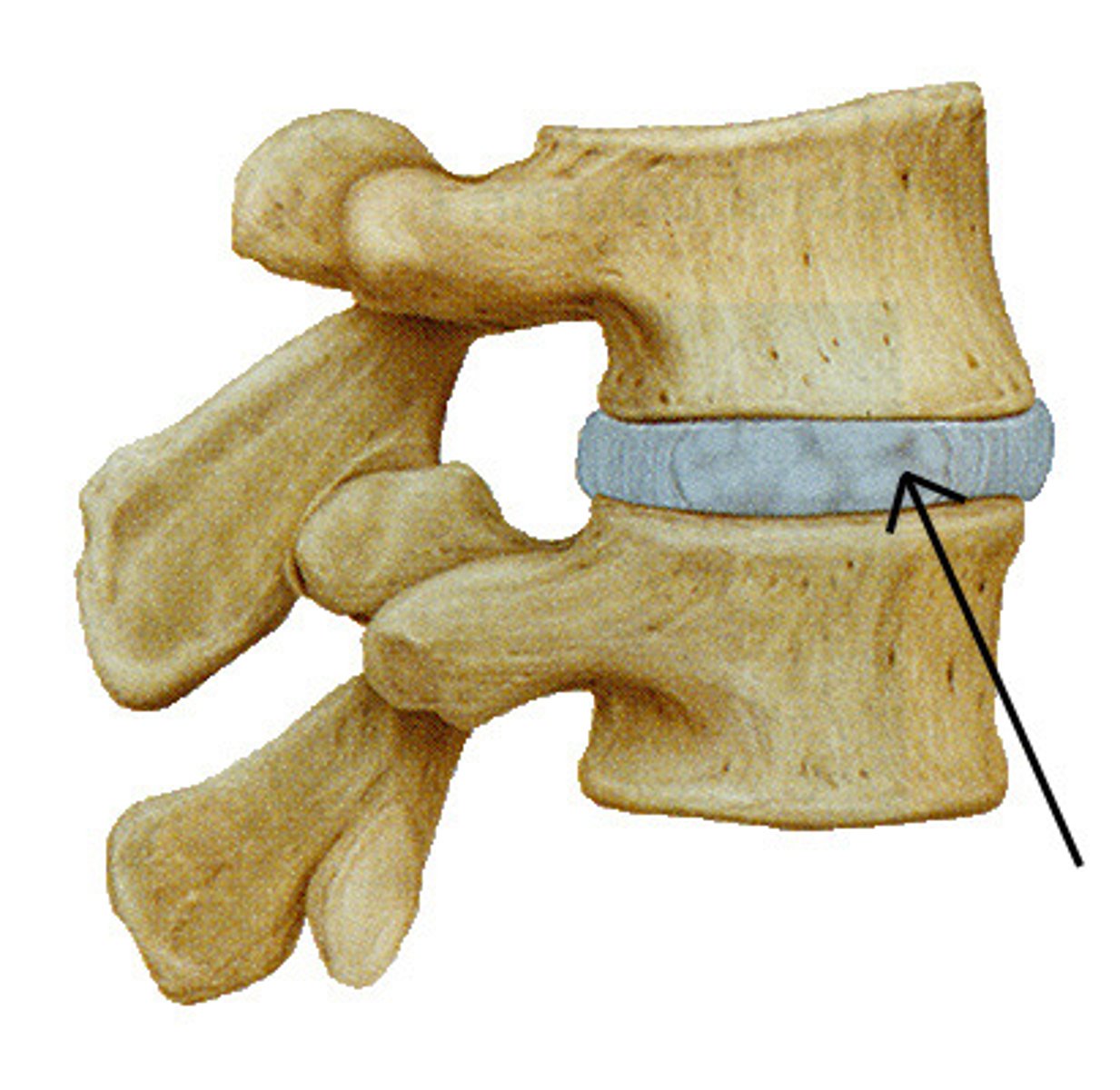
65°
Intervertebral discs have concentric rings composed of collagen fibers at _____________________________ angle with vertebral body.
Opposite
Concentric rings of intervertebral discs run in ______________________________ directions to create a strong, reinforced band of connective tissue that surrounds the nucleus pulposus, producing passive, ligamentous support.
Annulus fibrosis
Compression through the vertebral column creates pressure that pushes out against ______________________________.
Bowstring
Pressure against annulus fibrosis creates tension that causes annulus fibrosis fibers to _____________________________ ("hoop tension").
Counterforce
Force of annulus fibrosis against nucleus pulposus produces a ________________________________ against vertebral bodies, giving stability that we need to resist compression.
100%
Disc pressure is ____________________________ while standing.
2 times
Disc pressure while standing as if you are going to lift something up at your feet is _____________________________ that of standing.
3-4 times
Disc pressure while lifting an object up from your feet is _____________________________ that of standing.
Shock
Some mobility from spinal curvatures as they absorb ______________________________ during walking.
Facet joints
Discs and _________________________________ provide some mobility as well.
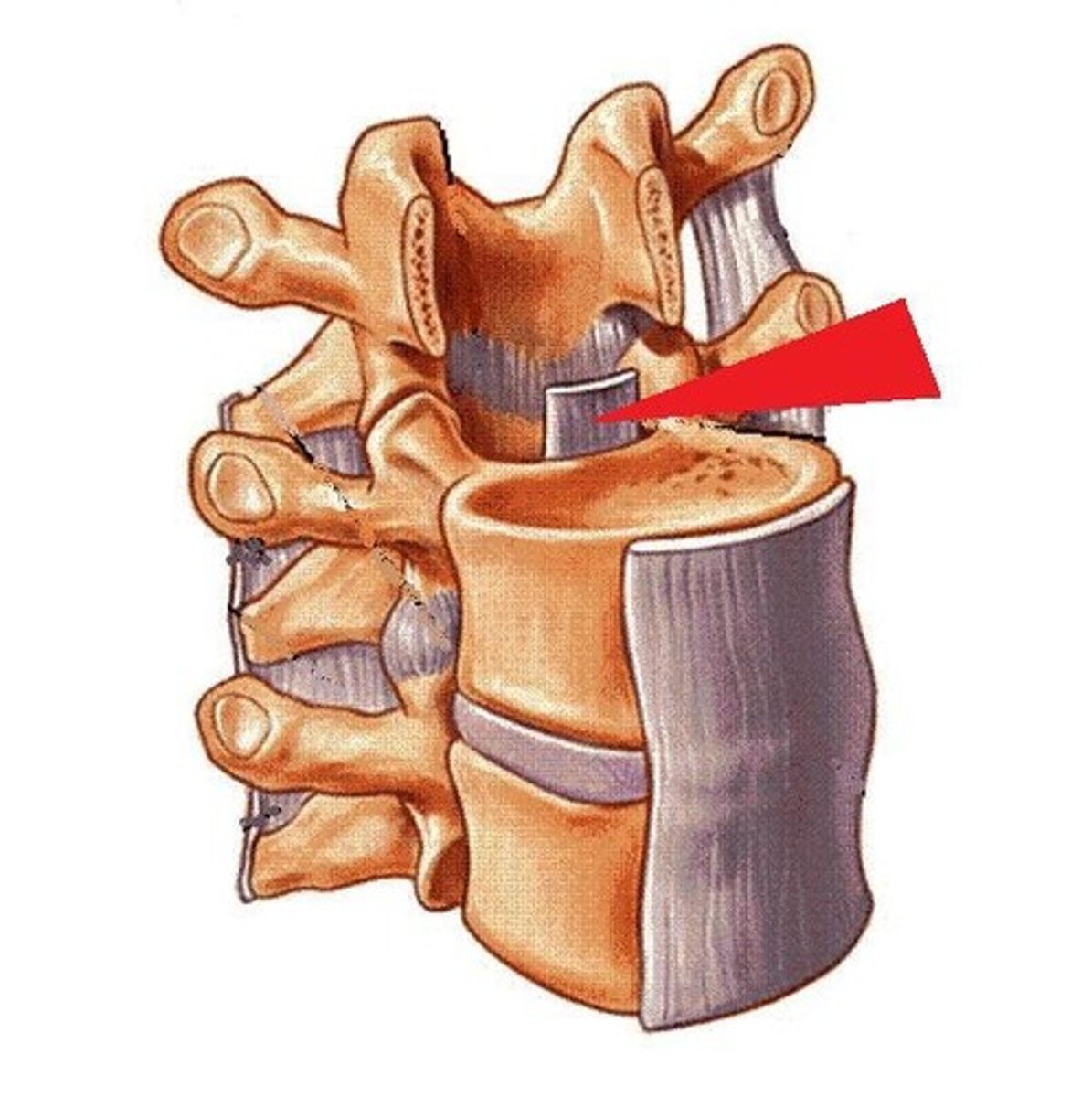
Posterior longitudinal ligament
Resists posterior shearing force and flexion.
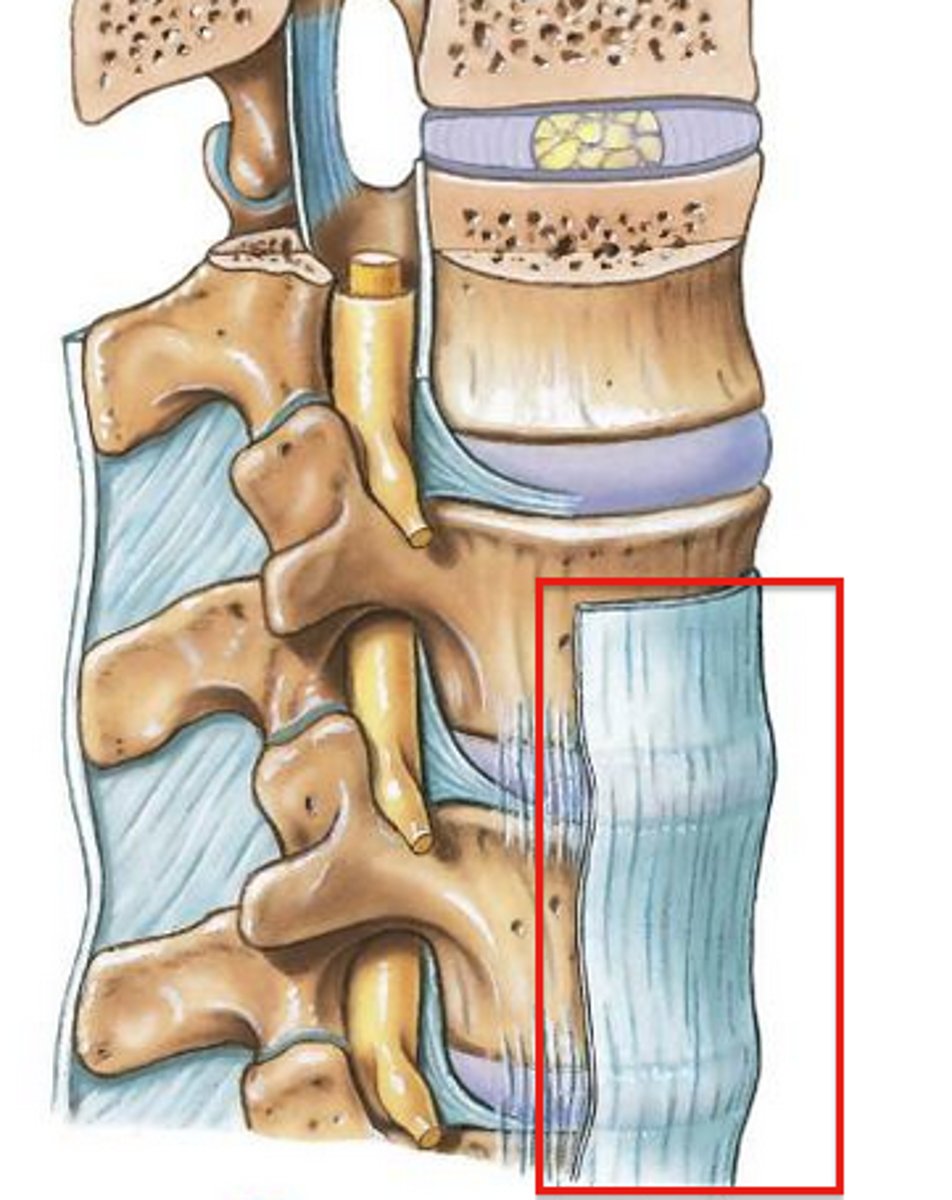
Anterior longitudinal ligament
Resists anterior shearing force, extension, and rotation.
Intertransverse ligament
Limits contralateral side-bending.
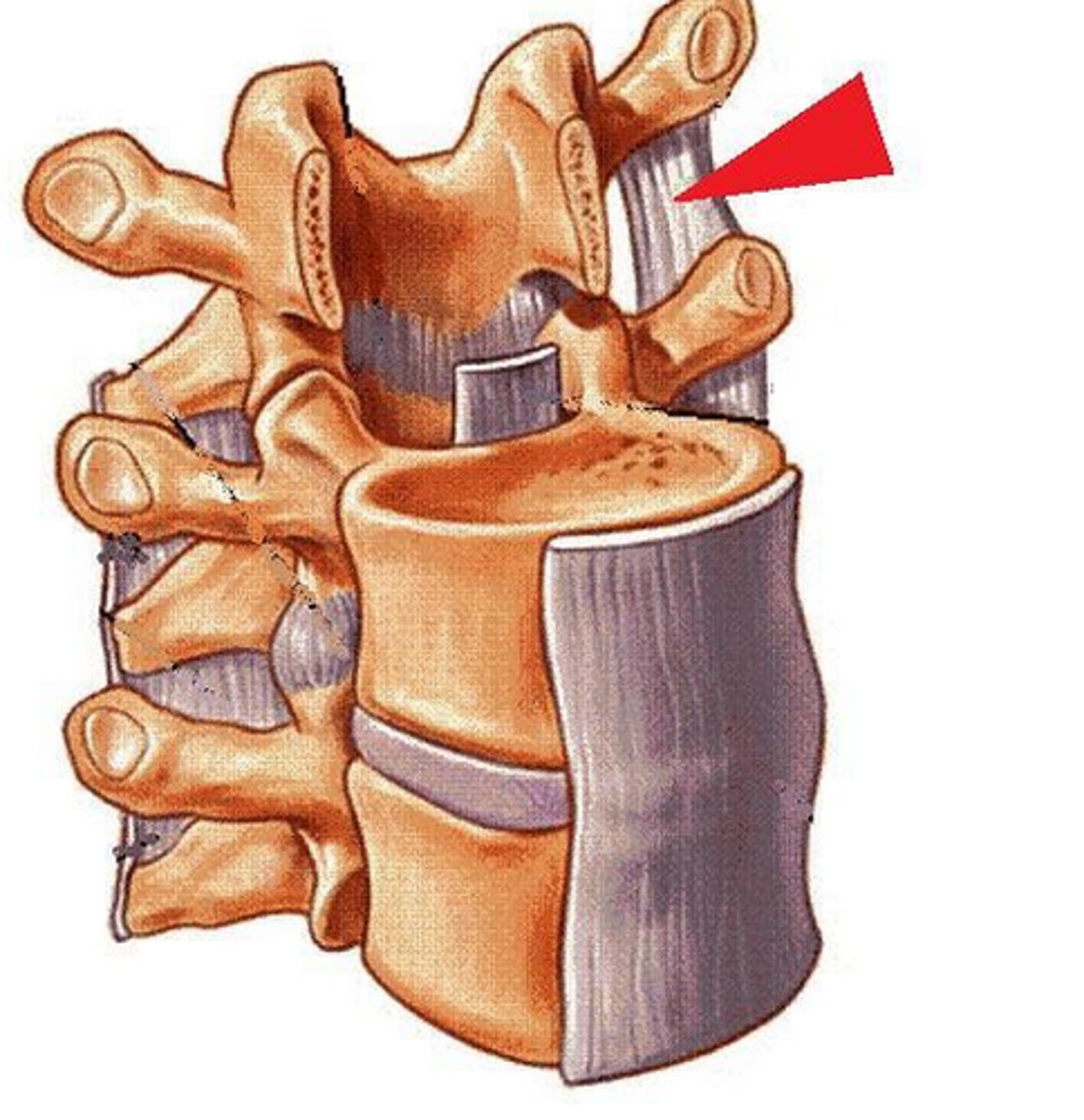
Ligamentum flavum
Limits flexion.
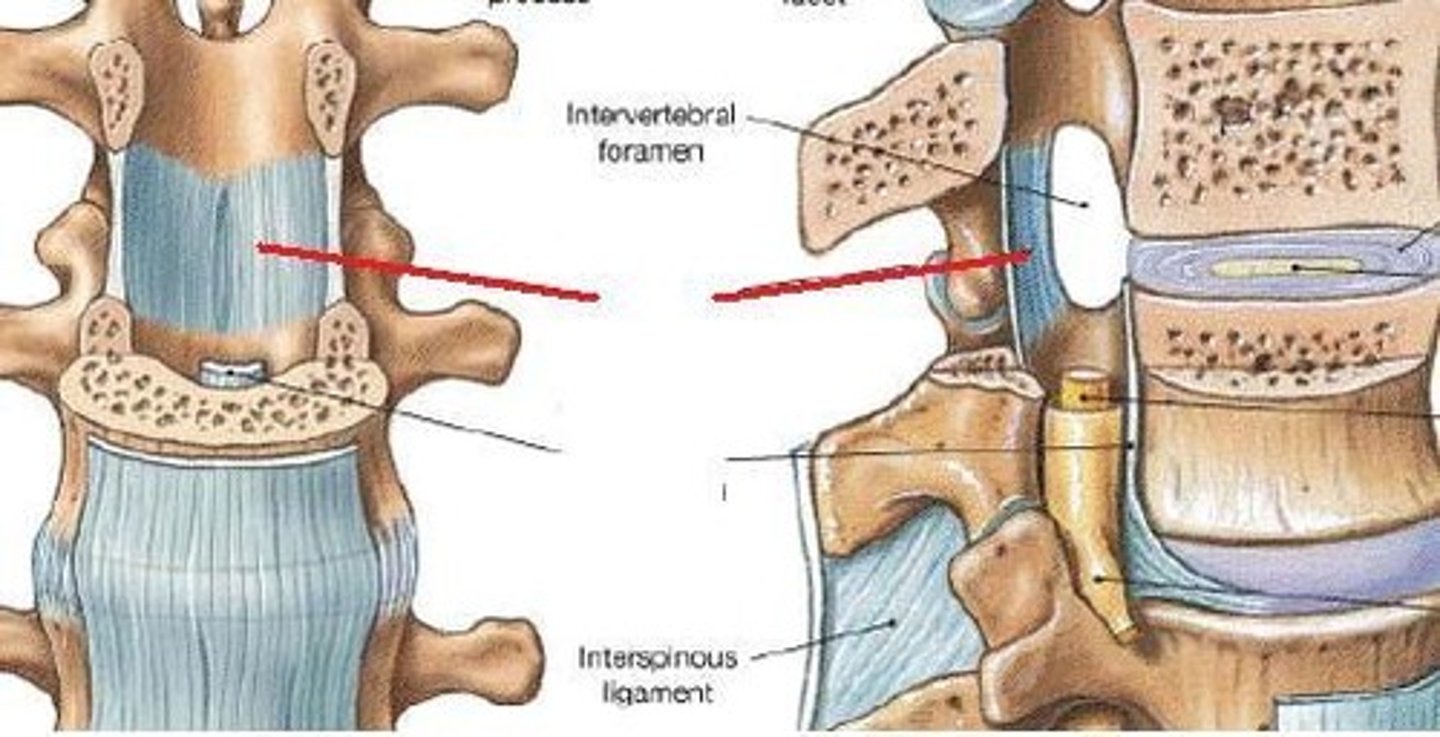
Interspinous ligament
Limits flexion.
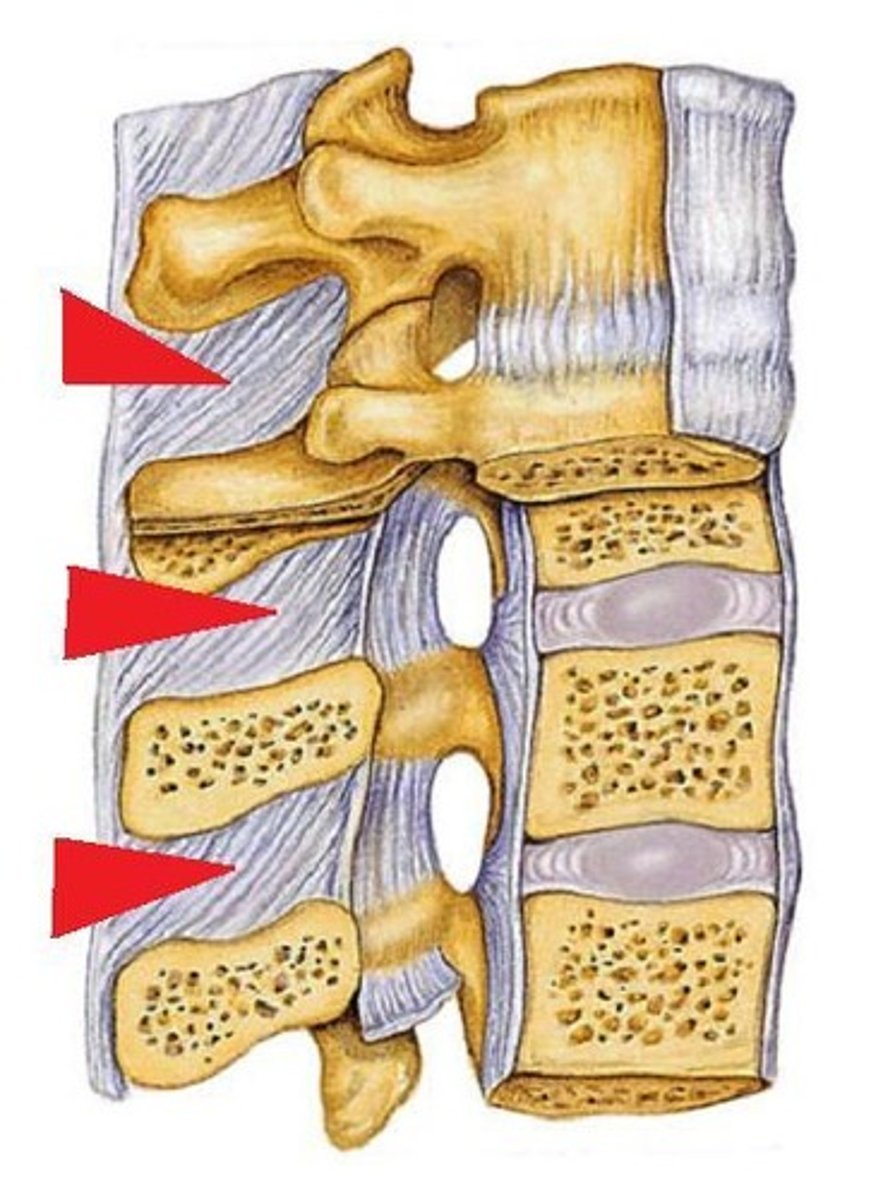
Supraspinous ligament
Limits flexion (A in image).
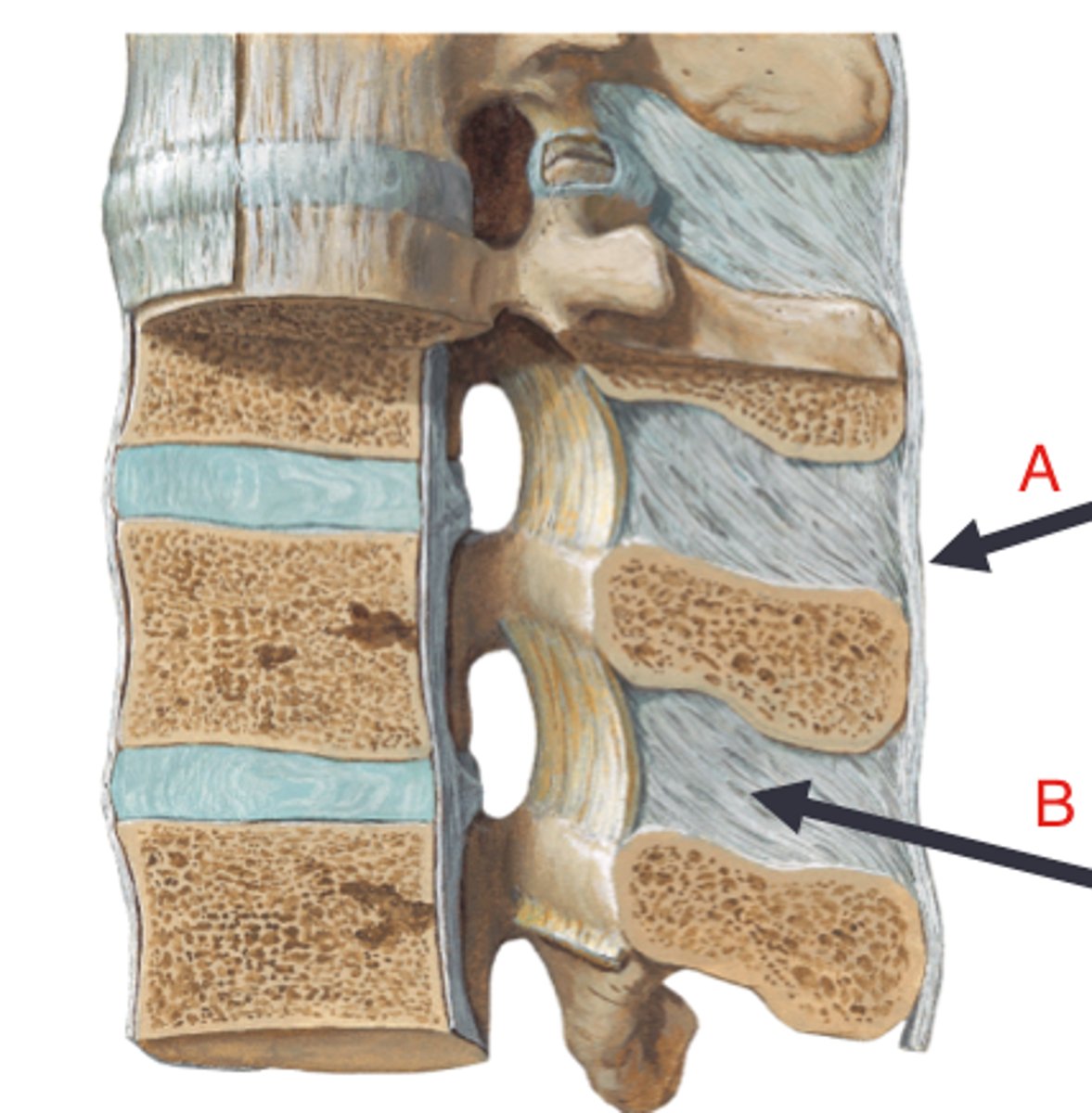
Iliolumbar ligament
Prevents anterior shear of L5 at S1; limits contralateral side-bending (A in image).
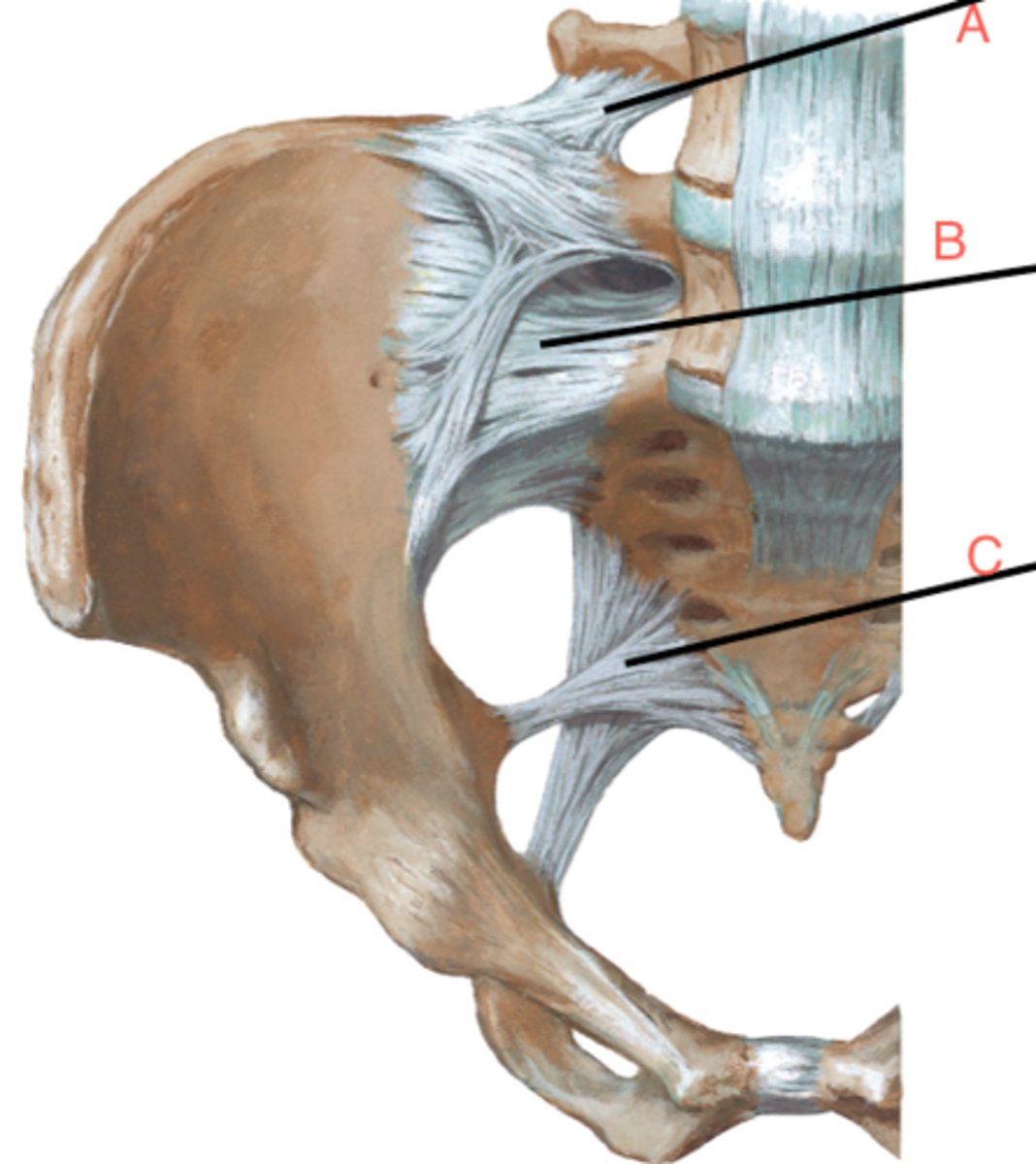
Anterior longitudinal ligament
What resists extension in the vertebral column?
1. Posterior longitudinal ligament
2. Ligamentum flavum
3. Interspinous ligament
4. Supraspinous ligament
What resists flexion in the vertebral column?
Anterior longitudinal ligament
What resists anterior shearing force?
Posterior longitudinal ligament
What resists posterior shearing force?
1. Intertransverse ligament
2. Iliolumbar ligament
What resists contralateral side-bending?
Rotate
C2 (axis) facet has a 20° angle from horizontal plane which allows C1 to _____________________________ freely on relatively flat surface.
45°
C3-C7 facets have a ___________________________ degree angle from vertical plane which allows for significant amount of motion.
Little
Facets of thoracic vertebrae have a 15° angle from vertical plane which allows for very __________________________ motion.
Sagittal plane
Facets of lumbar vertebrae turn so that they are 25° out from _____________________________________.
80°
Normal ROM for cervical extension.
Close-packed
Cervical extension is a ______________________________ movement.
Posterior roll, anterior glide.
Arthrokinematics of atlanto-occipital (OA) joint extension.
Posterior tilt.
Arthrokinematics of atlanto-axial (AA) joint extension.
Inferior glide.
Arthrokinematics of C2-C7 and thoracic joint extension.
Increase
Ratio of disc height to vertebral body height is an important ratio because increase in ratio leads to ________________________________ in motion.
2:5
Ratio of disc height to vertebral body height in cervical region.
1:5
Ratio of disc height to vertebral body height in thoracic region.
1:3
Ratio of disc height to vertebral body height in lumbar region.
Cervical spine
Highest availability of motion in ________________________________.
Thoracic region
Least availability of motion in _________________________________.
45-50°
Normal ROM for cervical flexion.
20-25%
_______________________________ of flexion and extension occurs at atlanto-occipital (OA) and atlanto-axial (AA) joints.
Inferior facets of the superior segment on the superior facets of the inferior segment
In the spine, when we describe arthrokinematics, we are talking about the motion of the ___________________________________. For example, C6 on C7.
Anterior roll, posterior glide.
Arthrokinematics of atlanto-occipital (OA) joint flexion.
Anterior tilt.
Arthrokinematics of atlanto-axial (AA) joint flexion.
Superior glide.
Arthrokinematics of C2-C7 and thoracic joint flexion.
Protraction
Forward head posture that produces increased flexion torque in cervical spine.
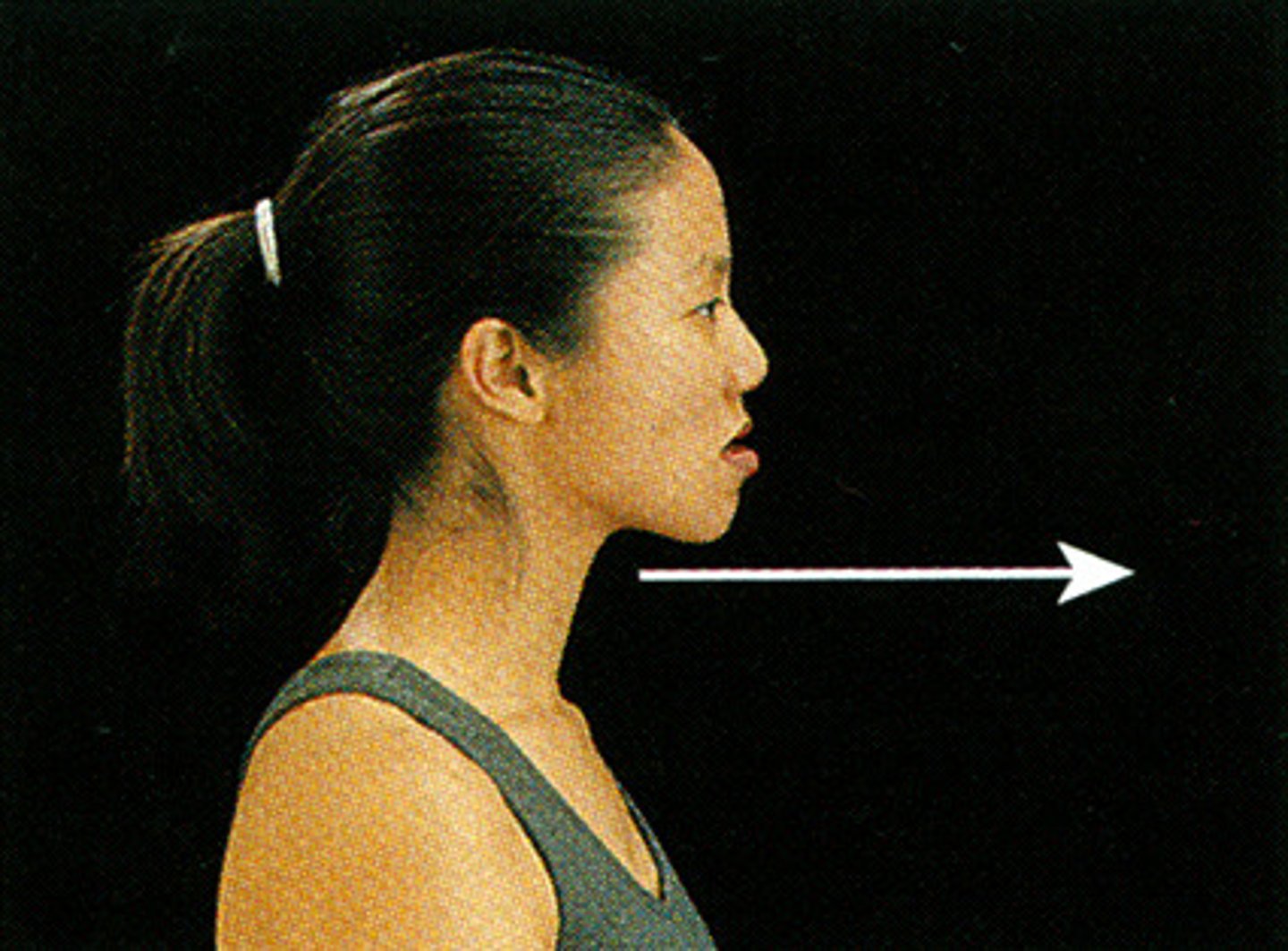
Extension
_______________________________ in upper cervical spine (C1-C2) occurs to produce protraction.
Flexion
__________________________________ in lower cervical spine (C3-C7) occurs to produce protraction.
Retraction
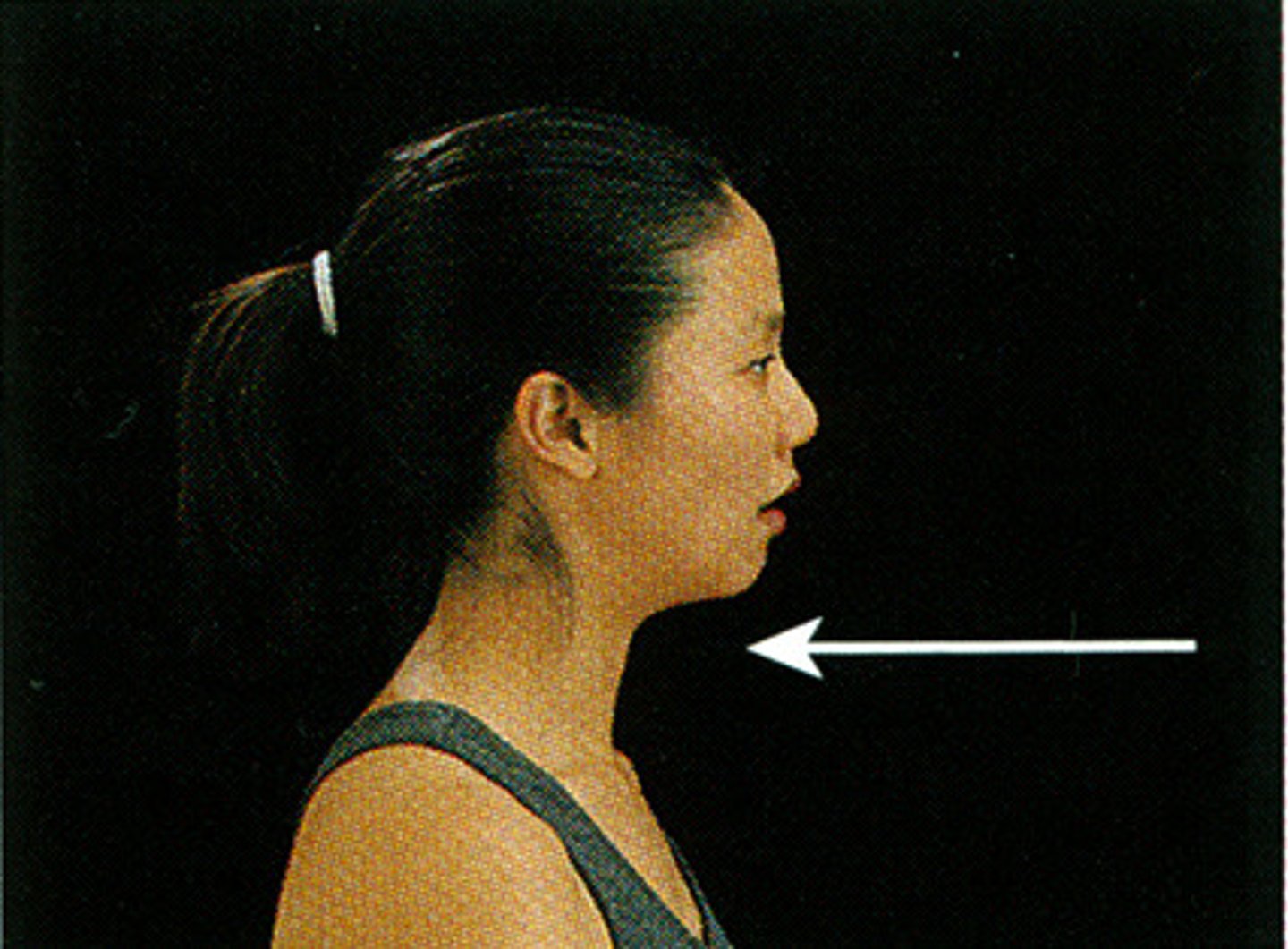
Flexion
________________________________ in upper cervical spine (C1-C2) occurs to produce retraction.
Extension
___________________________________ in lower cervical spine (C3-C7) occurs to produce retraction.
65-70°
Normal ROM for cervical rotation.
Atlanto-axial (AA) joint
___________________________________ is primary site of rotation in cervical spine.
Posterior glide of ipsilateral side, anterior glide of contralateral side.
Arthokinematics of atlanto-axial (AA) joint rotation.
Inferior glide on ipsilateral side, superior glide on contralateral side.
Arthrokinematics of C2-C7 and thoracic joint rotation.
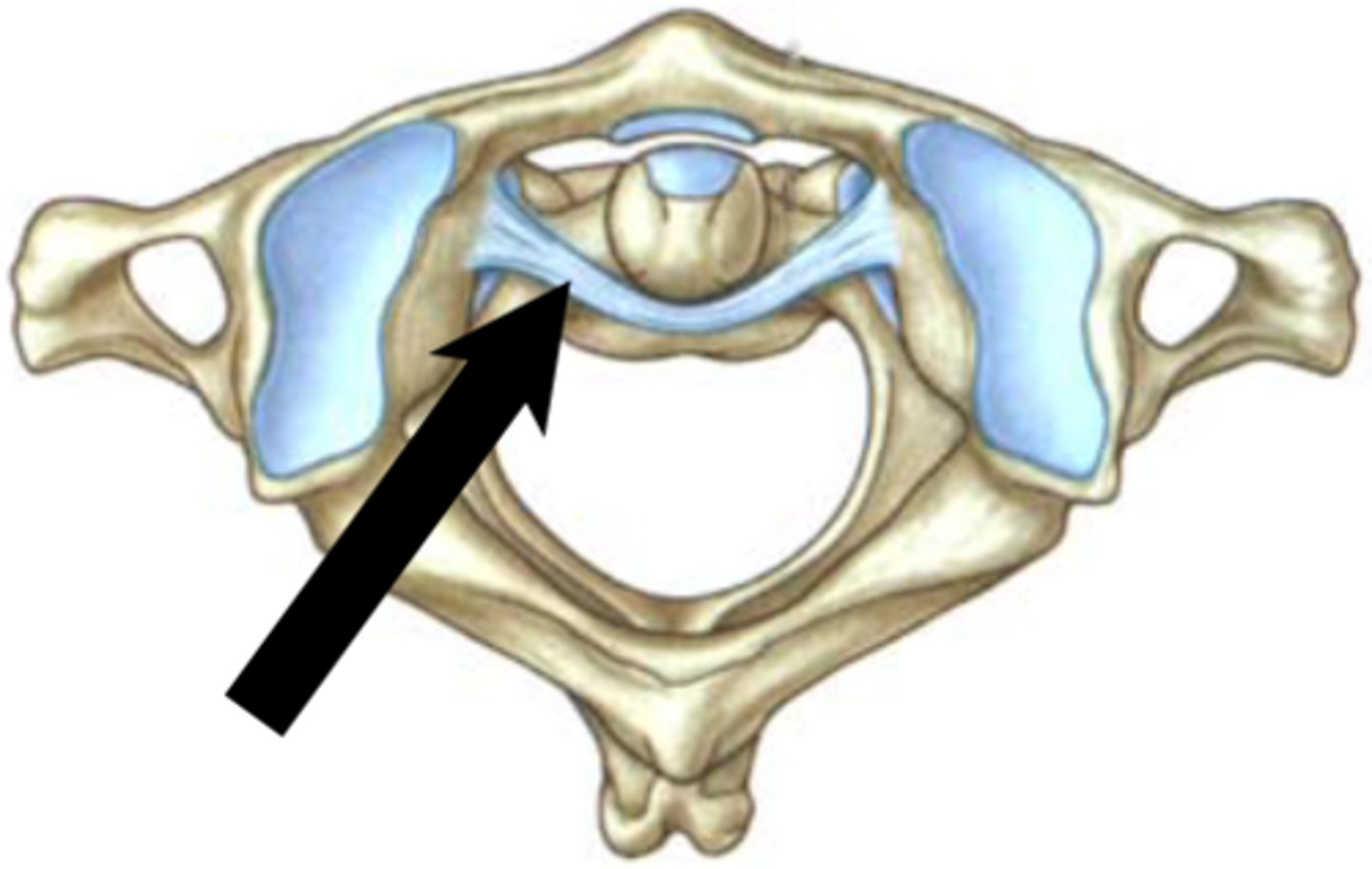
Transverse ligament of atlas
Stabilizes C1 on dens during rotation.
40°
Normal ROM for cervical side-bending.
Minimal tilting of occipital on atlas.
Arthrokinematics of atlanto-occipital (OA) joint side-bending.
Inferior glide on ipsilateral side, superior glide on contralateral side.
Arthrokinematics of C2-C7 and thoracic joint side-bending.
30-40°
Normal ROM for thoracic flexion.
20-25°
Normal ROM for thoracic extension.
30-35°
Normal ROM for thoracic rotation.
20-25°
Normal ROM for thoracic side-bending.
40-50°
Normal ROM for lumbar flexion.
15-20°
Normal ROM for lumbar extension.
5-7°
Normal ROM for lumbar rotation.
20°
Normal ROM for lumbar side-bending.
Superior glide.
Arthrokinematics of lumbar flexion.
Inferior glide.
Arthrokinematics of lumbar extension.
Ipsilateral gapping, contralateral compression.
Arthrokinematics of lumbar rotation.
Inferior glide on ipsilateral side, superior glide on contralateral side.
Arthrokinematics of lumbar side-bending.
Sagittal plane
There is more ______________________________ motion than anything else in the spine.
Cervical; lumbar
Sagittal plane motion in the spine comes predominantly from ________________________________ and ___________________________ regions.
C1-C2
Rotation in the spine comes predominantly from ________________________________ joint.
Frontal plane
At L4, L5, S1, facet joints face toward _____________________________ instead of sagittal plane in order to prevent anterior translation.
Lordotic curvature
Because of ________________________________, there are natural anterior shear forces on lumbar spine. The frontal plane orientation is meant to limit anterior translation of these vertebrae.
Same
According to Fryette's 2nd Law, side bending and rotation occur to the ___________________________ direction in the cervical region.
Opposite
According to Fryette's 1st Law, side bending is ___________________________________ side of rotation when spine is neutral.
Flexed/extended
According to Fryette's 2nd Law, side-bending and rotation occur to same direction when spine is _______________________________.
More
According to Fryette's 3rd Law, there is ____________________________ rotation and motion when the spine is neutral as opposed to flexed/extended.
1. Semispinalis capitis
2. Levator scapulae
3. Upper trapezius
4. Rectus capitis posterior major
What muscles produce cervical extension?
1. Sternocleidomastoid
2. Scalenus anterior
3. Longus colli
4. Longus capitis
What muscles produce cervical flexion?
Deep cervical flexors
Capital flexion is done by ______________________________.
Upper trapezius
Attaches to nuchal ligament, so spinous processes of cervical vertebrae.
Cervical extension
Bilateral concentric contraction of upper trapezius produces _________________________________.
Cervical extension, ipsilateral side-bend, contralateral rotation.
Unilateral contraction of upper trapezius produces __________________________________.
Levator scapulae
Runs from superior portion of scapula to transverse processes of cervical vertebrae.
Cervical extension
Bilateral concentric contraction of levator scapulae produces ______________________________.
Cervical extension, ipsilateral side-bend, ipsilateral rotation.
Unilateral concentric contraction of levator scapulae produces ____________________________________.
1. External obliques
2. Internal obliques
3. Transversus abdominis
4. Rectus abdominis
What muscles in the trunk produce flexion?
1. Psoas major
2. Erector spinae (iliocostalis and longissimus)
3. Multifidus
4. Latissimus dorsi
5. Quadratus lumborum
What muscles in the trunk produce extension?
All muscles on left side of body (e.g., left rectus abdominis, left psoas major, left erector spinae).
What muscles in the trunk produce left side-bend?
All muscles on right side of body (e.g., right external oblique, right quadratus lumborum, right latissimus dorsi).
What muscles in the trunk produce right side-bend?
 Note
Note  Flashcards (76)