Chapter 5 Chem GT, Periodic Trends, Ions, Scientists
 Studied by 0 people
 Call Kai
 Learn
Learn Practice Test
 Spaced Repetition
 Match
Match Flashcards
 Knowt Play
1/87

There's no tags or description
Looks like no tags are added yet.
Name | Mastery | Learn | Test | Matching | Spaced | Call with Kai |
|---|
No analytics yet
Send a link to your students to track their progress
88 Terms
Period
Horizontal row of elements in the periodic table
Group
Vertical column of the periodic table that contains elements with similar electron configurations; also known as a family.
Metal
Element that has a high melting point, is ductile, malleable, shiny, and a good conductor of heat and electricity. 91 of the 118 known elements are metals.
Nonmetal
Element that has a low melting point and a dull surface, breaks easily, is a poor conductor of heat and electricty.
Valence Electron
Electron in the outermost energy level of an atom that can be gained or lost to form a chemical bond
Atomic Radius
Distance between the center of the nucleus of an atom and the outermost electrons
ionization energy
the energy needed to remove one of its electrons
Electron affinity
Energy change that occurs when an atom gains an electron
Electronegativity
atoms ability to attract electrons in a chemical bond
Metalloids
also known as semimetals, elements that have properties of both metals and non-metals that divide those two groups on the periodic table. Boron and silicon are examples.
malleability
the ability of a substance to be hammered or beaten into thin sheets
ductile
can be coiled into wires
How are metalloids like metals
They have luster (shine) and are semiconductive.
How are metalloids unlike metals
They are not malleable or ductile or durable
How can you determine valence electrons?
1. Write the electron configuration
2. Determine the highest energy level (1, 2, 3, etc.)
3. Count the number of electrons in that level
Lewis Dot Notations
Notation with the element symbol and surrounding dots to represent electrons
Formula for the number of electrons in any level n
2n^2
Octet Rule
8 electrons in the valence shell. Elements want to have 8 valence electrons to have full valence electron orbitals
Elements will ____ electrons to get 8 valence electrons
gain/lose electrons
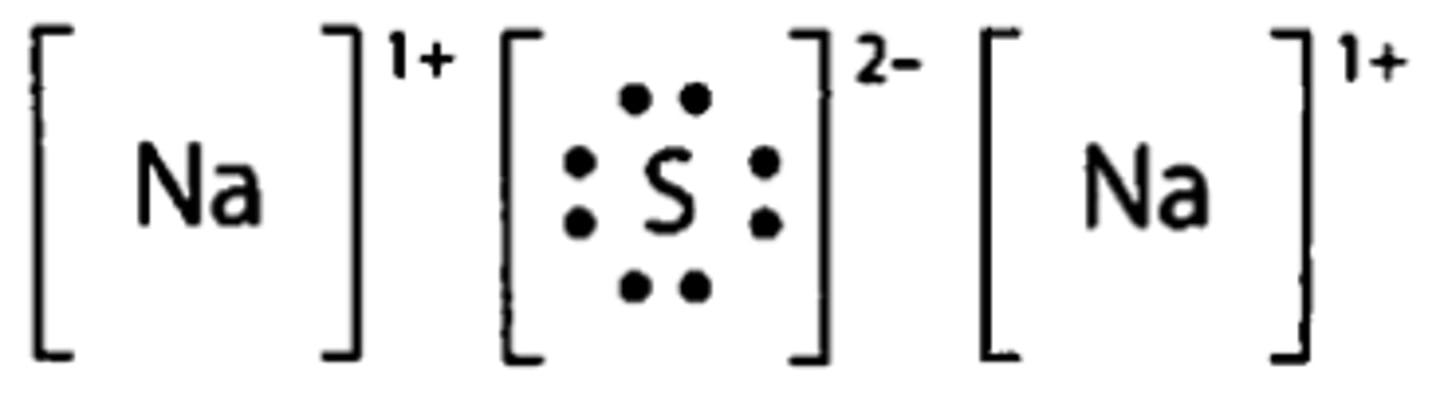
Cations
Element loses electrons forming an ion with a positive charge
Anions
Element gains electrons forming an ion with a negative charge
Ways to remember cations are positive
cats are good
ca+ion
Ways to remember anions are negatives
onions, like chem tests, make you cry
An atom with more than 4 valence electrons will want to ___ and become a ___
gain electrons and become an anion
An atom with less than 4 valence electrons will want to ___ and become a ___
lose electrons and become a cation
an atom that gains x electrons is an anion denoted
[element symbol] x-
an atom that loses x electrons is a cation denoted
[element symbol] x+
What period is the border between atoms that gain electrons and those that lose electrons?
period 4
As you move down a group or family, the atomic radius gets __
larger
As you move along (left to right) on a period the atomic radius gets ___
smaller
When an atom gains electron(s) or becomes a negative ion, it ___
becomes larger. There are more electrons to repel the attractive force of the protons
When an atom loses electron(s) or becomes a positive ion, it ___
becomes smaller. There are fewer electrons to repel the attractive force of the protons
As you move down a group, ionization energies __
decrease (valence electrons are further from the nucleus so there is less pull)
As you move left to right along a period, ionization energies __
increase (atoms want to gain electrons, so they lose less readily)
As you move along a period, the electronegativity __
increases
As you move down a family, the electronegativity __
decreases
charge of an ion from period I (hydrogen, lithium, sodium)
1+
charge of an ion from period V (nitrogen, phosphorus, arsenic)
3-
charge of an ion from period II (beryllium, magnesium, calcium)
2+
charge of an ion from period VIII (helium, neon, argon)
none, as they have a full valence shell
charge of an ion from period VI (oxygen, sulfur, selenium)
2-
charge of an ion from period VII (fluorine, chlorine, bromine)
1-
charge of an ion from period III (boron, aluminium, gallium)
3+
charge of an ion from period IV (carbon, silicon, germanium)
either 4+ or 4- since they can go either way. Carbon is one of the most reactive elements.
atomic radius
the distance between the nucleus and the outermost electrons
Why does the atomic radius get larger when going down?
You are adding more shells and increasing the principal quantum number and extending electrons further from the nucleus
Why does the atomic radius get smaller when moving right?
As you move left to right, you are adding more protons which exert stronger pulls on the electrons in a given principal quantum level. This stronger attraction decreases the atomic radius.
If principal quantum number was the determining factor for atomic radius, then all of the elements along the same period would be ___
the same size
An atom's ionization energy is a reflection of __
how strongly they hold on to their outermost electrons
Atoms with high ionization energies ___ their electrons
holds on tight
Atoms with low ionization energies are more likely to __
lose one of their outermost electrons and gain a positive charge
What unit is ionization energy stated in
joules per atom
For a large collection of atoms, ionization energy is stated in
moles
First ionization energy
the energy required to remove the first electron form an isolated atom
Successive ionization energies
energies required to remove electrons beyond the first electron (second ie for second electron and so on)
Successively, it takes __ ionization energy to remove more electrons from an atom
more
It takes ___ energy to remove electrons from inner shells than from outer shells
a lot more energy (larger than the amount of energy to remove electrons from the same shell)
Eg. I1 for sodium is 496, I2 for sodium (the electron in the inner shell) if over 4000
Electronegativity applies to
atoms in a chemical bond (such as H2O)
Electronegativity is measured in
using the Pauling scale, no units
Which element has the highest electronegativity on the Pauling scale?
Fluorine
What is electronegativity useful for
Molecular bonding, polarity, reactivity
Higher electronegativity =
stronger pull on electrons
In water molecules, hydrogen electrons are ___.
Pulled towards the oxygen atom as it has a higher electronegativity
Electron affinity applies to
isolated atoms in the gas phase
Electron affinity tells us the
energy released when gaining electron(s)
an atoms attraction or affinity for an extra electron
Electron affinity is measured in
kJ/mol kilojoules per mol
Which element has the highest electron affinity
Chlorine, it has the most negative electron affinity and the largest energy release
Nonmetals have __
more negative electron affinity
Why is the electron affinity of noble gases zero?
They are full so it requires energy to add an electron
Greater attraction =
greater negative electron affinity
What did John Newlands propose?
The Octave law which arranged elements by increasing atomic mass
What did Newlands notice about elemental properties every eight elements?
They have similar properties
Who was the first person to derive a periodic table of elements
John Newlands
Who established the atomic number?
Henry Moseley
Moseley's Law
frequency = a(Z-b)^2
Z = atomic number
What does Moseley's Law explain?
the precise relationship between the characteristic X-rays emitted by an element and its atomic number
Lothar Meyer's periodic table organized elements based on
atomic weight and periodic trends and valence
Where are the alkali metals?
Group 1 (I)
Where are the alkaline earth metals?
Group 2 (II)
Where are the halogens?
Group 17 (VII)
Where are the noble gases?
Group 18 (VIII)
Law of Triads
Grouping elements into trios based on similar properties (such as lithium, sodium, and potassium). The middle element's atomic weight is the rough mean of the other two elements.
Who proposed the Law of Triads?
Johann Wolfgang Dobereiner
Dobereiner's 1st Triad
Lithium, Sodium, and Potassium
Dobereiner's 2nd Triad
Calcium, Strontium, Barium
Dobereiner's 3rd Triad
Chlorine, Bromine, Iodine
Who created the periodic table?
Dmitri Mendeleev
Periodic Law
Atoms are arranged by increasing atomic number and sorted by chemical and physical properties and groups.
 Note
Note  Flashcards (61)