Forces and Their Effects
0.0(0)
 Studied by 0 people
 Call Kai
 Learn
Learn Practice Test
 Spaced Repetition
 Match
Match Flashcards
 Knowt Play
Card Sorting
1/12

Earn XP
Description and Tags
Last updated 1:29 PM on 6/15/23
Name | Mastery | Learn | Test | Matching | Spaced | Call with Kai |
|---|
No analytics yet
Send a link to your students to track their progress
13 Terms
1
New cards
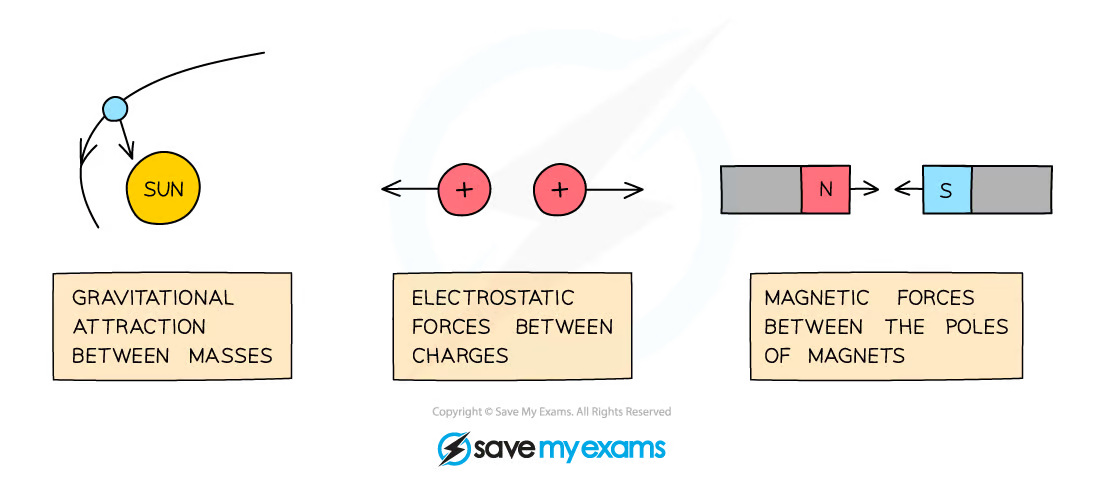
9\.1 Can you describe how objects can interact at a distance without contact?
**Non-contact force** = a force which acts at a distance, without any contact between bodies, due to the action of a field
**Gravitational attraction:**
* the attractive force experienced by two objects with mass
* e.g. the force between a planet and a comet
**Electrostatic force:**
* a force experienced by charged objects which can be attractive or repulsive
* e.g. the attraction between a proton and an electron
**Magnetic force:**
* a force experienced between magnetic poles that can be attractive or repulsive
* e.g. the attraction between the North and South poles of magnets
**Gravitational attraction:**
* the attractive force experienced by two objects with mass
* e.g. the force between a planet and a comet
**Electrostatic force:**
* a force experienced by charged objects which can be attractive or repulsive
* e.g. the attraction between a proton and an electron
**Magnetic force:**
* a force experienced between magnetic poles that can be attractive or repulsive
* e.g. the attraction between the North and South poles of magnets
2
New cards
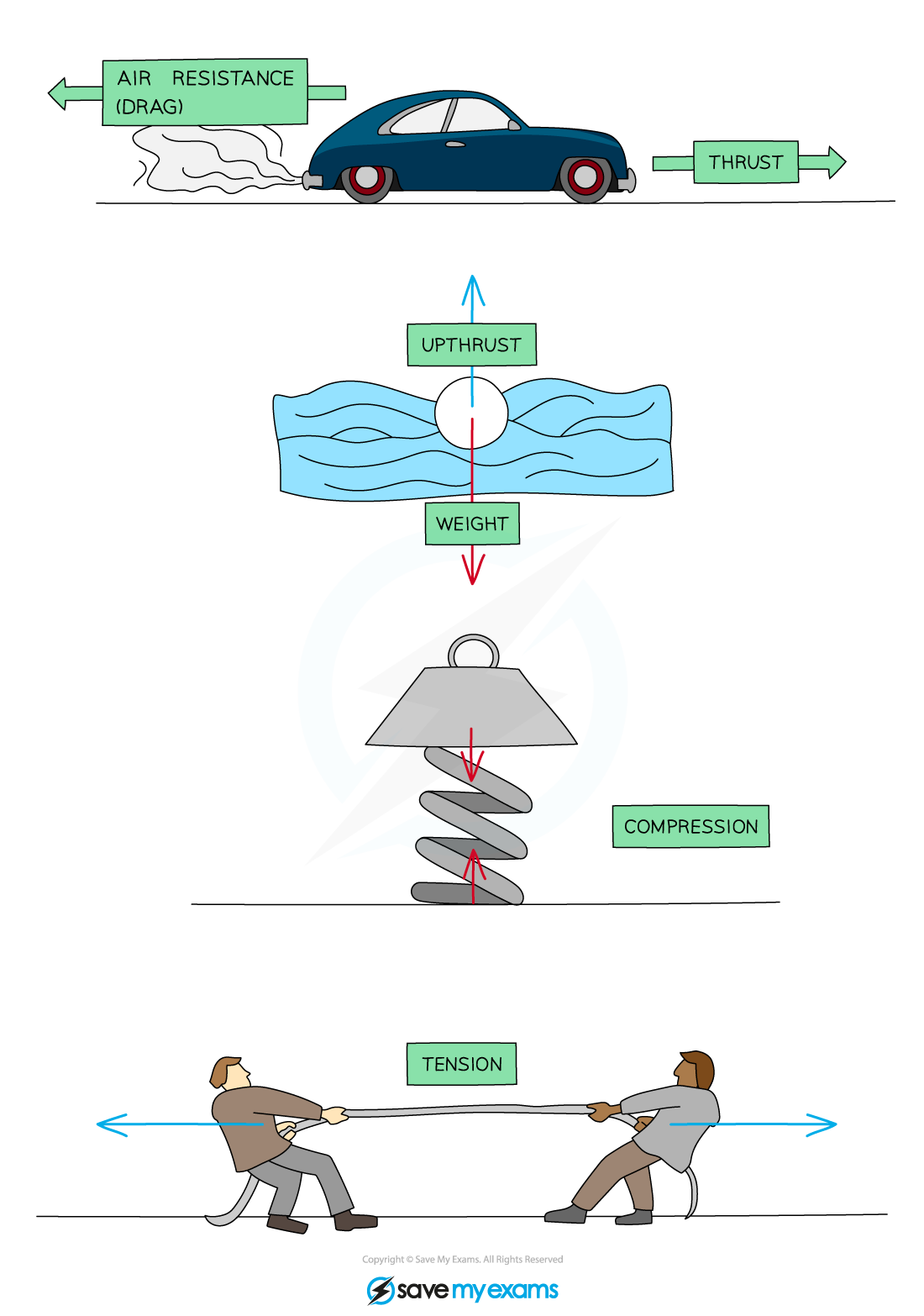
9\.1 Can you describe how objects can interact by contact, including normal contact force and friction?
**Contact force** = a force which acts between objects that are physically touching
**Friction:**
* a force that opposes motion
* occurs when objects rub against each other
**Air resistance:**
* a type of friction
* occurs when an object moves through the air
**Tension:**
* a force that pulls two objects connected by a length
* occurs when a force is applied to the length
**Normal force:**
* a force that pushes touching objects apart
* occurs when objects are supported by a surface
**Friction:**
* a force that opposes motion
* occurs when objects rub against each other
**Air resistance:**
* a type of friction
* occurs when an object moves through the air
**Tension:**
* a force that pulls two objects connected by a length
* occurs when a force is applied to the length
**Normal force:**
* a force that pushes touching objects apart
* occurs when objects are supported by a surface
3
New cards
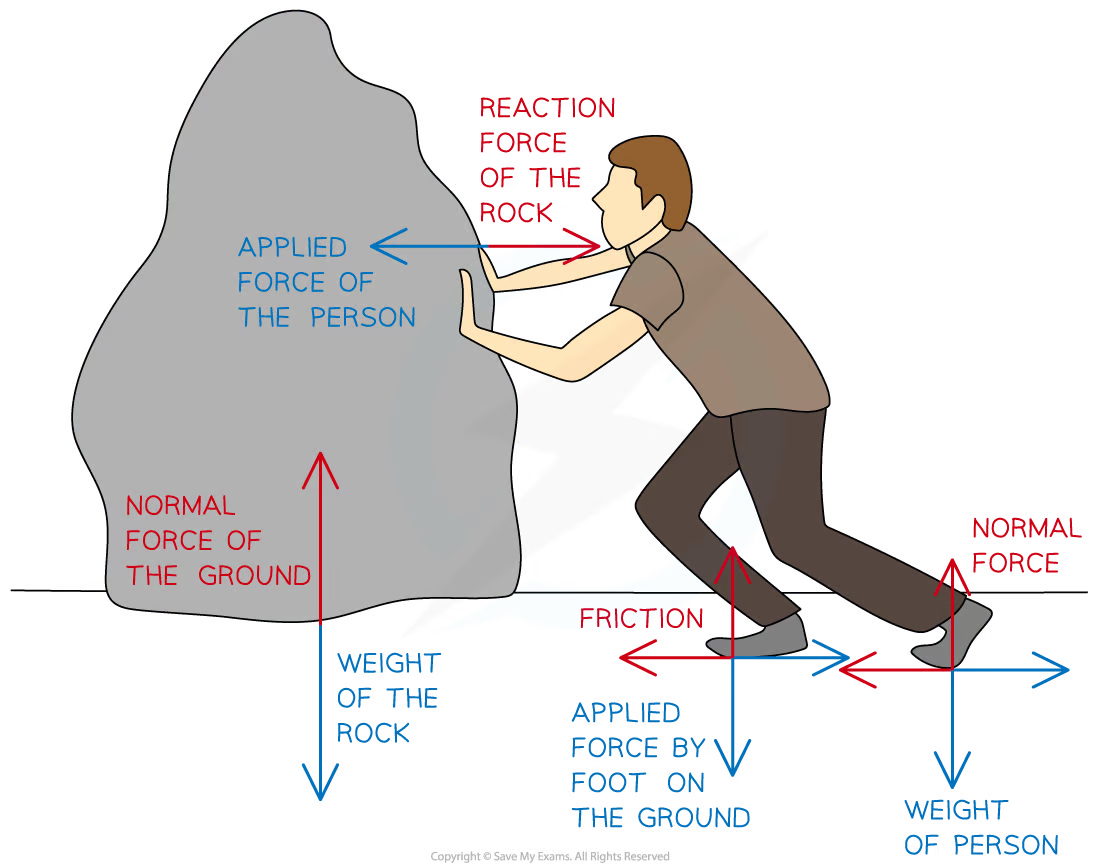
9\.1 Can you describe how objects can interact producing pairs of forces which can be represented as vectors?
When there is an interaction between two objects, a force is exerted on each object, known as a **force pair**
Force pairs can be represented by **arrows** in vector diagrams
* the **applied force** that the person exerts on the rock is opposed by a **reaction force** from the rock
* the **weight** of the rock on the ground is opposed by a **normal force**
* the **weight** of the person is also opposed by a **normal force**
* the **force applied** by the person driving their feet into the ground is opposed by **friction**
Force pairs can be represented by **arrows** in vector diagrams
* the **applied force** that the person exerts on the rock is opposed by a **reaction force** from the rock
* the **weight** of the rock on the ground is opposed by a **normal force**
* the **weight** of the person is also opposed by a **normal force**
* the **force applied** by the person driving their feet into the ground is opposed by **friction**
4
New cards
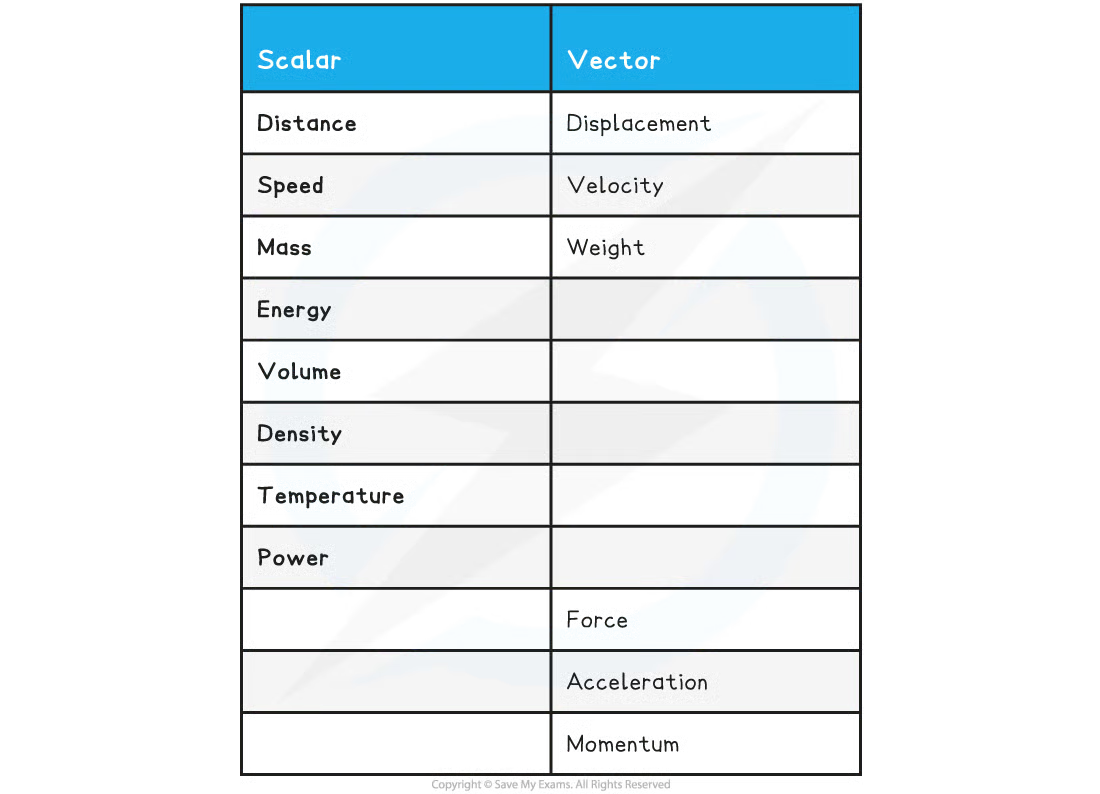
9\.2 Can you the difference between vector and scalar quantities?
**Scalars** are quantities that have only a **magnitude** whereas **vectors** have both a **magnitude** and a **direction**
5
New cards
9\.3 Can you use vector diagrams to illustrate the resolution of forces, a net force, and equilibrium situations?
Vector diagrams include arrows in a particular direction which represent the different forces on an object
The size of the arrow corresponds to the size of the force
Net, or resultant, forces can be calculated by adding or subtracting all of the forces acting on the object
* forces working in opposite directions are **subtracted** from each other
* forces working in the same direction are **added** together
If the forces acting in opposite directions are equal in size, then there will be no resultant force – the forces are said to be **balanced** and the system is in **equilibrium**
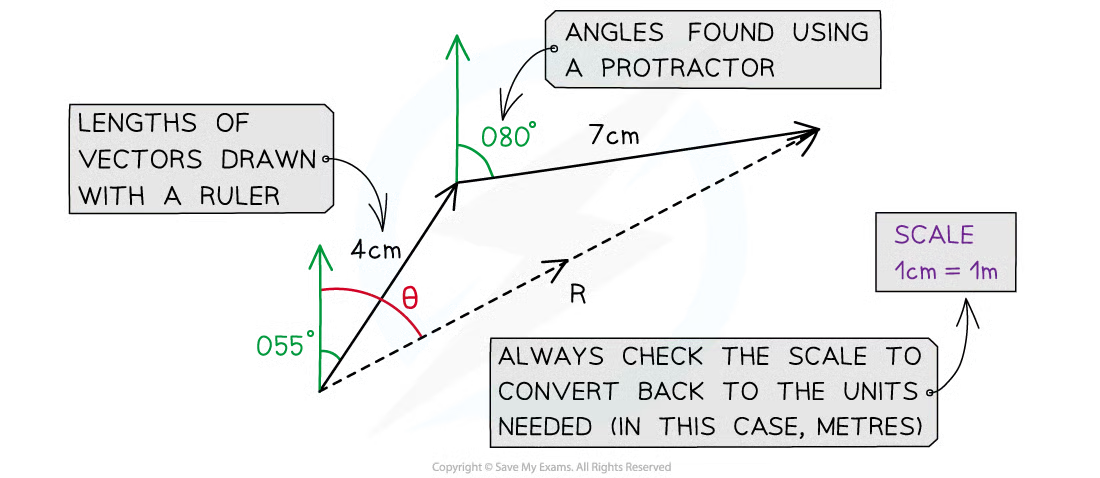
When two vectors are not at right angles, the resultant vector can be calculated using a scale drawing
* link the vectors head-to-tail if they aren’t already
* draw the resultant vector using the triangle or parallelogram method
* measure the length of the resultant vector using a ruler
* measure the angle of the resultant vector using a protractor
The size of the arrow corresponds to the size of the force
Net, or resultant, forces can be calculated by adding or subtracting all of the forces acting on the object
* forces working in opposite directions are **subtracted** from each other
* forces working in the same direction are **added** together
If the forces acting in opposite directions are equal in size, then there will be no resultant force – the forces are said to be **balanced** and the system is in **equilibrium**
When two vectors are not at right angles, the resultant vector can be calculated using a scale drawing
* link the vectors head-to-tail if they aren’t already
* draw the resultant vector using the triangle or parallelogram method
* measure the length of the resultant vector using a ruler
* measure the angle of the resultant vector using a protractor
6
New cards
9\.4 Can you draw and use free body force diagrams?
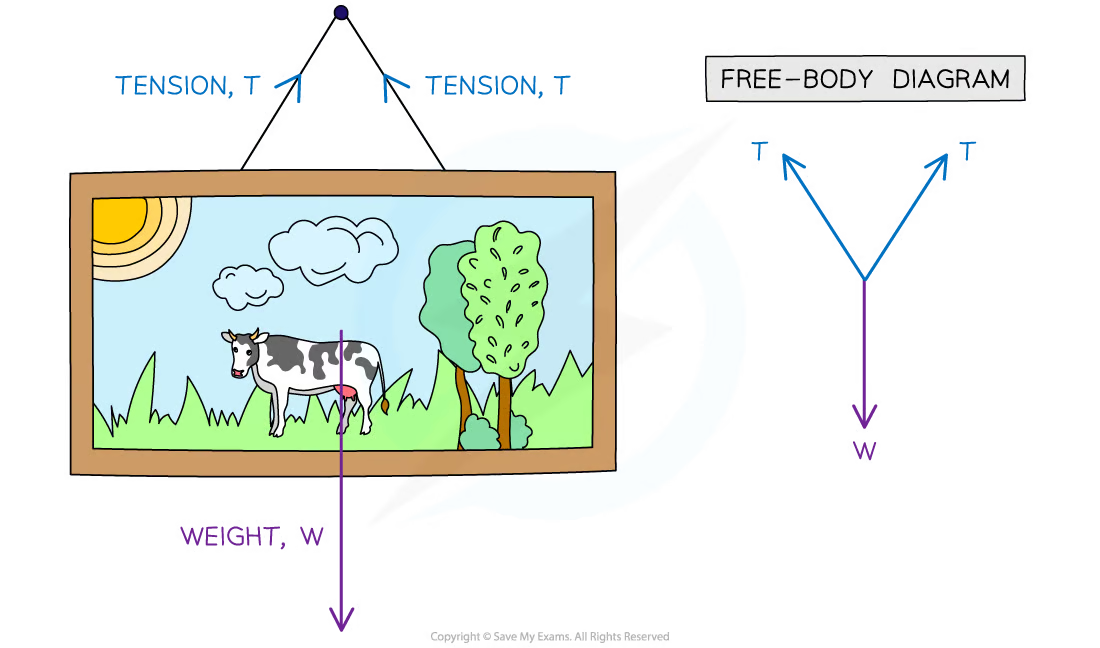
Free body diagrams are useful for modelling the forces that are acting on an object
Each force is represented as a **vector** arrow, where each arrow:
* is scaled to the **magnitude** of the force it represents
* points in the **direction** that the force acts
* is **labelled** with the name of the force it represents
Free body diagrams can be used:
* to identify which forces act in which plane
* to resolve the net force in a particular direction
Each force is represented as a **vector** arrow, where each arrow:
* is scaled to the **magnitude** of the force it represents
* points in the **direction** that the force acts
* is **labelled** with the name of the force it represents
Free body diagrams can be used:
* to identify which forces act in which plane
* to resolve the net force in a particular direction
7
New cards
9\.5 Can you explain examples of the forces acting on an isolated solid object or a system where several forces lead to a resultant force on an object and the special case of balanced forces when the resultant force is zero?
When many forces are applied to an object they can be combined (added) to produce one final force which describes the **combined action** of all of the forces
This single resultant force determines:
* the **direction** in which the object will move as a result of all of the forces
* the **magnitude** of the final force experienced by the object
The resultant force is sometimes called the **net force**
Forces can combine to produce
* **balanced** forces
* **unbalanced** forces
**Balanced** forces mean that the forces have combined in such a way that they cancel each other out and no resultant force acts on the body e.g. the **weight** of a book on a desk is balanced by the **normal** force of the desk and as a result, **no** **resultant force** is experienced by the book, the book and the table are **equal** and **balanced**
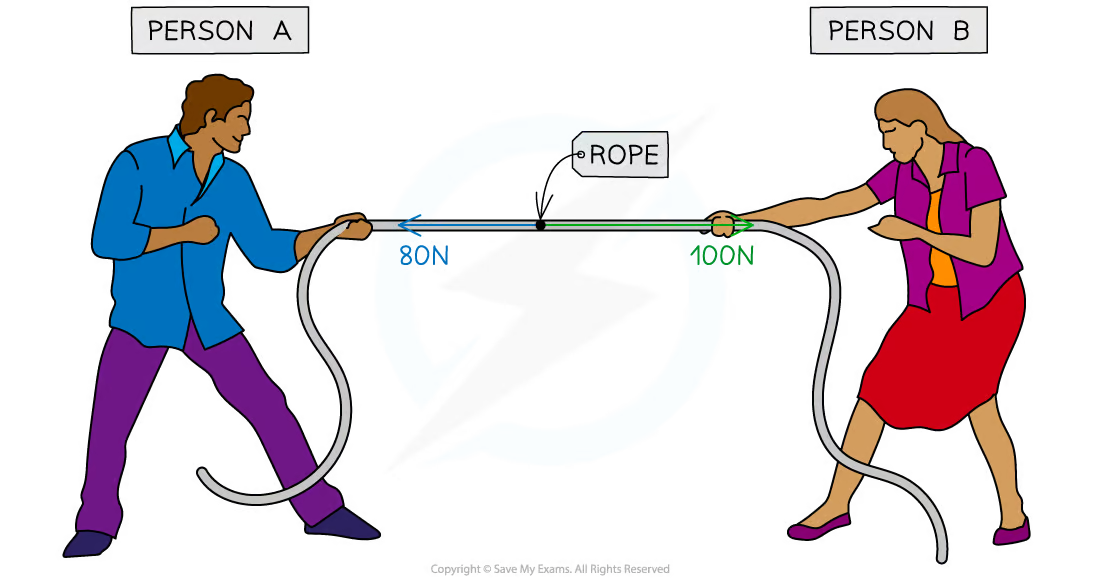
**Unbalanced** forces mean that the forces have combined in such a way that they do not cancel out completely and there is a **resultant force** on the object e.g when two people are playing a game of tug-of-war, working against each other on opposite sides of the rope, if person **A** pulls with 80 N to the left and person **B** pulls with 100 N to the right, these forces do not cancel each other out completely and since person **B** pulled with more force than person **A** the forces will be unbalanced and the rope will experience a resultant force of 20 N to the right
This single resultant force determines:
* the **direction** in which the object will move as a result of all of the forces
* the **magnitude** of the final force experienced by the object
The resultant force is sometimes called the **net force**
Forces can combine to produce
* **balanced** forces
* **unbalanced** forces
**Balanced** forces mean that the forces have combined in such a way that they cancel each other out and no resultant force acts on the body e.g. the **weight** of a book on a desk is balanced by the **normal** force of the desk and as a result, **no** **resultant force** is experienced by the book, the book and the table are **equal** and **balanced**
**Unbalanced** forces mean that the forces have combined in such a way that they do not cancel out completely and there is a **resultant force** on the object e.g when two people are playing a game of tug-of-war, working against each other on opposite sides of the rope, if person **A** pulls with 80 N to the left and person **B** pulls with 100 N to the right, these forces do not cancel each other out completely and since person **B** pulled with more force than person **A** the forces will be unbalanced and the rope will experience a resultant force of 20 N to the right
8
New cards
9\.6P Can you describe situations where forces can cause rotation?
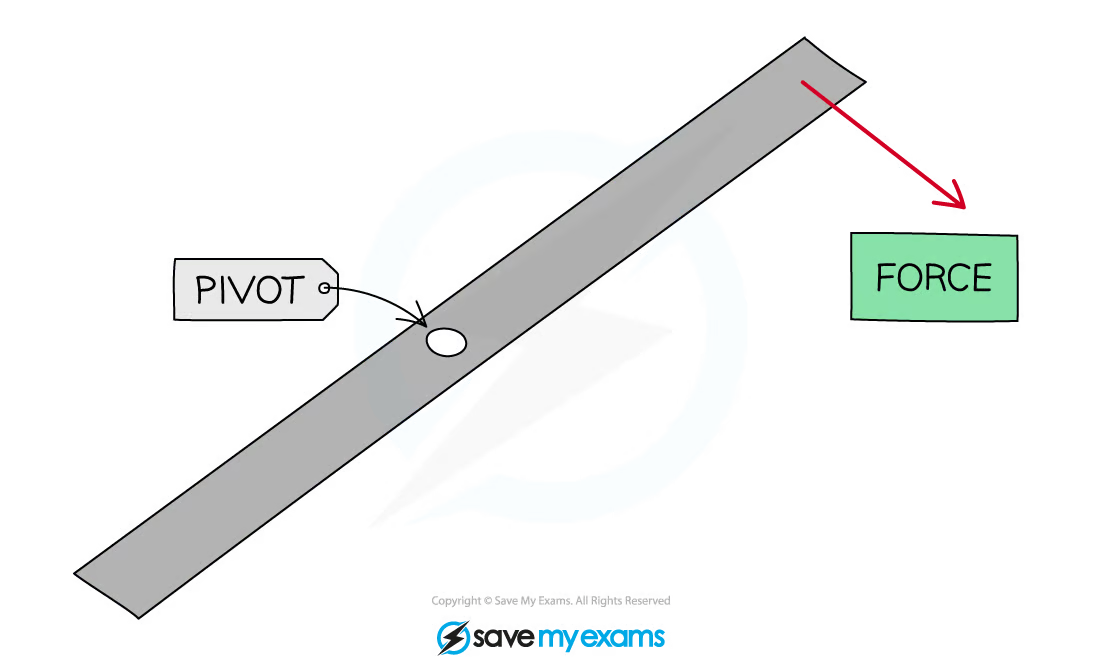
On one side of a pivot (a fixed point that the object can rotate around), a child on a see-saw, turning the handle of a spanner and a door opening and closing, rotation can be **clockwise** or **anticlockwise**
If two forces act on an object **without** passing through the same point, then the object can still rotate
* if the forces are equal and opposite, this is known as a **couple**
If two forces act on an object **without** passing through the same point, then the object can still rotate
* if the forces are equal and opposite, this is known as a **couple**
9
New cards
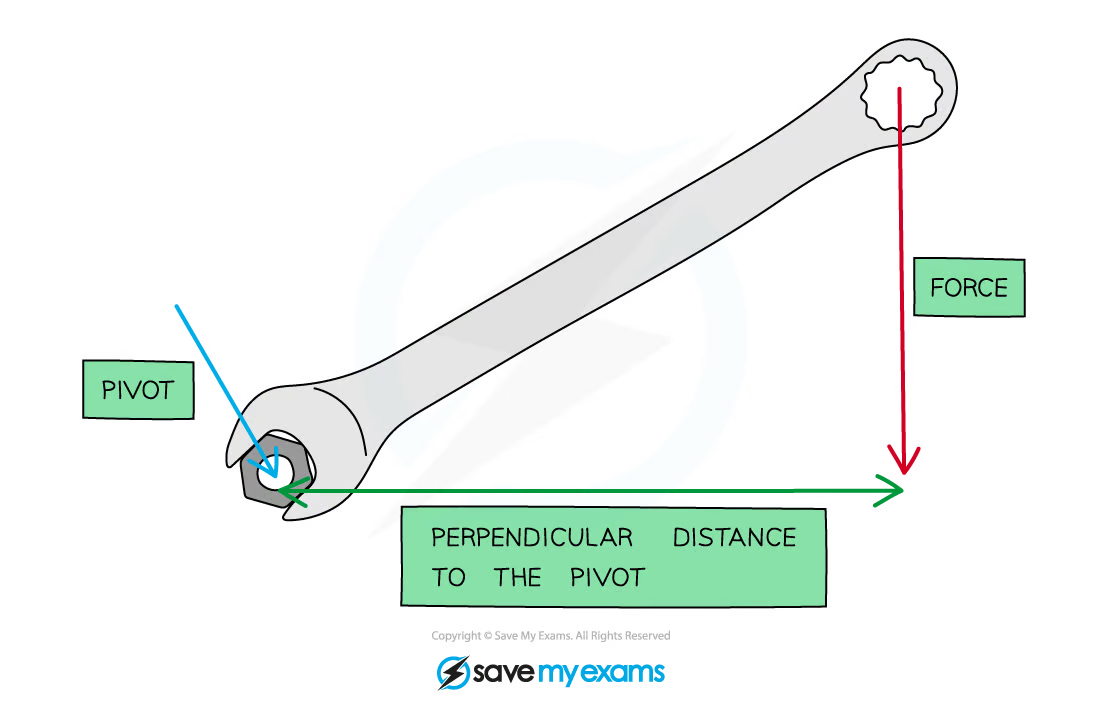
9\.7P What is the equation for a moment?
**Moment of a force = force × distance normal to the direction of the force**
Newton metre (N m) = newton (N) × metre (m)
Newton metre (N m) = newton (N) × metre (m)
10
New cards
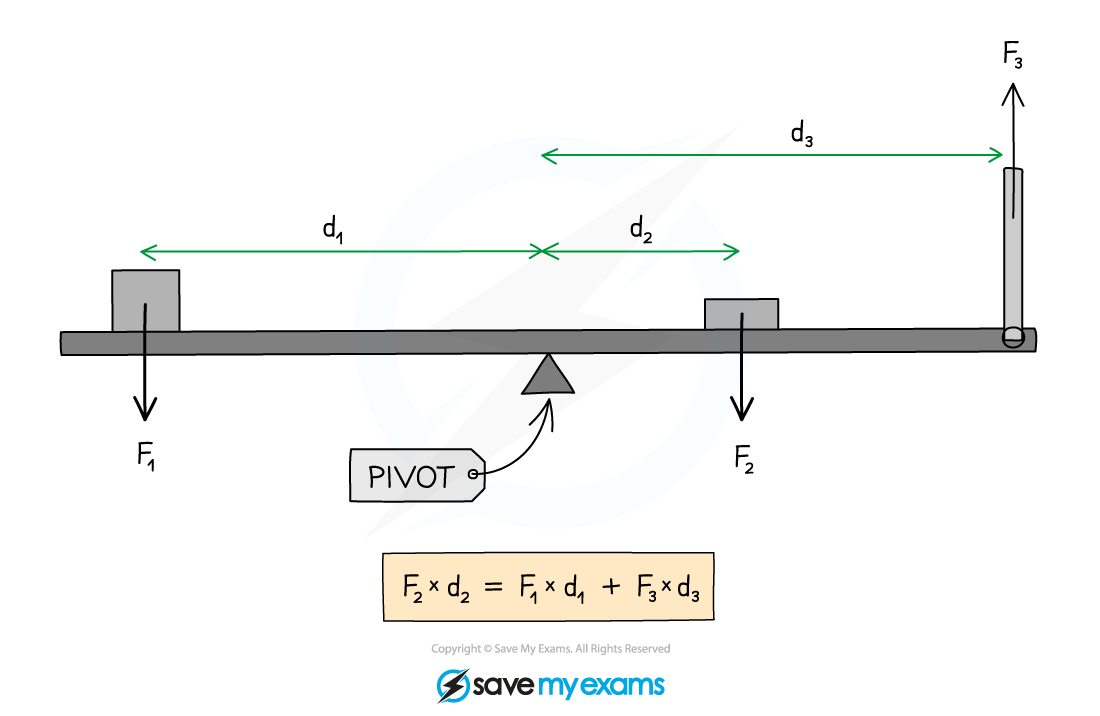
9\.8P What is the principle of moments in situations where rotational forces are in equilibrium?
**The sum of clockwise moments = the sum of anti-clockwise moments**
11
New cards
9\.9P How do levers transmit the rotational effects of forces?
Levers **increase** the size of a **force** acting on an object to make the object turn more easily
The force applied to a lever must act **further** from the pivot than the force has to overcome
To make a lever work better:
* increase the **size** of the force applied
* increase the **distance** of the force from the pivot
E.g. a bottle opener uses a lever to **amplify** the small force upwards applied by the person to create a large force upwards on the bottle top to remove it
* the line of action of the small force is much further from the pivot than the large force that is needed at the edge of the cap to remove it
* the bottle opener (lever) makes use of moments to act as a force multiplier
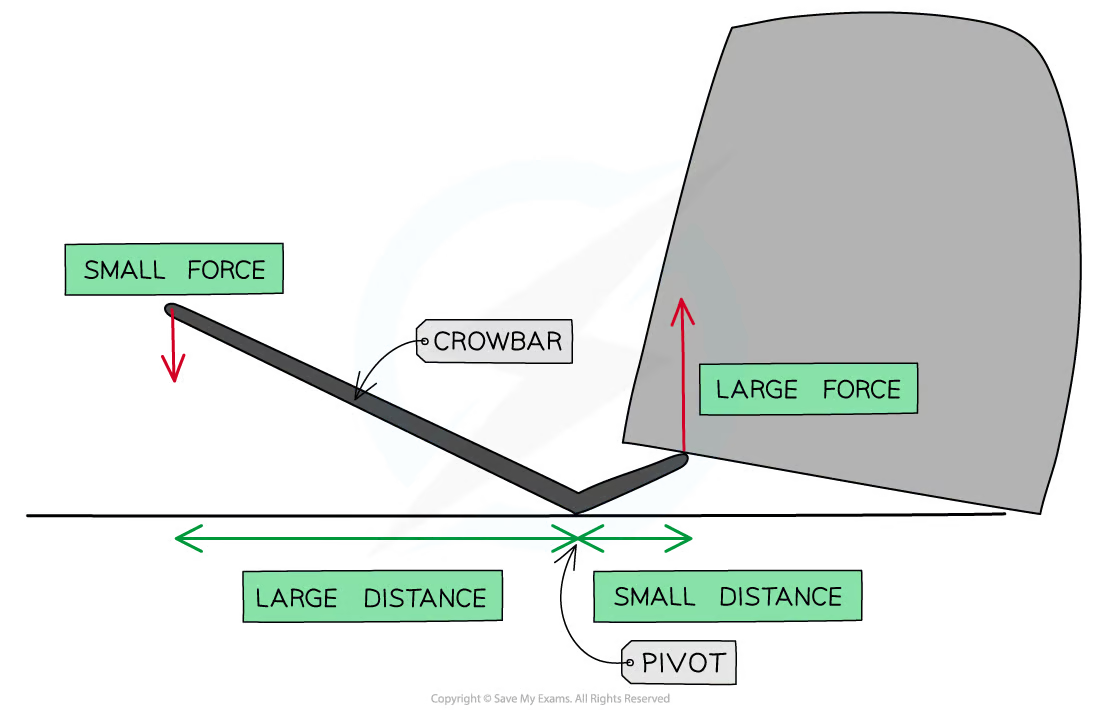
E.g. a crowbar is also a type of lever used to exert a large force on a narrow opening to help lift heavy objects
* the small force downwards applied by a person is far away from the pivot
* this creates a large force upwards on the heavy object, making it easier to lift
The force applied to a lever must act **further** from the pivot than the force has to overcome
To make a lever work better:
* increase the **size** of the force applied
* increase the **distance** of the force from the pivot
E.g. a bottle opener uses a lever to **amplify** the small force upwards applied by the person to create a large force upwards on the bottle top to remove it
* the line of action of the small force is much further from the pivot than the large force that is needed at the edge of the cap to remove it
* the bottle opener (lever) makes use of moments to act as a force multiplier
E.g. a crowbar is also a type of lever used to exert a large force on a narrow opening to help lift heavy objects
* the small force downwards applied by a person is far away from the pivot
* this creates a large force upwards on the heavy object, making it easier to lift
12
New cards
9\.9P How do gears transmit the rotational effects of forces?
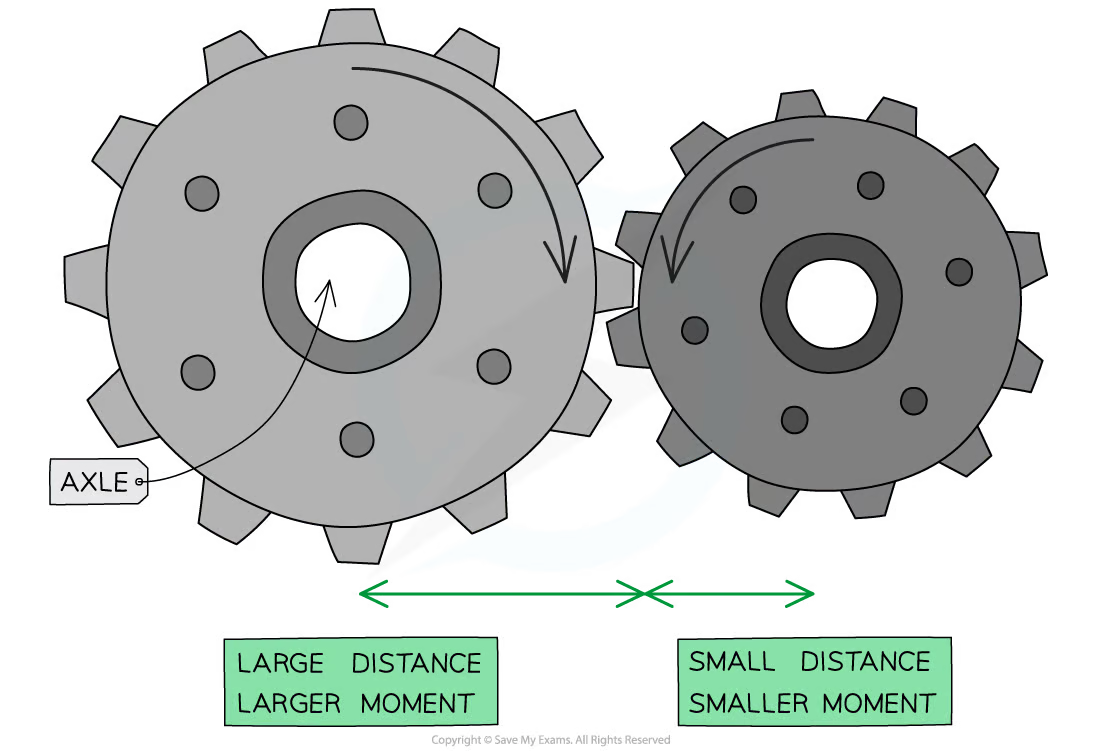
Gears, similar to levers, multiply the effect of a turning force using moments
They consist of wheels with toothed edges that rotate on an axle or shaft, which acts as the **pivot**
* the teeth of one gear fit into the teeth of another gear
* this lets one gear turn the other, meaning one axle or shaft can be used to turn another shaft
As one gear turns, the other must also turn
* where the gears meet, the teeth will then move in the **same** direction (e.g. downwards)
* one of the gears will then move clockwise, and the other anticlockwise (in opposite directions)
Although the force will be the same on both gears, the **moment** will not be. This depends on the size of the gear, which changes the distance of the teeth to the pivot (axle)
* if a larger gear is driven by a smaller gear, the large gear will rotate slower than the smaller gear but will have a greater moment. For example, a low gear on a bike or car
* if a smaller gear is driven by a larger gear, the smaller gear will rotate quicker than the larger gear but will have a smaller moment. For example, a high gear on a bike or cart
This is because the turning force on the larger gear wheel acts further from its pivot than the turning force of the smaller gear wheel acting on its own pivot
They consist of wheels with toothed edges that rotate on an axle or shaft, which acts as the **pivot**
* the teeth of one gear fit into the teeth of another gear
* this lets one gear turn the other, meaning one axle or shaft can be used to turn another shaft
As one gear turns, the other must also turn
* where the gears meet, the teeth will then move in the **same** direction (e.g. downwards)
* one of the gears will then move clockwise, and the other anticlockwise (in opposite directions)
Although the force will be the same on both gears, the **moment** will not be. This depends on the size of the gear, which changes the distance of the teeth to the pivot (axle)
* if a larger gear is driven by a smaller gear, the large gear will rotate slower than the smaller gear but will have a greater moment. For example, a low gear on a bike or car
* if a smaller gear is driven by a larger gear, the smaller gear will rotate quicker than the larger gear but will have a smaller moment. For example, a high gear on a bike or cart
This is because the turning force on the larger gear wheel acts further from its pivot than the turning force of the smaller gear wheel acting on its own pivot
13
New cards
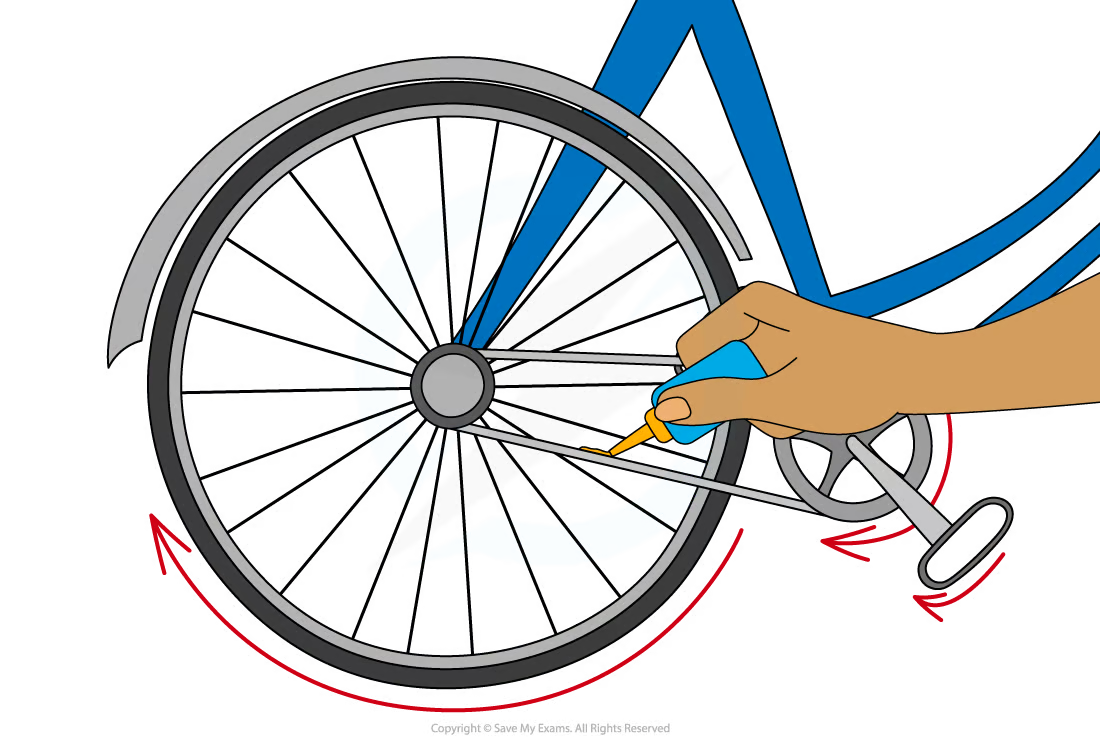
9\.10 What are ways of reducing unwanted energy transfer through lubrication?
Friction is a major cause of **wasted energy** in machines
E.g. the gears on a bike can become hot if the rider has been cycling for a long time
* energy is wasted as it is transferred from the **kinetic energy store** of the bike to the **thermal energy store** of the gears and the chain
* this friction makes them become hot and transfers energy by heating to the **thermal energy store** of the surrounding air
This wasted energy can be reduced if the amount of friction can be **reduced**
* this can be achieved by **lubricating** the parts that rub together
E.g. the gears on a bike can become hot if the rider has been cycling for a long time
* energy is wasted as it is transferred from the **kinetic energy store** of the bike to the **thermal energy store** of the gears and the chain
* this friction makes them become hot and transfers energy by heating to the **thermal energy store** of the surrounding air
This wasted energy can be reduced if the amount of friction can be **reduced**
* this can be achieved by **lubricating** the parts that rub together
 Note
Note  Flashcards (77)