Chapter 20: Electric Potential and Electric Potential Energy
 Studied by 0 people
 Call Kai
 Learn
Learn Practice Test
 Spaced Repetition
 Match
Match Flashcards
 Knowt Play
1/47

There's no tags or description
Looks like no tags are added yet.
Name | Mastery | Learn | Test | Matching | Spaced | Call with Kai |
|---|
No analytics yet
Send a link to your students to track their progress
48 Terms
Electric Potential causes…
voltage
electric potential = height of hill, voltage = height difference between two points on hill
Total mechanical energy of a system is constant when…
forces are conservative
E = K + U
K = ½ mv²
Potential Enegy
function of the position of particles
The change in potential energy of a particle moving between two points is __________ of the path taken.
independent
The gravitational potential energy of two masses separated by a distance r is:
F = GMm/r²
U = -Gm1m2/r
Ugrav = mgy
Coulomb force is…
conservative
If electric force does negative work, potential energy…
increases
ΔU = -Wconservative = -FΔxcosθ
If electric force does positive work, potential energy…
decreases
ΔU = -Wconservative = -FΔxcosθ
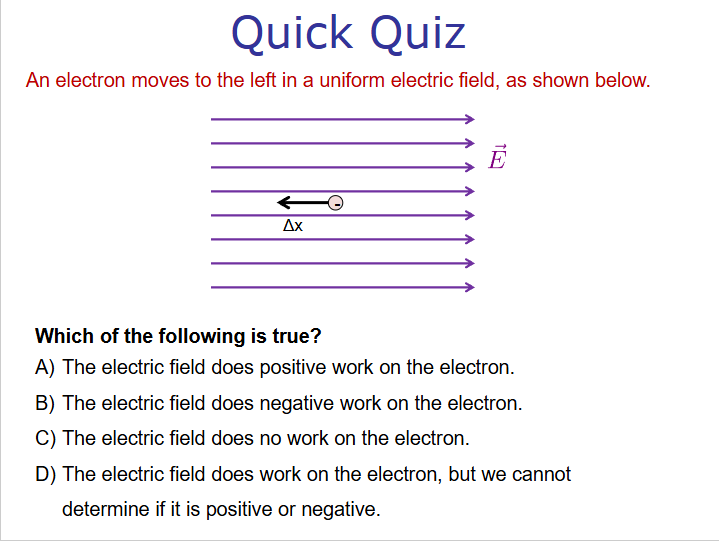
a) the electric field does positive work on the electron
The displacement and Force are pointing in the same direction, so work is positive
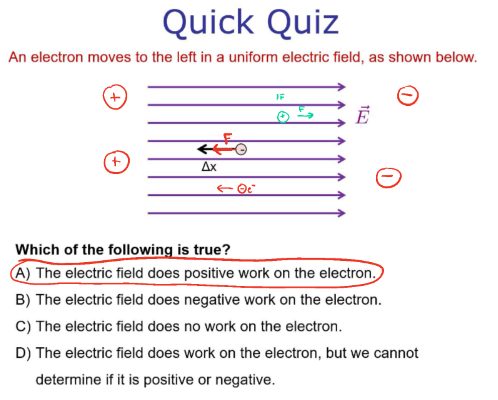
Electric field moves from…
positive to negative charge
Electric Potential, UE equation derivation
E = F/q → F = qE
W = FΔxcosθ = qEΔxcosθ
ΔU = -W = -qEΔxcosθ
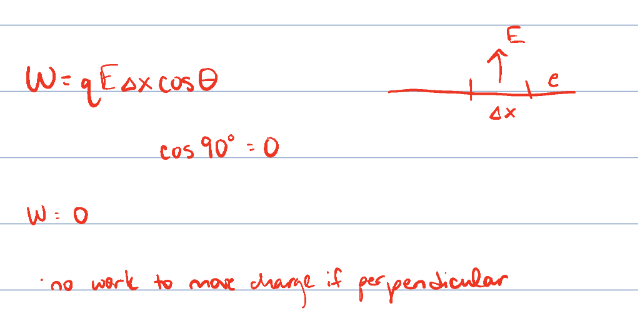
if theta = 90, cos90=1, so can often omit
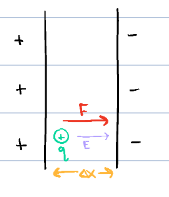
Potential Difference
V (Voltage)
ΔV = ΔU/q
units: unit/Volt (V) = J/C
Voltage = potential energy/charge, is like height for a charge
ΔV = -EΔxcosθ = -EΔx
costheta = 1
q cancels out
E = -ΔV/Δx = F/q
ΔU = qΔV = -W
when Voltage changes, it creates the Electric Field
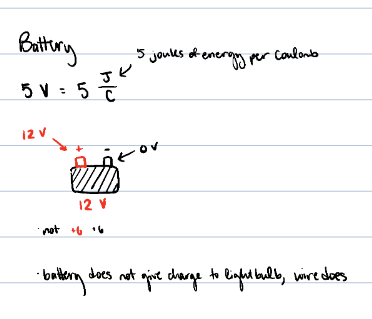
Battery Example - Voltage/Potential Difference
battery does not give charge to lightbulb, wire does
if battery has a voltage of 12V, the positive terminal has a voltage of 12V and the negative has a voltage of 0
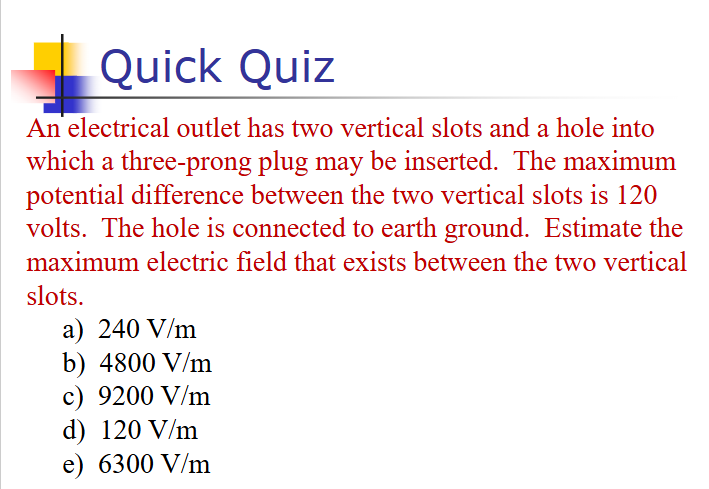
ΔV = 120 V
ΔV = -EΔx
|E| = |-ΔV/Δx| = |-120V /0.013 m| = 9200 V/m = c
The center circle of an outlet is…
ground
Current
flow of charge, flows because of electric field
Conservation of Mechanical Energy: Mass
EA = EB
E = K + U
K = 1/2mv²
Ug = mgh
KA + UA = KB + UB
Conservation of Mechanical Energy: Charge
EA = EB
k = 1/2mv²
UE = qV = qΔV
KA + UA = KB + UB
If m = 1kg and A = 5m height, what is velocity?
use conservation of mechanical energy (mass) to find
EA = EB
KA + UA = KB + UB
KA = 0, UB = 0
UA = KB
mgh = ½mv²
sqrt(2gh) = v = sqrt(2(9.8)(5)) = 9.9 m/s
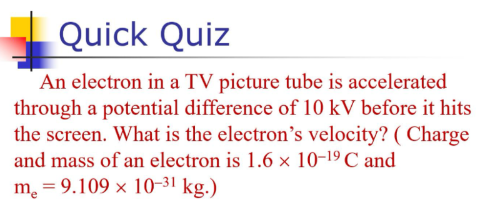
b
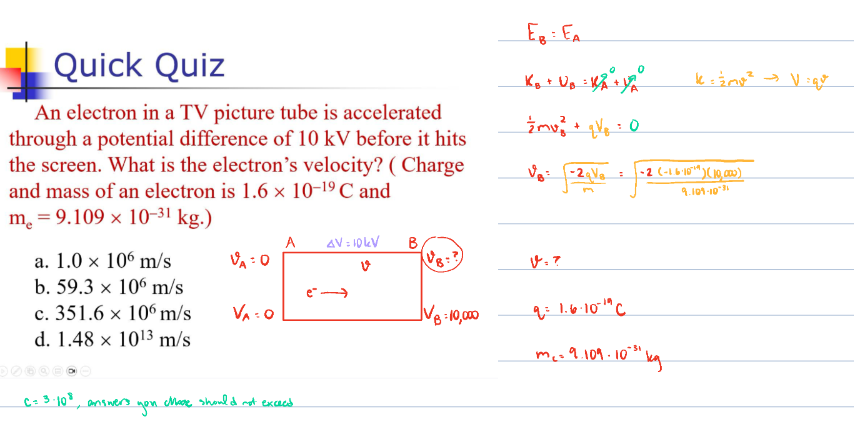
In a problem, if there is a height difference or charge moving through voltage…
apply energy conservation
positive charges accelerate in the direction of…
decreasing electric potential
because the force on a negative charge is opposite to the field direction
moves to a region of lower energy
negative charges accelerate in the direction of…
increasing electric potential
because the force on a negative charge is opposite to the field direction
moves to a region of lower energy
The point of zero electric potential is taken to be at ______ distance from the charge
an infinite
T/F: A potential exists at some point in space whether or not there is a test charge at that point.
True
Electric Potential (V) for a point charge
V = k(q/r)
k = 8.99×10⁹
q = charge
r = distance
Electric Potential Energy (U)
U = qV = k((q1+q2)/r)
scalar
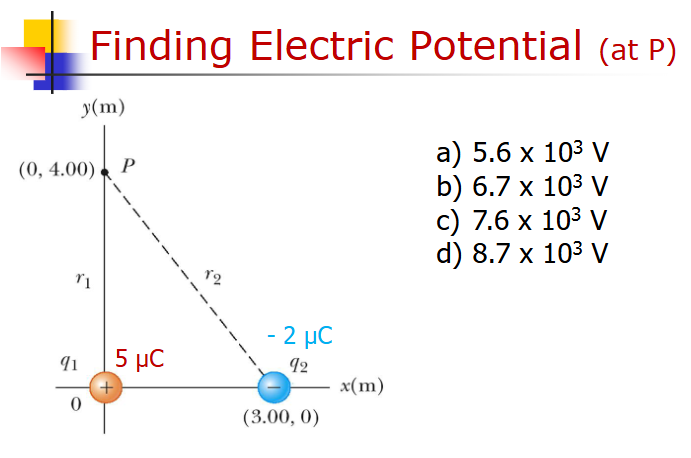
V = V1 + V2
V = k(q/r)
q/r1 = (5×10⁻⁶C/+4)
r2 = sqrt((4²)+(3²)) = 5
q/r2 = (-2×10⁻⁶C/5)
V = (8.99×10^9)((5×10⁻⁶C/+4)(-2×10-6C/5)
c: 7.6×10³
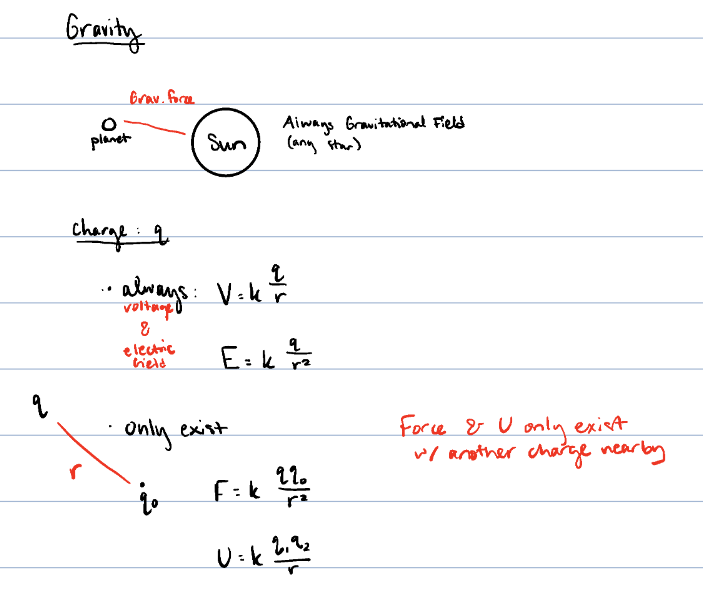
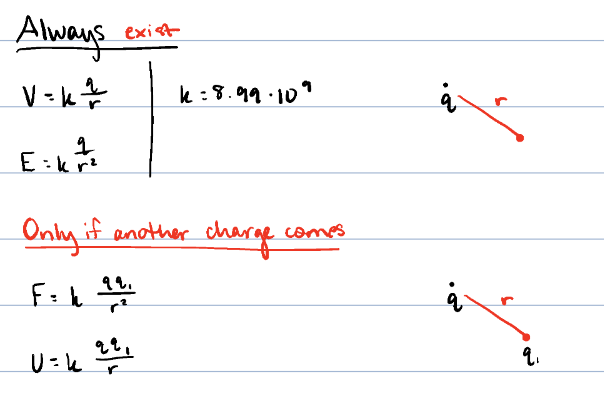
There is always _________ field, but _________ only exist if there is another charge nearby.
always gravitational or voltage & electric field
Force & U only exist if another nearby charge
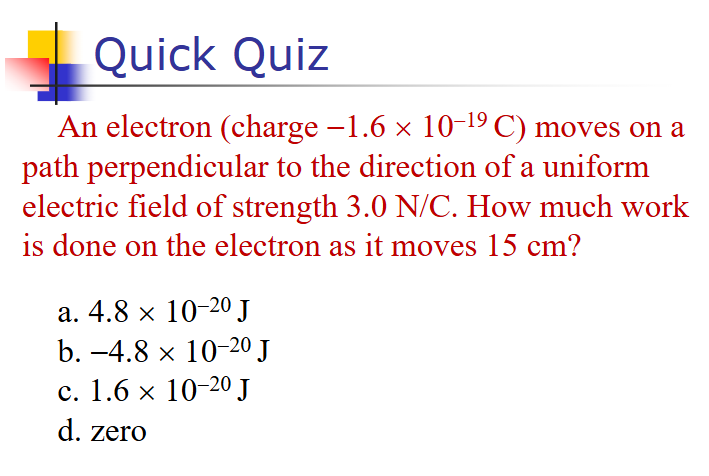
d. zero
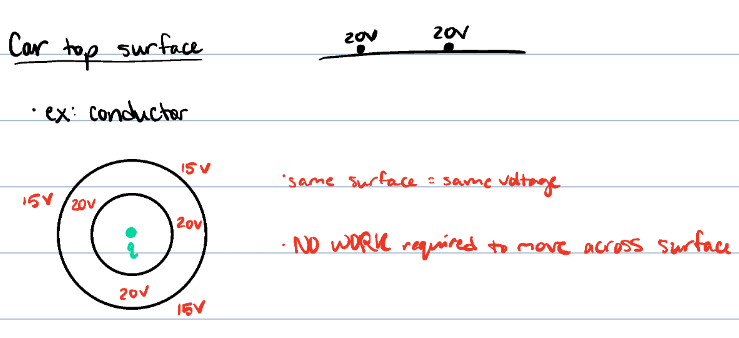
Equipotential Surface: Definition & Properties
same voltage/potential all around surface, ΔV = 0
all conductors have
no work required to move across surface
Properties:
W = qΔV = 0
ΔV = -EΔxcosθ
If ΔV=0, θ=90 degrees
E field is perpendicular
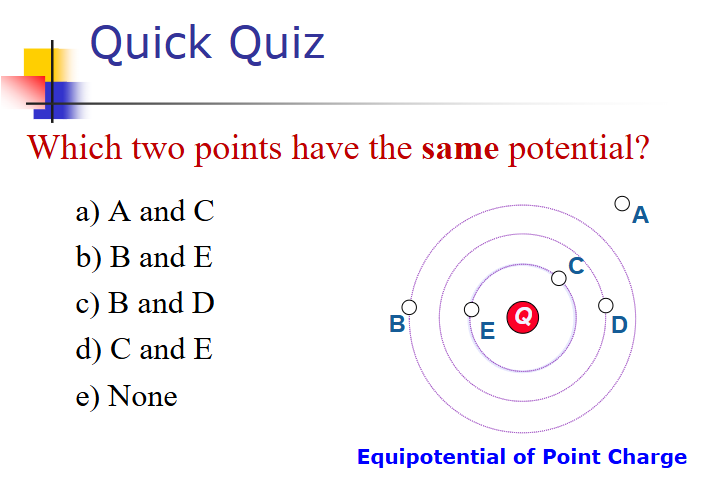
d. C & E
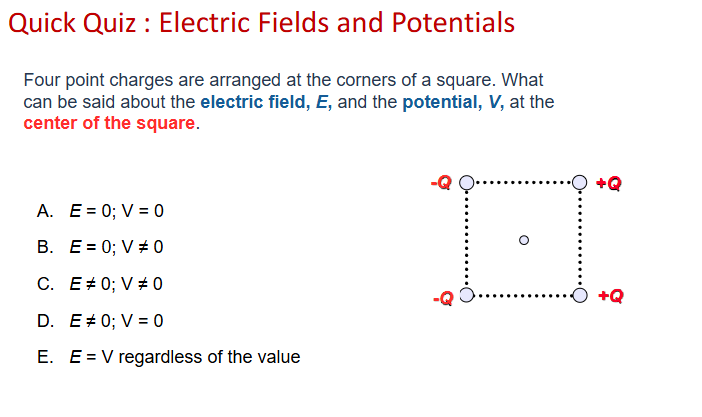
V = scalar
V = k(q/r)
In this ex: V = k(q/r) - k(q/r) - k(q/r) + k(q/r) → cancel out
E = vector
E = k(q/r²)
net E field goes towards left in this example
d. E dne 0, V=0
electric field is not zero, potential is zero
An EKG plots…
the heart’s potential difference (V) vs. time
Capacitor
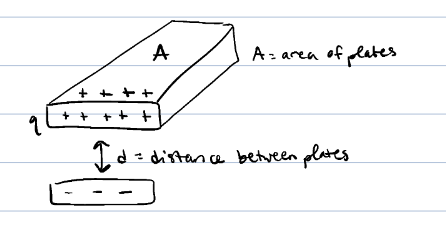
2 parallel plates, one positively charged and one negatively charged
store charge and energy
provide Electric Field
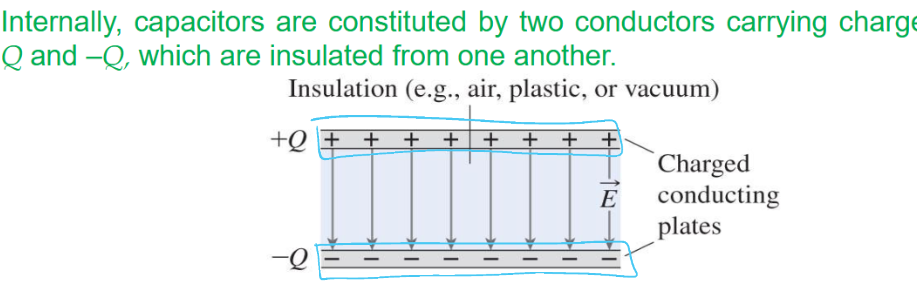
Capacitance (C)
C = q/ΔV (Farads; F = C/V)
q = charge
deltaV = change in voltage
depends only on geometry of conductors
Are batteries capacitors?
No
batteries release energy slowly, capacitor quickly
capacitor example: camera, touch screen (your finger = one plate, screen the other)
a battery can be used to charge the capacitor
Parallel Plate Capacitor
C = ε0 A/d
ε0 = 8.85×10^-12 C²/nm²
larger area, less space between plates = holds more charge
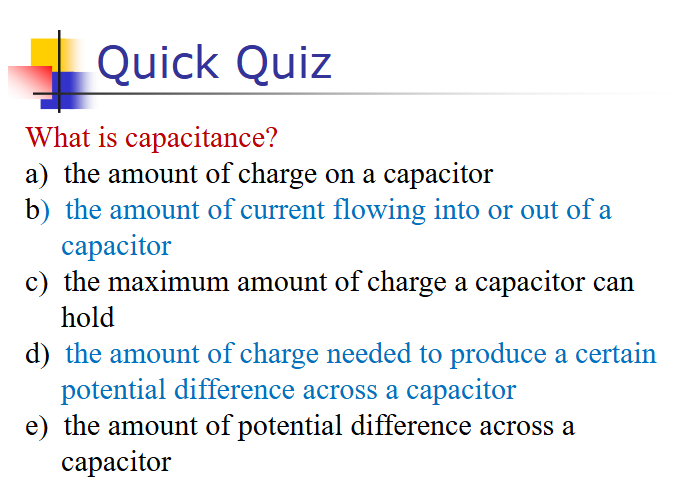
C=Q/V, Q=CV
d.
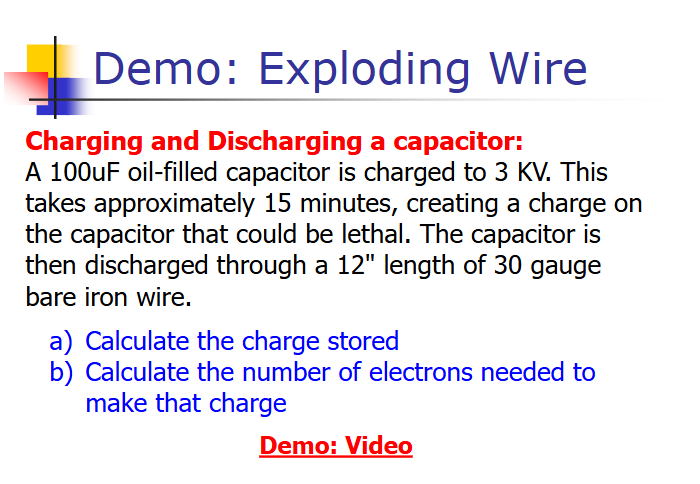
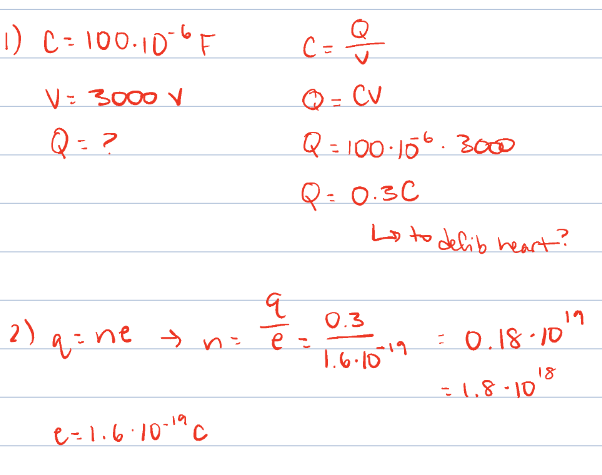
Energy Stored in Capacitor
Energy = ½QΔV = ½CΔV² = Q²/2C
extreme example: Z machine in New Mexico; used in experiments in controlled nuclear fusion
uses large number of capacitors in parallel to give tremendous equivalent capacitance
discharge energy into a target, heated to extremely high temp
can be charged slowly and then release energy very quickly
defibrillator
fibrillation (heart muscles twitch randomly and cannot pump blood)
strong electric shock stops the heart, giving cells ability to restore proper heartbeat
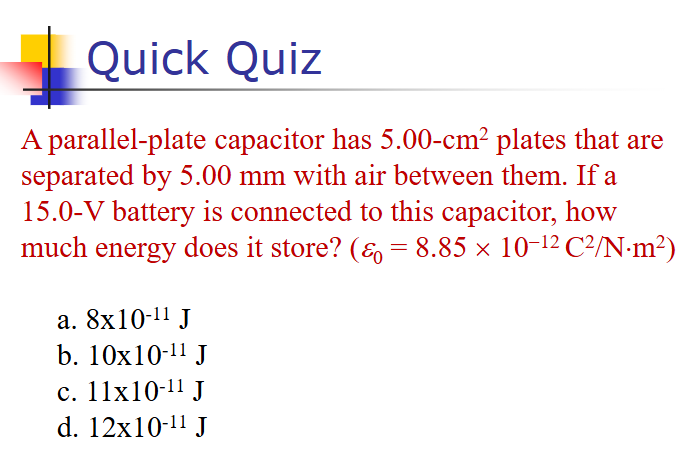
C = ε0 A/d
C = 8.85×10^-12(C²/Nm²)(0.0005m²)/(0.005m) = 8.85×10^-13 F
5 cm² (0.01×0.01m²/1×1cm²) = 0.0005m²
Energy = ½QΔV = ½CΔV²
Energy = ½ (8.85×10^-13F)(15.0V)² = 9.96×10^-11 = 10×10^-11
Capacitors with dielectrics
dielectric: insulating material between capacitor plates that increases capacitance
examples: rubber, plastic, or waxed paper
when dielectric completely fills region between plates, multiply by factor κ:
C = κC0 = κε0(A/d)
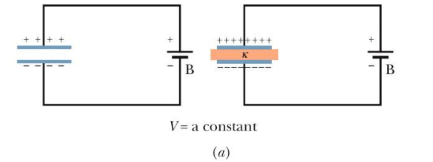
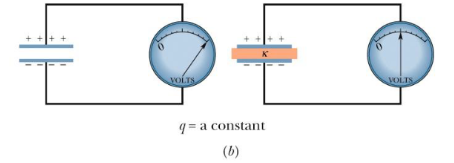
If the potential difference between the plates of a capacitor is maintained, as by the presence of battery B, the effect of a dielectric is to…
increase the charge on the plates
wants to increase capacitance
The battery keeps the voltage constant.
Adding a dielectric increases the capacitance.
Since Q=CV, more capacitance → more charge on the plates.
The electric field and voltage stay the same, but the capacitor can store more energy.
Basically: dielectric = more “room” for charge when voltage is fixed.
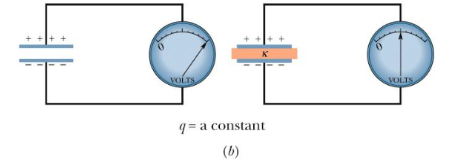
If the charge on the capacitor plates is maintained, as in this case by isolating the capacitor, the effect of a dielectric is to…
reduce the potential difference between the plates
wants to increase capacitance
Now the charge is fixed, so Q doesn’t change.
Adding a dielectric increases capacitance (C=κC0)
Since V=Q/C, more capacitance → voltage decreases.
Electric field E=V/d also decreases.
Energy U=Q²/(2C) decreases too.
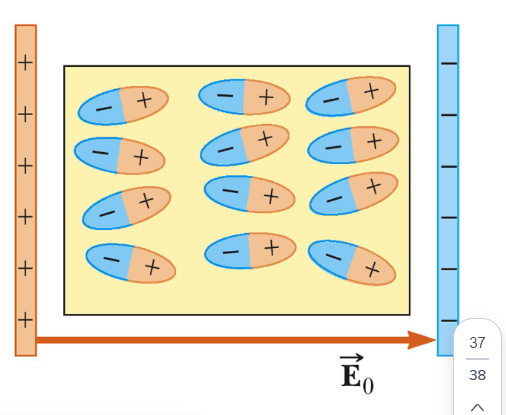
Atomic Description of Dielectrics
presence of the positive charge on the dielectric effectively reduces some of the negative charge on the metal
this allows more negative charge on the plates for a given applied voltage
the capacitance increases
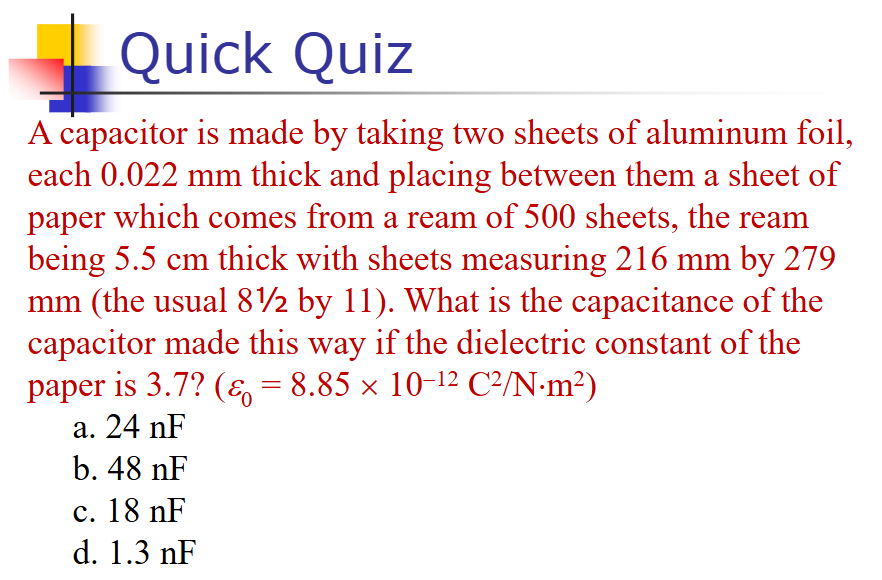
need to do out still xx.
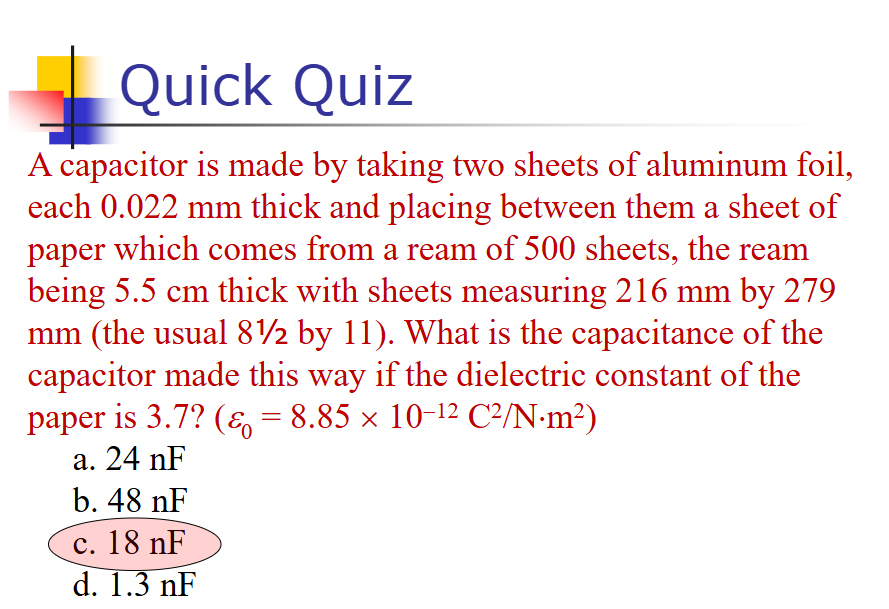
 Note
Note  Flashcards (52)