Art Since 1900 | Exam #2 | Dr. Bevin Butler
 Call Kai
 Learn
Learn Practice Test
 Spaced Repetition
 Match
Match Flashcards
 Knowt Play
1/66

Earn XP
Description and Tags
that time again, huh?
Name | Mastery | Learn | Test | Matching | Spaced | Call with Kai |
|---|
No analytics yet
Send a link to your students to track their progress
67 Terms
De Stijl
-Avoiding narrative and emotional content.
-Desire to minimize “facture” - evidence of the artist’s hand or process (visible brushstrokes, etc).
-Goal was a “scientifically based, universal language of the senses” that could “unify art and unify humanity.”
-Manifesto written 1918, published 1922
Geometric Abstraction
Total abstraction with strong geometric basis
Theo van Doesburg
-(1883-1931).
-Writer, actor, painter; Founder of De Stijl.
-Spirituality of painting as an art of ”the mind” rather than of everyday life
Piet Mondrian,
(1872-1944)
-Painter & art theorist
-Post-Impressionism, Cubism, Geometric Abstraction (De Stijl)
-“Seeking the Spiritual through the Rational”
-Neoplasticism – New Form – Flatten foreground and background (unify the composition as a whole)
-square guy
-Later interest in jazz music in NYC
Staatliches Bauhaus
-“National House of Building"
-German art school
-combined fine arts, design, and craft; individual artistic creativity + mass production
-Influenced nearly all areas of modern art, design, architecture, and arts education
-Closed in 1933 due to persecution by Nazi regime
László Moholy-Nagy
-(1895-1946)
-Hungarian educator, designer, painter, experimental photographer
-Inspired by De Stijl and Russian avant-garde artists
-Commitment to scientific investigation – kinetic sculpture and photograms (same time as Man Ray, but apparently unaware) as “light modulators”
Josef Albers,
-(1888-1976)
-German artist and educator; student → faculty at Bauhaus; Founder of Black Mountain College in 1933
-Married textile artist Annie Fleischmann (Albers)
-Taught foundations, furniture design, and glass painting at Bauhaus school
-Explorations of light and color with geometric forms
Wassily Kandinsky
-(1866-1944)
-Joined Bauhaus faculty in 1922 to teach Theory of Form & led mural painting workshop
Surrealism
-Depictions of an absurd world; opposed “rationality and convention” in art
-Between WWI & WWII
-Does not fully reject tradition; wanted to confirm the “invincibility of artistic genius”
-Creative genius is from the subconscious mind; creative impulse; total originality; masculinity
-followed Freud’s philosophies and used Freudian techniques to access subconscious mind
Psychoanalyst Sigmund Freud
-(1856-1939)
-Psychoanalysis to explain human aggression and deviance (in the wake of WWI)
-According to Freud:
-Personalities develop in childhood, importance of mother-son relationship (Oedipus Complex)
-Repressed s3xual desires
-Women as triggers for male feelings of shame and inadequacy (rejection or “Lack”)
-Result: women as objects of desire and/or fear
André Breton
-Surrealist writer and artist; pioneer of “Automatic Writing”
-Visual artists applied these methods to
drawing and painting
-Surprising results; love of the unexpected
and spontaneous
Exquisite Corpse
Surrealist game
Max Ernst
-(1891-1976)
•Delighted in “happy accidents” that made his artworks beyond his conscious control
•Ambiguous images – no clear meaning or interpretation
René Magritte
-(1898-1967)
-One of the most successful Surrealist artists
-Ordinary, everyday objects in unexpected contexts
-Challenges reality
Salvador Dali
(1904-1989)
-Combines Surreal content with hyper-realistic elements
-Themes: eroticism, death, decay
-Fluidity of time; Memento Mori
Frida Kahlo
-(1907-1954)
-Mexican painter
-“They thought I was a Surrealist, but I wasn’t. I never painted dreams or nightmares. I painted my own reality.”
-Physical and emotional pain
Abstract Expressionism
Combines Abstraction (non-naturalistic or objective imagery) & Expressionism (emotional art)
Based largely in New York City during and after WW2
Opposed all forms of social realism, anything promoting nationalism, and even ”pure” geometric abstraction
Gestural Painters
action painting
Jackson Pollock, Willem de Kooning, Franz Kline
Franz Kline
(1910-1962)
Born in Pennsylvania; taught at Black Mountain College & Pratt Institute (NYC)
Willem de Kooning
(1904-1997)
Dutch-born painter moved to U.S. in 1926; Also taught at Black Mountain College (close friends with Franz Kline)
incorporates figural stuff by 50s
Jackson Pollock
(1912-1956)
Splashed, dripped, poured paint onto canvas unrolled on the ground – “Action Painting”
Focus is actions & gestures of artist
The process becomes the subject matter –the act of creation is the art
large-scale canvases dominate viewers’ field of vision
Color Field Painters
Mark Rothko, Barnett Newman, Clyfford Still, Ad Reinhardt
Clyfford Still
1904-1980
U.S. Painter from North Dakota, Washington, Alberta
Taught at several universities (including VCU) before working in NYC
jagged shapes guy
Ad Reinhardt
(1913-1967)
New York painter
Studied with art historian Meyer Schapiro
enjoyed single colors
Barnett Newman
(1905-1970)
New York painter; Son of Polish Jewish immigrants
“Zips” – Thin vertical lines in paintings (and prints)
Mark Rothko
(1907-1970)
Color Fields – total abstraction
Contemplation & Emotion
hates notion of paintings being about color relationships
interest in religion eventually leads to ______ Chapel
gets sick in 1968, commits suicide in 1970
The Harlem Renaissance
(c 1918-1930s)
neighborhood (NYC); “The first overtly race-conscious cultural movement in America”
W.E.B. du Bois & Alain Locke (New Negro Movement) – Any conception of Black identity needed to be created by Black people (erasing the denigrating/negative stereotypes in favor of a positive/neutral self-image)
Impacts Arts & Culture – Poetry (Langston Hughes), Music (esp. Blues & Jazz), and the Visual Arts
No particular style in visual arts; grouped based on subject matter and philosophy of the “New Negro” movement
Palmer Hayden
folk art feel
common subject matter
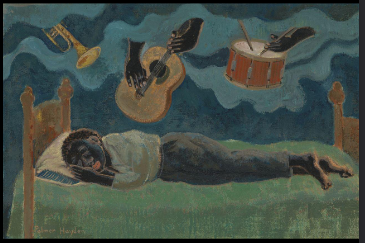
Palmer Hayden, Untitled (Dreamer), 1930. Oil on Canvas, 12 X 18 in
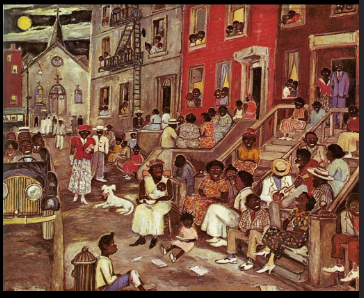
Palmer Hayden, Midsummer Night in Harlem,
c 1936. Oil on Canvas, 25 X 30 in.
Aaron Douglas
created Prodigal Son for book of biblical poetry
brings story into modern day, lots of Black American culture (jazz)
known for silhouettes
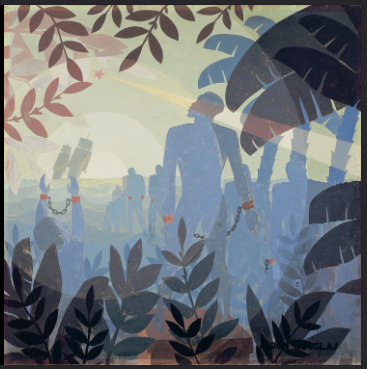
Aaron Douglas, Into Bondage, 1936. Oil on Canvas, 60 X 60 in.
Archibald Motely
more detail & naturalism
dabbles in different styles through later 1920s
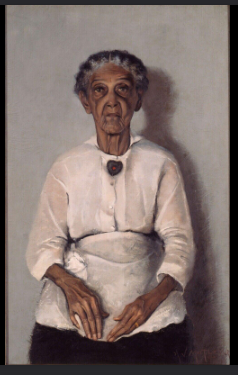
Archibald Motley, Portrait of my Grandmother,1922. Oil on Canvas, 38 X 24 in
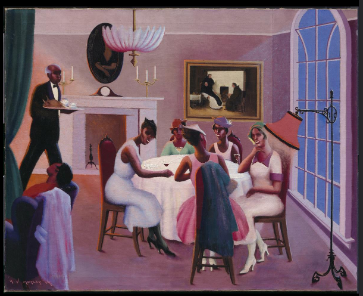
Archibald Motley, Cocktails, 1926. Oil on Canvas, 32 X 40 in.
Nationalism and Regionalism in American art
side effect of isolationist policies after WWI l
Naturalistic representations of American life; Intrinsically “American” themes
Against avant-garde modernist abstraction
Federal Art Project (FAP)
established by Works Progress Administration in 1935
government-sponsored program to support artists during economic recession
resulted in pressure to create art pleasing to the governing body
American Regionalism
Emphasize agrarian ideals, embrace “the heartland,” propagandistic potential
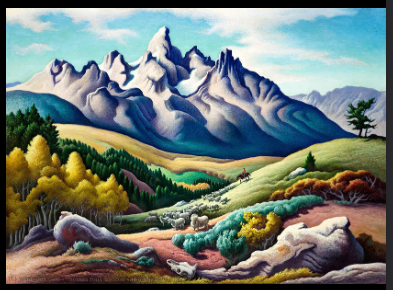
Thomas Hart Benton, The Sheepherder,
1934. Oil on Canvas, 48 X 66 in
Thomas Hart Benton
swirls and sweeps, landscapes, colors
America Today mural series
Primitivism
self taught, amateur
American Primitivism
folk art inspo, still rejecting European “fine art”
Grandma Moses
American Primitive painter
flat landscapes w/ simplistic figures
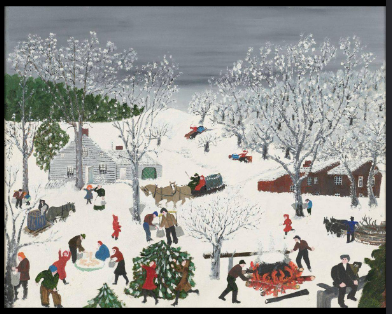
Grandma Moses, Sugaring Off, Dark Sky,1948. Oil & Tempera on Canvas Board
Social Realism
More socially conscious/critical, though more towards society than America
Desire to represent “the masses”
Art as a weapon to fight against capitalist exploitation
Edward Hopper
obituary read: “painter of lonliness”
lack of busy streets in paintings: The Nighthawks
Romare Bearden
Social Realism & Harlem Renaissance
works in both painting and collage
Jacob Lawrence
simplicity to communicate through strong subject matter
known for Migration of the Negro series
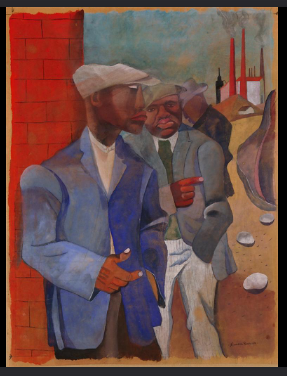
Romare Bearden, Factory Workers, 1942.
Gouache & Casein on Kraft Paper, 37 ½ X 29 in.
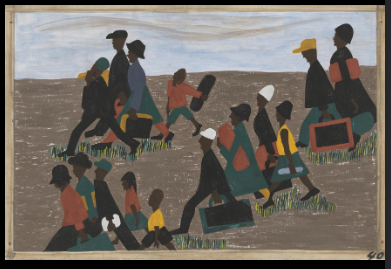
Jacob Lawrence, The Migration of the Negro series (40: The Migrants
arrived in Great Numbers), 1940. Casein Tempera on Board, 12 X 18 in.
Mexican Revolution
(1910×1920)
civil war
ends with present-day Constitution of Mexico
“Economic Miracle”
(1940-1970)
Shift from violent uprisings since Mexican Revolution to more political stability and economic success
“The Great Three”
most well known Modern Mexican artists
Diego Rivera
José Clemente Orozco
David Alfaro Siqueiros
Diego Rivera
(1886-1957)
Mexican painter and Communist activist
Studied in Europe 1907-1921 (met Picasso & Gris; saw Renaissance frescoes in Italy)
Monumental fresco/mural paintings
Attempt to ”create a national style reflecting both the history of Mexico and the socialist spirit of the Mexican Revolution”
Simple forms with bold areas of color
Inspiration of Aztec and Maya style
frequently hides Marx in works
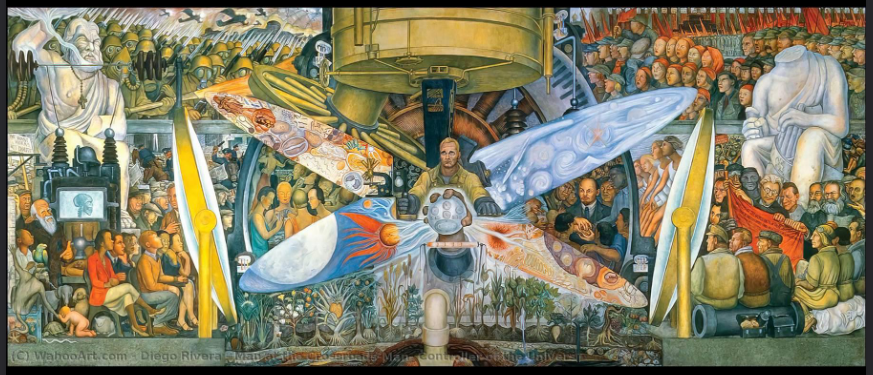
Diego Rivera, Re-Created Rockefeller Mural (Man, Controller of the Universe), 1934.
Man at the Crossroads
Rivera hired by & painted for Rockefellers
depicts capitalism and communism with positive Soviet rep
repainted elsewhere in 1934; og plastered over and later removed
José Clemente Orozco
(1883-1949)
Expressive, brash, “fiery” style
Not as positive about industry and technology as Rivera
The Epic of American Civilization
The Epic of American Civilization
24 mural panels at Dartmouth College (Hanover, NH), painted at same time as Rivera’s Rockefeller project
Themes: Indigenous groups and European colonists in North America; Impacts of war and rapid industrialization
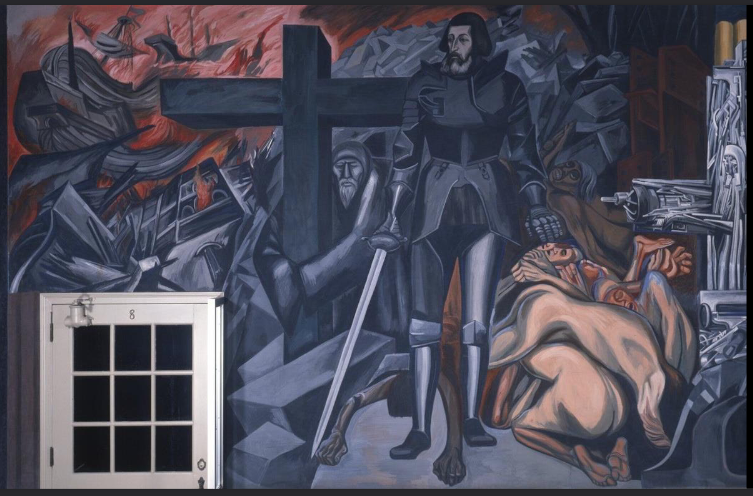
José Clemente Orozco, Cortez and the Cross (The Epic of American Civilization), 1932-1934, Mural, Dartmouth College.
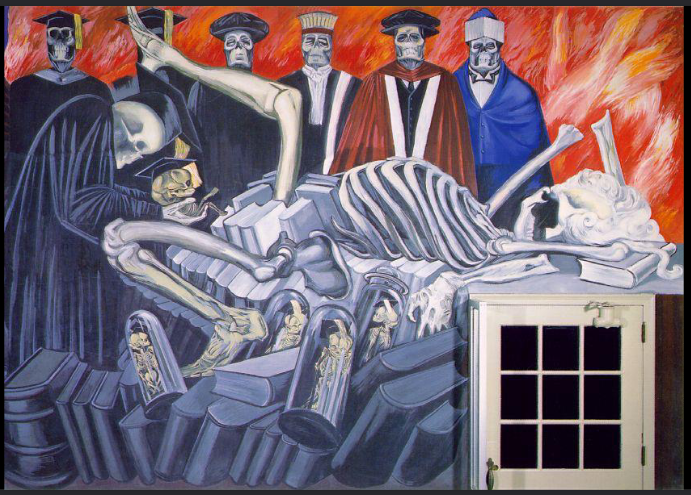
José Clemente Orozco, Gods of the Modern World (The Epic of American Civilization), 1932-1934, Mural, Dartmouth College
David Alfaro Siqueiros
(1896-1974)
Experimental techniques and imagery; fervent political activist and Communist (taught artists like Jackson Pollock in U.S. around 1935-1940
Echo of a Scream
Death to the Invader
Echo of a Scream
Painted the year Siqueiros joined the antifascist Republican Army in the Spanish Civil War
Based on a news photograph of a child among
rubble in the Sino-Japanese War
Death to the Invader
Mural project that creates an unconventional sense of space (covers the walls and vaulting of a small library)
Indigenous Chileans and Mexicans fighting against European (Spanish) colonialization
Frida Kahlo
(1907-1954)
Mexican Surrealist painter; subjects of physical pain and emotional grief
Sick with polio as a child
Bus accident in 1925 – Crushed spine, pelvis, and foot (back/body brace); suffered from chronic pain
Became icon of Mexican heritage in 1970s
Recurring subject matter and immediately recognizable fashion, accessories, hair, etc
barren land, plants, “crown“ of thorns, hair flowers
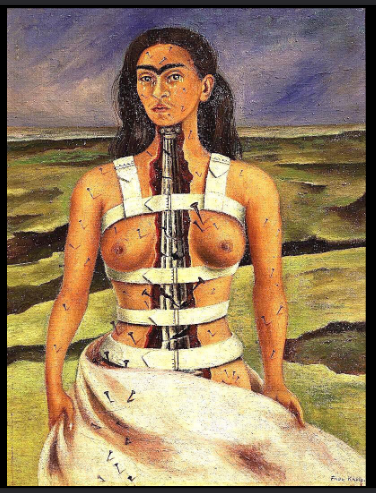
Frida Kahlo, The Broken Column, 1944, Oil on Masonite, 15 ¾ X 12 in.
Rufino Tamayo
(1899-1991)
Painter working in Mexico and New York City
Born in Oaxaca (ART TOUR!)
WPA artist until foreign artists were banned
Not interested in politically-charged work
Universal statements about the human condition, trauma, war, nature
primary colors w/black & white, bold & bright colors, abstracted & geometric, dogs, watermelons
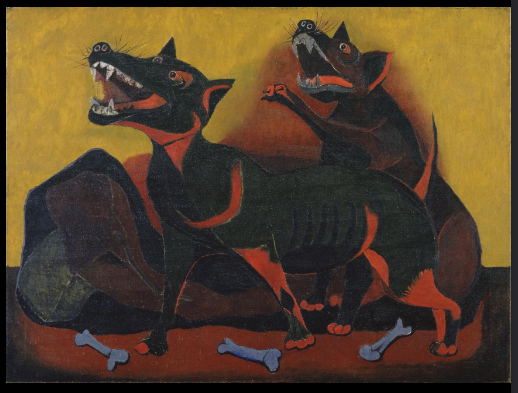
Rufino Tamayo, Animals, 1941, Oil on Canvas, 30 X 40 in

